Sample QuestionsWork, Power And Energy questions
One sample from each question group in this chapter. Select any group above to see the full set with answer keys.
You have to push with $15\ N$ of force to move it $10$ meters. How much work do you do?
- A
$15$ Joules
- ✓
$150$ Joules
- C
$1.5$ Joules
- D
$67$ Joules
Answer: B.
View full solution →Potential energy increases:
- ✓
- B
- C
As the velocity increases
- D
Answer: A.
View full solution →Ne megawatt is equivalent to:
- A
$10^2 \mathrm{~W}$
- ✓
$10^6 \mathrm{~W}$
- C
$10^4 \mathrm{~W}$
- D
$10^8 \mathrm{~W}$
Answer: B.
View full solution →You lift a suitcase from the floor and keep it on the table. The work done by you on the suitcase depends on:
- A
The path taken by the suitcase
- B
- ✓
The weight of the suitcase
- D
The time taken by you in doing so
Answer: C.
View full solution →Does the Law of Conservation of energy apply to machines?
- ✓
No, as machines require a constant input of energy in order to work
- B
Yes, the energy required to maintain motion is balanced by the energy lost to friction
- C
Yes, but only to perpetual motion machines
- D
No, as the law would apply to only perpetual motion machines
Answer: A.
View full solution →In the following Questions, the Assertion and Reason have been put forward. Read the statements carefully and choose the correct alternative from the following:
Assertion: Work done by the force of friction is always negative.
Reason: Friction force always acts in opposite direction to that of motion of the body.
- ✓
Both the Assertion and the Reason are correct and the Reason is the correct explanation of the Assertion.
- B
The Assertion and the Reason are correct but the Reason is not the correct explanation of the Assertion.
- C
Assertion is true but the Reason is false.
- D
The statement of the Assertion is false but the Reason is true.
Answer: A.
View full solution →A statement of Assertion is given by the corresponding statement of Reason. Of the statements, mark the correct answer as Mark the correct choice as: Assertion: Steam engine converts heat energy into kinetic energy.
Reason: Steam engine works on the principle conservation of energy.
- ✓
If both Assertion and Reason are true and Reason is the correct explanation of Assertion.
- B
If both Assertion and Reason are true, but Reason is not the correct explanation of Assertion.
- C
If Assertion is true, but Reason is false.
- D
If Assertion is false, but Reason is true.
Answer: A.
View full solution →In the following Questions, the Assertion and Reason have been put forward. Read the statements carefully and choose the correct alternative from the following:
Assertion: Greater the momentum of a body, more is its kinetic energy.
Reason: Kinetic energy is a scalar quantity and momentum is a vector quantity.
- ✓
Both the Assertion and the Reason are correct and the Reason is the correct explanation of the Assertion.
- B
The Assertion and the Reason are correct but the Reason is not the correct explanation of the Assertion.
- C
Assertion is true but the Reason is false.
- D
The statement of the Assertion is false but the Reason is true.
Answer: A.
View full solution →A statement of Assertion is given by the corresponding statement of Reason. Of the statements, mark the correct answer as Mark the correct choice as:
Assertion: In a stretched bow, potential energy is stored.
Reason: Mechanical energy of a moving body remains conserved.
- A
If both Assertion and Reason are true and Reason is the correct explanation of Assertion.
- B
If both Assertion and Reason are true, but Reason is not the correct explanation of Assertion.
- ✓
If Assertion is true, but Reason is false.
- D
If Assertion is false, but Reason is true.
Answer: C.
View full solution →A statement of Assertion is given by the corresponding statement of Reason. Of the statements, mark the correct answer as Mark the correct choice as: Assertion: Work done by a body is zero only when, displacement produced by the force is zero.
Reason: Work done by a force is negative when, displacement occurs in the direction of applied force.
- A
If both Assertion and Reason are true and Reason is the correct explanation of Assertion.
- B
If both Assertion and Reason are true, but Reason is not the correct explanation of Assertion.
- C
If Assertion is true, but Reason is false.
- ✓
If Assertion and Reason both are false.
Answer: D.
View full solution →Kinetic energy + Potential energy = Mechanical energy. [True/ False]
Work done by gravity on a man moving on horizontal surface is negative. [True/ False]
No, matter what is the magnitude of mass falling from a height, its acceleration is always the same. [True/ False]
Energy does not remain conserved in an oscillating pendulum. [True/ False]
State whether the following statement is true or false:
The potential energy of a body of mass $1kg$ kept at a height of $1m$ is $1J$?
View full solution →Fill in the following blanks with suitable word:
The sum of the potential and kinetic energies of a body is called ______ energy.
Fill in the following blanks with suitable word: The electricity meter installed in our home measures electric energy in the units of _____.
Fill in the following blanks with suitable word:
$1$ watt is a rate of working of one _____ per _____.
View full solution →View full solution → Both stretched spring and compressed spring have ________ energy.
Name five appliances or machines which use an electric motor.
What is the power of a body which is doing work at the rate of one joule per second$?$
View full solution → Name the device or machines which convert:
Electrical energy into sound energy.
Name the device or machines which convert: Chemical energy into electrical energy.
Find the energy possessed by an object of mass $10\ kg$ when it is at a height of $6m$ above the ground. $[g = 9.8 ms^{-1}]$
View full solution →A trolley is pushed along a road with a force of $400N$ through a distance of $60m$ in $1$ minute. Calculate the power developed.
View full solution →State law of conservation of energy.
Two bodies having equal masses are moving with uniform speeds of $v$ and $2v$ respectively. Find the ratio of their kinetic energies.
View full solution →In an experiment to measure his power, a student records the time taken by him in running in a flight of steps on a staircase. Use the following data to calculate the power of the student: Number of steps $=28$ Height of each step $= 20 cm$ Time taken $=5.4 s$ Mass of student $=55 kg$ Acceleration $=9.8 ms^{-2}$ Due to gravity.
View full solution →A body of mass $2kg$ is thrown vertically upwards with an initial velocity of $20m/s$. What will be its potential energy at the end of $2s$? (Assume $g = 10m/s^2$).
View full solution →A man drops a $10kg$ rock from the top of a $5m$ ladder. What is its speed just before it hits the ground? What is its kinetic energy when it reaches the ground? $(8 = 10m/s^2)$
View full solution →Explain how, the total energy a swinging pendulum at any instant of time remains conserved. Illustrate your answer with the help of a labeled diagram.
A man weighing $500\ N$ carried a load of $100\ N$ up a fighter of stairs $4\ m$ high in $5$ seconds. What is the power?
View full solution →A weightlifter is lifting weights of mass $200kg$ up to a height of $2$ metres. If $g = 9.8ms^{-2}$, Calculate:
- Potential energy acquired by the weights.
- Work done by the weightlifter.
View full solution →A body of $2\ kg$ falls from rest. What will be its kinetic energy during the fall at the end of $2s? ($Assume $g = 10m/s^2)$
View full solution →State and explain the law of conservation of energy with an example.
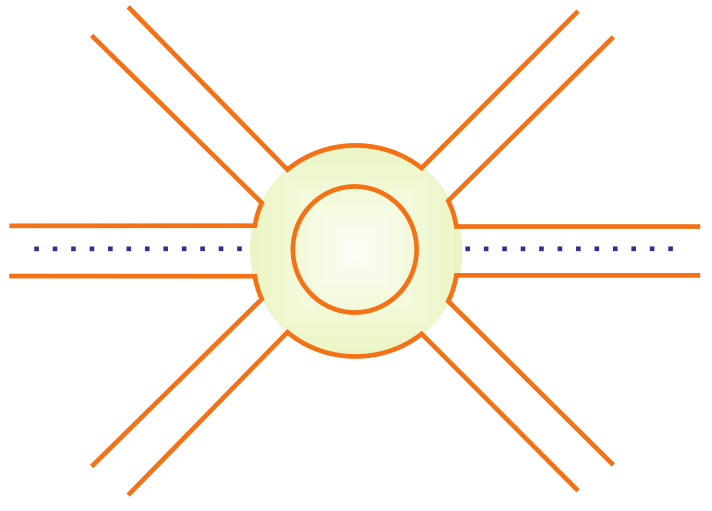
A boy is moving on a straight road against a frictional force of $5N.$ After travelling a distance of $1.5\ km$ he forgot the correct path at a round about (Fig.) of radius $100m.$ However, he moves on the circular path for one and half cycle and then he moves forward upto $2.0\ km.$ Calculate the work done by him.
View full solution →A light and a heavy object have the same momentum. Find out the ratio of their kinetic energies. Which one has a larger kinetic energy?
A ball of mass $200\ g$ falls from a height of $5$ metres. What is its kinetic energy when it just reaches the ground? $(8 = 9.8m/s).$
View full solution →A more powerful vehiclewould complete a journey in a shorter timethan a less powerful one. We talk of the powerof machines like motorbikes and motorcars.The speed with which these vehicles changeenergy or do work is a basis for theirclassification. Power measures the speed ofwork done, that is, how fast or slow work isdone. Power is defined as the rate of doingwork or the rate of transfer of energy. If anagent does a work $W$ in time $t$, then power isgiven by$P$= work/time
$P= W/T$. The unit of power is watt.
(i) The rate of doing work is defined as
$(a)$ Energy
$(b)$ Force
$(c)$ Power
$(d)$ None of these
(ii) Total energy consumed divided by total time taken is called as
$(a)$ Average power
$(b)$ Instantaneous power
$(c)$ Both $a$ and $b$
$(d)$ None of these
(iii) Let A and B having same weight start climbing the rope and reach height of 10m. Let A takes 10sec while B takes 12sec then work done
$(a)$ By both will be same
$(b)$ By $A$ is more than work done by $B$
$(c)$ By $B$ is more than work done by $A$
$(d)$ None of these
(iv) Define 1 Watt of power
(v) An electric bulb of 20W is used for 5h per day. Calculate the ‘units’ of energy consumed in one day by the bulb.
View full solution →The form of energy can be changed from one form to another. What happens to the totalenergy of a system during or after the process?Whenever energy gets transformed, the totalenergy remains unchanged. This is the law ofconservation of energy. According to this law, energy can only be converted from one form to another it can neither be created nor destroyed. The total energy before and after the transformation remains the same.The lawof conservation of energy is valid inall situations and for all kinds of transformations. Thus during motion the sum of the potential energy and kinetic energy of the object would be the same at all points. That is, potential energy + kinetic energy = constant.Andcalled as mechanical energy.
(i) Which of the energy conversion occur in electric iron?
$(a)$ Electric energy converted into heat energy
$(b)$ Electric energy converted into light energy
$(c)$ Heat energy converted into electrical energy>
$(d)$ None of these
(ii) When ball drops from height which of the energy conversion takes place
$(a)$ Gravitational potential energy converted into kinetic energy
$(b)$ Kinetic energy converted into Gravitational potential energy
$(c)$ Heat energy converted into electrical energy
$(d)$ None of these
(iii) When ball is thrown vertically upward which of the following quantity remains constant?
$(a)$ Energy
$(b)$ Force
$(c)$ Potential energy
$(d)$ None of these
(iv) State law of conservation of energy.
(v) In hydroelectric power plant which energy conversion happens?
View full solution →Lift an object through a certain height. The object can now do work. It begins to fall when released. This implies that it has acquired some energy. If raised to a greater height it can do more work and hence possesses more energy. From where did it get the energy? In the above situations, the energy gets stored due to the work done on the object. The energy transferred to an object is storedas potential energy if it is not used to cause a change in the velocity or speed of the object.An object increases its energy when raisedthrough a height. This is because work isdone on it against gravity while it is being raised. The energy present in such an objectis the gravitational potential energy.The gravitational potential energy of anobject at a point above the ground is definedas the work done in raising it from the ground by height hto that point against gravity.Let the work done on the object against gravity beW. That is,
work done, $W$ = force $\times $ displacement
$= mg \times h$
Therefore potential energy $(PE)= mg*h.$
(i) Energy possessed by body due to its position is called
$(a)$ Potential energy
$(b)$ Kinetic energy
$(c)$ Nuclear energy
$(d)$ None of these
(ii) SI unit of potential energy is
$(a)$ Joule$(J)$
$(b)$ Newton meter$(N-m)$
$(c)$ both $a$ and$ b$
$(d)$ None of these
(iii)You do work while winding the key of a toy car. The energy transferred to the spring inside is stored as
$(a)$ Potential energy
$(b)$ Kinetic energy
$(c)$ Nuclear energy
$(d)$ None of these
(iv)Find the energy possessed by an object of mass 5kg when it is at a height of 10 m above the ground. Given, $g = 9.8 m/s^2.$
(v)Find the work done by Gravity on an object of mass 5 kg which moves from height 10m to ground when it is released from height of 10 m. Given, $g = 9.8 m/s^2.$
View full solution →A moving object can do work. An object moving faster can do more work than an identical object moving relatively slow. A moving bullet, blowing wind, a rotating wheel, a speeding stone can do work. How does a bullet pierce the target? How does the wind move the blades of a windmill? Objects in motion possess energy. We call this energy kinetic energy.Thus, the kinetic energy possessed by an object of mass, m and moving with a uniform velocity, $v$ is
$\mathrm{KE}=1 / 2 \times \mathrm{mv}^2$
The energy possessed by an object is thus measured in terms of its capacity of doing work. The unit of energy is, therefore, the same as that of work, that is, joule $(J)$.
(i) Energy possessed by body which is in motion is called
$(a)$ Potential energy
$(b)$ Kinetic energy
$(c)$ Nuclear energy
$(d)$ None of these
(ii) Which of the following has same unit?
$(a)$ Potential energy and Force
$(b)$ Kinetic energy and work
$(c)$ Both $a$ and $b$
$(d)$ None of these
(iii) Kinetic energy depends
$(a)$ Inversely on velocity of body
$(b)$ Directly on square of velocity of body
$(c)$ Directly on velocity of body
$(d)$ None of these
(iv) Define kinetic energy of body. Give its SI unit
(v) Is kinetic energy scalar or vector? Justify your answer
View full solution →Work done by force acting on an object is equal to the magnitude of the force multiplied by the distance moved in the direction of the force. Work has only magnitude and no direction. Work done is negative when the force acts opposite to the direction of displacement. Work done is positive when the force is in the direction of displacement.The unit of work is newton-metre ($N$ m)or joule $(J)$.
(i) Work done is
$(a)$ Scalar quantity
$(b)$ Vector quantity
$(c)$ Tensor quantity
$(d)$ None of these
(ii) When force acts against the direction of displacement then work done will be
$(a)$ positive
$(b)$ negative
$(c)$ both a and b can possible
$(d)$ None of these
(iii) SI unit of work is
$(a)$ Joule$(J)$
$(b)$ Newton meter$(N-m)$
$(c)$ both $a$ and $b$
$(d)$ None of these
(iv)You are lifting stone from floor. Work is done by theforce exerted by you on the stone. Theobject moves upwards. The force youexerted is in the direction ofdisplacement. However, there is theforce of gravity acting on the object. Which one of these forces is doingpositive work?
Which one is doing negative work?
(v) Define 1J of work.
View full solution →