Questions · Page 1 of 2

LONG ANS. QUESTIONS(5 Mark)

🎯

Test yourself on this topic

50 questions · timed · auto-graded

Question 15 Marks
Answer the following questions briefly.What are Jet streams and how do they affect the climate of India?
Answer
Jet streams are high velocity westerly winds blowing through a narrow zone in the upper troposphere. The westerly flows are responsible for the western disturbances experienced in the north and north-western parts of the country. The easterly jet streams cause tropical depressions during the monsoon as well as October-November months.
View full question & answer
Question 25 Marks
Mention three striking features of the hot weather season.
Answer
The hot weather season begins from March and stays till May. Some striking features of this season are:
  1. Loo: These are strong, gusty, hot, dry winds blowing during the day over north and north-western India. Sometimes they even continue until late in the evening. Direct exposure to these winds may even prove to be fatal.
  2. Dust-storms: These are very common during the month of May in Northern India. These storms bring temporary relief as they lower temperature and may bring light rain and cool breeze.
  3. Thunderstroms: Hot weather season is also the season for localised thunder-storms, associated with violent winds, torrential rain, often accompanied by hail.
View full question & answer
Question 35 Marks
Have you heard of onset of monsoons? How does it take place in India?
Answer
  1. With the arrival of monsoon, the normal rainfall increases suddenly and carries on for several days.
  2. This is also known as ‘burst of monsoon’ and can be distinguished from the pre-monsoon showers.
  3. The monsoon arises at Southern tip of Indian peninsula generally by the first week of June approximately.
  4. Then it gets divided into two-The Arabian Sea branch and Bay of Bengal branch.
  5. Then it starts moving upwards, the Arabian Sea branch reaches $\frac{\text{Madhya Pradesh}}{\text{U.P.}}$ in about ten days.
  6. The Bay of Bengal branch also advances rapidly and arrives in Assam in the first week of June.
View full question & answer
Question 45 Marks
Give reasons why parts of Rajasthan, Gujarat and the leeward side of the Western Ghats are drought prone.
Answer
  1. Western Rajasthan and part of Gujarat are desert type regions with extreme climate. Intense thermal heating makes the desert land very dry.
  2. The Arabian Sea branch runs parallel to Aravallis, providing no barriers to the clouds, leaving it again a dry region.
  3. The Bay of Bengal branch is unable to reach up to western part and in winters even western disturbances also hardly give any rains to this region.
  4. The leeward side of the Western Ghats also lies in the rainshadow of S.W. monsoon.
  5. With the result, regions lying at the same latitude are unable to receive rains, if they are on the leeward side of the Western Ghats.
View full question & answer
Question 55 Marks
How do the Himalayas affect the climate of India?
Answer
The Himalayas play a very important role in influencing the climate of India. India is a monsoon land only because of the presence of Himalayas.
  1. It traps the monsoon winds from Arabian sea and Bay of Bengal and forces them to shed their moisture content within the Indian sub-continent in the form of snow and rain.
  2. It also blocks the cold winter storms of East Asia from entering India, thus protecting us from severe cold.
  3. The Himalayas splits the westerly jet streams into two branches such that the southward branch entering India plays a significant role in bringing the monsoon.
View full question & answer
Question 65 Marks
Differentiate between the 'bursting' and the ‘retreating' of the monsoon.
Answer
BURSTING OF MONSOON: Around the time of its arrival, the normal rainfall increases suddenly and continues constantly for several days. This is known as the ‘burst’ of the monsoon.
RETREATING OF MONSOON: During the months of October and November, the temperature in the Northern plains begins to decrease, and because of low temperature, the pressure starts rising and the low pressure is no longer strong enough to attract the monsoon winds. This results in the retreat of the monsoon.
View full question & answer
Question 75 Marks
Is it correct to say that India would have been an arid land without monsoon? Support your answer with five arguments.
Answer
India’s climate depends entirely on Monsoons.
Five reasons are:
  1. Since Western Rajasthan do not receive rainfall, it is an arid and sandy region.
  2. North Eastern winds which are prevailing in India are moving from land to sea, therefore they are dry. But due to deflection in the winds coming from South West direction, India does receive rains.
  3. Without Monsoons we might not be having thick forests level.
  4. Without Monsoon, Indian farmers might not be able to irrigate their lands in Peninsular India, as Peninsular rivers are seasonal and totally dependent on rains.
  5. The North Eastern Hills and Western Ghats are covered with lush green forests only because of Heavy rain in both these areas, or these areas might have been arid.
View full question & answer
Question 85 Marks
Discuss the mechanism of monsoons.
Answer
During summer, a low-pressure area develops over interior Asia as well as over north and north-western India. At the same time, there is a high-pressure system over the southern Indian Ocean. Winds move from a high-pressure area to a low-pressure area. As a result, the low-pressure system attracts the southeast trade winds of the southern hemisphere. On crossing the equator, these trade winds-due to the Coriolis force-turn right towards the low-pressure areas over the Indian subcontinent. After crossing the equator, these winds start blowing in a south-westerly direction, and enter the Indian peninsula as the southwest monsoon. As these winds blow over warm oceans, they bring abundant moisture to the subcontinent. Arriving at the southern tip of the Indian peninsula, the wind system breaks up into two branches-the Arabian Sea branch and the Bay of Bengal branch.
The Arabian Sea branch hits the Western Ghats, while the Bay of Bengal branch flows over the Bay of Bengal and hits the eastern Himalayas. The coastal areas west of the Western Ghats receive much of the rainfall from the Arabian Sea Branch, while the regions lying east of the Western Ghats do not receive much rain from these winds. The north-eastern parts of the country receive much of their rainfall from the Bay of Bengal Branch. As these winds move from east to west, the moisture they carry progressively declines. As a result, rainfall decreases from east to west. The Arabian Sea branch moves towards the north-east from the south-west, and joins the Bay of Bengal branch over the northern part of the country. The duration of the monsoon is between 100 to 120 days. By the end of this period, the low pressure system over north and north-west India gradually weakens, and this leads to the retreat of the monsoon winds.
View full question & answer
Question 95 Marks
Why has Leh moderate precipitation almost throughout the year?
Answer
Leh is also called a cold desert.
  1. Leh has moderate precipitation almost throughout the year because of its topographical location.
  2. It lies on the landlocked high Ladakh plateau, beyond the Himalayas.
  3. The local precipitation is very less, but it is well distributed in the form of rains in summers and snowfall in winters.
View full question & answer
Question 105 Marks
State how the pressure and wind conditions over India are unique.
Answer
  1. During winter, a high pressure area develops north of the Himalayas.
  2. Cold dry winds blow from this region to the low pressure areas over the oceans to the south.
  3. In summer, a low pressure area develops over interior Asia as well as over northwestern India.
  4. This causes a complete reversal of the direction of winds during summer.
  5. Air moves from the high pressure area over the southern Indian ocean in a south-westerly direction, crosses the equator and turns right towards the low pressure area over the Indian sub-continent.
  6. These winds are known as south-west monsoon winds.
  7. These winds blow over the warm oceans, gather moisture and bring widespread rainfall over the mainland of India.State how the pressure and wind conditions over India are unique.
View full question & answer
Question 115 Marks
Give an account of rainfall distribution in India.
Answer
  1. The rainfall distribution is highly unequal in our country. Parts of Western Coast and north-eastern India receive over about 400cm of rainfall annually.
  2. However, it is less than 60cm in western Rajasthan and adjoining parts of Gujarat, Haryana and Punjab. Rainfall is equally low in the interior of the Deccan Plateau, and east of the Sahyadri.
  3. A third area of low precipitation is around Leh in Jammu and Kashmir.
  4. The rest of the country receives moderate rainfall. Snowfall occurs in the Himalayan region.
View full question & answer
Question 125 Marks
How monsoon provides a very strong framework leading to overall climatic unity of the whole country?
Answer
Though climatic alterations are observed in India yet India is appreciated for its climatic unity. The Himalayas and the monsoonal breezes perform a prominent role in preserving this unity.
  1. The Himalayas originating from the north-west to the north-east functions as a meteorological boundary. The high ranges of Himalayas help the whole nation achieve moderately a tropical touch. The Himalayas also operate as an exclusive box within which the monsoon breezes blow and show their unparalleled performance.
  2. India gets maximum of its rainfall due to monsoon and that too in four summertime months. This relationships in rainfall and temperature have presented a bonding impression as far as peoples experience including agriculture, celebrations, etc are concerned.
View full question & answer
Question 135 Marks
What would be the possible dangers in the regions of Eastern Coast of India?
Answer
The delta region of the Eastern Coast of India is frequently struck by cyclones. This is because the cyclonic depressions that originate over the Andaman Sea, are brought in by the sub-tropical easterly jet stream, blowing over peninsular India during the monsoon as well as during the period between October and November.
  1. These cyclones cause heavy and widespread rain.
  2. These tropical cyclones are often very destructive.
  3. The deltas of Godavari, Krishna and Kaveri are frequently struck by cyclones which cause great damage to life and property.
  4. Sometimes, these cyclones arrive at the coasts of Odisha, West Bengal and Bangladesh.
View full question & answer
Question 145 Marks
Give three differences between a tropical cyclone and temperate cyclone.
Answer
S.No
Tropical Cyclones
Temperate Cyclones
1.
They originate between 8° and 20° north and south of the oceans in the tropical regions.
These are active over mid latitudinal regions between 35° and 65° latitudes in both the hemispheres.
2.
These are produced and developed mainly over the sea.
These are produced over both land and sea.
3.
These are limited to a small area and generally travel from the east to the west.
They comparatively cover a larger area and generally move from the west to the east.
4.
Wind is calm at the centre of the tropical cyclone with no rainfall.
Winds are strong and rainfall takes place at the centre of the temperate cyclones.
View full question & answer
Question 155 Marks
Which part of India experiences the highest diurnal range of temperature and why?
Answer
  1. Diurnal range of temperature is the difference between maximum and minimum temperature of a day.
  2. Diurnal range of temperature is high in desert regions like Rajasthan, Thar Desert and interior parts of Rann of Kutch.
  3. In these sandy areas, the day temperature may rise to 50° and drop down to near freezing point the same night.
  4. It is so because the sand absorbs heat very fast during day and loses heat very fast at night.
View full question & answer
Question 165 Marks
Why are the deltas of the Krishna, Kaveri and Godavari frequently struck by cyclones?
Answer
  1. The low pressure conditions over north-western India, get transferred to the Bay of Bengal by early November.
  2. This shift is associated with the occurrence of cyclonic depressions which originate over the Andaman Sea.
  3. These cyclones generally cross the eastern coasts of India and cause heavy and widespread rains.
  4. These tropical cyclones are often very destructive.
  5. The thickly populated deltas of the Godavari, the Krishna and the Kaveri are frequently struck by cyclones, which cause great damage to life and property.
  6. Sometimes, these cyclones arrive at the coasts of Odisha, W. Bengal and Bangladesh. The bulk of rainfall of the Coromandel coast is derived from depression and cyclones.
View full question & answer
Question 185 Marks
Explain the following terms:
  1. Coriolis Force.
  2. Jet Stream.
  3. Monsoon.
Answer
  1. Coriolis Force: The Coriolis force is caused due to the rotation of the earth. Because of the coriolis effect (caused due to the rotation of the earth) the winds in the Northern Hemispere gets deflected towards the right and in the Southern Hemisphere gets deflected towards left.
  2. Jet Stream: A jet stream is defined as a current of rapidly moving air that is usually several thousand miles long and wide but is relatively thin. They are found in the upper levels of Earth's atmosphere at the tropopause- the boundary between the troposphere and stratosphere (see atmospheric layers).
Jet streams are fast flowing, narrow, meandering air currents in the atmospheres of some planets, including Earth. On Earth, the main jet streams are located near the altitude of the tropopause and are westerly winds (flowing west to east). Their paths typically have a meandering shape.
  1. Monsoon: A monsoon is a seasonal change in the direction of the prevailing, or strongest, winds of a region. Monsoons cause wet and dry seasons throughout much of the tropics. Monsoons are most often associated with the Indian Ocean. Monsoons always blow from cold to warm regions.
Monsoons are measured by calculating the average rainfall or wind speed. The West African monsoon spans from June to September and is located in western Africa. The North American monsoon spans from July to September, creating storms and heavy rain in the southwestern part of the United States.
View full question & answer
Question 195 Marks
Give a brief account of the condition and characteristics of the retreating monsoons.
Answer
  1. This is the transition period during the months of October and November.
  2. With the apparent movement of the Sun towards the south, the low pressure trough over the northern plains becomes weaker. This is gradually replaced by a high pressure system.
  3. The south-west monsoon winds weaken and start withdrawing gradually.
  4. By the beginning of October, the monsoon withdraws from the northern plains.
  5. The months of October and November form a period of transition from hot rainy season to dry winter conditions.
  6. When monsoons retreat, skies get clear and the temperature rises.
  7. While day temperatures are high, nights are cool and pleasant. The land is still moist.
  8. Owing to the conditions of high temperature and humidity, the weather becomes oppressive during the day. This is commonly known as October Heat.
  9. The low pressure conditions get transferred to the Bay of Bengal by early November.
  10. The cyclonic depressions originate from the Andaman Sea and cause heavy and widespread rains on the eastern coast.
  11. These tropical cyclones are often very destructive and affect the coast of Odisha, West Bengal and Bangladesh.
View full question & answer
Question 205 Marks
State the important differences between the South-West monsoon and the North-East monsoon by explaining four distinct features of each.
Answer
 
South-West Monsoon
 
North-East Monsoon
1
These monsoon winds blow northward from the Arabian sea and the Bay of Bengal.
1
These monsoon winds blow from northeast towards the sea-side.
2
These monsoon winds blow from June to September.
2
These winds blow from October to November.
3
These winds cause country-wide rainfall.
3
These cause rainfall only in Coromandel coast including Tamil Nadu when these strike at the wetlands of the Eastern Ghats.
4
These blow from oceanic high pressure areas towards the low pressure areas of land.
4
These winds blow from land to sea as a result of reversal in the direction of wind or start of retreating monsoon season.
5
These winds blow during advancing monsoon season.
5
These winds blow during retreating monsoon season.
View full question & answer
Question 215 Marks
At times floods become major disasters in a country. Mention five ways in which the people in the affected area suffer. What can be done to minimise the sufferings of these people?
Answer
Flooding has many impacts:
  1. It damages property and endangers the lives of humans and other species.
  2. Rapid water runoff causes soil erosion and concomitant sediment deposition elsewhere (such as further downstream or down a coast).
  3. The spawning grounds for fish and other wildlife habitats can become polluted or completely destroyed.
  4. Some prolonged high floods can delay traffic in areas which lack elevated roadways.
  5. Floods can interfere with drainage and economical use of lands, such as interfering with farming.
Flood control methods are used to reduce or prevent the detrimental effects of flood waters. Flood relief methods are used to reduce the effects of flood waters or high water levels.
Some methods of flood control have been practiced since ancient times. These methods include planting vegetation to retain extra water, terracing hillsides to slow flow downhill, and the construction of floodways (man-made channels to divert floodwater). Other techniques include the construction of levees, lakes, dams, reservoirs,retention ponds to hold extra water during times of flooding.
View full question & answer
Question 225 Marks
State the chief characteristics of the hot weather season in India.
Answer
  1. India experiences the hot weather season from the month of March to May.
  2. The temperature in the northern plains of India is between 42 to 45°C and in the Deccan plateau, between 35 to 38°C.
  3. Towards the end of May, an elongated low pressure area develops in the region extending from the Thar Desert to Patna and Chotanagpur plateau.
  4. During the hot weather season, strong, gusty, hot, dry winds known as the ‘Loo’ blows. Direct exposure to these winds may even prove to be fatal.
  5. Dust storms are very common during the month of May in northern India. These storms bring temporary relief as they lower the temperatures.
  6. This is also the season of localised thunderstorms associated with violent winds and torrential rains known as Kaal Baisakhi in West Bengal.
View full question & answer
Question 235 Marks
Explain how an onshore wind affects the climate of the coastal region when it blows over an ocean current?
Answer
Warm and cold ocean currents can affect the climate of an area along the coast if the winds blow in from the ocean. Warm ocean currents heat the air above the water and carry the warm air to the land, increasing the temperature of the coastal region.
This effect can be seen in two cities at the same latitudes, but along different coastlines.
For example, cities along the west coast of the United States are affected by a cool ocean current that carries cool air toward the California coast. Along the east coast, the Gulf Stream brings warm air toward the coast, which helps maintain warmer temperatures along the coast. Areas that are “landlocked” receive the sun’s energy directly, based on latitude, but do not have the moderating effects of the ocean currents and the air they bring with them.
View full question & answer
Question 245 Marks
What is the role of ‘western disturbances’ in the Indian climate?
Answer
  1. A characteristic feature of the cold weather season over the northern plains is the inflow of cyclonic disturbances from the west and the northwest.
  2. These low pressure systems originate over the Mediterranean sea and Western Asia and move into India, along with easterly flow.
  3. They cause the much needed winter rains over the plains and snowfall in the mountains.
  4. Although the total amount of winter rainfall, locally known as ‘Mahawat’ is small, it is very useful for rabi crops.
These winds are called western disturbances since they came from the western part of India.
View full question & answer
Question 255 Marks
What do you understand by the phenomenon of ENSO?
Answer
  1. Normally, when the tropical eastern south pacific ocean experiences high pressure, the tropical eastern Indian Ocean experiences low pressure.
  2. But in certain years, there is a reversal in the pressure conditions and the eastern pacific has low pressure in comparison to the Indian Ocean.
  3. This periodic change in pressure conditions is known as Southern Oscillation (SO).
  4. The difference in pressure over Tahiti, in the Pacific Ocean and Darwin in northern Australia is computed to predict the intensity of the monsoon.
  5. A feature connected with the SO is the El Niño, a warm ocean current that flows past the Peruvian coast, in place of the cold Peruvian current every 2 to 5 years.
  6. The changes in pressure conditions are connected to the El Nino. Hence, the phenomenon is referred to as ENSO (EI Nino Southern Oscillations).
View full question & answer
Question 265 Marks
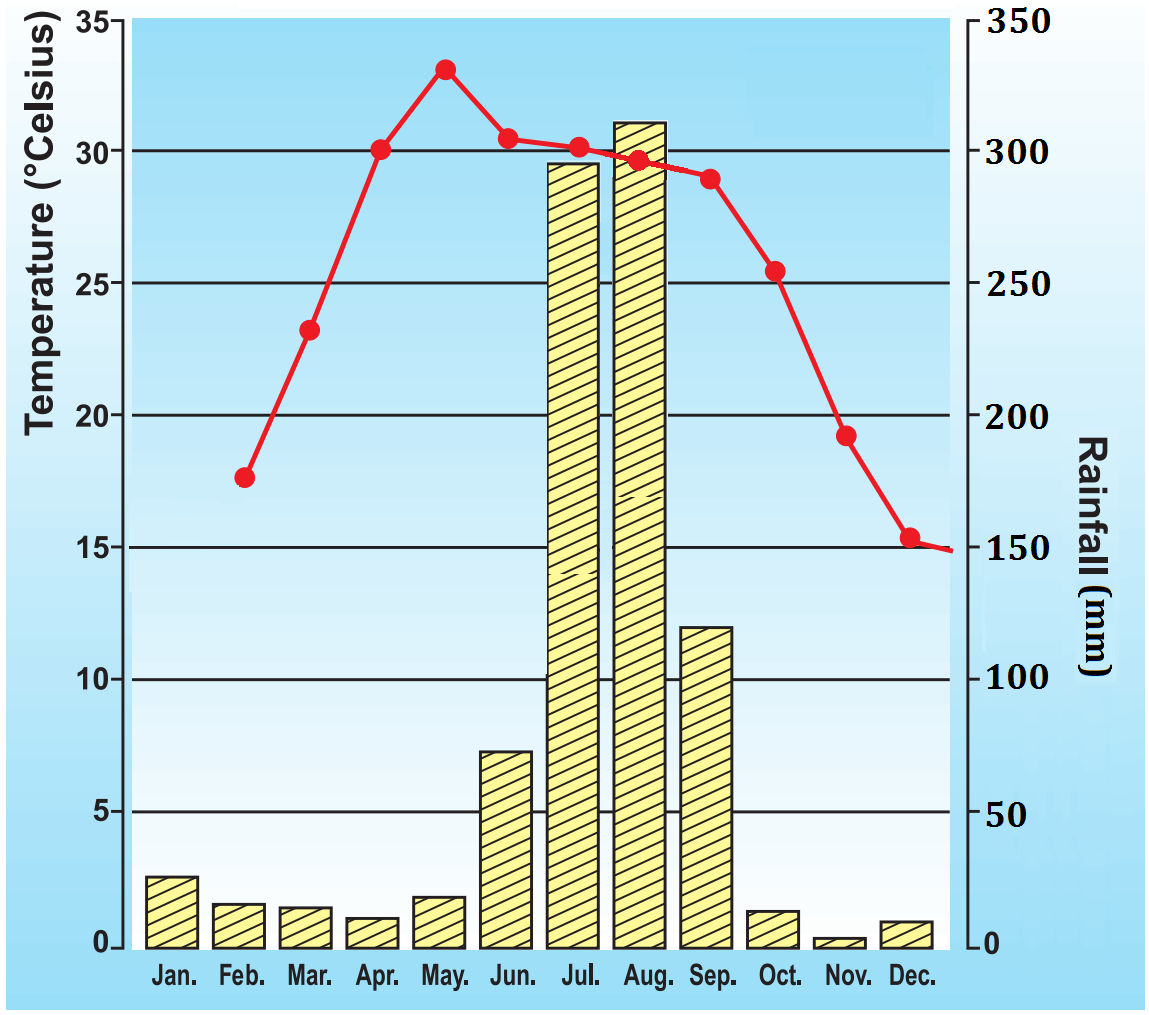
Study the climate data of Varanasi and answer each of the following questions in about 20 words.
  1. Name the rainiest month of the year. How much is the rainfall in this month?
  2. What is the annual range of temperature here?
  3. Which three months have the least rainfall?
  4. Name the hottest month and its temperature.
Answer
  1. August is the rainiest month with 325mm rainfall.
  2. Annual range of temperature is $32^{\circ} C -16^{\circ} C =16^{\circ} C$
  3. January, March, December have least rainfall.
  4. The hottest month is May. Temperature $\left(32^{\circ} C \right)$
View full question & answer
Question 275 Marks
What are the variations in precipitation in India?
Answer
  1. There are variations not only in the form and types of precipitation but also in its amount and the seasonal distribution.
  2. Precipitation is mostly in the form of snowfall in the upper parts of the Himalayas but it rains over the rest of the country.
  3. The annual precipitation varies from 400cm in Meghalaya to less than 10cm in Ladakh and western Rajasthan.
  4. Most parts of the country receive rainfall from June to September but some parts like the Tamil Nadu coast gets most of its rains during October and November.
View full question & answer
Question 285 Marks
There are a number of songs, dances, festivals and special food preparations associated with seasons in different regions of India. What do they represent?
Answer
India is a unique country where we can see unity in diversity. The country is divided into several regions, each with its unique culture and tradition. Each region is known or identified by its traditional songs, dances, festivals, dresses, etc. Our languages, too, differ from region to region. Thus, we see so many diversities. But these diversities do not bind us in narrow feelings. We all are Indians first. We have one national flag, one national emblem, and one national anthem. We all celebrate the Independence Day, the Republic Day and Gandhi Jayanti with the same zeal and enthusiasm.
View full question & answer
Question 295 Marks
Give an account of weather conditions and characteristics of the retreating monsoon.
Answer
The weather conditions and characteristics of the retreating monsoon are given below:
  1. It falls between October and November.
  2. It is a period of transition from hot rainy season to dry winter conditions.
  3. The withdrawal of the monsoon is marked by clear skies and rise in temperature.
  4. Day temperatures are high and humid but nights are cool and pleasant. This is commonly known as 'October heat'.
  5. In the second half of October, the mercury begins to fall rapidly in northern India. The low-pressure conditions over north-western India, get transferred to the Bay of Bengal by early November due to occurrence of cyclonic depressions, which originate over the Andaman Sea.
  6. The delta region of the Eastern Coast of India is frequently struck by cyclones. The deltas of Godavari, Krishna and Kaveri are also frequently struck by cyclones which cause great damage to life and property.
  7. Sometimes, these cyclones arrive at the coasts of Odisha, West Bengal and Bangladesh. The heavy rainfall of the Coromandel Coast is due to these depressions and cyclones.
View full question & answer
Question 305 Marks
Describe the regional variations in the climatic conditions of India with the help of suitable examples.
Answer
There is regional variation in the climatic conditions of India. Temperature and Precipitation vary from place to place and season to season.
  • In summers the temperature rises up to 50°C in parts of Rajasthan, whereas it may be around 20°C in Pahalgam in Kashmir.
  • In winters night temperature in Drass in Kashmir may be minus 45°C, whereas in Tiruvanantapuram in Kerala may have a temperature of 20°C.
  • In Andaman Islands the difference between day and night temperature may be hardly 7°-8°C.
  • Coastal areas experience less contrast in the temperature, whereas seasonal contrasts are more in the interior of the country.
  • There is decrease in rainfall generally from east to west in the northern plains.
  • Most part of India recieve rainfall from June-September, whereas some parts like the Tamil Nadu coast gets a large portion of its rain during October and November.
View full question & answer
Question 315 Marks
What is the distribution of rainfall in India?
Answer
  1. The western coast and northeastern India receive rainfall of over about 400cm.
  2. It is less than 60cm in western Rajasthan and adjoining parts of Gujarat, Haryana and Punjab.
  3. Rainfall is equally low in the interiors of the Deccan plateau and east of the Sahyadris.
  4. A third area of low precipitation is around Leh in Jammu and Kashmir.
  5. The rest of the country receives moderate rainfall.
  6. Snowfall is restricted to the Himalayan region.
View full question & answer
Question 325 Marks
Differentiate between South West (S.W.) monsoons and North East (N.E.) monsoons.
Answer
S.NO
S.W Monsoons (Advancing Monsoon)
N.E Monsoons (Retreating Monsoon)
1.
They blow from south-west to north-east from June to September.
They blow from north-east to south-west from the month of Dec., Jan. and Feb.
2.
These are onshore humid winds because they blow from sea to land.
These are offshore dry winds because they blow from land to sea.
3.
These are warm winds as they come from lower latitudes near equator.
They are rather cool winds.
4.
These warm and humid winds cause widespread rainfall.
These cold and dry offshore winds give no rains to India except Coromandel coast.
5.
These winds are known for their vagaries or uncertainties.
They do not suffer from the vagaries.
 
View full question & answer
Question 335 Marks
Give five reasons for the uneven distribution of rainfall in India.
Answer
The distribution of rainfall uneven in India due to the following reasons:
  1. Latitudinal extent: The tropical and coastal regions and plains receive more rainfall than the plateau and desert regions in the interior.
  2. Relief and topography: The windward side of mountains and hills receive more rainfall than leeward side.
  3. The vagaries of the monsoon: The unpredictability of the monsoon along with phenomena like monsoon troughs and depressions lead to uneven distribution of rainfall.
  4. Cyclonic disturbances: The occurrence of cyclonic depressions, which originate over the Andaman Sea, generally cross the eastern coasts of India cause heavy and widespread rain in deltas of the Godavari, the Krishna and the Kaveri, coasts of Odisha and West Bengal.
  5. Distance from the Sea: Places near the coastal region get more rainfall than the places situated far away from the sea.
View full question & answer
Question 345 Marks
What is meant by 'Southern Oscillation'? State an important feature of it.
Answer
  1. Usually while the tropical eastern South Pacific Ocean experiences high pressure, the tropical eastern Indian Ocean experiences low pressure. But, in certain years, there is a reversal in the pressure conditions and the eastern Pacific has lower pressure in comparison to the eastern Indian Ocean. This periodic change in pressure conditions is known as the Southern Oscillation.
  2. An important feature connected with the Southern Oscillation (SO) is the El Nino, a warm ocean current that flows past the Peruvian coast, in place of the cold Peruvian current, every 2 to 5 years. The changes in pressure conditions are connected to the El Nino. Hence, the phenomenon is referred to as ENSO (El Nino Southern Oscillations).
View full question & answer
Question 355 Marks
What are the six major controls of the climate of the world?
Answer
  1. Latitude: Due to the round shape of the Earth, the amount of solar energy received varies according to latitude. As a result, air temperature decreases from the equator towards the poles.
  2. Altitude: As one moves up to the higher altitudes, the atmosphere becomes less dense and temperature decreases. Therefore, hills are the cooler during summers.
  3. Pressure and winds: Pressure and wind system of an area depend on the latitude and altitude of the place. Thus, it influences the temperature and rainfall pattern.
  4. Distance from the sea: If the region is close to the sea, it makes the temperature moderate but if it is away from the sea, it experiences extreme weather conditions.
  5. Ocean currents: Ocean currents along with the onshore winds affect the climate of a coastal area. Any coastal area with warm or cold curren ts flowing fast, it will become warm or cold if the winds are onshore.
  6. Relief: High mountains act as barriers for cold and hot winds. They may also cause precipitation if they lie in the path of rain-bearing winds. The leeward side of mountains remains dry, whereas the windward side is able to receive rain.
View full question & answer
Question 365 Marks
Give an account of weather conditions and characteristics of the hot weather season.
Answer
  1. The global heat belt shifts northward during the hot weather season which lasts from March to May. In March, the highest temperature is about 38° Celsius, recorded on the Deccan Plateau.
  2. In April, temperature in Gujarat and Madhya Pradesh is around 42° Celsius.
  3. In May, temperature of 45° Celsius is common in the north-western parts of the country.
  4. In peninsular India, temperature remains lower due to the moderating influence of the oceans.
  5. The summer months experience rising temperature and falling air-pressure in the northern part of the country.
  6. Towards the end of May, an elongated low-pressure area develops in the region extending from the Thar Desert in the north-west to Patna and Chhota Nagpur Plateau in the east and southeast. Circulation of air begins to set in around this trough.
  7. Loo, a strong, gusty, hot, dry wind blows during the day over the north and north-western India. Direct exposure to loo may even prove to be fatal.
  8. Dust-storms are very common during the month of May in Northern India. These storms bring temporary relief as they lower the temperature.
  9. Thunderstorms are also common during this season. They are associated with violent winds, torrential downpours, often accompanied by hail.
  10. Pre-monsoon showers mark the close of this season particularly in Kerala and Karnataka.
View full question & answer
Question 375 Marks
Distinguish between the South-west monsoon and North-east monsoon.
Answer
Differences between South-west monsoon and North-east monsoon:
S.No
South-west Monsoon
North-east Monsoon
(i)
This season is from June to September.
This season starts from December and ends in February.
(ii)
It does not rain continuously. There are rainless intervals in this season.
It does not possess any rainless intervals.
(iii)
It blows in India, namely the Arabian Sea branch and Bay of Bengal branch.
It does not have any branches.
(iv)
Major portion of annual rainfall in India is due to this type of monsoon.
Minor portion of the annual rainfall in India is due to this type of monsoon.
View full question & answer
Question 385 Marks
Which winds cause rainfall in the following cities or areas?
  1. Chennai.
  2. Mumbai.
  3. Shillong.
  4. Kolkata.
  5. North West India.
Answer
  1. Chennai: The city gets most of its seasonal rainfall from the north-east monsoon winds.
  2. Mumbai: Receives rain from the South West Monsoon (winds) Arabian Sea branch.
  3. Shillong: cherrapunji is situated in the south part of meghalaga whereas shillong is on north. So the wind carrying the rain which originates from bay of bengal travels upward towards meghalaya in the north direction.
  4. Kolkata: Rains brought by the Bay of Bengal branch of South-West monsoon.
  5. North West India: North west India receives monsoon rainfall from July to September through the monsoon winds from Arabian sea and Bay of Bengal.
Western Disturbances originate in the Mediterranean sea and Atlantic ocean. These winds move towards the East bringing Cyclonic rain in temperate zone.
View full question & answer
Question 395 Marks
How will you differentiate between weather and climate?
Answer
BASIS FOR COMPARISON
WEATHER
CLIMATE
Meaning
Weather is everyday atmospheric condition of a particular region, as regards temperature, humidity, wind speed, etc.
Climate alludes to standard pattern of weather of a particular place, taken over more than 25 years.
What is it?
Minute by minute state of atmosphere in an area.
Average weather in a region.
Represents
What are the condition of atmosphere in a geographical location, over short period.
In what way atmosphere acts over typically long period.
Variation
Varies constantly.
Does not vary constantly.
Affected by
Temperature, humidity, air pressure, cloudiness, precipitation etc.
Temperature and Precipitation.
Assessment
For short term.
Over a long period.
Study
Meterology.
Climatology.
View full question & answer
Question 405 Marks
Give an account of weather conditions and characteristics of the cold season.
Answer
Following are the features of the cold season:
  • The winter season begins from mid-November and till February; in northern India.
  • December and January are the coldest months in the northern part of India.
  • The temperature ranges between 10°-15°C in the northern plains, while it ranges between 24°-25°C in Chennai.
  • The northeast trade winds prevail over the country in this season. As these winds blow from land to sea, most parts of the country experience a dry season.
  • The weather is usually marked by clear sky, low temperatures and low humidity and weak variable winds.
  • The inflow of the cyclonic disturbances from the west and the northwest is a characteristic feature of the cold weather over the northern plains.
  • These low-pressure systems originate over the Mediterranean Sea and Western Asia and move into India. They cause winter rains over the plains and snowfall in the mountains.
  • The winter rainfall is in small amount but is very important for the rabi crop. This rainfall is locally known as mahawat.
  • The peninsular region does not get a well-defined winter because of the moderating influence of the sea.
View full question & answer
Question 415 Marks
Give a brief account of how monsoons advance into India.
Answer
  1. In early June, the low pressure conditions over the northern plains intensify.
  2. These south-east trade winds cross the equator and blow in southwesterly direction, entering the Indian peninsula as the south-west monsoons.
  3. As these winds blow over warm oceans, they bring abundant moisture to the sub-continent.
  4. These winds are strong and blow at an average velocity of 30km per hour.
  5. Early in the season, the windward side of the Western Ghats receives very heavy rainfall, more than 250cm.
  6. The maximum rainfall of this season is received in the northeastern part of the country. Mawsynram in Khasi Hills receives the highest average rainfall in the world.
  7. Rainfall in the Ganges valley decreases from east to the west Rajasthan and parts of Gujarat get scanty rainfall.
View full question & answer
Question 425 Marks
What are the features of advancing monsoon?
Answer
The features of advancing monsoon are given below:
  1. It begins by early June.
  2. The low-pressure condition over the northern plains attracts the trade winds of the southern hemisphere. As these winds blow over warm oceans, they bring abundant moisture to the sub-continent.
  3. As a result, the windward side of the Western Ghats receives very heavy rainfall, and the Deccan Plateau and some parts of Madhya Pradesh also receive lesser amount of rain as they are lying in the rain-shadow area.
  4. The maximum rainfall of this season in the world is received by Mawsynram in the southern ranges of the Khasi Hills.
  5. Another phenomenon associated with the monsoon is its tendency to have 'breaks' in rainfall. The 'break' in monsoon means the monsoon rains take place only for a few days at a time.
  6. The monsoon is known for its uncertainties. While it causes heavy floods in one part, it may be responsible for droughts in the other.
View full question & answer
Question 435 Marks
How does the process of withdrawal of monsoon take place in India?
Answer
  1. Withdrawal or the retreat of monsoon is a more gradual process.
  2. The withdrawal of the monsoon begins in the northwestern states of India, by early September.
  3. By mid-October, it withdraws completely from the northern half of the peninsula.
  4. The withdrawal from the southern half of the peninsula is fairly rapid.
  5. By early December, the monsoon withdraws from the rest of the country
View full question & answer
Question 445 Marks
Write short notes on 'loo' and 'dust storms'.
Answer
Loo: It is a striking feature of the hot weather season. It is strong, gusty, hot, dry winds blowing during the day over the north and northwestern India. Sometimes they even continue until late in the evening. Direct exposure to these winds may even prove fatal.
Dust-storms: They are very common during the month of May in northern India. These storms bring temporary relief as they lower the temperature and may bring bright light rain and cool breeze.
View full question & answer
Question 455 Marks
Why do the north-east trade winds change their direction while blowing through the Ganga valley?
Answer
  1. A feeble high pressure area develops over the north-western part of India in the cold weather season. Light winds begin to blow outwards.
  2. These dry north-westerlies winds come in contact with the Indian trades (north-easterlies) over the Ganga valley.
  3. The direction of north-easterlies changes as a result of this contact as well as under the influence of topography.
  4. Their direction is north-westerlies down the Ganga valley and northerlies over the Ganga-Brahmaputra Delta.
  5. Over the Bay of Bengal, the trade winds retain their original northeasterlies direction, as they are free from the influence of any topography over the sea.
View full question & answer
Question 465 Marks
Describe the main features of the retreating monsoon season in India.
Answer
The characteristics of retreating monsoon are as mentioned below:
  1. The retreat of monsoon takes place due to the migration of Sun towards the South and the withdrawal of the South-West monsoon.
  2. A transition period is marked by the occurrence of tropical depressions and it causes tremendous loss of life and property.
  3. The par of the winter rainfall in Tamil Nadu and Andhra Pradesh is caused by the retreating monsoons.
  4. The storms in the Arabian sea though very rarely but occur between 12°N to 17°N in October and November.
  5. The withdrawal of monsoon leads to clear cloudless sky, high temperatures and high humidity during the month of October. This, this sultry and oppressive weather is often referred to as 'October Heat '.
View full question & answer
Question 475 Marks
When does withdrawal of the monsoon take place in different parts of the country?
Answer
Withdrawal of the monsoon is a more gradual process. The withdrawal of the monsoon begins in north-western states of India by early September. By mid-October, it withdraws completely from the northern half of the peninsula. The withdrawal from the southern half of the peninsula is fairly rapid. By early December, the monsoon has withdrawn from the rest of the country. The islands receive the very first monsoon showers, progressively from south to north, from the last week of April to the first week of May. The withdrawal takes place progressively from north to south from the first week of December to the first week of January. By this time the rest of the country is already under the influence of the winter monsoon.
View full question & answer
Question 485 Marks
"In spite of the moderating influences of the Himalayas variations exist in temperature, humidity and precipitation". Explain with example.
Answer
  1. In spite of the moderating influences of the Himalayas in the north and the sea in the south, regional variations do exist in temperature, humidity and precipitation. It is due to the six major controls of the climate of any place – latitude, altitude, pressure and wind system, distance from the sea (continentality), ocean currents and relief features.
  2. Example: In summer, some parts of the Rajasthan desert in northwestern India, record temperatures of 50°C, while it may be around 20°C in Pahalgam in Jammu and Kashmir, in the north of the country. On a winter night, the temperature at Drass in Jammu and Kashmir may be as low as minus 45°C, while Thiruvananthapuram may have a temperature of 22°C.
View full question & answer
Question 495 Marks
“A relief feature has a major role to play in determining the climate of a place. Support the statement with any three relevant examples.
Answer
  1. Altitude: As one moves up to the higher altitudes, the atmosphere becomes less dense and temperature decreases. Therefore, hills cool down during summers.
  2. Relief: High mountains act as barriers for cold and hot winds. They may also cause precipitation if they lie in the path of rain bearing winds. The Leeward sides of mountains remain dry, whereas windward side is able to receive rain.
  3. North Eastern hills: The maximum rainfall of the season is received in the north eastern hills. Garo, Khasi and Jaintia Hills located in Meghalaya traps the South West monsoon clouds and cause world’s highest rainfall in Mawsynram in Meghalaya.
View full question & answer
Question 505 Marks
are the major controls of the climate of a place? Explain them.
Answer
There are six major controls of the climate of a place:
  1. Latitude.
  2. Altitude.
  3. Pressure and wind system.
  4. Distance from the sea.
  5. Ocean currents.
  6. Relief features.
  1. Latitude: Due to the curvature of the earth, the amount of solar energy received varies according to latitude. As a result, air temperature generally decreases from the equator towards the poles.
  2. Altitude: As one goes from the surface of the earth to higher altitudes, the atmosphere becomes less dense and temperature decreases. The hills are, therefore, cooler during summers.
  3. Pressure and wind system: The pressure and wind system of any area depend on the latitude and altitude of the place. Thus, it influences the temperature and rainfall pattern.
  4. Distance from the sea: The sea exerts moderating influence on climate. As the distance from the sea increases, its moderating influence decreases and the people experience extreme weather conditions. This condition is known as continentality which means very hot during summers and very cold during winters.
  5. Ocean currents: Oceans along with onshore winds affect the climate of the coastal areas. For instance, any coastal area with warm or cold currents flowing past it, will be warmed or cooled if the winds are onshore.
  6. Relief features: High mountains act as a barrier for cold or hot winds. They may also cause precipitation if they are high enough and lie in the path of rain-bearing winds. The leeward side of the mountains remains relatively dry.
View full question & answer