Question types

Model Paper 1 question types

44 questions across 8 question groups — pick any mix to generate a Social Studies paper with step-by-step answer keys.

44
Questions
8
Question groups
5
Question types
Sample Questions

Model Paper 1 questions

One sample from each question group in this chapter. Select any group above to see the full set with answer keys.

Q 2MCQ (1 Mark)1 Mark
When people appear to be employed, this kind of unemployment is called:
  • A
    Seasonal unemployment
  • Disguised unemployment
  • C
    Educated unemployment
  • D
    All of these

Answer: B.

View full solution
Q 3MCQ (1 Mark)1 Mark
The event, 'Bloody Sunday' was later on called:
  • 1905 Revolution
  • B
    1917 February Revolution
  • C
    1917 October Revolution
  • D
    1917 Revolution

Answer: A.

View full solution
Q 4MCQ (1 Mark)1 Mark
Which of the following is the largest salt water lake in India?
  • Chilika lake
  • B
    Chilika lake
  • C
    Pulicat lake
  • D
    Pangong lake

Answer: A.

View full solution
Q 5MCQ (1 Mark)1 Mark
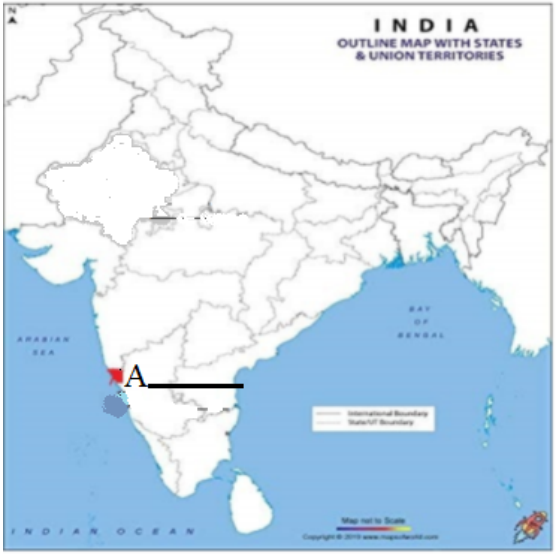
On the political map, A is also marked as the smallest state. Identify it from the following options.
Image
  • A
    Sikkim
  • B
    Puducherry
  • Goa
  • D
    Diu

Answer: C.

View full solution
Here are some reports of malpractices in Indian elections. Identify what is the problem in each case What should be done to correct the situation?
a. Following the announcement of elections, the minister promised to provide financial aid to reopen the closed sugar mill.
b. Opposition parties alleged that their statements and campaign was not given due attention in Doordarshan All India Radio.
c. An inquiry by the Election Commission showed that electoral rolls of a state contain name of 20 lakh fake voters.
d. The hoodlums of a political party were moving with guns, physically preventing supporters of other political parties to meet the voters and attacking meetings of other parties.
View full solution
Assertion (A): It was finally in 1946 that women in France won the right to vote.
Reason (R): The Constitution of 1791 reduced women to passive citizens.
  • Both A and R are true and R is the correct explanation of A.
  • B
    Both A and R are true but R is not the correct explanation of A.
  • C
    A is true but R is false.
  • D
    A is false but R is true.

Answer: A.

View full solution
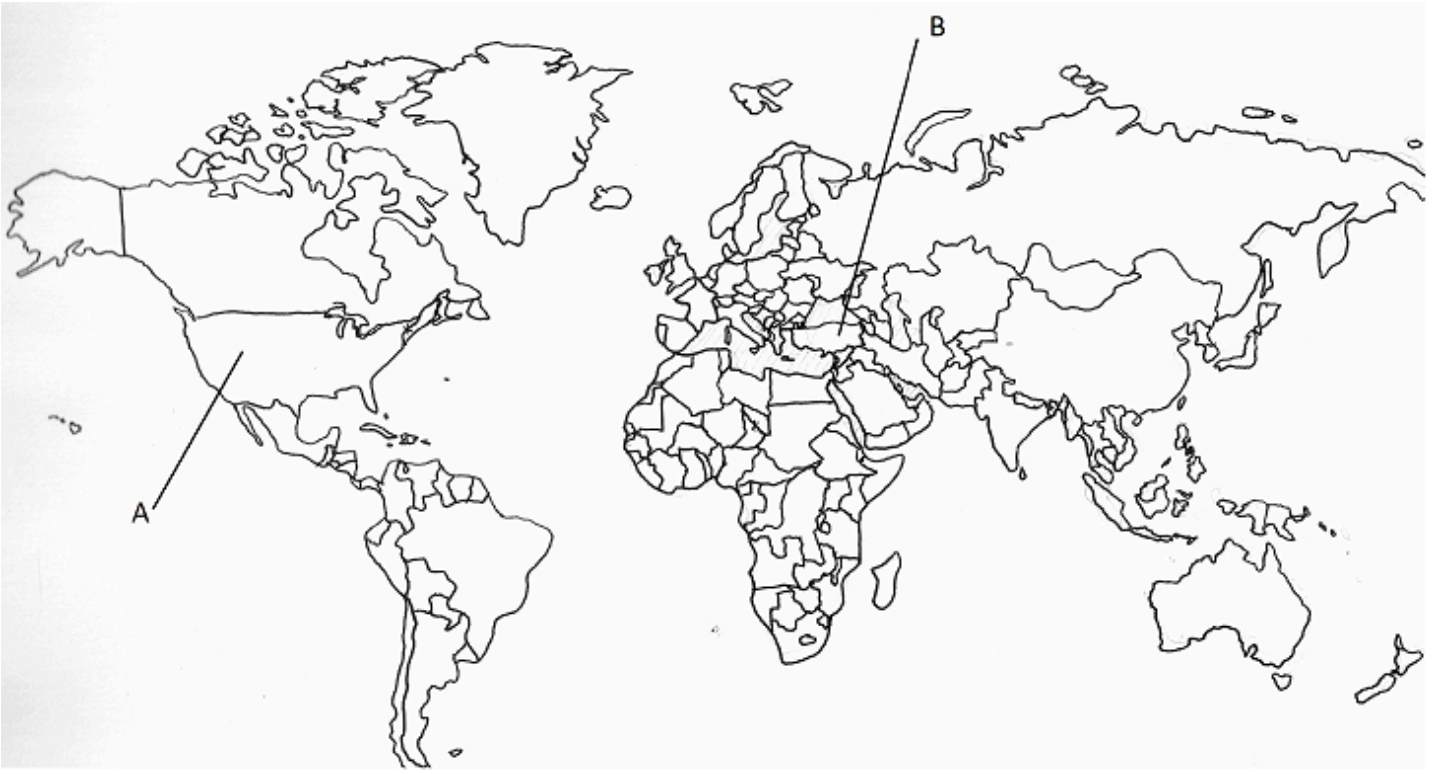
Two places A and B have been marked on the given outline map of the world. Identify them and write their correct names on the lines drawn near them
A. The allied power country of the second world war
B. The central power country of the first world war
Image
View full solution
On the outline map of India locate and label ANY THREE of the following with suitable Symbols.
a. Chotta Nagpur Plateau - Plateau
b. Konkan - Coastal Plains
c. Tropical Evergreen Forest - Vegetation Type
d. c-Bird Sanctuaries
View full solution
Poverty in India also has another aspect or dimension. The proportion of poor people is not the same in every state. Although state-level poverty has witnessed a secular decline from the levels of the early seventies, the success rate of reducing poverty varies from state to state. Recent estimates show while all India Head Count Ratio (HCR) was 21.9 percent in 2011-12 states like Madhya Pradesh,
Assam, Uttar Pradesh, Bihar and Odisha had above all India poverty level. Bihar and Odisha continue to be the two poorest states with poverty ratios of 33.7 and 32.6 percent respectively. Along with rural poverty, urban poverty is also high in Odisha, Madhya Pradesh, Bihar, and Uttar Pradesh. In comparison, there has been a significant decline in poverty in Kerala, Maharashtra, Andhra Pradesh, Tamil Nadu, Gujarat and West Bengal. States like Punjab and Haryana have traditionally succeeded in reducing poverty with the help of high agricultural growth rates. Kerala has focused more on human resource development. In West Bengal, land reform measures have helped in reducing poverty. In Andhra Pradesh and Tamil Nadu, the public distribution of food grains could have been responsible for the improvement.
i. What state has the highest rate of poverty among Bihar, Odisha, Punjab, and Assam? (1)
ii. Is it accurate to say that Kerala has eradicated poverty through the distribution of food at highly subsidized rates? (1)
iii. In which Indian states is poverty most prevalent? (2)
View full solution
India is one of the ancient civilisations in the world. It has achieved multifaceted socio-economic progress during the last five decades. It has moved forward displaying remarkable progress in the field of agriculture, industry, technology, and overall economic development. India has also contributed significantly to the making of world history. India is a vast country. Lying entirely in the Northern hemisphere the mainland extends between latitudes $8^{\circ} 4^{\prime} N$ and $37^{\circ} 6^{\prime} N$ and longitudes $68^{\circ} 7^{\prime} E$ and $97^{\circ} 25^{\prime} E$. The Tropic of Cancer divides the country into almost two equal parts. To the southeast and southwest of the mainland, lie the Andaman and Nicobar Islands and the Lakshadweep Islands in the Bay of Bengal and the Arabian Sea respectively. The southernmost point of the Indian Union was submerged under the seawater in 2004 during the Tsunami.
i. Name the southernmost point of the Indian Union that submerged under the seawater in 2004 during the Tsunami. (1)
ii. Tropic of Cancer divides the country into almost two equal parts. What is the latitudinal value of the Tropic of Cancer? (1)
iii. Give the names of India's two island groups. (2)
View full solution
All other coloured people were placed in between depending upon their external features. Hitler's racism borrowed from thinkers like Charles Darwin and Herbert
Spencer. Darwin was a natural scientist who tried to explain the creation of plants and animals through the concept of evolution and natural selection. Herbert Spencer later added the idea of survival of the fittest. According to this idea, only those species survived on earth that could adapt themselves to changing climatic conditions. We should bear in mind that Darwin never advocated human intervention in what he thought was a purely natural process of selection. However, his ideas were used by racist thinkers and politicians to justify imperial rule over conquered peoples.
i. Which race was at the top of the Nazi racial hierarchy? (1)
ii. Who were undesirables for the Nazis? (1)
iii. What steps did the Nazis take to establish a racial state after coming into power? (2)
View full solution

Generate a Model Paper 1 paper free

Pick question groups from the list above, set marks and difficulty, and export a branded PDF with step-by-step answer keys. First 3 chapters free — no signup.

Download App