Question types

Model Paper 3 question types

44 questions across 8 question groups — pick any mix to generate a Social Studies paper with step-by-step answer keys.

44
Questions
8
Question groups
5
Question types
Sample Questions

Model Paper 3 questions

One sample from each question group in this chapter. Select any group above to see the full set with answer keys.

Q 2MCQ (1 Mark)1 Mark
In which sector new services like biotechnology and information technology are now appearing?
  • Tertiary
  • B
    Manufacturing
  • C
    Secondary
  • D
    Primary

Answer: A.

View full solution
Q 5MCQ (1 Mark)1 Mark
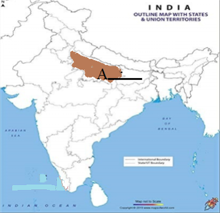
From Gujarat to Arunachal Pradesh, there is a time lag of two hours. There is a standard time taken on a place of a state marked as $A$ in the given map. Identify this olace from the following ontions.
Image
  • A
    Chhattisgarh
  • B
    Madhya Pradesh
  • Uttar Pradesh
  • D
    Uttarakhand

Answer: C.

View full solution
"Indian monsoon is said to be a unifying bond for the people of the country." Suppose the monsoon is disturbed for a prolonged period of time. What do you think, how will it affect the country?
View full solution
Assertion (A): Robespierre was the leader of the Jacobins club and his rule is referred to as the Reign of Terror.
Reason (R): He followed a policy of severe control and punishment.
  • Both $A$ and $R$ are true and $R$ is
  • B
    Both $A$ and $R$ are true but $R$ is the correct explanation of A . not the correct explanation of A.
  • C
    A is true but $R$ is false.
  • D
    $A$ is false but $R$ is true.

Answer: A.

View full solution
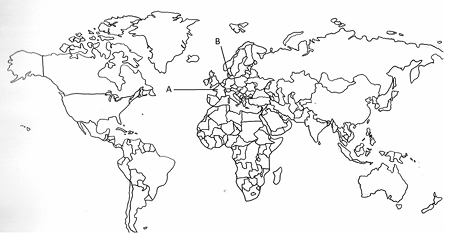
Two places A and B have been marked on the given outline map of the world. Identify then and write their correct names on the lines drawn near them
A. The place where they gave coonomic prosperity to the flourishing slave trade.
B. The place where Territories under German expansion,
Image
View full solution
On the outline map of India locate and label ANY THREE of the following with suitable Symbols.
a. Rajaji - Wild Life Sanctuaries
b. Corbett - National Parks
c. Anai Mudi - Mountain Peaks
d. The Narmada - The Peninsular rivers
View full solution
Mahatma Gandhi National Rural Employment Guarantec Act, 2005 aims to provide
100 days of wage employment to every household to ensure livelihood security in rural areas. It also aimed at sustainable development to address the cause of drought, deforestation and soil erosion. One-third of the proposed jobs have been reserved for women. Prime Minister Rozgar Yozana is another scheme which was started in 1993. The aim of the programme is to create self-employment opportunities for educated unemployed youth in rural areas and small towns. They are helped in setting up small business and industries. Rural Employment Generation Programme was launched in 1995. The aim of the programme is to create self-employment opportunities in rural areas and small towns. A target for creating 25 lakh new jobs has been set for the programme under the Tenth Five Year plan. Swarnajayanti Gram Swarozgar Yojana was launched in 1999. The programme aims at bringing the assisted poor families above the poverty line by organising them into self help groups through a mix of bank credit and government subsidy. Under the Pradhan Mantri Gramodaya Yozana launched in 2000, additional central assistance is given to states for basic services such as primary health, primary education, rural shelter, rural drinking water and rural electrification. The results of these programmes have been mixed. One of the major reasons for less effectiveness is the lack of proper implementation and right targeting. Moreover, there has been a lot of overlapping of schemes. Despite good intentions, the benefits of these schemes are not fully reached to the deserving poor, Therefore, the major emphasis in recent years is on proper monitoring of all the poverty alleviation programmes.
i. Explain any one cause for the less effectiveness of poverty alleviation programmes? (1)
ii. Explain any two features of the Mahatma Gandhi National Rural Employment Guarantec Act 2005? (1)
iii. What objectives did SGSY have? (2)
View full solution
India is one of the most ancient civilizations in the world. It has achieved multifaceted socio-economic progress during the last five decades. It has moved forward displaying remarkable progress in the field of agriculture, industry, technology, and overall economic development. India has also contributed significantly to the making of world history. India is a vast country. Lying entirely in the Northem hemisphere the mainland extends between latitudes $8^{\circ} 4^{\prime} N$ and $37^{\circ} 6^{\prime} N$ and longitudes $68^{\circ} 7^{\prime} E$ and $97^{\circ} 25^{\prime} E$. The Tropic of Cancer divides the country into almost two equal parts. To the southeast and southwest of the mainland, lie the Andaman and Nicobar islands and the Lakshadweep islands in the Bay of Bengal and the Arabian Sea respectively.
i. What is the latitudinal position of India?
ii. What is the longitude-wise location of India?
iii. Which latitudinal line divides India into approximately two equal parts? What is the latitudinal value of this line?
View full solution
Under the shadow of war, the Nazis proceeded to realise their murderous, racial ideal. Genocide and war became two sides of the same coin. Occupied Poland was divided up. Much of north-western Poland was annexed to Germany. Poles were forced to leave their homes and properties behind to be occupied by ethnic Germans brought in from occupied Europe. Poles were then herded like cattle in the other part called the General Government, the destination of all 'undesirables' of the empire. Members of the Polish intelligentsia were murdered in large numbers in order to keep the entire people intellectually and spiritually servile. Polish children who looked like Aryans were forcibly snatched from their mothers and examined by 'race experts'. If they passed the race tests they were raised in German families and if not, they were deposited in orphanages where most perished. With some of the largest ghettos and gas chambers, the General Government also served as the killing fields for the Jews.
i. Which ideology of the Nazis do the given passage reflect? (1)
ii. Under which law marriages between Jews and Germans were forbidden? (1) iii. Explain the night of broken glass under the Nazi regime. (2)
View full solution

Generate a Model Paper 3 paper free

Pick question groups from the list above, set marks and difficulty, and export a branded PDF with step-by-step answer keys. First 3 chapters free — no signup.

Download App