Question types

Model Paper 5 question types

44 questions across 8 question groups — pick any mix to generate a Social Studies paper with step-by-step answer keys.

44
Questions
8
Question groups
5
Question types
Sample Questions

Model Paper 5 questions

One sample from each question group in this chapter. Select any group above to see the full set with answer keys.

Q 1MCQ (1 Mark)1 Mark
The advantage of opening of the Suez canal to India
  • A
    Increase in political crisis
  • B
    Change in culture
  • C
    Influence the people
  • India's distance from Europe has been reduced

Answer: D.

View full solution
Q 2MCQ (1 Mark)1 Mark
Which scheme has been implemented to encourage attendance and retention of children and improve their nutritional status?
  • A
    Aanpurna Ann Yojana
  • B
    Vocational streams
  • Mid-day meal
  • D
    Navodaya Vidhyalay

Answer: C.

View full solution
Q 5MCQ (1 Mark)1 Mark
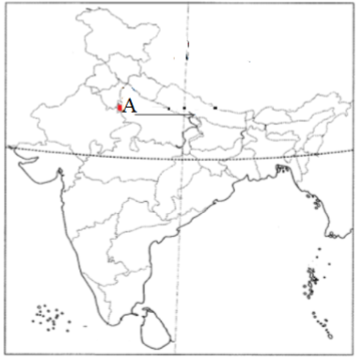
On the political map, A is marked as a metropolitan city characterized by River Yamuna and is located at the terminal part of the Aravali hill range. Identify it from the given options. 

Image
  • A
    Lucknow
  • B
    Dehradun
  • New Delhi
  • D
    Chandigarh

Answer: C.

View full solution
Chinappa was convicted for torturing his wife for dowry. Satbir was held guilty of practising untouchability. The court did not allow either of them to contest elections. Does this decision go against the principles of democratic elections?
View full solution
Read the following statements about a constitution. Give reasons why each of these is true or not true.
a. The authority of the rules of the constitution is the same as that of any other law.
b. Constitution lays down how different organs of the government will be formed.
c. Rights of citizens and limits on the power of the government are laid down in the constitution.
d. A constitution is about institutions, not about values.
View full solution
Assertion (A): The Bastille was hated by all and demolished.
Reason (R): It was a fortress prison where people hoped to find hoarded ammunition.
  • A
    Both $A$ and $R$ are true and $R$ is the correct explanation of A .
  • Both $A$ and $R$ are true but $R$ is the correct explanation of A . not the correct explanation of A.
  • C
    $A$ is true but $R$ is false.
  • D
    $A$ is false but $R$ is true.

Answer: B.

View full solution
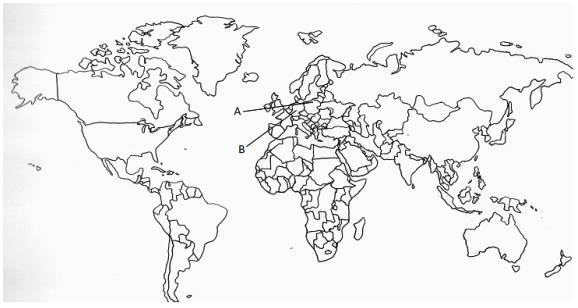
i. Two places A and B have been marked on the given outline map of the world. Identify them and write their correct names on the lines drawn near them
A. Central power
B. Louis XVI ascended the throne in 1774
View full solution
The proportion of people below the poverty line is also not the same for all social groups and economic categories in India. Social groups, which are most vulnerable to poverty are Scheduled Caste and Scheduled Tribe households. Similarly, among the economic groups, the most vulnerable groups are the rural agricultural labour households and urban casual labour households. The average for people below the poverty line for all groups in India is 22 . The double disadvantage of being a landless casual wage labour household in the socially disadvantaged social groups of the scheduled caste or the scheduled tribe population highlights the seriousness of the problem. Some recent studies have shown that except for the scheduled tribe households, all the other three groups (i.e. scheduled castes, rural agricultural labourers and the urban casual labour households) have seen a decline in poverty in the 1990s. Apart from these social groups, there is also inequality of incomes within a family. In poor families all suffer, but some suffer more than others. In some cases, women, elderly people and female infants are denied equal access to resources available to the family.
i. How are women, children, and the elderly the poorest of the poor? 
ii. Which social and economic groups are the most vulnerable to poverty?
iii. How do inequities in income occur within a family?
View full solution
India is one of the most ancient civilizations in the world. It has achieved multifaceted socio-economic progress during the last five decades. It has moved forward displaying remarkable progress in the field of agriculture, industry, technology, and overall economic development. India has also contributed significantly to the making of world history. India is a vast country. Lying entirely in the Northern hemisphere the mainland extends between latitudes $8^{\circ} 4^{\prime} N$ and $37^{\circ} 6^{\prime} N$ and longitudes $68^{\circ} 7^{\prime} E$ and $97^{\circ} 25^{\prime} E$. The Tropic of Cancer divides the country into almost two equal parts. To the southeast and southwest of the mainland, lie the Andaman and Nicobar islands and the Lakshadweep islands in the Bay of Bengal and the Arabian Sea respectively.
i. What is the latitudinal position of India?
ii. What is the longitude-wise location of India?
iii. Which latitudinal line divides India into approximately two equal parts? What is the latitudinal value of this line?
View full solution
Media was carefully used to win support for the regime and popularise its worldview. Nazi ideas were spread through visual images, films, radio, posters, catchy slogans and leaflets. In posters, groups identified as the 'enemies' of Germans were stereotyped, mocked, abused and described as evil. Socialists and liberals were represented as weak and degenerate. They were attacked as malicious foreign agents. Propaganda films were made to create hatred for Jews. The most infamous film was The Eternal Jew. Orthodox Jews were stereotyped and marked.
i. Jews were portrayed as killers of Christ and usurers. Who were 'usurers'?
ii. What did the Nuremberg Laws mean to the undesirables in Nazi Germany? 
iii. Hitler could have resolved the Jewish problem by the method of conversion but he didn't. What could be the possible reason behind it?
View full solution

Generate a Model Paper 5 paper free

Pick question groups from the list above, set marks and difficulty, and export a branded PDF with step-by-step answer keys. First 3 chapters free — no signup.

Download App