Question 11 Mark
Give a chemical test to distinguish between a primary and a secondary amine.
AnswerAromatic primary amine gives orange dye on treating with ice cold $\mathrm{NaNO}_2+\mathrm{HCl}$ followed by $\beta$-naphthol whereas secondary amine does not give this test/or describe carbyl amine test or Hinsberg test.
View full question & answer→Question 21 Mark
Write reactions of the final alkylation product of aniline with excess of methyl iodide in the presence of sodium carbonate solution.
AnswerAniline reacts with methyl iodide to produce N, N-dimethylaniline.
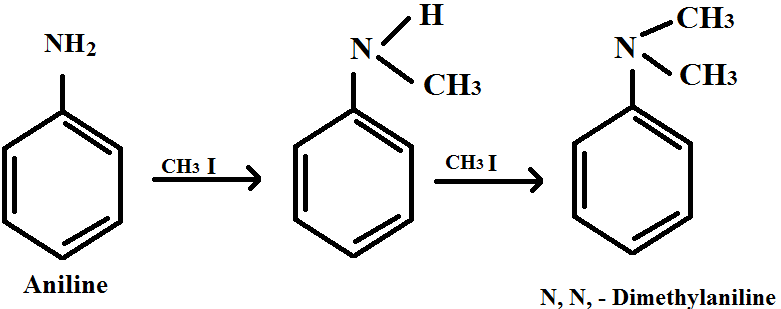
With excess methyl iodide, in the presence of $\mathrm{Na}_2\mathrm{CO}_3$ solution, N, N-dimethylaniline produces N, N, N-trimethylanilinium carbonate.
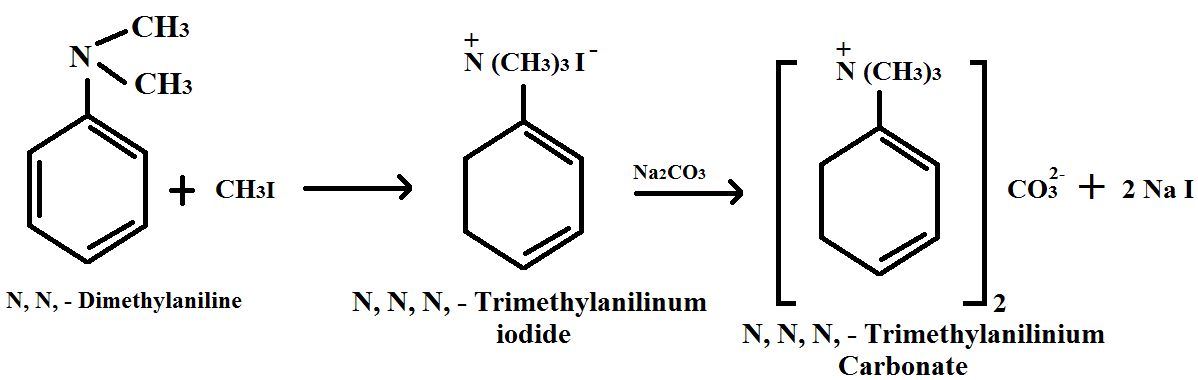
View full question & answer→Question 31 Mark
Write short notes on the following:
Ammonolysis.
AnswerAmmonolysis: Alkyl halide reacts with ammonia to form primary amine. The reaction of ammonia with alkyl halide is known as ammonolysis.
$\mathrm{CH}_3 \mathrm{Cl}+\mathrm{NH}_3 \rightarrow \mathrm{CH}_3 \mathrm{NH}_2 \cdot \mathrm{HCl}$
$\mathrm{CH}_3 \mathrm{NH}_2 \cdot \mathrm{HCl}+\mathrm{NH}_3 \rightarrow \mathrm{CH}_3 \mathrm{NH}_2+\mathrm{NH}_4 \mathrm{Cl}$
View full question & answer→Question 41 Mark
How will you convert:
Methanol to ethanoic acid.
AnswerConversion of methanol to Ethanoic acid.
$\text{CH}_3\text{OH} \xrightarrow[\text{P}/\text{I}_2]{\text{P}\text{I}_3}\text{CH}_3\text{I}\xrightarrow[\text{alc}]{\text{KCN}}\text{CH}_3\text{CN}\xrightarrow[(\text{dil HCl})]{\text{Hydrolysis}}\\\text{Methanol}\ \ \ \ \ \ \ \text{Methyl} \ \ \ \ \ \ \ \text{Methyl}\ \ \ \ \ \ \ \ \ \ \ \\ \ \ \ \ \ \ \ \ \ \ \ \ \ \ \ \ \ \ \ \ \ \ \ \ \text{iodide}\ \ \ \ \ \ \ \ \ \text{iodide}\\ \ \ \ \ \ \ \ \ \ \ \ \ \ \ \ \ \ \ \ \ \ \ \ \ \ \ \ \ \ \ \ \ \ \ \ \ \ \ \ \ \ \ \ \ \ \ \ \ \ \ \ \ \ \ \ \ \ \ \text{CH}_3\text{COOH}\\ \ \ \ \ \ \ \ \ \ \ \ \ \ \ \ \ \ \ \ \ \ \ \ \ \ \ \ \ \ \ \ \ \ \ \ \ \ \ \ \ \ \ \ \ \ \ \ \ \ \ \ \ \ \ \ \ \ \ \ \text{Ethanic acid}$
View full question & answer→Question 51 Mark
Why cannot aromatic primary amines be prepared by Gabriel phthalimide synthesis?
Answer
Gabrielphthalimide synthesis is used for the preparation of aliphatic primary amines. It involves nucleophilic substitution $\left(\mathrm{SN}_2\right)$ of alkyl halides by the anion formed by the phthalimide.
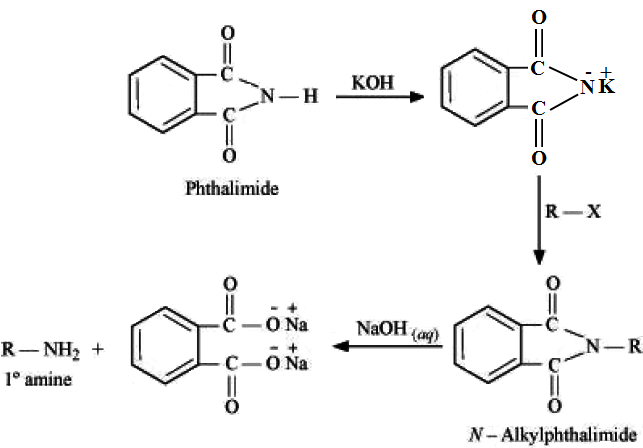
But aryl halides do not undergo nucleophilic substitution with the anion formed by the phthalimide.
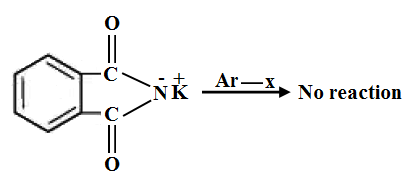
Hence, aromatic primary amines cannot be prepared by this process. View full question & answer→Question 61 Mark
Arrange the following:
In decreasing order of basic strength in gas phase:
$\mathrm{C}_2 \mathrm{H}_5 \mathrm{NH}_2,\left(\mathrm{C}_2 \mathrm{H}_5\right)_2 \mathrm{NH},\left(\mathrm{C}_2 \mathrm{H}_5\right)_3 \mathrm{~N}$ and $\mathrm{NH}_3$
Answer$\left(\mathrm{C}_2 \mathrm{H}_5\right)_2 \mathrm{NH}>\mathrm{C}_2 \mathrm{H}_5 \mathrm{NH}>\left(\mathrm{C}_2 \mathrm{H}_5\right)_3 \mathrm{~N}>\mathrm{NH}_3$
View full question & answer→Question 71 Mark
Complete the following reaction:
$\text{C}_6\text{H}_5\text{N}_2\text{Cl}+\text{C}_2\text{H}_5\text{OH}\rightarrow$
Answer$ \ \ \ \ \ \ \ \ \ \ \ \ \text{C}_6\text{H}_5\text{N}_2\text{Cl} \ \ + \ \ \ \text{C}_2\text{H}_5\text{OH}\rightarrow\text{C}_6\text{H}_6+\text{CH}_3\text{CHO}+\text{N}_2+\text{HCl}\\\text{Benzenediazonium} \ \ \ \ \ \ \ \text{Ethanol} \ \ \ \ \ \ \ \text{Benzene} \ \ \ \ \ \text{Ethanal}\\ \ \ \ \ \ \ \ \ \ \ \ \text{Cloride}$
View full question & answer→Question 81 Mark
Account for the following:
Although amino group is o– and p– directing in aromatic electrophilic substitution reactions, aniline on nitration gives a substantial amount of m-nitroaniline.
AnswerThe nitration of aniline is carried out using conc. $\mathrm{HNO}_3$ and $\mathrm{H}_2 \mathrm{SO}_4$. However, in the presence of conc. $\mathrm{H}_2 \mathrm{SO}_4$, aniline forms aniline hydrogen sulphate in which the anilinium ion, $\mathrm{C}_6 \mathrm{H}_5 \mathrm{NH}_3{ }^{+}$is meta directing because the positive charge on the nitrogen attracts electrons from the benzene ring.
View full question & answer→Question 91 Mark
How will you convert:
Ethanamine into methanamine.
AnswerConversion of Ethanamine into Methanamine.
$ \text{C}_2\text{H}_5\text{NH}_2\xrightarrow[]{\text{HONO}}\text{C}_2\text{H}_5\text{OH}\xrightarrow[\text{K}_2\text{Cr}_2\text{O}_7/ \text{H}_2\text{SO}_4]{\text{Oxidation}}\\\text{Ethanamine} \ \ \ \ \ \ \ \ \ \ \ \ \ \ \text{Ethyl} \ \ \ \ \ \ \ \ \ \ \ \ \ \ \ \ \ \ \ \ \ \ \ \ \ \ \ \ \ \ \ \ \\\ \ \ \ \ \ \text{alcohol}\\ \ \ \ \ \ \ \ \ \ \ \ \ \ \ \ \ \ \text{CH}_3\text{CHO}\xrightarrow[]{\text{Oxidation}}\text{CH}_3\text{COOH}\\ \ \ \ \ \ \ \ \ \ \ \ \ \ \ \ \text{Acetaldahyde} \ \ \ \ \ \ \ \ \ \ \text{Acetic acid}\\ \ \ \ \ \ \ \ \ \ \ \ \ \ \ \ \ \ \ \ \ \ \ \ \ \ \ \ \ \ \ \ \ \ \ \ \ \ \ \ \ \ \ \ \ \ \ \ \ \ \ \ \ \ \ \ \ \ \ \Big\downarrow{\text{NH}_3}\\\text{CH}_3\text{NH}_2\xleftarrow[]{\text{Br}_2/\text{KOH}}\text{CH}_3\text{CONH}_2\xleftarrow[]{\text{heat}}\text{CH}_3\text{COONH}_4\\\text{methamine} \ \ \ \ \ \ \ \ \ \ \ \ \ \text{Acetamide} \ \ \ \ \ \ \ \ \ \ \ \ \ \ \ \ \text{Ammonium}\\ \ \ \ \ \ \ \ \ \ \ \ \ \ \ \ \ \ \ \ \ \ \ \ \ \ \ \ \ \ \ \ \ \ \ \ \ \ \ \ \ \ \ \ \ \ \ \ \ \ \ \ \ \ \ \ \ \ \ \ \ \ \ \ \ \ \ \ \ \ \text{acetate}$
View full question & answer→Question 101 Mark
Arrange the following:
In increasing order of basic strength:
-
Aniline, p-nitroaniline and p-toluidine.
-
$C_6H_5NH_2, C_6H_5NHCH_3, C_6H_5CH_2NH_2.$
Answer
- P-nitro aniline < aniline < p-toluidine.
-
$C_6H_5NHCH_3 < C_6H_5NH_2 < C_6H_5CH_2NH_{2.}$
View full question & answer→Question 111 Mark
Write short notes on the following: Gabriel phthalimide synthesis.
Answer
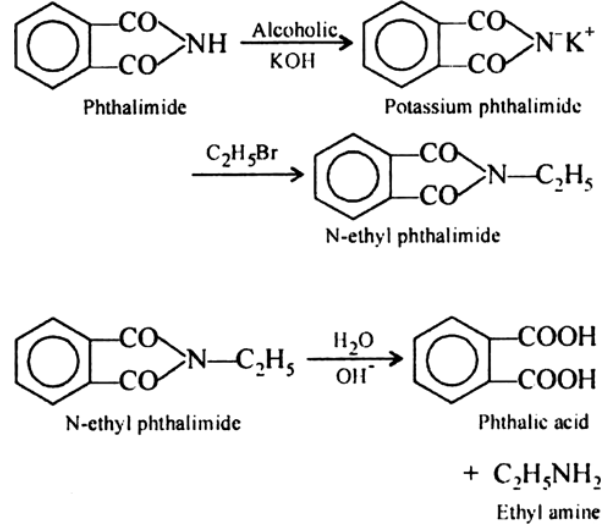
Gabriel phthalimide synthesis: Primary amines can be prepared by this process. In this process, phthalimide is reacted with alcoholic KOH to get potassium phthalimide which reacts with an alkyl halide to form N-alkyl phthalimide which on basis hydrolysis gives primary amine and phthalic acid. Phthalic acid can be reused to get phthalimide.
View full question & answer→Question 121 Mark
How will you convert? Benzene into N, N-dimethylaniline.
Question 131 Mark
Give plausible explanation for each of the following:
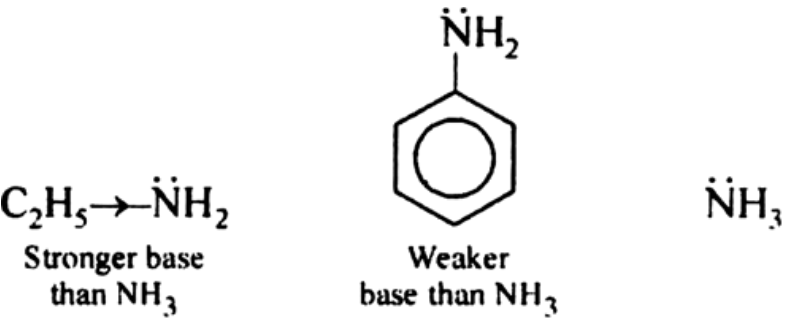
Why are aliphatic amines stronger bases than aromatic amines?
AnswerIn aliphatic amines, alkyl groups are electron releasing and increases the electron pair availability at N atom while aryl group in aromatic amines are electron withdrawing decreasing the availability of electron pair at N atom.
View full question & answer→Question 141 Mark
Give plausible explanation for each of the following:
Why do primary amines have higher boiling point than tertiary amines?
AnswerAmines are polar compounds and can form H-bonds as proton acceptors. Only primary and secondary amines can form intermolecular H-bonding due to the presence of H atom at N atom. Tertiary amines cannot form intermolecular in-bonding. Primary amines are higher boiling due to the presence of a stronger intermolecular force of attraction due to H-bonding.
$\cdot\cdot\cdot\text{H} \ \ \ \ \ \ \ \ \ \text{R} \ \ \ \ \ \ \ \ \ \ \text{H}\cdot\cdot\cdot\\ \ \ \ \ \ \ \ | \ \ \ \ \ \ \ \ \ \ \ | \ \ \ \ \ \ \ \ \ \ \ |\\\text{RNH}\cdot\cdot\cdot\text{NH}\cdot\cdot\cdot \ \text{NR} \ \ \ \ \ \ \ \ \ \ \ \ \\ \ \ \ \ \ \ \ \ \ \ \ \ \ \ \ \ \ \ \ | \ \ \ \ \ \ \ \ \ \ \ \ |\\ \ \ \ \ \ \ \ \ \ \ \ \ \ \ \ \ \ \ \text{H}\cdot\cdot\cdot \ \ \text{H}\cdot\cdot\cdot \ \$\text{Hydrogen bonding in primary})$
View full question & answer→Question 151 Mark
How will you convert:
Nitromethane into dimethylamine.
AnswerNitromethane into dimethylamine
$\text{CH}_3\text{NO}_2+6[\text{H}]\xrightarrow[]{\text{Sn}/\text{HCl}}\text{CH}_3\text{NH}_2\xrightarrow[-\text{HBr}]{\text{CH}_3\text{Br}}\\\text{Nitromethane} \ \ \ \ \ \ \ \ \ \ \ \ \ \ \ \ \ \ \ \text{Methyl}\\ \ \ \ \ \ \ \ \ \ \ \ \ \ \ \ \ \ \ \ \ \ \ \ \ \ \ \ \ \ \ \ \ \ \ \ \ \ \ \ \ \ \ \ \ \ \text{amine}\\ \ \ \ \ \ \ \ \ \ \ \ \ \ \ \ \ \ \ \ \ \ \ \ \ \ \ \ \ \ \ \ \ \ \ \ \ \ \ \ \ \ \ \ \ \ \ \ \ \ \ \ \ \ \ \ \ \ \ (\text{CH}_3)_2\text{NH}\\ \ \ \ \ \ \ \ \ \ \ \ \ \ \ \ \ \ \ \ \ \ \ \ \ \ \ \ \ \ \ \ \ \ \ \ \ \ \ \ \ \ \ \ \ \ \ \ \ \ \ \ \ \ \ \ \ \ \ \ \text{dimethyl amine}$
View full question & answer→Question 161 Mark
Write IUPAC names of following and classify them into primary, secondary, tertiary amines:
$\mathrm{CH}_3 \mathrm{NHCH}\left(\mathrm{CH}_3\right)_2$
Answer$\mathrm{CH}_3 \mathrm{NHCH}\left(\mathrm{CH}_3\right)_2$
Methyl isopropyl amine (secondary)
View full question & answer→Question 171 Mark
Convert Aniline into 1, 3, 5 - tribromobenzene.
Question 181 Mark
Write short notes on the following: Coupling reaction
Answer
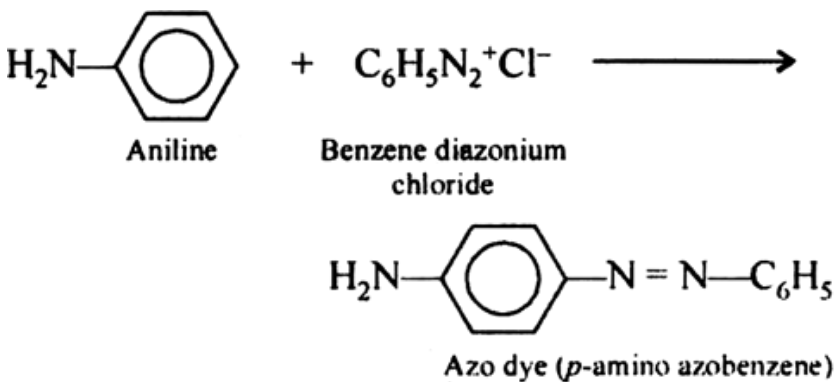
Coupling reaction: When benzene diazonium chloride reacts with phenol in which the phenol molecule at its para position is coupled with coupled with the diazonium salt to form p-hydroxyazobenzene. This is known as coupling reaction.
View full question & answer→Question 191 Mark
Write short notes on the following: Carbylamine reaction.
Answer
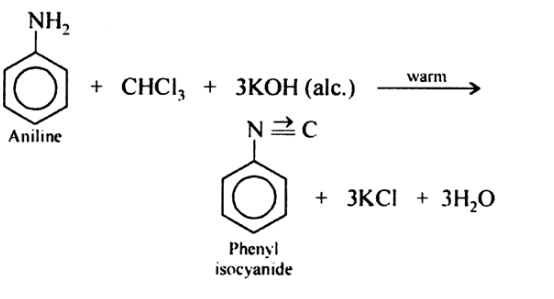
Carbylamine reaction: The carbylamines reaction test used for detection of primary amines. In this reaction, the analyte/ given compound is heated with alcoholic potassium hydroxide and chloroform. If a primary amine is present, the isocyanide(carbylamines) is formed which gives unpleasant smell.
$\text{CH}_3\text{CH}_2\text{NH}_2+\text{CHCl}_3+3\text{KOH}(\text{alc})\xrightarrow[]{\text{warm}}\\\text{Ethyl amine}\\ \ \ \ \ \ \ \ \ \ \ \ \ \ \ \ \ \text{CH}_3\text{CH}_2\stackrel{{\rightarrow}}{=}\text{C}+3\text{KCl}+3\text{H}_2\text{O}\\ \ \ \ \ \ \ \ \ \ \ \text{Ethyl isocyanide}$
View full question & answer→Question 201 Mark
Arrange the following in increasing order of their basic strength:
$\mathrm{C}_2 \mathrm{H}_5 \mathrm{NH}_2,\left(\mathrm{C}_2 \mathrm{H}_5\right)_2 \mathrm{NH},\left(\mathrm{C}_2 \mathrm{H}_5\right)_3 \mathrm{~N}, \mathrm{C}_6 \mathrm{H}_5 \mathrm{NH}_2$
Answer$\mathrm{C}_6 \mathrm{H}_5 \mathrm{NH}_2<\mathrm{C}_2 \mathrm{H}_5 \mathrm{NH}_2<\left(\mathrm{C}_2 \mathrm{H}_5\right)_3 \mathrm{~N}<\left(\mathrm{C}_2 \mathrm{H}_5\right)_2 \mathrm{NH}$
View full question & answer→Question 211 Mark
Account for the following:
$pK_b$ of aniline is more than that of methylamine.
AnswerIt is because, in aniline, the $NH_2$ group is attached directly to the benzene ring. It results in the unshared electron pair of the nitrogen atom to be in conjugation with the benzene ring and thus making it less available for protonation.
on another hand, in the case of methylamine (due to the +I effect of a methyl group), the electron density on the N-atom is increased. As a result, aniline is less basic than methylamine. Thus, $pk_b$ of aniline is more than that of methylamine.
View full question & answer→Question 221 Mark
Write short notes on the following: Acetylation.
Answer
Acetylation: The process, in which acetyl group $ \ \ \ \ \ \ \ \ \ \ \ \ \ \ \ \ \ \ \ \text{O} \\ \ \ \ \ \ \ \ \ \ \ \ \ \ \ \ \ \ \ \ ||\\\ \ \ \ \Bigg(\text{CH}_3-\text{C}-\Bigg)$ is introduced, is called acety lation. It is done by reaction with acetyl chloride or acetic
anhydride.
Aliphatic and aromatic primary and secondary amines undergo acetylation reaction by nucleophilic substitution when treated with acid chlorides, anhydrides or esters.
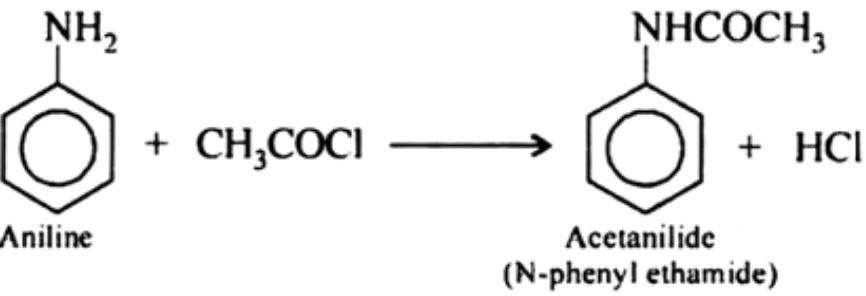
View full question & answer→Question 231 Mark
Give plausible explanation for each of the following:
Why are amines less acidic than alcohols of comparable molecular masses?
AnswerOxygen in alcohol is more electro negative than nitrogen in amines.
RC—H bond in alcohol is more polar with $^{δ+}$ charge on.
$RO^{δ-}H^{δ+}$ as compared to RN—H bond in Alcohols can loose proton to some extent but are proton acceptors.
$\text{RO}-\text{H}\rightleftharpoons\text{RO}^-+\text{H}^+\\ \ \ \ \ \ \ \ \ \ \ \ \ \ \ \ \ \ \ \ \text{Unstable}$
$\text{R}\stackrel{{. .} }{{\text{N}}}\text{H}_2+\text{H}^+\rightarrow\text{R}\stackrel{{+} }{{\text{N}}}\text{H}_3\\ \ \ \ \ \ \ \ \ \ \ \ \ \ \ \ \ \ \ \ \ \ \ \ \ \ \ \text{Stable}$
View full question & answer→Question 241 Mark
Write short notes on the following:
Hofmann’s bromamide reaction.
AnswerHoffmann bromamide degradation reaction: Hoffman develops a method for preparation of primary amines by treating an amide with bromine in an aqueous or ethanolic solution of sodium hydroxide.
In this reaction migration of an alkyl or aryl group takes place from carbonyl carbon of the amide to the nitrogen atom. The amine so formed contains one carbon less than that present in the amide.
$ \ \ \ \ \ \ \ \ \ \ \ \ \ \text{O}\\\ \ \ \ \ \ \ \ \ \ \ \ \ ||\\\text{CH}_3-\text{C}-\text{NH}_2+\text{Br}_2+4\text{KOH}\rightarrow{\\\\\\\\\\\\}\text{CH}_3\text{NH}_2\\\text{Ethanamide} \ \ \ \ \ \ \ \ \ \ \ \ \ \ \ \ \ \ \ \ \ \ \text{Methanamine}\\ \ \ \ \ \ \ \ \ \ \ \ \ \ \ \ \ \ \ \ \ \ \ \ \ \ \ \ \ \ \ \ \ +\text{K}_2\text{CO}_3+2\text{KBr}+2\text{H}_2\text{O}$
View full question & answer→Question 251 Mark
Write short notes on the following: Diazotisation.
Answer
Diazotization: It is a process of treating primary aromatic amine with nitrous acid at 273 - 278 K to get diazonium salts which are very useful compounds.
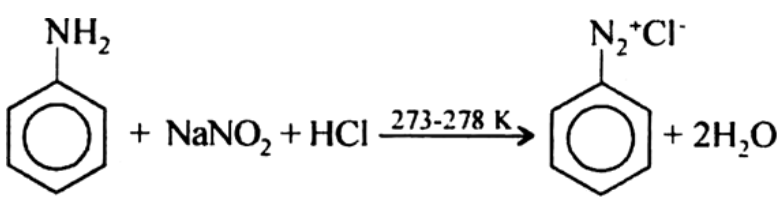
They are used to prepare benzene, phenol, halo-arenes, cyano benzene, dyes, etc.
View full question & answer→Question 261 Mark
Account for the following:
Aniline does not undergo Friedel-Crafts reaction.
AnswerA Friedel-crafts reaction is carried out in the presence of $\mathrm{AlCl}_3$. but $\mathrm{AlCl}_3$ is acidic in nature, while aniline is a strong base. Thus, aniline reacts with $\mathrm{AlCl}_3$ to form a salt. Due to the positive charge on the N -atom, electrophilic substitution in the benzene ring is deactivated. Hence, aniline does not under go the Friedel-crafts reactions.
Aniline does not under Friedel-Craft reaction (alkylation and acetylation) due to the salt formation with aluminium chloride, the Lewis acid which is used as a catalyst. Due to this, the nitrogen of aniline acquires a positive charge and hence acts as a strong deactivating group for further reaction.
View full question & answer→Question 271 Mark
Give one chemical test to distinguish between the following pairs of compounds. Ethylamine and aniline.
Answer
Ethylamine and aniline: To the ice cold solution of both these compounds prepared in excess of dilute HCl, add ice cold solution of sodium nitrite in water and of β—Naphthol (2—Naphthol) prepared in diluted in sodium hydroxide solution.
Further, cool the reaction mixture in both the cases. The mixture which forms a brilliant orange dye (azodye) contains aniline while the one in which no dye is formed has ethylamine present in it.
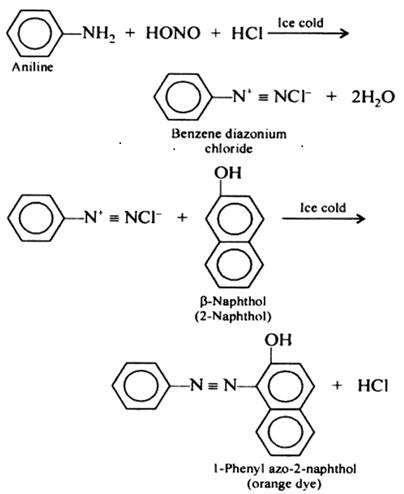
View full question & answer→Question 281 Mark
Account for the following:
Gabriel phthalimide synthesis is preferred for synthesising primary amines.
AnswerGabriel phthalimide synthesis results in the formation of primary amine only. secondary or tertiary amines are not formed in this synthesis. thus, the pure primary amine can be obtained. Therefore, Gabriel phthalimide synthesis is preferred for synthesising primary amines.
Phthalimide is alkylated with alkyl or benzyl halide and then hydrolysed or hydrazinolysis to get pure primary amine. In this method, phthalic acid is produced which can be again converted into phthalimide and used over and over again.
View full question & answer→Question 291 Mark
Complete the following reaction:
$\text{C}_6\text{H}_5\text{NH}_2+(\text{CH}_3\text{CO})_2\text{O}\rightarrow$
Answer$\text{C}_6\text{H}_5\text{NH}_2+(\text{CH}_3\text{CO})_2\text{O}\rightarrow\text{C}_6\text{H}_5-\text{N}-\text{C}-\text{CH}_3+\text{CH}_3\text{COOH}\\\text{Aniline} \ \ \ \ \ \ \ \ \text{acitic anhydride} \ \ \ \ \ \ \ \ \ \ \ \ \ \ \ \ \ | \ \ \ \ \ \ ||\\ \ \ \ \ \ \ \ \ \ \ \ \ \ \ \ \ \ \ \ \ \ \ \ \ \ \ \ \ \ \ \ \ \ \ \ \ \ \ \ \ \ \ \ \ \ \ \ \ \ \ \ \ \ \ \ \ \ \ \ \ \ \ \ \ \text{H} \ \ \ \ \ \text{O}\\ \ \ \ \ \ \ \ \ \ \ \ \ \ \ \ \ \ \ \ \ \ \ \ \ \ \ \ \ \ \ \ \ \ \ \ \ \ \ \ \ \ \ \ \ \ \ \ \ \ \ \ \ \ \ \ \ \ \text{N}-\text{Phenylethanamide}$
View full question & answer→Question 301 Mark
Complete the following reaction:
$\text{C}_6\text{H}_5\text{N}_2\text{Cl}\xrightarrow[(\text{ii})\text{NaNO}_2/\text{Cu}.\Delta]{(\text{i})\text{HBF}_4}$
Answer$\text{C}_6\text{H}_5\text{N}_2\text{Cl}\xrightarrow[(\text{ii})\text{NaNO}_2/\text{Cu}.\Delta]{(\text{i})\text{HBF}_4}\text{C}_6\text{H}_5\text{NO}_2+\text{N}_2+\text{NaBF}_4\\\text{Benzenediazonium} \ \ \ \ \ \ \ \ \ \ \ \ \text{Nitrobenzene}\\ \ \ \ \ \ \ \text{chloride}$
View full question & answer→Question 311 Mark
What are the hydrolysis products of
- Sucrose
- lactose?
AnswerBoth sucrose and lactose are disaccharides. Sucrose on hydrolysis gives one molecule each of glucose and fructose but lactose on hydrolysis gives one molecule each of glucose and galactose. $\text{C}_{12}\text{H}_{22}\text{O}_{11}+\text{H}_2\text{O}\xrightarrow[]{\text{H}_3\text{O}^+} \ \ \ \ \ \ \ \ \text{C}_6\text{H}_{12}\text{O}_6+ \ \ \ \ \ \ \ \ \text{C}_6\text{H}_{12}\text{O}_6\\\text{Sucrose} \ \ \ \ \ \ \ \ \ \ \ \ \ \ \ \ \ \ \ \ \ \ \ \ \ \ \ \ \ \ \ \text{D}-(+)-\text{Glucose} \ \ \ \ \text{D}-(-)-\text{Fructose}$ $\text{C}_{12}\text{H}_{22}\text{O}_{11}+\text{H}_2\text{O}\xrightarrow[]{\text{H}_3\text{O}^+} \ \ \ \ \ \ \ \ \text{C}_6\text{H}_{12}\text{O}_6+ \ \ \ \ \ \ \ \ \text{C}_6\text{H}_{12}\text{O}_6\\\text{Lactose} \ \ \ \ \ \ \ \ \ \ \ \ \ \ \ \ \ \ \ \ \ \ \ \ \ \ \ \ \ \ \ \text{D}-(+)-\text{Glucose} \ \ \ \ \text{D}-(+)-\text{Galactose}$
View full question & answer→Question 321 Mark
Accomplish the following conversion: Benzoic acid to aniline.
Answer
Benzoic acid to aniline
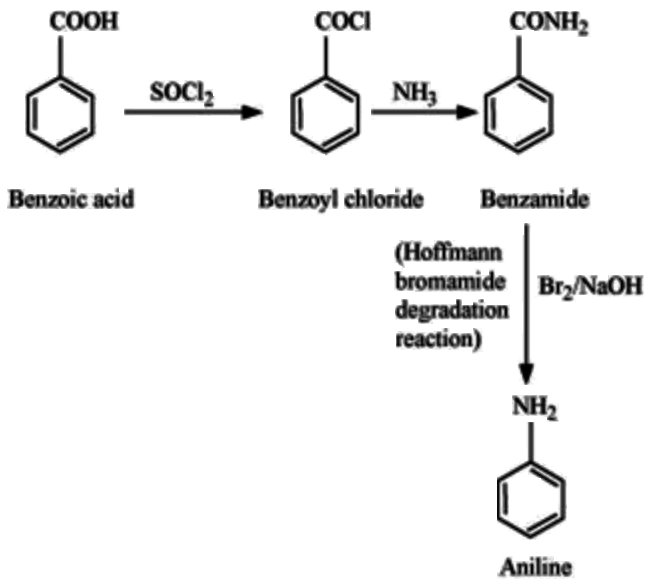
View full question & answer→Question 331 Mark
Complete the following reaction:
$\text{C}_6\text{H}_5\text{NH}_2+\text{H}_2\text{SO}_4(\text{conc.})\rightarrow$
Answer$\text{C}_6\text{H}_5\text{NH}_2+\text{conc}.\text{H}_2\text{SO}_4\rightarrow\text{C}_6\text{H}_5\stackrel{{+}}{{\text{N}}}\text{H}_3\text{HS}\stackrel{{-}}{{\text{O}_4}}\\\text{Aniline} \ \ \ \ \ \ \ \ \ \ \ \ \ \ \ \ \ \ \ \ \ \ \ \ \ \ \ \ \ \ \ \ \text{Anilinium hydrogen sulphate}$
View full question & answer→Question 341 Mark
Arrange the following:
In increasing order of boiling point:
$\mathrm{C}_2 \mathrm{H}_5 \mathrm{OH},\left(\mathrm{CH}_3\right)_2 \mathrm{NH}, \mathrm{C}_2 \mathrm{H}_5 \mathrm{NH}_2$
AnswerIncreasing order of given:
$\left(\mathrm{CH}_3\right)_2 \mathrm{NH}<\mathrm{C}_2 \mathrm{H}_5 \mathrm{NH}_2<\mathrm{C}_2 \mathrm{H}_5 \mathrm{OH}$
View full question & answer→Question 351 Mark
Write IUPAC names of the following compounds and classify them into primary, secondary and tertiary amines.
$\mathrm{m}-\mathrm{BrC}_6 \mathrm{H}_4 \mathrm{NH}_2$
Answer$\mathrm{m}-\mathrm{BrC}_6 \mathrm{H}_4 \mathrm{NH}_2$.
3-Isobromo aniline (primary)
View full question & answer→Question 361 Mark
Complete the following reaction:
$\text{C}_6\text{H}_5\text{N}_2\text{Cl}+\text{H}_3\text{PO}_2+\text{H}_2\text{O}\rightarrow$
Answer$\text{C}_6\text{H}_5\text{N}_2\text{Cl}+\text{H}_3\text{PO}_2+\text{H}_2\text{O}\rightarrow\text{C}_6\text{H}_6+\text{N}_2+\text{H}_3\text{PO}_3+\text{HCl}\\\text{Benzenediazonium} \ \ \ \ \ \ \ \ \ \ \ \ \ \ \ \ \ \ \ \ \ \text{Benzene}\\\text{Cloride}$
View full question & answer→Question 371 Mark
Complete the following acid-base reaction and name the product:
$\text{CH}_3\text{CH}_2\text{CH}_2\text{NH}_2+\text{HCl}\rightarrow$
Answer$\text{CH}_3\text{CH}_2\text{CH}_2\text{CH}_2\text{NH}_2\rightarrow\text{CH}_3\text{CH}_2\text{CH}_2\text{NH}_3 \ ^ +\text{Cl}^-\\\text{n-propylamine} \ \ \ \ \ \ \ \ \ \ \ \ \ \ \ \ \ \ \text{n-propylammoniumchloride}$
View full question & answer→Question 381 Mark
Complete the following reaction: $\text{C}_6\text{H}_5\text{N}_2\text{Cl}+\text{Br}_2(\text{aq})\rightarrow$
View full question & answer→Question 391 Mark
Arrange the following:In decreasing order of the $\mathrm{pK}_{\mathrm{b}}$ values:
$\mathrm{C}_2 \mathrm{H}_5 \mathrm{NH}_2, \mathrm{C}_6 \mathrm{H}_5 \mathrm{NHCH}_3,\left(\mathrm{C}_2 \mathrm{H}_5\right)_2 \mathrm{NH}$ and $\mathrm{C}_6 \mathrm{H}_5 \mathrm{NH}_2$
Answer$\left(\mathrm{C}_2 \mathrm{H}_5\right)_2 \mathrm{NH}>\mathrm{C}_2 \mathrm{H}_5 \mathrm{NH}_2>\mathrm{C}_6 \mathrm{H}_5 \mathrm{NHCH}_3>\mathrm{C}_6 \mathrm{H}_5 \mathrm{NH}_2$
View full question & answer→Question 401 Mark
Give one chemical test to distinguish between the following pairs of compounds.
Methylamine and dimethylamine
AnswerHeat both these amines with chloroform and alcohol KOH solution. The compound which gives unpleasant (offensive) smell is methylamine while the compound which does not give any smell is diethylamine.
$\text{CH}_3\text{NH}_2+\text{CHCl}_3+3\text{KOH}\xrightarrow[]{\text{Heat}}\text{CH}_3\text{N}\stackrel{{\rightarrow}}{{=}}\text{C}\\\text{Methyl amine}\ \ \ \ \ \ \ \ \ \ \ \ \ \ \ \ \ \ \ \ \ \ \ \ \ \ \ \ \ \ \ \ \ \ \ \ \ \ \ \ \text{Methyl}\\\ \ \ \ \ \ \ \ \ \ \ \ \ \ \ \ \ \ \ \ \ \ \ \ \ \ \ \ \ \ \ \ \ \ \ \ \ \ \ \ \ \ \ \ \ \ \ \ \ \ \ \ \ \ \ \ \ \ \ \ \ \ \ \ \ \ \text{isocyanide}\\\ \ \ \ \ \ \ \ \ \ \ \ \ \ \ \ \ \ \ \ \ \ \ \ \ \ \ \ \ \ \ \ \ \ \ \ \ \ \ \ \ \ \ \ \ \ \ \ \ \ \ \ \ \ \ \ \ \ \ \ \ \ \ \ \ \ (\text{offencive smell})\\\ \ \ \ \ \ \ \ \ \ \ \ \ \ \ \ \ \ \ \ \ \ \ \ \ \ \ \ \ \ \ \ \ \ \ \ \ \ \ \ \ \ \ \ \ \ \ \ \ \ \ \ \ \ \ \ \ \ \ \ \ \ \ \ \ +3\text{KCl}+3\text{H}_2\text{o}$
$(\text{CH}_3)\text{NH}+\text{CHCl}_3+3\text{KOH}\xrightarrow[]{\text{Heat}}\text{NO smell}\\ \ {\text{Dimethylamine}}\ \ \ \ \ \ \ \ \ \ \ \ \ \ \ \ \ \ \ \ \ \ \ \ \ \ \ \ \ \ \ \ \ \ \ \ \ \ \ \ \ \ \ \ \ \ \ \ \ \ \ \ \ $
View full question & answer→Question 411 Mark
Arrange the following:
In increasing order of solubility in water:
$\mathrm{C}_6 \mathrm{H}_5 \mathrm{NH}_2,\left(\mathrm{C}_2 \mathrm{H}_5\right)_2 \mathrm{NH}_4, \mathrm{C}_2 \mathrm{H}_5 \mathrm{NH}_2$
Answer$\mathrm{C}_6 \mathrm{H}_5 \mathrm{NH}_2<\left(\mathrm{C}_2 \mathrm{H}_5\right)_2 \mathrm{NH}<\mathrm{C}_2 \mathrm{H}_5 \mathrm{NH}_2 .$
View full question & answer→Question 421 Mark
How will you convert:
Ethanoic acid into methanamine.
AnswerEthanoic acid into methanamine.
$\text{CH}_3\text{COOH}+\text{HN}_3\xrightarrow[\text{Warm}]{\text{conc}.\ \text{H}_2 \text{SO}_4}\text{CH}_3\text{NH}_2+\text{CO}_2+\text{N}_2\\\text{Ethanoic} \ \ \ \ \ \ \ \text{Hydrazoic} \ \ \ \ \ \ \ \ \ \ \ \ \ \text{Methanamine}\\\text{acid}\ \ \ \ \ \ \ \ \ \ \ \ \ \ \ \text{acid}$
View full question & answer→Question 431 Mark
Arrange the following in increasing order of their basic strength:
$C_2H_5NH2, C_6H_5NH_2, NH_3, C_6H_5CH_2NH_2$ and $(C_2H_5)_2NH.$
Answer$C_6H_5NH_2 < NH_3 < C_6H_5CH_2NH_2 < C_2H_5NH_2 < (C_2H_5)_2NH$
View full question & answer→Question 441 Mark
Account for the following: Diazonium salts of aromatic amines are more stable than those of aliphatic amines.
Answer
Primary aliphatic amines form a highly unstable alkyl diazonium salts. Primary aromatic amines form arene diazonium salts which are stable for a short time in solution at low temperature (273 - 278 K). The stability of diazonium ions of aromatic amines is explained on the basis of resonance.
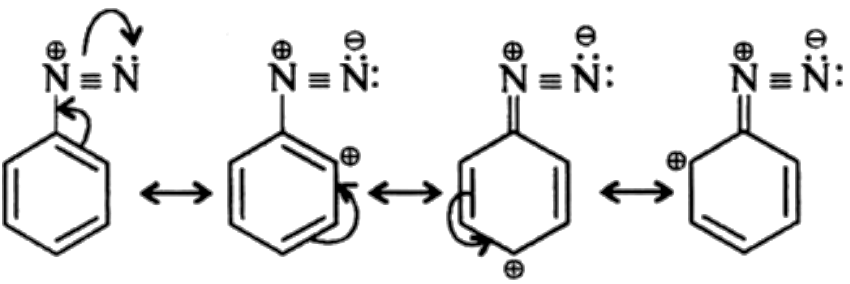
View full question & answer→Question 451 Mark
Complete the following acid-base reaction and name the product:
$(\text{C}_2\text{H}_5)_3\text{N}+\text{HCl}\rightarrow$
Answer$(\text{C}_2\text{H}_5)_3\text{N}+\text{HCl}\rightarrow\Big[(\text{C}_2\text{H}_5)_3\stackrel{{+}}{{\text{N}}}\text{H}\Big]\text{Cl}^-\\\text{Triethylamine} \ \ \ \ \ \ \ \ \text{Triemethylammonium chloride}$
View full question & answer→Question 461 Mark
Complete the following reaction:
$\text{C}_6\text{H}_5\text{NH}_2+\text{CHCl}_3+\text{alc.KOH}\rightarrow$
Answer$\text{C}_6\text{H}_5\text{NH}_2+\text{CHCl}_3+\text{alc.KOH}\xrightarrow[]{\text{Carbyamine} \text{ reaction}}3\text{H}_2\text{O}+3\text{KCl}+\text{C}_6\text{H}_5-\text{NC}\\ \ \ \ \ \ \ \ \ \ \ \ \ \ \ \ \ \ \ \ \ \ \ \ \ \ \ \ \ \ \ \ \ \ \ \ \ \ \ \ \ \ \ \ \ \ \ \ \ \ \ \ \ \ \ \ \ \ \ \ \ \ \ \ \ \ \ \ \ \ \ \ \ \ \ \ \ \ \ \ \ \ \ \ \ \ \ \ \ \ \ \ \ \ \ \ \ \ \ \ \ \ \ \ \ \ \ \ \ \ \ \ \text{Phynyl}\\ \ \ \ \ \ \ \ \ \ \ \ \ \ \ \ \ \ \ \ \ \ \ \ \ \ \ \ \ \ \ \ \ \ \ \ \ \ \ \ \ \ \ \ \ \ \ \ \ \ \ \ \ \ \ \ \ \ \ \ \ \ \ \ \ \ \ \ \ \ \ \ \ \ \ \ \ \ \ \ \ \ \ \ \ \ \ \ \ \ \ \ \ \ \ \ \ \ \ \ \ \ \ \ \ \ \ \ \ \ \ \text{isocynide}$
View full question & answer→Question 471 Mark
Arrange the following:
In increasing order of basic strength:
$C_6H_5NH_2, C_6H_5N(CH_3)_2, (C_2H_5)_2NH$ and $CH_3NH_2$
Answer$CH_3NH_2 > (C_2H_5)_2 NH > C_6H_5N(CH_3)_2 > C_6H_5 NH_2$
View full question & answer→Question 481 Mark
How will you convert:
Hexanenitrile into 1-aminopentane.
AnswerHexane nitrite into 1-amino pentane$\text{CH}_3(\text{CH}_2)\text{CN}\xrightarrow[(\text{Partial hydrolysis})]{\text{H}_2\text{O}/ \text{H}^+}\text{CH}_3(\text{CH}_2)_4\text{CONH}_2\xrightarrow[]{\text{Br}_2/\text{KOH}}\text{CH}_3(\text{CH}_2)_4\text{NH}_2\\\text{Hexane nitrate} \ \ \ \ \ \ \ \ \ \ \ \ \ \ \ \ \ \ \ \ \ \ \ \ \ \ \ \ \ \text{Hexanamide} \ \ \ \ \ \ \ \ \ \ \ \ \ \ \ \ \ \ \ \ \ \ \ \ \ \ \ \ \ \text{I-amino Pentane}$
View full question & answer→Question 491 Mark
Accomplish the following conversion: Benzyl chloride to 2 - phenylethanamine.
Answer
Benzyl chloride to 2-phenyl ethanamine.
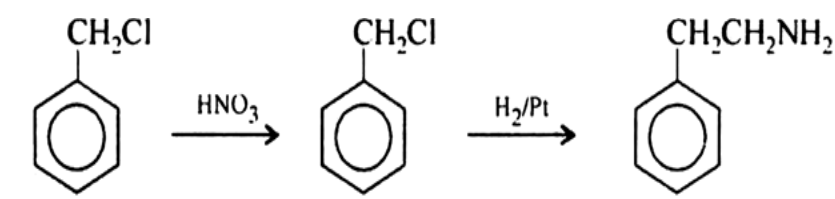
View full question & answer→Question 501 Mark
How will you convert:
Ethanoic acid into propanoic acid.
AnswerConversion of Ethanoic acid into Propanoic acid.
$\text{CH}_3\text{COOH}\xrightarrow[\text{Reduction}]{\text{LiAlH}_4}\text{CH}_3\text{CH}_2\text{OH}\xrightarrow[]{\text{PI}_3}\\\text{Ethanoic} \ \ \ \ \ \ \ \ \ \ \ \ \ \ \ \ \ \ \ \ \ \ \ \ \ \ \ \ \ \ \text{Ethyl} \ \ \ \ \ \ \ \ \ \ \\ \ \text{acid} \ \ \ \ \ \ \ \ \ \ \ \ \ \ \ \ \ \ \ \ \ \ \ \ \ \ \ \ \ \ \ \ \ \ \ \text{alcohol}\\\text{CH}_3\text{CH}_2\text{I}\xrightarrow[]{\text{KCN}}\text{CH}_3\text{CH}_2\text{CN}\xrightarrow[]{2\text{H}_2\text{O}/\text{H}^+}\\\text{Ethyl Iodide} \ \ \ \ \ \ \ \ \ \text{Ethyl cynide}\\ \ \ \ \ \ \ \ \ \ \ \ \ \ \ \ \ \ \ \ \ \ \ \ \ \ \ \ \ \ \ \ \ \ \ \ \ \ \ \text{CH}_3\text{CH}_2\text{COOH}\\ \ \ \ \ \ \ \ \ \ \ \ \ \ \ \ \ \ \ \ \ \ \ \ \ \ \ \ \ \ \ \ \ \ \ \ \ \ \ \ \ \ \ \ \ \text{Propinic acid}$
View full question & answer→