Questions

3 Marks Question

🎯

Test yourself on this topic

6 questions · timed · auto-graded

Question 13 Marks
Solve the following differential equation:$x \cos \text{y dy} = ( xe^{x} \log x + e^{x}) dx$
Answer
$x \cos \text{y dy} = ( xe^{x} \log x + e^{x}) dx$$\Rightarrow \int \cos \text{y dy} = \int \bigg( e^{x} \log x + \frac{e^{x}}{x}\bigg) \text{dx}$
$\therefore \sin y = \int {e^{x}} \log \text{x dx} + \int \frac{e^{x}}{x} \text{dx}$
$= \log x .e^{x} - \int e^{x} \frac{1}{x} \text{dx} + \int \frac{e^{x}}{x} \text{dx + c}$
$= e^{x} \log \text{x + c}$
View full question & answer
Question 23 Marks
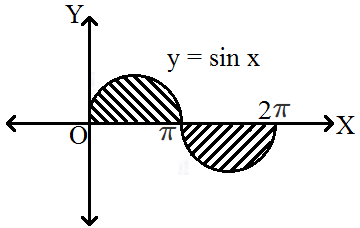
Find the area bounded by the curve $\text{y}=\sin\text{x}$ between x = 0 and $\text{x}=2\pi.$
Answer
Required area $=\int\limits^{2\pi}_0\sin\text{x dx}=\int\limits^{\pi}_0\sin\text{x dx}+\Big|\int\limits^{2\pi}_\pi\sin\text{x dx}|$ $=-\big[\cos\text{x}\big]^\pi_0+\Big|\big[-\cos\text{x}\big]^{2\pi}_\pi\Big|$ $=-\big[\cos\pi-\cos0\big]+\Big|-\big[\cos2\pi-\cos\pi\big]\Big|$
$=-\big[-1-1\big]+\big|-(1+1)\big|$ $=2+2=4\text{ sq. units}$
View full question & answer
Question 33 Marks
Calcualte the area under the curve $\text{y}=2\sqrt{\text{x}}$ included between the lines x = 0 and x = 1.
Answer
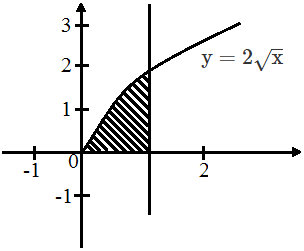
We have, $\text{y}=2\sqrt{\text{x}}$ or $\text{y}^2=4\text{x, x}\geq0$
The graph of above function is part of a parabola lying above x-axis. The graph is as shown in the adjacent figure. From the figure, area of shaded region, $\text{A}=\int\limits^1_02\sqrt{\text{x}}\text{ dx}$ $=2\Big[\frac{2}{3}\text{x}^{\frac{3}{2}}\Big]^1_0$ $=2\Big(\frac{2}{3}\Big)=\frac{4}{3}\text{ sq. units}$
View full question & answer
Question 43 Marks
Find the intervals in which the function f given by $\text{f}\text{(x)}=\text{x}^3+\frac{1}{\text{x}^3},\text{x}\neq0\text{ is}$ (i) increasing (ii) decreasing.
Answer
$\text{f}\text{(x)}=\text{x}^3+\frac{1}{\text{x}^3}$
$\therefore\ \text{f}'\text{(x)}=3\text{x}^2-\frac{3}{\text{x}^4}=\frac{3\text{x}^6-3}{\text{x}^4}$
Then,$\text{f}'\text{x}=0\Rightarrow3\text{x}^6-3=0\Rightarrow\text{x}^6=1\Rightarrow\text{x}\pm1$
Now, the points x = 1 and x = -1 divide the real line into three disjoint intervals i.e.,
$(-\infty,-1),(-1,1),\text{ and }(1,\infty).$
In intervals $(-\infty,-1) \text{ and } (1,\infty)$ i.e., when x < -1 and x > 1, f'(x) > 0.
Thus, when x < -1 and x > 1, f is increasing.
In interval (-1, 1) i.e., when -1 < x < 1, f'(x) <0.
Thus, when -1 < x < 1, f is decreasing.
View full question & answer
Question 53 Marks
Draw a rough sketch of the curve $\text{y}=\sqrt{\text{x}-1}$ in the interval [1, 5]. Find the area under the curve and between the lines x = 1 and x = 5.
Answer
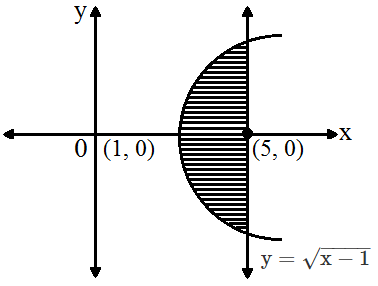
We have, $\text{y}=\sqrt{\text{x}-1}$ $\Rightarrow\ \text{y}^2=\text{x}-1$ Graph of the above equation is a parabola with vertex at (1, 0).
$\therefore$ Required area = Area of shaded region, $\text{A}=\int\limits^5_1(\text{x}-1)^{\frac{1}{2}}\text{dx}=\bigg[\frac{2\cdot(\text{x}-1)^{\frac{3}{2}}}{3}\bigg]^5_1$ $=\Big[\frac{2}{3}\cdot(5-1)^{\frac{3}{2}}-0\Big]$ $=\frac{16}{3}\text{ sq. units}$
View full question & answer
Question 63 Marks
Find the area bounded by the curve $\text{y}=2\cos\text{x}$ and the x-axis from x = 0 to $\text{x}=2\pi.$
Answer
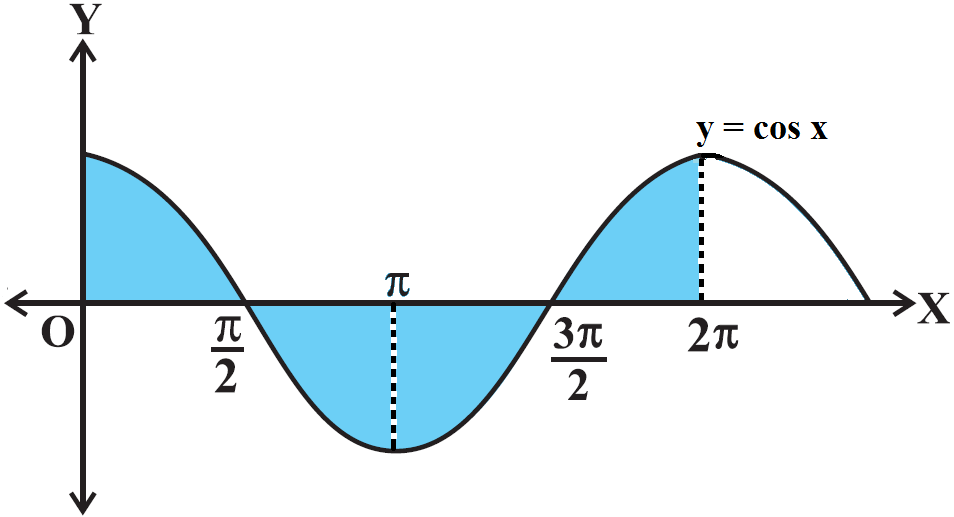
Graph for the function $\text{y}=2\cos\text{x };\ 0\leq\text{x}\leq2\pi$ is as shown below:

$\therefore$ Required area of shaded region $=\int\limits^{2\pi}_0\big|2\cos\text{x}\big|\text{dx}$
$=4\int\limits^{2\pi}_02\cos\text{x}\text{ dx}$
$=8\Big[\sin\text{x}\Big]^{\frac{\pi}{2}}_0=8\text{ sq. units}$
View full question & answer