Question 15 Marks
$\text{If} x = \text{a } \sin \text{ 2t}(1 + \cos\text{2t}) \text{ and }y = \text{b}\cos\text{2t}(1- \cos \text{2t}), \text{find }\frac{dy}{dx} \text{ at t} = \frac{\pi}{4}$
Answer$\frac{\text{dx}}{\text{dt}} = \text{2a } \cos \text{2t}(1 + \cos \text{2t}) - \text{2a } \sin \text{ 2t} \sin \text{ 2t}$
$ \frac{\text{dy}}{\text{dt}} = \text{-2b} \sin \text{2t} (1 - \cos \text{2t}) + \text{2b} \cos \text{ 2t} \sin \text{ 2t}$
$\frac{\text{dy}}{\text{dx}}\bigg]_{\text{t} = \frac{\pi}{4}} = \frac{\text{2b}\cos \text{2t}.\sin \text{2t - 2b}\sin \text{2t}(1 - \cos \text{2t})}{\text{2a } \cos \text{2t}(1 + \cos \text{2t}) - \text{2a } \sin \text{ 2t} \sin \text{ 2t}}\bigg]_{\text{t} = \frac{\pi}{4}} = \frac{\text{b}}{\text{a}}$
View full question & answer→Question 25 Marks
If $e^y(x + 1) = 1$, then show that $\frac{\text{d}^{2}\text{y}}{\text{dx}^{2}} = \bigg(\frac{\text{dy}}{\text{dx}}\bigg)^{2}.$
Answer$\text{e}^{\text{y}.} \text{(x + 1)} = 1 \Rightarrow \text{e}^{\text{y}}. \text{1 + (x + 1)}.\text{e}^{\text{y}}.\frac{\text{dy}}{\text{d}} = 0$
$\Rightarrow \frac{\text{dy}}{\text{dx}} = -\frac{1}{\text{(x + 1)}}$
$\frac{\text{d}^{2}\text{y}}{\text{dx}^{2}} = + \frac{1}{\text{(x + 1)}^{2}} = \big(\frac{\text{dy}}{\text{dx}}\big)^{2}$
View full question & answer→Question 35 Marks
$\text{ If }\text{ x } =\cos\text{t} (3-2\cos^2\text{t)}\ \text{and}\ \text{y}=\sin\text{t}(3-2\sin\text{ t}),\text{ find the value of}\ \frac{\text{dy}}{\text{dx}} = \text{ at t}=\frac{\pi}{\text{4}}.$
Answer$x = 3 \cos t – 2 \cos^3t$
$\therefore$$\frac{\text{dy}}{\text{dx}}=-3\sin\text{t}+6\cos^2\text{t}\sin\text{t}$
${\text{y}}=3\sin\text{t}-2\sin^3\text{t}$
$\therefore\ \frac{\text{dy}}{\text{dx}}=-3\cos\text{t}-6\sin^2\text{t}\cos\text{t}$
$\frac{\text{dy}}{\text{dx}} =\frac{3\cos \text{t}(1-2\sin^2\text{t})}{3\sin\text{t}(-1+2\cos^2\text{t})} = \cot\text{t}$
$\text{at t}=\frac{\pi}{4},\frac{\text{dy}}{\text{dx}}=1$
View full question & answer→Question 45 Marks
$\text{If x = a} (\cos 2\text{t +2t}\sin \text{2t}) \text{and y = a} (\sin \text{2t - 2t}\cos\text{2t}),\text{then find}\frac{\text{d}^{2}{\text{y}}}{\text{dx}^{2}}.$
Answer$\text{x = a} (\cos \text{2t + 2t} \sin \text{2t)}$
$\text{y = a} (\sin \text{2t - 2t} \cos \text{2t)}$
$\Rightarrow \frac{\text{dx}}{\text{dt}} = 4\text{ at} \cos \text{2 t}$
$\Rightarrow \frac{\text{dy}}{\text{dt}} = 4\text{ at} \sin \text{2 t}$
$\Rightarrow \frac{\text{dy}}{\text{dx}} = \tan \text{2 t}$
$\Rightarrow \frac{\text{d}^{2}\text{y}}{\text{dx}^{2}} = 2 \sec^{2} \text{2 t}. \frac{\text{dt}}{\text{dx}}$
$\frac{\text{d}^{2}\text{y}}{\text{dx}^{2}} = \frac{1}{2 \text{at} \cos^{3} \text{2t}}$
View full question & answer→Question 55 Marks
AB is the diameter of a circle and C is any point on the circle. Show that the area of triangle ABC is maximum, when it is an isosceles triangle.
Answer
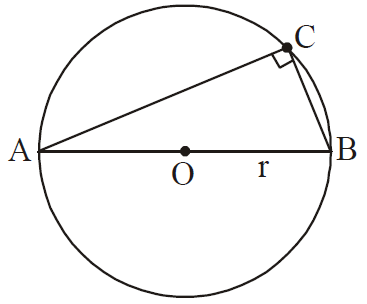
Correct Figure
Let the length of sides of $\triangle\ \text{ABC}$ are, AC = x and BC = y
$\Rightarrow x^2 + y^2 = 4r^2$ and Area A = $\frac{1}{\text{2}}\text{xy}$
$\text{A}=\frac{1}{2}\text{x}\sqrt{4\text{r}^2-\text{x}^2}\ \ \text{or}\ \text{S}=\frac{\text{x}^2}{4}(4\text{r}^2-\text{x}^2)$
$\text{S}=\frac{1}{4}[4\text{r}^2\text{x}^2-\text{x}^4]$
$\therefore\ \frac{\text{ds}}{\text{dx}}=\frac{1}{4}[8\text{r}^2\text{x}-4\text{x}^3]$
$\frac{\text{ds}}{\text{dx}}=0\Rightarrow2\text{r}^2=\text{x}^2\Rightarrow\text{x}=\sqrt2\text{r}$
$\text{and}\ \text{y}=\sqrt{4\text{r}^2-2\text{r}^2}=\sqrt2\text{r}$
$\text{and}\frac{\text{d}^2\text{s}}{\text{ds}^2}=\frac{1}{4}[8\text{r}^2-12\text{x}^2]=\frac{1}{4}[8\text{r}^2-24\text{r}^2]<0$
$\therefore\ $ For maximum area, x = y i.e., $\triangle\ $ is isosceles. View full question & answer→Question 65 Marks
If $x^y + y^x = a^b$, then find $\frac{\text{dy}}{\text{dx}}.$
Answer$x^y + y^x = ab$
Let $u + v = a^b$, where $x^y = u$ and $y^x = v$.
$\therefore \frac{\text{du}}{\text{dx}} + \frac{\text{dv}}{\text{dx}} = 0 \text{ }\text{ }\text{ }\text{ }\text{ }\dots\text{(i)}$
$\text{y} = \log \text{x} = \log \text{u} \Rightarrow \frac{\text{du}}{\text{dx}}=\text{x}^{\text{y}} \bigg[\frac{\text{y}}{\text{x}} + \log \text{x}. \frac{\text{dy}}{\text{dx}}\bigg]$
$\text{x} \log \text{y} = \log \text{v} \Rightarrow \frac{\text{dv}}{\text{dx}} = \text{y}^{\text{x}} \bigg[\frac{\text{x}}{\text{y}} \frac{\text{dy}}{\text{dx}} + \log \text{y}\bigg]$
$\text{putting in (i)} \text{x}^{\text{y}} \bigg[\frac{\text{y}}{\text{x}} + \log \text{x} \frac{\text{dy}}{\text{dx}}\bigg] + \text{y}^{\text{x}} \bigg[\frac{\text{x}}{\text{y}}\frac{\text{dy}}{\text{dx}} + \log \text{y} \bigg]= 0$
$\Rightarrow \frac{\text{dy}}{\text{dx}} = - \frac{\text{y}^{\text{x}} \log \text{y + y.x}^{\text{y - 1}}}{\text{x}^{\text{y}}. \log \text{x + x.y}^{\text{x - 1}}}$
View full question & answer→Question 75 Marks
If x = a sin 2t (1 + cos 2t) and y = b cos 2t (1 – cos 2t), show that at $\text{t}=\frac{\pi}{4},\big(\frac{\text{dy}}{\text{dx}}\big)=\frac{\text{b}}{\text{a}}$
Answer$\begin{aligned} & \frac{\mathrm{dx}}{\mathrm{dt}}=2 \mathrm{a} \cos 2 \mathrm{t}(1+\cos 2 \mathrm{t})-2 \mathrm{a} \sin ^2 2 \mathrm{t} \\ & \frac{\mathrm{dy}}{\mathrm{dt}}=2 \mathrm{~b} \cos 2 t \sin 2 t-2 b \sin 2 t(1-\cos 2 t)\end{aligned}$
$\therefore\ \frac{\text{dy}}{\text{dx}}=\frac{\text{b}}{\text{a}}\Bigg(\frac{\sin2\text{t}\cos2\text{t}-\sin2\text{t}(1-\cos2\text{t})}{\cos2\text{t}(1+\cos2\text{t})-\sin^22\text{t}}\Bigg)$
At t = $\frac{\pi}{4}$ sin 2t = 1 and cos 2t = 0
$\therefore\ \frac{\text{dy}}{\text{dx}}\big(\text{at t}=\frac{\pi}{4}\big)=\frac{\text{b}}{\text{a}}\Big(\frac{0-1}{0-1}\Big)$
View full question & answer→Question 85 Marks
Differentiate $x^{sin x} + (\sin x)^{\cos x}$ with respect to $x.$
Answer$\text{let y = u + v, u = x}^{\sin\text{x}}, \text{v }={(\sin \text{x})}^{\cos \text{x}} $
$\log \text{u} = \sin \text{x}\log \text{x}\Rightarrow\frac{\text{du}}{\text{dx}} = \text{x}^{\sin \text{x}}.\left\{\cos\text{x}\log\text{x} + \frac{\sin\text{x}}{\text{x}}\right\}$
$\log \text{v} = \cos \text{x}.\log(\sin \text{x})\Rightarrow\frac{\text{dv}}{\text{dx}} = (\sin\text{x})^{\cos \text{x}}. \left\{\cos \text{x}. \cot\text{x} - \sin\text{x}. \log(\sin \text{x})\right\}$
$\frac{\text{dy}}{\text{dx}}= \frac{\text{du}}{\text{dx}} + \frac{\text{dv}}{\text{dx}} = \text{x}^{\sin \text{x}}.\left\{ \cos\text{x}.\log\text{x} + \frac{\sin\text{x}}{\text{x}} + (\sin\text{x})^{\cos\text{x}}\right\}\left\{\cos \text{x}.\cot \text{x} - \sin\text{x}. \log (\sin \text{x})\right\}$
View full question & answer→Question 95 Marks
If $y = 2 \cos (\log x) + 3 \sin (\log x),$ Prove that $x^{2} \frac{d^{2}y}{dx}^{2} + x\frac{dy}{dx} + y = 0.$
Answer$\frac{\text{dy}}{\text{dx}} = \frac{-2\sin(\log \text{x})}{\text{x}} + \frac{3\cos(\log \text{x})}{\text{x}}$
$\Rightarrow\text{x}\frac{\text{dy}}{\text{dx}} = -2\sin(\log\text{x}) + 3 \cos(\log\text{x}), \text{differentiate w.r.t 'x'}$
$\Rightarrow\text{x}\frac{\text{d}^{2}\text{y}}{\text{dx}^{2}} + \frac{\text{dy}}{\text{dx}} = \frac{-2\cos(\log \text{x})}{\text{x}} - \frac{3\sin(\log\text{x})}{\text{x}}$
$\Rightarrow\text{x}^2\frac{\text{d}^{2}\text{y}}{\text{dx}^{2}} + \text{x}\frac{\text{dy}}{\text{dx}} = -\text{y} \Rightarrow\text{x}^{2}\frac{\text{d}^{2}\text{y}}{\text{dx}^{2}} + \text{x}\frac{\text{dy}}{\text{dx}} +\text{y} = 0$
View full question & answer→Question 105 Marks
Discuss the continuity and differentiability of the function $\text{f (x) = |x| + x - 1|}$ in the interval (-1, 2).
Answer$\text{f (x)} = \begin{cases} -2\text{x + 1} & \text{if} & \text{x}< 0 \\ \ \ \ \ \ 1 & \text{if} & 0 \leq\text{x}<1 \\ 2\text{x} - 1 & \text{if} & \text{x}\geq1 \end{cases}$
Only possible discontinuities are at $\text{x = 0, x = 1}$
$\begin{matrix} \text{at x = 0} & : & \text{at x = 1} \\ \text{L.H. limit = 1} & : &\text{L.H. limit = 1} \\ \text{f (0) = R. H. limit = 1} & : & \text{f (1) = R. H. limit = 1} \end{matrix} $
$\therefore \text{f(x)}$ is continuous in the interval (-1, 2)
$\text{At x = 0}$
$\text{L.H.D = -2} \neq \text{R.H.D = 1}$
$\therefore\text{f(x)}$ is not differentiable in the interval (-1, 2)
View full question & answer→Question 115 Marks
Differentiate the following with respect to x:
$\sin^{-1}\bigg(\frac{2^{\text{x} + 1}.3^{\text{x}}}{1 + (36)^{\text{x}}}\bigg)$
AnswerLet $\text{y} = \sin^{-1}\bigg(\frac{2^{\text{x} + 1 }.3^{\text{x}}}{1 +(36)^{\text{x}}}\bigg) = \sin^{-1}\bigg(\frac{2.2^{\text{x}}.3^{\text{x}}}{1 + (6^{2})^{\text{x}}}\bigg) = \sin^{-1}\bigg(\frac{2.6^{\text{x}}}{1 + (6^{\text{x}})^{2}}\bigg)$
Let $6^{\text{x}} = \tan\theta\Rightarrow\theta = \tan^{-1}(6^{\text{x}})$
$\therefore\text{y} = \sin^{-1}\bigg(\frac{2\tan\theta}{1 + \tan^{2}\theta}\bigg)\Rightarrow\text{y} = \sin^{-1}(\sin2\theta)$
$\Rightarrow\text{y} = 2 \theta\Rightarrow\text{y} = 2.\tan^{-1}(6^{\text{x}})$
$\Rightarrow\frac{\text{dy}}{\text{dx}} = \frac{2}{1 + (6^{\text{x}})^{2}}.\log_{e}6.6^{\text{x}}\Rightarrow\frac{\text{dy}}{\text{dx}} = \frac{2.6^{\text{x}}.\log_{e}6}{1 + 36^{\text{x}}}.$
View full question & answer→Question 125 Marks
Differentiate $\tan^{-1} \Bigg[\frac{\sqrt{\text{1+x}^{2}-1}}{\text{x}}\Bigg]$ with respect to x.
AnswerLet x = tan θ
$\therefore$ Given expression becomes $y = \tan^{-1} \Bigg(\frac{\sec\theta-1}{\tan\theta}\Bigg)=\tan^{-1}\Bigg(\frac{1-\cos\theta}{\sin\theta}\Bigg)$
$\therefore\text{y = tan}^{-1}\Bigg(\tan\frac{\theta}{2}\Bigg)=\frac{1}{2}\theta=\frac{1}{2}\tan^{-1}\text{x}$
$\therefore\frac{\text{dy}}{\text{dx}}=\frac{1}{\text{2(1+x}^{2})}$.
View full question & answer→Question 135 Marks
If x = a (cos t + t sin t) and y = a (sin t – t cos t), 0 < t < $\frac{\pi}{2},$
$\text{find }\frac{\text{d}^{2}\text{x}}{\text{dt}^{2}},\frac{\text{d}^{2}\text{y}}{\text{dt}^{2}}\text{ and }\frac{\text{d}^{2}\text{y}}{\text{dx}^{2}}$.
Answerx = a [cos t + t sin t] $\Rightarrow$ $\frac{\text{dx}}{\text{dt}}=\text{a}[-\sin\text{t}+\sin\text{t}+\text{t cos t}]=\text{at cos t}$
y = a [sin t - t cos t] $\Rightarrow$ $\frac{\text{dy}}{\text{dt}}=\text{a}[\cos\text{t}-\cos\text{t}+\text{t sin t}]=\text{at sin t}$
$\frac{\text{d}^{2}\text{x}}{\text{dt}^{2}}=\text{a[cos t - t sin t]},\Rightarrow\frac{\text{d}^{2}\text{y}}{\text{dt}^{2}}\text{a[sin t - t cos t]}$
$\frac{\text{dy}}{\text{dx}}=\tan\text{t}\Rightarrow\frac{\text{d}^{2}\text{y}}{\text{dx}^{2}}=\sec^{2}\text{t}\cdot\frac{\text{dt}}{\text{dx}}=\frac{\text{sec}^{2}\text{t}}{\text{at cos t}}=\frac{\text{sec}^{3}\text{t}}{\text{at}}$.
View full question & answer→Question 145 Marks
A binary operation * on the set {0, 1, 2, 3, 4, 5} is defined as:a * b = $ \begin{matrix} \text{a + b} & \text{if} & \text{a + b < 6} \\ \text{a + b - 6,} & \text{if} & \text{a + b }\geq6 \\ \end{matrix}$.
Show that zero is the identity for this operation and each element 'a' of the set is, invertible with 6 – a, being the inverse of 'a'.
Answersince a * 0 = a + 0 = a and 0 * a = 0 + a = aNote: $\forall$ a $\in$ {0, 1, 2, 3, 4, 5}
$\therefore$ 0 is the identity for *.
Also,$\forall$ a $\in$ {0, 1, 2, 3, 4, 5}, a * (6 – a) = a + (6 – a) – 6= 0 (which is identity)
Each element ‘a’ of the set is invertible with (6 – a), being the inverse of ‘a’.
View full question & answer→Question 155 Marks
Find the relationship between 'a' and 'b' so that the function 'f' defined by:
$\text{f(x)}=\begin{cases}\text{ax + 1,} &\text{if x}\leq3\\\text{bx + 3,} & \text{if x > 3}\end{cases}\text{is continuous at x = 3.} $
AnswerL.H.L. = 3a + 1
f (3) = 3a + 1
RHL = 3b + 3
since f(x) is continuous at x = 3, $\therefore$ 3a + 1 = 3b + 3.
OR 3a – 3b = 2, which is the required relation.
View full question & answer→Question 165 Marks
$\text{If y}=\cos^{-1}\bigg(\frac{3\text{x}+4\sqrt{1-\text{x}^2}}{5}\bigg),\ \text{find}\ \frac{\text{dy}}{\text{dx}}\dot{}$
Answer$=\cos^{-1}\bigg[\frac{3}{5}\text{x}+\frac{4}{5}\sqrt{1-\text{x}^2}\bigg]$
$=\cos^{-1}\bigg[\frac{3}{5}\dot{}\cos\theta+\frac{4}{5}\sin\theta\bigg]\ \text{where x}=\cos\theta$
$=\cos^{-1}\big[\cos\alpha\dot{}\cos\theta+\sin\alpha\dot{}\sin\theta\big],\;\because\ \text{if}\: \frac{3}{5}=\cos\alpha,\text{then}\frac{4}{5}=\sin \ \alpha $
$=\cos^{-1}\big[\cos\big(\alpha-\theta\big)\big]=\alpha-\theta=\cos^{-1}\big(3/5\big)-\cos^{-1}\text{x}$
$\Rightarrow\frac{\text{dy}}{\text{dx}}=\frac{1}{\sqrt{1-\text{x}^2}}$
View full question & answer→Question 175 Marks
If $(cos x)^y= (\sin y)^x$, find $\frac{\text{dy}}{\text{dx}}.$
Answer$(\cos x)^y = (\sin y)^x$
$\Rightarrow$ y log cos x = x log sin y
$\therefore$ log (cos x). $\frac{\text{dy}}{\text{dx}}$ - y . tan x = log sin y + x cot y. $\frac{\text{dy}}{\text{dx}}$
$\therefore$$\frac{\text{dy}}{\text{dx}}$ (log cos x - x cot y) = log sin y + y tan x
$\therefore$$\frac{\text{dy}}{\text{dx}}=\frac{\log\sin\text{y + y tan x}}{\text{log cos x - x}\cdot\text{cot y}}.$
View full question & answer→Question 185 Marks
If sin y = x sin (a + y), prove that $\frac{\text{dy}}{\text{dx}}=\frac{\sin^{2}\text{(a + y)}}{\sin\text{a}}.$
Answer$\sin\text{y}=\text{x}\sin\text{ (a + y)}\Rightarrow\cos\text{y }\frac{\text{dy}}{\text{dx}}=\sin\text{(a + y)}+\text{x}\cos\text{(a + y)}\frac{\text{dy}}{\text{dx}}........\text{(i)}$
$\Rightarrow\frac{\text{dy}}{\text{dx}}=\frac{\text{sin (a + y)}}{\cos\text{ y - x }\cos\text{(a + y)}}$
From (i), x = $\frac{\sin\text{y}}{\sin\text{(a + y)}}\Rightarrow\frac{\text{dy}}{\text{dx}}=\frac{\text{sin (a + y)}}{\cos\text{y}-\frac{\sin\text{y}}{\sin\text{(a + y)}}\cdot\cos\text{(a + y)}}$
$\Rightarrow\frac{\text{dy}}{\text{dx}}=\frac{\sin^{2}\text{(a + y)}}{\sin(\text{a + y - y)}}=\frac{\sin^{2}\text{(a + y)}}{\sin\text{a}}.$
View full question & answer→Question 195 Marks
If y = $\frac{\sin^{-1}\text{x}}{\sqrt{\text{1 - x}^{2}}}$ show that
$(1-\text{x}^{2})\frac{\text{d}^{2}\text{y}}{\text{dx}}-\text{3x}\frac{\text{dy}}{\text{dx}}-\text{y}=0.$
Answer$\sqrt{\text{1 - x}^{2}}\text{ y}=\sin^{-1}\text{x}$
$\sqrt{\text{1 - x}^{2}}\text{ }\frac{\text{dy}}{\text{dx}}-\frac{\text{xy}}{\sqrt{\text{1 - x}^{2}}}=\frac{1}{\sqrt{\text{1 - x}^{2}}}$
$\Rightarrow\text{(1 - x)}^{2}\text{ }\frac{\text{dy}}{\text{dx}}-\text{xy}=1$
$\Rightarrow\text{(1 - x)}^{2}\text{ }\frac{\text{d}^{2}\text{y}}{\text{dx}^{2}}-\text{ 2x }\frac{\text{dy}}{\text{dx}}-\text{ x }\frac{\text{dy}}{\text{dx}}-\text{y}=0$
$\Rightarrow\text{(1 - x)}^{2}\text{ }\frac{\text{d}^{2}\text{y}}{\text{dx}^{2}}-\text{ 3x }\frac{\text{dy}}{\text{dx}}-\text{ y }=0.$
View full question & answer→Question 205 Marks
Let f: N $\rightarrow$ N be defined by
$ \text{f(n)} = \begin{cases} \frac{\text{n + 1}}{2}, & \text{if n is odd}\\ \frac{\text{n}}{2},& \text{if n is even}\\ \end{cases}$for all n $\in$ N.
Find whether the function f is bijective.
AnswerFor n = 1, we have
$\text{f(1)}=\frac{1+1}{2}=\frac{2}{2}=1$
For n = 2, we have
$\text{f(2)}=\frac{2}{2}=1$
Thus, f(1) = f(2) for 1 ≠ 2
So, f is not one-one as two distinct elements in the domain have the same image under function f.
Suppose n be an arbitrary element of N.
If n is odd natural number, then 2n –1 is also an odd natural number.
$\therefore{\text{f (2n - 1)}}=\frac{\text{2n - 1 + 1}}{2}=\frac{\text{2n}}{2}=\text{n}$
If n is even natural number, then 2n is also an even natural number.
$\therefore{\text{f (2n)}}=\frac{\text{2n}}{2}=\text{n}$
Thus, for every n in the codomain of f, there exists its pre image in the domain N. Hence, the range of f is equal to the codomain of f. So, fis onto.
The function is not one-one but onto. Hence, f is not bijective.
View full question & answer→Question 215 Marks
If $y = \sin^{-1} \Bigg[\frac{\text{5x + 12}\sqrt{1 - \text{x}^{2}}}{13}\Bigg],\text{ find }\frac{\text{dy}}{\text{dx}}.$
AnswerLet $\frac{5}{13}$= $\cos \alpha$ and x = $\sin\theta$
$\therefore\sin\alpha=\frac{12}{13},\ \cos\theta=\sqrt{1-\text{x}^{2}}$
$\therefore\text{y}=\sin^{-1}(\sin\theta\cos\alpha+\cos\theta\sin\alpha)=\sin^{-1}[\sin(\theta+\alpha)]$
$=\theta+\alpha=\sin^{-1}\text{x}+\text{constant}$
$\therefore\text{dy}/\text{dx}=\frac{1}{\sqrt{1-\text{x}^{2}}}$.
View full question & answer→Question 225 Marks
If f(x), defined by the following, is continuous at x = 0, find the values of a, b and c.
$\text{f(x)} = \begin{cases} \frac{\text{sin (a + 1)x + sin x}}{\text{x}},\quad&\text{if x < 0}\\ \text{c}, \quad &\text{if x = 0}\\ \frac{\sqrt{\text{x + bx}^{2}}-\sqrt{\text{x}}}{\text{bx}^{3/2}},\quad&\text{if x > 0} \end{cases}$.
Answer$\text{L.H.L.}=\lim\limits_{\text{x} \to 0^{-}}\Bigg(\frac{\sin\text{(a+1)x}}{\text{(a+1)x}}\text{(a+1)}\frac{\sin\text{x}}{\text{x}}\Bigg)=\text{a+2}$
$\text{R.H.L.}=\lim\limits_{\text{x} \to 0^{+}}\Bigg(\frac{\sqrt{1+\text{bx}}-1}{\text{bx}}\Bigg)=\lim\limits_{\text{x} \to 0^{+}}\frac{1}{\sqrt{1+\text{bx}}+1}=\frac{1}{2}.$
f(0) = c
As f(x) is continuous at x = 0,
$\therefore\text{c}=\frac{1}{2},\text{a+2}=\frac{1}{2}\Rightarrow\text{a}=-3/2,$ b can take any arbitrary value.
View full question & answer→Question 235 Marks
If x = a (cos θ + log tan $\frac{\theta}{2}$) and y = a sin θ, find the value of $\frac{\text{dy}}{\text{dx}}$ at θ = $\frac{\pi}{4}.$
Answerx = a (cos θ + log tan $\frac{\theta}{2}$), y = a sin θ.
$\frac{\text{dx}}{\text{d}\theta}=\text{a}\Bigg[-\sin\theta+\frac{\frac{1}{2}\sec^{2}\theta/2}{\tan\frac{\theta}{2}}\Bigg],$
$=\text{a}\Bigg[-\sin\theta+\frac{1}{2}\frac{1}{\cos^{2}\theta/2}\frac{\cos\theta/2}{\sin\theta/2}\Bigg],$
$=\text{a}\Bigg[\frac{1}{\sin\theta}-\sin\theta\Bigg]=\frac{\text{a cos}^{2}\theta}{\sin\theta},\frac{\text{dy}}{\text{d}\theta}=\text{a cos}\theta$
$\frac{\text{dy}}{\text{dx}}=\frac{\text{a cos}\theta\times\sin\theta}{\text{a cos}^{2}\theta}=\tan\theta$
$\Bigg(\frac{\text{dy}}{\text{dx}}\Bigg)_{\text{at }\theta=\pi/4}=\text{1.}$
View full question & answer→Question 245 Marks
If $y = 3e^{2x}+ 2e^{3x}$, prove that
$\frac{\text{d}^{2}\text{y}}{\text{dx}^{2}}-5\frac{\text{dy}}{\text{dx}}+\text{6y}=0.$
Answer$\frac{\text{dy}}{\text{dx}}=6\text{ e}^{\text{2x}}+6\cdot\text{e}^{\text{3x}}$
$\frac{\text{d}^{2}\text{y}}{\text{dx}^{2}}=12\text{ e}^{\text{2x}}+18\cdot\text{e}^{\text{3x}}$
$\Rightarrow\frac{\text{d}^{2}\text{y}}{\text{dx}^{2}}-5\frac{\text{dy}}{\text{dx}}+6\text{y}$ = $(12 e^{2x}+ 18 e ^{3x}) -5 (6 e^{2x}+ 6 e^{3x}) + 6 (3 e^{2x}+ 2 e^{3x})$
$= 30 e^{2x} - 30 e^{2x} + 30 e^{3x} - 30 e^{3x} = 0$.
View full question & answer→Question 255 Marks
Evaluate:
$\DeclareMathOperator*{\median}{\text{lim}} \median_{\text{x}\rightarrow0}\frac{\text{tan x - sin x}}{\sin^{3}\text{x}}$.
Answer$\DeclareMathOperator*{\median}{\text{lim}} \median_{\text{x}\rightarrow0}\frac{\text{tan x - sin x}}{\sin^{3}\text{x}}=\DeclareMathOperator*{\median}{\text{lim}} \median_{\text{x}\rightarrow0}\frac{\text{tan x}\cdot\text{(1 - cos x)}}{\sin^{3}\text{x}}$
=$\DeclareMathOperator*{\median}{\text{lim}} \median_{\text{x}\rightarrow0}\frac{\text{tan x}\text{(1 - cos x)}}{\text{x}^{3}\frac{\sin^{3}\text{x}}{\text{x}^{3}}}=\DeclareMathOperator*{\median}{\text{lim}} \median_{\text{x}\rightarrow0}\frac{\tan\text{x}}{\text{x}}\cdot\frac{1 - \cos\text{x}}{\text{x}^{2}}\cdot\frac{1}{\frac{\sin^{3}\text{x}}{\text{x}^{3}}}$
$=\DeclareMathOperator*{\median}{\text{lim}} \median_{\text{x}\rightarrow0}\frac{\tan\text{x}}{\text{x}}\cdot\frac{\sin^{2}\text{x}}{\text{x}^{2}}\cdot\frac{1}{1+\text{cos x}}\cdot\frac{1}{\frac{\sin^{3}\text{x}}{\text{x}^{3}}}$
= $1.1\cdot\frac{1}{2}\cdot\frac{1}{1}=\frac{1}{2}$.
View full question & answer→Question 265 Marks
Find the derivative of sin (3x + 2) w.r.t. x from first principle.
Answer$\frac{\Delta\text{y}}{\Delta\text{x}}=\frac{\sin(\text{3x + 3} \Delta\text{x}+2)-\sin(\text{3x + 2})}{\Delta\text{x}}$
$\therefore\frac{\text{dy}}{\text{dx}}=\lim_{\Delta\text{x} \to 0}\cdot\frac{2\cos\Bigg[\text{3x + 2 +}\frac{3\Delta\text{x}}{2}\Bigg]\sin\Bigg(3\frac{\Delta\text{x}}{2}\Bigg)}{\Delta\text{x}}$
$=2\cos(\text{ 3x + 2})\cdot\lim_{\Delta\text{x} \to 0}\frac{\sin\Big(3\frac{\Delta\text{x}}{2}\Big)}{3\frac{\Delta\text{x}}{2}}\cdot\frac{3}{2}$
= 3 cos (3x + 2).
View full question & answer→Question 275 Marks
Verify Rolle's theorem for the function $f(x) = x^2 - 4x + 3 $on $[1, 3].$
Answerf (x) being a polynomial is continuous in [1, 3] and differentiable in (1, 3).
Also f (a) = f (1) = 0 = f (b) = f (3) $\therefore$ Roll s Theorem is applicable
$\Rightarrow\text{f'(c)}=2\text{c} - 4 = 0 \Rightarrow\text{c}=2\in(1, 3)$
Hence Rolle's theorem is verified.
View full question & answer→Question 285 Marks
If $\text{f(x)} = \begin{cases} \frac{\text{x}^{2}-25}{\text{x - 5}},\\\text{ }\text{ }\text{ }\text{ }\text{ }k,&\\ \end{cases}$$\quad \text{when x}\neq5\\\\\quad \text{when x = 5 }$is continuous at x = 5, find the value of k.
AnswerFor $\DeclareMathOperator*{\median}{\text{lim}} \median_{\text{x}\rightarrow5}\frac{\text{x}^{2}-25}{\text{x - 5}}=\DeclareMathOperator*{\median}{\text{lim}} \median_{\text{x}\rightarrow5}(\text{x + 5})=10$
$\therefore\text{k}=10$.
View full question & answer→Question 295 Marks
$\text{If y = }\sqrt{\text{x}}+\frac{1}{\sqrt{\text{x}}},\text{ show that }\text{2x}\frac{\text{dy}}{\text{dx}}+\text{y}=2\sqrt{\text{x}}.$
AnswerGetting $\frac{\text{dy}}{\text{dx}}=\frac{1}{2\sqrt{\text{x}}}-\frac{1}{\text{2x}\sqrt{\text{x}}}$
$\therefore\text{ 2x}\frac{\text{dy}}{\text{dx}}=\sqrt{\text{x}}-\frac{1}{\sqrt{\text{x}}}$
$\text{ 2x}\frac{\text{dy}}{\text{dx}}+\text{y}=\Bigg(\sqrt{\text{x}}-\frac{1}{\sqrt{\text{x}}}\Bigg)+\Bigg(\sqrt{\text{x}}+\frac{1}{\sqrt{\text{x}}}\Bigg)=2\sqrt{\text{x}}.$
View full question & answer→Question 305 Marks
If $y = \tan^{-1} \Bigg[\frac{\sqrt{1+\text{x}^{2}}-\sqrt{1-\text{x}^{2}}}{\sqrt{1+\text{x}^{2}}+\sqrt{1-\text{x}^{2}}}\Bigg],\text{ find }\frac{\text{dy}}{\text{dx}}.$
AnswerPut $x^2$ = cos 2$\theta$ to get $y = \tan^{-1} \Bigg[\frac{\sqrt{1+\cos2\theta}-\sqrt{1-\cos2\theta}}{\sqrt{1+\cos2\theta}+\sqrt{1-\cos2\theta}}\Bigg]$
$=\tan^{-1}\Bigg[\frac{\sqrt{2}\cos\theta-\sqrt{2}\sin\theta}{\sqrt{2}\cos\theta+\sqrt{2}\sin\theta}\Bigg]$
$=\tan^{-1}\Bigg[\frac{1-\tan\theta}{1+\tan\theta}\Bigg]=\tan^{-1}\Bigg[\tan\Bigg(\frac{\pi}{4}-\theta\Bigg)\Bigg]=\frac{\pi}{4}-\theta$
$\therefore\text{ y}-\frac{\pi}{4}-\frac{1}{2}\cos^{-1}\text{x}^{2}\Rightarrow\frac{\text{dy}}{\text{dx}}=\frac{\text{x}}{\sqrt{1-\text{x}^{4}}}.$
View full question & answer→Question 315 Marks
Differentiate $\sqrt{\tan\text{ x}}$ w.r.t. x from first principles.
Answer$\frac{\text{dy}}{\text{dx}}=\lim\limits_{\Delta\rightarrow0}\frac{\sqrt{\tan(\text{x +}\Delta\text{x})}-\sqrt{\tan\text{x}}}{\Delta\text{x}}$
$=\lim\limits_{\Delta\text{x}\rightarrow0}\frac{1}{\Big(\sqrt{\tan\text{( x + }\Delta\text{x})}+\sqrt{\tan\text{x}}\Big)}\cdot\frac{[\tan\text{(x +}\Delta\text{x})-\tan\text{x}]}{\Delta\text{x}}$
$=\frac{1}{2\sqrt{\tan\text{x}}}\lim\limits_{\Delta\text{x}\rightarrow0}\frac{\tan\text{(x +}\Delta\text{x - x})[1+\tan\text{ (x +}\Delta\text{x}).\tan\text{x}]}{\Delta\text{x}}$
$=\frac{1}{2\sqrt{\tan\text{x}}}.1.(1+\tan^{2}\text{x})=\frac{\sec^{2}\text{x}}{2\sqrt{\tan\text{x}}}.$
View full question & answer→Question 325 Marks
Evaluate:
$\lim\limits_{\text{y|} \to \infty}\Big(\sqrt{\text{x}^{2}+\text{x + 1}}-\text{x}\Big).$
Answer$\lim\limits_{x \to \infty}\Big(\sqrt{\text{x}^{2}+\text{x + 1}}-\text{x}\Big)=\lim\limits_{\text{x}\rightarrow\infty}\frac{\Big(\sqrt{\text{x}^{2}+\text{x + 1}}-\text{x}\Big)\Big(\sqrt{\text{x}^{2}+\text{x + 1}}+\text{x}\Big)}{\Big(\sqrt{\text{x}^{2}+\text{x + 1}}+\text{x}\Big)}$
$=\lim\limits_{\text{x}\rightarrow\infty}\frac{\text{x + 1}}{\sqrt{\text{x}^{2}+\text{x + 1}}+\text{x}}=\lim\limits_{\text{x}\rightarrow\infty}\frac{1+\frac{1}{\text{x}}}{\sqrt{1+\frac{1}{\text{x}}+\frac{1}{\text{x}^{2}}+1}}$
$\frac{1}{1+1}=\frac{1}{2}.$
View full question & answer→Question 335 Marks
If $xy = e^{(x–y)}$, then show that $\frac{\text{dy}}{\text{dx}} = \frac{\text{y (x - 1)}}{\text{x (y + 1)}}.$
Answer$\text{x}\frac{\text{dy}}{\text{dx}} + \text{y} = \text{e}^{\text{x - y}} \bigg(1 - \frac{\text{dy}}{\text{dx}}\bigg)$
$= \text{xy} \bigg(1 - \frac{\text{dy}}{\text{dx}}\bigg)$
$\Rightarrow \frac{\text{dy}}{\text{dx}} = \frac{\text{xy - y}}{\text{x + xy}} = \frac{\text{y (x - 1)}}{\text{x(1 + y)}}$
View full question & answer→Question 345 Marks
Find the values of a and b, if the function f defined by
$\text{f}(x) = \begin{cases} x^{2} + 3x + \text{a} \text{ }, & x \leq 1\\ bx + 2 \text{ }\text{ }\text{ }\text{ }\text{ }\text{ }\text{ }\text{ }\text{ }\text{ },& x > 1\\ \end{cases}$
is differentiable at x = 1.
Answer$\text{f}'_{1-} = \text{2x + 3 = 5}$
$\text{f}'_{1+} = \text{b}$
$\text{f}_{1-} = \text{f}'_{1+} \Rightarrow \text{b = 5}$
$\lim\limits_{\text{x} \rightarrow 1^{-}} \text{f(x)} = \text{f(1)} = \lim\limits_{\text{x} \rightarrow 1^{+}} \text{f(x)}$
$\Rightarrow \text{4 + a = b + 2}$
$\Rightarrow \text{a = 3}$
View full question & answer→Question 355 Marks
Differentiate $\tan^{-1} \bigg(\frac{\sqrt{1 + x^{2} - 1}}{x}\bigg)$ w.r.t. $\sin^{-1} \frac{2x}{1 + x^{2}}, \text{ if } x \in (-1, 1)$
Answer$\text{Let} \text{ u} = \tan^{-1} \frac{\sqrt{1 + \text{x}^{2} - 1}}{\text{x}}$
$\text{Put } \text{ x } = \tan \theta \Rightarrow \theta = \tan^{-1} \text{x}$
$\therefore \text{ u } = \tan^{-1} \bigg[\frac{\sec \theta - 1}{\tan \theta}\bigg]$
$= \tan^{-1} \bigg[\frac{1 - \cos \theta}{\sin \theta}\bigg]$
$= \tan^{-1} \big(\tan \frac{\theta}{2}\big)$
$ = \frac{\theta}{2} = \frac{1}{2} \tan^{-1} \text{x}$
$\Rightarrow \frac{\text{du}}{\text{dx}} = \frac{1}{2 (1 + \text{x}^{2})}$
$\text{v} = \sin^{-1} \bigg(\frac{\text{2x}}{1 + \text{x}^{2}}\bigg)$
$= 2\tan^{-1} \text{x}$
$\Rightarrow \frac{\text{dv}}{\text{dx}} = \frac{2}{1 + \text{x}^{2}}$
$\therefore \frac{\text{du}}{\text{dv}} = \frac{\text{du/dx}}{\text{dv/dx}} = \frac{1}{4}$
View full question & answer→Question 365 Marks
If $x = \sin \text{t} $ and $\text{y} = \sin \text{pt,}$ prove that $(1 - x^{2}) \frac{\text{d}^{2} \text{y}}{\text{dx}^{2}} - x \frac{\text{dy}}{\text{dx}} + \text{P}^{2}\text{y} = 0.$
Answer$\text{x} = \sin \text{t} \Rightarrow \frac{\text{dx}}{\text{dt}} = \cos \text{t}$
$\text{} = \sin \text{pt} \Rightarrow \frac{\text{dy}}{\text{dt}} = \text{p} \cos \text{pt}$
$\frac{\text{dy}}{\text{dx}} = \frac{\text{p} \cos \text{pt}}{\cos \text{t}}$
$\frac{\text{d}^{2}\text{y}}{\text{dx}^{2}} = \frac{\cos \text{t} (-\text{p}^{2} \sin \text{pt)} - \text{p} \cos \text{pt} (-\sin \text{t})}{\cos^{2}\text{t}}. \frac{\text{dt}}{\text{dx}}$
$= \frac{\text{-p}^{2} \sin \text{pt} \cos \text{t} + \text{p} \cos \text{pt} \sin \text{t}}{\cos^{3} \text{t}}$
$\text{Now} (1 - \text{x}^{2}) \frac{\text{d}^{2}\text{y}}{\text{dx}^{2}} - \text{x} \frac{\text{dy}}{\text{dx}} + \text{p}^{2} \text{y} = 0 \Bigg[ \text{Substituting values of y,}\frac{\text{dy}}{\text{dx}} \& \frac{\text{d}^{2}\text{y}}{\text{dx}^{2}}\Bigg]$
View full question & answer→Question 375 Marks
If log $y = \tan^{–1} x$, then show that $\text{(1 + x}^{2}) \frac{\text{d}^{2}\text{y}}{\text{dx}^{2}} + \text{(2x + 1)} \frac{\text{dy}}{\text{dx}} = 0.$
AnswerDifferentiating the given expression w.r.t. x, we get
$\frac{1}{\text{y}} \frac{\text{dy}}{\text{dx}} = \frac{1}{\text{1 + x}^{2}}$
$\Rightarrow \text{(1 + x}^{2}) \frac{\text{dy}}{\text{dx}} = \text{y}$
diff. again w.r.t. x,
$\text{(1 + x}^{2}) \frac{\text{d}^2\text{y}}{\text{dx}^2}+ \frac{\text{dy}}{\text{dx}} \text{(2x)} = \frac{\text{dy}}{\text{dx}}$
$\Rightarrow \text{(1 + x}^{2}) \frac{\text{d}^{2}\text{y}}{\text{dx}^{2}} + \text{(2x - 1)} \frac{\text{dy}}{\text{dx}} = 0$
View full question & answer→Question 385 Marks
Find the values of p and q, for which is continuous at
Question 395 Marks
$\text{If y} = \tan^{-1} \bigg(\frac{\sqrt{1 + x^{2}}+{\sqrt{1 - x^{2}}}}{\sqrt{1 + x^{2}} - {\sqrt{1 - x^{2}}}}\bigg), x^{2}\leq 1, \text{then find} \frac{dy}{dx}.$
Answer$\text{Putting x}^{2} = \cos\theta, \text{we get}$
$\text{y} = \tan^{-1} \bigg(\frac{\sqrt{1 +\cos \theta}+{\sqrt{1-\cos\theta}}}{\sqrt{1 +\cos\theta} - {\sqrt{1- \cos\theta }}}\bigg)$
$= \tan^{-1}\bigg(\frac{\cos\theta/2+\sin\theta/2}{\cos\theta/2-{\sin\theta/2}}\bigg)= \tan^{-1} \bigg(\frac{1 + \tan\theta/2}{1 - \tan\theta/2}\bigg)$
$\text{y} = \frac{\pi}{4} + {\theta}/{2} = \frac{\pi}{4} + \frac{1}{2} \cos^{-1}\text{x}^{2}$
$\frac{\text{dy}}{\text{dx}} = -\frac{1}{2} \frac{1}{\sqrt{1 - \text{x}^{4}}}. 2\text{x} = -\frac{\text{x}}{\sqrt{1 - \text{x}^{4}}}$
View full question & answer→Question 405 Marks
Differentiate $\tan^{-1}\Big(\frac{\sqrt{1 + \text{x}^{2}}-1}{\text{x}}\Big)$with respect to $\sin^{-1}\Big(\frac{2\text{x}}{1+\text{x}^{2}}\Big),$ when $\text{x}\neq0.$
Answerlet x = $\tan\theta\ \ \therefore\ \ \theta=\tan^{-1}\text{x}$
$\text{u}=\tan^{-1}\Bigg(\frac{\sqrt{1+\tan^2\theta}-1}{\tan\theta}\Bigg)=\tan^{-1}\bigg(\tan\frac{\theta}{2}\bigg)=\frac{\theta}{2}=\frac{1}{2}\tan^{-1}\text{x}$
$\text{v}=\sin^{-1}\Bigg(\frac{2\tan\theta}{1+\tan^2\theta}\Bigg)=\sin^{-1}(\sin2\theta)=2\theta={2}\tan^{-1}\text{x}$
$\frac{\text{du}}{\text{dx}}=\frac{1}{2(1+\text{x}^2)};\frac{\text{dv}}{\text{dx}}=\frac{2}{1+\text{x}^2}$
$\frac{\text{du}}{\text{dv}}=\frac{1}{2(1+\text{x}^2)}\times\frac{1+\text{x}^2}{2}=\frac{1}{4}$
$\text{In case, if x}= \cot\theta\text{ answer is}-\frac{1}{4}$
View full question & answer→Question 415 Marks
Differentiate the function $(\sin x)^{x} + \sin^{-1} \sqrt{x}$ with respect to x.
Answer$\text{y} = (\sin \text{x})^{\text{x}} + \sin^{-1} \sqrt{\text{x}}$
$\text{y = u + v} \Rightarrow \frac{\text{dy}}{\text{dx}} = \frac{\text{du}}{\text{dx}} + \frac{\text{dv}}{\text{dx}}$
$\text{u} = (\sin \text{x})^{\text{x}}$
$\Rightarrow \log \text{u = x } \log \sin \text{x} $
$\Rightarrow \frac{\text{du}}{\text{dx}} = (\sin \text{x})^{\text{x}} [\text{x} \cot \text{x} + \log \sin \text{x}]$
$\text{v} = \sin^{-1} \sqrt{\text{x}}$
$\Rightarrow \frac{\text{dv}}{\text{dx}} = \frac{1}{2\sqrt{\text{x - x}^{2}}}$
$\therefore \frac{\text{dy}}{\text{dx}} = (\sin \text{x})^{\text{x}} [\text{x} \cot \text{x} + \log \sin \text{x}] + \frac{1}{2\sqrt{\text{x - x}^{2}}}$
View full question & answer→Question 425 Marks
$\text{If } x^{\text{m }} \text{y}^{\text{n}} = ({x + \text{y)}^{\text{m + n}}}, \text{prove that} \frac{\text{d}^{2}\text{y}}{\text{d}x^{2}} = 0.$
Answer$\text{x}^{\text{m}} . \text{y}^{\text{n}} = \text{(x + y)}^{\text{m + n}}$
$\Rightarrow \text{m} \log \text{x + n} \log \text{y = (m + n)} \log \text{(x + y)}$
$\Rightarrow \frac{\text{m}}{\text{x}} + \frac{\text{n}}{\text{y}}.\frac{\text{dy}}{\text{dx}} = \frac{\text{m + n}}{\text{x + y}} \bigg(1 + \frac{\text{dy}}{\text{dx}}\bigg)$
$\Rightarrow \frac{\text{dy}}{\text{dx}} = \frac{\text{y}}{\text{x}} \text{ }\text{ }\text{ }\text{ }\text{ }\dots\text{(i)}$
$\frac{\text{d}^{2}{\text{y}}}{\text{dx}^{2}} = \frac{\text{x}\frac{\text{dy}}{\text{dx}}-\text{y}}{\text{x}^{2}} \text{ }\text{ }\text{ }\text{ }\text{ } \dots\text{(ii) }$
$= \frac{\text{x}{\frac{\text{y}}{\text{x}} -\text{y}}}{\text{x}^{2}} \text{ }\text{ }\text{ }\text{ }\text{ }\dots\text{using (i)}$
= 0
View full question & answer→Question 435 Marks
$\text{If x = a}\sin 2\text{t} (1 + \cos\text{2t) and y = b}\cos\text{2t (1} - \cos \text{2t)}, $ find the values of $\frac{\text{dy}}{\text{dx}} \text{at t} = \frac{\pi}{4} \text{and t} \frac{\pi}{3}.$
Answer$\text{Here x = a} \bigg(\sin \text{2t} + \frac{1}{2}\sin \text{4t }\bigg).\text{y = b}(\cos \text{2t} - \cos^{2}\text{2t})$
$\frac{\text{dx}}{\text{dt}} = 2\text{a}[\cos\text{2t}+ \cos\text{4t}], \frac{\text{dy}}{\text{dt}} = \text{2b}[-\sin \text{2t} + 2\cos\text{2t}\sin \text{2t}] = \text{2b}[\sin\text{4t} - \sin\text{2t}]$
$\frac{\text{dy}}{\text{dx}} = \frac{\text{b}}{\text{a}} \bigg[\frac{\sin\text{4t}- \sin\text{2t}}{\cos\text{4t} + \cos \text{2t}}\bigg]$
$\frac{\text{dy}}{\text{dx}}\bigg]_{\text{t} = \frac{\pi}{4}} = \frac{\text{b}}{\text{a}}$
$\text{and} \frac{\text{dy}}{\text{dx}}\bigg]_{\text{t} = \frac{\pi}{3}} = \sqrt{3}\frac{\text{b}}{\text{a}}$
View full question & answer→Question 445 Marks
Differentiatet $\tan^{-1}\Big(\frac{x}{\sqrt{1-x^2}}\Big)$ with respect to $\sin^{-1}(2x\sqrt{1-x^2}).$
Answer$\text{let u}=\tan^{-1}\Big(\frac{\text{x}}{\sqrt{1-\text{x}^2}}\Big);\ \text{v}=\sin^{-1}$$(2\text{x}\sqrt{1-\text{x}^2});\ \text{x}=\sin\theta\ \therefore\ \theta=\sin^{-1}\text{x}$
$\therefore\ \text{u}=\tan^{-1}\Big(\frac{\sin\ \theta}{\sqrt{1-\sin^2\theta}}\Big)=\tan^{-1}(\tan\theta)=\theta=\sin^{-1}\text{x}$
$\&\ \text{v}=\sin^{-1}(2\text{x}\sqrt{1-\text{x}^2})=\sin^{-1}(\sin2\theta)=2\theta=2\sin^{-1}\text{x}$
$\frac{\text{du}}{\text{dx}}=\frac{1}{\sqrt{1-\text{x}^2}},\ \frac{\text{dv}}{\text{dx}}=\frac{2}{\sqrt{1-\text{x}^2}}$
$\therefore\ \ \frac{\text{du}}{\text{dv}}=\frac{1}{\sqrt{1-\text{x}^2}}\times\frac{\sqrt{1-\text{x}^2}}{2}=\frac{1}{2}$
$(\text{In case, if x}=\cos\theta\ \text{than answer is }-\frac{1}{2}) $
View full question & answer→Question 455 Marks
$\text{If y = x}^{x},\text{Prove that } \frac{\text{d}^{2}\text{y}}{\text{dx}^{2}} - \frac{\text{1}}{\text{y}}\bigg(\frac{dy}{dx}\bigg)^{2} - \frac{y}{x} = 0.$
Answer$\text{y = x}^{\text{x}}\Rightarrow \log \text{y = x.}\log\text{x}$
$\Rightarrow \frac{1}{\text{y}}\frac{\text{dy}}{\text{dx}} = (1 + \log \text{x})$
$\Rightarrow\frac{1}{\text{y}}\frac{\text{d}^{2}{\text{y}}}{\text{ dx}^{2}} - \frac{1}{\text{y}^{2}} \bigg(\frac{\text{dy}}{\text{dx}}\bigg)^{2} = \frac{1}{\text{x}}$
$\Rightarrow \frac{\text{d}^{2}\text{y}}{\text{dx}^{2}} - \frac{1}{\text{y}} \bigg(\frac{\text{dy}}{\text{dx}}\bigg)^{2}-\frac{\text{y}}{\text{x}} = 0$
View full question & answer→Question 465 Marks
$\text{if x} = a \cos\theta + b \sin\theta, y = a\sin\theta - b\cos\theta, \text{show that y} ^{2} \frac{d^{2}y}{dx^{2}}- x \frac{dy}{dx} + y = 0.$
Answer$\frac{\text{dx}}{\text{d}\theta} = - \text{a} \sin\theta + {b} \cos\theta$
$\frac{\text{dy}}{\text{d}\theta} = \text{a} \cos\theta + {b} \sin\theta$
$\therefore \frac{\text{dy}}{\text{dx}} = \frac{\text{a} \cos\theta + {b} \sin\theta}{\text{a} \sin\theta + {b} \cos\theta} = -\frac{\text{x}}{\text{y}}$
$\text{or y} \frac{\text{dy}}{\text{dx}} + \text{x} = 0$
$\therefore \text{y} \frac{\text{d}^{2}\text{y}}{\text{dx}^{2}} + \frac{\text{dy}}{\text{dx}}.\frac{\text{dy}}{\text{dx}} + 1 = 0$
$\text{Using (i) we get y} \frac{\text{d}^{2}\text{y}}{\text{dx}^{2}} - \frac{\text{x}}{\text{y}} \frac{\text{dy}}{\text{dx}} +1 = 0$
$\therefore \text{y}^{2} \frac{\text{d}^{2}\text{y}}{\text{dx}^{2}} - \text{x} \frac{\text{dy}}{\text{dx}} + \text{y} = 0$
View full question & answer→Question 475 Marks
Differentiate $\tan^{-1}\bigg(\frac{\sqrt{1 - \text{x}^{2}}}{\text{x}}\bigg)$with respect to $\cos^{-1}(2 \text{x}\sqrt{1- \text{x}^{2}}),$ when $\text{x}\neq0.$
Answerlet $\text{u} = \tan^{-1}\bigg(\frac{\sqrt{1-\text{x}^{2}}}{\text{x}}\bigg),\text{v} = \cos^{-1}\bigg(2 \text{x}\sqrt{1- \text{x}^{2}}),\text{x} = \cos\theta\therefore\theta =\cos^{-1}\text{x}$
$\therefore\text{u} = \tan^{-1}\bigg(\frac{\sqrt{1-\cos^{2}\theta}}{\cos\theta}\bigg) = \tan^{-1}(\tan\theta) = \theta = \cos^{-1}\text{x}$
and $\text{v} = \cos^{-1}( 2\cos\theta\sqrt{1 -\cos^{2}\theta}) = \cos^{-1}(\sin2\theta) = \cos^{-1}\bigg(\cos\bigg(\frac{\pi}{2} - 2 \theta\bigg)\bigg)$
$ = \frac{\pi}{2} - 2\theta =\frac{\pi}{2} - 2\cos^{-1}\text{x}$
$\frac{\text{du}}{\text{dx}} = \frac{-1}{\sqrt{1-\text{x}^{2}}},\frac{\text{dv}}{\text{dx}} = \frac{2}{\sqrt{1-\text{x}^{2}}}$
$\therefore\frac{\text{du}}{\text{dv}} =\frac{-1}{\sqrt{1- \text{x}^{2}}}\times\frac{\sqrt{1-\text{x}^{2}}}{2} =\frac{-1}{2}$
( In case, If x = sin θ then answer is $\frac{1}{2}).$
View full question & answer→Question 485 Marks
$\text{if y} =\text{x}^{x},\text{prove that } \frac{\text{d}^{2}\text{y}}{\text{dx}^{2}} -\frac{1}{\text{y}}\bigg(\frac{\text{dy}}{\text{dx}}\bigg)^{2} -\frac{\text{y}}{\text{x}} =0.$
Answer$\text{y} = \text{x}^{\text{x}}\therefore\log\text{ y } =\text{x}\log\text{x},$
Taking log of both sides
$\Rightarrow\frac{1}{\text{y}}\frac{\text{dy}}{\text{dx}} =\log\text{x} + 1 ,$
Diff. w r t “x”
$\Rightarrow\frac{1}{\text{y}}\frac{\text{d}^{2}\text{y}}{\text{dx}^{2}} -\frac{1}{\text{y}^{2}}\bigg(\frac{\text{dy}}{\text{dx}}\bigg)^{2} = \frac{1}{\text{x}},$
Diff. w r t “x”
$\Rightarrow\frac{\text{d}^{2}\text{y}}{\text{dx}^{2}} -\frac{1}{\text{y}}\bigg(\frac{\text{dy}}{\text{dx}}\bigg)^{2} - \frac{\text{y}}{\text{x}} - 0 .$
View full question & answer→Question 495 Marks
If y $ = \log\bigg[\text{x+}\sqrt{\text{x}^{2} + \text{a}^{2}}\bigg],\text {show that } (\text{x}^{2} + \text{a}^{2})\frac{\text{d}^{2}\text{y}}{\text{dx}^{2}} + \text{x}\frac{\text{dy}}{\text{dx}} = 0.$
AnswerGiven y $ = \log\bigg[\text{x} +\sqrt{\text{x}^{2} + \text{a}^{2}}\bigg]$
$\Rightarrow\frac{\text{dy}}{\text{dx}} =\frac{1}{\text{x} + \sqrt{\text{x}^{2} + \text{a}^{2}}}.\bigg[1+ \frac{2\text{x}}{2\sqrt{\text{x}^{2} + \text{a}^{2}}}\bigg]\Rightarrow\frac{\text{dy}}{\text{dx}} = \frac{\text{x} + \sqrt{\text{x}^{2} + \text{a}^{2}}}{\bigg(\text{x} + \sqrt{\text{x}^{2} + \text{a}^{2}}\bigg)\bigg(\sqrt{\text{x}^{2} + \text{a}^{2}}\bigg)}$
$\Rightarrow\frac{\text{dy}}{\text{dx}} = \frac{1}{\sqrt{\text{x}^{2} + \text{a}^{2}}}$
Differentiating again w.r.t. x we get
$\frac{\text{d}^{2}\text{y}}{\text{dx}^{2}} = -\frac{1}{2}(\text{x}^{2} + \text{a}^{2})^{-\frac{3}{2}}.2\text{x} = \frac{-\text{x}}{(\text{x}^{2} + \text{a}^{2})^{\frac{3}{2}}}$
$\Rightarrow\frac{\text{d}^{2}\text{y}}{\text{dx}^{2}} =\frac{-\text{x}}{(\text{x}^{2} + \text{a}^{2}).\sqrt{\text{x}^{2} +\text{a}^{2}}}\Rightarrow(\text{x}^{2} + \text{a}^{2})\frac{\text{d}^{2}\text{y}}{\text{dx}^{2}} = -\frac{\text{x}}{\sqrt{\text{x}^{2} + \text{a}^{2}}}$
$\Rightarrow(\text{x}^{2} + \text{a}^{2}) \frac{\text{d}^{2}\text{y}}{\text{dx}^{2}} +\text{x}.\frac{\text{dy}}{\text{dx}} = 0 .$ [from (i)].
View full question & answer→Question 505 Marks
Differentiate the following function with respect to x:$(\log\text{x})^{x} + \text{x}^{\log\text{x}}.$
AnswerLet $y =(\log x)^x + x ^{logx}$
$\Rightarrow$ y =u+v where $u=(\log x)^x , v = x^{\log x}$
$\Rightarrow\frac{\text{dy}}{\text{dx}} = \frac{\text{du}}{\text{dx}} + \frac{\text{dv}}{\text{dx}}$ - - - - (i)
Now $u=(\log x)^x$
Taking logarithm of both sides, we get
logu= x. log(log x)
Differentiating both sides w.r.t.x, we get
$\frac{1}{\text{u}}.\frac{\text{du}}{\text{dx}} =\text{x}.\frac{1}{\log\text{x}}.\frac{1}{\text{x}} + \log(\log\text{x} )\Rightarrow\frac{\text{du}}{\text{dx}} = \text{u}\left\{\frac{1}{\log\text{x}} + \log(\log\text{x})\right\}$
$\Rightarrow\frac{\text{du}}{\text{dx}} = (\log\text{x})^{x}\left\{\frac{1}{\log\text{x}} + \log(\log\text{x})\right\}$ - - - - (ii)
Again $v = x^{\log x}$
Taking logarithm of both sides , we get
log $v = \log x^{\log x}$
$\Rightarrow\log\text{v} = \log\text{x}.\log\text{x}\Rightarrow\log v = ( \log\text{x})^{2}$
Differentiating both sides w.r.t.x, we get
$\frac{1}{v}\frac{\text{dv}}{\text{dx}} = 2 \log\text{x}.\frac{1}{\text{x}}$
$\Rightarrow\frac{\text{dv}}{\text{dx}} = 2 \text{x}^{log\text{ x}}.\frac{\log\text{x}}{\text{x}}$ - - - - - (iii)
Putting $\frac{\text{du}}{\text{dx}}\text{ and } \frac{\text{dv}}{\text{dx}}$ from (ii) and (iii) in (i) we get
$\frac{\text{dy}}{\text{dx}} = ( \log\text{x})^{x}\left\{\frac{1}{\log\text{x}} + \log(\log\text{x})\right\} + 2 \frac{\log\text{x.x}^{\log\text{x}}}{\text{x}}.$
View full question & answer→