MCQ 1511 Mark
What is the value of $a + b + c + d\ ?$
Answer$\text{ax}^3+\text{bx}^2+\text{cx}+\text{d}=\begin{bmatrix}\text{x}+1&\text{amp;}2\text{x}&\text{amp; 3}\text{x}\\2\text{x}+3&\text{amp;}\text{x+1}&\text{amp;}\text{x}\\2-\text{x}&\text{amp;}3\text{x}+4&\text{amp;}5\text{x}-1\end{bmatrix}$ if
$\text{x}=1\text{a}+\text{b}+\text{c}+\text{d}=\begin{bmatrix}2&\text{amp;}2&\text{amp;3}\\5&\text{amp;}2&\text{amp;1}\\1&\text{amp;}7&\text{amp;4} \end{bmatrix}$
$\text{a}+\text{b}+\text{c}+\text{d}=2-38+99=101-38=63$
View full question & answer→MCQ 1521 Mark
Let $a, b, c$ be positive real numbers. The following system of equations in $x, y$ and $z\ \frac{\text{x}^2}{\text{a}^2}+\frac{\text{y}^2}{\text{b}^2}-\frac{\text{z}^2}{\text{c}^2}=1,$ $\frac{\text{x}^2}{\text{a}^2}-\frac{\text{y}^2}{\text{b}^2}+\frac{\text{z}^2}{\text{c}^2}=1,$ $-\frac{\text{x}^2}{\text{a}^2}+\frac{\text{y}^2}{\text{b}^2}+\frac{\text{z}^2}{\text{c}^2}=1$ has:
- A
- ✓
- C
Infinitely many solutions.
- D
AnswerThe given system of equations can be written in matrix form as follows:
$\begin{bmatrix}\frac{1}{\text{a}^2}&\frac{1}{\text{b}^2}&\frac{-1}{\text{c}^2}\\\frac{1}{\text{a}^2}&\frac{-1}{\text{b}^2}&\frac{1}{\text{c}^2}\\\frac{-1}{\text{a}^2}&\frac{1}{\text{b}^2}&\frac{1}{\text{c}^2}\end{bmatrix}\begin{bmatrix}\text{x}\\\text{y}\\\text{z}\end{bmatrix}=\begin{bmatrix}1\\1\\1\end{bmatrix}$
Here,
$\text{A}=\begin{bmatrix}\frac{1}{\text{a}^2}&\frac{1}{\text{b}^2}&\frac{-1}{\text{c}^2}\\\frac{1}{\text{a}^2}&\frac{-1}{\text{b}^2}&\frac{1}{\text{c}^2}\\\frac{-1}{\text{a}^2}&\frac{1}{\text{b}^2}&\frac{1}{\text{c}^2}\end{bmatrix},\text{X}=\begin{bmatrix}\text{x}\\\text{y}\\\text{z}\end{bmatrix} $and $\text{B}=\begin{bmatrix}1\\1\\1\end{bmatrix}$
Now,
$|\text{A}|=\begin{vmatrix}\frac{1}{\text{a}^2}&\frac{1}{\text{b}^2}&\frac{-1}{\text{c}^2}\\\frac{1}{\text{a}^2}&\frac{-1}{\text{b}^2}&\frac{1}{\text{c}^2}\\\frac{-1}{\text{a}^2}&\frac{1}{\text{b}^2}&\frac{1}{\text{c}^2}\end{vmatrix}$
$=\frac{1}{\text{a}^2\text{b}^2\text{c}^2}\begin{vmatrix}1&1&-1\\1&-1&1\\-1&1&1\end{vmatrix}$
$=\frac{1}{\text{a}^2\text{b}^2\text{c}^2}\times1(-1-1)-1(1+1)-1(1-1)$
$=\frac{1}{\text{a}^2\text{b}^2\text{c}^2}\times(-2-2)$
$=\frac{-4}{\text{a}^2\text{b}^2\text{c}^2}$
$\Rightarrow|\text{A}|\neq0$
So, the given system of equations has a unique solution.
View full question & answer→MCQ 1531 Mark
If $B$ is a non$-$singular matrix and $A$ is a square matrix, then det $(B^{-1}AB)$ is equal to:
- A
Det$\left(A^{-1}\right)$
- B
Det$\left(B^{-1}\right)$
- ✓
Det$(A)$
- D
Det$(B)$
AnswerCorrect option: C. Det$(A)$
$B$ is non$-$singular.
This implies that $|\text{B}|\neq0,$ that $B$ is invertible and that $B^{-1}$ exists.
Here $B$ is invertible.
$\therefore|\text{B}^{-1}|=|\text{B}|^{-1}=\frac{1}{|\text{B}|}$
$\Rightarrow|\text{B}^{-1}\text{AB}|=|\text{B}^{-1}||\text{AB}|$
$\Rightarrow|\text{B}^{-1}\text{AB}|=|\text{B}|^{-1}|\text{A}||\text{B}|$
$\Rightarrow|\text{B}^{-1}\text{AB}|=\frac{1}{|\text{B}|}|\text{A}||\text{B}|$
$\Rightarrow|\text{B}^{-1}\text{AB}|=|\text{A}|$
View full question & answer→MCQ 1541 Mark
There are two value of a which makes the determinant $\triangle=\begin{vmatrix}1&-2&5\\2&\text{a}&-1\\0&4&2\text{a}\end{vmatrix}$ equal to $86$. The sum of these two values is :
Answer$\triangle=\begin{vmatrix}1&-2&5\\2&\text{a}&-1\\0&4&2\text{a}\end{vmatrix}=86$
$\Rightarrow 1\left(2 a^2+4\right)-2(-4 a-20)=86$
$\Rightarrow 2 a^2+4+8 a+40=86$
$\Rightarrow 2 a^2+8 a-42=0$
$\Rightarrow a^2+4 a-21=0$
$\Rightarrow a^2+7 a-3 a-21=0$
$\Rightarrow a(a+7)-3(a+7)=0$
$\Rightarrow a=-7,3$
Sum of the two values of $a=-7+3=-4$
Hence, the correct option is $(c)$
View full question & answer→MCQ 1551 Mark
If $\text{A}=\begin{bmatrix} 1 & 2 & -1 \\ -1 & 1 & 2 \\ 2 & -1 & 1 \end{bmatrix},$ then det $\text{(adj (adj A))}$ is:
- ✓
$14^4$
- B
$14^3$
- C
$14^2$
- D
$14$
AnswerCorrect option: A. $14^4$
$\text{A}=\begin{bmatrix} 1 & 2 & -1 \\ -1 & 1 & 2 \\ 2 & -1 & 1 \end{bmatrix}$
$|\text{A}|=14$
det $\text{(adj(adj A))}=|\text{A}|^{{\text{n}-1}^{2}}$
det $\text{(adj(adj A))}=|14|^{{3-1}^{2}}=14^4$
View full question & answer→MCQ 1561 Mark
If $\text{A}=\begin{vmatrix} 1 &\text{amp; 2} \\ 2 &\text{amp; 1} \end{vmatrix}$ and $\text{f}\text{(x)}=\frac{1+\text{x}}{1-\text{x}},$ then $\text{f}(|\text{A}|)$ is :
- ✓
$\dfrac{-1}{2}$
- B
$\dfrac{1}{2}$
- C
$\dfrac{-1}{3}$
- D
AnswerCorrect option: A. $\dfrac{-1}{2}$
Here, $|\text{A}| =1\times 1-2\times 2 = -3$
$\therefore\text{f}(|\text{A}|)=\cfrac{1+(-3)}{1+3}=-\cfrac{1}{2}$
View full question & answer→MCQ 1571 Mark
If $d$ is the determinant of a square matrix $A$ of order $n,$ then the determinant of its adjoint is:
- A
$d^n$
- ✓
$d^{n-1}$
- C
$d^{n+1}$
- D
$d$
AnswerCorrect option: B. $d^{n-1}$
We know,
$|\operatorname{adj} A|=|A|^{n-1}$
$\Rightarrow|\operatorname{adj} A|=d^{n-1}$
View full question & answer→MCQ 1581 Mark
Evaluate $ |\text{A}|^2-5|\text{A}|+1,$ if $\text{A}=\begin{bmatrix}7&4\\5&5\end{bmatrix}$ is:
AnswerGiven that, $\text{A}=\begin{bmatrix}7&4\\5&5\end{bmatrix}$
$|\text{A}|=(7(5)-5(4))$
$=35-20$
$=15$
$|\text{A}|^2-5|\text{A}|+1$
$=(15)^2-5(15)+1$
$=225-75+1$
$=151.$
View full question & answer→MCQ 1591 Mark
If $\left|\begin{array}{lll}<\text{br}> &1 &\text{amp; } 0 &\text{amp; } 0\\ <\text{br}>&2 &\text{amp; } 3 &\text{amp; } 4\\ <\text{br}>&5 &\text{amp; } -6 &\text{amp; x}<\text{br}> \end{array}\right|=45$ then $\text{x}=$
AnswerGiven, $\left|\begin{array}{lll}<\text{br}> &1 &\text{amp; } 0 &\text{amp; } 0\\ <\text{br}>&2 &\text{amp; } 3 &\text{amp; } 4\\ <\text{br}>&5 &\text{amp; } -6 &\text{amp; x}<\text{br}> \end{array}\right|=45$
By operation of matrix $(5),$
$1(3\text{x}+24)=45$
$3\text{x}=21$
$\Rightarrow \text{x}=7$
View full question & answer→MCQ 1601 Mark
Choose the correct answer from given four options in each of the Exercise : If $ x, y, z$ are all different from zero and $\begin{vmatrix}1+\text{x}&1&1\\1&1+\text{y}&1\\1&1&1+\text{z}\end{vmatrix}=0,$ then the value of $x^{-1}+y^{-1}+z^{-1}$ is :
- A
$xyz$
- B
$x^{-1}+y^{-1}+z^{-1}$
- C
$-x - y - z$
- ✓
$-1$
AnswerWe have, $\begin{vmatrix}1+\text{x}&1&1\\1&1+\text{y}&1\\1&1&1+\text{z}\end{vmatrix}=0$
Applying ${C}_1\rightarrow\text{C}_1-\text{C}_3$ and ${C}_2\rightarrow\text{C}_2-\text{C}_3,$
$\Rightarrow\ \begin{vmatrix}\text{x}&0&1\\0&\text{y}&1\\-\text{z}&-\text{z}&1+\text{z}\end{vmatrix}=0$
Expanding along $R _1$
$\text{x}\big[\text{y}(1+\text{z})+\text{z}\big]-0+1(\text{yz})=0$
$\Rightarrow\text{x}(\text{y}+\text{yz}+\text{z})+\text{zy}=0$
$\Rightarrow\text{xy}+\text{xyz}+\text{xz}+\text{xz}=0$
$\Rightarrow\frac{\text{xy}}{\text{xyz}}+\frac{\text{xyz}}{\text{xyz}}+\frac{\text{xz}}{\text{xyz}} +\frac{\text{yz}}{\text{xyz}} =0\ [$On dividing by $\text{(xyz)}$ from both sides$]$
$\Rightarrow\ \frac{1}{\text{x}}+\frac{1}{\text{y}}+\frac{1}{\text{z}}+1=0$
$\Rightarrow\ \frac{1}{\text{x}}+\frac{1}{\text{y}}+\frac{1}{\text{z}}=-1$
$\therefore\text{x}^{-1}+\text{y}^{-1}+\text{z}^{-1}=-1$
View full question & answer→MCQ 1611 Mark
Choose the correct answer from given four options in each of the Exercise : The value of the determinant $\begin{vmatrix}\text{x}&\text{x}+\text{y}&\text{x}+2\text{y}\\\text{x}+2\text{y}&\text{x}&\text{x}+\text{y}\\\text{x}+\text{y}&\text{x}+2\text{y}&\text{x}\end{vmatrix}$ is :
- A
$9 x^2(x+y)$
- B
$9 y^2(x+y)$
- C
$3 y^2(x+y)$
- ✓
$7 x^2(x+y)$
AnswerCorrect option: D. $7 x^2(x+y)$
We have, $\begin{vmatrix}\text{x}&\text{x}+\text{y}&\text{x}+2\text{y}\\\text{x}+2\text{y}&\text{x}&\text{x}+\text{y}\\\text{x}+\text{y}&\text{x}+2\text{y}&\text{x}\end{vmatrix}$
$=\begin{vmatrix}3(\text{x}+\text{y})&\text{x}+\text{y}&\text{y}\\3(\text{x}+\text{y})&\text{x}&\text{y}\\3(\text{x}+\text{y})&\text{x}+2\text{y}&-2\text{y}\end{vmatrix}$
$\big[\because\ \text{C}_1\rightarrow\text{C}_1+\text{C}_2+\text{C}_3$ and ${C}_3\rightarrow\text{C}_3 -\text{C}_2\big]$
$=3(\text{x}+\text{y})\begin{vmatrix}1&(\text{x}+\text{y})&\text{y}\\1&\text{x}&\text{y}\\1&(\text{x}+2\text{y})&-2\text{y}\end{vmatrix}\ [$Taking $3(x + y)$ common from first column$]$
$=3(\text{x}+\text{y})\begin{vmatrix}0&\text{y}&0\\1&\text{x}&\text{y}\\1&(\text{x}+2\text{y})&-2\text{y}\end{vmatrix}$
$[\because\ \text{R}_1\rightarrow\text{R}_1-\text{R}_2]$ Expanding along $R_1,$
$=3(\text{x}+\text{y})\big[-\text{y}(-2\text{y})-\text{y}\big]$
$=3\text{y}^2.3(\text{x}+\text{y})=9\text{y}^2(\text{x}+\text{y})$
View full question & answer→MCQ 1621 Mark
If $\text{A}=\frac{1}{3}\begin{bmatrix} 1 & 1 & 2 \\ 2 & 1 & -2 \\ \text{x} & 2 & \text{y} \end{bmatrix}$ is prthogonal, than $x + y =$
Answer$\text{A}=\frac{1}{3}\begin{bmatrix} 1 & 1 & 2 \\ 2 & 1 & -2 \\ \text{x} & 2 & \text{y} \end{bmatrix}$
$\text{A}^\text{T}\text{A}=\text{I}$
$\frac{1}{3}\begin{bmatrix} 1 & 2 & \text{x} \\ 1 & 1 & 2 \\ 2 & -2 & \text{y} \end{bmatrix}\frac{1}{3}\begin{bmatrix} 1 & 1 & 2 \\ 2 & 1 & -2 \\ \text{x} & 2 &\text{y} \end{bmatrix}=\begin{bmatrix} 1 & 0 & 0 \\ 0 & 1 & 0 \\ 0 & 0 & 1 \end{bmatrix}$
$\frac{1}{9}\begin{bmatrix} 1+4+\text{x}^2 & 1+2+2\text{x} & \text{xy}-2 \\ 1+2+2\text{x} & 1+1+4 & 2-2+2\text{y} \\ 2-4+\text{xy} & 2-2+2\text{y} & 4+4+\text{y}^2 \end{bmatrix}$
$=\begin{bmatrix} 1 & 0 & 0 \\ 0 & 1 & 0 \\ 0 & 0 & 1 \end{bmatrix}$
$\begin{bmatrix} 5+\text{x}^2 & 3+2\text{x} & \text{xy}-2 \\ 3+2\text{x} & 6 & 2\text{y} \\ -6+\text{xy} & 2\text{y} & 8+\text{y}^2 \end{bmatrix}$
$=\begin{bmatrix} 1 & 0 & 0 \\ 0 & 1 & 0 \\ 0 & 0 & 1 \end{bmatrix}$
Equality of two matrices does not hold Matrix $A$ is not orthogonal.
Hence, the given question is incorrect.
View full question & answer→MCQ 1631 Mark
The matrix $\begin{bmatrix}1 &\text{amp; } 0 &\text{amp; 1} \\ 2 &\text{amp; 1}&\text{amp; 0} \\ 3 &\text{amp; 1} &\text{amp; 1}\end{bmatrix}$ is:
- A
non$-$singular
- ✓
- C
skew$-$symmetric
- D
AnswerGiven $\text{A}=\begin{bmatrix}1 &\text{amp; } 0 &\text{amp; 1} \\ 2 &\text{amp; 1}&\text{amp; 0} \\ 3 &\text{amp; 1} &\text{amp; 1}\end{bmatrix}$
$\text{|A|}=\begin{bmatrix}1 &\text{amp; } 0 &\text{amp; 1} \\ 2 &\text{amp; 1}&\text{amp; 0} \\ 3 &\text{amp; 1} &\text{amp; 1}\end{bmatrix}$
$\Rightarrow∣\text{A}∣=1−1=0$
Hence$, A$ is singular.
View full question & answer→MCQ 1641 Mark
If $\text{A}=\begin{bmatrix}2&5&9\\6&1&3\\4&8&2\end{bmatrix},$ find $|\text{A}|$
Answer$\Rightarrow|\text{A}|=\begin{bmatrix}2&5&9\\6&1&3\\4&8&2\end{bmatrix}$ Evaluating along the first row, we get
$\triangle=2\begin{bmatrix}1&3\\8&2\end{bmatrix}-5\begin{bmatrix}6&3\\4&2\end{bmatrix}+9\begin{bmatrix}6&1\\4&8\end{bmatrix}$
$\triangle=2(2-24)-5(12-12)+9(48-4)$
$\triangle=2(-22)-0+9(44) $
$\triangle=-44+9(44)=44(-1+9)=352 $
View full question & answer→MCQ 1651 Mark
If $\text{S}=\begin{bmatrix}\text{a} & \text{b} \\ \text{c} & \text{d} \end{bmatrix},$ then $\text{adj A}$ is :
- A
$\begin{bmatrix} -\text{d} & -\text{b} \\ -\text{c} & \text{a} \end{bmatrix}$
- ✓
$\begin{bmatrix} \text{d} & -\text{b} \\ -\text{c} & \text{a} \end{bmatrix}$
- C
$\begin{bmatrix} \text{d} & \text{b} \\ \text{c} & \text{a} \end{bmatrix}$
- D
$\begin{bmatrix} \text{d} & \text{c} \\ \text{b} & \text{a} \end{bmatrix}$
AnswerCorrect option: B. $\begin{bmatrix} \text{d} & -\text{b} \\ -\text{c} & \text{a} \end{bmatrix}$
Adjoint of a square matrix of order $2$ is obtained by interchancing the diagoinal elements and changing the signs of off $-$ diagonal elements.
Here,
$\text{A}=\begin{bmatrix}\text{a} & \text{bc} & \text{d} \end{bmatrix}$
$\Rightarrow\text{adj A}=\begin{bmatrix}\text{d} & -\text{b}-\text{c} & \text{a} \end{bmatrix}$
View full question & answer→MCQ 1661 Mark
A set of points which do not lie on the same line are called as
AnswerCorrect option: B. non$-$collinear
A set of points which do not lie on the same line are called as non collinear points
View full question & answer→MCQ 1671 Mark
If $\text{A} = \begin{bmatrix}1&\text{amp; } \log_{\text{b}}\text{a}\\ \log_\text{a}\text{b}&\text{amp; } 1\end{bmatrix}$then $ |\text{A}|$ is equal to:
- ✓
$0$
- B
$\log_\text{a}\text{b}$
- C
$-1$
- D
$\log_\text{b}\text{a}$
AnswerOn solving the given matrix,
$|\text{A}|=1-\log_\text{a}\text{b}.\log_\text{b} \text{a}=1-1=0$
View full question & answer→MCQ 1681 Mark
For $A=\left[\begin{array}{cc}3 & 1 \\ -1 & 2\end{array}\right]$, then $14 A^{-1}$ is given by
- A
$14\left[\begin{array}{cc}2 & -1 \\ 1 & 3\end{array}\right]$
- B
$\left[\begin{array}{cc}4 & -2 \\ 2 & 6\end{array}\right]$
- C
$2\left[\begin{array}{ll}2 & -1 \\ 1 & -3\end{array}\right]$
- D
$2\left[\begin{array}{cc}-3 & -1 \\ 1 & -2\end{array}\right]$
AnswerWe have, $|A|=6+1=7$
Also, $\operatorname{adj} A=\left[\begin{array}{cc}2 & -1 \\ 1 & 3\end{array}\right]$
Now, $A^{-1}=\frac{1}{|A|} \operatorname{adj}(A)=\frac{1}{7}\left[\begin{array}{cc}2 & -1 \\ 1 & 3\end{array}\right]$
$
\therefore 14 A^{-1}=\left[\begin{array}{cc}
4 & -2 \\
2 & 6
\end{array}\right]
$
View full question & answer→MCQ 1691 Mark
For matrix $A=\left[\begin{array}{cc}2 & 5 \\ -11 & 7\end{array}\right],(\operatorname{adj} A)^{\prime}$ is equal to
- A
$\left[\begin{array}{ll}-2 & -5 \\ 11 & -7\end{array}\right]$
- B
$\left[\begin{array}{cc}7 & 5 \\ 11 & 2\end{array}\right]$
- C
$\left[\begin{array}{cc}7 & 11 \\ -5 & 2\end{array}\right]$
- D
$\left[\begin{array}{cc}7 & -5 \\ 11 & 2\end{array}\right]$
AnswerWe know that, $(\operatorname{adj} A)^{\prime}=$ cofactor matrix of $A$
Here, cofactor matrix of $A=\left[\begin{array}{cc}7 & 11 \\ -5 & 2\end{array}\right]=(\operatorname{adj} A)^{\prime}$
View full question & answer→MCQ 1701 Mark
Given that $A$ is a square matrix of order 3 and $|A|=-4$, then $|\operatorname{adj} A|$ is equal to
AnswerWe know that, $|\operatorname{adj} A|=\left.|A|\right|^{n-1}$, where $n$ is the order of $A$.
Here, $|\operatorname{adj} A|=|A|^2=(-4)^2=16$
View full question & answer→MCQ 1711 Mark
Given that A = [$a_{i j}$]is a square matrix of order $3 \times 3$ and $|A|=-7$, then the value of $\sum_{i=1}^3 a_{i 2} A_{i 2}$, where$A_{i j}$denotes the cofactor of element $a_{i j}$ is
AnswerWe have, $|A|=-7$
$\therefore \sum_{i=1}^3 a_{i 2} A _{ i 2}=a_{12} A _{12}+a_{22} A _{22}+a_{32} A _{32}=| A |=-7$
View full question & answer→MCQ 1721 Mark
Given that $A$ is a non$-$singular matrix of order $3$ such that $A^2=2 A,$ then value of $|2 A|$ is
Answer$\text{} \text{: We have, } A^2=2 A $
$\Rightarrow\left|A^2\right|=|2 A|$
$\Rightarrow |A|^2=2^3|A| [A s|k A|=k n|A| \text { for a matrix of order } n]$
$\Rightarrow |A|[|A|-8]=0$
$\Rightarrow \text {either }|A|=0 \text { or }|A|=8$
But $A$ is non$-$singular matrix
$\Rightarrow|A| \neq 0$
$\therefore |2 A|=2^3 \cdot|A|$
$=64$
View full question & answer→MCQ 1731 Mark
Value of $k,$ for which $A=\left[\begin{array}{cc}k & 8 \\ 4 & 2 k\end{array}\right]$ is a singular matrix is
Answer$\because A$ is a singular matrix.
$\therefore|A|=0 $
$\Rightarrow\left|\begin{array}{cc} k & 8 \\ 4 & 2 k \end{array}\right| =0 $
$\Rightarrow 2 k^2-32=0 $
$\Rightarrow k^2=16 $
$\Rightarrow k= \pm 4$
View full question & answer→MCQ 1741 Mark
If $\left[\begin{array}{cc}1 & -\tan \theta \\ \tan \theta & 1\end{array}\right]\left[\begin{array}{cc}1 & \tan \theta \\ -\tan \theta & 1\end{array}\right]^{-1}=\left[\begin{array}{cc}a & -b \\ b & a\end{array}\right],$ then
- A
$a=1=b$
- ✓
$a=\cos 2 \theta, b=\sin 2 \theta$
- C
$a=\sin 2 \theta, b=\cos \theta$
- D
$a=\cos \theta, b=\sin \theta$
AnswerCorrect option: B. $a=\cos 2 \theta, b=\sin 2 \theta$
We have,
${\left[\begin{array}{cc}1 & -\tan \theta \\ \tan \theta & 1 \end{array}\right]\left[\begin{array}{cc} 1 & \tan \theta \\ -\tan \theta & 1 \end{array}\right]^{-1}=\left[\begin{array}{cc}a & -b \\ b & a \end{array}\right]}$
Now $\left[\begin{array}{cc} 1 & \tan \theta \\ -\tan \theta & 1 \end{array}\right]^{-1}=\frac{1}{\sec ^2 \theta}\left[\begin{array}{cc} 1 & -\tan \theta \\ \tan \theta & 1 \end{array}\right] $
$=\left[\begin{array}{cc} \cos ^2 \theta & -\tan \theta \cos ^2 \theta \\ \cos ^2 \theta \tan \theta & \cos ^2 \theta
\end{array}\right] $
$\Rightarrow\left[\begin{array}{cc} 1 & -\tan \theta \\ \tan \theta & 1 \end{array}\right]\left[\begin{array}{cc}
\cos ^2 \theta & -\tan \theta \cos ^2 \theta \\ \cos ^2 \theta \tan \theta & \cos ^2 \theta \end{array}\right]=\left[\begin{array}{cc} a & -b \\ b & a \end{array}\right] $
$\Rightarrow\left[\begin{array}{cc} \cos ^2 \theta-\cos ^2 \theta \tan ^2 \theta & -2 \tan \theta \cos ^2 \theta \\ 2 \tan \theta \cos ^2 \theta & \cos ^2 \theta-\cos ^2 \theta \tan ^2 \theta \end{array}\right]=\left[\begin{array}{cc} a & -b \\ b & a \end{array}\right] $
$\therefore a=\cos ^2 \theta-\cos ^2 \theta \tan ^2 \theta $ and $ b=2 \tan ^2 \cos ^2 \theta$
$\Rightarrow a=\cos ^2 \theta\left(1-\frac{\sin ^2 \theta}{\cos ^2 \theta}\right) $ and $ b=\frac{2 \sin \theta}{\cos \theta} \cdot \cos ^2 \theta$
$\Rightarrow a=\cos ^2 \theta-\sin ^2 \theta=\cos 2 \theta$ and $ b=2 \sin \theta \cos \theta=\sin 2 \theta$
View full question & answer→MCQ 1751 Mark
If $A=\left[\begin{array}{ccc}1 & -2 & 4 \\ 2 & -1 & 3 \\ 4 & 2 & 0\end{array}\right]$ is the adjoint of a square matrix $B$, then $B^{-1}$ is equal to
AnswerCorrect option: D. $\pm \frac{1}{\sqrt{2}} A$
$A|=\left|\begin{array}{ccc}1 & -2 & 4 \\ 2 & -1 & 3 \\ 4 & 2 & 0\end{array}\right| $
$=1(0-6)+2(0-12)+4(4+4)=2$
Given $, A=\operatorname{adj} B$
$\Rightarrow|A|=|\operatorname{adj} B| $
$\Rightarrow|\operatorname{adj} B|=2$
$\Rightarrow|B|^2=2 \quad\left[\because|\operatorname{adj} B|=|B|^{3-1} \text {, where } B \text { is } 3 \times 3 \text { matrix }\right]$
$\Rightarrow|B|= \pm \sqrt{2}$
$\therefore B^{-1}= \pm \frac{1}{\sqrt{2}} A\left[\because B^{-1}=\frac{1}{|B|}(\operatorname{adj} B)\right]$
View full question & answer→MCQ 1761 Mark
If $A=\left[\begin{array}{ccc}1 & 0 & 0 \\ 0 & 1 & 0 \\ 59 & 69 & -1\end{array}\right], $ then $A^{-1}$
- ✓
is $A$
- B
is $(-A)$
- C
is $A ^2$
- D
AnswerCorrect option: A. is $A$
Given, $A=\left[\begin{array}{ccc}1 & 0 & 0 \\ 0 & 1 & 0 \\ 59 & 69 & -1\end{array}\right]$
Here, $|A|=-1$
And $ \text{adj } A=\left[\begin{array}{ccc}-1 & 0 & -59 \\ 0 & -1 & -69 \\ 0 & 0 & 1\end{array}\right]^{\top}=\left[\begin{array}{ccc}-1 & 0 & 0 \\ 0 & -1 & 0 \\ -59 & -69 & 1\end{array}\right] $
$\therefore A^{-1}=\frac{1}{|A|}(\operatorname{adj} A)=\left[\begin{array}{ccc}1 & 0 & 0 \\ 0 & 1 & 0 \\ 59 & 69 & -1\end{array}\right]=A$
View full question & answer→MCQ 1771 Mark
The inverse of $\left[\begin{array}{cc}-4 & 3 \\ 7 & -5\end{array}\right]$ is
- A
$\left[\begin{array}{cc}-5 & 3 \\ 7 & -4\end{array}\right]$
- B
$\left[\begin{array}{ll}5 & 3 \\ 7 & 4\end{array}\right]$
- C
$\left[\begin{array}{cc}-5 & 7 \\ 3 & -4\end{array}\right]$
- D
$\left[\begin{array}{ll}-5 & -3 \\ -7 & -4\end{array}\right]$
AnswerGiven, $A=\left[\begin{array}{cc}-4 & 3 \\ 7 & -5\end{array}\right] \therefore|A|=20-21=-1$
And adj $A=\left[\begin{array}{ll}-5 & -7 \\ -3 & -4\end{array}\right]^{\top}=\left[\begin{array}{ll}-5 & -3 \\ -7 & -4\end{array}\right]$
$
\therefore \quad A^{-1}=\frac{1}{|A|}(\operatorname{adj} A)=\left[\begin{array}{ll}
5 & 3 \\
7 & 4
\end{array}\right]
$
View full question & answer→MCQ 1781 Mark
The value of $\left|\begin{array}{ccc}\lfloor 1 & \lfloor 2 & \lfloor 3 \\ 2\lfloor 2 & 3 \underline{3} & 4\lfloor 4 \\ \lfloor 3 & \lfloor 4 & \lfloor 5\end{array}\right|$ is
AnswerGiven, $\left|\begin{array}{ccc}\lfloor 1 & \lfloor 2 & \lfloor 3 \\ 2\lfloor\underline{2} & 3 \underline{3} & 4\lfloor 4 \\ \underline{3} & \lfloor 4 & \lfloor 5\end{array}\right|=\left|\begin{array}{ccc}1 & 2 & 6 \\ 4 & 18 & 96 \\ 6 & 24 & 120\end{array}\right|$
$=1(2160-2304)-2(480-576)+6(96-108)$
$=-144-2(-96)+6(-12)$
$=-144+192-72$
$=-24$
View full question & answer→MCQ 1791 Mark
The determinant $\left|\begin{array}{ccc}y+k & y & y \\ y & y+k & y \\ y & y & y+k\end{array}\right|$ is equal to
- A
$k\left(3 y+k^2\right)$
- B
$3 y+k^3$
- C
$3 y+k^2$
- ✓
$k^2(3 y+k)$
AnswerCorrect option: D. $k^2(3 y+k)$
$\begin{array}{l}\text {Let } D=\left|\begin{array}{ccc} y + k & y & y \\ y & y + k & y \\ y & y & y + k \end{array}\right| \end{array} $
$ =(y+k)\left((y+k)^2-y^2\right)-y\left(y^2+k y-y^2\right)+y\left(y^2-y^2-y k\right)$
$=k^3+3 k^2 y$
$=k^2(k+3 y)$
View full question & answer→MCQ 1801 Mark
If $\left|\begin{array}{ccc}5 & 3 & -1 \\ -7 & x & -3 \\ 9 & 6 & -2\end{array}\right|=0,$ then the value of $x$ is
AnswerWe have, $\left|\begin{array}{ccc}5 & 3 & -1 \\ -7 & x & -3 \\ 9 & 6 & -2\end{array}\right|=0 $
$ \Rightarrow 5(-2 x+18)-3(14+27)-1(-42-9 x)=0$
$\Rightarrow -x+9=0 $
$\Rightarrow x=9$
View full question & answer→MCQ 1811 Mark
If $A=\left[\begin{array}{ll}\alpha & 2 \\ 2 & \alpha\end{array}\right]$ and $\left|A^3\right|=27, $ then the value of $\alpha$ is
- A
$\pm 1$
- B
$\pm 2$
- C
$\pm \sqrt{5}$
- ✓
$\pm \sqrt{7}$
AnswerCorrect option: D. $\pm \sqrt{7}$
Given $, A=\left[\begin{array}{ll} \alpha & 2 \\ 2 & \alpha \end{array}\right] $
$\left|A^3\right|=27$
$\Rightarrow|A|^3=27\left[\because\left|A^n\right|=|A|^n\right] $
$\Rightarrow|A|=3$
From $(i)$ and $(ii),$ we get
$\Rightarrow \alpha^2-4=3$
$ \Rightarrow \alpha^2=7$
$ \Rightarrow \alpha= \pm \sqrt{7}$
View full question & answer→MCQ 1821 Mark
If inverse of matrix $\left[\begin{array}{ccc}7 & -3 & -3 \\ -1 & 1 & 0 \\ -1 & 0 & 1\end{array}\right]$ is the matrix $\left[\begin{array}{lll}1 & 3 & 3 \\ 1 & \lambda & 3 \\ 1 & 3 & 4\end{array}\right]$, then value of $\lambda$ is
AnswerLet $A=\left[\begin{array}{ccc}7 & -3 & -3 \\ -1 & 1 & 0 \\ -1 & 0 & 1\end{array}\right]$ and $A^{-1}=\left[\begin{array}{lll}1 & 3 & 3 \\ 1 & \lambda & 3 \\ 1 & 3 & 4\end{array}\right]$ $|A|=7(1-0)+3(-1)-3(0+1)=7-3-3=1$ The cofactor matrix is $C=\left[\begin{array}{lll}1 & 1 & 1 \\ 3 & 4 & 3 \\ 3 & 3 & 4\end{array}\right]$
Thus, the adjoint of $A$ is $C^{\top}$.
So, $A^{-1}=\left[\begin{array}{lll}1 & 3 & 3 \\ 1 & 4 & 3 \\ 1 & 3 & 4\end{array}\right]=\left[\begin{array}{lll}1 & 3 & 3 \\ 1 & \lambda & 3 \\ 1 & 3 & 4\end{array}\right]$ (Given)
$\Rightarrow \lambda=4$
View full question & answer→MCQ 1831 Mark
If $A$ is a square matrix of order $3$ such that the value of $|\operatorname{adj} A|=8$, then the value of $\left|A^{\top}\right|$ is
- A
$\sqrt{2}$
- B
$-\sqrt{2}$
- C
$8$
- ✓
$2 \sqrt{2}$
AnswerCorrect option: D. $2 \sqrt{2}$
Given, $|\operatorname{adj} A|=8$
We know that $|\operatorname{adj} A|=|A|^{n-1}, n$ is the order of matrix.
$\Rightarrow|A|^{3-1}=8$
$\Rightarrow|A|^2=8$
$\Rightarrow|A|=2 \sqrt{2}$
$\therefore\left|A^T\right|=2 \sqrt{2}\left[\because|A|=\left|A^T\right|\right]$
View full question & answer→MCQ 1841 Mark
For the matrix $A=\left[\begin{array}{ccc}2 & -1 & 1 \\ \lambda & 2 & 0 \\ 1 & -2 & 3\end{array}\right]$ to be invertible, the value of $\lambda$ is
- A
$0$
- B
- C
$R -\{10\}$
- D
$R -\{-10\}$
AnswerGiven, $A=\left[\begin{array}{ccc}2 & -1 & 1 \\ \lambda & 2 & 0 \\ 1 & -2 & 3\end{array}\right]$
For invertible matrix, $|A| \neq 0$
So, $2(6-0)+1(3 \lambda-0)+1(-2 \lambda-2) \neq 0$
$\Rightarrow \quad 12+3 \lambda-2 \lambda-2 \neq 0$
$\Rightarrow \lambda+10 \neq 0 \Rightarrow \lambda \neq-10$
$\therefore \quad$ Required value of $\lambda$ is $R-\{-10\}$.
View full question & answer→MCQ 1851 Mark
If $A=\left[\begin{array}{ccc}-2 & 0 & 0 \\ 1 & 2 & 3 \\ 5 & 1 & -1\end{array}\right]$, then the value of $|A(\operatorname{adj} . A)|$ is:
AnswerWe have, $A=\left[\begin{array}{ccc}-2 & 0 & 0 \\ 1 & 2 & 3 \\ 5 & 1 & -1\end{array}\right] \Rightarrow|A|=(-2)(-2-3)=10$
As, $|A(\operatorname{adj} \cdot A)|=|A||\operatorname{adj} A|=|A||A|^{n-1}=|A|^n$
$\Rightarrow|A(\operatorname{adj} \cdot A)|=(10)^3=1000$
View full question & answer→MCQ 1861 Mark
Given that $A^{-1}=\frac{1}{7}\left[\begin{array}{cc}2 & 1 \\ -3 & 2\end{array}\right]$, matrix $A$ is :
- A
$7\left[\begin{array}{cc}2 & -1 \\ 3 & 2\end{array}\right]$
- B
$\left[\begin{array}{cc}2 & -1 \\ 3 & 2\end{array}\right]$
- C
$\frac{1}{7}\left[\begin{array}{cc}2 & -1 \\ 3 & 2\end{array}\right]$
- D
$\frac{1}{49}\left[\begin{array}{cc}2 & -1 \\ 3 & 2\end{array}\right]$
AnswerWe have, $A^{-1}=\frac{1}{7}\left[\begin{array}{cc}2 & 1 \\ -3 & 2\end{array}\right]$
$\because\left(A^{-1}\right)^{-1}=A$
Now, $\left(A^{-1}\right)^{-1}=\frac{\operatorname{adj}\left(A^{-1}\right)}{\left|A^{-1}\right|}=\frac{\frac{1}{7}\left[\begin{array}{cc}2 & -1 \\ 3 & 2\end{array}\right]}{\frac{1}{7}}=\left[\begin{array}{cc}2 & -1 \\ 3 & 2\end{array}\right]$
$
\Rightarrow \quad A=\left[\begin{array}{cc}
2 & -1 \\
3 & 2\end{array}\right]
$
View full question & answer→MCQ 1871 Mark
$\left|\begin{array}{ccc}-a & b & c \\ a & -b & c \\ a & b & -c\end{array}\right|=k a b c$, then the value of $k$ is:
AnswerWe have,
$\begin{aligned}
\left|\begin{array}{ccc}
-a & b & c \\
a & -b & c \\
a & b & -c
\end{array}\right| & =-a(b c-b c)-b(-a c-a c)+c(a b+a b) \\
& =2 a b c+2 a b c=4 a b c
\end{aligned}$
$\Rightarrow k a b c=4 a b c \Rightarrow k=4$
View full question & answer→MCQ 1881 Mark
Let $f(x)=\left|\begin{array}{cc}x^2 & \sin x \\ p & -1\end{array}\right|$, where $p$ is a constant. The value of $p$ for which $f^{\prime}(0)=1$ is
AnswerGiven, $f(x)=\left|\begin{array}{cc}x^2 & \sin x \\ p & -1\end{array}\right|=-x^2-p \sin x$
$\Rightarrow f^{\prime}(x)=-2 x-p \cos x$
We have $ f^{\prime}(0)=1$
$ \Rightarrow-2(0)-p \cos (0)=1 $
$\Rightarrow-p=1 $
$\Rightarrow p=-1$
View full question & answer→MCQ 1891 Mark
Given that $A$ is a square matrix of order 3 and $|A|=-2$, then $|\operatorname{adj}(2 A)|$ is equal to
Answer$|\operatorname{adj}(2 A)|=|(2 A)|^2=\left(2^3|A|\right)^2=2^6|A|^2$ $=2^6 \times(-2)^2=2^8$
View full question & answer→MCQ 1901 Mark
If $A$ and $B$ are invertible square matrices of the same order, then which of the following is not correct?
- A
$\left|A B^{-1}\right|=\frac{|A|}{|B|}$
- B
$\left|(A B)^{-1}\right|=\frac{1}{|A||B|}$
- C
$(A B)^{-1}=B^{-1} A^{-1}$
- D
$(A+B)^{-1}=B^{-1}+A^{-1}$
Answer$(A+B)^{-1} \neq B^{-1}+A^{-1}$
View full question & answer→MCQ 1911 Mark
$V$ is a matrix of order 3 such that $\mid$ adj $V \mid=7$.
Which of these could be $|V|$ ?
- A
$7^2$
- B
- ✓
$\sqrt{7}$
- D
$\sqrt[3]{7} \quad$
AnswerCorrect option: C. $\sqrt{7}$
$\sqrt{7}$
View full question & answer→MCQ 1921 Mark
If the area of the triangle with vertices $(-3,0),(3,0)$ and $(0, k)$ is $9$ sq units, then the value/s of $k$ is will be
AnswerCorrect option: B. $\pm 3$
Area $\left.=\left|\frac{1}{2}\right| \begin{array}{ccc}-3 & 0 & 1 \\ 3 & 0 & 1 \\ 0 & k & 1\end{array} \right\rvert\,$, given that the area
$=9 \text { sq. unit. } $
$ \Rightarrow \pm 9=\frac{1}{2}\left|\begin{array}{ccc} -3 & 0 & 1 \\
3 & 0 & 1 \\ 0 & k & 1 \end{array}\right| $
expanding along $ C_2 $ we get
$\Rightarrow \pm 18=-k(-3-3) $
$\Rightarrow \pm 18=6 k$
$\Rightarrow k= \pm 3$
View full question & answer→MCQ 1931 Mark
The points $D, E$ and $F$ are the mid-points of $A B, B C$ and $C A$ respectively.
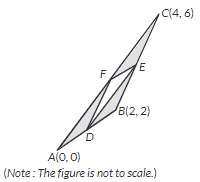
What is the area of the shaded region? AnswerCorrect option: B. $\frac{3}{2}$ squnits
$\frac{3}{2}$ squnits
View full question & answer→MCQ 1941 Mark
The value of $|A|$, if $A=\left[\begin{array}{ccc}0 & 2 x-1 & \sqrt{x} \\ 1-2 x & 0 & 2 \sqrt{x} \\ -\sqrt{x} & -2 \sqrt{x} & 0\end{array}\right]$, where $x \in R ^{+}$, is
- A
$(2 x+1)^2$
- B
- C
$(2 x+1)^3$
- D
$(2 x-1)^2$
AnswerGiven,
$
A=\left[\begin{array}{ccc}
0 & 2 x-1 & \sqrt{x} \\
1-2 x & 0 & 2 \sqrt{x} \\
-\sqrt{x} & -2 \sqrt{x} & 0
\end{array}\right], A^{\prime}=\left[\begin{array}{ccc}
0 & 1-2 x & -\sqrt{x} \\
2 x-1 & 0 & -2 \sqrt{x} \\
\sqrt{x} & 2 \sqrt{x} & 0
\end{array}\right]
$
Since, $A^{\prime}=-A$,
Matrix $A$ is a skew symmetric matrix of odd order.
$
\therefore \quad|A|=0
$
View full question & answer→MCQ 1951 Mark
Let $A$ be a $3 \times 3$ matrix such that $|\operatorname{adj} A|=64$. Then $|A|$ is equal to:
AnswerGiven, $|\operatorname{adj} A|=64$, where $A$ is a $3 \times 3$ matrix.
Since, $|\operatorname{adj} A|=|A|^{n-1}$, where $A$ is a $n \times n$ matrix.
$\Rightarrow \quad|\operatorname{adj} A|=|A|^{3-1}=64 \Rightarrow|A|^2=64 \Rightarrow|A|= \pm 8$.
View full question & answer→MCQ 1961 Mark
If $|A|=2$, where $A$ is a $2 \times 2$ matrix, then $\left|4 A^{-1}\right|$ equals:
AnswerGiven, $|A|=2$, Where $A$ is a $2 \times 2$ matrix.
Now, $\left|4 A^{-1}\right|=4|A|^{-1}$
and we know that, $|A|^{-1}=\frac{1}{|A|}$
$
\therefore\left|4 A^{-1}\right|=4 \times \frac{1}{|A|}=4 \times \frac{1}{2}=2
$
View full question & answer→MCQ 1971 Mark
If $A$ is a square matrix of order 3 and $|A|=6$, then the value of $|\operatorname{adj} A |$ is:
AnswerSince, order of a square matrix $A$ is 3 and $|A|=6$ We know that $| Adj A |=| A |^{n-1}=6^{3-1}=6^2=36$
View full question & answer→MCQ 1981 Mark
The value of the cofactor of the element of second row and third column in the matrix $\left[\begin{array}{ccc}4 & 3 & 2 \\ 2 & -1 & 0 \\ 1 & 2 & 3\end{array}\right]$ is:
AnswerLet $A=\left[\begin{array}{ccc}4 & 3 & 2 \\ 2 & -1 & 0 \\ 1 & 2 & 3\end{array}\right]$
Minor $M_{23}$ of an element $a_{23}$ of a matrix $A$ is given by
$M_{23}=\left|\begin{array}{ll}4 & 3 \\ 1 & 2\end{array}\right|=8-3=5$
$\because \quad$ Required cofactor $C_{23}=-M_{23}=-5$
View full question & answer→MCQ 1991 Mark
If $\left|\begin{array}{lll}\alpha & 3 & 4 \\ 1 & 2 & 1 \\ 1 & 4 & 1\end{array}\right|=0,$ then the value of $\alpha$ is
Answer$\left|\begin{array}{lll}\alpha & 3 & 4 \\ 1 & 2 & 1 \\ 1 & 4 & 1\end{array}\right|=0 $
$\Rightarrow \alpha(2-4)-3(1-1)+4(4-2)=0$
$\Rightarrow -2 \alpha+8=0$
$ \Rightarrow 2 \alpha=8$
$ \Rightarrow \alpha=4$
View full question & answer→MCQ 2001 Mark
The value of the determinant $\left|\begin{array}{ccc}2 & 7 & 1 \\ 1 & 1 & 1 \\ 10 & 8 & 1\end{array}\right|$ is
AnswerLet $|A|=\left|\begin{array}{ccc}2 & 7 & 1 \\ 1 & 1 & 1 \\ 10 & 8 & 1\end{array}\right|$
Expanding along $R_1$, we get
$|A|=2(1-8)-7(1-10)+1(8-10)$
$=2(-7)-7(-9)+1(-2)$
$=-14+63-2=47$
View full question & answer→