MCQ 11 Mark
If the projection of $\vec{\text{a}}=\hat{\text{i}}-2\hat{\text{j}}+3\hat{\text{k}}$ on $\vec{\text{b}}=2\hat{\text{i}}+\lambda\hat{\text{k}}$ is zero, then the value of $\lambda$ is:
- A
$0$
- B
$1$
- ✓
$\frac{-2}{3}$
- D
$\frac{-3}{2}$
AnswerCorrect option: C. $\frac{-2}{3}$
Since, two non zero vector $\vec{\text{a}}\ \&\ \vec{\text{b}}$ are i.e.,
$\vec{\text{a}}=\hat{\text{i}}-2\hat{\text{j}}+3\hat{\text{k}}$
$\vec{\text{b}}=2\hat{\text{i}}+\lambda\hat{\text{k}}$
$\vec{\text{a}}.\vec{\text{b}}=0$
$(\hat{\text{i}}-2\hat{\text{j}}+3\hat{\text{k}}).(2\hat{\text{i}}+\lambda\hat{\text{k}})=0$
$2+3\lambda=0$
$-2=3\lambda$
$\lambda=\frac{-2}{3}$
View full question & answer→MCQ 21 Mark
If the projection of $\vec{\text{a}}=\hat{\text{i}}-2\hat{\text{j}}+3\hat{\text{k}}$ on $\vec{\text{b}}=2\hat{\text{i}}+\lambda\hat{\text{k}}$ is zero, then the value of $\lambda$ is:
- A
$0$
- B
$1$
- ✓
$\frac{-2}{3}$
- D
$\frac{-3}{2}$
AnswerCorrect option: C. $\frac{-2}{3}$
Since, two non zero vector $\vec{\text{a}}\ \&\ \vec{\text{b}}$ are i.e.,
$\vec{\text{a}}=\hat{\text{i}}-2\hat{\text{j}}+3\hat{\text{k}}$
$\vec{\text{b}}=2\hat{\text{i}}+\lambda\hat{\text{k}}$
$\vec{\text{a}}.\vec{\text{b}}=0$
$(\hat{\text{i}}-2\hat{\text{j}}+3\hat{\text{k}}).(2\hat{\text{i}}+\lambda\hat{\text{k}})=0$
$2+3\lambda=0$
$-2=3\lambda$
$\lambda=\frac{-2}{3}$
View full question & answer→MCQ 31 Mark
If the projection of $\vec{\text{a}}=\hat{\text{i}}-2\hat{\text{j}}+3\hat{\text{k}}$ on $\vec{\text{b}}=2\hat{\text{i}}+\lambda\hat{\text{k}}$ is zero, then the value of $\lambda$ is:
- A
$0$
- B
$1$
- ✓
$\frac{-2}{3}$
- D
$\frac{-3}{2}$
AnswerCorrect option: C. $\frac{-2}{3}$
Since, two non zero vector $\vec{\text{a}}\ \&\ \vec{\text{b}}$ are i.e.,
$\vec{\text{a}}=\hat{\text{i}}-2\hat{\text{j}}+3\hat{\text{k}}$
$\vec{\text{b}}=2\hat{\text{i}}+\lambda\hat{\text{k}}$
$\vec{\text{a}}.\vec{\text{b}}=0$
$(\hat{\text{i}}-2\hat{\text{j}}+3\hat{\text{k}}).(2\hat{\text{i}}+\lambda\hat{\text{k}})=0$
$2+3\lambda=0$
$-2=3\lambda$
$\lambda=\frac{-2}{3}$
View full question & answer→MCQ 41 Mark
$\overrightarrow{\text{r}} = \overrightarrow{\text{x}}{\hat{\text{i}}}+ \overrightarrow{\text{y}}{\hat{\text{j}}}$ is the equation of:
View full question & answer→MCQ 51 Mark
A set of vectors taken in a given order gives a closed polygon. Then the resultant of these vectors is:
MCQ 61 Mark
Two or more vectors having the same initial point are:
AnswerTwo or more vectors having same initial points are known as co-initial vectors.
View full question & answer→MCQ 71 Mark
- A
- ✓
- C
Neither scalar nor vector
- D
View full question & answer→MCQ 81 Mark
If the curve a $y + x^2 = 7$ and $x^3 = y$, cut orthogonally at $(1, 1)$ then the value of a is:
View full question & answer→MCQ 91 Mark
If $\theta$ is the angle between the vectors $2\hat{\text{i}}-2\hat{\text{j}}+4\hat{\text{k}}$ and $3\hat{\text{i}}+\hat{\text{j}}+2\hat{\text{k}},$ then $\sin\theta=$
- A
$\frac{2}{3}$
- ✓
$\frac{2}{\sqrt{7}}$
- C
$\frac{\sqrt{2}}{7}$
- D
$\sqrt{\frac{2}{7}}$
AnswerCorrect option: B. $\frac{2}{\sqrt{7}}$
Let:
$\vec{\text{a}}=2\hat{\text{i}}-2\hat{\text{j}}+4\hat{\text{k}}$
$\vec{\text{b}}=3\hat{\text{i}}+\hat{\text{j}}+2\hat{\text{k}}$
$|\vec{\text{a}}|=\sqrt{2^2+(-2)^2+4^2}$
$=\sqrt{4+4+16}$
$=\sqrt{24}$
$=2\sqrt{6}$
$\Big|\vec{\text{b}}\big|=\sqrt{3^2+1^2+2^2}$
$=\sqrt{9+1+4}$
$=\sqrt{14}$
$\vec{\text{a}}\times\vec{\text{b}}=\begin{vmatrix}\hat{\text{i}}&\hat{\text{j}}&\hat{\text{k}}\\2&-2&4\\3&1&2 \end{vmatrix}$
$=-8\hat{\text{i}}+8\hat{\text{j}}+8\hat{\text{k}}$
$\big|\vec{\text{a}}\times\vec{\text{b}}\big|=\sqrt{64+64+64}$
$=\sqrt{192}$
$=8\sqrt{3}$
Let $\theta$ be the angle between $\vec{\text{a}}$ and $\vec{\text{b}}.$
$\big|\vec{\text{a}}\times\vec{\text{b}}\big|=|\vec{\text{a}}|\big|\vec{\text{b}}\big|\sin\theta$
$\Rightarrow8\sqrt{3}=(2\sqrt{6})(\sqrt{14})\sin\theta$
$\Rightarrow\sin\theta=\frac{8\sqrt{3}}{4\sqrt{21}}$
$=\frac{2}{\sqrt{7}}$
$\Rightarrow\theta=\sin^{-1}\Big(\frac{2}{\sqrt{7}}\Big)$
View full question & answer→MCQ 101 Mark
Which of the given qualities is a vector:
AnswerSpeed is a vector quantity as it has both magnitude and direction. Time, weight, volume have only magnitude and no direction. they all are scalar quantity.
View full question & answer→MCQ 111 Mark
If vectors $(\text{x}-2)\ \vec{\text{a}}+\vec{\text{b}}$ and $(2\text{x}+1)\ \vec{\text{a}}-\vec{\text{b}}$ are parallel then x:
- ✓
$\frac{1}{3}$
- B
$3$
- C
$-3$
- D
$\frac{-1}{3}$
AnswerCorrect option: A. $\frac{1}{3}$
As vectors (x - 2) a + b and (2x + 1) a - b are parallel.
$\frac{\text{x}-2}{2\text{x}+1}=-1$
$\Rightarrow\text{x - 2}=-2\text{x}-1$
$\therefore\text{x}=\frac{1}{3}$
View full question & answer→MCQ 121 Mark
Choose the correct answer from the given four options.
Projection vector of $\vec{\text{a}}$ on $\vec{\text{b}}$ is:
- ✓
$\bigg(\frac{\vec{\text{a}}\cdot\vec{\text{b}}}{|\vec{\text{b}}|^2}\bigg)\vec{\text{b}}$
- B
$\frac{\vec{\text{a}}\cdot\vec{\text{b}}}{|\vec{\text{b}}|}$
- C
$\frac{\vec{\text{a}}\cdot\vec{\text{b}}}{|\vec{\text{a}}|}$
- D
$\bigg(\frac{\vec{\text{a}}\cdot\vec{\text{b}}}{|\vec{\text{a}}|^2}\bigg)\vec{\text{b}}$
AnswerCorrect option: A. $\bigg(\frac{\vec{\text{a}}\cdot\vec{\text{b}}}{|\vec{\text{b}}|^2}\bigg)\vec{\text{b}}$
Projection vector of $\vec{\text{a}}$ on $\vec{\text{b}}$ is given by $\vec{\text{a}}\cdot\frac{\vec{\text{b}}}{|\vec{\text{b}}|}\vec{\text{b}}=\bigg(\frac{\vec{\text{a}}\cdot\vec{\text{b}}}{|\vec{\text{b}}|^2}\bigg)\vec{\text{b}}$
View full question & answer→MCQ 131 Mark
The unit vector in the direction of $\overrightarrow{\text{a}}$ is:
AnswerCorrect option: A. $\frac{\vec{\text{a}}}{\mid\vec{\text{a}\mid}}$
Consider the given vector $\vec{\text{a}}$
Unit vector $\hat{\text{a}}$
View full question & answer→MCQ 141 Mark
Choose the correct answer from the given four options. Assume that in a family, each child is equally likely to be a boy or a girl. A family with three children is chosen at random. The probability that the eldest child is a girl given that the family has at least one girl is:
- A
$\frac{1}{2}$
- B
$\frac{1}{3}$
- C
$\frac{2}{3}$
- ✓
$\frac{4}{7}$
AnswerCorrect option: D. $\frac{4}{7}$
Here, $S = \{(B, B, B), (G, G, G), (B, G, G), (G, B, G), (G, G, B), (G. B, B), (B, G, B), (B, B. G)\}$
$E_1 =$ Event that a family has atleast one girl, then
$E_1 = \{(G, B, B), (B, G, B), (B, B. G), (G, G, B), (B, G, G), (G. B, G), (G, G, G)\}$
$E_2 =$ Event that the eldest child is a girl, then
$E_2 = \{(G, B, B), (G, G, B), (G, B, G) (G, G, G)\}$
$\therefore\text{E}_1\cup\text{E}_2=\left\{(\text{G},\text{B},\text{B}),(\text{G},\text{G},\text{B}),(\text{G},\text{B},\text{G}),(\text{G},\text{G},\text{G})\right\}$
$\therefore\text{P}\Big(\frac{\text{E}_2}{\text{E}_1}\Big)=\frac{\text{P}(\text{E}_1\cap\text{E}_2)}{\text{P}(\text{E}_1)}$
$=\frac{\frac{4}{8}}{\frac{7}{8}}$
$=\frac{4}{7}$
View full question & answer→MCQ 151 Mark
If $\vec{\text{a}}$ and $\vec{\text{b}}$ are unit vectors,then the greatest value of $\sqrt{3}\big|\vec{\text{a}}+\vec{\text{b}}\big|+\big|\vec{\text{a}}-\vec{\text{b}}\big|$ is:
- A
$2$
- B
$2\sqrt{2}$
- ✓
$4$
- D
$\text{None of these}$
AnswerWe have
$\sqrt{3}\big|\vec{\text{a}}+\vec{\text{b}}\big|+\big|\vec{\text{a}}-\vec{\text{b}}\big|$
$=\sqrt{3}\times\sqrt{|\vec{\text{a}}|^2+\big|\vec{\text{b}}\big|^2+2|\vec{\text{a}}|\big|\vec{\text{b}}\big|\cos\theta}+\sqrt{|\vec{\text{a}}|^2+\big|\vec{\text{b}}\big|^2-2|\vec{\text{a}}|\big|\vec{\text{b}}\big|\cos\theta}$
$=\sqrt{3}\times\sqrt{1^2+1^2+2\times1\times1\cos\theta}+\sqrt{1^2+1^2-2\times1\times1\cos\theta}$ (As $\vec{\text{a}}$ and $\vec{\text{b}}$ unit vectors)
$=\sqrt{3}\times\sqrt{2+2\cos\theta}+\sqrt{2-2\cos\theta}$
$=\sqrt{3}\times\sqrt{2(1+\cos\theta)}+\sqrt{2(1-\cos\theta)}$
$=\sqrt{3}\times\sqrt{2\times2\cos^2\frac{\theta}{2}}+\sqrt{2\times2\sin^2\frac{\theta}{2}}$
$=2\sqrt{3}\cos\frac{\theta}{2}+2\sin\frac{\theta}{2}$
$=2\big(\sqrt{3}\cos\frac{\theta}{2}+\sin\frac{\theta}{2}\big)$
$=2\times2\big(\frac{\sqrt{3}}{2}\cos\frac{\theta}{2}+\frac{1}{2}\sin\frac{\theta}{2}\big)$
$=2\times2\big(\sin\frac{\pi}{3}\cos\frac{\theta}{2}+\cos\frac{\pi}{3}\sin\frac{\theta}{2}\big)$
$=4\sin\big(\frac{\pi}{3}+\frac{\theta}{2}\big)$
Now, maximum value of $\sin\text{a}=1$
⇒ Maximum value of $\sin\big(\frac{\pi}{3}+\frac{\theta}{2}\big)=1$
⇒ Maximum value of $4\sin\big(\frac{\pi}{3}+\frac{\theta}{2}\big)=4$
$\therefore$ Maximum velue of $\sqrt{3}\big|\vec{\text{a}}+\vec{\text{b}}\big|+\big|\vec{\text{a}}-\vec{\text{b}}\big|=4$
View full question & answer→MCQ 161 Mark
If the vectors $\hat{\text{i}}-2\text{x}\hat{\text{j}}+3\text{y}\hat{\text{k}}$ and $\hat{\text{i}}+2\text{x}\hat{\text{j}}-3\text{y}\hat{\text{k}}$ are perpendicular, then the locus of (x,y) is:
AnswerLet, $\vec{\text{a}}=\hat{\text{i}}-2\text{x}\hat{\text{j}}+3\text{y}\hat{\text{k}}$ and $\vec{\text{b}}=\hat{\text{i}}+2\text{x}\hat{\text{j}}-3\text{y}\hat{\text{k}}$
It is given that the vectors are perpendicular. so, their dot product is zero.
$\vec{\text{a}}.\vec{\text{b}}=0$
$\Rightarrow\big(\hat{\text{i}}-2\text{x}\hat{\text{j}}+3\text{y}\hat{\text{k}}\big).\big(\hat{\text{i}}+2\text{x}\hat{\text{j}}-3\text{y}\hat{\text{k}}\big)=0$
$\Rightarrow1-4\text{x}^2-9\text{y}^2=0$
$\Rightarrow4\text{x}^2+9\text{y}^2=1$
Dividing both sides by 36, we get
$\frac{\text{x}^2}{9}+\frac{\text{y}^2}{4}=1$
This is an ellipse.
View full question & answer→MCQ 171 Mark
If $\vec{\text{a}},\vec{\text{b}},\vec{\text{c}}$ are three non-coplanar vectors, then $\big(\vec{\text{a}}+\vec{\text{b}}+\vec{\text{c}}\big).\big[\big(\vec{\text{a}}+\vec{\text{b}}\big)\times\big(\vec{\text{a}}+\vec{\text{c}}\big)\big]$ equals:
- A
$0$
- B
$\big[\vec{\text{a}}\vec{\text{b}}\vec{\text{c}}\big]$
- C
$2\big[\vec{\text{a}}\vec{\text{b}}\vec{\text{c}}\big]$
- ✓
$-\big[\vec{\text{a}}\vec{\text{b}}\vec{\text{c}}\big]$
AnswerCorrect option: D. $-\big[\vec{\text{a}}\vec{\text{b}}\vec{\text{c}}\big]$
$\big(\vec{\text{a}}+\vec{\text{b}}+\vec{\text{c}}\big).\big[\big(\vec{\text{a}}+\vec{\text{b}}\big)\times\big(\vec{\text{a}}+\vec{\text{c}}\big)\big]$
$=\big(\vec{\text{a}}+\vec{\text{b}}+\vec{\text{c}}\big).\big(\vec{\text{a}}\times\vec{\text{a}}+\vec{\text{a}}\times\vec{\text{c}}+\vec{\text{b}}\times\vec{\text{a}}+\vec{\text{b}}\times\vec{\text{c}}\big)$
$=\big(\vec{\text{a}}+\vec{\text{b}}+\vec{\text{c}}\big).\big(\vec{\text{a}}\times\vec{\text{c}}+\vec{\text{b}}\times\vec{\text{a}}+\vec{\text{b}}\times\vec{\text{c}}\big)$
$=0+0+\big[\vec{\text{a}}\vec{\text{b}}\vec{\text{c}}\big]+\big[\vec{\text{b}}\vec{\text{a}}\vec{\text{c}}\big]+0+0+0+\big[\vec{\text{c}}\vec{\text{b}}\vec{\text{a}}\big]+0$
$=-\big[\vec{\text{a}}\vec{\text{b}}\vec{\text{c}}\big]$
View full question & answer→MCQ 181 Mark
If $\overline{\text{a}},\overline{\text{b}},\overline{\text{c}}$ are unit vectors such that $\overline{\text{a}}+\overline{\text{b}}+\overline{\text{c}}+\overline{\text{c.a}}=$
- A
$\frac{3}{2}$
- ✓
$-\frac{3}{2}$
- C
$\frac{1}{2}$
- D
$-\frac{1}{2}$
AnswerCorrect option: B. $-\frac{3}{2}$
View full question & answer→MCQ 191 Mark
If $\mid\text{a}\times\text{b}\mid=4$ and $\mid\text{a.b}\mid=2$ then $\mid{\text{a}}\mid^2\mid{\text{b}}\mid^2$ is equal to:
View full question & answer→MCQ 201 Mark
Let $\vec{\text{a}},\vec{\text{b}},\vec{\text{c}}$ be three unit vectors, such that $\big|\vec{\text{a}}+\vec{\text{b}}+\vec{\text{c}}\big|=1$ and $\vec{\text{a}}$ is perpendicular to $\vec{\text{b}}.$ If $\vec{\text{c}}$ makes angle $\alpha$ and $\beta$ with $\vec{\text{a}}$ and $\vec{\text{b}}$ respectively, then $\cos\alpha+\cos\beta=$
- A
$-\frac{3}{2}$
- B
$\frac{3}{2}$
- C
$1$
- ✓
$-1$
AnswerGiven that $\vec{\text{a}},\vec{\text{b}}$ and $\vec{\text{c}}$ are unit vectors.
So, $|\vec{\text{a}}|=1,\big|\vec{\text{b}}\big|=1$ and $\vec{\text{c}}=1.$
Since $\vec{\text{a}}$ and $\vec{\text{b}}$ are mutually perpendicular,
$\vec{\text{a}}.\vec{\text{b}}=0$
Now,
$\big|\vec{\text{a}}+\vec{\text{b}}+\vec{\text{c}}\big|=1$
$\Rightarrow\big|\vec{\text{a}}+\vec{\text{b}}+\vec{\text{c}}\big|^2=1$
$\Rightarrow|\vec{\text{a}}|^2+\big|\vec{\text{b}}\big|^2+|\vec{\text{c}}|^2+2\vec{\text{a}}.\vec{\text{b}}+2\vec{\text{b}}.\vec{\text{c}}+2\vec{\text{c}}.\vec{\text{a}}=1$
$\Rightarrow1+1+1+2(0)+2|\vec{\text{a}}|\big|\vec{\text{b}\big|}\cos\beta+2|\vec{\text{c}}||\vec{\text{a}}|\cos\alpha=1$
$\Rightarrow3+2(\cos\alpha+\cos\beta)=1$
$\Rightarrow2(\cos\alpha+\cos\beta)=-2$
$\Rightarrow\cos\alpha+\cos\beta=-1$
View full question & answer→MCQ 211 Mark
$\big(\vec{\text{a}}+2\vec{\text{b}}-\vec{\text{c}}\big).\big\{\big(\vec{\text{a}}-\vec{\text{b}}\big)\times\big(\vec{\text{a}}-\vec{\text{b}}-\vec{\text{c}}\big)\big\}$ is equal to:
- A
$\big[\vec{\text{a}}\vec{\text{b}}\vec{\text{c}}\big)$
- B
$2\big[\vec{\text{a}}\vec{\text{b}}\vec{\text{c}}\big)$
- ✓
$3\big[\vec{\text{a}}\vec{\text{b}}\vec{\text{c}}\big)$
- D
$0$
AnswerCorrect option: C. $3\big[\vec{\text{a}}\vec{\text{b}}\vec{\text{c}}\big)$
$\big(\vec{\text{a}}+2\vec{\text{b}}-\vec{\text{c}}\big).\big\{\big(\vec{\text{a}}-\vec{\text{b}}\big)\times\big(\vec{\text{a}}-\vec{\text{b}}-\vec{\text{c}}\big)\big\}$
$=\big(\vec{\text{a}}+2\vec{\text{b}}-\vec{\text{c}}\big).\big(\vec{\text{a}}\times\vec{\text{a}}-\vec{\text{a}}\times\vec{\text{b}}-\vec{\text{a}}\times\vec{\text{c}}-\vec{\text{b}}\times\vec{\text{a}}+\vec{\text{b}}\times\vec{\text{b}}+\vec{\text{b}}\times\vec{\text{c}}\big)$
$=\big(\vec{\text{a}}+2\vec{\text{b}}-\vec{\text{c}}\big).\big(-\vec{\text{a}}\times\vec{\text{b}}-\vec{\text{a}}\times\vec{\text{c}}+\vec{\text{a}}\times\vec{\text{b}}+\vec{\text{b}}\times\vec{\text{c}}\big)$
$=\big(\vec{\text{a}}+2\vec{\text{b}}-\vec{\text{c}}\big).\big(-\vec{\text{a}}\times\vec{\text{c}}+\vec{\text{b}}\times\vec{\text{c}}\big)$
$=\big[\text{a}\text{b}\text{c}\big]+2\big[\text{a}\text{b}\text{c}\big]$
$=3\big[\text{a}\text{b}\text{c}\big]$
View full question & answer→MCQ 221 Mark
If $\big[2\vec{\text{a}}+4\vec{\text{b}}\vec{\text{c}}\vec{\text{d}}\big]=\lambda\big[\vec{\text{a}}\vec{\text{c}}\vec{\text{d}}\big]+\mu\big[\vec{\text{b}}\vec{\text{c}}\vec{\text{d}}\big],$ then $\lambda+\mu=$
AnswerWe have
$\big[2\vec{\text{a}}+4\vec{\text{b}}\vec{\text{c}}\vec{\text{d}}\big]=\lambda\big[\vec{\text{a}}\vec{\text{c}}\vec{\text{d}}\big]+\mu\big[\vec{\text{b}}\vec{\text{c}}\vec{\text{d}}\big]$
$\Rightarrow\big[\big(2\vec{\text{a}}+4\vec{\text{b}}\big]\times\vec{\text{c}}\big].\vec{\text{d}}=\lambda\big[\vec{\text{a}}\vec{\text{c}}\vec{\text{d}}\big]+\mu\big[\vec{\text{b}}\vec{\text{c}}\vec{\text{d}}\big]$ (By definition of scalar triple product)
$\Rightarrow\big[\big(2\vec{\text{a}}\times\vec{\text{c}}\big)+\big(4\vec{\text{b}}\times\vec{\text{c}}\big)\big].\vec{\text{d}}=\lambda\big[\vec{\text{a}}\vec{\text{c}}\vec{\text{d}}\big]+\mu\big[\vec{\text{b}}\vec{\text{c}}\vec{\text{d}}\big]$
$\Rightarrow\big(2\vec{\text{a}}\times\vec{\text{c}}\big).\vec{\text{d}}+\big(4\vec{\text{b}}\times\vec{\text{c}}\big).\vec{\text{d}}=\lambda\big[\vec{\text{a}}\vec{\text{c}}\vec{\text{d}}\big]+\mu\big[\vec{\text{b}}\vec{\text{c}}\vec{\text{d}}\big]$
$\Rightarrow\big[2\vec{\text{a}}\vec{\text{ c }}\vec{\text{d}}\big]+\big[4\vec{\text{b}}\vec{\text{ c }}\vec{\text{d}}\big]=\lambda\big[\vec{\text{a}}\vec{\text{ c }}\vec{\text{d}}\big]+\mu\big[\vec{\text{b}}\vec{\text{ c }}\vec{\text{d}}\big]$
$\Rightarrow2\big[\vec{\text{a}}\vec{\text{c}}\vec{\text{d}}\big]+4\big[\vec{\text{b}}\vec{\text{c}}\vec{\text{d}}\big]=\lambda\big[\vec{\text{a}}\vec{\text{c}}\vec{\text{d}}\big]+\mu\big[\vec{\text{b}}\vec{\text{c}}\vec{\text{d}}\big]$ $\big(\therefore\big[\lambda\vec{\text{a}}\vec{\text{b}}\vec{\text{c}}\big]=\lambda\big[\vec{\text{a}}\vec{\text{b}}\vec{\text{c}}\big]$ for any scaler $\lambda\big)$
Comparing both sides, we get
$\lambda=2$
$\mu=4$
$\therefore\lambda+\mu=2+4=6$
View full question & answer→MCQ 231 Mark
A unit vector perpendicular to both $\hat{\text{i}}+\hat{\text{j}}$ and $\hat{\text{j}}+\hat{\text{k}}$ is:
- A
$\hat{\text{i}}-\hat{\text{j}}+\hat{\text{k}}$
- B
$\hat{\text{i}}+\hat{\text{j}}+\hat{\text{k}}$
- C
$\frac{1}{\sqrt{3}}\big(\hat{\text{i}}+\hat{\text{j}}+\hat{\text{k}}\big)$
- ✓
$\frac{1}{\sqrt{3}}\big(\hat{\text{i}}-\hat{\text{j}}+\hat{\text{k}}\big)$
AnswerCorrect option: D. $\frac{1}{\sqrt{3}}\big(\hat{\text{i}}-\hat{\text{j}}+\hat{\text{k}}\big)$
Let:
$\vec{\text{a}}=\hat{\text{i}}+\hat{\text{j}}+0\hat{\text{k}}$
$\vec{\text{b}}=0\hat{\text{i}}+\hat{\text{j}}+\hat{\text{k}}$
$\therefore\vec{\text{a}}\times\vec{\text{b}}=\begin{vmatrix}\hat{\text{i}}&\hat{\text{j}}&\hat{\text{k}}\\1&1&0\\0&1&1 \end{vmatrix}$
$=\hat{\text{i}}-\hat{\text{j}}+\hat{\text{k}}$
$\Rightarrow\big|\vec{\text{a}}\times\vec{\text{b}}\big|=\sqrt{1+1+1}$
$=\sqrt{3}$
Unit vector perpendicular to $\vec{\text{a}}$ and $\vec{\text{b}}=\frac{\vec{\text{a}}\times\vec{\text{b}}}{\big|\vec{\text{a}}\times\vec{\text{b}}\big|}=\frac{\hat{\text{i}}-\hat{\text{j}}+\hat{\text{k}}}{\sqrt{3}}$
Disclaimer: The answer given for this question in the textbook is incorrect.
View full question & answer→MCQ 241 Mark
The ratio in which $2x + 3y + 5z = 1$ divides the line joining the points $(1, 0, -3)$ and $(1, -5, 7)$ is:
- ✓
$5 : 3$
- B
$3 : 2$
- C
$2 : 1$
- D
$1 : 3$
AnswerCorrect option: A. $5 : 3$
View full question & answer→MCQ 251 Mark
Choose the correct answer from the given four options.
The value of $\lambda$ for which the vectors $3\hat{\text{i}}-6\hat{\text{j}}+\hat{\text{k}}$ and $2\hat{\text{i}}-4\hat{\text{j}}+\lambda\hat{\text{k}}$ are parallel, is:
- ✓
$\frac{2}{3}$
- B
$\frac{3}{2}$
- C
$\frac{5}{2}$
- D
$\frac{2}{5}$
AnswerCorrect option: A. $\frac{2}{3}$
As the vectors $3\hat{\text{i}}-6\hat{\text{j}}+\hat{\text{k}}$ and $2\hat{\text{i}}-4\hat{\text{j}}+\lambda\hat{\text{k}}$ are parallel
$\therefore\frac{3}{2}=\frac{-6}{-4}=\frac{1}{\lambda}$
$\Rightarrow\lambda=\frac{2}{3}$
View full question & answer→MCQ 261 Mark
What is the length of the longer diagonal of the parallelogram constructed on $5\vec{\text{a}}+2\vec{\text{b}}$ and $\vec{\text{a}}-3\vec{\text{b}}$ if it is given that $|\vec{\text{a}}|=2\sqrt{2},\big|\vec{\text{b}}\big|=3$ and the angle between $\vec{\text{a}}$ and $\vec{\text{b}}$ is $\frac{\pi}{4}$?
- A
$15$
- B
$\sqrt{113}$
- ✓
$\sqrt{593}$
- D
$\sqrt{369}$
AnswerCorrect option: C. $\sqrt{593}$
Let ABCD be a parallelogram in which
side $\overrightarrow{\text{AB}}=\overrightarrow{\text{DC}}=5\vec{\text{a}}+2\vec{\text{b}}$
and $\overrightarrow{\text{AD}}=\overrightarrow{\text{BC}}=\vec{\text{a}}-3\vec{\text{b}}$
and diagonals are AC and BD.
Now, $\overrightarrow{\text{AC}}=\overrightarrow{\text{AB}}+\overrightarrow{\text{BC}}$
$=\big(5\vec{\text{a}}+2\vec{\text{b}\big)}+\big(\vec{\text{a}}-3\vec{\text{b}}\big)$
$=6\vec{\text{a}}-\vec{\text{b}}$
$\therefore\big|\overrightarrow{\text{AC}}\big|=\big|6\vec{\text{a}}-\vec{\text{b}\big|}$
$=\sqrt{|6\vec{\text{a}}|^2+\big|\vec{\text{b}}\big|^2-2\times|6\vec{\text{a}}|\times\big|\vec{\text{b}}\big|\cos\theta}$
$=\sqrt{36|\vec{\text{a}}|^2+\big|\vec{\text{b}}\big|^2-12\times|\vec{\text{a}}|\times\big|\vec{\text{b}}\big|\cos\frac{\pi}{4}}$
$=\sqrt{36|2\sqrt{2}|^2+|3|^2-12\times|2\sqrt{2}|\times|3|\times\frac{1}{\sqrt{2}}}$
$=\sqrt{288+9-72}$
$=\sqrt{225}=15\text{ units}$
$\overrightarrow{\text{BD}}=\overrightarrow{\text{BA}}+\overrightarrow{\text{BD}}$
$=-\overrightarrow{\text{AB}}+\overrightarrow{\text{BD}}$
$=-\big(5\vec{\text{a}}+2\vec{\text{b}}\big)+\big(\vec{\text{a}}-3\vec{\text{b}}\big)$
$=-4\vec{\text{a}}-5\vec{\text{b}}$
$\therefore|\overrightarrow{\text{BD}}|=\big|-4\vec{\text{a}}-5\vec{\text{b}}\big|$
$=\big|4\vec{\text{a}}+5\vec{\text{b}}\big|$
$=\sqrt{|4\vec{\text{a}}|^2+|5\vec{\text{b}}|^2+2|4\vec{\text{a}}|\times|5\vec{\text{b}|}\cos\theta}$
$=\sqrt{16|\vec{\text{a}}|^2+25\big|\vec{\text{b}}\big|^2+40\times|\vec{\text{a}}|\times\big|\vec{\text{b}}\big|\cos\frac{\pi}{4}}$
$=\sqrt{16|2\sqrt{2}|^2+25|3|^2+40\times|2\sqrt{2}|\times|3|\times\frac{1}{\sqrt{2}}}$
$=\sqrt{128+25+240}$
$=\sqrt{593}\text{ units}$
Therefore, the larger diagonal $=\sqrt{593}$
View full question & answer→MCQ 271 Mark
If a, b, c are position vectors of the vertices of a $\Delta\text{ABC}$ then $\overrightarrow{\text{AB}}+\overrightarrow{\text{BC}}+\overrightarrow{\text{CA}}=$
AnswerIf we join head to tail all the vectors, then we end up at the initial point where we started, that is vertice A. the net sum is 0.
View full question & answer→MCQ 281 Mark
vectors $\vec{\text{a}}$ and $\vec{\text{b}}$ are inclined at angle $\theta=120^\circ.$ if $|\vec{\text{a}}|=1,\big|\vec{\text{b}}\big|=2,$ then $\big[\big(\vec{\text{a}}+3\vec{\text{b}}\big)\times\big(3\vec{\text{a}}-\vec{\text{b}}\big)\big]^2$ is equal to:
Answer$\big(\vec{\text{a}}+3\vec{\text{b}}\big)\times\big(3\vec{\text{a}}-\vec{\text{b}}\big)$
$=3\big(\vec{\text{a}}\times\vec{\text{a}}\big)-\vec{\text{a}}\times\vec{\text{b}}+9\big(\vec{\text{b}}\times\vec{\text{a}}\big)-3\big(\vec{\text{b}}\times\vec{\text{b}}\big)$
$=3(0)-\vec{\text{a}}\times\vec{\text{b}}-9\big(\vec{\text{a}}\times\vec{\text{b}}\big)-3(0)$
$=-10\big(\vec{\text{a}}\times\vec{\text{b}}\big)$
Now,
$\big|\big(\vec{\text{a}}\times3\vec{\text{b}}\big)\times\big(3\vec{\text{a}}-\vec{\text{b}}\big)\big|^2$
$=\big|-10\big(\vec{\text{a}}\times\vec{\text{b}}\big)\big|^2$
$=100\big|\big(\vec{\text{a}}\times\vec{\text{b}}\big)\big|^2$
$=100|\vec{\text{a}}|^2\big|\vec{\text{b}}\big|^2\sin^2120$
$=100(1)^2(2)^2\Big(\frac{\sqrt{3}}{2}\Big)^2$
$=400\times\frac{3}{4}$
$=300$
View full question & answer→MCQ 291 Mark
A point from a vector starts is called and where it ends is called its:
- A
Terminal point, endpoint.
- ✓
Initial point, terminal point
- C
- D
AnswerCorrect option: B. Initial point, terminal point
View full question & answer→MCQ 301 Mark
If the position vectors of $P, Q$ are respectively $5a + 4b$ and $3a - 2b$ then $\vec{\text{QP}}=$
- ✓
$2a + 6b$
- B
$2a − 6b$
- C
$2a + 5b$
- D
$2a − 5b$
AnswerCorrect option: A. $2a + 6b$
View full question & answer→MCQ 311 Mark
The summation of two unit vectors is a third unit vector, then the modulus of the difference of the unit vector is:
- ✓
$\sqrt{3}$
- B
$1-\sqrt{3}$
- C
$1+\sqrt{3}$
- D
$-\sqrt{3}$
AnswerCorrect option: A. $\sqrt{3}$
View full question & answer→MCQ 321 Mark
If $\vec{\text{a}},\vec{\text{b}},\vec{\text{c}}$ are any three mutualy perpendicular vectors of equal magnitude a, then $\big|\vec{\text{a}}+\vec{\text{b}}+\vec{\text{c}}\big|$ is equal to
- A
$\text{a}$
- B
$\sqrt{2}\text{a}$
- ✓
$\sqrt{3}\text{a}$
- D
$2\text{a}$
AnswerCorrect option: C. $\sqrt{3}\text{a}$
Given that
So, $|\vec{\text{a}}|=\big|\vec{\text{b}}\big|=|\vec{\text{c}}|=\text{a}\dots(1)$
Since they are mutually perpendicular,
$\vec{\text{a}}.\vec{\text{b}}=\vec{\text{b}}.\vec{\text{c}}=\vec{\text{c}}.\vec{\text{a}}=0\dots(2)$
Now,
$\big|\vec{\text{a}}+\vec{\text{b}}+\vec{\text{c}}\big|^2=|\vec{\text{a}}|^2+\big|\vec{\text{b}}\big|^2+|\vec{\text{c}}|^2+2\vec{\text{a}}.\vec{\text{b}}+2\vec{\text{b}}.\vec{\text{c}}+2\vec{\text{c}}.\vec{\text{a}}$
$=\text{a}^2+\text{a}^2+\text{a}^2+0+0+0$ [using (1) and (2)]
$=3\text{a}^2$
$\therefore\big|\vec{\text{a}}+\vec{\text{b}}+\vec{\text{c}}\big|=\sqrt{3}\text{a}$
View full question & answer→MCQ 331 Mark
If $\vec{a}\ \text{and}\ \vec{b}$ are two collinear vectors, then which of the following are incorrect:
- A
$\vec{b}=\lambda\vec{a},\ \text{for some scalar}\ \lambda$
- B
$\vec{a}=\pm\vec{b}$
- C
The respective components of $\vec{a}\ \text{and}\ \vec{b}$ are proportional.
- ✓
Both the vectors $\vec{a}\ \text{and}\ \vec{b}$ have same direction, but different magnitudes.
AnswerCorrect option: D. Both the vectors $\vec{a}\ \text{and}\ \vec{b}$ have same direction, but different magnitudes.
If $\vec{a}\ \text{and}\ \vec{b}$ are two collinear vectors, then they are parallel. Therefore, we have: $\vec{b}=\lambda\vec{a}\ (\text{For some scalar}\ \lambda)$ $\text{If}\ \lambda=\pm1,\ \text{then}\ \vec{a}=\pm\vec{b}$ $\text{If}\ \vec{a}=a_1\hat{i}+a_2\hat{j}+a_3\hat{k}\ \text{and}\ \vec{b}$ $=b_1\hat{i}+b_2\hat{j}+b_3\hat{k}, \text{then}\ \vec{b}=\lambda\vec{a}.$ $\Rightarrow{b_1}\hat{i}+b_2\hat{j}+b_3\hat{k}=\lambda\big({a_1}\hat{i}+a_2\hat{j}+a_3\hat{k}\big)$ $\Rightarrow{b_1}\hat{i}+b_2\hat{j}+b_3\hat{k}=\big(\lambda{a_1}\big)\hat{i}+\big(\lambda{a_2}\big)\hat{j}+\big(\lambda{a_3}\big)\hat{k}$ $\Rightarrow{b_1}=\lambda{a_1,}\ b_2=\lambda{a_2,}\ b_3=\lambda{a_3}$$\Rightarrow\frac{b_1}{a_1}=\frac{b_2}{a_2}=\frac{b_3}{a_3}=\lambda$
Thus, the respective components of $\vec{a}\ \text{and}\ \vec{b}$ are proportional. However, vectors $\vec{a}\ \text{and}\ \vec{b}$ can have different directions. Hence, the statement given in D is incorrect. The correct answer is D.
View full question & answer→MCQ 341 Mark
If $\big|\vec{\text{a}}\times\vec{\text{b}}\big|=4,\big|\vec{\text{a}}.\vec{\text{b}}\big|=2,$ then $|\vec{\text{a}}|^2\big|\vec{\text{b}}\big|^2=$
AnswerWe know
$\big(\vec{\text{a}}.\vec{\text{b}}\big)^2+\big|\vec{\text{a}}\times\vec{\text{b}}\big|62=|\vec{\text{a}}|^2\big|\vec{\text{b}}\big|^2\dots(1)$
$\big|\vec{\text{a}}.\vec{\text{b}}\big|=2$ (Given)
$\Rightarrow\big|\vec{\text{a}}.\vec{\text{b}}\big|^2=\big(\vec{\text{a}}.\vec{\text{b}}\big)^2$
From (1), we get
$(2)^2+(4)^2=|\vec{\text{a}}|^2\big|\vec{\text{b}}\big|^2$
$\Rightarrow|\vec{\text{a}}|^2\big|\vec{\text{b}}\big|^2=20$
View full question & answer→MCQ 351 Mark
$\text{The value of}\ \hat{\text{i}}\cdot(\hat{\text{j}}\times\hat{\text{k}})+\hat{\text{j}}\cdot(\hat{\text{i}}\times\hat{\text{k}})+\hat{\text{k}}\cdot(\hat{\text{i}}\times\hat{\text{j}})\ \text{is}$
Answer$\hat{\text{i}}\cdot\Big(\hat{\text{j}}\times\hat{\text{k}}\Big)+\hat{\text{j}}\cdot\Big(\hat{\text{i}}\times\hat{\text{k}}\Big)+\hat{\text{k}}\cdot\Big(\hat{\text{i}}\times\hat{\text{j}}\Big)$
$=\hat{\text{i}}\cdot\hat{\text{i}}+\hat{\text{j}}\cdot\Big(-\hat{\text{j}}\Big)+\hat{\text{k}}\cdot\hat{\text{k}}$
$=1-\hat{\text{j}}\cdot\hat{\text{j}}+1$
=1-1+1
=1
The correct answer is C.
View full question & answer→MCQ 361 Mark
Choose the correct answer:$\text{Let}\ \vec{\text{a}}\ \text{and}\ \vec{\text{b}}$ be two unit vectors and $\theta$ is the angle between them. Then $\vec{\text{a}}+\vec{\text{b}}$ is a unit vector if,
- A
$\theta=\frac{\pi}{4}$
- B
$\theta=\frac{\pi}{3}$
- C
$\theta=\frac{\pi}{2}$
- ✓
$\theta=\frac{2\pi}{3}$
AnswerCorrect option: D. $\theta=\frac{2\pi}{3}$
$\text{Let}\ \vec{\text{a}}\ \text{and}\ \vec{\text{b}}$ be two unit vectors and $\theta$ be the angle between them.
$\text{Then},\ \big|\vec{\text{a}}\big|=\Big|\vec{\text{b}}\Big|=1.$
$\text{Now},\ \vec{\text{a}}+\vec{\text{b}}$ is a unit vector if $\Big|\vec{\text{a}}+\vec{\text{b}}\Big|=1.$
$\Big|\vec{\text{a}}+\vec{\text{b}}\Big|=1$
$\Rightarrow\Big(\vec{\text{a}}+\vec{\text{b}}\Big)^2=1$
$\Rightarrow\Big(\vec{\text{a}}+\vec{\text{b}}\Big)\cdot\Big(\vec{\text{a}}+\vec{\text{b}}\Big)=1$
$\Rightarrow\vec{\text{a}}.\vec{\text{a}}+\vec{\text{a}}.\vec{\text{b}}+\vec{\text{b}}.\vec{\text{a}}+\vec{\text{b}}.\vec{\text{b}}=1$
$\Rightarrow\Big|\vec{\text{a}}\Big|^2+2\vec{\text{a}}.\vec{\text{b}}+\Big|\vec{\text{b}}\Big|^2=1$
$\Rightarrow1^2+2\Big|\vec{\text{a}}\Big|\Big|\vec{\text{b}}\Big|\cos\theta+1^2=1$
$\Rightarrow1+2.1.1\cos\theta+1=1$
$\Rightarrow\cos\theta=-\frac{1}{2}$
$\Rightarrow\theta=-\frac{2\pi}{3}$
Hence, $\vec{\text{a}}+\vec{\text{b}}$ is a unit vector if $\theta=\frac{2\pi}{3}.$
The correct answer is D.
View full question & answer→MCQ 371 Mark
The projection of the vector $\hat{\text{i}}+\hat{\text{j}}+\hat{\text{k}}$ along the vector of $\hat{\text{j}}$ is:
AnswerLet $\vec{\text{a}}=\hat{\text{i}}+\hat{\text{j}}+\hat{\text{k}}$ and $\vec{\text{b}}=\hat{\text{j}}$
The projection of $\vec{\text{a}}$ on $\vec{\text{b}}$ is
$\frac{\vec{\text{a}}.\vec{\text{b}}}{\big|\vec{\text{b}}\big|}$
$=\frac{\big(\hat{\text{i}}+\hat{\text{j}}+\hat{\text{k}}\big).\hat{\text{j}}}{|\hat{\text{j}}|}$
$=\frac{0+1+0}{1}$
$=1$
View full question & answer→MCQ 381 Mark
The position vectors of the points A, B, C are $2\hat{\text{i}}+\hat{\text{j}}-\hat{\text{k}},\ 3\hat{\text{i}}-2\hat{\text{j}}+\hat{\text{k}}$ and $\hat{\text{i}}+4\hat{\text{j}}-3\hat{\text{k}}$ respectively. These points,
- ✓
Form an isosceles triangle.
- B
- C
- D
AnswerCorrect option: A. Form an isosceles triangle.
Given: Position vectors of A, B, C are $2\hat{\text{i}}+\hat{\text{j}}-\hat{\text{k}},\ 3\hat{\text{i}}-2\hat{\text{j}}+\hat{\text{k}}$ and $\hat{\text{i}}+4\hat{\text{j}}-3\hat{\text{k}}$. Then,
$\overrightarrow{\text{AB}}=\big(3\hat{\text{i}}-2\hat{\text{j}}+\hat{\text{k}}\big)-\big(2\hat{\text{i}}+\hat{\text{j}}-\hat{\text{k}}\big)$
$=\hat{\text{i}}-3\hat{\text{j}}+2\hat{\text{k}}$
$\overrightarrow{\text{BC}}=\big(\hat{\text{i}}+4\hat{\text{j}}-3\hat{\text{k}}\big)-\big(3\hat{\text{i}}-2\hat{\text{j}}+\hat{\text{k}}\big)$
$=-2\hat{\text{i}}+6\hat{\text{j}}-4\hat{\text{k}}$
$\overrightarrow{\text{CA}}=\big(2\hat{\text{i}}+\hat{\text{j}}-\hat{\text{k}}\big)-\big(\hat{\text{i}}+4\hat{\text{j}}-3\hat{\text{k}}\big)$
$=\hat{\text{i}}-3\hat{\text{j}}+2\hat{\text{k}}$
Now, $\Big|\overrightarrow{\text{AB}}\Big|=\sqrt{1^2+(-3)^2+2^2}$
$=\sqrt{1+9+4}$
$=\sqrt{14}$
$\Big|\overrightarrow{\text{CA}}\Big|=\sqrt{1^2+(-3)^2+2^2}$
$=\sqrt{1+9+4}$
$=\sqrt{14}$
$\Big|\overrightarrow{\text{BC}}\Big|=\sqrt{(-2)^2+6^2+(-4)^2}$
$=\sqrt{4+36+16}$
$=\sqrt{56}$
$\therefore\Big|\overrightarrow{\text{AB}}\Big|=\Big|\overrightarrow{\text{CA}}\Big|$
Hence, the triangle is isosceles as two of its sides are equal.
View full question & answer→MCQ 391 Mark
If $\mid\text{a}\mid=5,\mid\text{b}\mid=13$ and $\mid\text{a}\times{\text{b}}\mid=25$ find $a.b:$
- A
$\underline{+}10$
- B
$\underline{+}40$
- ✓
$\underline{+}60$
- D
$\underline{+}25$
AnswerCorrect option: C. $\underline{+}60$
View full question & answer→MCQ 401 Mark
If $\vec{\text{a}}$ and $\vec{\text{b}}$ are unit vectors, then which of the following values of $\vec{\text{a}}.\vec{\text{b}}$ is not possible?
- ✓
$\sqrt{3}$
- B
$\frac{\sqrt{3}}{2}$
- C
$\frac{1}{\sqrt{2}}$
- D
$\frac{-1}{2}$
AnswerCorrect option: A. $\sqrt{3}$
It is given that $\vec{\text{a}}$ and $\vec{\text{b}}$ are unit vectors.
$\Rightarrow|\vec{\text{a}}|=\big|\vec{\text{b}}\big|=1$
Now,
$\vec{\text{a}}.\vec{\text{b}}$
$=|\vec{\text{a}}|\big|\vec{\text{b}}\big|\cos\theta$
$=(1)(2)\cos\theta$
$=\cos\theta$
The range of $\cos\theta$ is [-1,1].
$\therefore\sqrt{3}$ is not a possible value of $\cos\theta$ as it is greater than 1.
View full question & answer→MCQ 411 Mark
If G is the intersection of diagonals of a parallelogram ABCD and O is any point, then $\overrightarrow{\text{OA}}+\overrightarrow{\text{OB}}+\overrightarrow{\text{OC}}+\overrightarrow{\text{OD}}=$
- A
$2\overrightarrow{\text{OG}}$
- ✓
$4\overrightarrow{\text{OG}}$
- C
$5\overrightarrow{\text{OG}}$
- D
$3\overrightarrow{\text{OG}}$
AnswerCorrect option: B. $4\overrightarrow{\text{OG}}$
Let us consider the point O as origin.
G is the mid-point of AC.
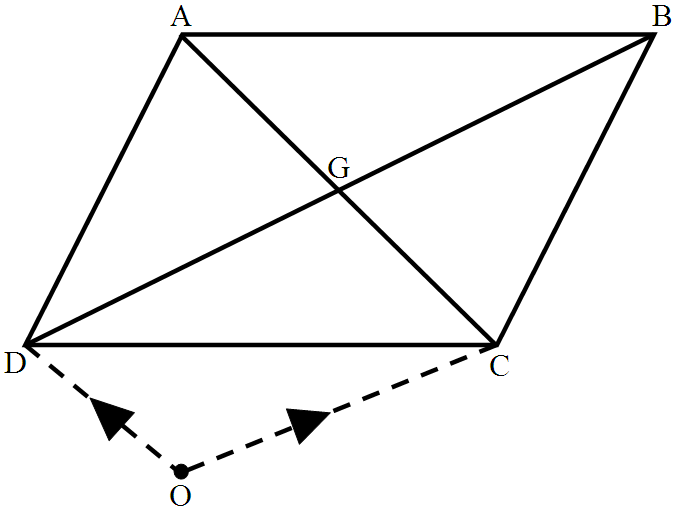
$\therefore\ \overrightarrow{\text{OG}}=\frac{\overrightarrow{\text{OA}}+\overrightarrow{\text{OC}}}2$
$2\overrightarrow{\text{OG}}=\overrightarrow{\text{OA}}+\overrightarrow{\text{OC}}\ \dots(1)$
Also, G is the mid-point BD
$\therefore\ \overrightarrow{\text{OG}}=\frac{\overrightarrow{\text{OB}}+\overrightarrow{\text{OD}}}2$
$2\overrightarrow{\text{OG}}=\overrightarrow{\text{OB}}+\overrightarrow{\text{OD}}\ \dots(2)$
On adding (1) and (2) we get,
$2\overrightarrow{\text{OG}}+2\overrightarrow{\text{OG}}=\overrightarrow{\text{OA}}+\overrightarrow{\text{OB}}+\overrightarrow{\text{OC}}+\overrightarrow{\text{OD}}$
$4\overrightarrow{\text{OG}}=\overrightarrow{\text{OA}}+\overrightarrow{\text{OB}}+\overrightarrow{\text{OC}}+\overrightarrow{\text{OD}}$
$\therefore\overrightarrow{\text{OA}}+\overrightarrow{\text{OB}}+\overrightarrow{\text{OC}}+\overrightarrow{\text{OD}}=4\overrightarrow{\text{OG}}$ View full question & answer→MCQ 421 Mark
The vectors $2\hat{\text{i}}+3\hat{\text{j}}-4\hat{\text{k}}$ and $\text{a}\hat{\text{i}}+\text{b}\hat{\text{j}}+\text{c}\hat{\text{k}}$ are perpendicular if:
AnswerIt is given that vectors $2\hat{\text{i}}+3\hat{\text{j}}-4\hat{\text{k}}$ and $\text{a}\hat{\text{i}}+\text{b}\hat{\text{j}}+\text{c}\hat{\text{k}}$ are perpendicular.
So, their dot product is zero.
$\Rightarrow2\text{a}+3\text{b}-4\text{c}=0$
$(\text{b})\text{a}=4;\text{b}=4;\text{c}=5$
$\Rightarrow2(4)+3(4)-4(5)=0$
$8+12-20=0$
$0=0,$ which is true.
View full question & answer→MCQ 431 Mark
The resultant of two concurrent forces $\vec{\text{nOP}}$ and $\vec{\text{mOQ}}$ is$(\text{m+n})\vec{\text{OR.}}$ Then R divides PQ in the ratio:
AnswerApplying Section Formula
$\text{R}=\frac{\text{KQ}+\text{P}}{\text{K}+1}$
$(\text{K+1})\text{R = KQ + P}$
$\text{K+1}=\frac{\text{m+n}}{\text{n}}$
$\text{K}=\frac{\text{m}}{\text{n}}$
View full question & answer→MCQ 441 Mark
If $\vec{\text{a}}$ is a non-zero of magnitude 'a' and $\lambda$ is a non-zero scalar, then $\lambda\vec{\text{a}}$ is a unit vector if:
AnswerCorrect option: D. $\text{a}=\frac{1}{|\lambda|}$
Given that
$|\vec{\text{a}}|=\text{a};$
Now,
$|\lambda\vec{\text{a}}|=1$
$\Rightarrow|\lambda||\vec{\text{a}}|=1$
$\Rightarrow|\lambda|\text{a}=1$
$\Rightarrow\text{a}=\frac{1}{|\lambda|}$
View full question & answer→MCQ 451 Mark
ABCD is a parallelogram with AC and BD as diagonals. Then, $\overrightarrow{\text{AC}}-\overrightarrow{\text{BD}}=$
- A
$4\overrightarrow{\text{AB}}$
- B
$3\overrightarrow{\text{AB}}$
- ✓
$2\overrightarrow{\text{AB}}$
- D
$\overrightarrow{\text{AB}}$
AnswerCorrect option: C. $2\overrightarrow{\text{AB}}$
Given: ABCD, a parallelogram with diagonals AC and BD. Then,
$\overrightarrow{\text{AC}}=\overrightarrow{\text{AB}}+\overrightarrow{\text{BC}}$
$\overrightarrow{\text{AD}}=\overrightarrow{\text{AB}}+\overrightarrow{\text{BD}}$
$\Rightarrow\ \overrightarrow{\text{BD}}=\overrightarrow{\text{AD}}-\overrightarrow{\text{AB}}$
$\therefore\overrightarrow{\text{AC}}-\overrightarrow{\text{BD}}=\overrightarrow{\text{AB}}+\overrightarrow{\text{BC}}-\overrightarrow{\text{AD}}+\overrightarrow{\text{AB}}=2\overrightarrow{\text{AB}}$ $\Big[\because\ \overrightarrow{\text{AD}}=\overrightarrow{\text{BC}}\Big]$
View full question & answer→MCQ 461 Mark
Choose the correct answer from the given four options.
The number of vectors of unit length perpendicular to the vectors $\vec{\text{a}}=2\hat{\text{i}}+\hat{\text{j}}+\hat{2\text{k}}$ and $\vec{\text{b}}=\hat{\text{j}}+\hat{\text{k}}$ is:
AnswerThe number of vectors of unit length perpendicular to the vectors $\vec{\text{a}}$ and $\vec{\text{b}}$ is $\vec{\text{c}}$ (say) i.e., $\vec{\text{c}}=\pm(\vec{\text{a}}\times\vec{\text{b}})$
So, there will be two vectors of unit length perpendicular to the vectors $\vec{\text{a}}$ and $\vec{\text{b}}.$
View full question & answer→MCQ 471 Mark
Can two different vectors have the same magnitude:
AnswerTwo vectors can have the same magnitude.
Magnitude of vector i - 2j + k is equal to magnitude of vector 2i + j - k.
View full question & answer→MCQ 481 Mark
The value of $\hat{\text{i}}.\big(\hat{\text{j}}\times\hat{\text{k}}\big)+\hat{\text{j}}.\big(\hat{\text{i}}\times\hat{\text{k}}\big)+\hat{\text{k}}.\big(\hat{\text{i}}\times\hat{\text{j}}\big),$ is:
Answer$\hat{\text{i}}.\big(\hat{\text{j}}\times\hat{\text{k}}\big)+\hat{\text{j}}.\big(\hat{\text{i}}\times\hat{\text{k}}\big)+\hat{\text{k}}.\big(\hat{\text{i}}\times\hat{\text{j}}\big)$
$=\hat{\text{i}}.\hat{\text{i}}+\hat{\text{j}}.(-\hat{\text{j}})+\hat{\text{k}}.\hat{\text{k}}$
$=|\hat{\text{i}}|^2-|\hat{\text{j}}|^2+|\hat{\text{k}}|^2$
$=1-1+1$
$=1$
View full question & answer→MCQ 491 Mark
If $\theta$ is the angle between two vectors $\vec{\text{a}}$ and $\vec{\text{b}},$ then $\vec{\text{a}}.\vec{\text{b}}\geq0$ only when:
AnswerCorrect option: B. $0\leq\theta\leq\frac{\pi}{2}$
$\vec{\text{a}}.\vec{\text{b}}\geq0$
$\Rightarrow|\vec{\text{a}}|\big|\vec{\text{b}}\big|\cos\theta\geq0$
$\Rightarrow\cos\theta\geq0$
$\Rightarrow0\leq\theta\leq\frac{\pi}{2}$
View full question & answer→MCQ 501 Mark
If $\vec{\text{a}}$ is any vector, then $\big(\vec{\text{a}}\times\hat{\text{i}}\big)^2+\big(\vec{\text{a}}\times\hat{\text{j}}\big)^2+\big(\vec{\text{a}}\times\hat{\text{k}}\big)^2=$
- A
$\vec{\text{a}}^2$
- ✓
$2\vec{\text{a}}^2$
- C
$3\vec{\text{a}}^2$
- D
$4\vec{\text{a}}^2$
AnswerCorrect option: B. $2\vec{\text{a}}^2$
Let $\vec{\text{a}}={\text{a}}_1\hat{\text{i}}+{\text{a}}_2\hat{\text{j}}+{\text{a}}_3\hat{\text{k}}$
$\vec{\text{a}}\times\hat{\text{i}}=\begin{vmatrix}\hat{\text{i}}&\hat{\text{j}}&\hat{\text{k}}\\\text{a}_1&\text{a}_2&\text{a}_3\\1&0&0 \end{vmatrix}$
$=\text{a}_3\hat{\text{j}}-\text{a}_2\hat{\text{k}}$
$\Rightarrow\big(\vec{\text{a}}\times\hat{\text{i}}\big)^2=\big(\text{a}_3\hat{\text{j}}-\text{a}_2\hat{\text{k}}\big)^2$
$={\text{a}_3}^2|\hat{\text{j}}|^2+{\text{a}_2}^2|\hat{\text{k}}|^2-2\text{a}_3\text{a}_2\big(\hat{\text{j}}.\hat{\text{k}}\big)$
$={\text{a}_3}^2+{\text{a}_2}^2$ $\big(\because\hat{\text{j}}.\hat{\text{k}}=0\dots(1)\big)$
$\therefore\vec{\text{a}}\times\hat{\text{j}}=\begin{vmatrix}\hat{\text{i}}&\hat{\text{j}}&\hat{\text{k}}\\\text{a}_1&\text{a}_2&\text{a}_3\\0&1&0 \end{vmatrix}$
$=-\text{a}_3\hat{\text{i}}+\text{a}_1\hat{\text{k}}$
$\Rightarrow\big(\vec{\text{a}}\times\hat{\text{j}}\big)^2=\big(-\text{a}_3\hat{\text{i}}+\text{a}_1\hat{\text{k}}\big)^2$
$={\text{a}_3}^2|\hat{\text{i}}|^2+{\text{a}_1}^2|\hat{\text{k}}|^2-2\text{a}_3\text{a}_2\big(\hat{\text{i}}.\hat{\text{k}}\big)$
$={\text{a}_3}^2+{\text{a}_1}^2$ $(\because\hat{\text{i}}.\hat{\text{k}}=0)\dots(2)$
$\therefore\vec{\text{a}}\times\hat{\text{k}}=\begin{vmatrix}\hat{\text{i}}&\hat{\text{j}}&\hat{\text{k}}\\\text{a}_1&\text{a}_2&\text{a}_3\\0&0&1 \end{vmatrix}$
$=\text{a}_2\hat{\text{i}}-\text{a}_1\hat{\text{j}}$
$\Rightarrow\big(\vec{\text{a}}\times\hat{\text{k}}\big)^2=\big(\text{a}_2\hat{\text{i}}-\text{a}_1\hat{\text{j}}\big)^2$
$={\text{a}_2}^2|\hat{\text{i}}|^2+{\text{a}_1}^2|\hat{\text{j}}|^2-2\text{a}_1\text{a}_2\big(\hat{\text{i}}.\hat{\text{j}}\big)$
$={\text{a}_2}^2+{\text{a}_1}^2$ $(\because\hat{\text{i}}.\hat{\text{j}}=0)\dots(3)$
Adding (1), (2) and (3), we get
$\big(\vec{\text{a}}\times\hat{\text{i}}\big)^2+\big(\vec{\text{a}}\times\hat{\text{j}}\big)^2+\big(\vec{\text{a}}\times\hat{\text{k}}\big)^2={\text{a}_3}^2+{\text{a}_2}^2+{\text{a}_3}^2+{\text{a}_1}^2+{\text{a}_2}^2+{\text{a}_1}^2$
$=2\big({\text{a}_1}^2+{\text{a}_2}^2+{\text{a}_3}^2\big)$
$=2\vec{\text{a}}^2$ $\big(\because|\vec{\text{a}}|=\sqrt{{\text{a}_1}^2+{\text{a}_2}^2+{\text{a}_3}^2}\big)$
View full question & answer→