MCQ 11 Mark
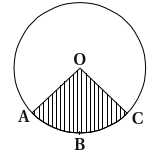
From the figure, shadded region is called.
MCQ 21 Mark
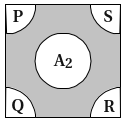
A quadrant of a circle of radius $2 cm$ is cut also a circle of diameter $4 cm$ is cut from the middle of the square handkerchief. Sum of all areas $P+Q+R+S=A_1$ then __________ is possible.
- ✓
$A _1= A _2$
- B
$A _1< A _2$
- C
$A _1 \neq A _2$
- D
$A _1> A _2$
AnswerCorrect option: A. $A _1= A _2$
$A _1= A _2$
View full question & answer→MCQ 31 Mark
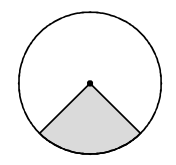
What does the non - shaded area represents in the following circle ?
MCQ 41 Mark
Length of one fourth arc of the sector of the circle with radius $28 cm$ is __________
- ✓
$14 \pi$
- B
$28 \pi$
- C
$7 \pi$
- D
$36 \pi$
AnswerCorrect option: A. $14 \pi$
$14 \pi$
View full question & answer→MCQ 51 Mark
Area of the sector of the circle of radius $r$ unit and length of arc of one $l$ unit is _________ .
- A
$\frac{\pi r^2 \theta}{360}$
- B
$\frac{1}{2} \times$ Base $\times$ Altitude
- ✓
$\frac{1}{2} l r$
- D
$\frac{\pi r^2 \theta}{180}$
AnswerCorrect option: C. $\frac{1}{2} l r$
$\frac{1}{2} l r$
View full question & answer→MCQ 61 Mark
Measure of an angle subtends by the minute hand during $15$ minute is_________.
- A
$15^{\circ}$
- B
$45^{\circ}$
- C
$60^{\circ}$
- ✓
$90^{\circ}$
AnswerCorrect option: D. $90^{\circ}$
$90^{\circ}$
View full question & answer→MCQ 71 Mark
If a chord of a circle of radius $r$ subtends a right angle at the centre of the circle, then the area of the corresponding segment of the circle is
AnswerCorrect option: D. $\left(\frac{\pi}{4}-\frac{1}{2}\right) r^2$
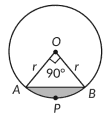
In the figure, segment $A P B$ is made by the chord $A B, \angle A O B=90^{\circ}$ is the angle subtended at the centre $O$ of the circle having radius $r.$
Area of the segment $A P B$
$=$ Area of the sector $\text{OAPB} -$ Area of the $\triangle O A B$
$=\frac{90^{\circ}}{360^{\circ}} \times \pi r^2-\frac{1}{2} \times r^2 \times \sin 90^{\circ}$
$=\frac{1}{4} \pi r^2-\frac{1}{2} \times r^2$
$=\left(\frac{\pi}{4}-\frac{1}{2}\right) r^2$ View full question & answer→MCQ 81 Mark
The diameter of a circle whose area is equal to the sum of the areas of two circles of radii $12\ cm$ and $5 \ cm$ is
- A
$30 \ cm$
- B
$15 \ cm$
- ✓
$26 \ cm$
- D
$25 \ cm$
AnswerCorrect option: C. $26 \ cm$
Let $R$ be the radius of the circle.According to question, we have
$\pi R^2=\pi(12)^2+\pi(5)^2$
$\Rightarrow \pi R^2=\pi(144+25)$
$\Rightarrow R^2=169$
$\Rightarrow R=13$
$\therefore$ Diameter of the required circle $=2 R=26 \ cm$
View full question & answer→MCQ 91 Mark
The circumference of a circle is equal to the sum of the circumferences of two circles having diameters $34 \ cm$ and $10 \ cm$. The radius of the new circle is
- A
$14 \ cm$
- B
$28 \ cm$
- ✓
$22 \ cm$
- D
$44 \ cm$
AnswerCorrect option: C. $22 \ cm$
Let $R$ be the radius of the new circle.Circumference of new circle
$=\left(2 \pi \times \frac{34}{2}+2 \pi \times \frac{10}{2}\right)$
$=2 \pi \times(17+5)=(2 \pi \times 22) \ cm$
$\Rightarrow 2 \pi R=2 \pi \times 22 $
$\Rightarrow R=22 \ cm$
$\therefore$ Radius of the new circle is $22 \ cm$.
View full question & answer→MCQ 101 Mark
If the area of a square is same as the area of a circle, then the ratio of their perimeters, in terms of $\pi$, is
- A
$\pi: \sqrt{3}$
- ✓
$2: \sqrt{\pi}$
- C
$3: \pi$
- D
$\pi: \sqrt{2}$
AnswerCorrect option: B. $2: \sqrt{\pi}$
Let $a$ be the side of the square and $r$ be the radius of the circle.
$\therefore a^2=\pi r^2$
$\Rightarrow \frac{a^2}{r^2}=\pi $
$\Rightarrow \frac{a}{r}=\sqrt{\pi}$
Now, required ratio $=\frac{4 a}{2 \pi r}=\frac{2 \sqrt{\pi}}{\pi}=\frac{2}{\sqrt{\pi}}=2: \sqrt{\pi}$
View full question & answer→MCQ 111 Mark
If the circumference of a circle increases from $4 \pi$ to $8 \pi$, then its area is
Answer(d) : Let $r$ and $R$ be the radii of original and new circles respectively.
$
\therefore \quad 2 \pi r=4 \pi \Rightarrow r=2
$
Also, $2 \pi R=8 \pi \Rightarrow R=4$
Now, area of original circle $=\pi r^2=\pi(2)^2=4 \pi$
Area of new circle $=\pi R^2=\pi(4)^2=16 \pi$
Hence, area of original circle is quadrupled.
View full question & answer→MCQ 121 Mark
The area of a circular path of uniform width $h$ surrounding a circular region of radius $r$ is
- A
$\pi(2 r+h) r$
- ✓
$\pi(2 r+h) h$
- C
$\pi(h+r) r$
- D
$\pi(h+r) h$
AnswerCorrect option: B. $\pi(2 r+h) h$
(b) : Here, radius of inner circle is $r$ and width of path is $h$.
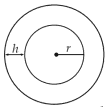
$\therefore \quad$ Radius of outer circle $=r+h$
Now, area of path $=\pi(r+h)^2-\pi r^2$
$=\pi\left(r^2+h^2+2 r h-r^2\right)=\pi(h+2 r) h$ View full question & answer→MCQ 131 Mark
A circular park has a path of uniform width around it. The difference between the outer and inner circumferences of the circular path is $132 m$. The width of path is
- A
$20 m$
- ✓
$21 m$
- C
$22 m$
- D
$24 m$
AnswerCorrect option: B. $21 m$
Let $R_1 m$ and $R_2 m$ be the radii of the outer and inner circular path.
$\therefore 2 \pi R_1-2 \pi R_2=132 $
$\Rightarrow R_1-R_2=\frac{132}{2 \pi}$
$\Rightarrow R_1-R_2=\frac{132 \times 7}{2 \times 22}=21$
Hence, the width of the path is $21 m$.
View full question & answer→MCQ 141 Mark
The radii of two concentric circles are $19 cm$ and $16 cm$ respectively. The area of the ring enclosed by these circles is
- A
$320 cm ^2$
- ✓
$330 cm ^2$
- C
$352 cm ^2$
- D
$350 cm ^2$
AnswerCorrect option: B. $330 cm ^2$
(b) : Let $R$ and $r$ be the outer and inner radius respectively.
Area of the ring $=\pi\left(R^2-r^2\right)=\pi(R+r)(R-r)$
$
=\left\{\frac{22}{7} \times(19+16)(19-16)\right\}=\left(\frac{22}{7} \times 35 \times 3\right)=330 cm ^2
$
View full question & answer→MCQ 151 Mark
A race track is in the form of a circular ring whose outer and inner circumferences are $396 m$ and $352 m$ respectively. The width of the track is
- A
$63 m$
- B
$56 m$
- ✓
$7 m$
- D
$3.5 m$
Answer(c) : Let $R$ and $r$ be the outer and inner radii of the track respectively.
$\therefore \quad 2 \pi R=396$
...(i) and $2 \pi r=352$Subtracting (ii) from (i), we get $2 \pi R-2 \pi r=396-352$
$\Rightarrow 2 \pi(R-r)=44$
$\therefore \quad$ Width of the track $=R-r=\frac{44}{2 \pi}=\frac{44}{\left(2 \times \frac{22}{7}\right)}=7 m$
View full question & answer→MCQ 161 Mark
A steel wire when bent in the form of a square enclosed an area of $121 cm ^2$. If the same wire is bent in the form of a circle, then the circumference of the circle is
- A
$88 cm$
- ✓
$44 cm$
- C
$22 cm$
- D
$11 cm$
AnswerCorrect option: B. $44 cm$
(b) : Let $a$ be the side of square.
$\therefore a^2=121 \Rightarrow a=11 cm$
$\therefore \quad$ Perimeter of square $=4 a=4 \times 11=44 cm$
$\therefore$ Circumference of the circle $=$ Perimeter of square $=44 cm$
View full question & answer→MCQ 171 Mark
The area of the sector of a circle of radius $R$ making a central angle of $x$ is
- A
$\frac{x}{180^{\circ}} \times 2 \pi R$
- B
$\frac{x}{360^{\circ}} \times 2 \pi R$
- C
$\frac{x}{180^{\circ}} \times \pi R^2$
- ✓
$\frac{x}{360^{\circ}} \times \pi R^2$
AnswerCorrect option: D. $\frac{x}{360^{\circ}} \times \pi R^2$
View full question & answer→MCQ 181 Mark
A sector of a circle of diameter $8 cm$ contains an angle of $135^{\circ}$. The area of the sector is
- ✓
$6 \pi cm ^2$
- B
$6 cm ^2$
- C
$12 \pi cm ^2$
- D
$20 cm ^2$
AnswerCorrect option: A. $6 \pi cm ^2$
(a) : Here, diameter $=8 cm$ and $\theta=135^{\circ}$
$\therefore \quad$ Area of sector $=\frac{\theta}{360^{\circ}} \times \pi r^2=\frac{135^{\circ}}{360^{\circ}} \times \pi\left(\frac{8}{2}\right)^2=6 \pi cm ^2$.
View full question & answer→MCQ 191 Mark
The sum of areas of a major sector and the corresponding minor sector of a circle is equal to
Answer(a) : The sum of the angles subtended by the minor and major sectors of the circle at the centre of the circle is $360^{\circ}$. So the sum of their areas is equal to area of the circle.
View full question & answer→MCQ 201 Mark
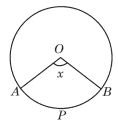
In the given figure, $O$ is the centre of the circle. The area of the sector $O A P B$ is $\frac{5}{12}$ part of the area of the circle. Find angle $x$.
- A
$130^{\circ}$
- B
$60^{\circ}$
- C
$45^{\circ}$
- ✓
$150^{\circ}$
AnswerCorrect option: D. $150^{\circ}$
(d): Given, area of sector $O A P B=\frac{5}{12} \times$ Area of circle $\Rightarrow \frac{x}{360^{\circ}} \times \pi r^2=\frac{5}{12} \times \pi r^2 \Rightarrow x=150^{\circ}$
View full question & answer→MCQ 211 Mark
A car has two wipers which do not overlap. Each wiper has a blade of length $42 cm$ sweeping through an angle of $120^{\circ}$. Find the total area cleaned at each sweep of the blades.
- A
$4224 cm ^2$
- ✓
$3696 cm ^2$
- C
$1848 cm ^2$
- D
$5544 cm ^2$
AnswerCorrect option: B. $3696 cm ^2$
(b): Clearly, each wiper sweeps a sector of a circle of radius $42 cm$ and central angle $120^{\circ}$.
$\therefore \quad$ Total area cleaned at each sweep $=2 \times \frac{\theta}{360^{\circ}} \times \pi r^2$ $=2 \times \frac{120^{\circ}}{360^{\circ}} \times \frac{22}{7} \times 42 \times 42 cm ^2=3696 cm ^2$
View full question & answer→MCQ 221 Mark
In a circle of diameter $70 cm$, if an are subtends an angle of $60^{\circ}$ at the centre, then length of are is
- A
$11 cm$
- B
$22 / 7 cm$
- ✓
$36.67 cm$
- D
$44 cm$
AnswerCorrect option: C. $36.67 cm$
(c) : Here, $r=\frac{70}{2} cm =35 cm$ and $\theta=60^{\circ}$
$\therefore \quad$ Length of $\operatorname{arc}=\frac{\theta}{360^{\circ}} \times 2 \pi r$
$
=\frac{60^{\circ}}{360^{\circ}} \times 2 \times \frac{22}{7} \times 35=2 \times 22 \times 5 \times \frac{1}{6}=36.67 cm
$
View full question & answer→MCQ 231 Mark
Priyanshu has a motor cycle with wheels of diameter $91 cm$. There are 22 spokes in the wheel. Find the length of are between two adjoining spokes.
- A
$26 cm$
- ✓
$13 cm$
- C
$15 cm$
- D
$18 cm$
AnswerCorrect option: B. $13 cm$
(b) : Radius of wheel $=\frac{91}{2} cm$
Angle between two adjoining spokes, $\theta=\frac{360^{\circ}}{22}$
$\therefore \quad$ Length of the arc $=\frac{\theta}{360^{\circ}} \times 2 \pi r$
$
=\frac{360^{\circ}}{360^{\circ} \times 22} \times 2 \times \frac{22}{7} \times \frac{91}{2}=13 cm
$
View full question & answer→MCQ 241 Mark
The radius of a circle is $18 cm$ and the angle subtended by an are of this circle at the centre is $40^{\circ}$. Find the length of this are.
- A
$\pi cm$
- B
$2 \pi cm$
- C
$3 \pi cm$
- ✓
$4 \pi cm$
AnswerCorrect option: D. $4 \pi cm$
(d) : Here, $r=18 cm , \theta=40^{\circ}$
Length of arc $=\frac{\theta}{360^{\circ}} \times 2 \pi r=\frac{40^{\circ}}{360^{\circ}} \times 2 \pi \times 18=4 \pi cm$
View full question & answer→MCQ 251 Mark
A pendulum swings through an angle of $60^{\circ}$ and describes an arc $8.8 cm$ in length. The length of pendulum is
- A
$4.2 cm$
- B
$2.1 cm$
- ✓
$8.4 cm$
- D
$6.3 cm$
AnswerCorrect option: C. $8.4 cm$
(c) : Let $r$ be the length of pendulum.
Length of an $\operatorname{arc}=\frac{\theta}{360^{\circ}} \times 2 \pi r$
$\Rightarrow \quad 8.8=\frac{60^{\circ}}{360^{\circ}} \times 2 \times \frac{22}{7} \times r \Rightarrow r=\frac{360^{\circ} \times 8.8 \times 7}{2 \times 22 \times 60^{\circ}}=8.4 cm$
View full question & answer→MCQ 261 Mark
Find the perimeter of a sector of a circle of radius $7 \ cm$ and central angle $45^{\circ}$.
- ✓
$19.5 \ cm$
- B
$39 \ cm$
- C
$14 \ cm$
- D
$7 \ cm$
AnswerCorrect option: A. $19.5 \ cm$
Here $r=7 \ cm , \theta=45^{\circ}$
Perimeter of sector $=2 r+$ length of arc of sector
$=2 r+\frac{\theta}{360^{\circ}} \times 2 \pi r=2 \times 7+\frac{45^{\circ}}{360^{\circ}} \times 2 \times \frac{22}{7} \times 7$
$=14+5.5=19.5 \ cm$
View full question & answer→MCQ 271 Mark
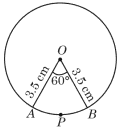
In given figure, there is a circle with centre $O$ and radius $3.5 cm$. If the central angle is $60^{\circ}$, then the length of $O A P B$ is (Take $\pi=3.14$ )
- A
$35 cm$
- B
$32.08 cm$
- ✓
$10.66 cm$
- D
$18.33 cm$
AnswerCorrect option: C. $10.66 cm$
(c) : Here, $r=3.5 cm , \theta=60^{\circ}$
Length of $O A P B=2 r+\frac{\theta}{360^{\circ}} \times 2 \pi r$
$
=2 \times 3.5+\frac{60^{\circ}}{360^{\circ}} \times 2 \times 3.14 \times 3.5=10.66 cm
$
View full question & answer→MCQ 281 Mark
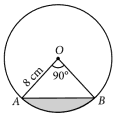
In the given figure, the shaded area is
- A
$50(\pi-2) \ cm ^2$
- ✓
$16(\pi-2) \ cm ^2$
- C
$16(\pi+2) \ cm ^2$
- D
$5(\pi-2) \ cm ^2$
AnswerCorrect option: B. $16(\pi-2) \ cm ^2$
We have, radius $=8 \ cm$ and $\theta=90^{\circ}$
$\therefore$ Area of minor segment $=$ Area of sector $-$ Area of $\triangle \text{A O B}$
$=\frac{\theta}{360^{\circ}} \times \pi r^2-\frac{1}{2} \times \text { base } \times \text { height }$
$=\frac{90^{\circ}}{360^{\circ}} \times \pi \times(8)^2-\frac{1}{2} \times 8 \times 8$
$=\frac{64}{4} \pi-32=16(\pi-2) \ cm ^2$
View full question & answer→MCQ 291 Mark
The number of revolutions made by a circular wheel of radius $0.25 m$ in rolling a distance of $11 km$ is
Answer(d) : In one revolution wheel covers distance of $2 \pi r$.So, in $n$ revolution it will cover $2 \pi r n$ distance.
$
\therefore S=2 \pi r n
$
According to question, $S=11 km , r=0.25 m$ so,
$
11 \times 1000=n \times 2 \times \frac{22}{7} \times 0.25 \Rightarrow n=7000
$
View full question & answer→MCQ 301 Mark
The area swept by $7 cm$ long minute hand of a clock in 10 minutes is
- A
$77 cm ^2$
- B
$12 \frac{5}{6} cm ^2$
- C
$7 \frac{1}{12} cm ^2$
- ✓
$25 \frac{2}{3} cm ^2$
AnswerCorrect option: D. $25 \frac{2}{3} cm ^2$
(d) : Angle formed by minute hand of a clock in 60 minutes $=360^{\circ}$
$\therefore \quad$ Angle formed by minute hand of a clock in 10 minutes $=\frac{10}{60} \times 360^{\circ}=60^{\circ}$
Length of minute hand of a clock $=$ radius $=7 cm$
$\therefore \quad$ Required area
$
=\pi r^2 \times \frac{\theta}{360^{\circ}}=\frac{22}{7} \times 7 \times 7 \times \frac{60^{\circ}}{360^{\circ}}=\frac{77}{3} cm ^2=25 \frac{2}{3} cm ^2
$
View full question & answer→MCQ 311 Mark
The area $\left(\right.$ in $cm ^2$ ) of the largest circle that can be inscribed in a square of side $12 cm$ is
- A
$6 \pi$
- B
$44 \pi$
- C
$12 \pi$
- ✓
$36 \pi$
AnswerCorrect option: D. $36 \pi$
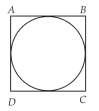
(d) : Let $A B C D$ be the square.

$\therefore \quad$ Diameter of circle $=$ Side of square $=12 cm$
$\therefore \quad$ Radius $(r)=\frac{12}{2}=6 cm$
$\therefore \quad$ Area of circle $=\pi r^2=\pi(6)^2=36 \pi cm ^2$ View full question & answer→MCQ 321 Mark
The length of an arc of a sector of radius $R$ making a central angle $x$ is
- A
$\frac{x}{180^{\circ}} \times 2 \pi R$
- ✓
$\frac{x}{360^{\circ}} \times 2 \pi R$
- C
$\frac{x}{180^{\circ}} \times \pi R^2$
- D
$\frac{x}{360^{\circ}} \times \pi R^2$
AnswerCorrect option: B. $\frac{x}{360^{\circ}} \times 2 \pi R$
View full question & answer→MCQ 331 Mark
If the sum of the areas of two circles with radii $R_1$ and $R_2$ is equal to the area of a circle of radius $R$, then
- A
$R_1+R_2=R$
- ✓
$R_1^2+R_2^2=R^2$
- C
$R_1+R_2
- D
$R_1^2+R_2^2
AnswerCorrect option: B. $R_1^2+R_2^2=R^2$
(b) : According to the given condition,
Circumference of circle of radius R
= Circumference of circle of radius $R_1$
+ Circumference of circle of radius $R_2$
$
\therefore \quad \pi R^2=\pi R_1^2+\pi R_2^2 \Rightarrow R^2=R_1^2+R_2^2
$
View full question & answer→MCQ 341 Mark
If the sum of the circumferences of two circles with radii $R_1$ and $R_2$ is equal to the circumference of a circle of radius $R$, then
- ✓
$R_1+R_2=R$
- B
$R_1+R_2>R$
- C
$R_1+R_2
- D
AnswerCorrect option: A. $R_1+R_2=R$
(a) : According to the given condition,Circumference of circle of radius $R$
$=$ Circumference of circle of radius $R_1$
+ Circumference of circle of radius $R_2$
$\therefore \quad 2 \pi R=2 \pi R_1+2 \pi R_2 \Rightarrow R=R_1+R_2$
View full question & answer→MCQ 351 Mark
The area of the circle that can be inscribed in a square of side $6 cm$ is
- A
$36 \pi cm ^2$
- B
$18 \pi cm ^2$
- C
$12 \pi cm ^2$
- ✓
$9 \pi cm ^2$
AnswerCorrect option: D. $9 \pi cm ^2$
(d) : Given, side of a square $=6 cm$
$\therefore \quad$ Diameter of a circle $(d)$
$=$ Side of square $=6 cm$
$\therefore \quad$ Radius of a circle $(r)=\frac{d}{2}=\frac{6}{2} cm =3 cm$
$\therefore \quad$ Area of a circle $=\pi r^2=\pi(3)^2$ $=9 \pi cm ^2$
View full question & answer→MCQ 361 Mark
The radius of a circle whose circumference is equal to the sum of the circumferences of the two circles of diameters $36 cm$ and $20 cm$ is
- A
$56 cm$
- B
$42 cm$
- ✓
$28 cm$
- D
$16 cm$
AnswerCorrect option: C. $28 cm$
(c) : We have,
Circumference of new circle $=$ Circumference of first circle + Circumference of second circle
$\Rightarrow \pi d=36 \pi+20 \pi \quad$ [where $d$ is diameter of new circle]
$\Rightarrow d=56$
$\therefore$ Required radius of circle $=\frac{56}{2} cm =28 cm$
View full question & answer→MCQ 371 Mark
If the difference between the circumference and the radius of a circle is $37 cm$, then using $\pi=\frac{22}{7}$, the circumference (in $cm$ ) of the circle is
Answer(b) : Let $r$ be the radius of the circle. Circumference of the circle $=2 \pi r$
$\therefore \quad$ According to question, $2 \pi r-r=37 cm$
$\Rightarrow r(2 \pi-1)=37$
$\Rightarrow r\left(2 \times \frac{22}{7}-1\right)=37 \Rightarrow r \times \frac{37}{7}=37$
$\Rightarrow \quad r=7 cm$
$\therefore$ Circumference of the circle $=2 \times \frac{22}{7} \times 7=44 cm$
View full question & answer→MCQ 381 Mark
If the perimeter and the area of a circle are numerically equal, then the radius of the circle is
Answer(a) : Let $r$ be the radius of the circle.Given, perimeter of the circle $=$ Area of the circle
$
\Rightarrow 2 \pi r=\pi r^2 \Rightarrow 2=r
$
View full question & answer→MCQ 391 Mark
The radii of two circles are $8 cm$ and $6 cm$ respectively. The diameter of the circle having area equal to the sum of the areas of the two circles (in cm) is
Answer(c) : Let the radius of the required circle be $r cm$.
Area of required circle $=$ Area of circle of radius $8 cm +$ Area of circle of radius $6 cm$
$\Rightarrow \pi r^2=\pi(8)^2+\pi(6)^2$
$\Rightarrow r^2=64+36 \Rightarrow r^2=100 \Rightarrow r=10 cm$
Required diameter $=2 \times 10=20 cm$
View full question & answer→MCQ 401 Mark
If the area of a circle is numerically equal to twice its circumference, then the diameter of the circle is
Answer(c) : Let radius of the circle be $r$ units.According to given condition,
Area of circle $=2 \times$ Circumference of circle
$\Rightarrow \pi r^2=2 \times 2 \pi r \Rightarrow r^2=4 r \Rightarrow r(r-4)=0$
$\Rightarrow \quad r=4 \quad(\because r \neq 0)$
$\therefore$ Diameter of the circle $=2 r=8$ units
View full question & answer→MCQ 411 Mark
The circumference of a circle is $22 cm$. The area of its quadrant (in $cm ^2$ ) is
- A
$\frac{77}{2}$
- B
$\frac{77}{4}$
- ✓
$\frac{77}{8}$
- D
$\frac{77}{16}$
AnswerCorrect option: C. $\frac{77}{8}$
(c) : Let the radius of the circle be $r cm$.Given circumference of circle, $2 \pi r=22 cm$
$\Rightarrow r=\frac{22 \times 7}{2 \times 22} \Rightarrow r=\frac{7}{2}$
Area of quadrant of circle $=\frac{1}{4} \pi r^2=\frac{1}{4} \times \frac{22}{7} \times \frac{7}{2} \times \frac{7}{2}$
$
=\frac{77}{8} cm ^2
$
View full question & answer→MCQ 421 Mark
Find the area of a semi circle, where the circumference of circle is $44 cm$. [Use $\left.\pi=\frac{22}{7}\right]$
- A
$38.5 cm ^2$
- ✓
$77 cm ^2$
- C
$60 cm ^2$
- D
$154 cm ^2$
AnswerCorrect option: B. $77 cm ^2$
(b) : Let the radius of the circle be $r$.
Given, circumference of the circle, $2 \pi r=44 cm$
$
\Rightarrow 2 \times \frac{22}{7} \times r=44 \Rightarrow r=7 cm
$Now, area of a semi circle $=\frac{1}{2} \times \pi r^2=\frac{1}{2} \times \frac{22}{7} \times(7)^2$
$
=77 cm ^2
$
View full question & answer→MCQ 431 Mark
If the area of a circle is $A$, radius of the circle is $r$ and circumference of it is $C$, then
AnswerCorrect option: A. $r C=2 A$
(a) : $A=\pi r^2=\frac{r \times 2 \pi r}{2}=\frac{r C}{2} \Rightarrow 2 A=r C$
View full question & answer→MCQ 441 Mark
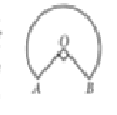
In the given figure, the shape of the top of a table is that of a sector of a circle with centre $O$ and $\angle A O B=90^{\circ}$. If $A O=O B=42 cm$, then find the perimeter of the top of the table. $\left[\right.$ Use $\left.\pi=\frac{22}{7}\right]$|
- A
$150 cm$
- B
$250 cm$
- ✓
$282 cm$
- D
$182 cm$
AnswerCorrect option: C. $282 cm$
(c) : Given, radius $(r)$ of the table $=42 cm$ and $\angle A O B=90^{\circ}$
Perimeter of top of the table $=\frac{2 \pi r \theta}{360^{\circ}}+2 r$ (where $\theta=360^{\circ}-90^{\circ}=270^{\circ}$ ) $=2 \times \frac{22}{7} \times 42 \times \frac{270^{\circ}}{360^{\circ}}+2(42)=198+84=282 cm$
View full question & answer→MCQ 451 Mark
If an are subtending an angle of $75^{\circ}$ at the centre of a circle A and another are subtending an angle of $55^{\circ}$ at the centre of circle B. are of same length, then the ratio of area of circle A to that of circle B is
Answer(c) : Let $r_1$ and $r_2$ be the radii of circles $A$ and $B$ respectively.
$
\begin{aligned}
& \therefore \quad \frac{2 \pi r_1 \times 75^{\circ}}{360^{\circ}}=\frac{2 \pi r_2 \times 55^{\circ}}{360^{\circ}} \Rightarrow \frac{r_1}{r_2}=\frac{55^{\circ}}{75^{\circ}}=\frac{11}{15} \\
& \therefore \text { Ratio of areas }=\frac{\pi r_1^2}{\pi r_2^2}=\left(\frac{r_1}{r_2}\right)^2=\left(\frac{11}{15}\right)^2=\frac{121}{225}
\end{aligned}
$
View full question & answer→