Question 513 Marks
Two $A.P.s$ have the same common difference. The first term of one $A.P.$ is $2$ and that of the other is $7.$ The difference between their $10^{th}$ terms is the same as the difference between their $21^{st}$ terms, which is the same as the difference between any two corresponding terms. Why$?$
AnswerFirst term of $1^{st} A.P.$ is $2.$
First term of $2^{nd} A.P.$ is $7.$
Consider the difference of their $10^{th}$ terms.
$a_{10}- a'_{10}= a + 9d - a' - 9d'$
$= a -a' + 9d - 9d'$
$= 2 - 7 + 0 [d = d']$
$= -5$
$a_{21} - a'_{21}= a + 20d - a' - 20d'$
$= a - a' + 20d - 20d'$
$= 2 - 7 + 0 [d = d']$
$= -5$
Therefore, $a_{10} - a'_{10}= a_{21} -a'_{21}$
The difference between any two corresponding terms of $A.P's$ in same as the difference between their terms.
View full question & answer→Question 523 Marks
In a school, students decided to plant trees in and around the school to reduce air pollution. It was decided that the number of trees, that each section of each class will plant, will be double of the class in which they are studying. If there are $1$ to $12$ classes in the school and each class has two sections, find how many trees were planted by the students.
AnswerClasses: $I + II + III + .... + XII$
Sections: $2(I) + 2(II) + 2(III) + ..... + 2(XII)$
Total nos. of trees
$= (2 × 2) + (2 × 4) + (2 × 6) + ..... + (2 × 24)$
$= 4 + 8 + 12 + ..... + 48$ Here $a_1= 4$
$\therefore\ \text{S}_{12}=\frac{12}{2}(4+48)$
$= 6(52) n = 12$
$= 312 $ trees
Here $a_1= 4$
$a_n= 48$
$n = 12$
$\text{S}_\text{n}=\frac{\text{n}}{2}(\text{a}_1+\text{a}_\text{n})$
Value: We should care for our environment and love nature.
View full question & answer→Question 533 Marks
Write the value of $a_{30}-a_{10}$ for the A.P. $4, 9, 14, 19, .....$
AnswerGiven,
A.P. $4, 9, 14, 19, .....$
Here, First term $a = 4$
and Difference $d = 9 - 4 = 5$
We know,
$ a_n=a+(n-1) d $
$ 30^{\text {th }} \text { term } $
$ a_{30}=4+(30-1) 5 $
$ \Rightarrow a_{30}=4+29 \times 5 $
$ \Rightarrow a_{30}=4+145 $
$ \Rightarrow a_{30}=149 $
$ 10^{\text {th }} \text { term. } $
$ a_{10}=4+(10-1) 5 $
$ \Rightarrow a_{10}=4+9 \times 5 $
$ \Rightarrow a_{10}=4+45 $
$ \Rightarrow a_{10}=49$
Now, we have to find $a_{30}-a_{10}$
$ \Rightarrow a_{30}-a_{10}=149-49 $
$ \Rightarrow a_{30}-a_{10}=100$
Hence, value of $a_{30}-a_{10}$ is $100 .$
View full question & answer→Question 543 Marks
Write the expression $a_n- a_k$ for the $A.P. a, a + d, a + 2d, ...$
Hence, find the common difference of the $A.P.$ for which,
$a_{10}- a_5= 200.$
AnswerWe know,
$a_n=a+(n-1) d $
$ \text { Let, } $
$ n^{\text {th }} \text { term } a_n=a+(n-1) d $
$ \Rightarrow a_n=a+n d-d $
$ k^{\text {th }} \text { term, } a_k=a+(k-1) d $
$ \Rightarrow a_k=a+k d-d$
Now,
$ \Rightarrow a_n-a_k=(a+n d-d)-(a+k d-d) $
$ \Rightarrow=a+n d-d-a-k d+d $
$ \Rightarrow=n d-k d $
$ \Rightarrow=d(n-k)$
Given,
$a_{10}-a_5=200$
From $(1) a_{10}-a_5=(10-5) d$
$200=5 \times d$
$\text{d}=\frac{200}{5}=40\Rightarrow\ \text{d}=40$
View full question & answer→Question 553 Marks
How many terms of the sequence $18, 16, 14, .....$ should be taken so that sum is zero?
AnswerGiven A.P.
$18, 16, 14, .....$
Sum, $S_n= 0$
Here, First term $a = 18$
and Difference $d = 16 - 18 = -2$
We know,
$\text{S}_\text{n}=\frac{\text{n}}{2}\Big[2\text{a}+(\text{n}-1)\text{d}\Big]$
$\Rightarrow\ 0=\frac{\text{n}}{2}[2(18)+(\text{n}-1)(-2)]$
$⇒ 0 = n[36 - 2n + 2]$
$⇒ 0 = n[38 - 2n]$
$⇒ 0 = 38 - 2n$
$⇒ 2n = 38$
$⇒ n = 19$
Hence, Sum of $19$ terms is zero.
View full question & answer→Question 563 Marks
Let there be an $A.P.$ with first term $'a',$ common difference $'d'.$ If $a_n$ denotes in $n^{th}$ term and $S_n$ the sum of first $n$ terms, find.
$a,$ if $a_n= 28, S_n= 144$ and $n = 9.$
Answer$ a_n=28, S_n=144, n=9 $
$ a_n=a+(n-1) d $
$ \Rightarrow a_9=a+(9-1) d=a+8 d$
$a + 8d = 28 .....(i)$
$\text{S}_\text{n}=\frac{\text{n}}{2}[\text{a}+\text{l}]\Rightarrow\ \frac{9}{2}(\text{a}+28)=144$
$\Rightarrow\ \text{a}+28=\frac{144\times2}{9}=32$
$\text{a}=32-48=4$
$\therefore$ From $(i)$
$4+8\text{d}=28\Rightarrow\ 8\text{d}=28-4=24$
$\Rightarrow\ \text{a}=\frac{24}{8}=3$
Hence $a = 4.$
View full question & answer→Question 573 Marks
How many multiples of $4$ lie between $10$ and $250?$
AnswerLet,
Multiple of $4$ lie between $10$ and $250$
$12, 16, 20, ..... 248$
we know $a_n= a+ (n - 1)d$
Here,
First term $a= 12$
Difference $d = 16 - 12 = 4$
$ \text { and Last } \mathrm{n}^{\text {th }} \text { term } \mathrm{a}_{\mathrm{n}}=248 $
$ \text { Then, } \mathrm{a}_{\mathrm{n}}=\mathrm{a}+(\mathrm{n}-1) \mathrm{d} $
$ \Rightarrow 248=12+(\mathrm{n}-1) 4 $
$ \Rightarrow 248=12+4 \mathrm{n}-4 $
$ \Rightarrow 4 \mathrm{n}=248-12+4 $
$ \Rightarrow 4 \mathrm{n}=240 $
$ \Rightarrow \mathrm{n}=60$
Hence, multiple of $4$ lies between $10$ and $250$ is $60.$
View full question & answer→Question 583 Marks
Write the common difference of an A.P. whose $n^{th}$ term is $a_n= 3n + 7.$
AnswerGiven,
$a_n=3 n+7$
Puting $n=1,2,3, \ldots .$.
$ a_1=3(1)+7=3+7=10 $
$ a_2=3(2)+7=6+7=13 $
$ \text { and } a_3=3(3)+7=9+7=16$
Now, Common difference
$ d=a_2-a_1=13-10=3 $
$ d=a_3-a_2=16-13=3$
Hence, common difference is $3.$
View full question & answer→Question 593 Marks
Find the sum of all integers between $100$ and $550,$ which are divisible by $9.$
AnswerAll integers between $100$ and $550$ which are divisible by $9$ are
$108, 117, 126, 135, ....., 549$
Where $a = 108, d = 9$ and $l = 549$
$\therefore a_n= a + (n - 1)d$
$⇒ 549 = 108 + (n - 1) × 9$
$⇒ 549 = 108 + 9n - 9$
$⇒ 9n = 549 - 108 + 9 = 558 - 108 = 450$
$\therefore\ \text{n}=\frac{450}{9}=50$
$\therefore\ \text{S}_\text{n}=\frac{\text{n}}{2}[\text{a}+\text{l}]$
$\Rightarrow\ \text{S}_{20}=\frac{50}{2}[108+549]$
$=25(657)=16425$
View full question & answer→Question 603 Marks
Write $5^{th}$ term from the end of the $ A.P. 3, 5, 7, 9, ....., 201$
AnswerGiven,
$A.P, 3, 5, 7, 9, ..... 201$
Here, First term $a = 3$
Difference $d = 5 - 3 = 2$
and Last term $a_n= 201$
We knaw,
$a_n= a + (n - 1)d$
$⇒ 201 = 3 + (n - 1)2$
$⇒ 201 = 3 + 2n - 2$
$⇒ 201 = 1 + 2n$
$⇒ 2n = 201 - 1$
$⇒ 2n = 200$
$\Rightarrow\ \text{n}=\frac{100}{2}$
$⇒ n = 100$
Now, we have to find $5^{\text {th }}$ term from the end $100^{\text {th }}-4^{\text {th }}=96^{\text {th }}$
$ a_n=a+(n-1) d $
$ \Rightarrow a_{96}=3+(96-1) 2 $
$ \Rightarrow a_{96}=3+95 \times 2 $
$ \Rightarrow a_{96}=3+190 $
$ \Rightarrow a_{96}=193$
Hence, $5^{\text {th }}$ term from the end of given $A.P.$ is $193.$
View full question & answer→Question 613 Marks
The first and the last terms of an $A.P.$ are $17 $and $350$ respectively. If the common difference is $9,$ how many terms are there and what is their sum$?$
AnswerGiven,
$a = 17, l = 350, d = 9$
$l = a_n= a + (n - 1)d$
$350 = 17 + (n - 1)9$
$333 = (n - 1)9$
$\text{n}-1=\frac{333}{9}=37$
$\text{n}=38$
$\therefore 38$ terms ate there
$\text{S}_\text{n}=\frac{\text{n}}{2}\{\text{a}+\text{l}\}$
$\text{S}_{38}=\frac{38}{2}(17+350)$
$=19\times367$
$\therefore\ \text{S}_\text{38}=6973$
View full question & answer→Question 623 Marks
In which of the following situations, the sequence of numbers formed will form an $A.P.?$
Divya deposited $Rs. 1000$ at compound interest at the rate of $10\%$ per annum. The amount at the end of first year, second year, third year, ...., and so on.
AnswerAAmount ar the end of the $1^{\text {st }}$ year $=Rs. 1100$
Amount at the end of the $2^{\text {nd }}$ year $=Rs. 1210$
Amount at the end of $3^{\text {rd }}$ year $= Rs. 1331$ and so on.
So, the amount $($in $Rs.)$ at the end of $1^{\text {st }}$ year, $2^{\text {nd }}$ year, $3^{\text {rd }}$ year, ..... are
$1100,1210,1331, \ldots .$.
Here, $a_2-a_1=110$
$a_3-a_2=121$
As $\text{a}_2-\text{a}_1\neq\text{a}_3-\text{a}_2,$ it does not from an $AP.$
View full question & answer→Question 633 Marks
For the following arithmetic progressions write the first term a and the common difference d:
$0.3, 0.55, 0.80, 1.05, ....$
Answer$0.3, 0.55, 0.80, 1.05, .....$
Here first term $(a) = 0.3$
We have $=a_2-a_1=0.55-0.3=0.25$
$a_3-a_2=0.80-0.55=0.25$
$\therefore$ Common difference $= 0.25.$
View full question & answer→Question 643 Marks
Sum of the first $14$ terms of an $A.P$. is $1505$ and its first term is $10$. Find its $25^{th}$ term.
AnswerSum of first $14$ terms of an $A.P. = 1505$
First term $(n) = 10$
$\text{S}_\text{n}=\frac{\text{n}}{2}[2\text{a}+(\text{n}-1)\text{d}]$
$\text{S}_{14}=\frac{14}{2}[2\times10+(14-1)\text{d]}$
$\Rightarrow\ 1505=7(20+13\text{d})$
$\Rightarrow\ 1505=140+91\text{d}$
$\Rightarrow\ 91\text{d}=1505-140=1365$
$\text{d}=\frac{+1365}{91}=+15$
$\therefore\ \text{T}_{25}=\text{a}+(\text{n}-1)\text{d}$
$=10+(25-1)(15)$
$=10+24\times(+15)=10+360=370$
View full question & answer→Question 653 Marks
The sum of $5^{\text {th }}$ and $9^{\text {th }}$ terms of an $A.P.$ is $30 .$ If its $25^{\text {th }}$ term is three times its $8^{\text {th }}$ term, find the $A.P.?$
AnswerLet $a$ be the first term and $d$ be the common difference.
We know that, $n^{th}$ term $= a_n= a + (n - 1)d$
According to the question,
$a_5+ a_9= 30$
$⇒ a + (5 - 1)d + a + (9 - 1)d = 30$
$⇒ a + 4d + a + 8d = 30$
$⇒ 2a + 12d = 30$
$⇒ a + 6d = 15 .....(1)$
Also,
$a_{25}= 3(a_8)$
$⇒ a + (25 - 1) d = 3[a + (8 - 1)d]$
$⇒ a + 24d = 3a - 21d$
$⇒ 3a - a = 24d - 21d$
$⇒ 2a = 3d$
$\text{a}=\frac{3}{2}\text{d}\ .....(\text{ii})$
Substituting the value of $(ii)$ in $(i),$ we get
$\frac{3}{2}\text{d}+6\text{d}=15$
$⇒ 3d + 12d = 15 × 2$
$⇒ 15d = 30$
$⇒ d = 2$
$\Rightarrow\ \text{a}=\frac{3}{2}\times2\ [\text{From (ii)}]$
$\Rightarrow\ \text{a}= 3$
Thus, the $A.P.$ is $3, 5, 7, 9, .....$
View full question & answer→Question 663 Marks
Find the sum of,
All $3$ - digit natural numbers, which are multiples of $11.$
AnswerWe know that the first $3$ digit number multiples of $11$ will be $110.$
Last 3 digit number multiple of $11$ will be $990.$
So here,
First term $(a) = 110$
Last term $(l) = 990$
Common difference $(d) = 11$
So, here the first step is to find total number of terms.Let us take the number of terms as $n.$
Now, as we know,
$a_n= a + (n - 1)d$
So, for the last term,
$990 = 110 + (n - 1)11$
$990 = 110 + 11n - 11$
$990 = 99 + 11n$
$891 = 11n$
$81 = n$
Now, using the formula for the sum of terms, we get
$\text{S}_{\text{n}}=\frac{81}{2}[2(110)+(81-1)11]$
$\text{S}_{81}=\frac{81}{2}[220+80\times11]$
$\text{S}_{81}=\frac{81}{2}\times1100$
$\text{S}_\text{n}=81\times550$
$\text{S}_{81}=44550$
Therefore, the sum of all the $3$ digit multiples of $11$ is $44550.$
View full question & answer→Question 673 Marks
The first and the last term of an $A.P.$ are $17$ and $350$ respectively. If the common difference is $9,$ how many terms are there and what is their sum$?$
Answer$a = 17$ and $ l = 350, d = 9$
Let number of term of the $A.P. = n$
$a_n=a+(n-1) d$
$350 = 17 + (n - 1) × 9 = 17 + 9n - 9$
$350 = 8 + 9n$
$9n = 350 - 8 = 342$
$\therefore\ \text{n}=\frac{342}{9}=38$
$\therefore$ Number of terms $= 38$
$\text{S}_\text{n}=\frac{\text{n}}{2}[2\text{a}+(\text{n}-1)\text{d}]$
$=\frac{38}{2}[2\times17+37\times9]=19[34 + 333]$
$=19\times367=6973$
View full question & answer→Question 683 Marks
Find the sum of first $20$ terms of the sequence whose $n^{th}$ term is $a_n= An + B.$
Answer$ n^{\text {th }} \text { term }=a_n=A n+B \text { and number of terms }=20 $
$ \therefore a_1=A \times 1+B=A+B $
$ a_2=A \times 2+B=2 A+B $
$ a_3=A \times 3+B=3 A+B$
$\therefore$ First term $(a) = A + B$
Common difference $= a_2 - a_1$
$= 2A + B - A - B = A$
$\therefore\text{S}_\text{n}=\frac{\text{n}}{2}[2\text{a}+(\text{n - 1}\text{d}]$
$\text{S}_{20}=\frac{20}{2}\Big[2(\text{A}+\text{B})+(20 -1)\text{A}]$
$=10[2\text{A}+2\text{B}+19\text{A}]$
$=10[21\text{A}+2\text{B}]=210\text{A}+20\text{B}$
View full question & answer→Question 693 Marks
Write the first five terms of the following sequences whose $n^{th}$ terms are:
$a^n=(-1)^n 2^n$
Answer$a^n=(-1)^n 2^n$
Here, the $\mathrm{n}^{\text {th }}$ term is given by the above expression. So, to find the first term we use $\mathrm{n}=1$, we get,
$ a_1=(-1)^1 \cdot 2^1 $
$ =(-1) \cdot 2 $
$ =-2$
Similarly, we find the other four terms,
$ \text { Second term }(n=2), $
$ a_2=(-1)^2 \cdot 2^2 $
$ =1.4 $
$ =4 $
$ \text { Third term }(n=3) $
$ a_3=(-1)^3 \cdot 2^3 $
$ =(-1) \cdot 8 $
$ =-8$
Fourth term $(n=4)$,
$ a_4=(-1)^4 \cdot 2^4 $
$ =1.16 $
$ =16$
Fifth term $(\mathrm{n}=5)$,
$ a_5=(-1)^5 \cdot 2^5 $
$ =(-1) \cdot 32 $
$ =-32$
Therefore, the first five terms of the given A.P are $a_1=-2, a_2=4, a_3=-8, a_4=16, a_5=-32$.
View full question & answer→Question 703 Marks
Write time first five terms of the following sequances whose $n^{th}$ terms are:
$a_n= 3n + 2$
Answer$a_n= 3n + 2$
Let $n = 1, 2, 3, 4, 5,$ them
First five terms,
$ a_1=3 \times 1+2=3+2=5 $
$ a_2=3 \times 2+2=6+2=8 $
$ a_3=3 \times 3+2=9+2=11 $
$ a_4=3 \times 4+2=12+2=14 $
$ a_5=3 \times 5+2=15+2=17$
View full question & answer→Question 713 Marks
The sum of three terms of an $A.P.$ is $21$ and the product of the first and the third terms exceeds the second term by $6,$ find three terms.
AnswerGiven,
Sum of three terms of on $A.P.$ is $21.$
Product of first and the third term exceeds the secomd term by $6.$
Let, the three numbers be $a - d, a, a + d,$ with common differnce $d:$ then,
$(a - d) + a + (a + d) = 21$
$3a = 21$
$\text{a}=\frac{21}{3}=7$
and $(a - d)(a + d) = a + 6$
$a^2- d^2= a + 6$
Put $a = 7 ⇒ 7^2- d^2= 7 + 6$
$49 - 13 = d^2$
$d^2= 36$
$\text{d}=\sqrt{36}$
$\text{d}=\pm6$
$\therefore$ The three terms are $a - d, a, a + d, $ i.e., $1, 7, 13.$
View full question & answer→Question 723 Marks
In which of the following situations, the sequence of numbers formed will form an A.P.?
The amount of air present in the cylinder when a vacuum pump removes each time $\frac{1}{4}$ of the remaining in the cylinder.
AnswerHere, let us take initial amount of air present in the cylinder as 100 units.
Amount left after vacuum pump removes air for $1^{st}$ time $=100-\Big(\frac{1}{4}\Big)100$
$= 100 - 25 = 75$
Amount left after vacuum pump removes air for $2^{nd}$ time $=75-\Big(\frac{1}{4}\Big)75$
$= 75 - 18.75 = 56.25$
Amount left after vacuum pump removes air fir $3^{rd}$ time $=56.25-\Big(\frac{1}{4}\Big)56.25$
$= 56.25 - 14.06 = 42.19$
Thus, the amount left in the cylinder at various stages is $100, 75, 56.25, 42.19, .....$
Now, for a sequence to be an A.P., the difference between adjecent terms should be equal.
Here,
$a_1- a = 75 - 100 = -25$
Also,
$a_2- a_1= 56.25 - 75 = -18.75$
Since, $\text{a}_2-\text{a}\neq\text{a}_2-\text{a}_1$
The sequence is not an A.P.
View full question & answer→Question 733 Marks
The first term of an $A.P.$ is $5,$ the common difference is $3$ and the last term is $80?$
AnswerThe First term of an A.P. $(a) = 5$
Common difference $(d) = 3$
Last term $= 80$
Let the last term be $n^{th}$
$a_n= a + (n - 1) d$
$⇒ 80 = 5 + (n - 1) × 3$
$⇒ 80= 5 + 3n - 3$
$⇒ 3n = 80 - 5 + 3 = 78$
$⇒ n = 26$
Number of terms $= 26$
View full question & answer→Question 743 Marks
Find the sum of,
All $2$ - digit natural numbers divisible by $4.$
AnswerWe can see it forms an $A.P.$ as the common difference is $4$ and the first term is $4.$
To find no. of terms $n,$
We know that
$a_n= a + (n - 1)d$
$96 = 12 + (n - 1)4$
$84 = (n - 1)4$
$21 = n - 1$
$22 = n$
Now,
First term $(a) = 12$
Number of terms $(n) = 22$
Common difference $(d) = 4$
Now, using the formula for the sum of n terms, we get
$\text{S}_{22}=\frac{22}{2}\{2(12)+(22-1)4\}$
$\text{S}_{22}=11\{24+84\}$
$\text{S}_{22}=1188$
Hence, The sum of $22$ terms is $1188$ which are divisible by $4.$
View full question & answer→Question 753 Marks
For the following arithmetic progressions write the first term a and the common difference d:
$-1.1, -3.1, -5.1, -7.1, .....$
Answer$-1.1, -3.1, -5.1, -7.1, .....$
Here first term $(a) = -1.1$
We have $= a_2- a_1= -3.1 - (-1.1)$
$= -3.1 + 1.1 = -2.0$
$ a_3-a_2=-5.1-(-3.1)=-5.1+3.1=-2.0 $
$a_4-a_3=-7.1-(-5.1)=-7.1+5.1=-2.0$
$\therefore$ Common difference $= -2.0.$
View full question & answer→Question 763 Marks
In which of the following situations, the sequence of numbers formed will form an $A.P.?$
The cost of digging a well for the first metre is $Rs. 150$ and rises by $Rs. 20$ for each succeeding metre.
AnswerCost of digging a well for the first metre $= Rs. 150$
Cost for the second metre $= Rs. 150 + Rs. 20 = Rs. 170$
Cost for the third metre $= Rs. 170 + Rs. 20 = Rs. 190$
Cost for the fourth metre $= Rs. 190 + Rs. 20 = Rs. 210$
The sequence will be $($in rupees$)$
$150, 170, 190, 210, .....$
Which is an $A.P.$
Whose $= 150$ and $d = 20.$
View full question & answer→Question 773 Marks
Write the expression of the common difference of an A.P. whose first term is a and $n^{th}$ term is b.
AnswerHere, we are given
First term $= a$
Last term $= b$
Let us take the common difference as d
Now, we know
$a_n= a + (n - 1)d$
So,
For the last term $(a_n),$
$b = a + (n - 1)d$
$b - a = (n - 1)d$
$\text{d}=\frac{\text{b}-\text{a}}{\text{n}-1}$
Therefore, common difference of the A.P. is $\text{d}=\frac{\text{b}-\text{a}}{\text{n}-1}$.
View full question & answer→Question 783 Marks
For what value of $n,$ the $n^{th}$ terms of the arithmetic progressions $63, 65, 67, ...$ and $3, 10, 17, ...$ are equal?
AnswerIn the A.P. $63, 65, 67, .....$
$a = 63$ and $d = 65 - 63 = 2$
$a_n= a_1+ (n - 1)d = 63 + (n - 1) × 2 = 63 + 2n - 2 = 61 + 2n$
and in the A.P. $3, 10, 17, .....$
$a = 3$ and $ d = 10 - 3 = 7$
$a_n= a + (n - 1)d = 3 + (n - 1) × 7 = 3 + 7n - 7 = 7n - 4$
But both $n^{th}$ terms are equal
$61 + 2n = 7n - 4$
$⇒ 61 + 4 = 7n - 2n$
$⇒ 65 = 5n$
$⇒ n = 13$
$n = 12.$
View full question & answer→Question 793 Marks
The third term of an $A.P.$ is $7$ and the seventh term exceeds three times the third term by $2.$ Find the first term, the common difference and the sum of first $20$ terms.
AnswerGiven,
$ a_3=7 \text { and } 3 a_3+2=a_7 $
$ a_7=3 \times 7+2 $
$ a_7=21+2=23 $
$ \therefore a_n=a+(n-1) d $
$ a_3=a+(3-1) d \text { and } a_7=a+(7-1) d$
$7 = a + 2d .....(i)$
$23 = a + 6d .....(ii)$
Subtract $(i)$ from $(ii)$
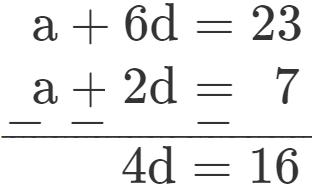
$d = 4$
Put $d = 4$ in $(i) ⇒ 7 = a + 2.4$
$a = 7 - 8 = -1$
Given to find sum of first $20$ terms.
$\text{S}_{20}=\frac{20}{2}\big[-2+(20-1)4\big]$
$=10(-2+76)$
$\therefore\ \text{S}_{20}=740$ View full question & answer→Question 803 Marks
Write the first five terms of the following sequences whose $n^{th}$ terms are:
$\text{a}_\text{n}=\frac{3\text{n}-2}{5}$
Answer$\text{a}_\text{n}=\frac{3\text{n}-2}{5}$
Let $n = 1, 2, 3, 4, 5,$ then
$\text{a}_1=\frac{3\times1-2}{5}=\frac{3-2}{5}=\frac{1}{5}$
$\text{a}_2=\frac{3\times2-2}{5}=\frac{6-2}{5}=\frac{4}{5}$
$\text{a}_3=\frac{3\times3-2}{5}=\frac{9-2}{5}=\frac{7}{5}$
$\text{a}_4=\frac{3\times4-2}{5}=\frac{12-2}{5}=\frac{10}{5}=2$
$\text{a}_5=\frac{3\times5-2}{5}=\frac{15-2}{5}=\frac{13}{5}$
View full question & answer→Question 813 Marks
Write the sequence with $n^{th}$ term:
$a_n= 6 - n.$
Show the all of the above sequences form $A.P.$
Answer$a_n= 6 - n$
Now, to show that it is an $A.P,$ we will find its few terms by substituting $n = 1, 2, 3$
So, Substituting $n = 1,$ we get
$ a_1=6-1 $
$ a_1=5$
Substituting $\mathrm{n}=2$, we get
$ a_2=6-2 $
$ a_2=4$
Substituting $\mathrm{n}=3$, we get
$ a_3=6-3 $
$ a_3=3$
Further, for the given to sequence to be an $A.p,$
$\text { Common difference }(\mathrm{d})=\mathrm{a}_2-\mathrm{a}_1=\mathrm{a}_3-\mathrm{a}_2$
Here,
$ a_2-a_1=4-5 $
$ =-1$
Also,
$ a_3-a_2=3-4 $
$ =-1$
Since $a_2-a_1=a_3-a_2$
Hence, the given sequence is an $A.P.$
View full question & answer→Question 823 Marks
A piece of equipment cost a certain factory $Rs. 60,000.$ If it depreciates in value, $15\%$ the first, $13.5\%$ the next year, $12\%$ the third year, and so on. What will be its value at the end of $10$ years, all percentages applying to the original cost$?$
AnswerCost of a piece of equipment $= Rs. 600,000$
Rate of depreciation for the first year $= 15\%$
For the second year $= 13.5\%$
For the third year $= 12.0\%$ and so on
The depreciation is in $A.P.$
Whose first term $(a) = 15$
and common difference $(d) = 13.5 - 15.0 = -1.5$
Period $(n) = 10$
$\therefore$ Total depreciation % $(\text{S}_\text{n})=\frac{\text{n}}{2}[2\text{a}+(\text{n}-1)\text{d}]$
$=\frac{10}{2}[2\times15+(10-1)(-1.5)]$
$=5[30+9\times(-1.5)]$
$=5[30-13.5]=5\times16.5=82.5$
$\therefore$ Total depreciation $=\frac{600000\times82.5}{100}$
$= Rs. 495000$
$\therefore$ Its value at the end of $10$ years
$= Rs. 600000 - Rs. 495000 = Rs. 105000$
View full question & answer→Question 833 Marks
Find the sum of the following arithmetic progressions:
$a + b, a - b, a - ab, .....$ to $22$ terms.
AnswerIn an $A.P.$ let first term $= a,$ common difference $= d,$ and there are $n$ terms. Then, sum of $n$ terms is,
$\text{S}_\text{n}=\frac{\text{n}}{2}\{2\text{a} + (\text{n} - 1)\text{d}\}$
Given,
$a + b, a - b, a - 3b, .....$
Here,
First term, $a = a + b,$
Difference $d = a - b - (a + b) = a - b - a - b = -2b$
and no of terms $n = 22$
We know $\text{S}_\text{n}=\frac{\text{n}}{2}\{2\text{a} + (\text{n} - 1)\text{d}\}$
$\Rightarrow\ \text{S}_\text{n}=\frac{22}{2}[2(\text{a}+\text{b})+(22-1)-2\text{b}]$
$ \Rightarrow S_n=11[2 a+2 b+21 \times-2 b] $
$ \Rightarrow S_n=11[2 a+2 b-42 b] $
$ \Rightarrow S_n=11[2 a-40 b] $
$\Rightarrow S_n=22 a-440 b$
Hence, Sum of $22$ terms is $22a - 440b.$
View full question & answer→Question 843 Marks
If $S_n$ denotes the sum of the first n terms of an A.P., prove that $S_{30}=3\left(S_{20}-S_{10}\right)$.
AnswerSn is the sum of first n terms of an A.P.
To prove: $S_{30}=3\left(S_{20}-S_{10}\right)$
$\text{S}_\text{n}=\frac{\text{n}}{2}[2\text{a}+(\text{n}-1)\text{d}]$
$\text{R.H.S.} = 3(\text{S}_{20} - \text{S}_{10})$
$=3\Big[\frac{20}{2}\big(2\text{a}+(20-1)\text{d}\big)-\frac{10}{2}\big(2\text{a}+(10-1)\text{d}\Big]$
$=3\Big[10\big(2\text{a}+19\text{d}\big)-5\big(2\text{a}+9\text{d}\big)\Big]$
$3\Big[20\text{a}+190\text{d}-10\text{a}-45\text{d}\Big]$
$=3\big[10\text{a}+145\text{d}\big]$
$30\text{a}+435\text{d}$
$15\big[2\text{a}+29\text{d}\big]$
$=\frac{30}{2}\big[2\text{a}+(30-1)\text{d}\big]$
$=\text{S}_{30}=\text{R.H.S.}$
View full question & answer→Question 853 Marks
Find the sum of,
The first $40$ positive integers divisible by,
- $3$
- $5$
- $6$
Answer
- First 40 positive integers divisible by $3$
are $3, 6, 9, 12, 15, ....., 120$
in which $a = 3, d = 3$ and $l = 120$
$\text{S}_\text{n}=\frac{\text{n}}{2}[2\text{a}+(\text{n}-1)\text{d}]$
$\text{S}_{40}=\frac{40}{2}[2\times3+(40-1)\times3]$
$= 20[6 + 39 × 3]$
$= 20[6 + 117] = 20 × 123 = 2460$
- $40$ multiple of $5$ are
In which first term $(a) = 5$
Common difference $(d) = 5$
and last term $(l) = 200$
$\therefore\ \text{S}_{\text{n}}=\frac{\text{n}}{2}[2\text{a}+(\text{n}-1)\text{d}]$
$\text{S}_{40}=\frac{40}{2}[2\times5+(40 - 1)\times5]$
$= 20[10 + 39 × 5] = 20[10 + 195]$
$= 20 × 205 = 4100$
- $40$ multiples of $6$ are
$6, 12, 18, 24, ....., 240$
In which first term $(a) = 6$
Common difference $(d) = 6$
$\therefore\ \text{S}_{\text{n}}=\frac{\text{n}}{2}[2\text{a}+(\text{n}-1)\text{d}]$
$\text{S}_{40}=\frac{40}{2}[2\times6+(40 - 1)\times6]$
$= 20[12 + 39 × 6] = 20[12 + 234]$
$= 20 × 246 = 4920$ View full question & answer→Question 863 Marks
Find the indicated terms in the following sequences whose $n^{th}$ terms are:
$a_n=n(n-1)(n-2); a_5$band $a_8$.
AnswerGiven $n^{\text {th }}$ term is $a_n=n(n-1)(n-2)$
To find $5^{\text {th }}, 8^{\text {th }}$ terms of given sequence, put $n=5,8$ an then, we get
$ a_5=5(5-1)(5-2)=5 \times 4 \times 3=60 $
$ a_8=8(8-1)(8-2)=8 \times 7 \times 6=336$
$\therefore$ The required terms are $\mathrm{a}_5=60$ and $\mathrm{a}_8=336$.
View full question & answer→Question 873 Marks
In an $A.P.,$ if the first term is $22$, the common difference is $-4$ and the sum to $n$ terms is $64,$ find $n$.
AnswerGiven,
$a = 22, d = -4, S_n= 64$
$\text{S}_\text{n}=\frac{\text{n}}{2}(2\text{a}+(\text{n}-1)\text{d})$
$64=\frac{\text{n}}{2}\big[2\times22+(\text{n}-1)(-4)\big]$
$64=\text{n}(24-2\text{n})$
$64=2\text{n}(12-\text{n})$
$12\text{n}-\text{n}^2=\frac{64}{2}=32$
$\text{n}^2-12\text{n}+32=0$
$(\text{n}-4)(\text{n}-8)=0$
$\therefore\ \text{n}=4\text{ or }8$
View full question & answer→Question 883 Marks
Which of the following sequences are arithmetic progressions. For those which are arithmetic progressions, find out the common difference.
$\frac{1}{2},\frac{1}{4},\frac{1}{6},\frac{1}{8}, .....$
AnswerIn the given problem, we are given various sequences.
We need to find out that the given sequences are an A.P. of not and then find its common difference (d).
$\frac{1}{2},\frac{1}{4},\frac{1}{6},\frac{1}{8}, .....$
in the given sequance
$\text{a}_1=\frac{1}{2},\text{a}_2=\frac{1}{4},\text{a}_3=\frac{1}{6},\text{a}_4=\frac{1}{8}.$
Check the condition
$a_2-a_1=a_3-a_2$
$\frac{1}{4}-\frac{1}{2}=\frac{1}{6}-\frac{1}{4}$
$\frac{1-2}{4}=\frac{4-6}{24}$
$\frac{-1}{4}=-\frac{2}{24}$
$\frac{-1}{4}\neq\frac{-1}{12}$
Condition is not sarisfied
$\therefore$ Given sequnce not in A.P.
View full question & answer→Question 893 Marks
Write the sequence with $n^{th}$ term:
$a_n= 5 + 2n.$
Show the all of the above sequences form A.P.
Answer$ a_n=5+2 n$
$ \text { Put } n=1,2,3 \ldots$
$ a_1=5+2 \times 1=7$
$ a_2=5+2 \times 2=9$
$ a_3=5+2 \times 3=11$
$ a_2-a_1=a_3-a_2$
$ 9-7=11-9$
$ 2=2$
Common difference is $2$
So that
A.P,$7, 9, 11, 13, 15...$
View full question & answer→Question 903 Marks
Find:
$11^{th}$ term of the A.P. $10.0, 10.5, 11.0, 11.5, .....$
AnswerGiven,
A.P. $10.0, 10.5, 11.0, 11.5, .....$
Here,
First term $a = 10.0$
Common difference $d = 10.5 - 10.0 = 0.5$
We have to find $10^{\text {th }}$ term,
So Putting $\mathrm{n}=11$
We know, $\mathrm{n}^{\text {th }}$ term of A.P.
$a_n=a+(n-1) d $
$ \Rightarrow a_{11}=10.0+(11-1) 0.5 $
$ \Rightarrow a_{11}=10+10 \times 0.5 $
$ \Rightarrow a_{11}=10+5 $
$ \Rightarrow a_{11}=15$
Hence, $11^{\text {th }}$ term of given A.P. is $15$
View full question & answer→Question 913 Marks
Which of the following sequences are arithmetic progressions. For those which are arithmetic progressions, find out the common difference.
$3, 6, 12, 24, .....$
AnswerIn the given problem, we are given various sequences.
We need to find out that the given sequences are an A.P. of not and then find its common difference (d).
$3, 6, 12, 24, .....$
Here,
First term $(a) = 3$
$ a_1=6 $
$ a_2=12$
Now, for the given to sequance to be an A.P, Common difference $(\mathrm{d})=\mathrm{a}_1-\mathrm{a}=\mathrm{a}_2-\mathrm{a}_1$
Here,
$ a_1-a=6-3$
$ =3$
Also,
$ a_2-a_1=12-6 $
$ =6$
Since $\text{a}_1-\text{a}\neq\text{a}_2-\text{a}_1$
Hence, the given sequence is not an A.P.
View full question & answer→Question 923 Marks
Find the indicated terms in the following sequences whose $n^{th}$ terms are:
$\text{a}_\text{n}=\frac{3\text{n}-2}{4\text{n}+5};\text{a}_7\text{ and }\text{a}_8$
Answer$\text{a}_\text{n}=\frac{3\text{n}-2}{4\text{n}+5}$
We need to find $a_7$ and $a_8$
Now, to find $a_7$ term we use $n = 7,$ we get,
$\text{a}_7=\frac{3(7)-2}{4(7)+5}$
$=\frac{21-2}{28+5}$
$=\frac{19}{33}$
Also, to find $a_8$ term we use $n = 8,$ we get
$\text{a}_8=\frac{3(8)-2}{4(8)+5}$
$=\frac{24-2}{32+5}$
$=\frac{22}{37}$
Thus, $\text{a}_7=\frac{19}{33}\text{ and }\text{a}_8=\frac{22}{37}$
View full question & answer→Question 933 Marks
Find:
Which term in the $A.P. 84, 80, 76, .....$ is $0?$
AnswerIn the given problem, we are given an $A.P.$ and the value of one of its term. We need to find which term it is $(n).$
So here we will find the value of n using the formula, $a_n= a + (n - 1)d.$
Given,
$A.P., 84, 80, 76, .....$
$a_n= 0$
Here,
First term $= 84$
Difference $= (80 - 84) = -4$
We have to find which term of $A.P.$ is $0$
We know, $n^{th}$ term of $A.P.$
$a_n= a + (n - 1)d$
$⇒ 0 = 84 + (n - 1) - 4$
$⇒ 0 = 84 + (-4n + 4)$
$⇒ 0 = 84 - 4n + 4$
$⇒ 4n = 88$
$\Rightarrow\ \text{n}=\frac{88}{4}$
$⇒ n = 22$
Hence, $22^{th}$ term of the given $A.P.$ is $0.$
View full question & answer→Question 943 Marks
Find the sum of all integers between $50$ and $500,$ which are divisible by $7.$
AnswerAll integers between $50$ and $500$ which are divisible by $7,$ are
$56, 63, 70, 77, ....., 497$
($\because$ 497 is divisible by 7)
In which $a = 56, d = 63 - 56 = 7$ and $l = 497$
$a_n=a+(n-1) d$
$⇒ 497 = 56 + (n - 1)7 ⇒ 497 = 56 + 7n - 7$
$⇒ 7n = 497 - 56 + 7 = 448$
$\Rightarrow\text{n}=\frac{448}{7}=64$
Now, $\text{S}_\text{n}=\frac{\text{n}}{2}[\text{a}+\text{l}]=\frac{64}{2}[56+497]$
$=32(553)=17696$
View full question & answer→Question 953 Marks
Find the sum of the following arithmetic progressions:
$3,\frac{9}{2},6,\frac{15}{2}, .....,\text{to }12\text{ terms}.$
AnswerIn an $A.P.$ let first term $= a,$ common difference $= d,$ and there are $n$ terms. Then, sum of $n$ terms is,
$\text{S}_\text{n}=\frac{\text{n}}{2}\{2\text{a} + (\text{n} - 1)\text{d}\}$
Common difference of the $A.P. (d) = a_2- a_1$
$=\frac{9}{2}-3$
$=\frac{9-6}{2}$
$=\frac{3}{2}$
Number of terms $(n) = 25$
First term for the given $A.P. (a) = 3$
So, using the formula we get,
$\text{S}_{25}=\frac{25}{2}\Big[2(3)+(25-1)\Big(\frac{3}{2}\Big)\Big]$
$=\Big(\frac{25}{2}\Big)\Big[6+(24)\Big(\frac{3}{2}\Big)\Big]$
$=\Big(\frac{25}{2}\Big)\Big[6+\Big(\frac{72}{2}\Big)\Big]$
$=\Big(\frac{25}{2}\Big)[6+36]$
$=\Big(\frac{25}{2}\Big)[42]$
$=(25)(21)$
$=525$
On further simplifying, we get,
$S_{25}= 525$
Therefore, the sum of first $25$ terms for the given $A.P.$ is $525.$
View full question & answer→Question 963 Marks
Find the common difference and write the next four terms of the following arithmetic progressions:
$-1,\frac{1}{4},\frac{3}{2},\ .....$
AnswerGiven arithmetic progression is,
$-1,\frac{1}{4},\frac{3}{2},\ .....$
$\text{a}_1=-1,\text{a}_2=\frac{1}{4},\text{a}_3=\frac{3}{2},\ .....$
Common difference $(d) = a_2- a_1$
$=\frac{1}{4}-(-1)$
$=\frac{1+4}{4}$
$\text{d}=\frac{5}{4}$
To find next for terms.
$\text{a}_4=\text{a}_3+\text{d}=\frac{3}{2}+\frac{5}{4}=\frac{6+5}{4}=\frac{11}{4}$
$\text{a}_5=\text{a}_4+\text{d}=\frac{11}{4}+\frac{5}{4}=\frac{16}{4}$
$\text{a}_6=\text{a}_5+\text{d}=\frac{16}{4}+\frac{5}{4}=\frac{21}{4}$
$\text{a}_7=\text{a}_6+\text{d}=\frac{21}{4}+\frac{5}{4}=\frac{26}{4}$
$\therefore\ \text{d}=\frac{5}{4},\text{d}_4=\frac{11}{4},\text{a}_5=\frac{16}{4},\text{a}_6=\frac{21}{4},\text{a}_7=\frac{26}{4}.$
View full question & answer→Question 973 Marks
Find:
Is $302$ a term of the A.P. $3, 8, 13, .....?$
AnswerIn the given problem, we are given an A.P. and the Value of one of its term.
We need to find whether it is a term of the A.P. or not so here we will use the formula $a_n= a + (n - 1)d.$
Here,
$A.P. = 3, 8, 13, .....$
First term $(a) = 3$
and Common difference $(d) = 8 - 3 = 5$
Let $a_n= 302,$ then
$302 = a + (n - 1)d = 3 + (n - 1) × 5$
$⇒ 302 = 3 + 5n - 5$
$⇒ 302 - 3 + 5 = 5n$
$\Rightarrow\ 304=5\text{n}\Rightarrow\text{n}=\frac{304}{5}=60\frac{4}{5}$
Since $n$ is not a natural number
$\therefore 302$ is not a term of the given sequence.
View full question & answer→Question 983 Marks
Write the arithmetic progression when first term $a$ and common difference $d$ are as following:
$a = -1.5, d = -0.5.$
AnswerFirst term $(a) = -1.5$
and common difference $(d) = -0.5$
$\therefore$ Second term $= a + d = -1.5 + (-0.5)$
$= -1.5 - 0.5 = -2.0$
Third term $= a + 2d = -1.5 + 2(-0.5)$
$= -1.5 - 1.0 = -2.5$
Fourth term $= a + 3d = -1.5 + 3(0.5)$
$= -1.5 - 1.5 = -3.0$
Fifth term $= a + 4d = -1.5 + 4(-0.5)$
$= -1.5 - 2.0 = -3.5$
$\therefore$ AP Will be $-1.5, -2.0, -2.5, -3.0, -3.5, .....$
View full question & answer→Question 993 Marks
Find the number of terms of the $A.P. -12, -9, -6, ....., 21.$ If 1 is added to each term of this $A.P.,$ then find the sum of all terms of the $A.P.$ thus obtained.
AnswerFirst term $\mathrm{a}_1=-12$
Common difference, $d=a_2-a_1=-9-(-12)=3$
$a_n=21 $
$ \Rightarrow a+(n-1) d=21$
$ \Rightarrow-12+(n-1) \times 3=21$
$ \Rightarrow 3 n=36 $
$ \Rightarrow n=12$
Therefore, number of terms in the given $A.P.$ is $12.$
Now, when $1$ is added to each of the $12$ terms, the sum will increase by $12.$
So, the sum of all terms of the $A.P.$ thus obtained
$= S_{12}+ 12$
$=\frac{12}{2}[2(-12)+11(3)]+12$
$= 6 × (9) + 12$
$= 66$
View full question & answer→Question 1003 Marks
Which term of the sequence $114, 109, 104, .....$ is the first negative term?
AnswerHere,
A.P. is $114, 109, 104, .....$
So, first term a = 114
Now,
Common difference $(d) = a_1- a$
$= 109 - 114$
$= -5$
Now, we need to find the first negative term,
$a_n < 0$
$114 + (n - 1)(-5) < 0$
$114 - 5n + 5 < 0$
$119 - 5n < 0$
$5n > 119$
Further simplifying, we get,
$\text{n}>\frac{119}{5}$
$\text{n}>23\frac{4}{5}$
$\text{n}\geq24$ (as n is a natural number)
Thus,$ n = 24$
Therefore, the first negative term is the $24^{th}$ term of the given A.P.
View full question & answer→