Question 514 Marks
Solve for $x$ and $y$:
$\frac{1}{\text{2x}}+\frac{1}{\text{3y}}=2,$
$\frac{1}{\text{3x}}+\frac{1}{\text{2y}}=\frac{13}{6}$ $(\text{x}\neq0,\ \text{y}\neq0).$
Answer$\frac{1}{\text{2x}}+\frac{1}{\text{3y}}=2,$ $\frac{1}{\text{3x}}+\frac{1}{\text{2y}}=\frac{13}{6}$
Putting $\frac{1}{\text{x}}=\text{u}$ and $\frac{1}{\text{y}}=\text{v}$ the given equations become
$\frac{1}{2}\text{u}+\frac{1}{3}\text{v}=2$ and $\frac{1}{3}\text{u}+\frac{1}{2}\text{v}=\frac{13}{6}$
$\Rightarrow\text{3u}+\text{2v}=12\ \dots(\text{i})$ and $\text{2u}+\text{3v}=13\ \dots(\text{ii})$
Multiplying $(i)$ by $3$ and $(ii)$ by $2$, we get
$v = 3$
$\Rightarrow\frac{1}{\text{x}}=2$ and
$\Rightarrow\frac{1}{\text{y}}=3$
$\Rightarrow\text{x}=\frac{1}{2}$ and
$\Rightarrow\text{y}=\frac{1}{3}$
View full question & answer→Question 524 Marks
If $2$ is added to each of two given numbers, their ratio becomes $1 : 2$. However, if $4$ is subtracted from each of the given numbers, the ratio becomes $5 : 11$. Find the numbers.
AnswerLet the required numbers be $x$ and $y$ respectively.
Then,
$\frac{\text{x}+2}{\text{y}+2}=\frac{1}{2}$
$\Rightarrow2\text{x}+4=\text{y}+2$
$\Rightarrow2\text{x}-\text{y}=-2$
$\frac{\text{x}-4}{\text{y}-4}=\frac{5}{11}$
$\Rightarrow11\text{x}-44=5\text{y}-20$
$\Rightarrow11\text{x}-5\text{y}=24$
Therefore,
$2x - y = 2 ...(1)$
$11x - 5y = 24 ...(2)$
Multiplying $(1)$ by $5$ and $(2)$ by $1$
$10x - 5y = -10 ...(3)$
$11x - 5y = 24 ...(4)$
Subtracting $(3)$ and $(4),$
We get:
$x = 34$
Putting $x = 34$ in $(1)$, we get
$2 \times 34 - y = -2$
$\Rightarrow 68 - y = -2$
$\Rightarrow -y = -2 - 68$
$\Rightarrow y = 70$
Hence, the required numbers are $34$ and $70.$
View full question & answer→Question 534 Marks
There are two classrooms $A$ and $B$. If $10$ students are sent from $A$ to $B$, the number of students in each room becomes the same. If $20$ students are sent from $B$ to $A$, the number of students in $A$ becomes double the number of students in $B$. Find the number of students in each room.
AnswerLet the number of student in class room $A$ and $B$ be $x$ and $y$ respectively.
When $10$ students are transferred from $A$ to $B$ :
$x - 10 = y + 10$
$x - y = 20 ...(1)$
When $20$ students are transferred from $B$ to $A:$
$2(y - 20) = x + 20$
$\Rightarrow 2y - 40 = x + 20$
$\Rightarrow -x + 2y = 60 ...(2)$
Adding $(1)$ and $(2)$, we get
$\Rightarrow y = 80$
Putting $y = 80$ in $(1)$, we get
$\Rightarrow x - 80 = 20$
$\Rightarrow x = 100$
Hence, number of students of $A$ and $B$ are $100$ and $80$ respectively.
View full question & answer→Question 544 Marks
Solve the following system of equations graphically:
$2x + 3y = 8,$
$x - 2y + 3 = 0$
AnswerOn a graph paper, draw a horizontal line $X'OX$ and a vertical line $YOY'$ representing the $x-$axis and $y-$axis, respectively.
Given equations are $2x + 3y = 8$
and $x - 2y + 3 = 0$
Graph of $2x + 3y = 8:$
$2x + 3y = 8$
$\Rightarrow\text{y}=\frac{8-\text{2x}}{3}\ \dots(1)$
Thus we have the following table for $2x + 3y = 8$
|
$x:$
|
$1$ |
$-5$
|
$7$
|
|
$y:$
|
$2$
|
$6$
|
$-2$
|
On the graph paper plot the points $A (1,2), B (-5,6)$ and $C (7,-2)$.
Join $A B$ and $A C$ to get the graph line $B C$.
Thus, the line $A C$ is the equation of $2 x+3 y=8$.
Graph of $x-2 y+3=0$ :
For graph of $x-2 y+3=0$
$\Rightarrow\text{y}=\frac{\text{x}+3}{2}\ \dots(2)$
Thus, we have the following table for$ x - 2y + 3 = 0$
|
$x:$
|
$1$
|
$3$
|
$-3$
|
|
$y:$
|
$2$
|
$3$
|
$0$
|
Now, on the same graph paper plot the points $P(3,3)$ and $Q(-3,0)$.
The point $A(1,2)$ has already been plotted.
Join PA and $QA$ to get the line $PQ.$
Thus, line $P Q$ is the graph of the equation $x-2 y+3=0$.
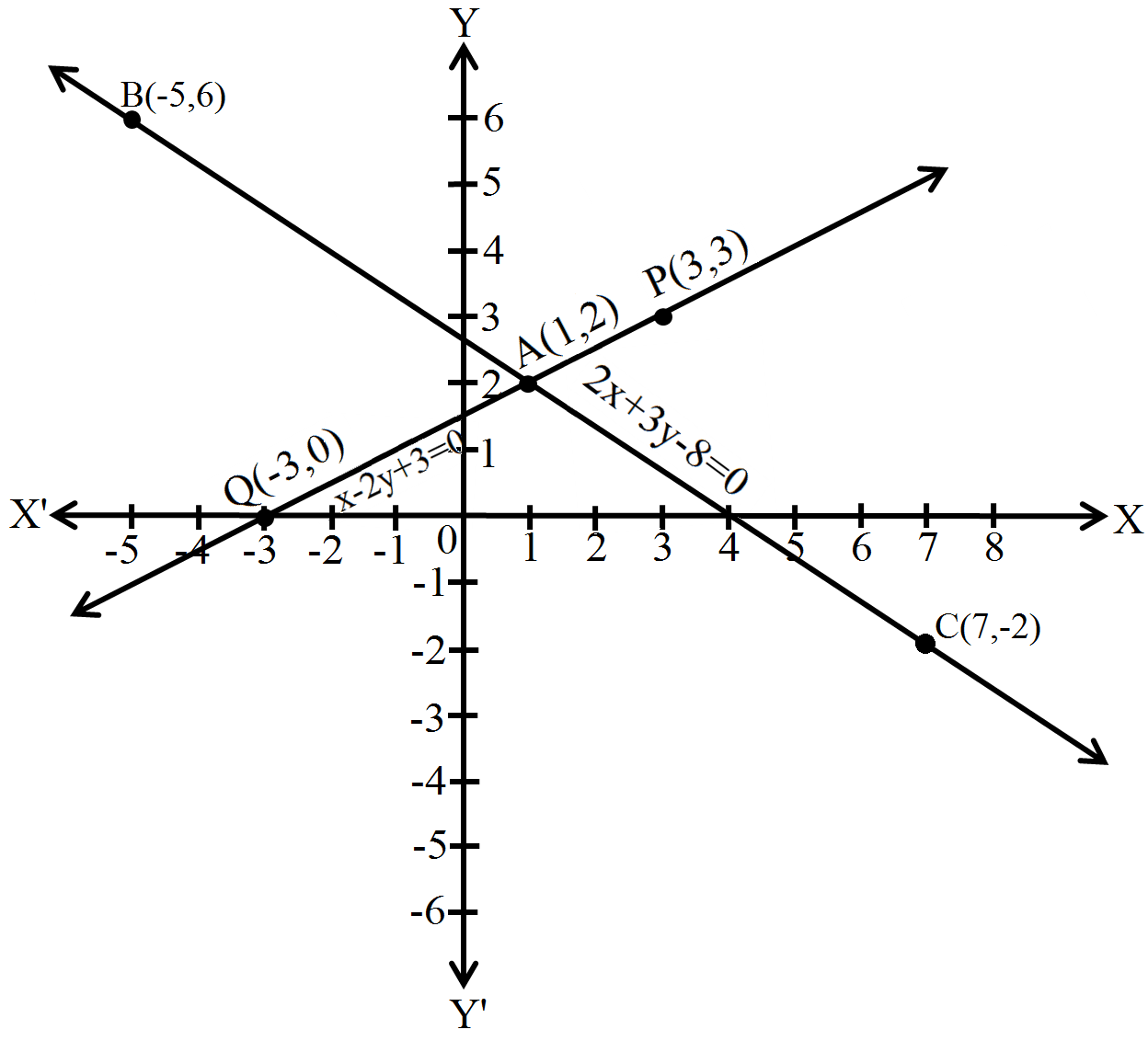
The two graph lines intersect at $A(1, 2).$
$\therefore x = 1, y = -2$ is the solution of the given system of equations. View full question & answer→Question 554 Marks
Solve for $x$ and $y$
$\frac{5}{\text{x}+\text{1}}-\frac{2}{\text{x}-\text{1}}=\frac{1}{2}$
$\frac{10}{\text{x}+\text{1}}+\frac{2}{\text{y}-\text{1}}=\frac{5}{2}$
AnswerThe given equations are:
$\frac{5}{\text{x}+\text{1}}-\frac{2}{\text{x}-\text{1}}=\frac{1}{2}$ and $\frac{10}{\text{x}+\text{1}}+\frac{2}{\text{y}-\text{1}}=\frac{5}{2}$
Putting $\frac{1}{\text{x}+\text{1}}=\text{u}$ and $\frac{1}{\text{y}-\text{1}}=\text{v}$
$\text{5u}-\text{2v}=\frac{1}{2}\ \dots(1)$
$\text{10u}+\text{2v}=\frac{5}2{}\ \dots(2)$
Adding $(1)$ and $(2)$
$\text{15u}=\frac{1}{2}+\frac{5}{2}=\frac{5+1}{2}=3$
$\therefore\text{u}=\frac{3}{15}=\frac{1}{5}=\frac{1}{\text{x}+1}$
$\therefore\text{x}+1=5$ or $\text{x}=4$
Putting value of u in $(1)$
$5\times\frac{1}{5}-\text{2v}=\frac{1}{2}$ or $-\text{2v}=\frac{1}{2}-1=-\frac{1}2{}$
$\therefore\text{v}=\frac{1}{4}=\frac{1}{\text{y}-1}$ or $y - 1 = 4 $or $y = 5$
Hence the required solution is $x = 4$ and $y = 5$
View full question & answer→Question 564 Marks
Solve the following system of equations graphically:
$2x + 3y = 2,$
$x - 2y = 8$
AnswerOn a graph paper, draw a horizontal line $X^{\prime} O X$ and a vertical line $Y O Y^{\prime}$ representing the $x$-axis and $y$-axis, respectively. Graph of $2 x+3 y=2$ :
$y=\frac{2(1-x)}{3}$
Putting $x=1$, we get $y=0$
Putting $x=-2$, we get $y=2$
Putting $x=4$, we get $y=-2$
$\therefore$ Table for $2 x+3 y=2$ is
|
$x:$
|
$1$
|
$-2$
|
$4$
|
|
$y:$
|
$0$
|
$2$
|
$-2$
|
Plot the points $A(1,0), B(-2,2)$ and $C(4,-2)$ on the graph paper.
Join $A B$ and $A C$ to get the graph line $B C$.
Extend it on both ways.
Thus, the line $B C$ is the graph of $x+3 y=2$.
Graph of $x-2 y=8$ :
$y=\frac{x-8}{2}$
Putting $x=2$, we get $y=-3$
Putting $x=4$, we get $y=-2$
Putting $x=0$, we get $y=-4$
Table for $x-2 y=8$ is
|
$x:$
|
$2$
|
$4$
|
$0$
|
|
$y:$
|
$-3$
|
$-2$
|
$-4$
|
Now, on the same graph paper plot the points $P(0,-4)$ and $Q(2,-3)$. The point $C(4,-2)$ has already been plotted. Join $PQ$ and $QC$ and extend it on both ways.
Thus, line $PC$ is the graph of $x-2 y=8$.
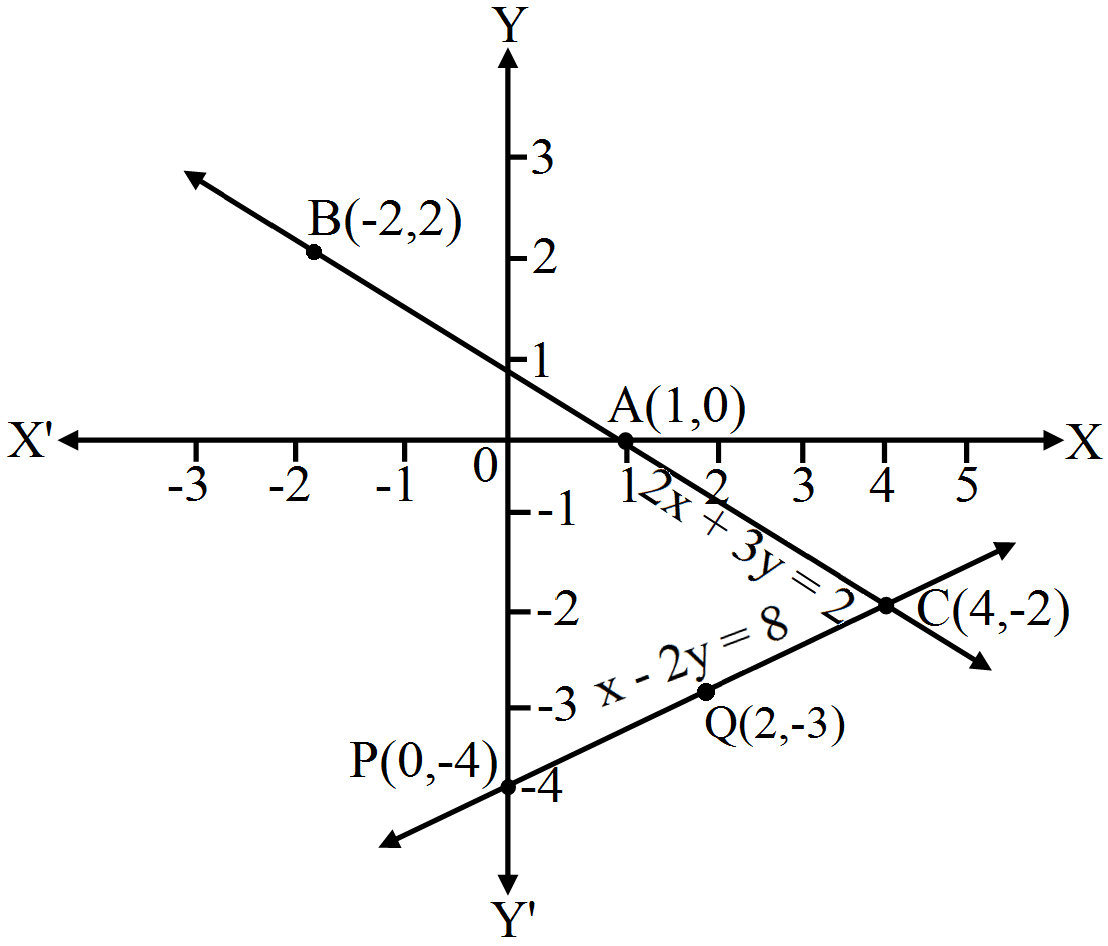
The two graph lines intersect at $C (4,-2)$.
$\therefore x=4, y=-2$ is the solution of the given system of equations. View full question & answer→Question 574 Marks
The present age of a woman is $3$ years more than three times the ages of her daughter. Three years hence, the woman's age will be $10$ years more than twice the age of her daughter. Find their present ages.
AnswerLet the present ages of woman and daughter be $x$ and $y$ respectively.
Then,
Their present ages:
$x = 3y + 3$
$\Rightarrow x - 3y = 3 ...(1)$
Three years later:
$(x + 3) = 2(y + 3) + 10$
$\Rightarrow x + 3 = 2y + 6 + 10$
$\Rightarrow x - 2y = 13 ...(2)$
Subtracting $(2)$ from $(1)$, we get
$\Rightarrow y = 10$
Putting $y = 10$ in $(1)$, we get
$x - 3 \times 10 = 3$
$\Rightarrow x = 33$
$\therefore x = 33, y = 10$
Hence, present ages of woman and daughter are $33$ and $10$ years.
View full question & answer→Question 584 Marks
Solve the following systems of equations by using the method of cross multiplication:
$\frac{5}{(\text{x}+\text{y})}-\frac{2}{(\text{x}-\text{y})}+1=0,$
$\frac{15}{(\text{x}+\text{y})}+\frac{7}{(\text{x}-\text{y})}-10=0$ $(\text{x}\neq\text{y},\ \text{x}\neq-\text{y}).$
AnswerTaking $\frac{1}{\text{x}+\text{y}}=\text{u}$ and $\frac{1}{\text{x}-\text{y}}=\text{v},$ the given equations become:
$5u - 2v + 1 = 0 ...(i)$
$15u + 7v - 10 = 0 ...(ii)$
Here, $a_1=5, b_1=-2, c_1=1, a_2=15, b_2=-7$ and $c_2=-10$
By cross multiplication, we have:
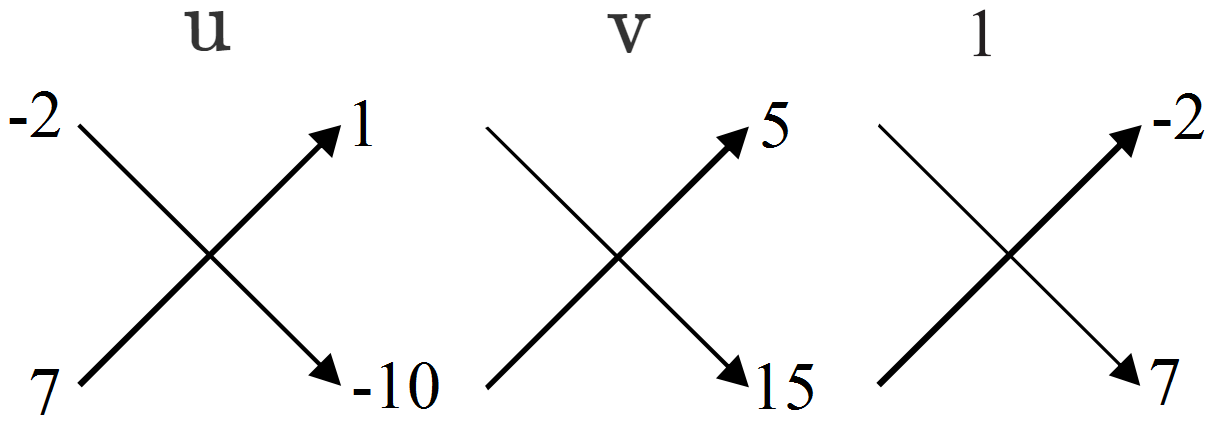
$\therefore\frac{\text{u}}{[-2\times(-10)-1\times7]}=\frac{\text{v}}{[1\times15-(-10)\times5]}=\frac{1}{[35+30]}$
$\Rightarrow\frac{\text{u}}{20-7}=\frac{\text{v}}{15+50}=\frac{1}{65}$
$\Rightarrow\frac{\text{u}}{13}=\frac{\text{v}}{65}=\frac{1}{65}$
$\Rightarrow\text{u}=\frac{13}{65}=\frac{1}{5},\ \text{v}=\frac{65}{65}=1$
$\Rightarrow\frac{1}{\text{x}+\text{y}}=\frac{1}{5},\ \frac{1}{\text{x}-\text{y}}=1$
So, $(x + y) = 5 ...(iii)$
and $(x - y) = 1 ...(iv)$
Again, the above equations $(iii)$ and $(iv)$ may be written as:
$x + y - 5 = 0 ...(v)$
$x - y - 1 = 0 ...(vi)$
Here, $a_1=1, b_1=1, c_1=-5, a_2=1, b_2=-1$ and $c_2=-1$
By cross multiplication, we have:
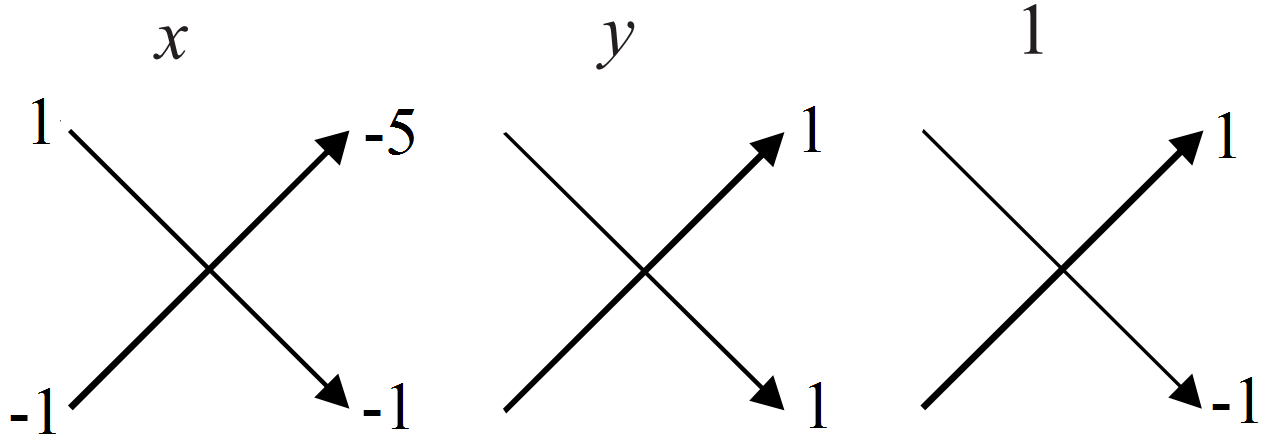
$\therefore\frac{\text{x}}{[1\times(-1)-(-5)\times(-1)]}=\frac{\text{y}}{(-5)\times1-(-1)\times1}=\frac{1}{[1\times(-1)-1\times1]}$
$\Rightarrow\frac{\text{x}}{(-1-5)}=\frac{\text{y}}{(-5+1)}=\frac{1}{(-1-1)}$
$\Rightarrow\frac{\text{x}}{-6}=\frac{\text{y}}{-4}=\frac{1}{-2}$
$\Rightarrow\text{u}=\frac{-6}{-2}=3,\ \text{y}=\frac{-4}{-2}=2$
Hence, $x = 3$ and $y = 2$ is the required solution. View full question & answer→Question 594 Marks
Abdul travelled $300\ km$ by train and $200\ km$ by taxi taking $5$ hours $30$ minutes. But, if he travels $260\ km$ by train and $240\ km$ by taxi, he takes $6$ minutes longer. Find the speed of the train and that of the taxi.
AnswerLet the speeds of the train and taxi be $x km/h$ and $y km/h$ respectively.
Then, time taken to cover 300km by the train $=\frac{300}{\text{x}}\ \text{hours}$
and time taken to cover 200km by the taxi $=\frac{200}{\text{y}}\ \text{hours}$
Total time taken $=5\frac{30}{60}\ \text{hours}=5\frac{1}{2}\ \text{hours}=\frac{11}{2}\ \text{hours}$
$\therefore\frac{300}{\text{x}}+\frac{200}{\text{y}}=\frac{11}{2}$
$\Rightarrow\frac{600}{\text{x}}+\frac{400}{\text{y}}=11$
Put $\frac{1}{\text{x}}=\text{u}$ and $\frac{1}{\text{y}}=\text{v}$
$\Rightarrow 600u + 400v = 11 ...(i)$
Again, time taken to cover $260\ km$ by the train $=\frac{260}{\text{x}}\ \text{hours}$
and time taken to cover $240\ km$ by the taxi $=\frac{240}{\text{y}}\ \text{hours}$
Total time taken $=5\frac{36}{60}\ \text{hours}=5\frac{3}{5}\ \text{hours}=\frac{28}{5}\ \text{hours}$
$\Rightarrow 1300u + 1200v = 28 ...(ii)$
Multiplying $(i)$ by $3$ and subtracting $(ii)$ from it, we get
$500u = 5$
$\Rightarrow\text{u}=\frac{5}{500}$
$\Rightarrow\text{u}=\frac{1}{100}$
Substituting $\text{u}=\frac{1}{100}$ in $(i),$ we get $\text{v}=\frac{1}{80}$
Now,
$\text{u}=\frac{1}{100}$
$\Rightarrow\frac{1}{\text{x}}=\frac{1}{100}$
$\Rightarrow\text{x}=100$
$\text{v}=\frac{1}{80}$
$\Rightarrow\frac{1}{\text{y}}=\frac{1}{80}$
$\Rightarrow\text{y}=80$
$\therefore$ Speed of the train $= 100\ km/hr$
and speed of the taxi $= 80\ km/hr$
View full question & answer→Question 604 Marks
A part of monthly hostel charges in a college hostel are fixed and the remaining depends on the number of days one has taken food in the mess. When a student A takes food for $25$ days, he has to pay $₹ \ 4500$, whereas a student $B$ who takes food for $30$ days, he has to pay $₹ \ 5200$. Find the fixed charges per month and the cost of the food per day.
AnswerLet the fixed charges be $₹ x$ and other charges be $₹ y$ per km.
According to the given condition,
$x + 25y = 4500 ...(i)$
$x + 30y = 5200 ...(ii)$
Subtracting $(i)$ from $(ii)$, we get
$5y = 700$
$\Rightarrow y = 140$
Substituting $y = 140$ in $(i)$, we get
$x = 1000.$
Hence, the fixed charges is $₹ 1000$ and the cost of food per day is $₹ 140$
View full question & answer→Question 614 Marks
Solve for $x$ and $y$:
$\frac{2}{(3\text{x}+\text{2y)}}+\frac{3}{(3\text{x}-\text{2y)}}=\frac{17}{5},$
$\frac{5}{(3\text{x}+\text{2y)}}+\frac{1}{(3\text{x}-\text{2y)}}=2$
Answer$\frac{2}{(3\text{x}+\text{2y)}}+\frac{3}{(3\text{x}-\text{2y)}}=\frac{17}{5},$
$\frac{5}{(3\text{x}+\text{2y)}}+\frac{1}{(3\text{x}-\text{2y)}}=2$
Putting $\frac{1}{\text{3x}+\text{2y}}=\text{u}$ and $\frac{1}{\text{3x}-\text{2y}}=\text{v}$ so, we get
$\text{2u}+\text{3v}=\frac{17}{5}\ \dots(\text{i})$and
$\text{5u}+\text{v}=2\ \dots(\text{ii})$
Multiplying $(ii)$ by $3$ and subtract it from $(i).$
$\Rightarrow\text{15u}+\text{3v}=6$ and $\text{2u}+\text{3v}=\frac{17}{5}$
$\Rightarrow-13\text{u}=\frac{17}{5}-6$
$\Rightarrow-13\text{u}=-\frac{13}{5}$
$\Rightarrow\text{u}=\frac{1}{5}$
Substituting $\text{u}=\frac{1}{5}$ in $(i)$, we get $v = 1$
$\Rightarrow\frac{1}{\text{3x}+\text{2y}}=\frac{1}{5}$ and $\frac{1}{\text{3x}-\text{2y}}=1$
$\Rightarrow\text{3x}+\text{2y}=5\ \dots(\text{iii})$ and $\text{3x}-\text{2y}=1\ \dots(\text{iv})$
Adding $(iii)$ and $(iv)$, we get
$6x = 6$
$x = 1$
Substituting $x = 1$ in $(iii)$, we get $y = 1$
Hence, $x = 1$ and $y = 1$
View full question & answer→Question 624 Marks
If $45$ is subtracted from twice the greater of two numbers, it result in the other number. If $21$ is subtracted from twice the smaller number, it results in the greater number. Find the numbers.
AnswerLet the greater number be $x$ and $y$ resoectively.
According to the question:
$2x - 45 = y$
$\Rightarrow 2x - y = 45 ...(1)$
and
$2y - x = 21$
$\Rightarrow -x + 2y = 21 ...(2)$
Multiplying $(1)$ by $2$ and $(2)$ by $1$
$4x - 2y = 90 ...(3)$
$-x + 2y = 21 ...(4)$
Adding $(3)$ and $(4)$, we get
$3x = 111$
$\Rightarrow\text{x}=\frac{111}{3}=37$
Putting $x = 37$ in $(1)$, we get
$2 \times 37 - y = 45$
$\Rightarrow 74 - y = 45$
$\Rightarrow y = 29$
Hence, the greater and the smaller numbers are $37$ and $29.$
View full question & answer→Question 634 Marks
Solve for $x$ and $y$:
$\frac{5}{\text{x}+\text{y}}-\frac{2}{\text{x}-\text{y}}=-1,$
$\frac{15}{\text{x}+\text{y}}+\frac{7}{\text{x}-\text{y}}=10$
Answer$\frac{5}{\text{x}+\text{y}}-\frac{2}{\text{x}-\text{y}}=-1,$
$\frac{15}{\text{x}+\text{y}}+\frac{7}{\text{x}-\text{y}}=10$
Put $\frac{1}{\text{x}+\text{y}}=\text{u}$ and $\frac{1}{\text{x}-\text{y}}=\text{v}$
So, we get
$5u - 2v = -1 ...(i)$ and $15u + 7v = 10 ...(ii)$
Multiply $(i)$ by $3$ and subtract $(ii)$ it from.
$\Rightarrow 15u - 6v = -3$ and $15u + 7v = 10$
$\Rightarrow -13v = -13$
$\Rightarrow v = 1$
Substituting $v = 1$ in $(i)$, we get $\text{u}=\frac{1}{5}$
$\Rightarrow\frac{1}{\text{x}+\text{y}}=\frac{1}{5}$ and $\frac{1}{\text{x}-\text{y}}=1$
$\Rightarrow x + y = 5 ...(iii)$ and $x - y = 1 ...(iv)$
Adding $(iii)$ and $(iv)$, we get
$2x = 6$
$\Rightarrow x = 3$
Substituting $x = 3$ in $(iii)$, we get $y = 2$
So, $x = 3$ and $y = 2$
View full question & answer→Question 644 Marks
Solve for $x$ and $y$:
$\frac{\text{bx}}{\text{a}}-\frac{\text{ay}}{\text{b}}+\text{a}+\text{b}=0,$
$\text{bx}-\text{ay}+\text{2ab}=0$
Answer$\frac{\text{bx}}{\text{a}}-\frac{\text{ax}}{\text{b}}+\text{a}+\text{b}=0$
By taking $L.C.M$., we get
$\frac{\text{b}^2\text{x}-\text{a}^2\text{y}+\text{a}^2\text{b}+\text{b}^2\text{a}}{\text{ab}}=0$
$b^2x - a^2y = -a^2b - b^2a ...(1)$
$bx - ay = - 2ab ...(2)$
Multiplying $(1)$ by $1$ and $(2)$ by a
$b^2x - a^2y = -a^2b - b^2a ...(3)$
$abx - a^2b = - 2a^2b ...(4)$
Subtracting $(3)$ from $(4)$
$(ab - b^2)x = -2a^2b + a^2b + ab^2$
$b(a - b)x = -a^2b + ab^2 = -ab(a - b)$
$\therefore\ \text{x}=\frac{-\text{ab}(\text{a}-\text{b})}{\text{b}(\text{a}-\text{b})}$
$x = -a$
Putting $x = -a$, in $(1)$, we get
$b^2(-a) - a^2y = -a^2b - b^2a$
$-ab^2 - a^2y = -a^2b - b^2a$
$-a^2y = -a^2b - b^2a + ab^2$
$-a^2y = -a^2b$
$\Rightarrow\text{y}=\frac{-\text{a}^2\text{b}}{-\text{a}^2}=\text{b}$
$\therefore$ solution is $x = -a, y = b$
View full question & answer→Question 654 Marks
Solve the following systems of equations by using the method of cross multiplication:
$6x - 5y - 16 = 0,$
$7x - 13y + 10 = 0$
AnswerThe given equations are:
$6x - 5y - 16 = 0 ...(i)$
$7x - 13y + 10 = 0 ...(ii)$
Here, $a_1=6, b_1=-5, c_1=-16, a_2=7, b_2=-13$ and $c_2=10$
By cross multiplication, we have:
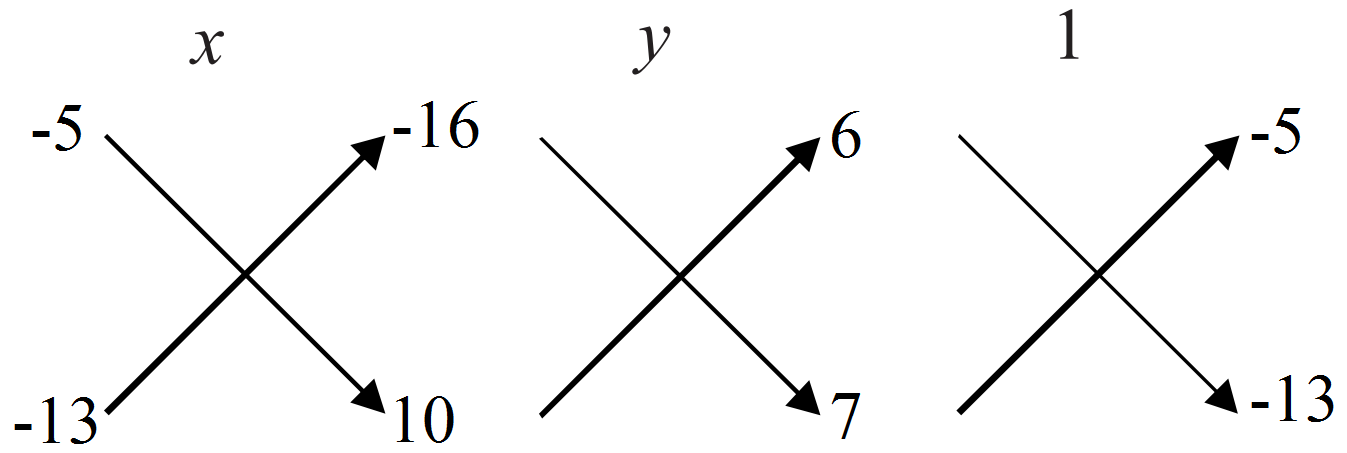
$\therefore\frac{\text{x}}{[(-5)\times10-(-16)\times(-13)]}=\frac{{\text{y}}}{[(-16)\times7-10\times6]}=\frac{1}{[6\times(-13)-(-5)\times7]}$
$\Rightarrow\frac{\text{x}}{(-50-208)}=\frac{\text{y}}{(-112-60)}=\frac{1}{(-78+35)}$
$\Rightarrow\frac{\text{x}}{(-258)}=\frac{\text{y}}{(-172)}=\frac{1}{(-43)}$
$\Rightarrow\text{x}=\frac{-258}{-43}=6,\ \text{y}=\frac{-172}{-43}=4$
Hence, $x = 6$ and $y = 4$ is the required solution. View full question & answer→Question 664 Marks
Find two numbers such that the sum of twice the first and thrice the second is $92$, and four times the first exceeds seven times the second by $2$
AnswerLet the first and second number be $x$ and $y$ respectively.
According to the question:
$2x + 3y = 90 ...(i)$
$4x - 7y = 2 ...(ii)$
Multiplying $(i)$ by $7$ and $(ii)$ by $3$, we get
$14x + 21y = 644 ...(iii)$
$12x + 21y = 6 ...(iv)$
Adding $(3)$ and $(4)$, we get
$26x = 650$
$\Rightarrow\text{x}=\frac{650}{26}=25$
Putting $x = 25$ in $(i),$
We get:
$2 \times 25 + 3y = 92$
$50 + 3y = 92$
$\Rightarrow 3y = 92 - 50$
$\Rightarrow\text{y}=\frac{42}{3}= 14$
$\Rightarrow y = 14$
Hence, the first number is $25$ and second is $14$
View full question & answer→Question 674 Marks
Solve the following systems of equations by using the method of cross multiplication:
$\frac{\text{ax}}{\text{b}}-\frac{\text{by}}{\text{a}}=\text{a}+\text{b},$
$\text{ax}-\text{by}=\text{2ab}$
AnswerThe given equations may be written as:
$\frac{\text{ax}}{\text{b}}-\frac{\text{by}}{\text{a}}-(\text{a}+\text{b})=0\ \dots(\text{i})$
$\text{ax}-\text{by}-\text{2ab}=0\ \dots(\text{ii})$
Here, Here, $a_1=\frac{a}{b}, b_1=\frac{-b}{a}, c_1=-(a+b), a_2=a, b_2=-b$ and $c_2=-2 a b$
By cross multiplication, we have:
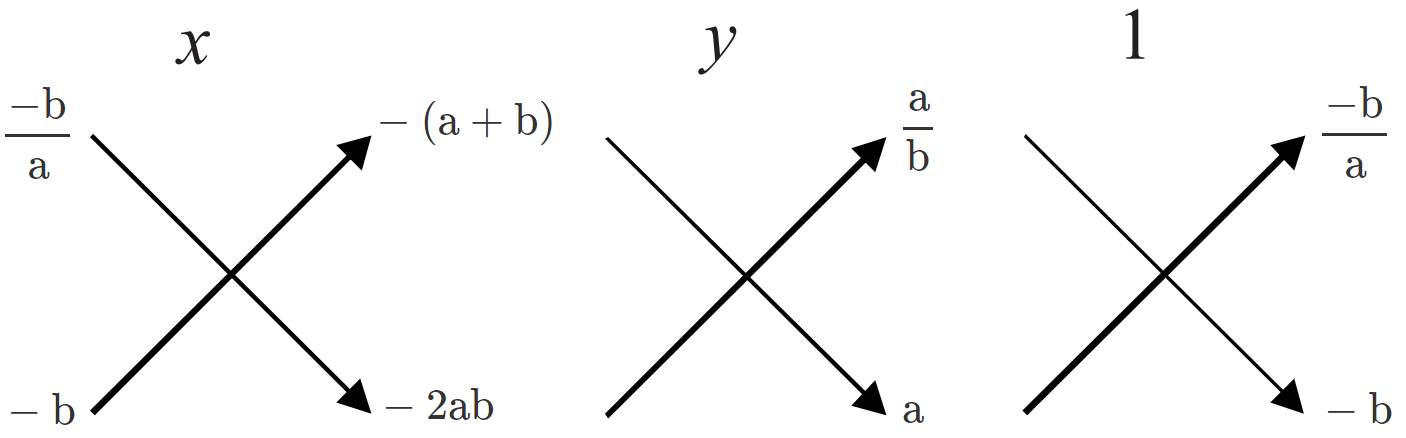
$\therefore\frac{\text{x}}{\big(-\frac{\text{b}}{\text{a}}\big)\times(-\text{2ab})-(-\text{b})\times(-(\text{a}+\text{b}))}=\frac{\text{y}}{-(\text{a}+\text{b})\times\text{a}-(-\text{2ab})\times\frac{\text{a}}{\text{b}}}\\=\frac{1}{\frac{\text{a}}{\text{b}}\times(-\text{b})-\text{a}\times\big(-\frac{\text{b}}{\text{a}}\big)}$
$\Rightarrow\frac{\text{x}}{\text{2b}^2-\text{b}(\text{a}+\text{b})}=\frac{\text{y}}{-\text{a}(\text{a}+\text{b})+\text{2a}^2}=\frac{1}{-\text{a}+\text{b}}$
$\Rightarrow\frac{\text{x}}{\text{2b}^2-\text{ab}+\text{b}^2}=\frac{\text{y}}{-\text{a}^2-\text{ab}+\text{2a}^2}=\frac{1}{-\text{a}+\text{b}}$
$\Rightarrow\frac{\text{x}}{(\text{b}^2-\text{ab})}=\frac{\text{y}}{(\text{a}^2-\text{ab})}=\frac{1}{-(\text{a}-\text{b})}$
$\Rightarrow\frac{\text{x}}{-\text{b}(\text{a}-\text{b})}=\frac{\text{y}}{\text{a}(\text{a}-\text{b})}=\frac{1}{-(\text{a}-\text{b})}$
$\Rightarrow\text{x}=\frac{-\text{b}(\text{a}-\text{b})}{-(\text{a}-\text{b})}=\text{b},\ \text{y}=\frac{\text{a}(\text{a}-\text{b})}{-(\text{a}-\text{b})}=-\text{a}$
Hence, $x = b$ and $y = -a$ is the required solution. View full question & answer→Question 684 Marks
A lady has only $25$-paisa and $50$-paisa coins in her purse. If she has $50$ coins in all totalling $₹ 19.50$, how many coins of each kind does she have?
AnswerLet the number of $25$ -paisa coins be $\times$ and the number of $50 -$paisa coins be $y$.
Then, $x+y=50...(i)$
Since she has a total of $₹ 19.50 ,$
$25x + 50y = 19.50(100)$
$\Rightarrow 25x + 50y = 1950$
$\Rightarrow x + 2y = 78 ...(ii)$
Subracting $(i)$ from $(ii)$, we get
$y = 28$
Substituting $y =28$ in $(i),$ we get
$x = 22$
So, the number of $25-$paisa coins is $22$ and the number of $50-$paisa coins is $28.$
View full question & answer→Question 694 Marks
Solve the following system of equations graphically:
$2x + 3y + 5 = 0,$
$3x - 2y - 12 = 0$
Answer$\text{2x}+\text{3y}+5=0$
$\Rightarrow\text{y}=\frac{-5-\text{2x}}{3}$
|
$x:$
|
$-4$
|
$-1$
|
|
$y:$
|
$1$
|
$-1$
|
$\text{3x}-\text{2y}-12=0$
$\Rightarrow\text{y}=\frac{\text{3x}-12}{2}$
|
$x:$
|
$0$
|
$4$
|
|
$y:$
|
$-6$
|
$0$
|
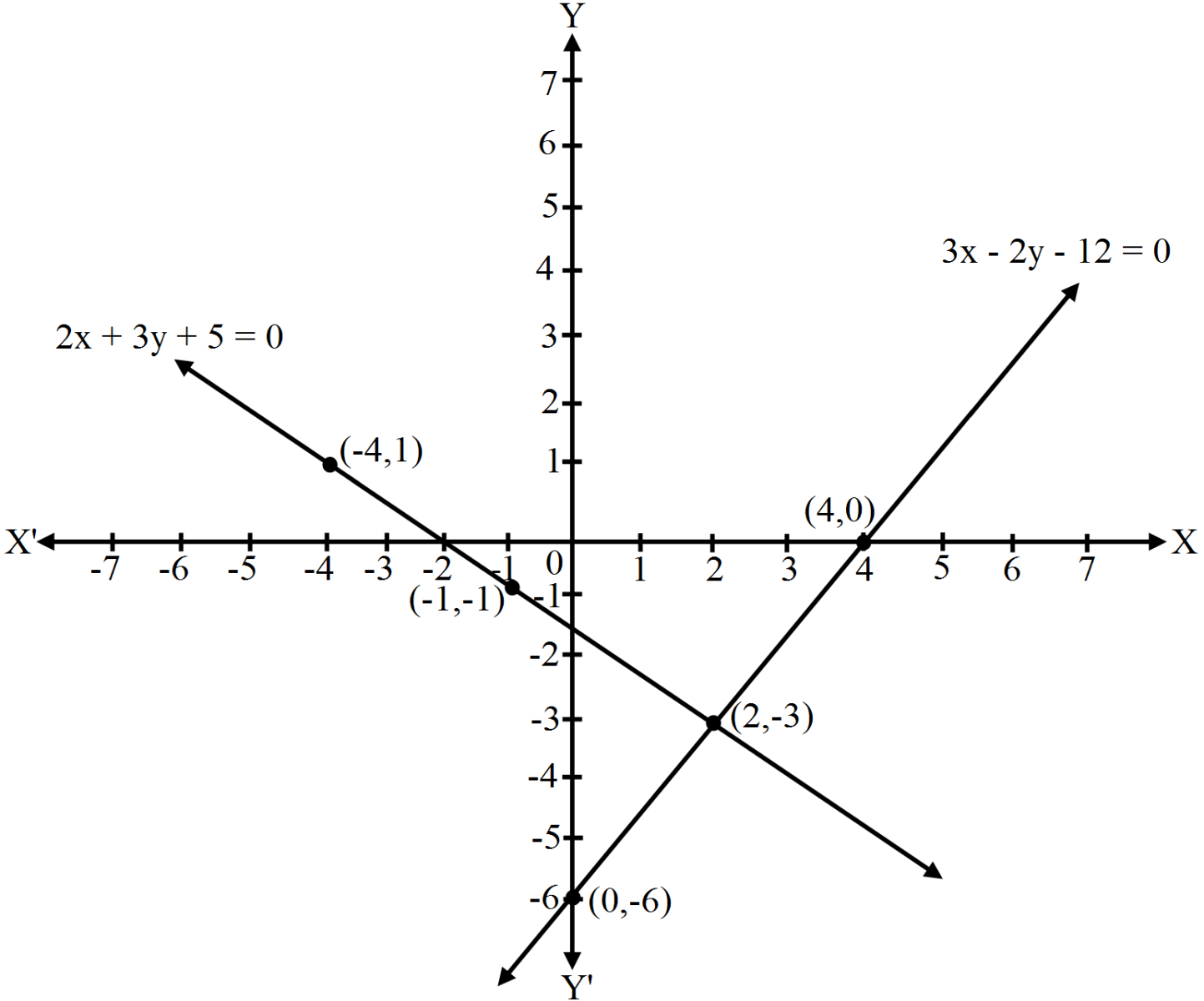
Since the two graph intersect at $(2, -3),$
$x = 2$ and $y = -3$ View full question & answer→Question 704 Marks
Solve each of the following given systems of equations graphically and find the vertices and area of the triangle formed by these lines and the y-axis:
$2x - 3y = 12, x + 3y = 6$
Answer$\text{2x}-\text{3y}=12,$
$\Rightarrow\text{y}=\frac{\text{2x}-12}{3}$
| $x:$ |
$0$ |
$3$ |
| $y:$ |
$-4$ |
$-2$ |
$\text{x}+\text{3y}=6$
$\Rightarrow\text{y}=\frac{6-\text{x}}{3}$
| $x:$ |
$0$ |
$3$ |
| $y:$ |
$2$ |
$1$ |
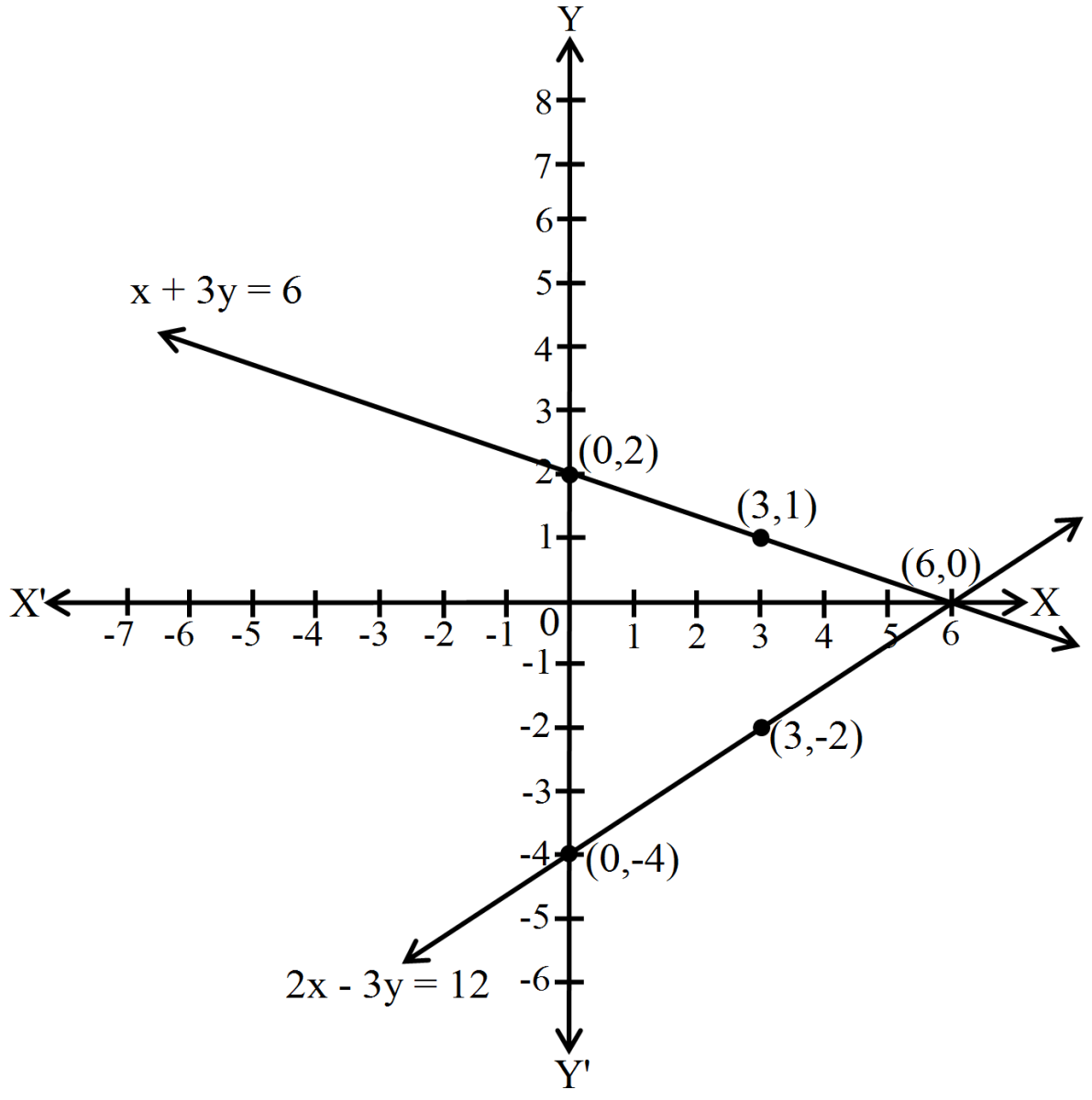
Since the two graph intersect at $(6,0)$,
$x=6 \text { and } y=0$
The vertices of the triangle formed by these lines and the $y$-axis are $(6,0),(0,-4)$ and $(0,2)$. So, height of the triangle $=$ distance from $(6,0)$ to $y$-axis
$=6 \text { units }$
Base $=6$ units
Area of triangle $=\frac{1}{2}\times$ base × height
$=\frac{1}{2}\times6\times6$
$=18\ \text{sq. units}$ View full question & answer→Question 714 Marks
Two years ago, a man was five times as old as his son. Two years later, his age will be $8$ more than three times the ago of the son. Find their present ages.
AnswerLet the present ages of the man and his son be $x$ years and $y$ years respectively.
Then,
Two years ago:
$(x - 2) = 5(y - 2)$
$\Rightarrow x - 2 = 5y - 10$
$\Rightarrow x - 5y = -8 ...(1)$
Two years later:
$(x + 2) = 3(y + 2) + 8$
$\Rightarrow x + 2 = 3y + 6 + 8$
$\Rightarrow x - 3y = 12 ...(2)$
Subtracting $(2)$ from $(1)$, we get
$-2y = -20$
$\Rightarrow y = 10$
Putting $y = 10 $ in $(1)$, we get
$x - 5 \times 10 = -8$
$\Rightarrow x - 50 = -8$
$\Rightarrow x = 42$
Hence the present ages of the man and the son are $42$ years and $10$ respectively.
View full question & answer→Question 724 Marks
Solve the following systems of equations by using the method of cross multiplication:
$2ax + 3by = (a + 2b),$
$3ax + 2by = (2a + b).$
AnswerThe given equations may be written as:
$2ax + 3by = (a + 2b) ...(i)$
$3ax + 2by = (2a + b) ...(ii)$
Here, $a_1=2 a, b_1=3 b, c_1=-(a+2 b), a_2=3 a, b_2=2 b$ and $c_2=-(2 a+b)$
By cross multiplication, we have:
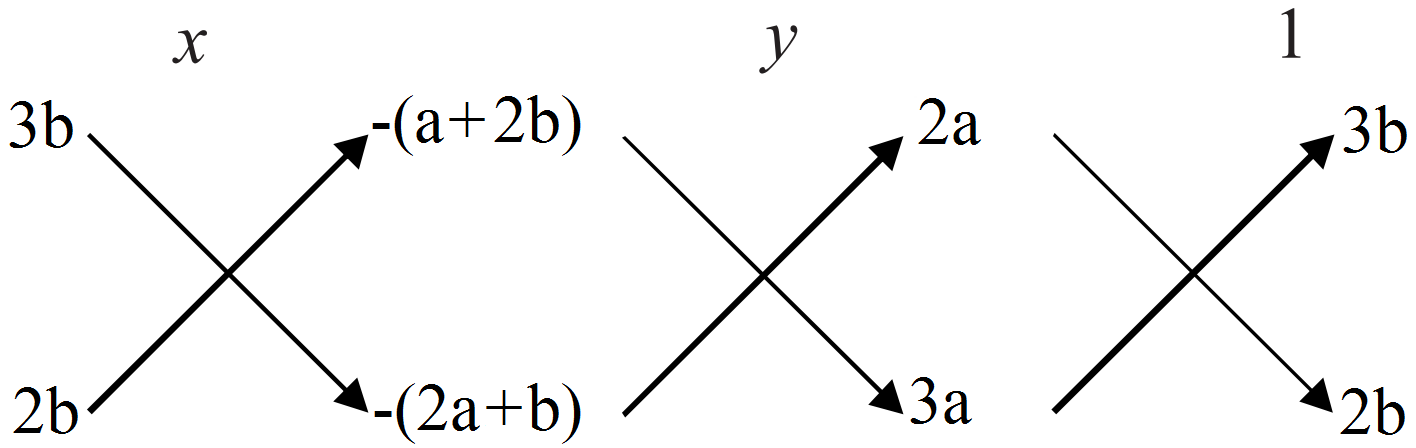
$\therefore\frac{\text{x}}{[\text{3b}\times(-(\text{2a}+\text{b}))-2\text{b}\times(-(\text{a}+2\text{b}))]}=\frac{\text{y}}{[-(\text{a}+2\text{b})\times3\text{a}-\text{2a}\times(-(\text{2a}+\text{b}))]}$
$=\frac{1}{[\text{2a}\times2\text{b}-3\text{a}\times\text{3b}]}$
$\Rightarrow\frac{\text{x}}{\big(-\text{6ab}-\text{3b}^2+\text{2ab}+\text{4b}^2\big)}=\frac{\text{x}}{\big(-\text{3a}^2-\text{6ab}+\text{4a}^2+\text{2ab}\big)}=\frac{1}{\text{4ab}-\text{9ab}}$
$\Rightarrow\frac{\text{x}}{\text{b}^2-\text{4ab}}=\frac{\text{y}}{\text{a}^2-\text{4ab}}=\frac{1}{-\text{5ab}}$
$\Rightarrow\frac{\text{x}}{-\text{b}(\text{4a}-\text{b})}=\frac{\text{y}}{-\text{a}(4\text{b}-\text{a})}=\frac{1}{-5\text{ab}}$
$\Rightarrow\text{x}=\frac{-\text{b}(\text{4a}-\text{b})}{-5\text{ab}}=\frac{(\text{4a}-\text{b})}{\text{5a}},$
$\text{y}=\frac{-\text{a}(\text{4b}-\text{a})}{-\text{5ab}}=\frac{(\text{4b}-\text{a})}{\text{5b}}$
Hence, $\text{x}=\frac{(\text{4a}-\text{b})}{\text{5a}}$ and $\text{y}=\frac{(\text{4a}-\text{b})}{\text{5b}}$ is the required solution. View full question & answer→Question 734 Marks
A number consisting of two digits is seven times the sum of its digits. When $27$ is subtracted from the number, the digits are reversed. Find the number.
AnswerLet the ten's digit of required number be $x$ and its unit's be $y$ respectively
Required number $= 10x + y$
$\therefore 10x + y = 7(x + y)$
$10x + y = 7x + 7y$
$3x - 6y = 0 ...(1)$
Number found on reversing the digits$ = 10y + x$
$\therefore (10x + y) - 27 = 10y + x$
$\Rightarrow 10x - x + y - 10y = 27$
$\Rightarrow 9x - 9y = 27$
$\Rightarrow (x - y) = 27$
$x - y = 3 ...(2)$
Multiplying $(1)$ by $1$ and $(2)$ by $6$
$3x - 6y = 0 ...(3)$
$6x - 6y = 18 ...(4)$
Subracting $(3)$ from $(4)$, We get
$\Rightarrow 3x = 18$
$\Rightarrow\text{x}=\frac{18}{3}$
$\Rightarrow x = 6$
Putting$ x = 6$ in $(1)$, we get
$\Rightarrow 3 \times 6 - 6y = 0$
$\Rightarrow 18 - 6y = 0$
$\Rightarrow -6y = -18$
$\Rightarrow\text{y}=\frac{-18}{-6}$
$\Rightarrow y = 3$
Number $= 10x + y$
$= 10 \times 6 + 3$
$= 60 + 3$
$= 63$
Hence, the number is $63.$
View full question & answer→Question 744 Marks
Solve: $\frac{\text{ax}}{\text{b}}-\frac{\text{by}}{\text{a}}=\text{a}+\text{b},$ $\text{ax}-\text{by}=\text{2ab}.$
AnswerThe given equation may be written as follows:
$\frac{\text{ax}}{\text{b}}-\frac{\text{by}}{\text{a}}-(\text{a+b})=0\ ...(\text{i})$
$ax - by - 2ab = 0 ...(ii)$
Here, $\text{a}_1=\frac{\text{a}}{\text{b}},\ \text{b}_1=\frac{\text{b}_1}{\text{a}},$ $\text{c}_1=-(\text{a+b}),\ \text{a}_2=\text{a},$ $\text{b}_2= -\text{b},\ \text{c}_2=-2\text{ab}$
By cross multiplying, we have:
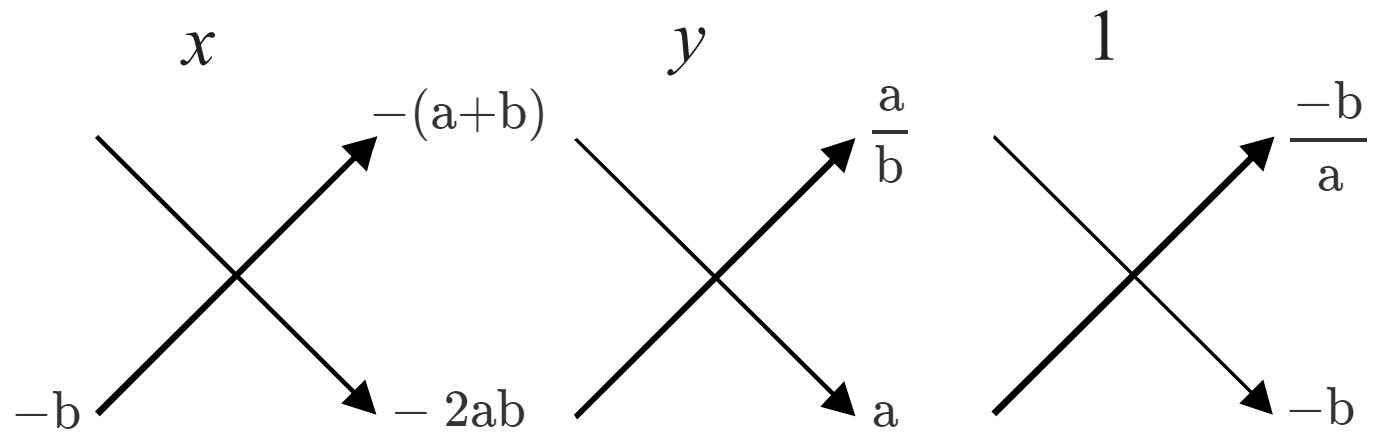
$\therefore\frac{\text{x}}{\big(-\frac{\text{b}}{\text{a}}\big)\times(-2\text{ab})-(-\text{b})\times(-(\text{a+b}))}\\\ \ \ =\frac{\text{y}}{-(\text{a+b})\times\text{a}-(-2\text{ab})\times\frac{\text{a}}{\text{b}}}\\\ \ \ =\frac{1}{\frac{\text{a}}{\text{b}}\times(-\text{b})-\text{a}\times\big(-\frac{\text{b}}{\text{a}}\big)}$
$\Rightarrow\frac{\text{x}}{2\text{b}^2-\text{b}(\text{a+b})}=\frac{\text{y}}{-(\text{a+b})+2\text{a}^2}=\frac{1}{-\text{a+b}}$
$\Rightarrow\frac{\text{x}}{2\text{b}^2-\text{ab}-\text{b}^2}=\frac{\text{y}}{-\text{a}^2-\text{ab}+2\text{a}^2}=\frac{1}{-\text{a+b}}$
$\Rightarrow\frac{\text{x}}{\text{b}^2-\text{ab}}=\frac{\text{y}}{\text{a}^2-\text{ab}}=\frac{1}{-(\text{a}-\text{b})}$
$\Rightarrow\frac{\text{x}}{-\text{b}(-\text{a}-\text{b})}=\frac{\text{y}}{\text{a}(\text{a}-\text{b})}=\frac{1}{-(\text{a}-\text{b})}$
$\Rightarrow\text{x}=\frac{-\text{b}(\text{a}-\text{b})}{-(\text{a}-\text{b})}=\text{b},\ \text{y}=\frac{\text{a}(\text{a}-\text{b})}{-(\text{a}-\text{b})}=-\text{a}$
Hence, $x = b$ and $y = -a$ is the required solution. View full question & answer→Question 754 Marks
On selling a tea at $5\%$ loss and a lemon set at $15\%$ gain, a crockery seller gains $₹7$. If he sells the tea set at $5\%$ gain and the lemon set at $10\%$ gain, he gains $₹13$. Find the actual price of each of the tea set and the lemon set.
AnswerLet the $CP$ of the tea-set and the lemon-set be $₹ x$ and $₹ y$ respectively.
Then, loss on the tea-set $=₹\ \frac{\text{5x}}{100}$
$=₹\ \frac{\text{x}}{20}$
and gain on the lemon-set $=₹\ \frac{15\text{y}}{100}$
$=₹\ \frac{\text{3y}}{20}$
$\therefore$ Net gain $=₹\ \Big(\frac{\text{3y}}{20}-\frac{\text{x}}{20}\Big)$
$\therefore\frac{\text{3y}}{20}-\frac{\text{x}}{20}=7$
$\Rightarrow\text{3y}-\text{x}=140\ \dots(\text{i})$
Again, gain on the tea-set $=₹\ \frac{\text{5x}}{100}$
$=₹\ \frac{\text{x}}{20}$
and loss on the lemon-set $=₹\ \frac{\text{10y}}{100}$
$=₹\ \frac{\text{y}}{10}$
Total gain $=₹\ \Big(\frac{\text{x}}{20}+\frac{\text{y}}{10}\Big)$
$\therefore\frac{\text{x}}{20}+\frac{\text{y}}{10}=13$
$\text{x}+\text{2y}=260\ \dots(\text{ii})$
Adding $(1)$ and $(ii)$, we get
$5y = 400$
$\Rightarrow y = 80$
Substituting $y = 80$ in $(ii),$ we get
$\Rightarrow x = 100$
Hence, actual price of the tea-set is $₹ 100$ and that of the lemon-set is $₹ 80$
View full question & answer→Question 764 Marks
$23$ spoons and $17$ forks together cost $₹ 1770$, while $17$ spoons and $23$ forks together cost $₹ 1830$. Find the cost of a spoon and that of a fork.
AnswerLet each spoon cost $₹ x$ and each fork cost $₹ y$
According to the first condition,
$23x + 17y = 1770 ...(i)$
According to the second condition,
$17x + 23y = 1830 ...(ii)$
Adding $(i)$ and $(ii)$, we get
$40x + 40y = 3600$
$\Rightarrow x + y = 90 ...(iii)$
Subract $(ii)$ from $(i)$, we get
$6x - 6y = -60$
$\Rightarrow x - y = -10 ...(iv)$
Adding $(iii)$ and $(iv)$, we get
$2x = 80$
$\Rightarrow x = 40$
Substituting $x = 40$ in $(iii)$, we get
$y = 50$
Hence, the cost of each spoon is $₹ 40$ and the cost of each fork is $₹ 50.$
View full question & answer→Question 774 Marks
Solve the following system of equations graphically:
$3x + 2y = 4,$
$2x - 3y = 7$
AnswerOn a graph paper, draw a horizontal line $X'OX$ and a vertical line $YOY$' representing the x-axis and y-axis, respectively.
Graph of $3x + 2y = 4:$
$3x + 2y = 4$
$\Rightarrow\text{y}=\frac{4-\text{3x}}{2}$
Thus we have the following table for $3x + 2y = 4$
|
$x:$
|
$0$ |
$2$
|
$-2$
|
|
$y:$
|
$2$
|
$-1$
|
$5$
|
Plot the points $A(0,2), B(2,-1)$ and $C(-2,5)$ on the graph paper.
Join $A B$ and $A C$ to get the graph line $B C$.
Extend it on both ways.
Thus, the line $B C$ is the graph of $3 x+2 y=4$.
Graph of $2 x-3 y=7$ :
$\Rightarrow y=\frac{2 x-7}{3}$
Thus, we have the following table for $2 x-3 y=7$ is
|
$x:$
|
$2$
|
$-1$
|
$5$
|
|
$y:$
|
$-1$
|
$-3$
|
$1$
|
Now, on the same graph paper plot the points $P(-1,-3)$ and $Q(5,1)$. The point $B(2,-1)$ has already been plotted. Join $PB$ and $QB$ and extend it on both ways.
Thus, line $P Q$ is the graph of $2 x-3 y=7$.
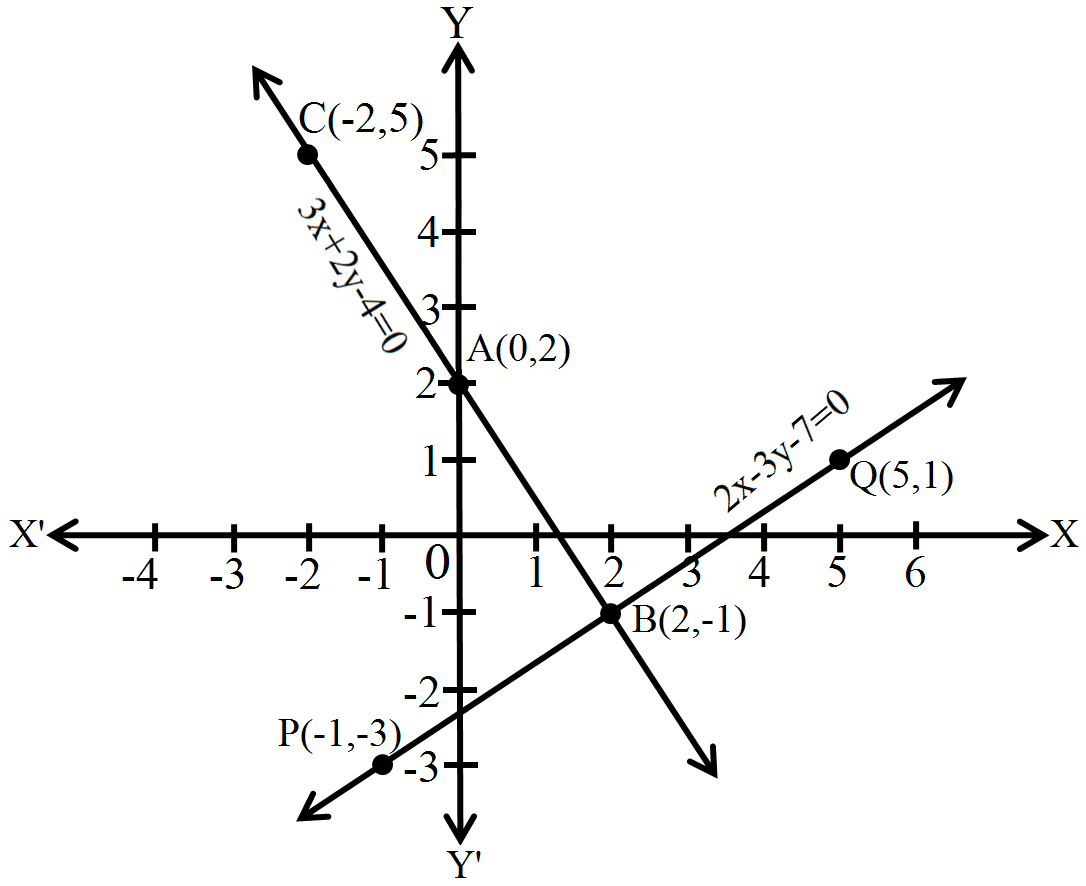
The two graph lines intersect at $B(2, -1).$
$\therefore x = 2, y = -1$ is the solution of the given system of equations. View full question & answer→Question 784 Marks
A chemist has one solution containing $50\%$ acid and a second one containing $25\%$ acid. How much of each should be used to make $10$ litres of a $40\%$ acid solution?
AnswerLet $x$ litres of $50 \%$ solution be mixed with $y$ litres of $25 \%$ solution.
Accroding to the given condition,
$50\% of x + 25\% of y = 40\% of 10$
$\Rightarrow\frac{50}{100}\text{x}+\frac{25}{100}\text{y}=\frac{40}{100}(10)$
$50x + 25y = 40(10)$
$2x + y = 16 ...(i)$
Since the amount of each solutions adds to $10$ litres,
$x + y = 10 ...(ii)$
Subtract $(ii)$ from $(i).$
$x = 6$
Substituting $x = 6$ in $(ii),$ we get
$y = 4.$
Hence, $6$ liters of $50\%$ solution is to be mixed with $4$ litres of $25\%$ solution.
View full question & answer→Question 794 Marks
The length of a room exceeds its breadth by $3$ metres. If the length in increased by $3$ metres and the breadth is decreased by $2$ metres, the area remains the same. Find the length and the breadth of the room.
AnswerLet the length = x meters and breadth $= y$ meters
Then,
$x = y + 3$
$\Rightarrow x - y = 3 ...(1)$
Also
$(x + 3)(y - 2) = xy$
$\Rightarrow 3y - 2x = 6 ...(2)$
Multiplying $(1)$ by $2$ and $(2)$ by $1$
$\Rightarrow -2y + 2x = 6 ...(3)$
$\Rightarrow 3y - 2x = 6 ...(4)$
Adding $(3)$ and $(4)$, we get
$\Rightarrow y = 12$
Putting $y = 12$ in $(1)$, we get
$x - 12 = 3$
$\Rightarrow x= 15$
$\therefore x = 15, y = 12$
Hence length $= 15$ metres and breadth $= 12$ metres
View full question & answer→Question 804 Marks
The area of a rectangle gets reduced by $8m^2$, when its length is reduced by $5\ m$ and its breadth is increased by $3\ m$. If we increase the length by $3\ m$ and breadth by $2\ m$, the area is increased by $74m^2$. Find the length and the breadth of the rectangle.
AnswerLet the length of a rectangle be $x$ meters and breadth be $y$ meters.
Then, area $= xy$ sq.m
Now,
$xy - (x - 5)(y + 3) = 8$
$\Rightarrow xy - [xy - 5y + 3x - 15] = 8$
$\Rightarrow xy - xy + 5y - 3x + 15 = 8$
$\Rightarrow 3x - 5y = 7 ...(1)$
And
$(x + 3)(y + 2) - xy = 74$
$\Rightarrow xy + 3y +2x + 6 - xy = 74$
$\Rightarrow 2x + 3y = 68 ...(2)$
Multiplying $(1)$ by $3$ and $(2) $by $5$, we get
$9x - 15y = 21 ...(3)$
$10x + 15y = 340 ...(4)$
Adding $(3)$ and $(4)$, we get
$\text{19x}=361$
$\Rightarrow\text{x}=\frac{361}{19}=19$
Putting $x = 19$ in $(3)$, we get
$9 \times 19 - 15y = 21$
$\Rightarrow 171 - 15y = 21$
$\Rightarrow\text{y}=\frac{150}{15}=10$
$\therefore x = 19$ meters, $y = 10$ meters
Hence, length $= 19m$ and breadth $= 10m$
View full question & answer→Question 814 Marks
Show graphically that each of the following given systems of equations has infinitely many solutions:
$2x + y = 6, 6x + 3y = 18$
AnswerOn a graph paper, draw a horizontal line $X^{\prime} O X$ and a vertical line $Y O Y^{\prime}$ representing the $x$-axis and $y$-axis, respectively.
The given system equations is $2 x+y=6,6 x+3 y=18$
Graph of $2 x+y=6$ :
$2x + y = 6$
$⇒ y = -2x + 6 ...(1)$
Thus, we have the following table for equation $(1)$
|
$x:$
|
$3$ |
$1$
|
$2$
|
|
$y:$
|
$0$
|
$4$ |
$2$
|
On the graph paper plot the points $A(3,0), B(1,4)$ and $C(2,2)$.
Join $A C$ and $B C$ to get the graph line $A B$.
Thus, the line $A B$ is the graph of the equation of $2 x+y=6$.
Graph of $6 x-2 y=10$ :
For graph of $6 x+3 y=18$
$\Rightarrow\text{y}=\frac{-\text{6x}+18}{3}\ \dots(2)$
Thus, we have the following table for equation $(2)$
|
$x:$
|
$3$
|
$1$
|
$2$
|
|
$y:$
|
$0$
|
$4$
|
$2$
|
These points, $A(3,0), B(1,4)$ and $C(2,2)$ are the same as obtained above.
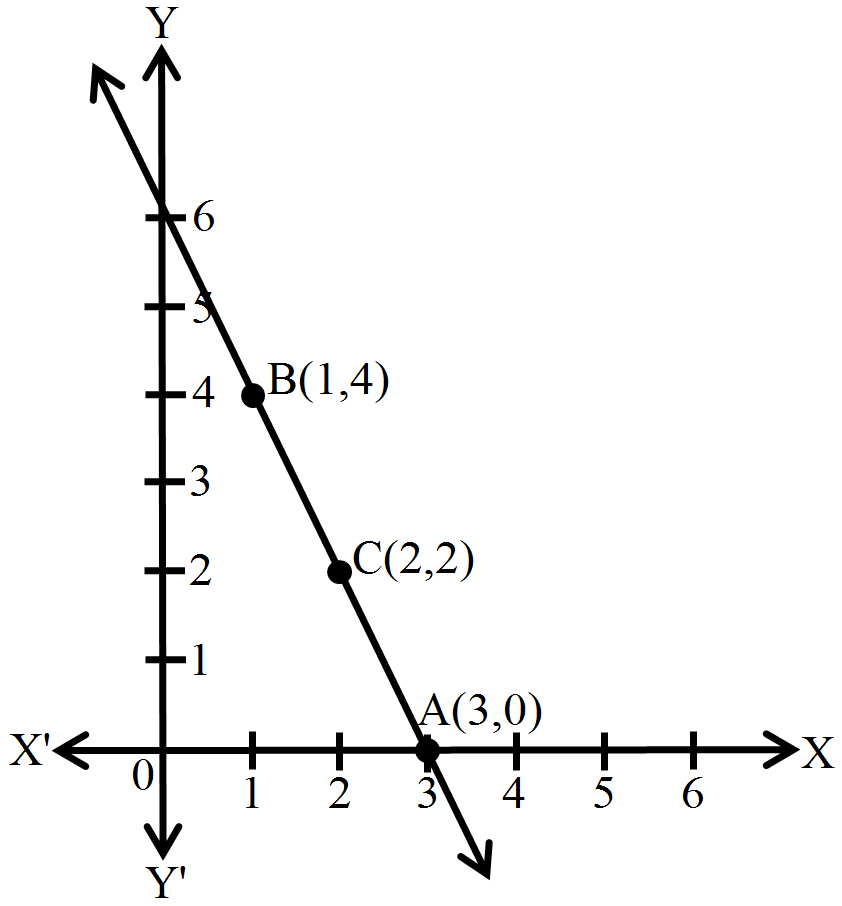
Thus, we find that the two line graphs coincide.
Hence the given system of equations has infinitely many solutions. View full question & answer→Question 824 Marks
Find two numbers such that the sum of thrice the first and the second is $142$, and four times the first exceeds the second by $138.$
AnswerLet the first and second numbers be $x$ and $y$ resoectively.
According to the question:
$3x + y = 142 ...(i)$
$4x - y = 138 ...(ii)$
Adding $(i)$ and $(ii),$ we get
$7x = 280$
$\Rightarrow\text{x}=\frac{280}{7}=40$
Putting $x = 40$ in $(i),$ we get
$3 × 40 + y = 142$
$y = 142 - 120$
$y = 22$
Hence, the first second numbers are $40$ and $22$
View full question & answer→Question 834 Marks
Solve for $x$ and $y$
$\frac{\text{x}-\text{y}-8}{2}=\frac{\text{x}+\text{2y}-14}{3}=\frac{\text{3x}+\text{y}-12}{11}$
Hint: $a = b = c \Rightarrow a = b $and $b = c.$
AnswerThe given equations are:
$\frac{\text{x}-\text{y}-8}{2}=\frac{\text{x}+\text{2y}-14}{3}=\frac{\text{3x}+\text{y}-12}{11}$
Therefore, we have
$\frac{\text{x}-\text{y}-8}{2}=\frac{\text{3x}+\text{y}-12}{11}$
By cross multiplication, we get
$11x + 11y - 88 = 6x + 2y - 24$
$11x - 6x + 11y - 2y = -24 + 88$
$5x + 9y = 64 ...(1)$
$\frac{\text{x}+\text{2y}-14}{3}=\frac{\text{3x}+\text{y}-12}{11}$
By cross multiplication, we get
$11x + 22y - 154 = 9x + 3y - 36$
$11x - 9x + 22y - 3y = -36 + 154$
$2x + 19y = 118 ...(2)$
By Multiplication $(1)$ by $19$ and $(2)$ by $9$
$95x + 171y = 1216 ...(3)$
$18x + 171y = 1062 ...(4)$
Subtracting $(4)$ from $(3)$, we get
$77x = 154$
$\Rightarrow x = 2$
Substituting $x = 2$ in $(1),$ we get
$5 \times 2 + 9y = 64$
$\Rightarrow 9y = 54$
$\Rightarrow y = 6$
$\therefore$ Solution is $x = 2$ and $y = 6$
View full question & answer→Question 844 Marks
Solve each of the following given systems of equations graphically and find the vertices and area of the triangle formed by these lines and the x-axis:
$4x - 3y + 4 = 0, 4x + 3y - 20 = 0$
AnswerOn a graph paper, draw a horizontal line $X^{\prime} O X$ and a vertical line $Y O Y^{\prime}$ representing the $x$-axis and $y$-axis, respectively. The given system equations is $4 x-3 y+4=0,4 x+3 y-20=0$
Graph of $4x - 3y + 4 = 0:$
$4x - 3y + 4 = 0$
$\Rightarrow\text{y}=\frac{4\text{x}+4}{3}\ \dots(1)$
Thus, we have the following table for equation $(1)$
|
$x:$
|
$-1$ |
$2$
|
$5$
|
|
$y:$
|
$0$
|
$4$
|
$8$
|
On the graph paper plot the points $A(-1,0), B(2,4)$ and $C(5,8)$.
Join $A B$ and $B C$ to get the graph line $A C$.
Thus, the line $A C$ is the graph of the equation of $4 x-3 y+4=0$.
Graph of $4 x+3 y-20=0$ :
For graph of $4 x+3 y-20=0$
$\Rightarrow\text{y}=\frac{-\text{4x}+20}{3}\ \dots(2)$
Thus, we have the following table for equation $(2)$
|
$x:$
|
$2$
|
$-1$
|
$5$
|
|
$y:$
|
$4$
|
$8$
|
$0$
|
Now, on the same graph paper plot the points $P(-1,8)$ and $Q(5,0)$.
The third point $B(2,4)$ has already been plotted.
Join $P B$ and $Q B$ to get the line $P Q$.
Thus, line $P Q$ is the graph of the equation $4 x+3 y-20=0$.
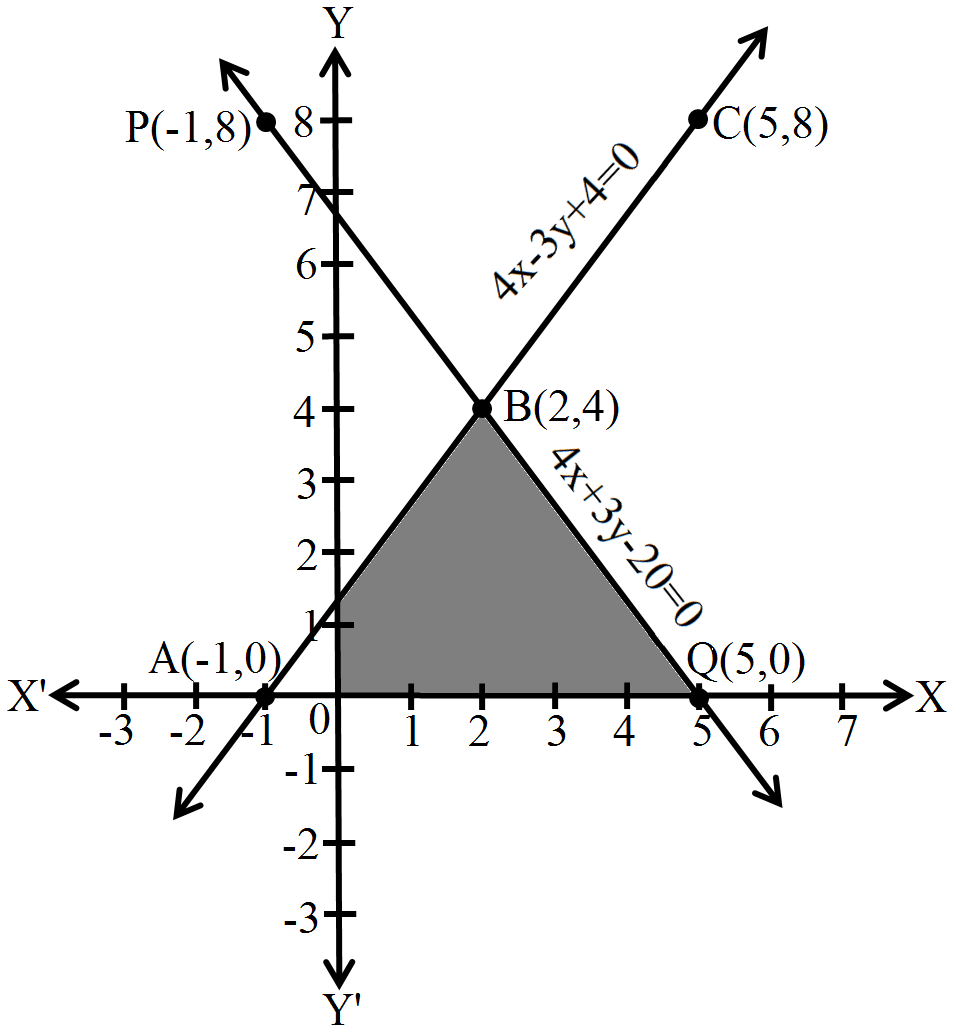
The two graph lines intersect at $B(2,4)$.
$\therefore x=2, y=4$ is the solution of the given system of equations.
Clearly, the vertices of $\triangle A B Q$ formed by these lines and the $x$-axis are $A(-1,0), B(2,4)$ and $Q(5,0)$
Consider the triangle $\triangle ABQ$ :
Height of the triangle $=4$ units and base $(A Q)=6$ units
Area of triangle
Area $=\Big(\frac{1}{2}\times\text{Base}\times\text{height}\Big)\text{sq. units}$
$=\Big(\frac{1}{2}\times4\times6\Big)\text{sq. units}$
Area of $\triangle\text{ABQ}=12\text{sq. }\text{units}$ View full question & answer→Question 854 Marks
Solve for $x$ and $y$
$\frac{1}{2(\text{x}+\text{2y)}}+\frac{5}{3(3\text{x}-\text{2y)}}=\frac{-3}{2},$
$\frac{5}{4(\text{x}+\text{2y)}}-\frac{3}{5(3\text{x}-\text{2y)}}=\frac{61}{60}$
Answer$\frac{1}{2(\text{x}+\text{2y)}}+\frac{5}{3(3\text{x}-\text{2y)}}=\frac{-3}{2},$
and $\frac{5}{4(\text{x}+\text{2y)}}-\frac{3}{5(3\text{x}-\text{2y)}}=\frac{61}{60}$
Putting $\frac{1}{\text{x}+\text{2y}}=\text{u},\ \frac{1}{\text{3x}-\text{2y}}=\text{v,}$ we get
$\frac{1}{2}\text{u}+\frac{5}{3}\text{v}=-\frac{3}{2}\ \dots(1)$
$\frac{5}{4}\text{u}-\frac{3}{5}\text{v}=\frac{61}{60}\ \dots(2)$
Multiplying $(1)$ by $6$ and $(2)$ by $20$, we get
$\text{3u}+\text{10v}=-9\ \dots(3)$
$\text{25u}-12\text{v}=\frac{61}{3}\ \dots(4)$
Multiplying $(3)$ by $6$ and $(4)$ by $5$, we get
$\text{18u}+\text{60v}=-54\ \dots(5)$
$\text{125u}-60\text{v}=\frac{305}{3}\ \dots(6)$
Adding $(5)$ and $(6)$, we get
$\text{143u}=\frac{305}{3}-54=\frac{305-162}{2}=\frac{143}{3}$
$\therefore\text{u}=\frac{1}{3}=\frac{1}{\text{x}+\text{2y}}$
$\therefore\text{x}+\text{2y}=3\ \dots(7)$
Putting value of u in $(3)$, we get
$1 + 10v = -9$
$10v = -10$ or $v = -1$
$\Rightarrow-1=\frac{1}{\text{3x}-\text{2y}}$
$3x - 2y = -1 ...(8)$
Adding $(7)$ and $(8)$, we get
$\text{4x}=2$
$\therefore\text{x}=\frac{1}{2}$
Putting value of $x$ in $(7)$
$\frac{1}2{}+\text{2y}=3$ or $\text{2y}=3-\frac{1}{2}=\frac{5}2{}$
$\therefore\ \text{y}=\frac{5}{4}$
Thus required solution is $\text{x}=\frac{1}{2},\ \text{y}=\frac{5}{4}$
View full question & answer→Question 864 Marks
Solve for $x$ and $y$
$\frac{\text{x}}{\text{a}}-\frac{\text{y}}{\text{b}}=0,$
$\text{ax}+\text{by}=(\text{a}^2+\text{b}^2)$
Answer$\frac{\text{x}}{\text{a}}-\frac{\text{y}}{\text{b}}=0$
$\Rightarrow\text{x}=\frac{\text{ay}}{\text{b}}\ \dots(\text{i})$
$\text{ax}+\text{by}=(\text{a}^2+\text{b}^2)\ \dots(\text{ii})$
Substituting $(i)$ in $(ii)$, we get
$\text{a}\Big(\frac{\text{ay}}{\text{b}}\Big)+\text{by}=(\text{a}^2+\text{b}^2)$
$\Rightarrow\Big(\frac{\text{a}^2\text{y}}{\text{b}}\Big)+\text{by}=(\text{a}^2+\text{b}^2)$
$\Rightarrow\text{a}^2\text{y}+\text{b}^2\text{y}=(\text{a}^2\text{b}+\text{b}^3)$
$\Rightarrow\text{y}(\text{a}^2+\text{b}^2)=\text{b}(\text{a}^2+\text{b}^2)$
$\Rightarrow\text{y}=\text{b}$
Substituting in $(i)$, we get $x = a$
So, $x = a$ and $y = b.$
View full question & answer→Question 874 Marks
Places $A$ and $B$ are $160\ km$ apart on a highway. One car starts from $A$ and another car from $B$ at the same time. If they travel in the same direction, they meet in $8$ hours. But, if they travel towards each other, they meet in $2$ hours. Find the speed of each car.
AnswerLet $X$ and $Y$ be the cars starting from $A$ and $B$ respectively and let their speeds be $x km / hr$ and $y km / hr$ respectively. Then, $A B=160 km$.
Case $1$: When the two cars move in the same direction In this case, let the two cars meet at a point $M.$

Distance covered by $X$ in $8$ hours $=8 xkm$
Distance covered by $Y$ in $8$ hours $=8 ykm$
$\therefore AM=(8 x) km \text { and } BM=(8 y) km$
$\Rightarrow AM - BM = AB$
$\Rightarrow (8x - 8y) = 160$
$\Rightarrow x - y = 20 ...(i)$
Case 2: When the two cars move in the opposite direction.
In this case, let the two cars meet at a point P.

Distance covered by $X$ in $2$ hours $= 2x \ km$
Distance covered by $Y$ in $2$ hours $- 2y \ km$
$AP = (2x)\ km$ and $BP = (2y)km$
$\Rightarrow AP + BP = AB$
$\Rightarrow (2x + 2y) = 160$
$\Rightarrow x + y = 80 .....(ii)$
Adding $(i)$ and $(ii)$, we get
$2x - 100$
$\Rightarrow x = 50$
Substituting $x = 50$ in $(ii)$, we get
$\Rightarrow y = 30.$
Hence, the speed of the car starting from $A$ is $50 km / h$
and that of the one starting from $B$ is $30 km / h$. View full question & answer→Question 884 Marks
Solve for $x$ and $y$
$\frac{3}{\text{x}}-\frac{1}{\text{y}}+\text{9}=0,$
$\frac{2}{\text{x}}+\frac{3}{\text{y}}=\text{5}$ $(\text{x}\neq0,\ \text{y}\neq0).$
AnswerPutting $\frac{1}{\text{x}}=\text{u}$ and $\frac{1}{\text{y}}=\text{v}$ the given equations become
$3u - v = 9 ...(1)$
$2u + 3v = 5 ...(2)$
Multiplying $(1)$ by $3$ and $(2)$ by $1$, we get
$9u - 3v = -27 ...(3)$
$2u + 3v = 5 ...(4)$
Adding $(3)$ and $(4)$, we get
$11u = -22$
$\Rightarrow\text{u}=\frac{-22}{11}=-2$
Putting $u = -2$ in $(1)$, we get
$3 \times (-2) - v = -9$
$\Rightarrow -6 - v = -9$
$\Rightarrow -v = -9 + 6$
$\Rightarrow -v = -3$
$\Rightarrow v = 3$
Now, $u = -2$
$\Rightarrow\frac{1}{\text{x}}=-2$
$\Rightarrow\text{x}=\frac{-1}{2}$
and, $v = 3$
$\Rightarrow\frac{1}{\text{y}}=3$
$\Rightarrow\text{y}=\frac{1}{3}$
$\therefore$ The solution is $\text{x}=\frac{-1}{2}$ and $\text{y}=\frac{1}{3}$
View full question & answer→Question 894 Marks
Solve the following system of equations graphically:
$2x + 3y - 4 = 0,$
$3x - y + 5 = 0$
Answer$\text{2x}+\text{3y}-4=0$
$\Rightarrow\text{y}=\frac{4-\text{2x}}{3}$
|
$x:$
|
$2$
|
$-1$
|
|
$y:$
|
$0$
|
$2$
|
$\text{3x}-\text{y}+5=0$
$\Rightarrow\text{y}=\text{3x}+5$
|
$x:$
|
$0$
|
$-1$
|
|
$y:$
|
$5$
|
$2$
|
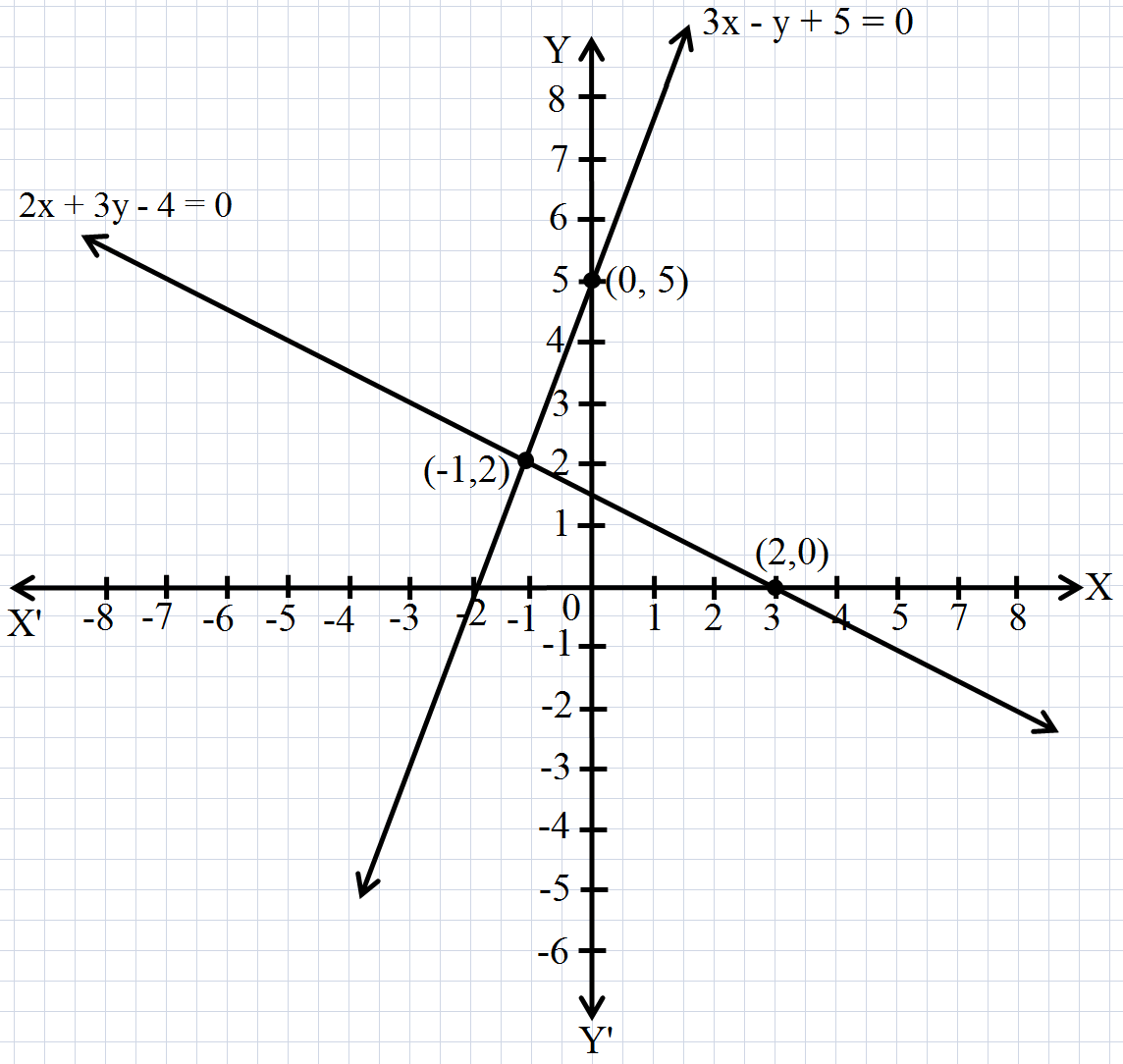
Since the two graph intersect at $(-1, 2),$
$x = -1$ and $y = 2$ View full question & answer→Question 904 Marks
The area of a rectangle gets reduced by $67$ square metres, when its length is increased by $3 \ m$ and breadth is decreased by $4\ m$. If the length is reduced by $1 \ m$ and breadth is increased by $4 \ m$, the area is increased by $89$ square metres. Find the dimensions of the rectangle.
AnswerLet the length of the rectangle be $x$ and the breadth be $y.$
So, the area of the rectangle $= xy$
According to the first condition,
$(x + 3)(y - 4) = xy - 67$
$\Rightarrow xy - 4x + 3y - 12 - xy - 67$
$\Rightarrow 4x + 3y = -55 ...(i)$
According to the second condition,
$(x - 1)(y + 4) = xy + 89$
$\Rightarrow xy + 4x - y - 4 = xy + 89$
$\Rightarrow 4x - y = 93 ...(ii)$
Adding $(i)$ and $(ii),$ we get
$2y = 38$
$\Rightarrow y = 19$
Substituting $y = 19$ in $(ii)$, we get $x = 28.$
Hence, the dimensions of the rectangle are $28\ m$ and $19\ m$
View full question & answer→Question 914 Marks
Draw the graphs of the following equations on the same graph paper:
$2 x+y=2,2 x+y=6$
Find the coordinates of the vertices of the trapezium formed by these lines. Also, find the area of the trapezium so formed.
Hint: The line $2 x+y=2$ cuts the $x$-axis at $A(1,0)$ and the $y$-axis at $B(0,2)$.
The line $2 x+y=6$ cuts the $x$-axis at $C(3,0)$ and the $y$-axis at $D(0,6)$.
Area of trap. ABCD $=\text{ar}(\triangle\text{OCD})-\text{ar}(\triangle\text{OAB})$
$=\Big(\frac{1}{2}\times3\times6\Big)-\Big(\frac{1}{2}\times1\times2\Big)$
$=8\ \text{sq. units}$
Answer$2\text{x}+\text{y}=2$
$\Rightarrow\text{y}=2-\text{2x}$
| $x:$ |
$0$ |
$1$ |
| $y:$ |
$2$ |
$0$ |
$\text{2x}+\text{y}=6$
$\Rightarrow\text{y}=6-\text{2x}$
| $x:$ |
$0$ |
$3$ |
| $y:$ |
$6$ |
$0$ |
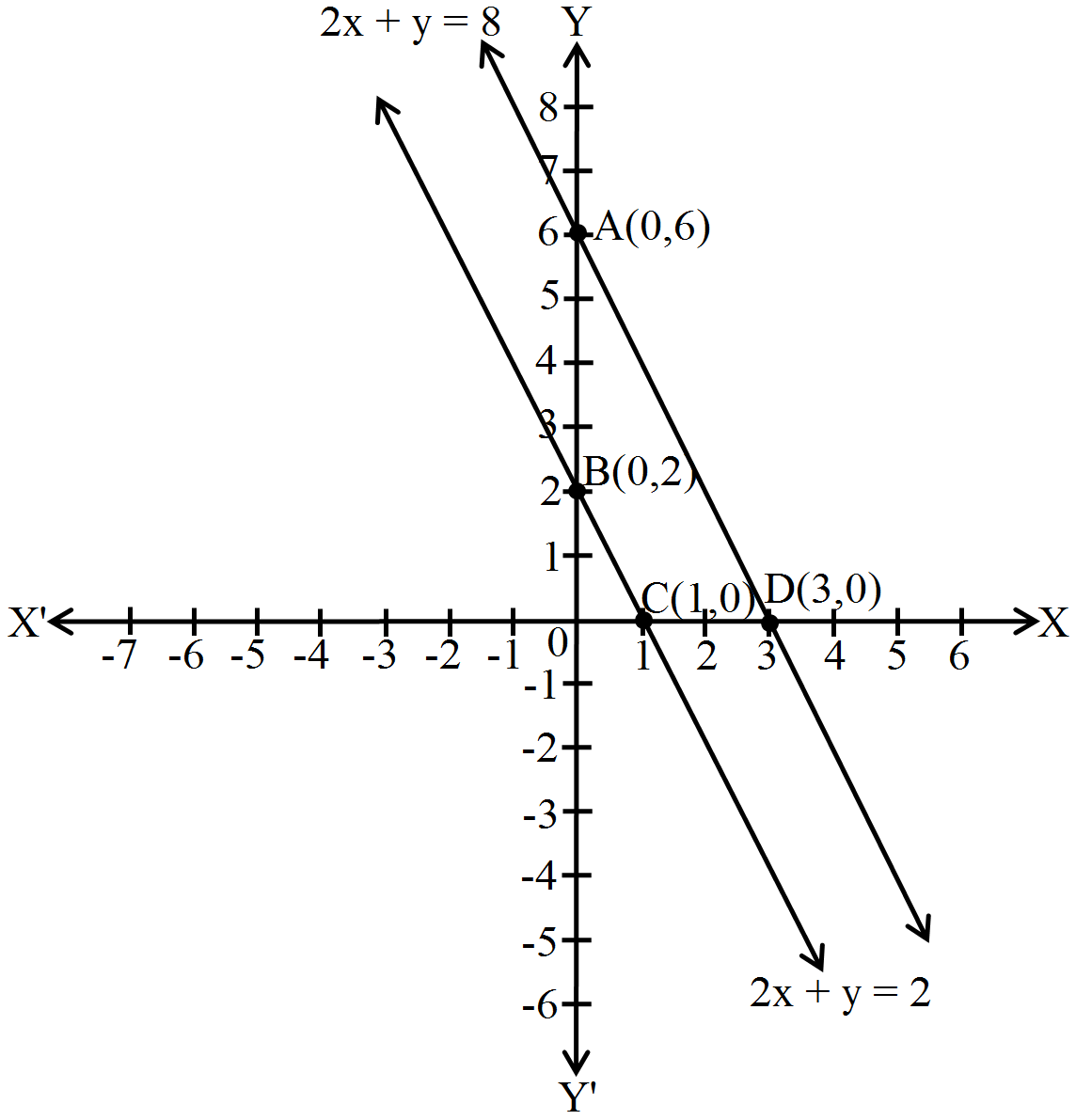
Since the two graph of the system of equations is parallel lines, the system has no solution and hence is inconsistent. View full question & answer→Question 924 Marks
Taxi charges in a city consist of fixed charges and the remaining depending upon the distance travelled in kilometres. If a man travels $80\ km$, he pays $₹ 1,330$, and travelling $90\ km$, he pays $₹ 1,490$. Find the fixed charges and rate per km.
AnswerLet the fixed charges be $₹ x$ and other charges be $₹ y$ per km.
According to the given condition,
$x + 80y - 1330 ...(i)$
$x + 90y = 1490 ...(ii)$
Subtracting $(i)$ from $(ii)$, we get
$10y = 160$
$⇒ y = 16$
Substituting y $- 16$ in $(i)$, we get
$x = 50.$
Hence, the fixed charges is $₹ 50$ and the other charges is $₹ 16$ per $km.$
View full question & answer→Question 934 Marks
A sailor goes 8km downstream in $40$ minutes and returns in $1$ hour. Find the speed of the sailor in still water and the speed of the current.
AnswerLet the speed of the sailor in still water be $x \ km/h$ and the speed of the current be $y \ km/hr.$
The upstream speed $= (x + y) \ km/hr$
The upstream speed $= (x - y) \ km/hr$
We know that, distance = speed $\times $ time
When the sail or goes downstream,
$(\text{x}+\text{y})\times\frac{40}{60}=8$
$\Rightarrow x + y = 12 ....(i)$
When the sailor goes upstream,
$(x - y) \times 1 = 8$
$\Rightarrow x - y = 8 ...(ii)$
Adding $(i)$ and $(ii)$, we get
$2x = 20$
$\Rightarrow x = 10$
Substitutiting in $(i),$ we get
$\Rightarrow y = 2.$
Hence, the speed of the sailor in still water is 10km/hr
and the speed of the current is $2\ km/hr.$
View full question & answer→Question 944 Marks
The monthly incomes of $A$ and $B$ are in the ratio $5 : 4$ and their monthly expenditures are in the ratio $7 : 5$. If each saves $₹ 9000$ per month, find the monthly income of each.
AnswerLet the monthly incomes of $A$ and $B$ be $₹ 5 x$ and $4 x$ respectively and let their expenditures be $₹ 7 y$ and 5 respectively.
We know that, savings = income - expenditure
Then, A's monthly savings $=₹(5 x-7 y)$
and B's monthly savings $=₹(4 x-5 y)$
But, the monthly saving of each is $₹ 9000$.
$\therefore 5 x-7 y=9000 \ldots \text { (i) }$
$\text { and } 4 x-5 y=9000 \ldots \text { (ii) }$
Multiply $(i)$ by $5$ and $(ii)$ by $7 ,$
$25x - 35y - 45000 ...(iii)$ and
$28x - 35y - 63000 ...(iv)$
Subtracting $(iii)$ from $(iv)$, we get
$3x = 18000$
$\Rightarrow x = 6000$
Substituting $x = 6000$ in $(i)$, we get
$\Rightarrow y = 3000.$
So, A's income $=5 x=₹ 30000$
and B's income $=4 x=₹ 24000$
Hence, the monthly income of $A$ is $₹ 30000$
and that of B is $₹ 24000$
View full question & answer→Question 954 Marks
Solve for $x$ and $y$
$px + qy = p - q,$
$qx - py = p + q$
Answer$px + qy = p - q ...(i)$
$qx - py = p + q ...(ii)$
Multiplying $(i)$ by p and $(ii)$ by $q$ and adding, we get
$p^2 x+q^2 x=p^2-p q+p q+q^2$
$\Rightarrow\text{x}=\frac{\text{p}^2+\text{q}^2}{\text{p}^2+\text{q}^2}$
$\Rightarrow x = 1$
Substituting $x = 1$ in $(i)$, we get
$p + qy = p - q$
$y = -1$
So, $x = 1$ and $y = -1$
View full question & answer→Question 964 Marks
$5$ chairs and $4$ tables together cost $₹ 5,600$, while $4$ chairs and $3$ tables together cost $₹ 4,340.$ Find the cost of a chair and that of a table.
AnswerLet each chair cost $₹ x$ and each table cost $₹ y$
According to the first condition,
$5x + 4y = 5600 ...(i)$
According to the second condition,
$4x + 3y = 4340 ...(ii)$
Multiplying $(i)$ by $3$ and $(ii)$ by $4$,
We get:
$15x + 12y = 16800 and 16x + 12y = 17360$
Subracting the above equations, we get
$x = 560$
Substituting $x = 560$ in $(iii)$, we get
$y = 700$
Hence, the cost of each chair is $₹ 560$ and the cost of each table is $₹ 700.$
View full question & answer→Question 974 Marks
The difference between two numbers is $14$ and the difference between their squares is $448$. Find the numbers.
AnswerLet the numbers be $x$ and $y$ respectively.
According to the question:
$ x-y=14....(1) $
$ x^2-y^2=448....(2)$
From (1), we get:
$x=14+y....(3)$
Putting $x=14+y$ in $(2),$ we get
$ (14+y)^2-y^2=448 $
$ 196+y^2+28 y-y^2=448 $
$ 196+28 y=448 $
$ 28 y=448-196 $
$ y=\frac{252}{28} $
$ y=9$
Putting $y=9$ in $(1)$, we get
$ x-9=14 $
$ \Rightarrow x=14+9 $
$ \Rightarrow x=23$
Hence, the required numbers are $23$ and $9.$
View full question & answer→Question 984 Marks
Solve the following system of equations graphically:
$2x - 5y + 4 = 0,$
$2x + y - 8 = 0$
AnswerOn a graph paper, draw a horizontal line $X^{\prime} O X$ and a vertical line $Y O Y^{\prime}$ representing the $x$-axis and $y$-axis, respectively. Given equations are $2 x-5 y+4=0$
and $2x + y - 8 = 0$
Graph of $2x - 5y + 4 = 0:$
$2x - 5y + 4 = 0$
$\Rightarrow\text{y}=\frac{\text{2x}+4}{5}\ \dots(1)$
Thus, we have the following table for $2x - 5y + 4 = 0$
|
$x:$
|
$-2$ |
$3$
|
$8$
|
|
$y:$
|
$0$
|
$2$
|
$4$
|
On the graph paper plot the points $A(-2,0), B(3,2)$ and $C(8,4)$.
Join $A B$ and $B C$ to get the graph line $A C$.
Thus, the line $A C$ is the graph of the equation of $2 x-5 y+4=0$.
Graph of $2 x+y-8=0$ :
For graph of $2 x+y-8=0$
$\Rightarrow y=-2 x+8 \ldots(2)$
Thus, we have the following table for $2 x+y-8=0$
|
$x:$
|
$1$
|
$3$
|
$2$
|
|
$y:$
|
$6$
|
$2$
|
$4$
|
Now, on the same graph paper plot the points $P(1,6)$ and $Q(2,4)$.
The third point $B(3,2)$ has already been plotted.
Join $PQ$ and $QB$ to get the line $PB$.
Thus, line $PB$ is the graph of the equation $2 x+y-8=0$.
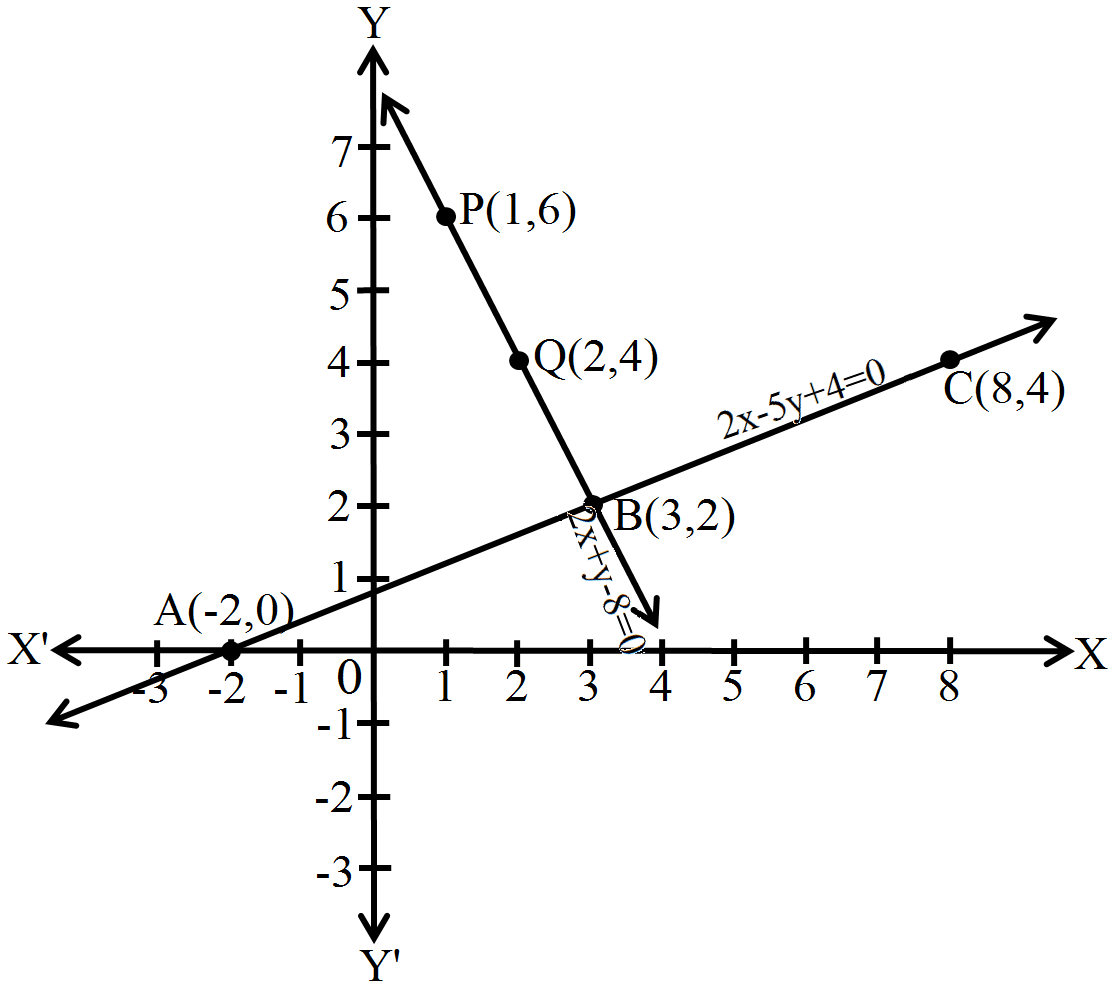
The two graph lines intersect at $B(3, 2).$
$\therefore$ $x = 3, y = 2$ is the solution of the given system of equations.
View full question & answer→Question 994 Marks
A boat goes $12\ km$ upstream and $40\ km$ downstream in $8$ hours. It can go $16\ km$ upstream in $8$ hours. It can go $16\ km$ upstream and $32\ km$ downstream in the same time. Find the speed of the boat in still water and the speed of the stream.
AnswerLet the speed of the boat in still water be $x \ km/hr$ and speed of the stream be $y \ km/hr.$
Then,
Speed upstream $= (x - y)\ km/hr$
Speed downstream$ = (x + y) \ km/hr$
Time taken to cover 12km upstream $=\frac{12}{\text{x}-\text{y}}\text{hrs.}$
Time taken to cover 40km downstream $=\frac{40}{\text{x}+\text{y}}\text{hrs.}$
Total time taken = 8hrs.
$\therefore\frac{12}{\text{x}-\text{y}}+\frac{40}{\text{x}+\text{y}}=8$
Again, time taken to cover 16km upstream $=\frac{16}{(\text{x}-\text{y})}$
Time taken to taken to cover 32km downstream $=\frac{32}{(\text{x}+\text{y})}$
Total time taken = 8hrs.
$\therefore\frac{16}{(\text{x}-\text{y})}+\frac{32}{(\text{x}+\text{y})}=8$
Putting $\frac{1}{(\text{x}-\text{y})}=\text{u}$ and $\frac{1}{(\text{x}+\text{y})}=\text{v},$ we get
$12u + 40v = 8$
$3u + 10v = 2 ...(1)$
and
$16u + 32v = 8$
$2u + 4y = 1 ...(2)$
Multiplying $(1)$ by $4$ and $(2)$ by $10$, we get
$12u + 40v = 8 ...(3)$
$200 + 40v = 10 ...(4)$
Subtracting $(3)$ from $(4)$, we get
$\text{8u}=2$
$\Rightarrow\text{u}=\frac{1}{4}$
Putting $\text{u}=\frac{1}{4}$ in $(3)$, we get
$3\times\frac{1}{4}+\text{10v}=2$
$\Rightarrow\text{10v}=\frac{5}{4}$
$\Rightarrow\text{v}=\frac{1}{8}$
$\text{u}=\frac{1}{4}$
$\Rightarrow\frac{1}{\text{x}-\text{y}}=\frac{1}{4}$
$\Rightarrow\text{x}-\text{y}=4\ \dots(5)$
$\text{v}=\frac{1}{8}$
$\Rightarrow\frac{1}{\text{x}+\text{y}}=\frac{1}{8}$
$\Rightarrow\text{x}+\text{y}=8\ \dots(6)$
On adding $(5)$ and $(6)$, we get
$2x = 12$
$x = 6$
Putting $x = 6$ in $(6)$, we get
$6 + y = 8$
$\Rightarrow y = 8 - 6 = 2$
$\therefore x = 6, y = 2$
Hence, the speed of the boat in still water = 6km/hr and speedot the stream $= 2\ km/hr$
View full question & answer→Question 1004 Marks
Show graphically that each of the following given systems of equations is inconsistent, i.e., has no solutions:
$x - 2y = 6, 3x - 6y = 0$
Answer$\text{x}-\text{2y}=6$
$\Rightarrow\text{y}=\frac{\text{x}-\text{6}}{2}$
| $x:$ |
$0$ |
$2$ |
| $y:$ |
$-3$ |
$-2$ |
$\text{3x}-\text{6y}=0$
$\Rightarrow\text{y}=\frac{1}{2}\text{x}$
| $x:$ |
$0$ |
$4$ |
| $y:$ |
$0$ |
$2$ |
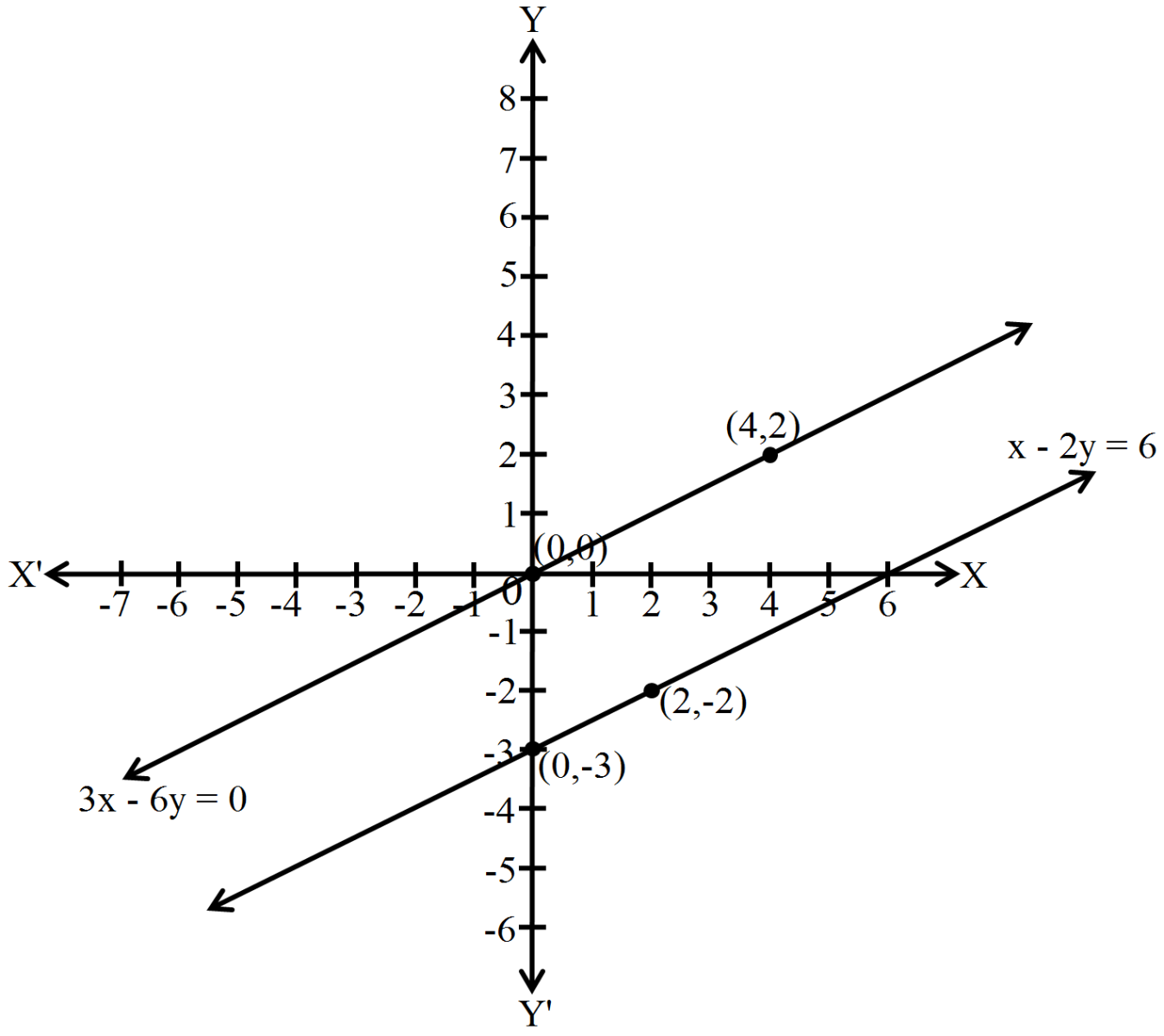
Since the two graph of the system of equations is parallel lines, the system has no solution and hence is inconsistent. View full question & answer→