Question 11 Mark
Solve the pair of linear equations by substitution method: $3x – y = 3; 9x – 3y = 9$
Answer$3x - y = 3$
$9x - 3y = 9$
The given pair of linear equations is
$3x - y = 3..............(1)$
$9x - 3y = 9.............(2)$
From equation(1),
$y = 3x - 3...................(3)$
$9x - 3(3x - 3) = 9$
$\Rightarrow$ $9x - 9x + 9 = 9$
$\Rightarrow$ $9 = 9$
which is true. Therefore, equation $(1)$ and $(2)$ have infinitely many solutions.
View full question & answer→Question 21 Mark
Is the pair of linear equation consistent/inconsistent? If consistent, obtain the solution graphically: $2x – 2y – 2 = 0; 4x – 4y – 5 = 0$
Answer$2 x - 2 x - 2 = 0................(1)$
$4 x - 4 y - 5 = 0..................(2)$
Here, $a _ { 1 } = 2 , \quad b = - 2 , c _ { 1 } = - 2$
$a _ { 2 } = 4 , b _ { 2 } = - 4 , c _ { 2 } = - 5$
We see that $\frac { a _ { 1 } } { a _ { 2 } } = \frac { b _ { 1 } } { b _ { 2 } } \neq \frac { c _ { 1 } } { c _ { 2 } }$
Hence, the lines represented by the equations $(1)$ and $( 2)$ are parallel.
Therefore, equations $(1)$ and $(2)$ have no solution, i.e., the given pair of a linear equation is inconsistent.
View full question & answer→Question 31 Mark
Is the pair of linear equation consistent/inconsistent? If consistent, obtain the solution graphically: $x – y = 8; 3x – 3y = 16$
Answer$x - y = 8.................(1)$
$3 x - 3 y = 16.............(2)$
Here, $a _ { 1 } = 1 , b _ { 1 } = - 1 , c _ { 1 } = - 8$
$a _ { 2 } = 3 , b _ { 2 } = - 3 , c _ { 2 } = - 16$
We see that $\frac { a _ { 1 } } { a _ { 2 } } = \frac { b _ { 1 } } { b _ { 2 } } \neq \frac { c _ { 1 } } { c _ { 2 } }$
Hence, the lines represented by the equations $(1)$ and $(2)$ are parallel.
Therefore, equations $(1)$ and $(2)$ have no solution, i.e., the given pair of linear equation is inconsistent.
View full question & answer→Question 41 Mark
On comparing the ratios $ \frac { a _ { 1 } } { a _ { 2 } } , \frac { b _ { 1 } } { b _ { 2 } } $ and $\frac { c _ { 1 } } { c _ { 2 } }$, find out whether the pair of linear equation is consistent, or inconsistent: $5x - 3y = 11; -10x + 6y = -22$
AnswerFrom the given equations, We get,
$\frac{a_{1}}{a_{2}}=\frac{5}{-10}=-\frac{1}{2}$
$\frac{b_{1}}{b_{2}}=-\frac{3}{6}=-\frac{1}{2}$
$\frac{c_{1}}{c_{2}}=\frac{11}{-22}=-\frac{1}{2}$
Hence,
$\frac{a_{1}}{a_{2}}=\frac{b_{1}}{b_{2}}=\frac{c_{1}}{c_{2}}$
Therefore the given pair of line has an infinite number of solutions. So the given pair of linear equation is consistent.
View full question & answer→Question 51 Mark
On comparing the ratios $\frac { a _ { 1 } } { a _ { 2 } } , \frac { b _ { 1 } } { b _ { 2 } } \text { and } \frac { c _ { 1 } } { c _ { 2 } }$, find out whether the pair of linear equations are consistent, or inconsistent: $\frac { 4 } { 3 } x + 2y = 8; 2x + 3y = 12.$
AnswerGiven equations are:
$\frac { 4 } { 3 } x $ $+ 2y = 8; 2x + 3y = 12$
Compare equation $\frac{4}{3} x+2 y=8$ with $\mathrm{a}_1 \mathrm{x}+\mathrm{b}_1 \mathrm{y}+\mathrm{c}_1=0$ and $2 \mathrm{x}+3 \mathrm{y}=12$
with $a_2 x+b_2 y+c_2=0$, We get, $a_1=\frac{4}{3}, a_1=\frac{4}{3}, b_1=2, c_1=-8, a_2=2, b_2=3, c_2=-12$
$\frac { a _ { 1 } } { a _ { 2 } } = \frac { \frac { 4 } { 3 } } { 2 } = \frac { 2 } { 3 } , \frac { b _ { 1 } } { b _ { 2 } } = \frac { 2 } { 3 }$ and $\frac { c _ { 1 } } { c _ { 2 } } = \frac { 8 } { 12 } = \frac { 2 } { 3 }$
Here $\frac { a _ { 1 } } { a _ { 2 } } = \frac { b _ { 1 } } { b _ { 2 } } = \frac { c _ { 1 } } { c _ { 2 } }$
Therefore, the lines have infinitely many solutions.
Hence, they are consistent.
View full question & answer→Question 61 Mark
Use elimination method to find all possible solutions of the following pair of linear equations:
2x + 3y = 8 ...(1)
4x + 6y = 7 ...(2)
AnswerStep 1: Multiply equation (i) by 2 and equation (ii) by 1 to make the coefficients of x equal. Then we get the equations as :
4x + 6y = 16 ...(iii)
4x + 6y = 7 ...(iv)
Step 2: Subtracting equation (iv) from equation (iii),we get
(4x - 4x) + (6y - 6y) = 16 - 7
i.e., 0 = 9, which is a false statement. Therefore, the given pair of equations has no solution.
View full question & answer→Question 71 Mark
Two rails are represented by the equations: $x + 2y – 4 = 0$ and $2x + 4y – 12 = 0$. Will the rails cross each other?
AnswerThe pair of linear equations are given as:
$x + 2y – 4 = 0 ...(i)$
$2x + 4y – 12 = 0 ...(ii)$
We express $x$ in terms of $y$ from equation $(i)$, to get
$x = 4 – 2y$
Now, we substitute this value of $x$ in equation $(ii)$, to get
$2(4 – 2y) + 4y – 12 = 0$
$i.e., 8 – 12 = 0$
$i.e., – 4 = 0$
Which is a false statement. Therefore, the equations do not have a common solution. So, the two rails will not cross each other.
View full question & answer→Question 81 Mark
If $\frac{1}{a}+\frac{1}{b}=5$ and $\frac{2}{a}+\frac{2}{b}=3$ then find $\frac{a-b}{a b}$.
Answer$\frac{1}{a}+\frac{1}{b}=5 $
$\frac{2}{a}+\frac{2}{b}=3$
Substituting equation $(i)$ and $(ii),$
$-\frac{1}{a}+\frac{1}{b}=2$
$\therefore \frac{-b+a}{a b}=2$
$\therefore \frac{a-b}{a b}=2$
View full question & answer→Question 91 Mark
$\frac{x}{2}=\frac{9}{4}=\frac{3}{y}$ then find the value of $2 x(x-3 y)$.
View full question & answer→Question 101 Mark
To eliminate $x$ from the equations $x+y+3 x=12$ (i) and $8 x+3 y=17$ ...............
$(ii)$ by which number the equations $(ii)$ is multiplied ?
Answer$x+y+3 x=12 \Rightarrow 4 x+y=12$
The coefficient of $x$ in equation $(i)$ is $4$
$8 x+3 y=17$
The coefficient of $x$ in equation $(ii)$ is $8$ .
Let the equation $(ii)$ is multiplied by $m$ then we eliminate $x$.
$8 \times m=-4 \quad(-4$ is additive inverse of 4$)$
$\therefore m=\frac{4}{8}-\frac{1}{2}$
View full question & answer→Question 111 Mark
The Equations $5 x+6 y=13$ and $6 x+5 y=20$ then find the value of $x^2-y^2$. (Without finding the value of $x, y)$
View full question & answer→Question 121 Mark
What is the solution of $y+x=5$ and $y-x=9$ ?
Answer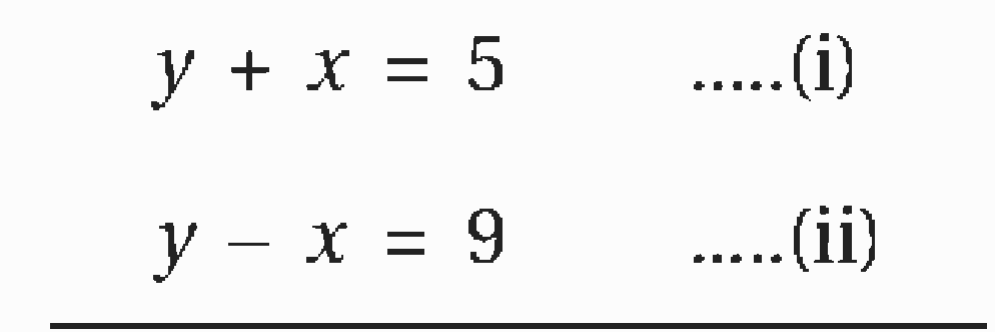
$\therefore 2 y=14$
$\therefore y=7$
Substituting $y=7$ in equation $(i)$ we have
$y+x=5$
$\therefore 7+x=5$
$\therefore x=-2$
$\therefore(x, y)=(-2,7) \text { is its solution }$ View full question & answer→Question 131 Mark
To eliminate $y$ from the equations $x+2 y=1500$ $..........$
$(i)$ and $x-4 y=0$ $......... (ii),$ by which number the equation $(i)$ is multiplied $?$
Answer$(i)$ and $x-4 y=0$ $(ii)$, by which number the equation $(i)$ is multiplied $?$
The coefficient of $y$ in the equation $(i)$ is $2$ and the coefficient of $y$ in the equation $(ii)$ is $-4$ so, we multiply equation $(i)$ by $2$ to eliminate $y$.
View full question & answer→Question 141 Mark
Write the formula to find $y$ in the method of elimination.
Answer$
y=\frac{a_2 c_1-a_1 c_2}{a_1 b_2-a_2 b_1}
$
View full question & answer→Question 151 Mark
Write the formula to find $x$ in the method of elimination.
Answer$
x=\frac{b_1 c_2-b_2 c_1}{a_1 b_2-a_2 b_1}
$
View full question & answer→Question 161 Mark
To eliminate $x$ from the equations $3 x+y=7$ $(i)$ and $-x+2 y=2$ $................ (ii)$ by which number the equation$(ii)$ is multiplied ?
AnswerIn equation $(i)$ the coefficient of $x$ is $3$ and in equation $(ii)$ the coefficient of $x$ is $-1$ .
So, we multiply equation $(ii)$ by $3$ to eliminate $x$
View full question & answer→Question 171 Mark
For the equations, $2 x+y=5$ and $y-1=0$ find the value of $x$.
Answer$y-1=0$
$\therefore y=1$
substituting $y =1$ in $2 x+y=5$, we get
$\therefore 2 x+1=5$
$\therefore 2 x=4$
$\therefore x=2$
View full question & answer→Question 181 Mark
If the pair of linear equations in two variable is $x+2 y=10$ and $x=-2$ then find the value of $y$.
Answer$x+2 y=10$
$ \therefore-2+2 y=10 $
$ \therefore 2 y=10+2$
$\therefore 2 y=12 $
$ \therefore y=6$
View full question & answer→Question 191 Mark
Find the solution set of the equations $x-3 y=1$ and $3 x+y=3$ using the method of substitutions.
Answer$x-3 y=1 \ldots \text { (i) } 3 x+y=3 $
$\therefore x=3 y+1$
Substitute $x=3 y+1$ in the equation $(ii)$ we have,
$\therefore 3(3 y+1)+y=3 $
$\therefore 9 y+3+y=3 $
$\therefore 10 y+3=3 $
$\therefore 10 y=3-3 $
$\therefore 10 y=0 $
$\therefore y=0 $
$x-3 y=1 $
$\therefore x-3(0)=1 $
$\therefore x-0=1 $
$\therefore x=1$
Thus, $(x, y)=(1,0)$
Solution set $=\{(x, y) / x=1, y=0\}$.
View full question & answer→Question 201 Mark
The solution of the equations $x+2 y+2=0$ and $3 x+6 y-k=0$ is infinite then the value of $k$ is .......... .
AnswerComparing $x+2 y+2$ with
$a_1 x+b_1 y+c_1=0$,
we have
$
a_1=1, b_1=2, c_1=2
$
Comparing $3 x+6 y-k=0$
with
$
a_2 x+b_2 y+c_2=0,
$
we have
$
a_2=3, b_2=6, c_2=-k
$
For infinite solution :
$
\begin{array}{c}
b_1 c_2-b_2 c_1=0 \\
\therefore(2)(-k)-(6)(2)=0 \\
\therefore-2 k-12=0 \\
\therefore k=-6
\end{array}
$
View full question & answer→Question 211 Mark
If $\frac{a_1}{a_2}=\frac{b_1}{b_2}$ but $\frac{a_1}{a_2} \neq \frac{c_1}{c_2}$ or $\frac{b_1}{b_2} \neq \frac{c_1}{c_2}$ then how many solution the equations has ?
Answer$\frac{a_1}{a_2}=\frac{b_1}{b_2}$ but $\frac{a_1}{a_2} \neq \frac{c_1}{c_2}$ or $\frac{b_1}{b_2} \neq \frac{c_1}{c_2}$ then the equations has no solution. The solution set is empty.
View full question & answer→Question 221 Mark
Write the condition that the equations $a_1 x+b_1 y+c_1=0$ and $a_2 x+b_2 y+c_2=0$ have infinite solution?
AnswerThe Condition that $a_1 x+b_1 y+c_1=0$ and $a_2 x+b_2 y+c_2=0$ have infinite solution is $\frac{a_1}{a_2}=\frac{b_1}{b_2}=\frac{c_1}{c_2}$
View full question & answer→Question 231 Mark
If $a_1 b_2-b_1 a_2=b_1 c_2-b_2 c_1=c_1 a_2-a_1 c_2$ then what is the solution set of the equations $a_1 x+b_1 y+a$ $=0$ and $a_2 x+b_2 y+c_2=0$ ?
AnswerIf $a_1 b_2-b_1 a_2=b_1 c_2-b_2 c_1 a_2-a_2 c_2$ then the equations have infinite solution.
View full question & answer→Question 241 Mark
Solve the equations: $2 x+y=6$ and $4 x+2 y=5$.
Answer$
\begin{array}{c}
2 x+y=6 \\
\therefore 2 x+y-6=0
\end{array}
$
Comparing with
$
a_1 x+b_1 y+c_1=0,
$
we have
$
a_1=2, b_1=1, c_1=-6
$
$
\begin{array}{c}
4 x+2 y=5 \\
\therefore \quad 4 x+2 y-5=0
\end{array}
$
Comparing with
$
a_2 x+b_2 y+c_2=0,
$
we have
$
a_2=4, b_2=2, c_2=-5
$
$
\frac{a_1}{a_2}=\frac{2}{4}=\frac{1}{2}, \frac{b_1}{b_2}=\frac{1}{2}, \frac{c_1}{c_2}=\frac{-6}{-5}=\frac{6}{5}
$
Here, $\frac{a_1}{a_2}=\frac{b_1}{b_2}$ but $\frac{a_1}{a_2} \neq \frac{c_1}{c_2}$ and $\frac{b_1}{b_2} \neq \frac{c_1}{c_2}$
$\therefore$ Solution set of the given equations is $\phi$.
View full question & answer→Question 251 Mark
How many solutions does the linear equations $2 x+y-3=0$ and $6 x+3 y=9$ have ?
Answer$2 x+y-3=0 $
$\text { and } 6 x+3 y=9$
$\therefore 6 x+3 y-9=0$
Divide by $3$, we have
$2 x+y-3=0$ which is same as equation $(i)$
So they have infinite solutions
View full question & answer→Question 261 Mark
Which type of the graph of $p(x)=2 x+5$ is ?
Answer$p(x)=2 x+5$ is a linear polynomial so its graph is a line.
View full question & answer→Question 271 Mark
If the graph of the equation $2 x+9 y+(k-2)=0$ passes through the origin then find the value of $k$
AnswerHere $c=k-2$
$\therefore k-2=0 $
$\therefore k=2$
View full question & answer→Question 281 Mark
Write the standard form of a linear equations in two variables.
Answer$
a x+b y+c=0 \text { where } a \neq 0, b \neq 0 \text { and } a^2+b^2 \neq 0
$
View full question & answer→Question 291 Mark
Find the solution of the pair of the linear equations $x-3=0$ and $y-2=0$.
Answer$x-3=0 \Rightarrow x=3 $
$y-2=0 \Rightarrow y=2$
Solution $(x, y)=(3,2)$
View full question & answer→Question 301 Mark
What is general form at the linear equation at two variable if it passes from origin.
Question 311 Mark
If $\frac{x}{15}=\frac{3}{5}=\frac{y}{10}$ then find the value of $2 x+3 y$.
Answer$
\begin{array}{l|l}
\frac{x}{15}=\frac{3}{5}=\frac{y}{10} \\
\therefore \frac{x}{15}=\frac{3}{5} & \therefore \frac{3}{5}=\frac{y}{10} \\
\therefore 5 x=45 & \therefore 5 y=30 \\
\therefore x=9 & \therefore y=6
\end{array}
$
Now, $2 x+3 y=2(9)+3(6)=18+18=36$
View full question & answer→Question 321 Mark
In the equation $a x+b y+c=0$ If $a=0$ and $b \neq 0, c=0$ then which axis is represented the graph of the equation ?
View full question & answer→Question 331 Mark
Convert $x=\frac{3 y}{4}+\frac{21}{5}$ in a standard form.
Answer$x=\frac{3 y}{4}+\frac{21}{5} $
$\therefore \frac{x}{1}=\frac{3 y}{4}+\frac{21}{5} $
$\therefore 20 x=15 y+84 $
$\therefore 20 x-15 y-84=0$
View full question & answer→Question 341 Mark
Convert $\frac{x}{5}-\frac{y}{3}=2$ in a standard form.
Answer$\frac{x}{5}-\frac{y}{3}=2 $
$\therefore 3 x-5 y=30$
$\therefore 3 x-5 y-30=0$
View full question & answer→Question 351 Mark
If $\frac{x}{3}=\frac{16}{y}=4$ then find the value of $x+y$.
Answer$\frac{x}{3}=\frac{16}{y}=4 \therefore \frac{x}{3}=4 \Rightarrow x=12 $
$\therefore \frac{16}{y}=4 \Rightarrow 4 \Rightarrow y=4$
$\therefore x+y=12+4=16$
View full question & answer→Question 361 Mark
Convert $\frac{x}{3}+\frac{y}{5}=1$ in a standard form.
Answer$
\begin{aligned}
\frac{x}{3}+\frac{y}{5} & =\frac{1}{1} \\
& =5 x+3 y=15 \\
& =5 x+3 y-15=0
\end{aligned}
$
View full question & answer→