Questions

1 Marks Question

🎯

Test yourself on this topic

13 questions · timed · auto-graded

Question 11 Mark
It is given that in a group of $3$ students, the probability of $2$ students not having the same birthday is $0.992$. What is the probability that the $2$ students have the same birthday?
Answer
  1. The probability that she takes out an orange flavoured candy is $0$ because the bag contains lemon flavoured candies only.
  2. Probability that she takes out a lemon flavoured candy is $1$ because the bag contains lemon flavoured candies only.
View full question & answer
Question 21 Mark
A bag contains lemon flavoured candies only. Malini takes out one candy without looking into the bag. What is the probability that she takes out
  1. an orange flavoured candy?
  2. a lemon flavoured candy?
Answer
Since, $P(E) + P (not E) = 1 P (not E) = 1 - P(E) = 1 - 0.05 = 0.95$
View full question & answer
Question 31 Mark
If P(E) = 0.05, what is the probability of not E?
Answer
– 1.5 cannot be the probability of an event because 0$ \leqslant $P(E)$ \leqslant $ 1. The probability of a sure event is 1 and the probability of an impossible event is 0.
View full question & answer
Question 41 Mark
Why is tossing a coin considered to be a fair way of deciding which team should get the ball at the beginning of a football game?
Answer
It is an equally likely event because in the given experiment, “A baby is born, It is a boy or a girl, we know that there are only two possible outcomes – either a boy or a girl.
View full question & answer
Question 51 Mark
A baby is born. It is a boy or a girl. Is this experiment has an equally likely outcome? Explain.
Answer
It is an equally likely event because in the given experiment, a trial is made to answer a true-false question. The answer is either right or wrong only.
View full question & answer
Question 61 Mark
A trial is made to answer a true-false question. The answer is right or wrong. Is this experiment has an equally likely outcome? Explain.
Answer
It is not an equally likely event because the outcome depends upon many factors e.g. quality of player.
View full question & answer
Question 71 Mark
A player attempts to shoot a basketball. She/he shoots or misses the shot. Is this experiment has an equally likely outcome? Explain.
Answer
In the experiment, “A driver attempts to start a car. The car starts or does not start”, it depends on several factors such as fuel, engine condition etc. So we are not justified to assume that each outcome is as likely to occur as the other. Thus, the experiment has not equally likely outcomes.
View full question & answer
Question 81 Mark
A driver attempts to start a car. The car starts or does not start, is this experiment has an equally likely outcome? Explain.
Answer
0, 1
View full question & answer
Question 91 Mark
$12$ defective pens are accidentally mixed with $132$ good ones. It is not possible to just look at a pen and tell whether or not it is defective. One pen is taken out at random from this lot. Determine the probability that the pen taken out is a good one.
Answer
Total number of pens $= 132 + 12 = 144$
Number of good pens $= 132$
Let E be the event of getting a good pen.
Therefore, $P$(getting a good pen), $P(E) =$
$\frac { \text { Number of outcomes favorable to } E } { \text { Number of all possible outcomes } } = \frac { 132 } { 144 } = \frac { 11 } { 12 }$ Thus, the probability of getting a good pen is $\frac{{11}}{{12}}$.
View full question & answer
Question 101 Mark
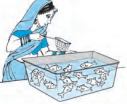
Gopi buys a fish from a shop for his aquarium. The shopkeeper takes out one fish at random from a tank containing $5$ male fish and $8$ female fish. What is the probability that the fish taken out is a male fish?
Answer
There are $13 (8 + 5)$ fish out of which one can be chosen in $13$ ways.
Total number of elementary events $= 13$
There are 5 male fish out of which one male fish can be chosen in $5$ ways.
Favourable number of elementary events $= 5$
Hence, required probability $= \frac { 5 } { 13 }$
View full question & answer
Question 111 Mark
Two players, Sangeeta and Reshma, play a tennis match. It is known that the probability of Sangeeta winning the match is $0.62$. What is the probability of Reshma winning the match?
Answer
Probability of winning the match by Reshma
$=$ Probability of loosing the match by Sangeeta
$= 1 -$ Probability of winning the match by Sangeeta
$= 1 - 0.62 = 0.38$
View full question & answer
Question 121 Mark
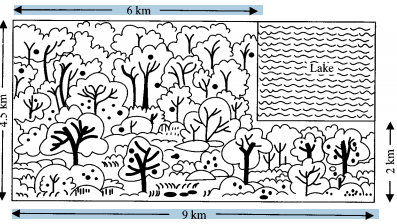
A missing helicopter is reported to have crashed somewhere in the rectangular region in Fig. What is the probability that it is crashed inside the lake shown in the figure?
Answer
According to the question,
Area of the entire region where the helicopter can crash $= (4.5\times 9) km^2 = 40.5\ km^2$
Area of the lake $= (2.5\times  3) km^2 = 7.5\ km^2$
Probability that the helicopter crashed inside the lake$= \frac { 7.5 } { 40.5 } = \frac { 75 } { 405 } = \frac { 5 } { 27 }$
View full question & answer
Question 131 Mark
Find the probability of getting a head when a coin is tossed once. Also find the probability of getting a tail.
Answer
In the experiment of tossing a coin once, the number of possible outcomes is two: Head $(H)$ and Tail $(T)$. $P$ (head) = $\frac{\text { Number of favourable outcomes } }{\text { Number of all possible outcomes }}=\frac{1}{2}$
$P$ (tail) = $\frac{\text { Number of favourable outcomes }}{\text { Number of all possible outcomes }}=\frac{1}{2}$
View full question & answer
1 Marks Question - Maths STD 10 Questions - Vidyadip