The probability of an event is greater than or equal to ________ and less than or equal to ________.
Question types
Probability question types
54 questions across 5 question groups — pick any mix to generate a Maths paper with step-by-step answer keys.
54
Questions
5
Question groups
5
Question types
01
Fill In The Blanks[1 Marks ]
5 Q→02True False[1 Marks ]
6 Q→031 Marks Question
13 Q→042 Marks Questions
21 Q→053 Marks Question
9 Q→Sample Questions
Probability questions
One sample from each question group in this chapter. Select any group above to see the full set with answer keys.
View full solution →
The sum of the probabilities of all the elementary events of an experiment is ________.
The probability of an event that is certain to happen is ________. Such an event is called ________.
The probability of an event that cannot happen is ________. Such an event is called ________.
Probability of an event E + Probability of the event not E = ________.
If three balanced coin tossed once then total outcomes get $8$
View full solution →The probability is $1$ of the event "The Sun rises in the East'.
View full solution →If $P(A)=\frac{4}{5}$ then $P(\bar{A})=\frac{5}{4}$
View full solution →$0 \leq P(E) \leq 1$ (where $E$ is an event)
View full solution →The probability is $\frac{1}{2}$ to get 50 marks in $100$ marks question paper.
View full solution →It is given that in a group of $3$ students, the probability of $2$ students not having the same birthday is $0.992$. What is the probability that the $2$ students have the same birthday?
View full solution →A bag contains lemon flavoured candies only. Malini takes out one candy without looking into the bag. What is the probability that she takes out
- an orange flavoured candy?
- a lemon flavoured candy?
If P(E) = 0.05, what is the probability of not E?
Why is tossing a coin considered to be a fair way of deciding which team should get the ball at the beginning of a football game?
A baby is born. It is a boy or a girl. Is this experiment has an equally likely outcome? Explain.
A bag contains $3$ red balls and $5$ black balls. A ball is drawn at random from the bag. What is the probability that the ball drawn is
View full solution →- red ?
- not red ?
Which of the following cannot be the probability of an event?
Is the given statement correct or not correct?
If a die is thrown, there are two possible outcomes- an odd number or an even number.
Therefore, the probability of getting an odd number is $\frac{1}{2}$.
View full solution →If a die is thrown, there are two possible outcomes- an odd number or an even number.
Therefore, the probability of getting an odd number is $\frac{1}{2}$.
Is the given statement correct or not correct?
If two coins are tossed simultaneously there are three possible outcomes- two heads, two tails or one of each. Therefore, for each of these outcomes, the probability is $\frac{1}{3}$.
View full solution →If two coins are tossed simultaneously there are three possible outcomes- two heads, two tails or one of each. Therefore, for each of these outcomes, the probability is $\frac{1}{3}$.
A die is thrown twice. What is the probability that:
View full solution →- $5$ will not come up either time?
- $5$ will come up at least once?
A box contains $5$ red marbles, $8$ white marbles and $4$ green marbles. One marble is taken out of the box at random. What is the probability that the marble taken out will be
View full solution →- red ?
- white ?
- not green ?
- Two dice, one blue and one grey, are thrown at the same time. Complete the following table:
Event: Sum on $2$ dice $2$ $3$ $4$ $5$ $6$ $7$ $8$ $9$ $10$ $11$ $12$ Probability $\frac{1}{{36}}$ $\frac{5}{{36}}$ $\frac{1}{{36}}$ - A student argues that there are $11$ possible outcomes $2, 3, 4, 5, 6, 7, 8, 9, 10, 11$ and $12$. Therefore, each of them has a probability $\frac{1}{11}$. Do you agree with this argument? Justify your answer.
One card is drawn from a well-shuffled deck of $52$ cards. Find the probability of getting
View full solution →- a king of red colour
- a face card
- a red face card
- the jack of hearts
- a spade
- the queen of diamonds
A die is thrown once. Find the probability of getting
View full solution →- a prime number;
- a number lying between $2$ and $6$
- an odd number.
A game of chance consists of spinning an arrow which comes to rest pointing at one of the numbers $1, 2, 3, 4, 5, 6, 7, 8 ($see figure$)$ and these are equally likely outcomes. What is the probability that it will point at:
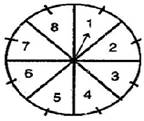
- A$8?$
- Ban odd number?
- Ca number greater than$ 2?$
- Da number less than $9?$
Generate a Probability paper free
Pick question groups from the list above, set marks and difficulty, and export a branded PDF with step-by-step answer keys. First 3 chapters free — no signup.