Questions

2 Marks Questions

🎯

Test yourself on this topic

21 questions · timed · auto-graded

Question 12 Marks
A bag contains $3$ red balls and $5$ black balls. A ball is drawn at random from the bag. What is the probability that the ball drawn is
  1. red ?
  2. not red ?
Answer
Probability that two students are not having same birthday $= P(E) = 0.992$.
We know, probability of occurrence of an event and probability of non occurrence of event $= 1$
$\therefore$ $P(E)$ + $P ( \overline { E } )$ $= 1$
$\Rightarrow$0.992 + $P ( \overline { E } )$ $= 1$
$\Rightarrow$$P ( \overline { E } )$ $= 1 - 0.992$
$\Rightarrow$$P ( \overline { E } )$ $= 0.008$
Hence, $P$(two students have the same birthday) $= 0.008$
View full question & answer
Question 22 Marks
Which of the following cannot be the probability of an event?
Answer
Proabibilty of the event=Number of favourble outcomes Total number of possible outcomes
Probability of head= $P(H)$=$\frac12$
Probability of tail = $P(T)$=$\frac12$ i.e. $P\left(H\right)=\frac12=P\left(T\right)=\frac12$
Probability of getting head and tail both are same.
$\therefore$Tossing a coin considered to be fairway.
View full question & answer
Question 32 Marks
Is the given statement correct or not correct?
If a die is thrown, there are two possible outcomes- an odd number or an even number.
Therefore, the probability of getting an odd number is $\frac{1}{2}$.
Answer
Total outcomes that can occur are $1, 2, 3, 4, 5, 6$
Number of possible outcomes of a dice $= 6$
Numbers which are odd $= 1, 3, 5$
Total numbers which are odd $= 3$
Numbers which are even $= 2, 4, 6$
Total numbers which are even $= 3$
Probability of getting an odd number $=\frac{\text {Number of outcomes where there is an odd number}}{\text {Total number of outcomes}}$
$=\frac{3}{6}=\frac{1}{2}$
Hence, the given statement is correct.
View full question & answer
Question 42 Marks
Is the given statement correct or not correct?
If two coins are tossed simultaneously there are three possible outcomes- two heads, two tails or one of each. Therefore, for each of these outcomes, the probability is $\frac{1}{3}$.
Answer
All possible outcomes $= (H, H), (H, T), (T, H), (T, T)$
Probability of an event = $\frac{\text { Favourabe outcomes }}{\text { Total outcomes }}$
Probability $(2$ heads$) =$ $\frac{1}{4}$
Probability $(2$ tails$) =$ $\frac{1}{4}$
It is not correct.
If we want to get the probability of them we should categorize the outcomes like this but they are not equally likely because one of each can result in two ways from a head-on first coin and tail on second or from the tail on first and head on second.
View full question & answer
Question 52 Marks
A die is thrown twice. What is the probability that:
  1. $5$ will not come up either time?
  2. $5$ will come up at least once?
[Hint: Throwing a die twice and throwing two dice simultaneously are treated as the same experiment]
Answer
$(i)$ The outcomes associated with the experiment in which a dice is thrown is twice:
$(1, 1) (1, 2) (1, 3) (1, 4) (1, 5) (1, 6)$
$(2, 1) (2, 2) (2, 3) (2, 4) (2, 5) (2, 6)$
$(3, 1) (3, 2) (3, 3) (3, 4) (3, 5) (3, 6)$
$(4, 1) (4, 2) (4, 3) (4, 4) (4, 5) (4, 6)$
$(5, 1) (5, 2) (5, 3) (5, 4) (5, 5) (5, 6)$
$(6, 1) (6, 2) (6, 3) (6, 4) (6, 5) (6, 6)$
Therefore, Total number of favourable outcomes $= 36$
The number of outcomes where $5$ come at least once are $11$ Hence the number of outcomes where $5$ will not come up either time $36-11=25$.
$\therefore$ $P(E)$=$P\left(5will\;not\;come\;up\;either\;time\right)$$=\frac{Number\;of\;favorable\;outcomes\;}{Number\;of\;total\;outcomes}$= $\frac{25}{36}$ and
$P(B)$=$P\left(5\;will\;come\;up\;at\;least\;once\right)$$=\frac{Number\;of\;favorable\;outcomes\;}{Number\;of\;total\;outcomes}$ = $\frac{11}{36}$
View full question & answer
Question 62 Marks
A game consists of tossing a one-rupee coin 3 times and noting its outcome each time. Hanif wins if all the tosses give the same result i.e., three heads or three tails and loses otherwise. Calculate the probability that Hanif will lose the game.
Answer
Since a coin is tossed $3$ times
$\therefore$ Possible outcomes are $= {HHH, HHT, HTH, THH, HTT, THT, TTH, TTT}$
Total possible outcomes $= 8$
outcomes having $3$ heads and $3$ tails ${HHH,TTT}$ $Proabibilty\;of\;the\;event=\frac{Number\;of\;favourble\;outcomes}{Total\;number\;of\;possible\;outcomes}$
$P($Hanif will win the game$)$ = $\frac28=\frac14$
$P ($Hanif will lose the game$)$ =$\frac11-\frac14=\frac{4-1}4=\frac34$
View full question & answer
Question 72 Marks
A lot consists of $144$ ball pens of which $20$ are defective and the others are good. Nuri will buy a pen if it is good, but will not buy if it is defective. The shopkeeper draws one pen at random and gives it to her. What is the probability that
  1. she will buy it?
  2. she will not buy it?
Answer
Total number of favourable outcomes $= 144$ $Proabibilty\;of\;the\;event=\frac{Number\;of\;favourble\;outcomes}{Total\;number\;of\;possible\;outcomes}$
  1. Number of non-defective pens $= 144 - 20 = 124$
    Number of favourable outcomes $= 124$
    Hence $P$ (she will buy) $= P$ (a non-defective pen) = $\frac{124}{144}=\frac{31}{36}$
  2. Number of favourable outcomes $= 20$
    Hence $P$ (she will not buy) $= P$ (a defective pen) = $\frac{20}{144}=\frac5{36}$
View full question & answer
Question 82 Marks
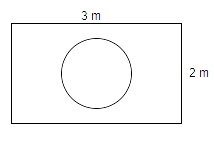
Suppose you drop a die at random on the rectangular region shown in Figure. What is the probability that it will land inside the circle with diameter $1m?$
Answer
Total area of the given figure (rectangle) = $3\times2=6m^2$
$d =1$
$r=\frac12$
And Area of circle = $\mathrm{πr}^2$= $\mathrm\pi\left(\frac12\right)^2=\frac{\mathrm\pi}4\mathrm m^2$
$Proabibilty\;of\;the\;event=\frac{Number\;of\;favourble\;outcomes}{Total\;number\;of\;possible\;outcomes}$
Hence, $P$(die to land inside the circle) = $\frac{\frac{\mathrm\pi}4}6=\frac{\mathrm\pi}{24}$
Hence the probability of die to land inside the circle is $\frac{\mathrm\pi}{24}$
View full question & answer
Question 92 Marks
A child has a die whose 6 faces show the letters given below:

The die is thrown once. What is the probability of getting $(i) A, (ii) D?$
Answer

There are $6$ letters in a die consisting of $3A's, 1B, 1C$ and $1D$.
  1. let $E_1$ be the event of getting $A$.
    number of favourable outcomes $= 3$
    P(getting A)$=P(E_1)= \frac { 3 } { 6 } = \frac { 1 } { 2 }$
  2. let $E_2$ be the event of getting $D$.
    number of favourable outcomes $ = 1$
    $P$ (getting $D$)$=P(E_2)= \frac { 1 } { 6 }$
View full question & answer
Question 102 Marks
A box contains $90$ discs which are numbered from $1$ to $90$. If one disc is drawn at random from the box, find the probability that it bears
  1. a two-digit number
  2. a perfect square number
  3. a number divisible by 5.
Answer
Total number of favourable outcomes $= 90$ $Probability\;of\;the\;event=\frac{Number\;of\;favourble\;outcomes}{Total\;number\;of\;possible\;outcomes}$
  1. Number of two-digit numbers from $1$ to $90$ are $90 - 9 = 81$
    $\therefore$Favourable outcomes $= 81$
    Hence, $P$ (getting a disc bearing a two-digit number) = $\frac{81}{90}=\frac9{10}$
  2. From $1$ to $90$, the perfect squares are $1, 4, 9, 16, 25, 36, 49, 64$ and $81$.
    $\therefore$Favourable outcomes $= 9$
    Hence $P$ (getting a perfect square) = $\frac9{90}=\frac1{10}$
  3. The numbers divisible by $5$ from $1$ to $90$ are $18$.
    $\therefore$Favourable outcomes = $18$
    Hence $P$ $($getting a number divisible by $5)$ = $\frac{18}{90}=\frac15$
View full question & answer
Question 112 Marks
  1. A lot of $20$ bulbs contain $4$ defective ones. One bulb is drawn at random from the lot. What is the probability that this bulb is defective?
  2. Suppose the bulb drawn in $(i)$ is not defective and is not replaced. Now one bulb is drawn at random from the rest. What is the probability that this bulb is not defective?
Answer
  1. Total number of favourable outcomes $= 20$
    $Probablity\;of\;the\;event=\frac{Number\;of\;favourble\;outcomes}{Total\;number\;of\;possible\;outcomes}$
    Number of favourable outcomes $= 4$
    Hence P (getting a defective bulb) = $\frac4{20}=\frac15$
  2. Now total number of favourable outcomes $= 20 - 1 = 19$
    Number of favouroable outcomes $= 19 - 4 = 15$
    Hence P (getting a non-defective bulb) = $\frac{15}{19}$
View full question & answer
Question 122 Marks
Five cards—the ten, jack, queen, king and ace of diamonds, are well-shuffled with their face downwards. One card is then picked up at random.
  1. What is the probability that the card is the queen?
  2. If the queen is drawn and put aside, what is the probability that the second card picked up is
    1. an ace?
    2. a queen?
Answer
Total number of favourable outcomes $= 5$ $Proabibilty\;of\;the\;event=\frac{Number\;of\;favourble\;outcomes}{Total\;number\;of\;possible\;outcomes}$
  1. $(i)$ There is only one queen.
    $\therefore$ Favourable outcome $= 1$
    Hence, $P$ (the queen) = $\frac15$
  2. In this situation, total number of favourable outcomes = $4$
    1. Favourable outcome = $1$
      Hence, $P$ (an ace) = $\frac14$
    2. There is no card as queen.
      $\therefore$Favourable outcome = $0$
      Hence, $P$ (the queen) = $\frac04=0$
View full question & answer
Question 132 Marks
A box contains $3$ blue, $2$ white, and $4$ red marbles. If a marble is drawn at random from the box, what is the probability that it will be
  1. white?
  2. blue?
  3. red?
Answer
Total no. of possible outcomes $= 3+2+4 = 9$
No. of favourable outcomes for white marbles $= 2$ $Proabibilty\;of\;the\;event=\frac{Number\;of\;favourble\;outcomes}{Total\;number\;of\;possible\;outcomes}$
Required probability $P$ (white marbles) = $\frac29$
No. of favourable outcomes for blue marbles $= 3$
Required probability $P$ (Blue marbles) = $\frac39=\frac13$
No. of favourable outcomes for red marbles $= 4$
Required probability P(red marbles) = $\frac49$
View full question & answer
Question 142 Marks
There are $40$ students in class $X$ of a school of whom $25$ are girls and $15$ are boys. The class teacher has to select one student as a class representative. He writes the name of each student on a separate card, the cards being identical. Then she puts cards in a bag and stirs them thoroughly. She then draws one card from the bag. What is the probability that the name written on the card is the name of
  1. a girl?
  2. a boy?
Answer
Since there are $40$ students and there is one card for each student. So, one, card can be chosen out of $40$ cards in $40$ ways.
Total number of elementary events = $40$
  1. There are $25$ girls and corresponding to each girl there is card of her name. Therefore,
    a card with the name of a girl can be chosen in $25$ ways.
    Favourable number of elementary events = $25$
    Hence, $P$ (Getting a card with the name of a girl)$= \frac { 25 } { 40 } = \frac { 5 } { 8 }$
  2. We have,
    $P$ (Getting a card with name of a boy) = $1 - P$ (Getting a card with name of a girl) $= 1 - \frac { 5 } { 8 } = \frac { 3 } { 8 }$
View full question & answer
Question 152 Marks
Savita and Hamida are friends. What is the probability that both will have
  1. different birthdays?
  2. the same birthday? (ignoring a leap year)
Answer
Savita may have any one of the $365$ days of the year as her birthday.
Similarly, Hamida may have any one of $365$ days of the year as her birthday.
$\therefore$ Total number of ways in which Savita and Hamida may have their birthday = 365 $\times$ 365
  1. We have,
    Probability that Savita and Hamida will have different birthdays $= 1$
    Therefore,ProbabilityProbability that Savita and Hamida will have the same birthday $= 1 - \frac { 1 } { 365 } = \frac { 364 } { 365 }$
  2. Savita and Hamida may have same birthday on any one of $365$ days of the year.
    Number of ways in which Savita and Hamida will have same birthday $= 365$
    Therefore,Probability that Savita and Hamida will have the same birthday $= \frac { 365 } { 365 \times 365 } = \frac { 1 } { 365 }$
View full question & answer
Question 162 Marks
One card is drawn from a well-shuffled deck of $52$ cards. Calculate the probability that the card will
  1. be an ace,
  2. not be an ace.
Answer
Well-shuffling ensures equally likely outcomes.
  1. There are $4$ aces in a deck. Let $E$ be the event ‘the card is an ace’.
    The number of outcomes favourable to $E = 4$
    The number of possible outcomes = $52$
    Therefore, $P(E)$ = $\frac{4}{52}=\frac{1}{13}$
  2. Let $F$ be the event ‘card drawn is not an ace’.
    The number of outcomes favourable to the event $F = 52 - 4 = 48$
    The number of possible outcomes = $52$
    Therefore, $P(F)$ = $\frac{48}{52}=\frac{12}{13}$
View full question & answer
Question 172 Marks
Suppose we throw a die once.
  1. What is the probability of getting a number greater than $4?$
  2. What is the probability of getting a number less than or equal to $4?$
Answer
  1. Let $E$ be the event that ‘getting a number greater than $4’$.
    The number of possible outcomes is six: $1, 2, 3, 4, 5$ and $6$, and the outcomes favourable to $E$ are $5$ and $6$.
    Therefore, the number of outcomes favourable to $E$ is $2$.
    so, $P(E) = P($number greater than $4) =$ $\frac{2}{6}=\frac{1}{3}$
  2. Let $F$ be the event that ‘getting a number less than or equal to $4’$.
    Number of possible outcomes $= 6$
    Outcomes favourable to the event $F$ are $1, 2, 3, 4.$
    so, the number of outcomes favourable to $F$ is $4$.
    Therefore, $P(F)$ $=\frac{4}{6}=\frac{2}{3}$
View full question & answer
Question 182 Marks
A bag contains a red ball, a blue ball and a yellow ball, all the balls being of the same size. Kritika takes out a ball from the bag without looking into it. What is the probability that she takes out the
  1. yellow ball?
  2. red ball?
  3. blue ball?
Answer
Kritika takes out a ball from the bag without looking into it. So, it is equally likely that she takes out any one of them.
Let $Y$ be the event that ‘the ball taken out is yellow’, $B$ be the event that ‘the ball taken out is blue’ and $R$ be the event that ‘the ball taken out is red’.
Now, the number of possible outcomes $= 3$.
  1. The number of outcomes favourable to the event $Y = 1$.
    So, $P(Y)=\frac{1}{3}$
    Similarly,
  2. $P(R)=\frac{1}{3}$
  3. $P(B)=\frac{1}{3}$
View full question & answer
Question 192 Marks
A carton consists of $100$ shirts of which $88$ are good, $8$ have minor defects and $4$ have major defects. Jimmy, a trader, will only accept the shirts which are good, but Sujatha, another trader, will only reject the shirts which have major defects. One shirt is drawn at random from the carton. What is the probability that
  1. it is acceptable to Jimmy?
  2. it is acceptable to Sujatha?
Answer
One shirt is drawn at random from the carton of $100$ shirts. This can be done in $100$ ways.
Total number of elementary events $= 100$.
  1. Since Jimmy accepts only good shirts and the number of good shirts is 88
    Number of elementary events favourable to Jimmy $= 88$
    So, probability that a shirt is acceptable to Jimmy $= 0.88$
  2. Sujatha accepts good as well as shirts having minor defects.
    The number of such shirts is $88 + 8 = 96$
    Number of elementary events favourable to an event of selecting a good shirt or a shirt with minor defect is $96$.
    Hence, probability that a shirt is acceptable to Sujatha$= \frac { 96 } { 100 } = 0.96$
View full question & answer
Question 202 Marks
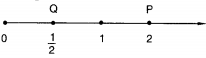
In a musical chair game, the person playing the music has been advised to stop playing the music at any time within $2$ minutes after she starts playing. What is the probability that the music will stop within the first half-minute after starting?
Answer
The possible outcomes are all the numbers between $0\ and\ 2$.
Suppose $A$ be the event 'music is stopped within the first half minute'.
$\therefore$ Outcomes favourable to the event $A$ are all points on the number line from $O$ to $Q$ i.e. from $0\ to\ \frac{1}{2}$

Total number of outcomes are the points on the number line from $O$ to P i.e. from $0$ to $2$.
$\therefore$$P ( A ) = \frac { \text { Length } O Q } { \text { Length } O P } = \frac { 1 / 2 } { 2 } = \frac { 1 } { 4 }$
View full question & answer
Question 212 Marks
It is given that in a group of 3 students, the probability of 2 students not having the same birthday is 0.992. What is the probability that the 2 students have the same birthday?
Answer
The probability that the two students have the same birthday is 0.008.
This is a classic example of complementary events in probability. An event and its complement are the only two possible outcomes, so their probabilities must sum to 1.
Event E: Two students have the same birthday.
Event $\bar{E}$ :  Two students do not have the same birthday.
$P(E)+P(\bar{E})=1$
P(same birthday)=1−P(not same birthday)
P(same birthday)=1−0.992
P(same birthday)=0.008
View full question & answer
2 Marks Questions - Maths STD 10 Questions - Vidyadip