Questions

3 Marks Question

🎯

Test yourself on this topic

9 questions · timed · auto-graded

Question 13 Marks
A box contains $5$ red marbles, $8$ white marbles and $4$ green marbles. One marble is taken out of the box at random. What is the probability that the marble taken out will be
  1. red ?
  2. white ?
  3. not green ?
Answer
Total number of marbles in the box $= 5 + 8 + 4 = 17$
$\therefore$Total number of elementary events $= 17$ $Proabibilty\;of\;the\;event=\frac{Number\;of\;favourble\;outcomes}{Total\;number\;of\;possible\;outcomes}$
  1. There are $5$ red marbles in the box.
    $\therefore$Favourable number of elementary events $= 5$
    $\therefore$P (getting a red marble) = $\frac5{17}$
  2. There are $8$ white marbles in the box.
    $\therefore$Favourable number of elementary events $= 8$
    $\therefore$P (getting a white marble) = $\frac8{17}$
  3. There are $5 + 8 = 13$ marbles in the box, which are not green.
    $\therefore$Favourable number of elementary events $= 13$
    $\therefore$P (not getting a green marble) = $\frac{13}{17}$
View full question & answer
Question 23 Marks
  1. Two dice, one blue and one grey, are thrown at the same time. Complete the following table:
    Event: Sum on $2$ dice $2$ $3$ $4$ $5$ $6$ $7$ $8$ $9$ $10$ $11$ $12$
    Probability $\frac{1}{{36}}$           $\frac{5}{{36}}$       $\frac{1}{{36}}$
  2. A student argues that there are $11$ possible outcomes $2, 3, 4, 5, 6, 7, 8, 9, 10, 11$ and $12$. Therefore, each of them has a probability $\frac{1}{11}$. Do you agree with this argument? Justify your answer.
Answer
  1. It can be observed that,
    To get the sum as $2,$ possible outcomes $= (1, 1)$
    To get the sum as $3,$ possible outcomes $= (2, 1)$ and $(1, 2)$
    To get the sum as $4,$ possible outcomes $= (3, 1), (1, 3), (2, 2)$
    To get the sum as $5,$ possible outcomes $= (4, 1), (1, 4), (2, 3), (3, 2)$
    To get the sum as $6,$ possible outcomes $= (5, 1), (1, 5), (2, 4), (4, 2), (3, 3)$
    To get the sum as $7,$ possible outcomes $= (6, 1), (1, 6), (2, 5), (5, 2), (3, 4), (4, 3)$
    To get the sum as $8,$ possible outcomes $= (6, 2), (2, 6), (3, 5), (5, 3), (4, 4)$
    To get the sum as $9,$ possible outcomes $= (3, 6), (6, 3), (4, 5), (5, 4)$
    To get the sum as $10$, possible outcomes $= (4, 6), (6, 4), (5, 5)$
    To get the sum as $11$, possible outcomes $= (5, 6), (6, 5)$
    To get the sum as $12$, possible outcomes $= (6, 6)$
    Event $2$ $3$ $4$ $5$ $6$ $7$ $8$ $9$ $10$ $11$ $12$
    Probability $\frac{1}{{36}}$ $\frac{2}{{36}}$ $\frac{3}{{36}}$ $\frac{4}{{36}}$ $\frac{5}{{36}}$ $\frac{6}{{36}}$ $\frac{5}{{36}}$ $\frac{4}{{36}}$ $\frac{3}{{36}}$ $\frac{2}{{36}}$ $\frac{1}{{36}}$
  2. The probability of each of these sums will not be $\frac{1}{11}$ as their sums are not equally likely.
View full question & answer
Question 33 Marks
One card is drawn from a well-shuffled deck of $52$ cards. Find the probability of getting
  1. a king of red colour
  2. a face card
  3. a red face card
  4. the jack of hearts
  5. a spade
  6. the queen of diamonds
Answer
Total number of cards in one deck of cards is $52$. $\therefore$ Total number of outcomes $n = 52$
  1. Let $E_1=$ Event of getting a king of red color. So number of outcomes favourable to $E_1m = 2 $ So $P(E​_1)=\frac mn=\frac{2}{52}=\frac{1}{26}$
  2. Let $E_2=$ Event of getting a face card
    $\therefore$ Numbers of outcomes favourable to $E_1​​​​​, m= 12$. Hence $P(E_2) = \frac mn= \frac{{12}}{{52}} = \frac{3}{{13}}$
  3. Let $E_3=$ Event of getting a red face card
    $\therefore$ Numbers of outcomes favourable to $E_3=6$ [$\because$ there are 6 red face cards in a deck ] Hence $ P(E_3) =\frac mn =\frac{6}{52}=\frac{3}{26}$
  4. Let $E_4=$ Event of getting a jack of heart
    $\therefore$ Numbers of outcomes favourable to $E_4= 1$ [$\because$ there is only one jack of heart in deck of cards.]
    Hence $ P(E_4)=\frac mn = \frac{1}{{52}}$
  5. Let $E_5=$ Event of getting a spade
    $\therefore$ Numbers of outcomes favourable to $E_5= 13$ [$\because$ there are 13 spade in a deck]
    Hence $P(E_5) =\frac mn = \frac{{13}}{{52}}$
  6. Let $E_6=$ Event of getting the queen of diamond
    $\therefore$ Numbers of outcomes favourable to $E_6= 1$ [$\because$ there is only one queen of diamond in a deck]
    Hence, $P(E_6)= \frac mn= \frac{1}{{52}}$
View full question & answer
Question 43 Marks
A die is thrown once. Find the probability of getting
  1. a prime number;
  2. a number lying between $2$ and $6$
  3. an odd number.
Answer
Number of all possible outcome $(1, 2, 3, 4, 5, 6) = 6$
  1. Let E be the event of getting a prime number. Then, the outcomes favourable to $E$ are $2, 3$ and $5.$
    Therefore, the number outcomes favourable to $E$ is$ 3.$
    So, $\mathrm { P } ( \mathrm { E } ) = \frac { \text { Number of outcomes favourable to } \mathrm { E } } { \text { Number of all possible outcomes } } = \frac { 3 } { 6 } = \frac { 1 } { 2 }$
  2. Let E be the event of getting a number lying between $2$ and $6.$
    Then, the outcomes favourable to E are 3, 4, and 5. Therefore, the number of outcomes favourable to $E$ is $3.$
    So, $\mathrm { P } ( \mathrm { E } ) = \frac { \mathrm { Number~of~outcomes } \text { favourable to } \mathrm { E } } { \text { Number of all possible outcomes } } = \frac { 3 } { 6 } = \frac { 1 } { 2 }$
  3. Let E be the event getting an odd number.
    Then, the outcomes favourable to $E$ are $1, 3$, and $5$. Therefore, the number of outcomes favourable to $E$ is $3.$
    So, $\mathrm { P } ( \mathrm { E } ) = \frac { \text { Number of outcomes favourable to } \mathrm { E } } { \text { Number of all possible outcomes } } = \frac { 3 } { 6 } = \frac { 1 } { 2 }$
View full question & answer
MCQ 53 Marks
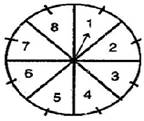
A game of chance consists of spinning an arrow which comes to rest pointing at one of the numbers $1, 2, 3, 4, 5, 6, 7, 8 ($see figure$)$ and these are equally likely outcomes. What is the probability that it will point at:
  • A
    $8?$
  • B
    an odd number?
  • C
    a number greater than$ 2?$
  • D
    a number less than $9?$
Answer
Out of 8 numbers, an arrow can point any of the numbers in $8$ ways.
$\therefore$Total number of outcomes $= 8$
$Proabibilty\;of\;the\;event=\frac{Number\;of\;favourble\;outcomes}{Total\;number\;of\;possible\;outcomes}$
  1. Favourable number of outcomes $= 1$
    Hence, $P ($arrow points at $8) = \frac18$
  2. Favourable number of outcomes $= 4$
    Hence, $P ($arrow points at an odd number$) = \frac48=\frac12$
  3. Favourable number of outcomes $= 6$
    Hence, $P ($arrow points at a number greater than $2) = \frac68=\frac34$
  4. Favourable number of outcomes $= 8$
    Hence, $P ($arrow points at a number less than $9) = \frac88=1$
View full question & answer
Question 63 Marks
A piggy bank contains hundred $50$ p coins, fifty ₹ $1 $coins, twenty ₹ $2$ coins and ten ₹ 5 coins. If it is equally likely that one of the coins will fall out when the bank is turned upside down, what is the probability that the coin
  1. will be a $50$ p coin?
  2. will not be a ₹ $5$ coin?
Answer
Number 50 p coins in the piggy bank$ = 100$
Number of Re. 1 coins in the piggy bank $= 50$
Number of Rs. 2 coins in the piggy bank $= 20$
Number of Rs. 5 coins in the piggy bank $= 10$
∴ Total number of coins in the piggy bank $= 100 + 50 + 20 -10 = 180$
∴ Number of all possible outcomes $= 180$
  1. Number of favourable outcomes to the event that the coin will be a $50$ p coin $= 100$
    ∴ Probability that the coin will be a $50$ p coin
    $\frac{Number\;of\;favourable\;outcomes\;to\;the\;event\;that\;the\;coin\;will\;be\;a\;50\;p\;coin}{\;Number\;of\;all\;possible\;outcomes}$ $\frac{100}{180}=\frac59$
  2. Number of favourable outcomes to the event that the coin will not be a Rs. $5$ coin
    $= 100 + 50 + 20 = 170$
    ∴ Probability that the coin will not be Rs. $5$ coin
    $\frac{Total \ no.\;of\;favourable\;outcomes}{Total\;number\;of\;possible\;outcomes}$ $\frac{170}{180}=\frac{17}{18}$
View full question & answer
Question 73 Marks
Harpreet tosses two different coins simultaneously (say, one is of ₹ $1$ and other of ₹ $2$). What is the probability that he gets at least one head?
Answer
If we suppose, H for 'head' and T for 'tail'. When two coins are tossed simultaneously, the possible outcomes are $(H, H),(H, T),(T, H),(T, T)$, which are all equally likely. Here (Rs.$2).$ Similarly $(H, T)$ means head up on the first coin (say on Rs1) and head up on the second coin and so on.
The outcomes favourable to the event $E$, 'at least one head' are $(H, H),(H, T)$ and $(T, H)$.
So, the number of outcomes favourable to $E$ is $3 .$
Therefore, $P(E)=\frac{3}{4}$
i.e, the probability that Harpreet gets at least one head is $\frac{3}{4}$.
Note you can also find $P(E)$ as follows:
$P(E)=1-P(\bar{E})=1-\frac{1}{4}=\frac{3}{4}\left(\text { Since } P(\bar{E})=P(\text { no head })=\frac{1}{4}\right.$
View full question & answer
Question 83 Marks
Two dice, one blue and one grey are thrown at the same time. Write down all the possible outcomes. What is the probability that the sum of the two numbers appearing on the top of the dice is
  1. $8?$
  2. $13?$
  3. less than or equal to $12?$
Answer
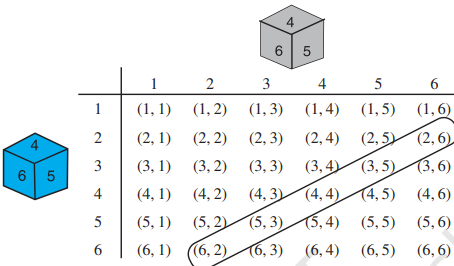
When the blue die shows $‘1’$, the grey die could show any one of the numbers $1, 2, 3, 4, 5, 6$. The same is true when the blue die shows $‘2’, ‘3’, ‘4’, ‘5’$ or $‘6’$. The possible outcomes of the experiment are listed in the table below; the first number in each ordered pair is the number appearing on the blue die and the second number is that on the grey die.

So, the number of possible outcomes $= 6 \times 6 = 36.$
  1. The outcomes favourable to the event ‘the sum of the two numbers is $8’$ denoted by $E$, are: $(2, 6), (3, 5), (4, 4), (5, 3), (6, 2)$ (see Fig.)
    i.e., the number of outcomes favourable to $E = 5.$
    Hence, $P(E) = \frac{5}{36}$
  2. As you can see from Fig., there is no outcome favourable to the event F, ‘the sum of two numbers is $13’.$
    So, $P(F) = \frac{0}{36} = 0$
  3. As you can see from Fig., all the outcomes are favourable to the event G, ‘sum of two numbers $\leq 12’.$
    So, P(G) = $\frac{36}{36}=1$
View full question & answer
Question 93 Marks
Two dice, one blue and one gray, are thrown at the same time. Find the following probabilities.
(i) Sum of the digits on dice is 13.
(ii) Same digit on both dice.
(iii) Product of digits on dice is even.
Answer
When two dice are thrown, one blue and one gray, the total number of possible outcomes is 6×6=36.
(i) Sum of the digits on dice is 13
The maximum possible sum from two dice is when both show a 6, which is 6+6=12. It is impossible for the sum to be 13.
Number of favorable outcomes = 0
Probability $=\frac{0}{36}=0$
(ii) Same digit on both dice
The favorable outcomes are when both dice show the same number. These are the pairs:(1, 1), (2, 2), (3, 3), (4, 4), (5, 5), (6, 6)
Number of favorable outcomes = 6
Probability $=\frac{6}{36}=\frac{1}{6}$
(iii) Product of digits on dice is even
The product of two numbers is even if at least one of the numbers is even. A more efficient way to find this is to consider the complementary event: the product is odd.
The product of two numbers is odd only if both numbers are odd. The odd digits on a die are $\{1,3,5\}$.
Number of outcomes where both dice are odd  = (Number of odd outcomes on die 1) × (Number of odd outcomes on die 2)
Number of outcomes where both dice are odd = 3×3=9
P(product is odd) $=\frac{9}{36}=\frac{1}{4}$
The probability of the product being even is 1−P(product is odd).
P(product is even) $=1-\frac{1}{4}=\frac{3}{4}$
View full question & answer
3 Marks Question - Maths STD 10 Questions - Vidyadip