Questions

4 Marks Questions

🎯

Test yourself on this topic

11 questions · timed · auto-graded

Question 14 Marks
A box contains 90 discs which are numbered from 1 to 90. If one disc is drawn at random from the box. find the probability that it bears (1) a two digit number (2) a perfect square number and (3) a number divisible by 5. (4) a perfect cube number.
Answer
One disc is drawn at random from a box containing 90 discs numbered from 1 to 90 .
$\therefore$ The number of all possible outcomes in the experiment of drawing one disc $=90$
(1) Let $A$ be the event 'the disc drawn bears a two-digit number'.
Among numbers from 1 to 90 , there are 81 two-digit numbers: $10,11, \ldots, 90$.
$\therefore$ The number of outcomes favourable to $A$ is 81 .
$\therefore P(A)=\frac{81}{90}=\frac{9}{10}$
(2) Let $B$ be the event 'the disc drawn bears a perfect square number'.
Among numbers from 1 to 90 , there are 9 perfect square numbers
$1,4,9,16,25,36,49,64,81$.
$\therefore$ The number of outcomes favourable to $B$ is 9 .
$\therefore P(B)=\frac{9}{90}=\frac{1}{10}$
(3) Let $C$ be the event 'the disc drawn bears a number divisible by 5 '.
Among numbers from 1 to 90 , there are 18 numbers which are divisible by 5 in
5. $10,15, \ldots, 85,90$.
$\therefore$ The number of outcomes favourable to $C$ is 18 .
$
\begin{aligned}
\therefore P(C) & =\frac{18}{90} \\
& =\frac{1}{5}
\end{aligned}
$
(4) Let $D$ be the event 'the disc drawn bears a perfet cube number' Among numbers from 1 to 90 , there are 4 perfect cube numbers: $(1,8,27,64$ ).
$
\begin{aligned}
\therefore P(D) & =\frac{4}{90} \\
& =\frac{2}{45}
\end{aligned}
$
View full question & answer
Question 24 Marks
One card is drawn from a well-shuffled deck of 52 cards. Find the probability of getting: (1) a king of red colour (2) a face card (3) a spade (4) the queen of diamonds.
Answer
The number of all possible outcomes in the experiment of drawing a card $=52$.
(1) Let $A$ be the event 'the card drawn is a king of red colour'.
$\therefore$ The number of outcomes favourable to $A$ is 2 .
$
\therefore P(A)=\frac{2}{52}=\frac{1}{26}
$
(2) Let B be the event 'the card drawn is a face card'.
$\therefore$ The number of outcomes favourable to $B$ is 12 .
$
\therefore P(B)=\frac{12}{52}=\frac{3}{13}
$
(3) Let $C$ be the event 'the card drawn is a spade'.
$\therefore$ The number of outcomes favourable to $C$ is 13 .
$
\therefore P(C)=\frac{13}{52}=\frac{1}{4}
$
(4) Let $D$ be the event 'the card drawn is a queen of diamond".
$\therefore$ The number of outcomes favourable to $D$ is 1 .
$
\therefore P(D)=\frac{1}{52}
$
View full question & answer
Question 34 Marks
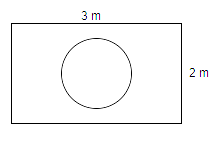
Suppose you drop a die at random on the rectangular region shown in Figure. What is the probability that it will land inside the circle with diameter 1m?
Answer
Total area of the given figure (rectangle) = $3\times2=6m^2$
d =1
$r=\frac12$
And Area of circle = $\mathrm{πr}^2$= $\mathrm\pi\left(\frac12\right)^2=\frac{\mathrm\pi}4\mathrm m^2$ 
$Proabibilty\;of\;the\;event=\frac{Number\;of\;favourble\;outcomes}{Total\;number\;of\;possible\;outcomes}$ 
Hence, P(die to land inside the circle) = $\frac{\frac{\mathrm\pi}4}6=\frac{\mathrm\pi}{24}$ 
Hence the probability of die to land inside the circle is $\frac{\mathrm\pi}{24}$
View full question & answer
Question 44 Marks
Suppose we throw a die once.
  1. What is the probability of getting a number greater than 4?
  2. What is the probability of getting a number less than or equal to 4?
Answer
  1. Let E be the event that ‘getting a number greater than 4’.
    The number of possible outcomes is six: 1, 2, 3, 4, 5 and 6, and the outcomes favourable to E are 5 and 6.
    Therefore, the number of outcomes favourable to E is 2.
    so, P(E) = P(number greater than 4) = $\frac{2}{6}=\frac{1}{3}$
  2. Let F be the event that ‘getting a number less than or equal to 4’.
    Number of possible outcomes = 6
    Outcomes favourable to the event F are 1, 2, 3, 4.
    so, the number of outcomes favourable to F is 4.
    Therefore, P(F) $=\frac{4}{6}=\frac{2}{3}$
View full question & answer
Question 54 Marks
A carton consists of 100 shirts of which 88 are good, 8 have minor defects and 4 have major defects. Jimmy, a trader, will only accept the shirts which are good, but Sujatha, another trader, will only reject the shirts which have major defects. One shirt is drawn at random from the carton. What is the probability that
  1. it is acceptable to Jimmy?
  2. it is acceptable to Sujatha?
Answer
One shirt is drawn at random from the carton of 100 shirts. This can be done in 100 ways.
Total number of elementary events = 100.
  1. Since Jimmy accepts only good shirts and the number of good shirts is 88
    Number of elementary events favourable to Jimmy = 88 
    So, probability that a shirt is acceptable to Jimmy = = 0.88
  2. Sujatha accepts good as well as shirts having minor defects.
    The number of such shirts is 88 + 8 = 96
    Number of elementary events favourable to an event of selecting a good shirt or a shirt with minor defect is 96.
    Hence, probability that a shirt is acceptable to Sujatha$= \frac { 96 } { 100 } = 0.96$
View full question & answer
Question 64 Marks
A bag contains a red ball, a blue ball and a yellow ball, all the balls being of the same size. Kritika takes out a ball from the bag without looking into it. What is the probability that she takes out the
  1. yellow ball?
  2. red ball?
  3. blue ball?
Answer
Kritika takes out a ball from the bag without looking into it. So, it is equally likely that she takes out any one of them.
Let Y be the event that ‘the ball taken out is yellow’, B be the event that ‘the ball taken out is blue’ and R be the event that ‘the ball taken out is red’.
Now, the number of possible outcomes = 3.
  1. The number of outcomes favourable to the event Y = 1.
    So, $P(Y)=\frac{1}{3}$
    Similarly,
  2. $P(R)=\frac{1}{3}$
  3. $P(B)=\frac{1}{3}$
View full question & answer
Question 74 Marks
A lot consists of 144 ball pens of which 20 are defective and the others are good. Nuri will buy a pen if it is good, but will not buy if it is defective. The shopkeeper draws one pen at random and gives it to her. What is the probability that
  1. she will buy it?
  2. she will not buy it?
Answer
Total number of favourable outcomes = 144 $Proabibilty\;of\;the\;event=\frac{Number\;of\;favourble\;outcomes}{Total\;number\;of\;possible\;outcomes}$
  1. Number of non-defective pens = 144 - 20 = 124
     Number of favourable outcomes = 124
    Hence P (she will buy) = P (a non-defective pen) = $\frac{124}{144}=\frac{31}{36}$
  2. Number of favourable outcomes = 20
    Hence P (she will not buy) = P (a defective pen) = $\frac{20}{144}=\frac5{36}$
View full question & answer
Question 84 Marks
A box contains 3 blue, 2 white, and 4 red marbles. If a marble is drawn at random from the box, what is the probability that it will be
  1. white?
  2. blue?
  3. red?
Answer
Total no. of possible outcomes = 3+2+4 = 9
No. of favourable outcomes for white marbles = 2 $Proabibilty\;of\;the\;event=\frac{Number\;of\;favourble\;outcomes}{Total\;number\;of\;possible\;outcomes}$
Required probability P(white marbles) = $\frac29$
No. of favourable outcomes for blue marbles = 3
Required probability P(Blue marbles) = $\frac39=\frac13$
No. of favourable outcomes for red marbles = 4
Required probability P(red marbles) = $\frac49$
View full question & answer
Question 94 Marks
 Five cards—the ten, jack, queen, king and ace of diamonds, are well-shuffled with their face downwards. One card is then picked up at random.
  1. What is the probability that the card is the queen?
  2. If the queen is drawn and put aside, what is the probability that the second card picked up is
    1. an ace?
    2. a queen?
Answer
Total number of favourable outcomes = 5 $Proabibilty\;of\;the\;event=\frac{Number\;of\;favourble\;outcomes}{Total\;number\;of\;possible\;outcomes}$
  1. (i) There is only one queen.
    $\therefore$ Favourable outcome = 1
    Hence, P (the queen) = $\frac15$
  2. In this situation, total number of favourable outcomes = 4
    1. Favourable outcome = 1
      Hence, P (an ace) = $\frac14$
    2. There is no card as queen.
      $\therefore$Favourable outcome = 0
      Hence, P (the queen) = $\frac04=0$​​​​​​​
View full question & answer
Question 104 Marks
A box contains 90 discs which are numbered from 1 to 90. If one disc is drawn at random from the box, find the probability that it bears
  1. a two-digit number
  2. a perfect square number
  3. a number divisible by 5.
Answer
Total number of favourable outcomes = 90 $Probability\;of\;the\;event=\frac{Number\;of\;favourble\;outcomes}{Total\;number\;of\;possible\;outcomes}$
  1. Number of two-digit numbers from 1 to 90 are 90 - 9 = 81
    $\therefore$Favourable outcomes = 81
    Hence, P (getting a disc bearing a two-digit number) = $\frac{81}{90}=\frac9{10}$
  2. From 1 to 90, the perfect squares are 1, 4, 9, 16, 25, 36, 49, 64 and 81.
    $\therefore$Favourable outcomes = 9
    Hence P (getting a perfect square) = $\frac9{90}=\frac1{10}$
  3. The numbers divisible by 5 from 1 to 90 are 18.
    $\therefore$Favourable outcomes = 18
    Hence P (getting a number divisible by 5) = $\frac{18}{90}=\frac15$
View full question & answer
Question 114 Marks
One card is drawn from a well-shuffled deck of 52 cards. Find the probability of getting
  1. a king of red colour
  2. a face card
  3. a red face card
  4. the jack of hearts
  5. a spade
  6. the queen of diamonds
###One card is drawn from a well-shuffled deck of 52 cards. Find the Probability of getting
(i) a king of red colour
(ii) the jack of hearts
(iii) a spade
(iv) a red face card
Answer
Total number of cards in one deck of cards is 52. $\therefore$ Total number of outcomes n = 52
  1. Let E1= Event of getting a king of red color. So number of outcomes favourable to Em = 2  So P(E​​​​​​1)=$\frac mn=\frac{2}{52}=\frac{1}{26}$
  2. Let E2= Event of getting a face card
    $\therefore$ Numbers of outcomes favourable to E​​​​​​2​​​​​,  m= 12.          Hence P(E2) =$\frac mn$= $\frac{{12}}{{52}} = \frac{3}{{13}}$
  3. Let E3= Event of getting a  red face card
    $\therefore$ Numbers of outcomes favourable to E3 = 6  [$\because$ there are 6  red face cards in a deck ]            Hence P(E3) = $\frac mn =\frac{6}{52}=\frac{3}{26}$
  4. Let E4= Event of getting a jack of heart 
    $\therefore$ Numbers of outcomes favourable to E4 = 1 [$\because$ there is only one jack of heart in deck of cards.] 
    Hence P(E4)=$\frac mn =$ $\frac{1}{{52}}$
  5. Let E5= Event of getting a spade 
    $\therefore$ Numbers of outcomes favourable to E5 = 13 [$\because$ there are 13 spade in a deck] 
    Hence P(E5) =$\frac mn =$ $\frac{{13}}{{52}}$
  6. Let E= Event of getting the queen of diamond
    $\therefore$ Numbers of outcomes favourable to E6 = 1 [$\because$ there is only one queen of diamond in a deck]
    Hence, P(E​​​​​​6)=  $\frac mn$= $\frac{1}{{52}}$
View full question & answer
4 Marks Questions - Maths STD 10 Questions - Vidyadip