MCQ 11 Mark
The probability of a certain event is
Answer(b):The probability of a certain event is always 1 .
View full question & answer→MCQ 21 Mark
Which of the following cannot be the probability of an event?
Answer(d):For probability of an event $E, 0 \leq P(E) \leq 1$.
View full question & answer→MCQ 31 Mark
If probability of success is $0.9 \%$, then probability of failure is
Answer(d):Probability of failure $=1$ - Probability of success
$=1-\frac{0.9}{100}=1-\frac{9}{1000}=\frac{1000-9}{1000}=\frac{991}{1000}=0.991$
View full question & answer→MCQ 41 Mark
If $P(E)=0.01$, then $P(\operatorname{not} E)$ is equal to
Answer(d):$P(\operatorname{not} E)=1-P(E)=1-0.01=0.99$
View full question & answer→MCQ 51 Mark
A single letter is selected at random from the word 'PROBABILITY'. The probability that it is a vowel is
- A
$\frac{3}{11}$
- ✓
$\frac{4}{11}$
- C
$\frac{2}{11}$
- D
$\frac{5}{11}$
AnswerCorrect option: B. $\frac{4}{11}$
(b):Total number of letters in the word
'PROBABILITY' = 11
$\therefore \quad$ Total number of possible outcomes $=11$
Vowels in the word 'PROBABILITY' are $\{ O , A , I , I \}$
So, favourable number of outcomes $=4$
$\therefore \quad$ Required probability $=\frac{4}{11}$
View full question & answer→MCQ 61 Mark
A letter is chosen at random from the English alphabets. Find the probability that the letter chosen succeeds $V$.
- ✓
$\frac{2}{13}$
- B
$\frac{5}{26}$
- C
$\frac{1}{26}$
- D
$\frac{1}{2}$
AnswerCorrect option: A. $\frac{2}{13}$
(a):Total number of outcomes $=26$
Letters succeeding $V$ are $\{W, X, Y, Z\}$ i.e.,
favourable number of outcomes is 4 .
$\therefore \quad$ Required probability $=\frac{4}{26}=\frac{2}{13}$
View full question & answer→MCQ 71 Mark
Two coins are tossed simultaneously. The probability of getting no head is
- ✓
$\frac{1}{4}$
- B
$\frac{1}{2}$
- C
$\frac{3}{4}$
- D
AnswerCorrect option: A. $\frac{1}{4}$
(a):Total possible outcomes are $\{H H, H T, T H, T T\}$ i.e., 4 in number.
Favourable outcome is $\{T T\}$ i.e., 1 in number.
$\therefore \quad P($ getting no head $)=\frac{1}{4}$
View full question & answer→MCQ 81 Mark
In a single throw of a die, the probability of getting a multiple of 2 is
- ✓
$\frac{1}{2}$
- B
$\frac{1}{3}$
- C
$\frac{1}{6}$
- D
$\frac{2}{3}$
AnswerCorrect option: A. $\frac{1}{2}$
(a):Total number of possible outcomes $=6$
Favourable outcomes of getting multiple of 2 are $\{2,4,6\}$ i.e., 3 in number.
$\therefore \quad$ Required probability $=\frac{3}{6}=\frac{1}{2}$
View full question & answer→MCQ 91 Mark
A card is drawn from a pack of 52 cards. The probability of drawing a black face card is
- A
$\frac{2}{13}$
- ✓
$\frac{3}{26}$
- C
$\frac{1}{13}$
- D
$\frac{3}{52}$
AnswerCorrect option: B. $\frac{3}{26}$
(b):Total number of cards $=52$
Number of black face cards $=6$
$ \therefore \quad P(\text { getting a black face card })=\frac{6}{52}=\frac{3}{26} $
View full question & answer→MCQ 101 Mark
A number $x$ is chosen at random from the numbers $-2,-1,0,1,2$. What is the probability that $x^2<2$ ?
- A
$\frac{1}{5}$
- B
$\frac{2}{5}$
- ✓
$\frac{3}{5}$
- D
$\frac{4}{5}$
AnswerCorrect option: C. $\frac{3}{5}$
(c):Clearly, number $x$ can take any one of the five given values.
So, total number of possible outcomes $=5$
We observe that $x^2<2$, when $x$ take any one of the following three values $-1,0$ and 1 .
So, favourable number of outcomes $=3$
$ \therefore P\left(x^2<2\right)=\frac{3}{5} $
View full question & answer→MCQ 111 Mark
A box contains 100 discs, numbered from 1 to 100. If one disc is drawn at random from the box, then the probability that it bears a prime number less than 30 , is
- A
$\frac{7}{100}$
- ✓
$\frac{1}{10}$
- C
$\frac{4}{50}$
- D
$\frac{9}{50}$
AnswerCorrect option: B. $\frac{1}{10}$
(b):Total number of possible outcomes $=100$
Let $E$ be the event 'drawing a prime number less than $30^{\circ}$.
Outcomes favourable to $E$ are $\{2,3,5,7,11,13,17,19$, $23,29\}$ i.e., 10 in number.
$ \therefore \quad P(E)=\frac{10}{100}=\frac{1}{10} $
View full question & answer→MCQ 121 Mark
If a die is thrown, then what is the probability of getting a number less than 4 and greater than 3 ?
- ✓
$0$
- B
- C
$\frac{1}{3}$
- D
$\frac{2}{3}$
Answer(a):There is no such number lie on a die, which is less than 4 and greater than 3 .
$\therefore \quad$ Required probability $=0$
View full question & answer→MCQ 131 Mark
In a single throw of a pair of dice, the probability of getting the sum as a perfect square is
- ✓
$\frac{7}{36}$
- B
$\frac{5}{36}$
- C
$\frac{8}{36}$
- D
$\frac{11}{36}$
AnswerCorrect option: A. $\frac{7}{36}$
(a):Total number of possible outcomes $=6 \times 6=36$
Let $E$ be the event 'getting the sum as a perfect square'.
$\therefore$ Outcomes favorable to $E$ are $\{(1,3),(2,2),(3,1)$, $(3,6),(4,5),(5,4),(6,3) \mid$ i.e., 7 in number.
$ \therefore \quad P(E)=\frac{7}{36} $
View full question & answer→MCQ 141 Mark
A card is accidently dropped from a pack of 52 playing cards. The probability that it is a red card is
- ✓
$\frac{1}{2}$
- B
$\frac{1}{13}$
- C
$\frac{1}{52}$
- D
$\frac{12}{13}$
AnswerCorrect option: A. $\frac{1}{2}$
(a):Total number of possible outcomes $=52$
$\because \quad$ Number of red cards $=26$
So, number of favourable outcomes $=26$
$\therefore \quad$ Required probability $=\frac{26}{52}=\frac{1}{2}$
View full question & answer→MCQ 151 Mark
A letter is chosen at random from the English alphabet. Probability that it is a letter of the word "SIMULTANEOUSLY" is
- A
$\frac{14}{26}$
- ✓
$\frac{11}{26}$
- C
$\frac{10}{26}$
- D
$\frac{15}{26}$
AnswerCorrect option: B. $\frac{11}{26}$
(b):Total number of possible outcomes $=26$
Distinct letters in the word "SIMULTANEOUSLY" are {S, I, M, U, L, T, A, N, E, O, Y} i.e., 11 in number.
So, favourable number of outcomes $=11$
$\therefore \quad$ Required probability $=\frac{11}{26}$
View full question & answer→MCQ 161 Mark
A number $x$ is chosen at random from $-5,-4,-3,-2,-1,0,1,2,3,4,5$. The probability that $|x| \leq 3$ is
- A
$\frac{3}{11}$
- B
$\frac{6}{11}$
- ✓
$\frac{7}{11}$
- D
$\frac{9}{11}$
AnswerCorrect option: C. $\frac{7}{11}$
(c):Total number of possible outcomes $=11$
Let $E$ be the event ' $|x| \leq 3$ '.
So, outcomes favourable to $E$ are $\{-3,-2,-1,0,1,2,3\}$ i.e., 7 in number.
$ \therefore \quad P(E)=\frac{7}{11} $
View full question & answer→MCQ 171 Mark
A child has a block in the shape of a cube with one letter written on each face as follows:

The cube is thrown once. What is the probability of getting $A$ ? - ✓
$\frac{1}{3}$
- B
$\frac{1}{6}$
- C
$\frac{1}{2}$
- D
$\frac{1}{4}$
AnswerCorrect option: A. $\frac{1}{3}$
(a):Total number of possible outcomes $=6$
As there are two $A$ 's.
$\therefore \quad$ Favourable number of outcomes $=2$
$\therefore \quad$ Required probability $=\frac{2}{6}=\frac{1}{3}$
View full question & answer→MCQ 181 Mark
A bag contains 4 red, 5 black and 3 yellow balls. A ball is taken out of the bag at random. Find the probability that the ball taken out is not of yellow colour.
- A
$\frac{2}{3}$
- B
$\frac{1}{3}$
- ✓
$\frac{3}{4}$
- D
$\frac{1}{2}$
AnswerCorrect option: C. $\frac{3}{4}$
(c):Total number of possible outcomes $=4+5+3=12$
Favourable number of outcomes $=5+4=9$
$\therefore \quad$ Required probability $=\frac{9}{12}=\frac{3}{4}$
View full question & answer→MCQ 191 Mark
A bag contains 12 red roses only. Shalini takes out one rose without looking into the bag. The probability that she takes out an orange rose is
- A
$\frac{1}{2}$
- ✓
$0$
- C
- D
$\frac{2}{3}$
Answer(b):Since, there is no orange rose in the bag.
$\therefore \quad$ Required probability $=0$
View full question & answer→MCQ 201 Mark
A month is selected at random from a year. The probability that it is May or July is
- A
$\frac{1}{12}$
- ✓
$\frac{1}{6}$
- C
$\frac{3}{4}$
- D
$\frac{1}{3}$
AnswerCorrect option: B. $\frac{1}{6}$
(b):Number of months in a year $=12$
So, total number of possible outcomes $=12$
Favourable outcomes are May or July i.e., 2
$\therefore \quad$ Required probability $=\frac{2}{12}=\frac{1}{6}$
View full question & answer→MCQ 211 Mark
A card is drawn at random from a pack of 52 cards. The probability that the drawn card is not a king is
- A
$\frac{1}{13}$
- B
$\frac{9}{13}$
- C
$\frac{4}{13}$
- ✓
$\frac{12}{13}$
AnswerCorrect option: D. $\frac{12}{13}$
(d):Total number of possible outcomes $=52$
Number of king cards in the pack $=4$
$\therefore \quad$ Number of cards that are not king $=52-4=48$
So, favourable number of outcomes $=48$
$\therefore \quad$ Required probability $=\frac{48}{52}=\frac{12}{13}$
View full question & answer→MCQ 221 Mark
A die is thrown once. Find the probability of getting an odd prime number.
- A
$\frac{1}{2}$
- ✓
$\frac{1}{3}$
- C
$\frac{1}{6}$
- D
$\frac{1}{4}$
AnswerCorrect option: B. $\frac{1}{3}$
(b):Total possible outcomes are $(1,2,3,4,5,6\}$ i.e., 6 in number.
Favourable outcomes are $\{3,5\}$ i.e., 2 in number.
$\therefore \quad$ Required probability $=\frac{2}{6}=\frac{1}{3}$
View full question & answer→MCQ 231 Mark
One ticket is selected at random from 100 tickets numbered $00,01,02, \ldots, 99$. Suppose $x$ is sum of the digits and $y$ is product of the digits. Then, probability of getting $x=8$ and $y=0$ is
- A
$\frac{2}{17}$
- B
$\frac{3}{27}$
- ✓
$\frac{1}{50}$
- D
$\frac{1}{25}$
AnswerCorrect option: C. $\frac{1}{50}$
(c):Total number of possible outcomes $=100$
Sum of digits $=8$ and product $=0$
$\therefore \quad$ Favourable outcomes are 08 and 80 i.e., 2
$\therefore \quad$ Required probability $=\frac{2}{100}=\frac{1}{50}$
View full question & answer→MCQ 241 Mark
A card is drawn from a pack of well-shuffled deck of 52 playing cards. The probability that the number on the card is a perfect square is
- ✓
$\frac{2}{13}$
- B
$\frac{3}{13}$
- C
$\frac{5}{13}$
- D
$\frac{7}{52}$
AnswerCorrect option: A. $\frac{2}{13}$
(a):Perfect square numbers on the cards are $[4,9\}$ i.e., 2 in number.
$\therefore$ Total number of favourable outcomes $=4 \times 2=8$
Total number of possible outcomes $=52$
$\therefore \quad$ Required probability $=\frac{8}{52}=\frac{2}{13}$
View full question & answer→MCQ 251 Mark
An integer is chosen between 0 to 50 . What is the probability that it is divisible by 4 ?
- ✓
$\frac{12}{49}$
- B
$\frac{13}{49}$
- C
$\frac{1}{7}$
- D
$\frac{4}{49}$
AnswerCorrect option: A. $\frac{12}{49}$
(a):Total number of possible outcomes $=49$
Favourable outcomes are $\{4,8,12, \ldots, 48\}$ i.e., 12 in number.
$\therefore \quad$ Required probability $=\frac{12}{49}$
View full question & answer→MCQ 261 Mark
A die is thrown once. The probability of getting a non-prime number is
- A
$\frac{2}{3}$
- B
$\frac{1}{3}$
- ✓
$\frac{1}{2}$
- D
$\frac{1}{6}$
AnswerCorrect option: C. $\frac{1}{2}$
(c):Total number of possible outcomes $=6$
Favourable outcomes are $\{1,4,6\}$ i.e., 3 in number.
$\therefore \quad P($ getting a non-prime number $)=\frac{3}{6}=\frac{1}{2}$
View full question & answer→MCQ 271 Mark
The probability expressed as a percentage of a particular occurrence can never be
- A
- ✓
- C
- D
anything but a whole number
Answer(b):We know that, the probability expressed as a percentage always lies from 0 to 100 . So, it cannot be less than 0 .
View full question & answer→MCQ 281 Mark
If $P(A)$ denotes the probability of an event $A$, then
- A
$P\left(A^{\prime}\right)<0$
- B
$P\left(A^{\prime}\right)>1$
- ✓
$0 \leq P\left(A^{\prime}\right) \leq 1$
- D
$-1 \leq P\left(A^{\prime}\right) \leq 1$
AnswerCorrect option: C. $0 \leq P\left(A^{\prime}\right) \leq 1$
(c):Since, probability of any event always lies from 0 to 1 .
View full question & answer→MCQ 291 Mark
When a die is thrown, the probability of getting an odd number less than 3 is
- ✓
$\frac{1}{6}$
- B
$\frac{1}{3}$
- C
$\frac{1}{2}$
- D
$0$
AnswerCorrect option: A. $\frac{1}{6}$
(a):When a die is thrown, then total number of possible outcomes $=6$
Odd number less than 3 is 1 only.
$\therefore \quad$ Number of favourable outcomes $=1$
$\therefore \quad$ Required probability $=\frac{1}{6}$
View full question & answer→MCQ 301 Mark
A card is drawn from a deck of 52 cards. The event $E$ is that card is not an ace of hearts. The number of outcomes favourable to $E$ is
Answer(d):In a deck of 52 cards, there are 13 cards of hearts and 1 of them is ace of heart.
Hence, the number of outcomes favourable to $E$ $=52-1=51$
View full question & answer→MCQ 311 Mark
One ticket is drawn at random from a bag containing tickets numbered 1 to 40 . The probability that the selected ticket has a number, which is a multiple of 5 is
- ✓
$\frac{1}{5}$
- B
$\frac{3}{5}$
- C
$\frac{4}{5}$
- D
$\frac{1}{3}$
AnswerCorrect option: A. $\frac{1}{5}$
(a):Total number of outcomes $=40$
Multiples of 5 from 1 to 40 are $\{5,10,15,20,25,30,35,40\}$
So, number of favourable outcomes $=8$
$\therefore \quad$ Required probability $=\frac{8}{40}=\frac{1}{5}$
View full question & answer→MCQ 321 Mark
A school has five houses $A, B, C, D$ and $E$. A class has 23 students, 4 from house $A, 8$ from house $B, 5$ from house $C, 2$ from house $D$ and rest from house $E$. A single student is selected at random to be the class monitor. The probability that the selected student is not from $A, B$ and $C$ is
- A
$\frac{4}{23}$
- ✓
$\frac{6}{23}$
- C
$\frac{8}{23}$
- D
$\frac{17}{23}$
AnswerCorrect option: B. $\frac{6}{23}$
(b):Total number of students $=23$
Number of students in houses $A, B$ and $C=4+8+5=17$
$\therefore \quad$ Remaining students $=23-17=6$
So, probability that the selected student is not from $A, B$ and $C=\frac{6}{23}$
View full question & answer→MCQ 331 Mark
A letter is chosen at random from the letters of the word 'PRONUNCIATION'. Find the probability that the letter chosen is a vowel.
- ✓
$\frac{6}{13}$
- B
$\frac{2}{3}$
- C
$\frac{1}{8}$
- D
$\frac{7}{13}$
AnswerCorrect option: A. $\frac{6}{13}$
(a):$\because$ There are 13 letters in the given word.
$\therefore \quad$Total number of possible outcomes $=13$
Vowels are O, U, I, A, I, O i.e., 6 in number.
$\therefore \quad$ Favourable number of outcomes $=6$
$\therefore \quad$ Required probability $=6 / 13$
View full question & answer→MCQ 341 Mark
A bag contains 4 red and 6 black balls. A ball is taken out of the bag at random. Find the probability of getting a black ball.
- A
$\frac{1}{5}$
- B
$\frac{2}{5}$
- C
$\frac{4}{5}$
- ✓
$\frac{3}{5}$
AnswerCorrect option: D. $\frac{3}{5}$
(d):Number of red balls $=4$
Number of black balls $=6$
Total number of balls in the bag $=4+6=10$
$\therefore \quad P($ getting a black ball $)=\frac{6}{10}=\frac{3}{5}$
View full question & answer→MCQ 351 Mark
A die is thrown once. Find the probability of getting a number which is not a factor of 36 .
- A
$\frac{1}{3}$
- B
$\frac{1}{2}$
- ✓
$\frac{1}{6}$
- D
$\frac{5}{6}$
AnswerCorrect option: C. $\frac{1}{6}$
(c):Let $E$ be the event of getting a number on the die which is not a factor of 36 and this number is 5 .
Total number of possible outcomes $=6$ Number of outcomes favourable to event $E=1$
$\therefore \quad$ Required probability $=\frac{1}{6}$
View full question & answer→MCQ 361 Mark
The blood group of 16 students of class $X$ are recorded as follows :
$A , B , O , O , AB , O , A , O , B , A , O , B , A , O , O , AB$
Find the probability of selecting a student with blood group $O$.
- A
$\frac{5}{16}$
- ✓
$\frac{7}{16}$
- C
$\frac{3}{16}$
- D
$\frac{1}{4}$
AnswerCorrect option: B. $\frac{7}{16}$
(b):Total number of possible outcomes $=16$
Let $E$ be an event of selecting a student with blood group $O$.
So, favourable number of outcomes $=7$
$ \therefore \quad P(E)=\frac{7}{16} $
View full question & answer→MCQ 371 Mark
A box contains 100 red cards, 200 yellow cards and 50 blue cards. If a card is drawn at random from the box, then find the probability that it will be neither yellow nor a blue card.
- A
$\frac{1}{7}$
- ✓
$\frac{2}{7}$
- C
$\frac{3}{7}$
- D
$\frac{5}{7}$
AnswerCorrect option: B. $\frac{2}{7}$
(b):Total number of cards $=100+200+50=350$
Total number of possible outcomes $=350$
$ \begin{aligned} \text { Number of favourable outcomes } & =\text { Number of red cards } \\ & =100 \end{aligned} $
$\therefore \quad P($ neither getting yellow nor a blue card) $=\frac{100}{350}=\frac{2}{7}$
View full question & answer→MCQ 381 Mark
Sunita picked a prime number from the integers 1 to 20 . The probability that it will be the number 13 is
- A
$\frac{1}{20}$
- ✓
$\frac{1}{8}$
- C
$\frac{2}{7}$
- D
$\frac{13}{20}$
AnswerCorrect option: B. $\frac{1}{8}$
(b):$\because$ Prime number between 1 to 20 are $\{2,3,5,7$, $11,13,17,19\}$
So, total number of outcomes $=8$
Favourable outcome is $\{13\}$ i.e., 1
$\therefore \quad$ Required probability $=\frac{1}{8}$
View full question & answer→MCQ 391 Mark
A box contains 100 memory cards out of which 25 are good and 75 are defective. A memory card is selected at random. The probability that selected memory card is defective is
- A
$\frac{1}{4}$
- B
$\frac{1}{2}$
- ✓
$\frac{3}{4}$
- D
AnswerCorrect option: C. $\frac{3}{4}$
(c):Total number of possible outcomes $=100$
Favourable number of outcomes $=75$
$P($ selecting a defective memory card $)=\frac{75}{100}=\frac{3}{4}$
View full question & answer→MCQ 401 Mark
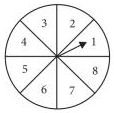
A game of chance consists of spinning an arrow on a circular board, divided into 8 equal parts, which comes to rest pointing at one of the numbers $1,2,3, \ldots ., 8$ as shown in the given figure which are equally likely outcomes. What is the probability that the arrow will point at a number which is less than 9 .
- A
$\frac{1}{2}$
- B
$\frac{1}{3}$
- C
$\frac{1}{8}$
- ✓
Answer(d):Total number of outcomes $=8$
Favourable outcomes are $\{1,2,3,4,5,6,7,8\}$ i.e., 8 in number.
$\therefore \quad P($ getting a number less than 9$)=\frac{8}{8}=1$
View full question & answer→MCQ 411 Mark
₹ 5 coins, twenty eight ₹ 10 coins and eight ₹ 20 coins. Now, they said to Nisha, their another friends, to choose a coin randomly.
Find the probability that the coin chosen is ₹ 5 coin.
- A
$\frac{17}{55}$
- B
$\frac{36}{85}$
- ✓
$\frac{18}{85}$
- D
$\frac{1}{15}$
AnswerCorrect option: C. $\frac{18}{85}$
(c):Total number of coins $=50+48+36+28+8=170$
Number of ₹ 5 coins $=36$
$\therefore \quad$ Required probability $=\frac{36}{170}=\frac{18}{85}$
View full question & answer→MCQ 421 Mark
₹ 5 coins, twenty eight ₹ 10 coins and eight ₹ 20 coins. Now, they said to Nisha, their another friends, to choose a coin randomly.
Find the probability that the coin chosen is ₹ 20 coin.
- A
$\frac{13}{85}$
- ✓
$\frac{4}{85}$
- C
$\frac{3}{85}$
- D
$\frac{4}{15}$
AnswerCorrect option: B. $\frac{4}{85}$
(b):Number of ₹ 20 coins $=8$
$\therefore \quad$ Required probability $=\frac{8}{170}=\frac{4}{85}$
View full question & answer→MCQ 431 Mark
$₹\ 5$ coins, twenty eight $₹\ 10$ coins and eight $₹\ 20$ coins. Now, they said to Nisha, their another friends, to choose a coin randomly.
Find the probability that the coin chosen is not a $₹\ 10$ coin.
- A
$\frac{15}{31}$
- B
$\frac{36}{85}$
- C
$\frac{1}{5}$
- ✓
$\frac{71}{85}$
AnswerCorrect option: D. $\frac{71}{85}$
Number of $₹\ 10$ coins $=28$
Probability $($coin is of $₹\ 10) =\frac{28}{170}$
$\therefore$ Required probability $=1-P\ ($coin is of $\text ₹ 10)$
$\quad=1-\frac{28}{170}=\frac{142}{170}=\frac{71}{85}$
View full question & answer→MCQ 441 Mark
₹ 5 coins, twenty eight ₹ 10 coins and eight ₹ 20 coins. Now, they said to Nisha, their another friends, to choose a coin randomly.
Find the probability that the coin chosen is of denomination of atleast ₹ 10 .
- ✓
$\frac{18}{85}$
- B
$\frac{36}{85}$
- C
$\frac{1}{17}$
- D
$\frac{16}{85}$
AnswerCorrect option: A. $\frac{18}{85}$
(a):Total number of coins of ₹ 10 and ₹ 20
$ =28+8=36 $
$\therefore \quad$ Required probability $=\frac{36}{170}=\frac{18}{85}$
View full question & answer→MCQ 451 Mark
₹ 5 coins, twenty eight ₹ 10 coins and eight ₹ 20 coins. Now, they said to Nisha, their another friends, to choose a coin randomly.
Find the probability that the coin chosen is of denomination of atmost ₹ 5.
- ✓
$\frac{67}{85}$
- B
$\frac{36}{85}$
- C
$\frac{4}{85}$
- D
$\frac{18}{85}$
AnswerCorrect option: A. $\frac{67}{85}$
(a):Total number of coins of ₹ 1, ₹ 2 and ₹ 5
$ =50+48+36=134 $
$\therefore \quad$ Required probability $=\frac{134}{170}=\frac{67}{85}$
View full question & answer→MCQ 461 Mark
Which of the following is not the probability of an event ?
MCQ 471 Mark
India reached in Semifinal match in world cup cricket match. Other than India three more team Australia, New zealand and England also plays the game then ………... is the probability of an event that India win the world cup.
- ✓
$\frac{1}{4}$
- B
- C
- D
$\frac{1}{8}$
AnswerCorrect option: A. $\frac{1}{4}$
$\frac{1}{4}$
View full question & answer→MCQ 481 Mark
$\mathrm{P}\left(\mathrm{A}^{\prime}\right)=0.57$ then $\mathrm{P}(\mathrm{A})$……………..
View full question & answer→MCQ 491 Mark
………. is the probability of the event that there are 5 Wednesdays in the month of April.
- A
$\frac{1}{7}$
- ✓
$\frac{2}{7}$
- C
$\frac{5}{7}$
- D
$\frac{5}{30}$
AnswerCorrect option: B. $\frac{2}{7}$
$\frac{2}{7}$
View full question & answer→MCQ 501 Mark
………… is the probability of an event that on first day of the month has Sunday.
- A
$\frac{1}{14}$
- ✓
$\frac{1}{7}$
- C
$\frac{1}{28}$
- D
$\frac{1}{30}$
AnswerCorrect option: B. $\frac{1}{7}$
$\frac{1}{7}$
View full question & answer→