Questions · Page 2 of 2

2 Marks Questions

Question 512 Marks
Write down the decimal expansions of the following rational numbers by writing their denominators in the form $2^m× 5^n$, where, m, n are non-negative integers.
$\frac{13}{125}$
Answer
The given number is $\frac{13}{125}.$
$\frac{13}{125} = \frac{13}{5^{3}} = \frac{13}{5^{3} \times 2^0}$
$= \frac{13\times 2^{3}}{5^{3}\times 2^{3}} = \frac{13\times 8}{(10)^3} = \frac{104}{1000} = 0.104$
Thus, the decimal expansion of $\frac{13}{125}$ is 0.014.
View full question & answer
Question 522 Marks
Without actually performing the long division, state whether state whether the following rational numbers will have a terminating decimal expansion or a non terminating repeating decimal expansion.
$\frac{129}{2^2\times5^7\times7^{17}}$
Answer
Since the denominator is not of the form $2^m,5^n$, and it also has $7$ as its factor, the decimal expansion of $\frac{129}{2^2\times5^77^{17}}$ is non-terminating repeating.
View full question & answer
Question 532 Marks
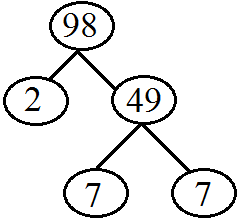
Write 98 as product of its prime factors.
Answer
Using factors tree for prime factorisation of $98$.

prime factoris of $98 = 2 \times 7 \times 7$
View full question & answer
Question 542 Marks
Define $HCF$ of two positive integers and find the $HCF$ of the following pairs of numbers:
$240$ and $6552$
Answer
By applying Euclid’s division lemma
$6552 = 240 \times 27 + 72$
Since remainder ≠ 0, apply division lemma on divisor of $240$ and remainder $72.$
$240 = 72 \times 3 + 24$
Since remainder ≠ 0, apply division lemma on divisor of $72$ and remainder $24.$
$72 = 24 \times 3 + 0$
$\therefore$ $H.C.F$ of $6552$ and $240$ is $= 24.$
View full question & answer
Question 552 Marks
Find the $HCF$ of the following pairs of integers and express it as a linear combination of them.
$1288$ and $575$
Answer
By applying Euclid’s division lemma
$1288 = 575 × 2 + 138 …..(i)$
Since remainder $≠ 0,$ apply division lemma on division $575$ and remainder $138.$
$575 = 138 × 4 + 23 …..(ii)$
Since remainder $≠ 0,$ apply division lemma on division $138$ and remainder $23 …..(iii)$
$HCF = 23$
Now, $23 = 575 - 138 × 4 [$from $(ii)]$
$= 575 - [1288 - 575 × 2] × 4 [$from $(i)]$
$= 575 - 1288 × 4 + 575 × 8$
$= 575 × 9 - 1288 × 4$
View full question & answer
Question 562 Marks
Use Euclid's division algorithm to find the $HCF$ of:
$136, 170$ and $255$
Answer
Given integers are $136, 170$ and $255.$
Let us first find the $HCF$ of $136, 170$ by Euclid lemma.
Clearly, $170 > 136.$ So, we will apply Euclid’s division lemma to $136$ and $170.$
$170 = 136 × 1 + 34$
Remainder is $34$ which is a non-zero number.
Now, apply Euclid’s division lemma to $136$ and $34.$
$136 = 34 × 4 + 0$
The remainder at this stage is zero.
Therefore, $34$ is the $HCF$ of $136$ and $170.$
Now, again use Euclid’s division lemma to find the $HCF$ of $34$ and $255.$
$255 = 34 × 7 + 17$
Remainder is $17$ which is a non-zero number.
Now, apply Euclid’s division lemma to $34$ and $17.$
$34 = 17 × 2 + 0$
The remainder at this stage is zero.
Therefore, $17$ is the $HCF$ of $136, 170$ and $255.$
View full question & answer
Question 572 Marks
What can you say about the prime factorisations of the $43$ of the following rationals:
$0.120120012000120000...$
Answer
We have,
$0.120120012000120000...$
We can see that it is a non-terminating repeating decimal expersion.
So, its denominator has factors others them $2$ or $5$.
View full question & answer
Question 582 Marks
Define $HCF$ of two positive integers and find the $HCF$ of the following pairs of numbers:
$75$ and $243$
Answer
Prime factors of $75$ and $243$ are
$75 = 3 × 5 × 5 = 3 × 5^2$
$243 = 3 × 3 × 3 × 3 × 3 = 3^5$
$HCF (75, 243) =$ Product of the smallest power of each common prime factor in the number
$= 3$
View full question & answer
Question 592 Marks
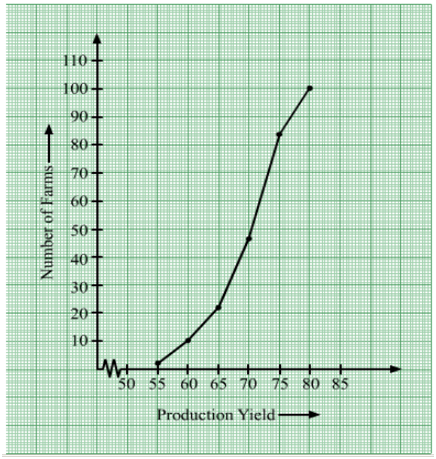
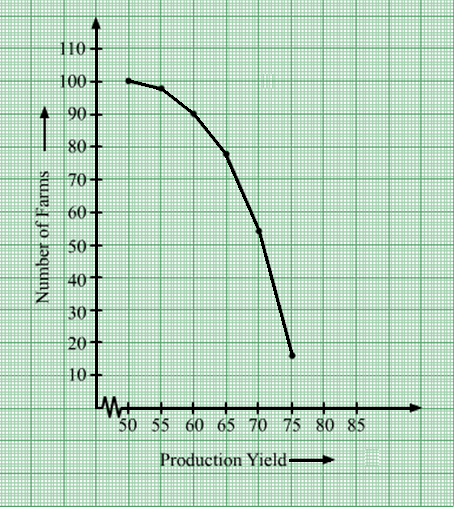
The following table gives production yield per hectare of wheat of 100 farms of a village:
Production yield 50-55 55-60 60-65 65-70 70-75 75-80 in kg per hecctare
Number of farms 2 8 12 24 38 16
Draw ‘less than’ ogive and ‘more than’ ogive.
View full question & answer
Question 602 Marks
The shirt sizes worn by a group of 200 persons, who bought the shirt from a store, are as follows:
Shirt size 37 38 39 40 41 42 43 44
Number of persons 15 25 39 41 36 14 15 12
Find the model shirt size worn by the group.
Answer
Shirt size 37 38 39 40 41 42 43 44
Number of persons 15 25 39 41 36 17 15 12
We see that frequency of 40 is maximum which is 41
$\therefore\ \text{Mode}=40$
View full question & answer
Question 612 Marks
Write the median class for the following frequency distribution:
Class-interval 0-10 10-20 20-30 30-40 40-50 50-60 60-70 70-80
Frequency 5 8 7 12 28 20 10 10
Answer
We are given the following table.
Class interval Frequency Cumulative Frequency
0-10 5 5
10-20 8 13
20-30 7 20
30-40 12 32
40-50 28 60
50-60 20 80
60-70 10 90
70-80 10 100
  N = 100
Here, N = 100 $\therefore\frac{\text{N}}{2}=50$ The cumulative frequency just greater than 50 is 60.

So, the median class is 40−50.
View full question & answer
Question 622 Marks
Write the median class of the following distribution:
Classes 0-10 10-20 20-30 30-40 40-50 50-60 60-70
Frequency 4 4 8 10 12 8 4
Answer
Consider the following distribution table.
Class Frequency C.F.
0-10 4 4
10-20 4 8
20-30 8 16
30-40 10 26
40-50 12 38
50-60 8 46
60-70 4 50
  N = 50
Here, N = 50 $\frac{\text{N}}{2}=25$ The cumulative frequency just greater than 25 is 26. So, the meian class is 30-40
View full question & answer
Question 662 Marks
find the class marks of classes 10-25 and 35-55.
Answer
We know that Class mark $=\frac{\text{Sum of its limits}}{2}$ $\therefore$ Class mark of 10-25 $=\frac{10+25}{2}=\frac{35}{2}=17.5$ and class mark of 35-55 $=\frac{35+55}{2}=\frac{90}{2}=45$
View full question & answer
Question 672 Marks
Find the mode of the following distribution.
Class-interval 10-15 15-20 02-25 25-30 30-35 35-40
Frequency 30 45 75 35 25 15
Answer
Class interval 10-15 15-20 20-25 25-30 30-35 35-40
No. of persons 30 45 75 35 25 15
Here the maximum frequency is 75 then the corresponding class 20-25 is the moidel class
$\text{L}=25,\text{h}=25-20=5,\text{f}=75,\text{f}_1=45,\text{f}_2=35$
$\text{Model}=\text{L}+\frac{\text{f}-\text{f}_1}{2\text{f}-\text{f}_1-\text{f}_2}\times\text{h}$
$=20+\frac{75-45}{2\times75-45-35}\times5$
$=20+\frac{30\times5}{70}$
$=20+2.14$
$=22.14$
View full question & answer
Question 682 Marks
n the graphical representation of a frequency distribution, if the distance between mode and mean isk times the distance between median and mean, then write the value of k.
Answer
We know that Mode = 3 median – 2 mean ….(i) Now mode – mean = k (median – mean), ….(ii) But mode – mean = 3 median – 2 mean [from (i)] ⇒ Mode – mean = 3 (median – mean) ….(iii) Comparing (ii) and (iii) k = 3
View full question & answer
Question 692 Marks
Find the mode of the following distribution:
Class-interval 0-10 10-20 20-30 30-40 40-50 50-60 60-70 70-80
Frequency 5 8 7 12 28 20 10 10
Answer
Class interval 0-10 10-20 20-30 30-40 40-50 50-60 60-70 70-80
No.of persons 5 8 7 12 28 20 10 10
Here the maximum frequency is 28 then the corresponding class 40-50 is the model class
$\text{L}=40,\text{h}=50-40=10,\text{f}=28,\text{f}_1=12,\text{f}_2=20$
$\text{Model}=\text{L}+\frac{\text{f}-\text{f}_1}{2\text{f}-\text{f}_1-\text{f}_2}\times\text{h}$
$=40+\frac{28-12}{2\times28-12-20}\times10$
$=40+\frac{16\times10}{24}$
$=40+16.67=46.67$
View full question & answer
Question 702 Marks
Find the mode of the following distribution.
Class-interval 25-30 30-35 35-40 40-45 45-50 50-60
Frequency 25 34 50 42 38 14
Answer
Class interval 25-30 30-35 35-40 40-45 45-50 50-60
No. of persons 25 34 50 42 38 14
Here the maximum frequency is 28 then the corresponding class 40-45 is the model class
$\text{L}=35,\text{h}=40-35=5,\text{f}=50,\text{f}_1=34,\text{f}_2=42$
$\text{Model}=\text{L}+\frac{\text{f}-\text{h}}{2\text{f}-\text{f}_1-\text{f}_2}\times\text{h}$
$=35+\frac{50-34}{2(50)-34-42}\times5$
$=35+\frac{16\times5}{24}$
$=35+3.33$
$=35.33$
View full question & answer
Question 712 Marks
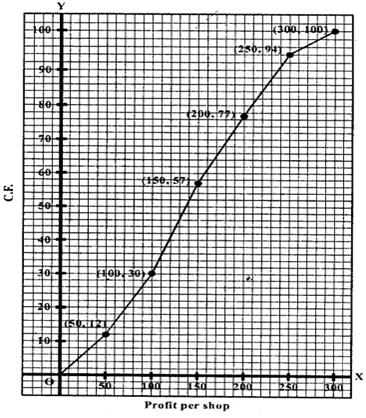
The monthly profits (in Rs.) of 100 shops are distributed as follows:
Profits per shop 0-50 50-100 100-150 150-200 200-250 250-300
No. of shops 12 18 27 20 17 6
Draw the frequency polygor it.
View full question & answer
2 Marks Questions - Page 2 - Maths STD 10 Questions - Vidyadip