Question 13 Marks
Prove that the ratio of the perimeters of two similar triangles is the same as the ratio of their corresponding sides.
AnswerLet the two triangles be $ABC$ and $PQR.$
We have:
$\triangle\text{ABC}\sim\triangle\text{PQR}$
Here,
$BC = a, AC = b$ and $AB = c$
$PQ = r, PR = q$ and $QR = p$
We have to prove:
$\frac{\text{a}}{\text{p}}=\frac{\text{b}}{\text{q}}=\frac{\text{c}}{\text{r}}=\frac{\text{a+b+c}}{\text{p+q+r}}$
$\triangle\text{ABC}\sim\triangle\text{PQR};$ therefore, their corresponding sides will be proportional.
$\Rightarrow\frac{\text{a}}{\text{p}}=\frac{\text{b}}{\text{q}}=\frac{\text{c}}{\text{r}}=\text{k }(\text{say})\dots(\text{i})$
$\Rightarrow\text{a}=\text{kp},\text{b}=\text{kq}$ and $\text{c}=\text{kr}$
$\therefore\frac{\text{Perimeter of}\triangle\text{ABC}}{\text{Perimeter of}\triangle\text{PQR}}=\frac{\text{a+b+c}}{\text{p+q+r}}=\frac{\text{kp+kq+kr}}{\text{p+q+r}}=\text{k}\dots(\text{ii})$
From $(i)$ and $(ii),$ we get:
$\frac{\text{a}}{\text{p}}=\frac{\text{b}}{\text{q}}=\frac{\text{c}}{\text{r}}=\frac{\text{a+b+c}}{\text{p+q+r}}=\frac{\text{Perimeter of}\triangle\text{ABC}}{\text{Perimeter of}\triangle\text{PQR}}$
This completes the proof.
View full question & answer→Question 23 Marks
The corresponding altitudes of two similar triangles are $6\ cm$ and $9\ cm$ respectively, Find the ratio of their areas.
AnswerLet the two triangle be $ABC$ and $DEF$ with altitudes $AP$ and $DQ,$ respectively.
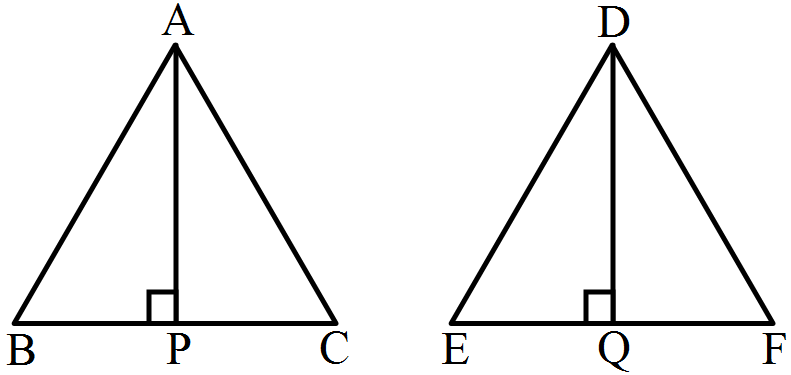
It is given that $\triangle\text{ABC}\sim\triangle\text{DEF}.$
We know that the ratio of areas of two similar triangle is equia to the ratio of squares of their corresponding altitudes.
$\therefore\frac{\text{ar}(\triangle\text{ABC})}{\text{ar}(\triangle\text{DEF})}=\frac{(\text{AP})^2}{(\text{DQ})^2}$
$\Rightarrow\frac{\text{ar}(\triangle\text{ABC})}{\text{ar}(\triangle\text{DEF})}=\frac{\text{6}^2}{\text{9}^2}$
$=\frac{36}{81}$
$=\frac{4}{9}$
Hence, the ratio of their areas is $4 : 9$ View full question & answer→Question 33 Marks
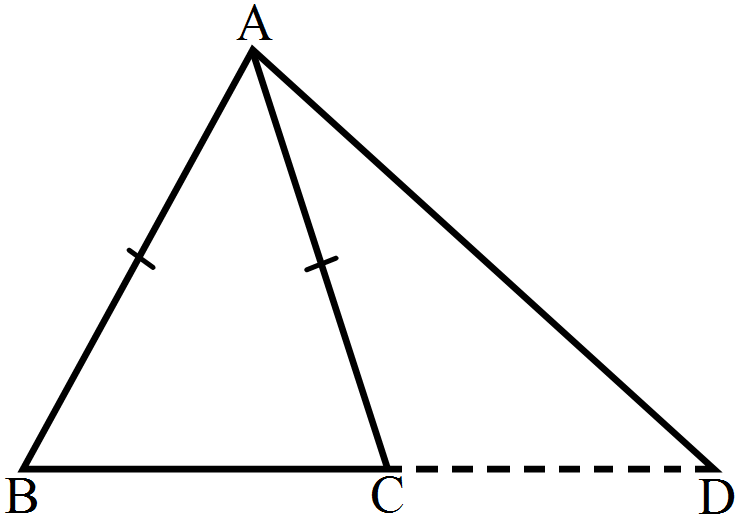
In $\triangle\text{ABC},\text{AB}=\text{AC}.$ Side $BC$ is produced to $D.$ prove that
$(\text{AD}^2-\text{AC}^2)=\text{BD}.\text{CD}$
Answer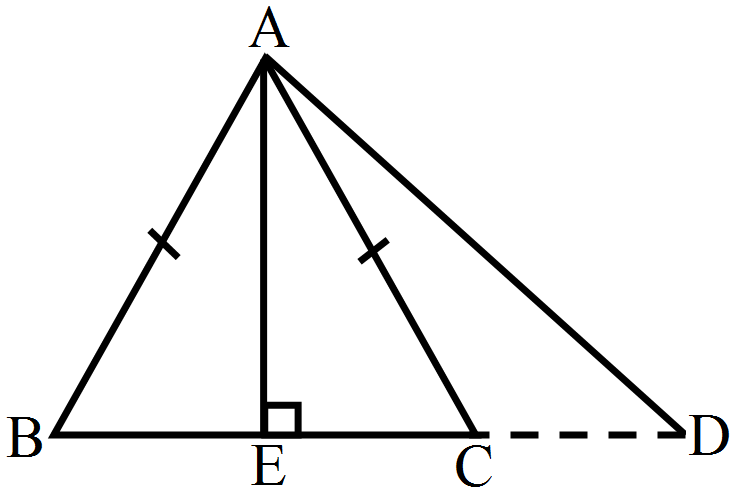
Constructing: Draw $\text{AE}\perp\text{BC}.$
Since $\triangle\text{ABC}$ is an isosceles triangle.
We know that in an isosceles triangle,
the altitude and median are the same.
So,$CE = BE$
$⇒ DE + CE = BE + DE = BD$
In $\triangle\text{AED},$
By pythagoras Theorem,
$ A D^2=A E^2+D E^2 $
$ \Rightarrow A E^2=A D^2-D E^2 \ldots . . .(i)$
$\text { In } \triangle \mathrm{AEC}$
By Pythagoras Theorem,
$ A C^2=A E^2+E C^2 $
$ \Rightarrow A E^2=A C^2-E C^2 \ldots . . \text { (ii) }$
From $(i)$ and $(ii),$ we have
$ A D^2-D E^2=A C-E C^2 $
$ \Rightarrow A D^2-A C^2=D E^2-E C^2 $
$ \Rightarrow A D^2-A C^2=(D E-E C)(D E+E C) $
$ \Rightarrow A D^2-A C^2=(C D)(B D) $
$ \Rightarrow A D^2-A C^2=B D \times C D$
Hence proved. View full question & answer→Question 43 Marks
$D$ and $E$ are points on the sides AB and AC respectively of a $\triangle\text{ABC}$ such that $DE || BC:$
$AD = (7x - 4)\ cm, AE = (5x - 2)\ cm, DB = (3x + 4)\ cm$ and $EC = 3x\ cm.$
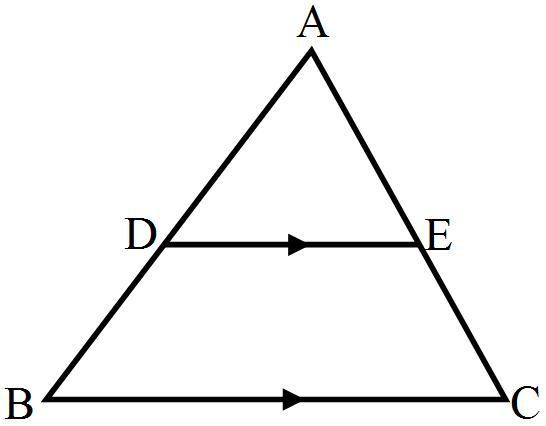
AnswerIn $\triangle\text{ABC},$ it is given that $DE || BC.$
Applying Thales' theorem, we get:
$\frac{\text{AD}}{\text{DB}}=\frac{\text{AE}}{\text{EC}}$
$\Rightarrow\frac{7\text{x}-4}{3\text{x}+4}=\frac{5\text{x}-2}{3\text{x}}$
$\Rightarrow3\text{x}(7\text{x}-4)=(5\text{x}-2)(3\text{x}+4)$
$\Rightarrow21\text{x}^2-12\text{x}=15\text{x}^2+14\text{x}-8$
$\Rightarrow6\text{x}^2-26\text{x}+8=0$
$\Rightarrow\big(\text{x}-4\big)\big(6\text{x}-2\big)=0$
$\Rightarrow\text{x}=4,\frac{1}{3}$
$\therefore\text{x}\not=\frac{1}{3}$ (as if $\text{x}=\frac{1}{3}$ then AE will become negative)
$\therefore\text{x}=4\text{cm}$
View full question & answer→Question 53 Marks
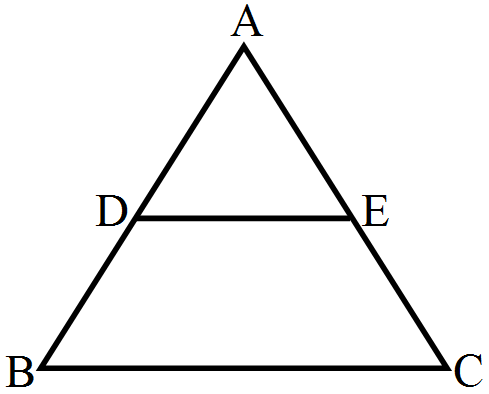
$D$ and $E$ are points on the sides $AB$ and $AC$ respectively of a $\triangle\text{ABC}.$ In the following cases, determine whether $DE || BC$ or not.
$AD = 7.2\ cm, AE = 6.4\ cm, AB = 12\ cm$ and $AC = 10\ cm.$
AnswerWe have:
$AD = 7.2\ cm, AB = 12\ cm$
Therefore,
$DB = 12 - 7.2 = 4.8\ cm$
Similarly,
$AE = 6.4\ cm, AC = 10\ cm$
Therefore,
$EC = 10 - 6.4 = 3.6\ cm$
Now,
$\frac{\text{AD}}{\text{DB}}=\frac{7.2}{4.8}=\frac{3}{2}$
$\frac{\text{AE}}{\text{EC}}=\frac{6.4}{3.6}=\frac{16}{9}$
Thus, $\frac{\text{AD}}{\text{DB}}\not=\frac{\text{AE}}{\text{EC}}$
Applying the converse of Thalse' theorem, we conclude thet $DE$ is not parallel to $BC$.
View full question & answer→Question 63 Marks
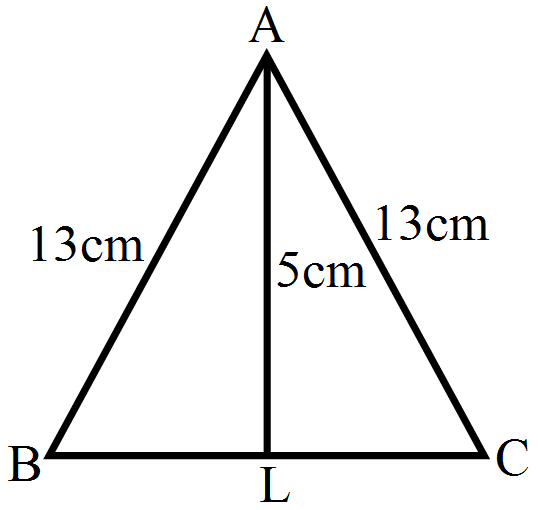
$\triangle\text{ABC}$ is an isosceles triangle with $AB = AC = 13\ cm.$ The length of altitude from $A$ on $BC$ is $5\ cm.$ Find $BC.$
AnswerGiven: $\triangle\text{ABC}$ is an isosceles triangle with $AB = AC = 13\ cm^2$
Const: Draw altitude from $A$ to $BC (\text{AL}\perp\text{BC} ).$
Now, $AL = 5\ cm$
In $\triangle\text{ALB},$
$\angle\text{ALB}=90^\circ$
$\therefore\text{AB}^2=\text{AL}^2+\text{BL}^2$(by pythagoras theorem)
$\therefore13^2=(5)^2+\text{BL}^2$
$(169-25)\text{cm}^2=\text{BL}^2$
$\text{BL}^2=144\text{cm}^2$
$\text{BL}=\sqrt{144}\text{cm}=12\text{cm}$
In $\triangle\text{ALC},$
$\angle\text{ALC}=90^\circ$
$\text{AC}^2=\text{AL}^2+\text{LC}^2$
$\Rightarrow\text{LC}^2=\Big(\text{AC}^2-\text{AL}^2\Big)$
$=\Big[(13)^2-(5)^2\Big]\text{cm}^2$
$=(169-25)\text{cm}^2$
$=144\text{cm}^2$
$=\sqrt{144}=12\text{cm}$
$\therefore\text{BC}=\text{BL}+\text{LC}$
$=(12+12)\text{cm}=24\text{cm}$ View full question & answer→Question 73 Marks
The sides of certain triangles are given below. Determine them are right triangles:
$9\ cm, 16\ cm, 18\ cm.$
AnswerFor a given triangle to be a right angled, the sum of the squares of the two sides must be equal to the square of the largest side.
Let $a = 9\ cm, b = 16\ cm$ and$ c= 18\ cm.$ Then
$\Big(\text{a}^2+\text{b}^2\Big)=\Big[9^2+(16)^2\Big]$
$=(81+256)\text{cm}^2$
$=337\text{cm}^2$
and $\text{c}^2=(18)^2\text{cm}^2=324\text{cm}^2$
$\therefore\big(\text{a}^2+\text{b}^2\big)\not=\text{c}^2$
Hence the given triangle is not right angled.
View full question & answer→Question 83 Marks
In the given figure, $DE || BC.$ If $DE = 3\ cm, BC = 6\ cm$ and $\text{ar}(\triangle\text{ADE})=15\text{cm}^2,$ find the area of $\triangle\text{ABC}.$
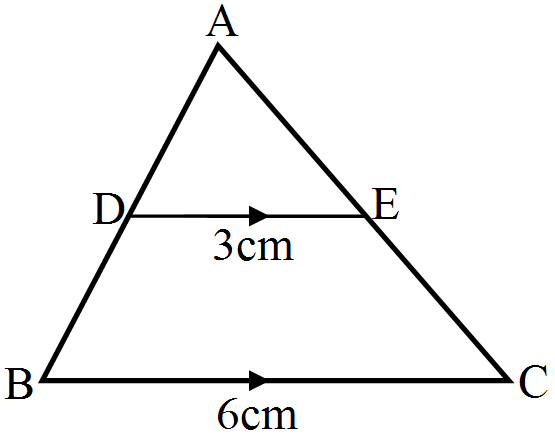
AnswerIt is given that $DE || BC$
$\therefore\angle\text{ADE}=\angle\text{ABC} ($Corresponding angles$)$
$\angle\text{AED}=\angle\text{ACB} ($Corresponding angles$)$
By $AA$ similarity, we can conclude that $\triangle\text{ADE}\sim\triangle\text{ABC}.$
$\therefore\frac{\text{ar}(\triangle\text{ADE})}{\text{ar}(\triangle\text{ABC})}=\frac{\text{DE}^2}{\text{BC}^2}$
$\Rightarrow\frac{15}{\text{ar}(\triangle\text{ABC})}=\frac{3^2}{6^2}$
$\Rightarrow\text{ar}(\triangle\text{ABC})=\frac{15\times36}{9}$
$=60\text{cm}^2$
Hence, area of triangle $ABC$ is $60\ cm^2$
View full question & answer→Question 93 Marks
In a trapezium $ABCD,$ it is given that $AB || CD$ and $AB = 2CD.$ Its diagonals $AC$ and $BD$ intersect at the point $O$ such that $\text{ar}(\triangle\text{AOB})=84\text{cm}^2.$ Find $\text{ar}(\triangle\text{COD}).$
AnswerIn $\triangle\text{AOB}$ and $\triangle\text{COD},$ we have:
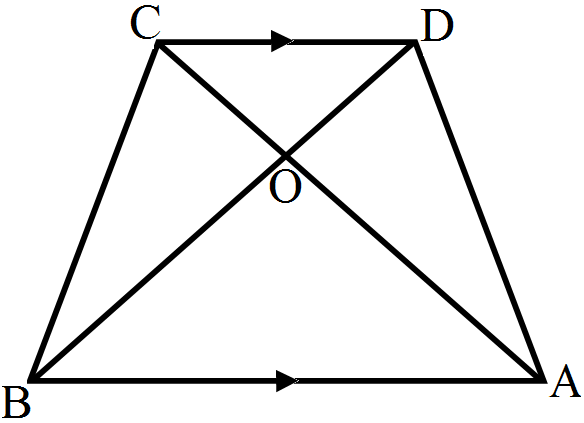
$\angle\text{AOB}=\angle\text{COD} ($Vertically opposite angles$)$
$\angle\text{OAB}=\angle\text{OCD} ($Alternate angles as $AB || CD)$
Applying $AA$ similiarity criterion, we get:
$\triangle\text{AOB}\sim\triangle\text{COD}$
$\therefore\frac{\text{ar}(\triangle\text{AOB})}{\text{ar}(\triangle\text{COD})}=\frac{\text{AB}^2}{\text{CD}^2}$
$\Rightarrow\frac{84}{\text{ar}(\triangle\text{COD})}=\Big(\frac{\text{AB}}{\text{CD}}\Big)^2$
$\Rightarrow\frac{84}{\text{ar}(\triangle\text{COD})}=\Big(\frac{2\text{CD}}{\text{CD}}\Big)^2$
$\Rightarrow\text{ar}(\triangle\text{COD})=\frac{84}{4}=21\text{cm}^2$ View full question & answer→Question 103 Marks
In the given figure, $\angle\text{AMN}=\angle\text{MBC}=76^\circ.$ If $p, q$ and $r$ are the lengths of $AM, MB$ and $BC$ respectively then express the length of $MN$ in terms of $p, q$ and $r.$
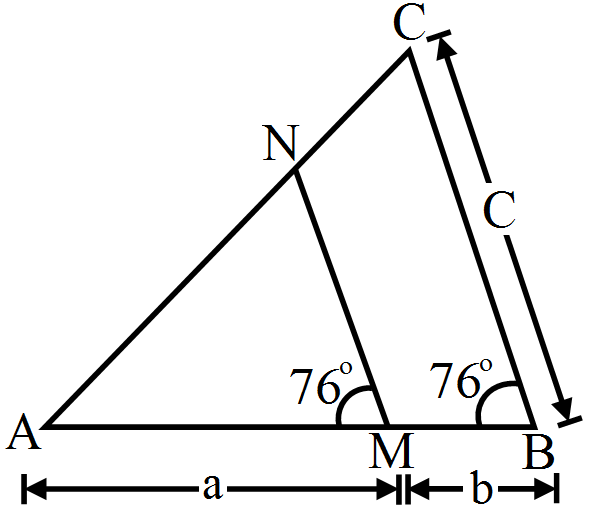
AnswerIn $\triangle\text{ABC}$ and $\triangle\text{AMN},$
$\angle\text{M}=\angle\text{B}=76^\circ .....($corresponding angles$)$
and $\angle\text{BAC}=\angle\text{MAN} .....($common angle$)$
$\Rightarrow\triangle\text{ABC}\sim\triangle\text{AMN} .....(AA$ criterion$)$
$\frac{\text{AB}}{\text{AM}}=\frac{\text{BC}}{\text{MN}}$
$\frac{\text{AM}+\text{MB}}{\text{AM}}=\frac{\text{BC}}{\text{MN}}$
$\frac{\text{a}+\text{b}}{\text{a}}=\frac{\text{c}}{\text{MN}}$
$\Rightarrow\text{MN}=\frac{\text{ac}}{\text{a}+\text{b}}$
View full question & answer→Question 113 Marks
Find the height of an equilateral triangle of side $12\ cm.$
Answer$\triangle\text{ABC}$ is an equilateral triangle in which all side are equal.
Therefore, $AB = BC = AC = 12\ cm$
If $BC = 12\ cm$
Then, $BD = BC = 6\ cm$
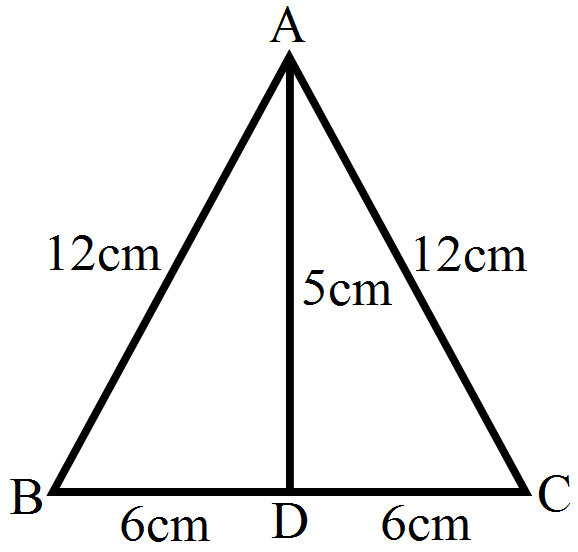
In $\triangle\text{ADB},$
$\text{AB}^2=\text{AD}^2+\text{BD}^2$
$($By applying pythagoras theorem$)$
$\text{AD}^2=\text{AB}^2-\text{BD}^2$
$\text{AD}^2=\Big[(12)^2-(6)^2\Big]\text{cm}^2$
$\text{AD}^2=\sqrt{108}\text{cm}$
$\text{AD}=\sqrt{108}\text{cm}=6\sqrt{3}\text{cm}$
Hence the height of the triangle is $6\sqrt{3}\text{cm}$ View full question & answer→Question 123 Marks
$\triangle\text{ABC}\sim\triangle\text{PQR}$ and $\text{ar}(\triangle\text{ABC})=4\text{ar}(\triangle\text{PQR}).$ If $BC\ 12\ cm,$ find $QR.$
AnswerGiven: $\text{ar}(\triangle\text{ABC})=4\text{ar}(\triangle\text{PQR})$
$\frac{\text{ar}(\triangle\text{ABC})}{\text{ar}(\triangle\text{PQR})}=\frac{\text{4}}{\text{1}}$
$\therefore\triangle\text{ABC}\sim\triangle\text{PQR}$
$\therefore\frac{\text{ar}(\triangle\text{ABC})}{\text{ar}(\triangle\text{PQR})}=\frac{\text{BC}^2}{\text{QR}^2}$
$\therefore\frac{\text{BC}^2}{\text{QR}^2}=\frac{\text{4}}{\text{1}}$
$\Rightarrow\text{QR}^2=\frac{12^2}{4}$
$\Rightarrow\text{QR}^2=36$
$\Rightarrow\text{QR}=6$
Hence, $QR = 6\ cm$
View full question & answer→Question 133 Marks
$\triangle\text{ABC}\sim\triangle\text{DEF}$ such that $\text{ar}(\triangle\text{ABC})=64\text{cm}^2$ and $\text{ar}(\triangle\text{DEF})=169\text{cm}^2.$ If $BC = 4\ cm,$ find $EF.$
Answer$\therefore\triangle\text{ABC}\sim\triangle\text{DEF}$
$\therefore\frac{\text{ar}(\triangle\text{ABC})}{\text{ar}(\triangle\text{DEF})}=\frac{\text{BC}^2}{\text{EF}^2}$
$\Rightarrow\frac{64}{169}=\frac{4^2}{\text{EF}^2}$
$\Rightarrow\text{EF}^2=\frac{16\times169}{\text{64}}$
$\Rightarrow\text{EF}=\frac{4\times13}{\text{8}}=6.5\text{cm}$
View full question & answer→Question 143 Marks
The corresponding sides of two similar triangles are in the ratio $2 : 3.$ If the area of the smaller triangle is $48cm^2$, find the area of the larger triangle.
AnswerIt is given that the triangles are similar.
Therefore, the ratio of areas of similar triangles will be equal to the ratio of squares of their corresponding sides.
$\therefore\frac{48}{\text{Area of larger triangle}}=\frac{2^2}{3^2}$
$\Rightarrow\frac{48}{\text{Area of larger triangle}}=\frac{4}{9}$
$\Rightarrow\text{Area of larger triangle}=\frac{48\times9}{4}=108\text{cm}^2$
View full question & answer→Question 153 Marks
$ABCD$ is a parallelogram in which $P$ is the midpoint of $DC$ and $Q$ is a point on $AC$ such that $\text{CQ}=\frac{1}{4}\text{AC}.$ If $PQ$ produced meets $BC$ at $R, $ prove that $R$ is the midpoint of $BC$.
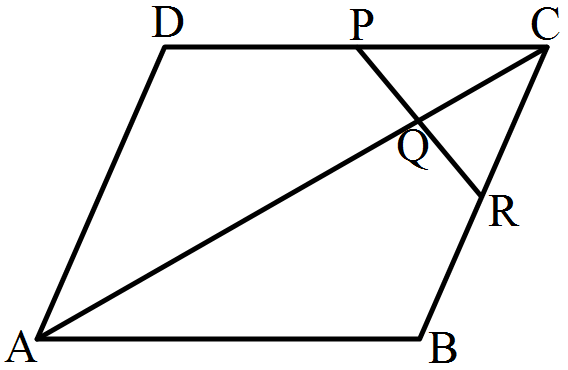
AnswerWe know that the diagonals of a parallelogram bisect each other.
Therefore,
$\text{CS}=\frac{1}{2}\text{AC}\dots(\text{i})$
Also, it is given that $\text{CQ}=\frac{1}{4}\text{AC}\dots(\text{ii})$
Dividing equation $(ii)$ by $(i),$ we get:
$\frac{\text{CQ}}{\text{CS}}=\frac{\frac{1}{4}\text{AC}}{\frac{1}{2}\text{AC}}$
or, $\text{CQ}=\frac{1}{2}\text{CS}$
Hence, $Q$ is the midpoint of $CS.$
Therefore, according to midpoint theorem in $\triangle\text{CSD}$
$PQ || DS$
If $PQ || DS,$ we can say that $QR || SB$
In $\triangle\text{CSB},\text{Q}$ is midpoint of $CS$ and $QR || SB.$
Applying converse of midpoint theorem, we conclude that $R$ the midpoint of $CB.$
This comletes the proof .
View full question & answer→Question 163 Marks
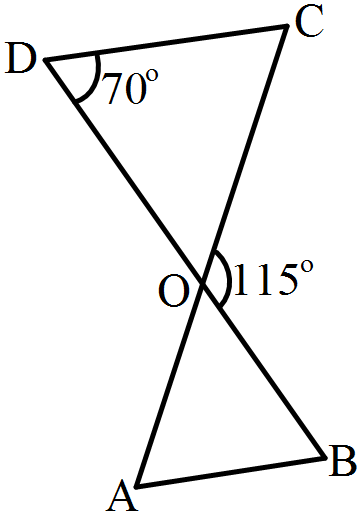
In the given figure, $\triangle\text{ODC}\sim\triangle\text{OBA},\angle\text{BOC}=115^\circ$ and $\angle\text{CDO}=70^\circ.$
Find
- $\angle\text{DOC}$
- $\angle\text{DCO}$
- $\angle\text{OAB}$
- $\angle\text{OBA}$
Answer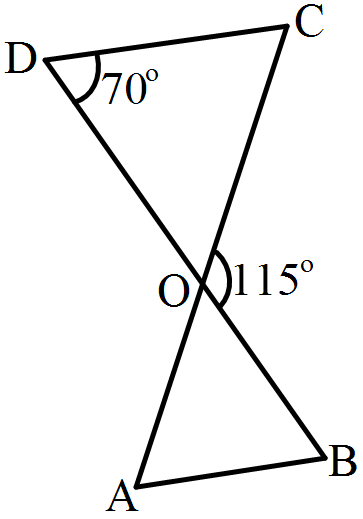
$\triangle\text{ODC}\sim\triangle\text{OBC}$
$\angle\text{BOC}=115^\circ$
$\angle\text{CDO}=70^\circ$
- $\angle\text{DOC}=(180^\circ-\angle\text{BOC})$
$=(180^\circ-115^\circ)$
$=65^\circ$
- $\angle\text{OCD}=180^\circ-\angle\text{CDO}-\angle\text{DOC}$
$\angle\text{OCD}=180^\circ-(70^\circ+65^\circ)$
$=45^\circ$
- Now, $\triangle\text{ABO}\sim\triangle\text{ODC}$
$\angle\text{AOB}=\angle\text{OCD }(\text{vert.Opp }\angle\text{s})=45^\circ$
$\angle\text{OAB}=\angle\text{OCD}=45^\circ$
- $\angle\text{OBA}=\angle\text{ODC} ($alternate angles$) = 70^\circ$
So, $\angle\text{OAB}=45^\circ$ and $\angle\text{OBA}=70^\circ$ View full question & answer→Question 173 Marks
The corresponding sides of two similar triangles $ABC$ and $DEF$ are $BC = 9.1\ cm$ and $EF = 6.5\ cm.$ If the rerimeter of $\triangle\text{DEF}$ is $25\ cm,$ find the perimeter of $\triangle\text{ABC}.$
Answer$\triangle\text{ABC}$ and $\triangle\text{DEF}$ are two similar triangles, therefore corresponding sides of both the triangle are proportional.
Hence, $\frac{\text{Perimeter of }\triangle\text{ABC}}{\text{Perimeter of }\triangle\text{DEF}}=\frac{\text{BC}}{\text{EF}}$
Let peremeter of $\triangle\text{ABC}=\text{x} \text{ cm}$
$\therefore\frac{\text{x}}{25}=\frac{9.1}{6.5}$
$\text{x}=\frac{9.1\times25}{6.5}=35\text{cm}$
Hence, perimeter of $\triangle\text{ABC}=35\text{ cm}$
View full question & answer→Question 183 Marks
Two triangles $DEF$ and $GHK$ are such that $\angle\text{D}=48^\circ$ and $\angle\text{H}=57^\circ.$ If $\triangle\text{DEF}\sim\triangle\text{GHK}$ then find the measure of $\angle\text{F}.$
AnswerGiven that $\triangle\text{DEF}\sim\triangle\text{GHK}.$
$\angle\text{D}=\angle\text{G}=48^\circ\dots(\text{Given})$
$\angle\text{E}=\angle\text{H}=57^\circ\dots(\text{Given})$
In $\triangle\text{DEF},$
$\angle\text{D}+\angle\text{E}+\angle\text{F}=180^\circ\dots(\text{Angel Sum Property})$
$\Rightarrow48^\circ+57^\circ+\angle\text{F}=180^\circ$
$\Rightarrow\angle\text{F}=75^\circ$
View full question & answer→Question 193 Marks
For the following statments state whether true $(T) $ or false$(F):$
The ratio of the areas of two similar triangles is equal to the ratio of their corresponding angle-bisector segments.
AnswerTrue.
Solution:
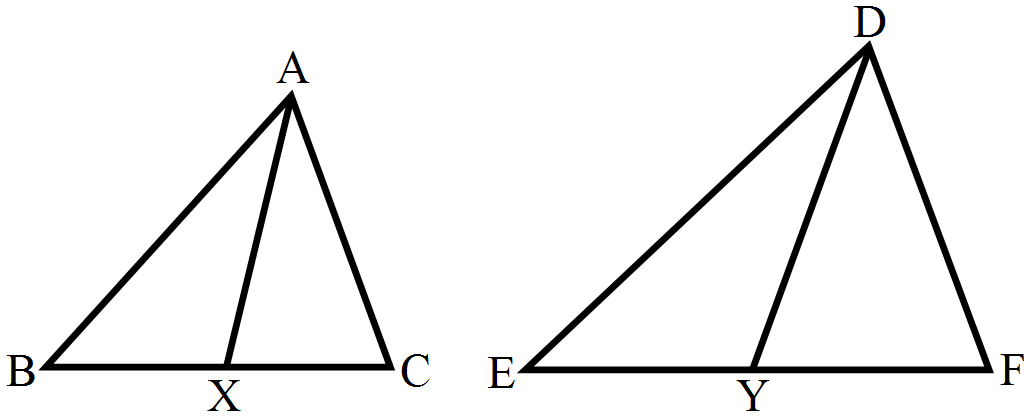
Given that $\triangle\text{ABC}\sim\triangle\text{DEF}$ in which $AX$ and $DY$ are the bisectors of $\angle\text{A}$ and $\angle\text{D}$ respectively.
To prove: $\frac{\text{ar}(\triangle\text{ABC})}{\text{ar}(\triangle\text{DEF})}=\frac{\text{AX}^2}{\text{DY}^2}$
We know that,
The ratio of the areas of two similar triangles is equal to the ratio of the squares of the squares of the squares of the corresponding sides.
$\therefore\frac{\text{ar}(\triangle\text{ABC})}{\text{ar}(\triangle\text{DEF})}=\frac{\text{AB}^2}{\text{DE}^2}\dots\text{(i)}$
$\triangle\text{ABC}\sim\triangle\text{DEF}$
$\Rightarrow\angle\text{A}=\angle\text{D}$
$\Rightarrow\frac{1}{2}\angle\text{A}=\frac{1}{2}\angle\text{D}$
$\Rightarrow\angle\text{BAX}=\frac{1}{2}\angle\text{EDY}$
In $\triangle\text{ABX}$ and $\triangle\text{DEY},$
$\angle\text{BAX}=\angle\text{EDY}$ and $\angle\text{B}=\angle\text{E}$
So, by the $AA$ criterion for similarity,
$\triangle\text{ABX}\sim\triangle\text{DEY}$
$\Rightarrow\frac{\text{AB}}{\text{DE}}=\frac{\text{AX}}{\text{DY}}$
$\Rightarrow\frac{\text{AB}^2}{\text{DE}^2}=\frac{\text{AX}^2}{\text{DY}^2}\dots(\text{ii})$
From $(i)$ and $(ii),$
$\frac{\text{ar}(\triangle\text{ABC})}{\text{ar}(\triangle\text{DEF})}=\frac{\text{AX}^2}{\text{DY}^2}$ View full question & answer→Question 203 Marks
$D$ and $E$ are points on the sides $AB$ and $AC$ respectively of a $\triangle\text{ABC}.$ In the following cases, determine whether DE || BC or not.
$AB = 10.8\ cm, AD = 6.3\ cm, AC = 9.6\ cm$ and $EC = 4\ cm.$
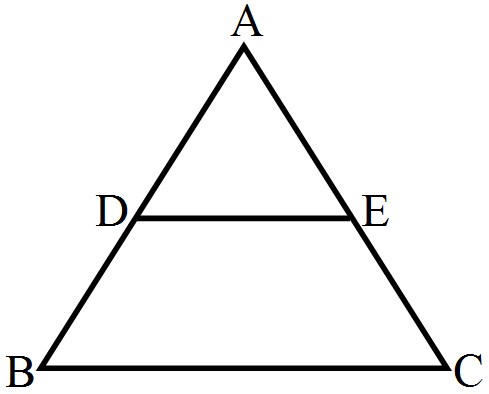
AnswerWe have:
$AB = 10.8\ cm, AD = 6.3\ cm$
Therefore,
$DB = 10.8 - 6.3 = 4.5\ cm$
Similarly,
$AC = 9.6\ cm, EC = 4\ cm$
Therefore,
$AE = 9.6 - 4 = 5.6\ cm$
Now,
$\frac{\text{AD}}{\text{DB}}=\frac{6.3}{4.5}=\frac{7}{5}$
$\frac{\text{AE}}{\text{EC}}=\frac{5.6}{4}=\frac{7}{5}$
$\Rightarrow\frac{\text{AD}}{\text{DB}}=\frac{\text{AE}}{\text{EC}}$
Applying the converse of Thalse' theorem, we conclude thet $DE || BC$.
View full question & answer→Question 213 Marks
State the midpoint theorem.
AnswerThe line segment joining the mid-points of any two sides of a triangle is parallel to the third side.
View full question & answer→Question 223 Marks
A guy wire attached to a vertical pole of height $18m$ is $24m$ long and has a stake attached to the other end. How far from the base of the pole should the stake be driven so that the wire will be taut$?$
Answer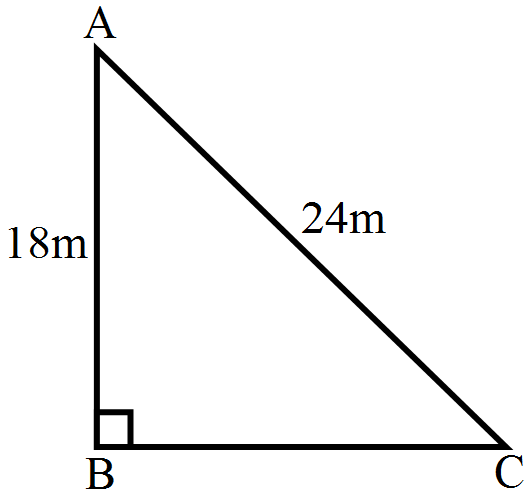
Let $AC$ be a guy wire attached to be a pole $AB$ of height $18m.$
Let $BC$ be the distance that the stake is away from the pole so that the wire will be taut.
In $\triangle\text{ABC},$
By Pythagoras Theorem,
$ A C^2=A B^2+B C^2 $
$ \Rightarrow 24^2=18^2+B C^2 $
$ \Rightarrow B C^2=24^2-18^2 $
$ \Rightarrow B C^2=576-324 $
$ \Rightarrow B C^2=252$
$\Rightarrow\text{BC}^2=6\sqrt{7}\text{m}$
So, the stake should be $6\sqrt{7}\text{m}$ away from the pole so that the wire will be taut. View full question & answer→Question 233 Marks
In the given figure, $D$ is the midpoint of side $BC$ and $\text{AE}\perp\text{BC}.$ If $BC = a, AC = b, AB = c, ED = x, AD = p$ and $AE = h,$ prove that.
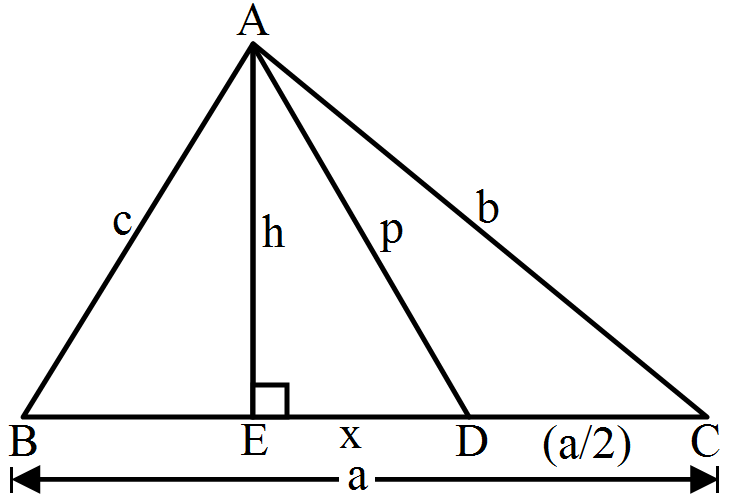
$(\text{b}^2-\text{c}^2)=2\text{ax}$ AnswerGiven: $D$ is the midpoint of side $\text{BC},\text{AE}\perp\text{BC},\text{BC}=\text{a},\text{AC}=\text{b},\text{AB}=\text{c},\text{ED}=\text{x},\text{AD}=\text{p}$ and $\text{AE}=\text{h}$
In $\triangle\text{AEC},\angle\text{AEC}=90^\circ$
$\text{AD}^2=\text{AE}^2+\text{ED}^2$ (by pythagoras theorem)
$\Rightarrow\text{p}^2=\text{h}^2+\text{x}^2$
$(iv)$ Subtracting $(2)$ from $(1),$ we get
$\text{b}^2-\text{c}^2=\text{p}^2+\text{ax}+\frac{\text{a}^2}{4}-\bigg(\text{p}^2-\text{ax}+\frac{\text{a}^2}{4}\bigg)$
$=\text{p}^2+\text{ax}+\frac{\text{a}^2}{4}-\text{p}^2+\text{ax}-\frac{\text{a}^2}{4}$
$\big(\text{b}^2-\text{c}^2\big)=2\text{ax}$
View full question & answer→Question 243 Marks
The sides of certain triangles are given below. Determine them are right triangles:
$1.4\ cm, 4.8\ cm, 5\ cm.$
AnswerFor a given triangle to be a right angled, the sum of the squares of the two sides must be equal to the square of the largest side.
Let $a = 1.4\ cm, b = 4.8\ cm,$ and $c = 5\ cm$
$\big(\text{a}^2+\text{b}^2\big)=\big[(1.4)^2+(4.8)^2\big]\text{cm}^2$
$=(1.96+23.04)\text{cm}^2=25\text{cm}^2$
$\text{c}^2=(5\text{cm)}^2=25\text{cm}^2$
$\therefore\big(\text{a}^2+\text{b}^{2}\big)=\text{c}^2$
Hence, the given triangle is a right triangle.
View full question & answer→Question 253 Marks
An aeroplane leaves an airport and flies due north at a speed of $1000\ km$ per hour. At the same time, aeroplane leaves the same airport and flies due west at a speed of $1200\ km$ per hour. How far apart will be the two planes after $1\frac{1}{2}\text{hour}?$
Answer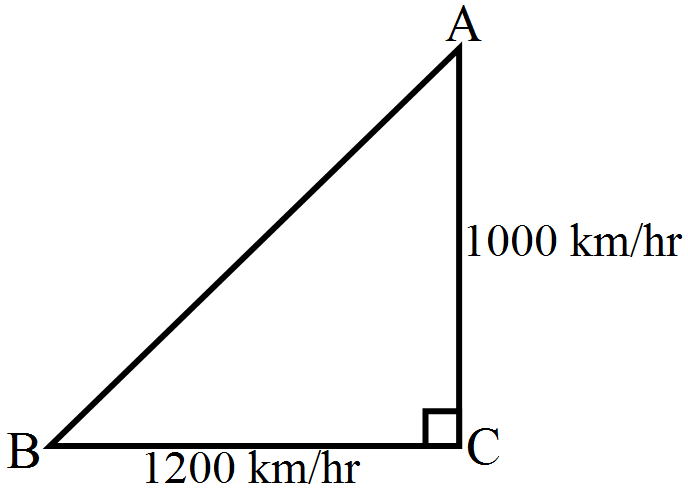
Let $C$ be the airport and let $A$ and $B$ be the two aerplanes flying north and west respectively Distance covered by $A$ in $1\frac{1}{2}=\frac{3}{2}\text{hours}$
$= AC$
$=1000\times\frac{3}{2}=1500\text{km}$
Distance covered by B in $1\frac{1}{2}=\frac{3}{2}\text{hours}$ hours
$= BC$
$=1200\times\frac{3}{2}=1800\text{km}$
In $\triangle\text{ABC},$
By Pythagoras theorem,
$ A B^2=A C^2+B C^2 $
$ \Rightarrow A B^2=1500^2+1800^2 $
$\Rightarrow A B^2=2250000+3420000 $
$ \Rightarrow A B^2=5490000$
$\Rightarrow\text{AB}=300\sqrt{61}\text{km}$
Hence, after $1\frac{1}{2}$ hours, the planes $A$ and $B$ are $300\sqrt{61}\text{km}$ apart. View full question & answer→Question 263 Marks
For the following statments state whether true $(T)$ or false$(F):$
Any two rectangles are similar.
AnswerFalse.
Solution:
Two rectangles are similar if their cirresponding sides are proportional.
View full question & answer→Question 273 Marks
The sides of certain triangles are given below. Determine them are right triangles:
$1.6\ cm, 3.8\ cm, 4\ cm.$
AnswerFor a given triangle to be a right angled, the sum of the squares of the two sides must be equal to the square of the largest side.
let $a = 1.6\ cm, b = 3.8\ cm$ and $c = 4\ cm$
$\big(\text{a}^2+\text{b}^2\big)=\big[(1.6)^2+{(3.8})^2\big]\text{cm}^2$
$=(2.56+14.44)\text{cm}^2=17\text{cm}^2$
$\text{c}^2=(4)^2=16\text{cm}^2$
$\therefore\big(\text{a}^2+\text{b}^2\big)\not=\text{c}^2$
Hence, the given triangle is a right triangle.
View full question & answer→Question 283 Marks
$D$ and $E$ are points on the sides $AB$ and $AC$ respectively of a $\triangle\text{ABC}$ such that $DE || BC:$
If $AD = 3.6\ cm, AB = 10\ cm$ and $AE = 4.5\ cm$, find $EC$ and $AC.$
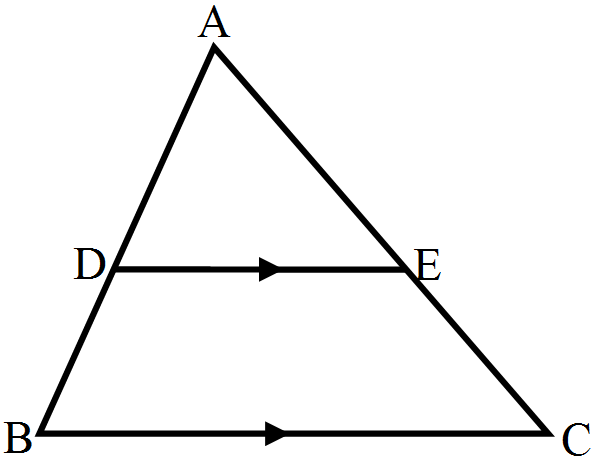
AnswerIn $\triangle\text{ABC},$ it is given that $DE || BC.$
Applying Thales' theorem, we get:
$\frac{\text{AD}}{\text{DB}}=\frac{\text{AE}}{\text{EC}}$
$\therefore\text{AD}=3.6,\text{AB}=10\text{cm},\text{AE}=4.5\text{cm}$
$\therefore\text{DB}=10-3.6=6.4\text{cm}$
or, $\frac{3.6}{6.4}=\frac{4.5}{\text{EC}}$
or, $\text{EC}=\frac{6.4\times4.5}{3.6}$
or, $\text{EC}=8\text{cm}$
Thus, $\text{AC}=\text{AE}+\text{EC}$
$=4.5 +8=12.5\text{cm}$
View full question & answer→Question 293 Marks
State Pythagoras theoram.
AnswerIn a right triangle, the square of the hypotenuse is equal to the sum of the squares of the other two sides.
View full question & answer→Question 303 Marks
In a $\triangle\text{ABC},\text{AD}$ is the bisector of $\angle\text{A}.$
If $AB = 5.6\ cm, BD = 3.2\ cm$ and $BC = 6\ cm,$ find $AC.$
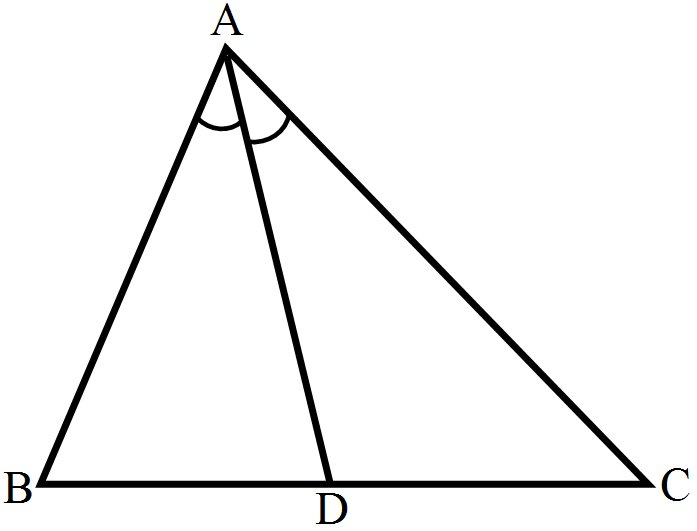
AnswerIt is given that $AD$ bisects $\angle\text{A}.$
Applying angle-bisector theorem in $\triangle\text{ABC},$ we get:
$\frac{\text{BD}}{\text{DC}}=\frac{\text{AB}}{\text{AC}}$
$BD = 3.2\ cm, BC = 6\ cm$
Therefore, $DC = 6 - 3.2 = 2.8\ cm$
$\Rightarrow\frac{3.2}{2.8}=\frac{5.6}{\text{AC}}$
$\Rightarrow\text{AC}=\frac{5.6\times2.8}{3.2}=4.9\text{cm}$
View full question & answer→Question 313 Marks
State the two properties which are necessary for given two triangles to be similar.
Question 323 Marks
A man goes $10m$ due south and then $24m$ due west. How far is he from the starting point$?$
Answerstarting from $O,$ let the man goas from $O$ to A and then $A$ to $B$ as shows in the figure.
Then,
$\text{OA}=10\text{m},\text{AB}=24\text{m }$ and $\angle\text{OAB}=90^\circ$
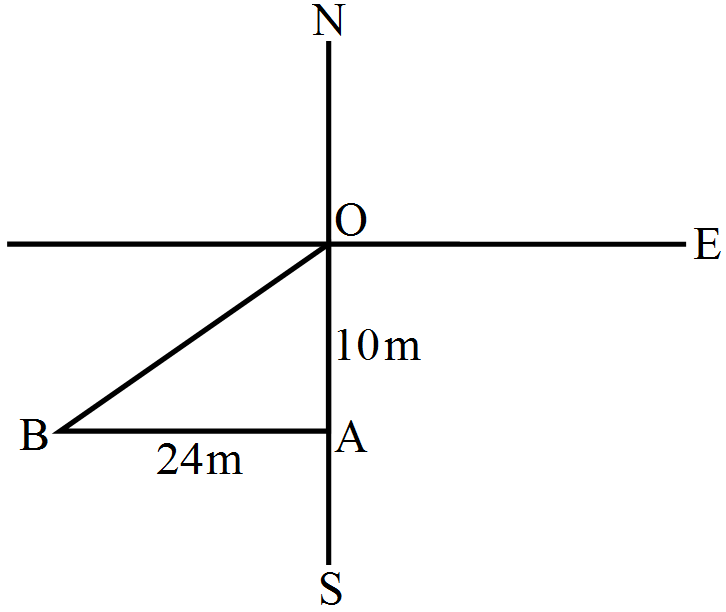
Using Pythagoras theorem:
$ O B^2=O A^2+A B^2 $
$\Rightarrow O B^2=10^2+24^2 $
$ \Rightarrow O B^2=100+576$
$ \Rightarrow O B^2=676$
$\Rightarrow\text{OB}=\sqrt{676}=26\text{m}$
Hence, the man is $26m$ south-west from the starting position. View full question & answer→Question 333 Marks
In the given figure, side $BC$ of $\triangle\text{ABC}$ is bisected at $D$ and $O$ is any point on $AD. BO$ and $CO$ produced meet $AC$ and $AB$ at $E$ and $F$ respectively, and $AD$ is produced to $X$ so that $D$ is the midpoint of $OX$ Prove that $AO : AX = AF : AB$ and show that $EF || BC.$
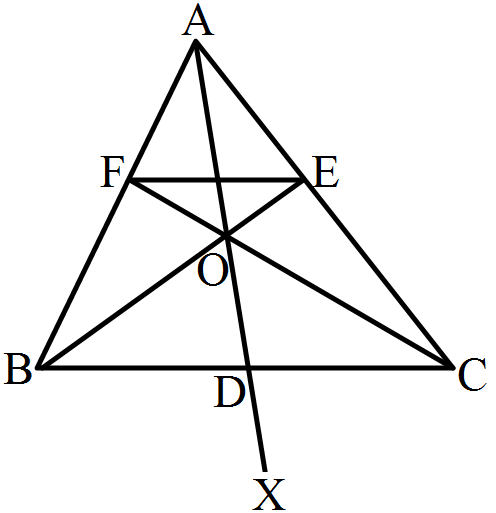
AnswerIt is given that $BC$ is bisected at $D.$
$\therefore\text{BD}=\text{DC}$
It is also given that $OD = OX$
The diagonals $OX$ and $BC$ of quadrilateral $BOCX$ bisect each other.
Therefore, $BOCX$ is a parallelogram
$\therefore\text{BO }||\text{ CX}$ and $\text{BX }||\text{ CO}$
$\text{BX }||\text{ CF}$ and $\text{CX }||\text{ BE}$
$\text{BX }||\text{ OF}$ and $\text{CX }||\text{ OE}$
Applying Thales' theorem in $\triangle\text{ABX},$ we get:
$\frac{\text{AO}}{\text{AX}}=\frac{\text{AF}}{\text{AB}}\dots(1)$
Also, in $\triangle\text{ACX},\text{CX }||\text{ OE}.$
Therefore by Thales' theorem, we get:
$\frac{\text{AO}}{\text{AX}}=\frac{\text{AE}}{\text{AC}}\dots(2)$
From $(1)$ and $(2),$ we have:
$\frac{\text{AF}}{\text{AB}}=\frac{\text{AE}}{\text{AC}}$
Applying the converse of Thales' theorem in $\triangle\text{ABC},\text{EF }||\text{ CB}.$
This completes the proof.
View full question & answer→Question 343 Marks
A $13-m-$long ladder reaches a window of a building $12m$ above the ground. Determine the distance of the foot of the ladder from the building.
AnswerLet $AB$ be the building and $CB$ be the ladder.
Then,
$\text{AB}=12\text{m},\text{CB}=13\text{m}$ and $\angle\text{CAB}=90^\circ$
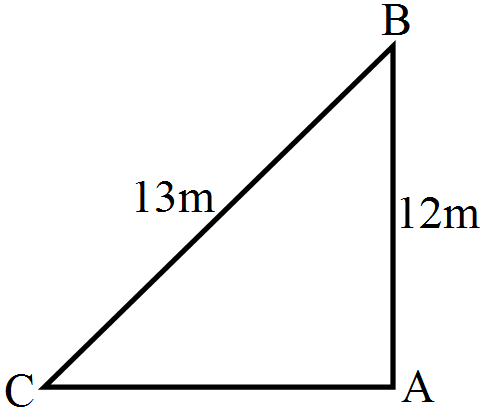
By Pythagoaras theoram, we have
$\text{CB}^2=\text{AB}^2+\text{AC}^2$
$\text{AC}^2=\big[\text{CB}^2-\text{AB}^2\big]$
$=\Big[(13)^2-(12)^2\Big]\text{m}^2$
$=(169-144)\text{m}^2$
$=25\text{m}^2$
$\Rightarrow\text{AC}=\sqrt{25}\text{m}=5\text{m}$
Hence, the distance of the fool of the ladder from the building is $5m.$ View full question & answer→Question 353 Marks
$D$ and $E$ are points on the sides $AB$ and $AC$ respectively of a $\triangle\text{ABC}$ such that $DE || BC:$
If $\frac{\text{AD}}{\text{AB}}=\frac{8}{15}$ and $EC = 3.5\ cm,$ find $AE.$
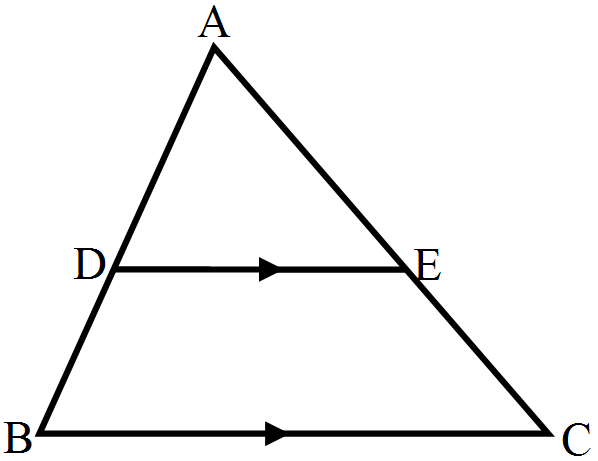
AnswerIn $\triangle\text{ABC},$ it is given that $DE || BC.$
Applying Thales' theorem, we get:
$\frac{\text{AD}}{\text{AB}}=\frac{\text{AE}}{\text{AC}}$
$\Rightarrow\frac{\text{8}}{\text{15}}=\frac{\text{AE}}{\text{AE}+\text{EC}}$
$\Rightarrow\frac{\text{8}}{\text{15}}=\frac{\text{AE}}{\text{AE}+\text{3.5}}$
$\Rightarrow8\text{AE}+28=15\text{AE}$
$\Rightarrow7\text{AE}=28$
$\Rightarrow\text{AE}=4\text{cm}$
View full question & answer→Question 363 Marks
In a $\triangle\text{ABC},\text{M}$ and $N$ are points on the sides $AB$ and $AC$ respectively such that $BM || BC.$
Answer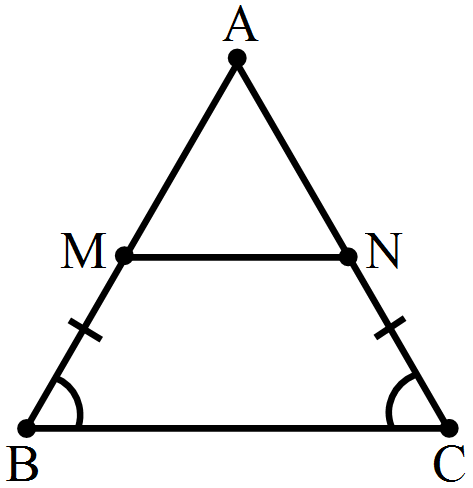
In $\triangle\text{ABC},\angle\text{B}=\angle\text{C}$
$\therefore\text{AB}=\text{AC} ($Sides opposite to equal angle are equal$)$
Subtracting BM from both sides, we get
$AB - BM = AC - BM$
$⇒ AB - BM = AC - CN (\therefore\text{BM=CN})$
$⇒ AM = AN$
$\therefore\angle\text{AMN}=\angle\text{ANM} ($Angels opposite to equal sides are equal$)$
Now, in $\triangle\text{ABC},$
$\angle\text{A}+\angle\text{B}+\angle\text{C}=180^\circ\dots(1)($Angle Sum Property of triangle$)$
Again in $\triangle\text{AMN},$
$\angle\text{A}+\angle\text{AMN}+\angle\text{ANM}=180^\circ\dots(2)($Angle Sum Property of triangle$)$
From $(1)$ and $(2),$ we get
$\angle\text{B}+\angle\text{C}=\angle\text{AMN}+\angle\text{ANM}$
$\Rightarrow2\angle\text{B}=2\angle\text{ANM}$
$\Rightarrow\angle\text{B}=\angle\text{AMN}$
Since, $\angle\text{B}$ and $\angle\text{AMN}$ are corresponding angles.
$\therefore\text{MN }||\text{ BC}$ View full question & answer→Question 373 Marks
In $\triangle\text{ABC},\text{D}$ is the midpoint of $BC$ and $\text{AE}\perp\text{BC}.$ If $\text{AC}>\text{AB},$ show that.
$\text{AB}^2=\text{AD}^2-\text{BC}.\text{DE}+\frac{1}{4}\text{BC}^2.$
AnswerGiven: $\triangle\text{ABC}$ in which $D$ is the midpoint of $BC$. $\text{AE}\perp\text{BC}$ and $AC > AB.$
Then $BD = CD$ and $\angle\text{AED}=90^\circ,$
Then, $\angle\text{ADE}<90^\circ$ and $\angle\text{ADC}>90^\circ$
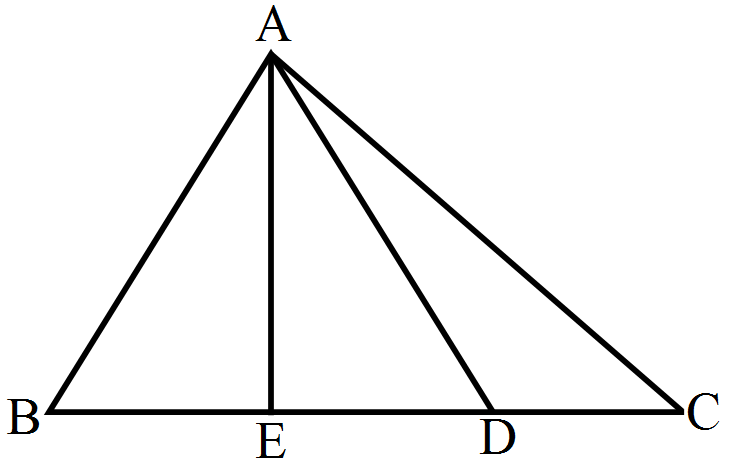
In $\triangle\text{AED},$
$\angle\text{AED}=90^\circ$
$\therefore\text{AD}^2=\text{AE}^2+\text{DE}^2$
$\Rightarrow\text{AE}^2=\big(\text{AD}^2-\text{DE}^2\big)\dots(1)$
In $\triangle\text{AEB},\angle\text{AEB}=90^\circ$
$\therefore \text{AB}^2=\text{AE}^2+\text{BE}^2\dots(2)$
Putting value of $AE^2$ from $(1)$ in $(2),$ we get
$\therefore\text{AB}^2=\big(\text{AD}^2-\text{DE}^2\big)+\text{BE}^2$
$=\big(\text{AD}^2-\text{DE}^2\big)+\big(\text{BD}^2-\text{DE}^2\big)\Big[\text{But}\text{ BD}=\frac{1}{2}\text{BC}\Big]$
$=\text{AD}^2-\text{DE}^2+\Big(\frac{1}{2}\text{BC}-\text{DE}\Big)^2$
$=\text{AD}^2-\text{DE}^2+\frac{1}{4}\text{BC}^2+\text{DE}^2-\text{BC.DE}$
$\text{AB}^2=\text{AD}^2-\text{BC},\text{DE}+\frac{1}{4}\text{BC}^2$ View full question & answer→Question 383 Marks
$D$ and $E$ are points on the sides $AB$ and $AC$ respectively of a $\triangle\text{ABC}.$ In the following cases, determine whether $DE || BC$ or not.
$AD = 5.7\ cm, DB = 9.5\ cm, AE = 4.8\ cm$ and $EC = 8\ cm.$
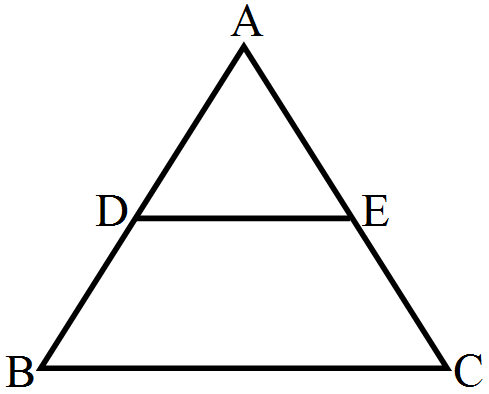
AnswerWe have:
$\frac{\text{AD}}{\text{DB}}=\frac{5.7}{9.5}=0.6\text{cm}$
$\frac{\text{AE}}{\text{EC}}=\frac{4.8}{8}=0.6\text{cm}$
Hence, $\frac{\text{AD}}{\text{DB}}=\frac{\text{AE}}{\text{EC}}$
Applying the converse of Thalse' theorem, we conclude thet $DE || BC.$
View full question & answer→Question 393 Marks
$ABCD$ is a quadrilateral in which $AD = BC$. If $P, Q, R, S$ be the midpoints of $AB, AC, CD$ and $BD$ respectively, show that $PQRS$ is a rhombus.
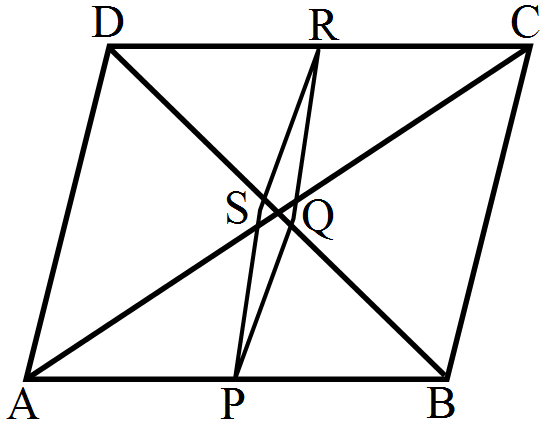
Answer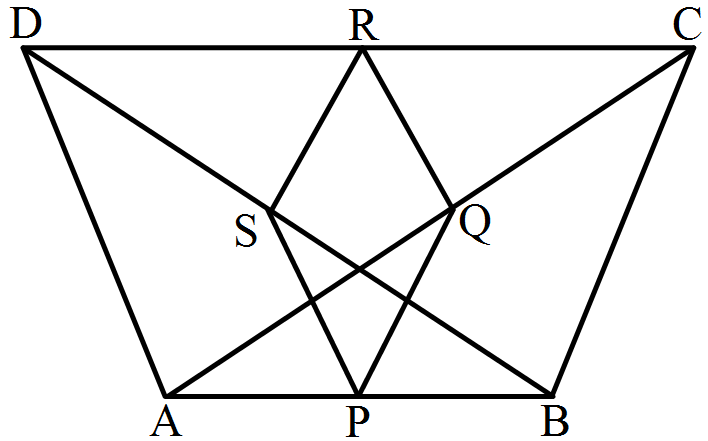
Given: $ABCD$ is a quadrilateral in which $AD = BC. P, Q, R, S$ are the midpoint of $AB, AC, CD$ and $BD.$
To prove: $PQRS$ is a rhombus
Proof: In $\triangle\text{ABC},$
Since $P$ and $Q$ are mid point of $AB$ and $AC$
Therefore,$PQ || BC$ and $\text{PQ}=\frac{1}{2}\text{BC}=\frac{1}{2}\text{DA}$ (Mid-point theorem)
Similarly,
In $\triangle\text{CDA},$
Since $R$ and $Q$ are mid point of $CD$ and $AC$
Therefore, $RQ || DA$ and $\text{PQ}=\frac{1}{2}\text{DA}$
In $\triangle\text{BDA},$
Since $S$ and $P$ are mid point of $BD$ and $AB$
Therefore, $SP || DA$ and $\text{SP}=\frac{1}{2}\text{DA}$
In $\triangle\text{CDB},$
Since $S$ and $P$ are mid point of $BD$ and $CD$
Therefore, $SR || BC$ and $\text{SR}=\frac{1}{2}\text{BC}=\frac{1}{2}\text{DA}$
$\therefore\text{SP }||\text{ RQ}$ and $\therefore\text{PQ }||\text{ SR}$ and $\text{PQ}=\text{RQ}=\text{SP}=\text{SR}$
Hence, $PQRS$ is a rhombus. View full question & answer→Question 403 Marks
In the given figure, $O$ is a point inside a $\triangle\text{PQR}$ such that $\angle\text{PQR}=90^\circ,\text{OP}=6\text{cm}$ and $\text{OR}=8\text{cm}.$ If $\text{PQ}=24\text{cm}$ and $\text{QR}=26\text{cm},$ prove that $\triangle\text{PQR}$ is right-angled.
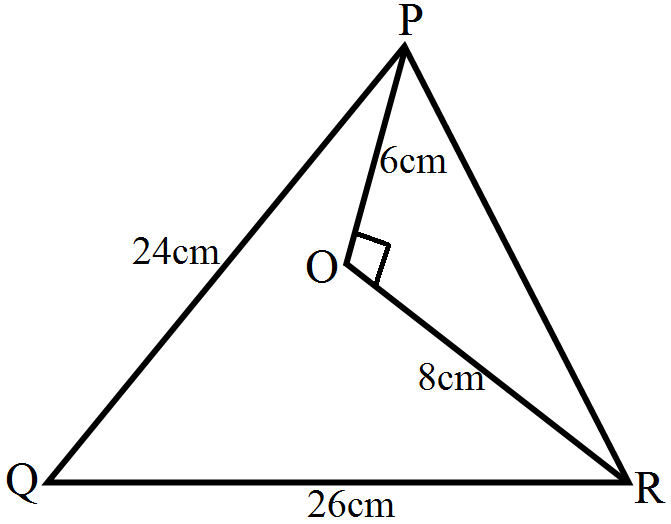
AnswerIn $\triangle\text{PQR},\angle\text{QPR}=90^\circ,\text{PQ}=24\text{cm},$ and $\text{QR}=26\text{cm}^2$
In $\triangle\text{POR},\text{PO}=6\text{cm},\text{QR}=8\text{cm},$ and $\angle\text{POR}=90^\circ$
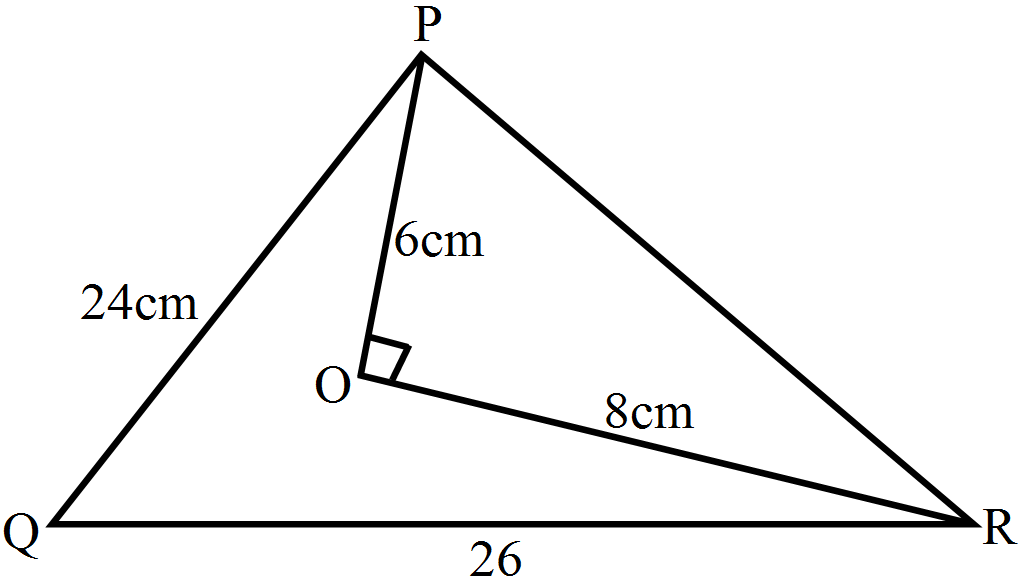
In $\triangle\text{POR},$
$\text{PR}^2=\text{PO}^2+\text{OR}^2$
$\text{PR}^2=(6^2+8^2)\text{cm}^2$
$=(36+64)\text{cm}^2=100\text{cm}^2$
$\text{PR}=\sqrt{100}\text{cm}=10\text{cm}$
In $\triangle\text{PQR},$
By Pythagoras theoram, we have
$\text{QR}^2=\text{QP}^2+\text{PR}^2$
$(26)^2\text{cm}^2=\Big(24^2+10^2\Big)\text{cm}^2$
$676\text{cm}^2=(576+100)\text{cm}^2$
$676\text{cm}^2=676\text{cm}^2$
Hence, $\text{QR}^2=\text{QP}^2+\text{PR}^2($sum of square of two sides equal to square of greatest side$)$
Hence, $\triangle\text{PQR}$ is a right triangle which ois right angled at $P.$ View full question & answer→Question 413 Marks
In the given pairs of triangles, find which pair of triangles are similar. State the similarity criterior and write the similarity relation in symbolic from.
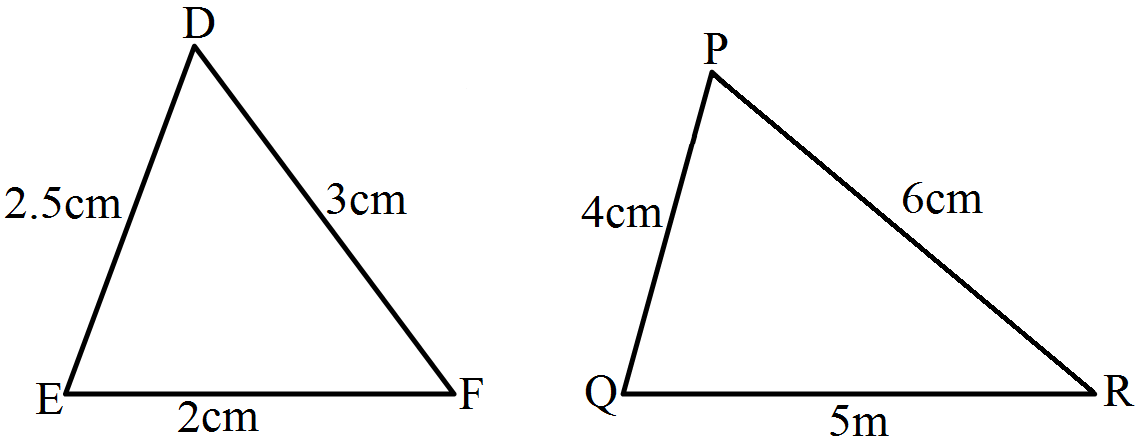
AnswerIn $\triangle\text{EFD}$ and $\triangle\text{PQR}$
$FE = 2\ cm, FD = 3\ cm, ED = 2.5\ cm$
$PQ = 4\ cm, PR = 6\ cm, QR = 5\ cm$
$\Rightarrow\frac{\text{PQ}}{\text{FE}}=\frac{\text{PR}}{\text{FD}}=\frac{\text{QR}}{\text{ED}}$
$\therefore\triangle\text{FED}\sim\triangle\text{PQR} (SSS$ similarity$)$
View full question & answer→Question 423 Marks
The corresponding sides of two similar triangles are in the ratio $2 : 3$. If the area of the smaller triangle is $48cm^2$, find the area of the larger triangle.
AnswerGiven that the triangles are similar.
$\Rightarrow\frac{\text{area of the smaller triangle}}{\text{area of the larger triangle}}=\Big(\frac{2}{3}\Big)^2$
$\Rightarrow\frac{48}{\text{area of the larger triangle}}=\frac{4}{9}$
$\Rightarrow\text{area of the larger triangle = 108cm}^2$
View full question & answer→Question 433 Marks
A vertical pole of lenght $7.5m$ casts a shadow $5m$ long on the ground and at the same time a tower casts a shadow $24m$ long. Find the height of the tower.
Answer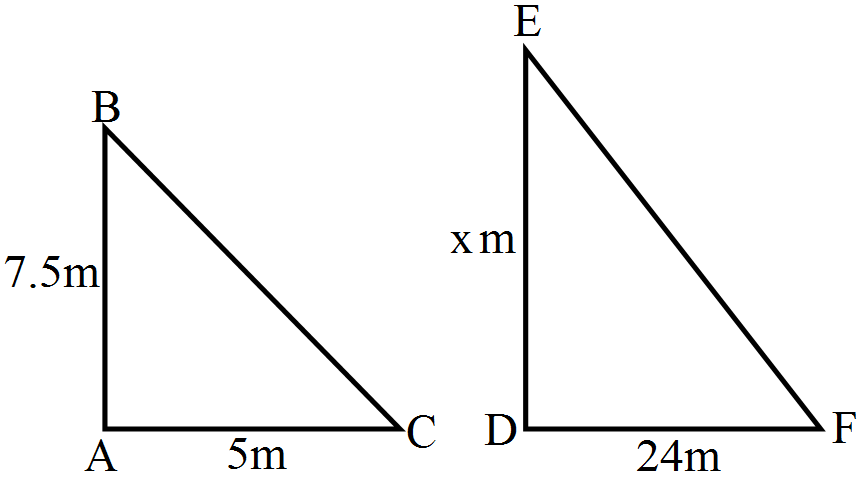
Let $AB$ be the vertical stick and let $AC$ be its shadow.
Then, $AB = 7.5m$ and $AC = 5m$
Let $DE$ be the vertical tower and let $DF$ be its shadow
Then, $DF = 24m,$ Let $DE = x$ meters
Now, In $\triangle\text{BAC}$ and $\triangle\text{EDF},$
$\triangle\text{BAC}\sim\triangle\text{EDF}$ by $SAS$ criterion
$\Rightarrow\frac{\text{AB}}{\text{DE}}=\frac{\text{AC}}{\text{DF}}$
$\Rightarrow\frac{7.5}{\text{x}}=\frac{5}{24}$
$\Rightarrow\text{x}=\frac{7.5\times24}{5}=36\text{m}$
therefore, height of the vertical tower is $36m.$ View full question & answer→Question 443 Marks
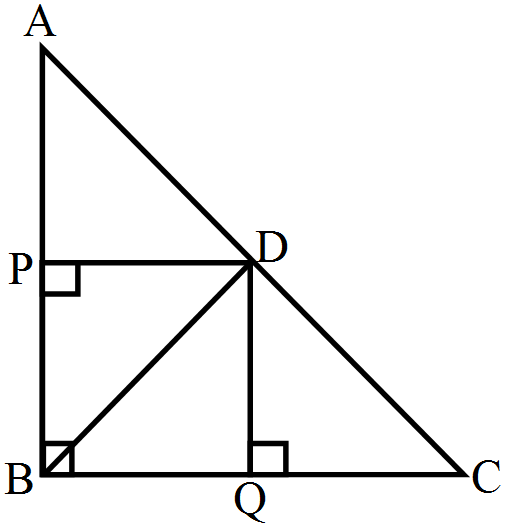
In a right triangle $ABC,$ right-angled at $B, D$ is a point on hypotenuse such that $\text{BD}\perp\text{AC}.$ If $\text{DP}\perp\text{AB}$ and $\text{DQ}\perp\text{BC}$ then prove that.
- $\text{DQ}^2=\text{DP}.\text{DQ}$
- $\text{DP}^2=\text{DQ}.\text{AP}$
AnswerWe know that
when a perpendicular is drawn from the vertex of a triangle on to the hypotenuse, then the triangles on both sides of the perpendicular are similar to eachother and the to the whole triangle.
- In $\triangle\text{DBC},$
$\triangle\text{DQB}\sim\triangle\text{DQC}$
$\Rightarrow\frac{\text{DQ}}{\text{DQ}}=\frac{\text{QB}}{\text{QC}}$
$\Rightarrow\text{DQ}^2=\text{QB}.\text{QC}$
Since all the angles of $PBQD$ are $90^\circ ,$
$PBQD$ is a rectangle.
$⇒ QB = DP$ and $PB = DQ ....(i)$
$⇒ DQ^2= DP . QC$
- Similarly, since $PD$ is a perpendicular on $AB,$
$\triangle\text{APD}\sim\triangle\text{DPB}$
$\Rightarrow\frac{\text{DP}}{\text{PB}}=\frac{\text{AP}}{\text{DP}}$
$\Rightarrow\frac{\text{DP}}{\text{DQ}}=\frac{\text{AP}}{\text{DP}}\dots(\text{using }(\text{i}))$
$\Rightarrow\text{DP}^2=\text{DQ}.\text{AP}$ View full question & answer→Question 453 Marks
In $\triangle\text{ABC},$ the bisector of $\angle\text{B}$ meets $AC$ at $D.$ A line $PQ || AC$ meets $AB, BC$ and $BD$ at $P, Q$ and $R$ respectively.
Show that $PR × BQ = QR × BP.$
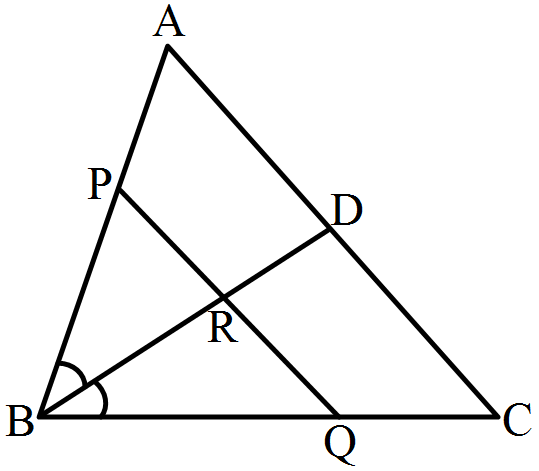
AnswerIn triangle $BQP, BR$ bisects angle $B.$
Applying angle bisector theorem, we get:
$\frac{\text{QR}}{\text{PR}}=\frac{\text{BQ}}{\text{BP}}$
$⇒ BP × QR = BQ × PR$
This completes the proof.
View full question & answer→Question 463 Marks
In the given pairs of triangles, find which pair of triangles are similar. State the similarity criterior and write the similarity relation in symbolic from.
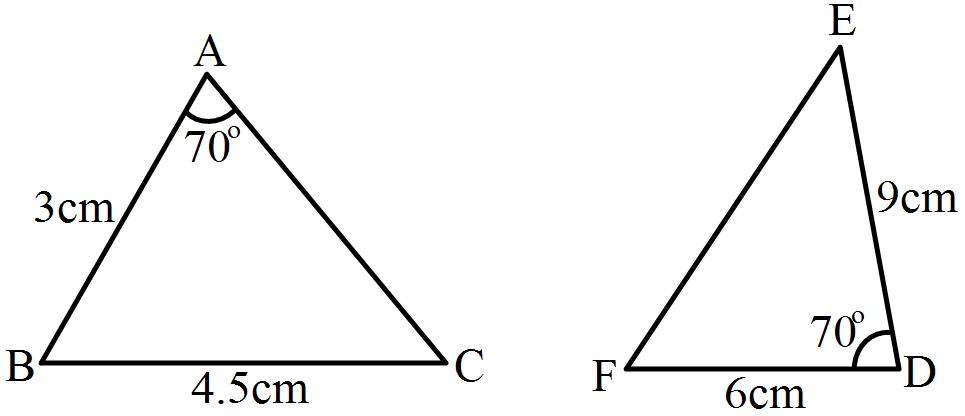
AnswerIn $\triangle\text{ABC}$ and $\triangle\text{EFD}$
$\angle\text{A}=\angle\text{D}=70^\circ$
$SAS:$ Similarity condition is not satisfied as $\angle\text{A}$ and $\angle\text{D}$ are not included angles.
View full question & answer→Question 473 Marks
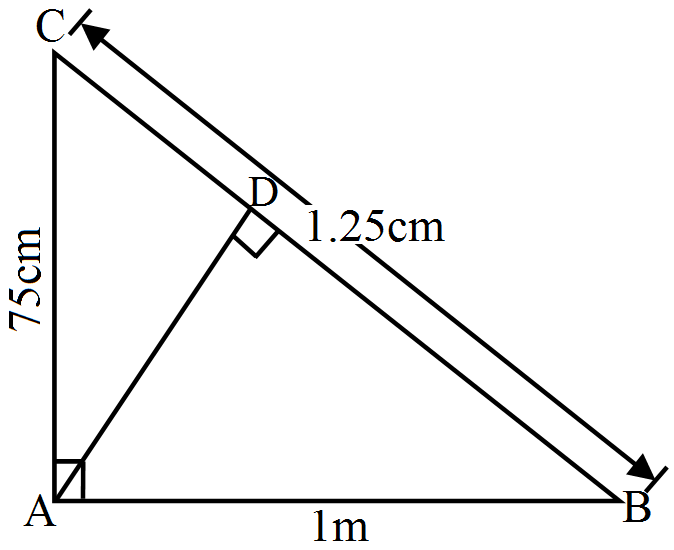
In the given figure, $\angle\text{CAB}=90^\circ$ and $\text{AD}\perp\text{BC}.$ Show that $\triangle\text{BDA}\sim\triangle\text{BAC}.$ If $AC = 75\ cm, AB = 1m,$ and $BC = 1,25m$ find $AD.$
Answer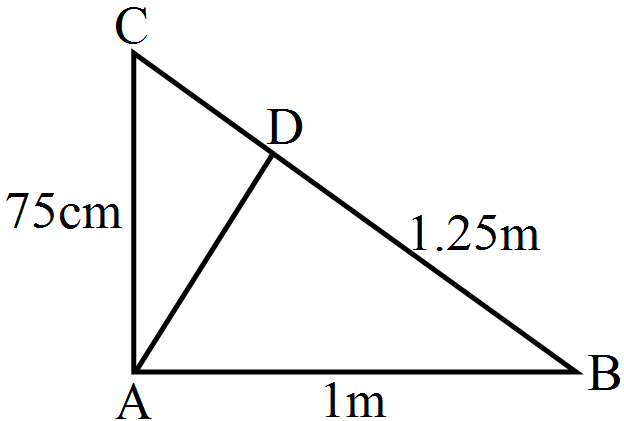
Given: $AB = 100\ cm, BC = 125\ cm, AC = 75\ cm$
Proof:
In $\triangle\text{BAC}$ and $\triangle\text{BDA}$
$\angle\text{BAC}=\angle\text{BDA}=90^\circ$
$\angle\text{B}=\angle\text{B}($ common$)$
$\triangle\text{BAC}\sim\triangle\text{BDA}($ by $AA$ similarities$)$
$\Rightarrow\frac{\text{BA}}{\text{BC}}=\frac{\text{AD}}{\text{AC}}$
$\Rightarrow\frac{\text{100}}{\text{125}}=\frac{\text{AD}}{\text{75}}$
$\Rightarrow\text{AD}=\frac{\text{100}\times75}{\text{125}}=60\text{ cm}$
Therefore, $AD = 60\ cm$ View full question & answer→Question 483 Marks
In the given figure, $DE || BC$ such that $AD = x\ cm, DB = (3x + 4)\ cm, AE = (x + 3)\ cm$ and $EC = (3x + 19)\ cm.$ Find the value of $x$.
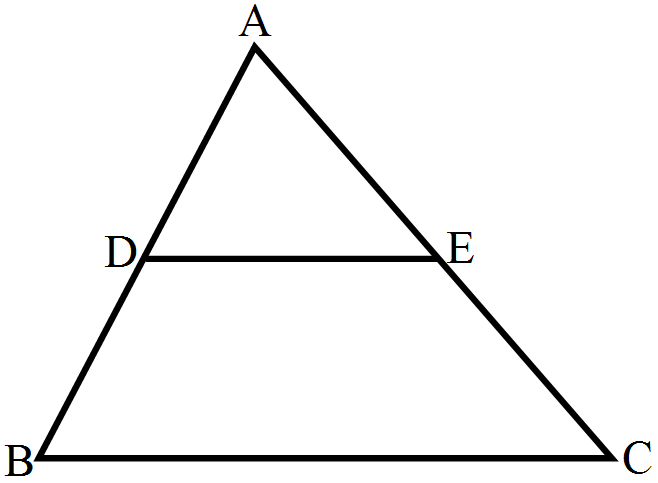
AnswerIn $\triangle\text{ABC,}$
$DE || BC$
By Basic proportionality theorem,
$\frac{\text{AD}}{\text{DB}}=\frac{\text{AE}}{\text{EC}}$
$\Rightarrow\frac{\text{x}}{\text{3x}+4}=\frac{\text{x}+3}{\text{3x}+19}$
$\Rightarrow\text{x}(3\text{x}+19)=(\text{x}+3)(3\text{x}+4)$
$\Rightarrow3\text{x}^2+19\text{x}=3\text{x}^2+4\text{x}+9\text{x}+12$
$\Rightarrow6\text{x}=12$
$\Rightarrow\text{x}=2$
View full question & answer→Question 493 Marks
Find the lenght of each side of a rhombus whose diagonals are $24\ cm$ and $10\ cm$. long.
AnswerLet $ABCD$ be the given rhombus whose diagonals intersect at $O.$
Then $AC = 24\ cm$ and $BD = 10\ cm$
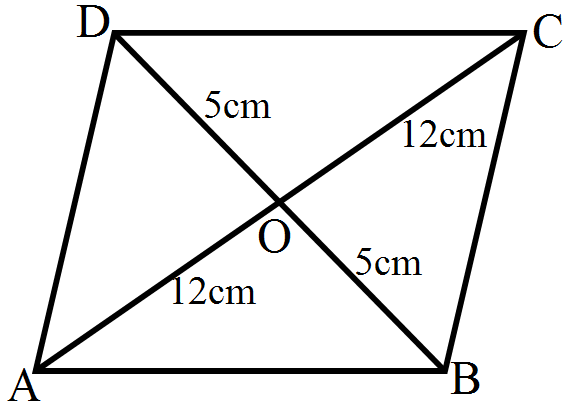
We know that the diagonals of a rhombus bisect each other at right angles.
$\text{OA}=\frac{1}{2}\text{AC}=12\text{cm}$
$\text{OB}=\frac{1}{2}\text{BD}=5\text{cm}$
and $\angle\text{AOB}=90^\circ$
Form right $\triangle\text{AOB},$ we have
$\text{AB}^2=\text{OA}^2+\text{OB}^2$
$\Rightarrow\text{AB}^2=\Big[(12)^2+(5)^2\Big]\text{cm}^2$
$\Rightarrow(144+25)\text{cm}^2=169\text{cm}^2$
$\Rightarrow\text{AB}=\sqrt{169}\text{cm}=13\text{cm}$
Hence, each side of a rhombus $13\ cm.$ View full question & answer→Question 503 Marks
In a $\triangle\text{ABC},\text{AD}$ is the bisector of $\angle\text{A}.$
If $AB = 5.6\ cm, AC = 4\ cm$ and $DC = 3\ cm$, find $BC.$
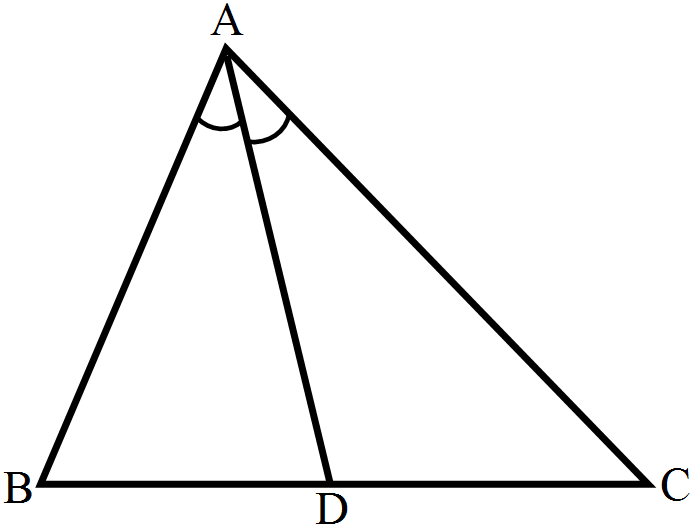
AnswerIt is given that $AD$ bisects $\angle\text{A}.$
Applying angle-bisector theorem in $\triangle\text{ABC},$ we get:
$\frac{\text{BD}}{\text{DC}}=\frac{\text{AB}}{\text{AC}}$
$\Rightarrow\frac{\text{BD}}{3}=\frac{5.6}{\text{4}}$
$\Rightarrow\text{BD}=\frac{5.6\times3}{4}$
$\Rightarrow\text{BD}=4.2\text{cm}$
Hence, $BC = 3 + 4.2 = 7.2\ cm$
View full question & answer→