Questions · Page 2 of 2

M.C.Q (1 Marks)

MCQ 511 Mark
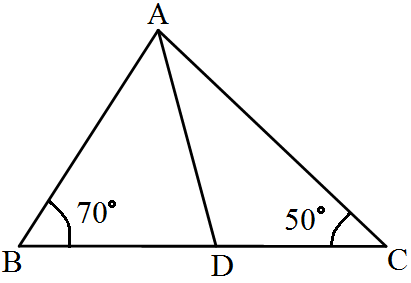
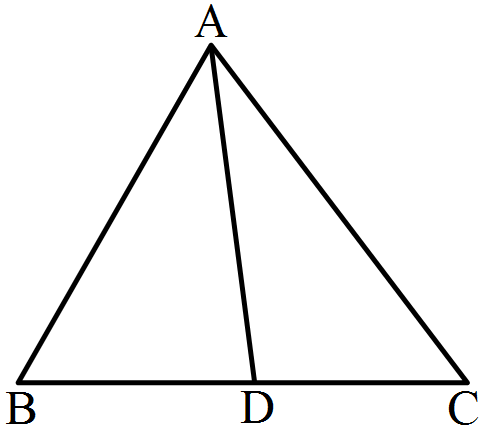
In $\triangle\text{ABC}$ it is given that $\frac{\text{AB}}{\text{AC}}=\frac{\text{BD}}{\text{DC}}.$ If $\angle\text{B}=70^\circ$ and $\angle\text{C}=50^\circ$ then $\angle\text{BAD}=?$
  • $30^\circ$
  • B
    $40^\circ$
  • C
    $45^\circ$
  • D
    $50^\circ$
Answer
Correct option: A.
$30^\circ$


in $\triangle\text{ABC}$ it is given that $\frac{\text{AB}}{\text{AC}}=\frac{\text{BD}}{\text{DC}}.$
$\Rightarrow AD$ bisects $\angle\text{BAC}$
In $\triangle\text{ABC},$
$\angle\text{BAC}+\angle\text{ABC}+\angle\text{ACB}=180^\circ$
$\Rightarrow\angle\text{BAC}+70^\circ+50^\circ=180^\circ$
$\Rightarrow\angle\text{BAC}=60^\circ$
$\Rightarrow\angle\text{BAD}=\angle\text{DAC}=30^\circ$
View full question & answer
MCQ 521 Mark
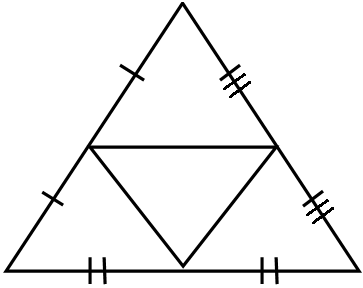
The line segments joining the midpoint of the sides of a triangle form four triangles, each of which is:
  • A
    Congruent to the original triangle.
  • Similar to the original triangle.
  • C
    An isosceles triangle.
  • D
    An equilateral triangle.
Answer
Correct option: B.
Similar to the original triangle.


The line segments joining the midpoint of the side of a triangle form four triangles, each of which is similar to the original triangle.
View full question & answer
MCQ 531 Mark
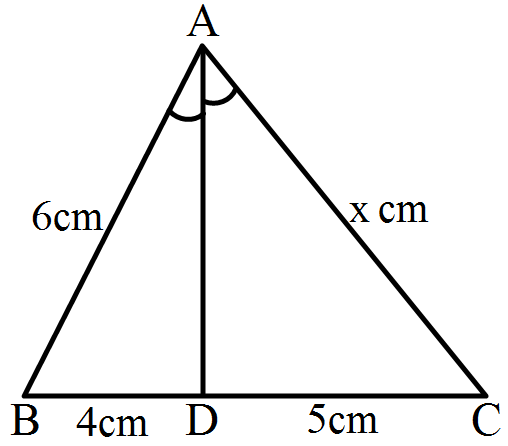
In a $\triangle\text{ABC}$ it is given that $AD$ is the internal bisector of $\angle\text{A}.$ If $BD = 4cm, DC = 5cm$ and $AB = 6cm$, then $AC =?$
  • A
    $4.5cm$
  • B
    $8cm$
  • C
    $9cm$
  • $7.5cm$
Answer
Correct option: D.
$7.5cm$
since $AD$ is the bisector of $\angle\text{A},$
by the angle bisector theorem,
$\frac{\text{AB}}{\text{AC}}=\frac{\text{BD}}{\text{DC}}$
$\Rightarrow\frac{6}{\text{x}}=\frac{4}{5}$
$\Rightarrow\text{x}=7.5\text{cm}$
So, $AC = 7.5cm$.
View full question & answer
MCQ 541 Mark
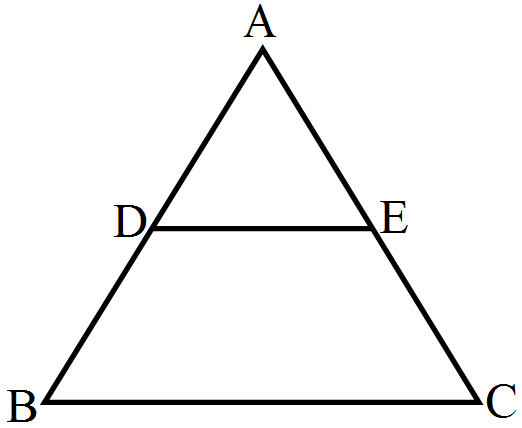
In the given figure, $DE || BC$. If $DE = 5cm, BC = 8cm$ and $AD = 3.5cm$ then $AB =?$
  • $5.6cm$
  • B
    $4.8cm$
  • C
    $5.2cm$
  • D
    $6.4cm$
Answer
Correct option: A.
$5.6cm$
$herefore\text{DE }||\text{ BC}$
$\therefore\frac{\text{AD}}{\text{AB}}=\frac{\text{AE}}{\text{AC}}=\frac{\text{DE}}{\text{BC}}$ (Thales' theorem)
$\Rightarrow\frac{3.5}{\text{AB}}=\frac{5}{\text{8}}$
$\Rightarrow\text{AB}=\frac{3.5\times8}{\text{5}}=5.6\text{cm}$
View full question & answer
MCQ 551 Mark
In $\triangle\text{ABC}$ and $\triangle\text{DEF},$ it is given that $\angle\text{B}=\angle\text{E},\angle\text{F}=\angle\text{C}$ and $\text{AB}=3\text{DE},$ then the two triangles are:
  • A
    Congruent but not similar
  • Similar but not congruent
  • C
    Neither congruent not similar
  • D
    Similar as well as congruent
Answer
Correct option: B.
Similar but not congruent
In $\triangle\text{ABC}$ and $\triangle\text{DEF},$
It is given that $\angle\text{B}=\angle\text{E},\angle\text{F}=\angle\text{C},$ and hence $\angle\text{A}=\angle\text{D}$
So, the two triangles are similar.
Since $AB = 3DE$
$\Rightarrow\text{AB}\not=\text{DE}$
So, the triangles are not congruent.
Thus, the two triangles are similar, but not cogruent.
View full question & answer
MCQ 561 Mark
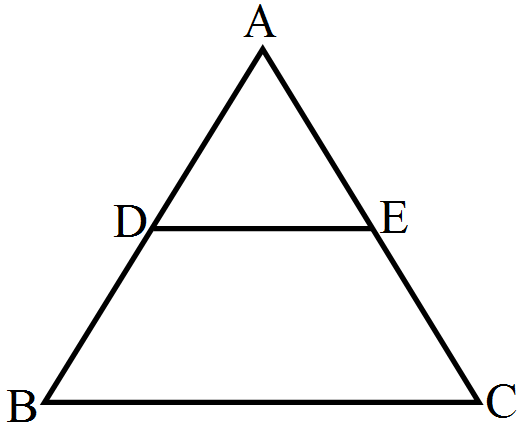
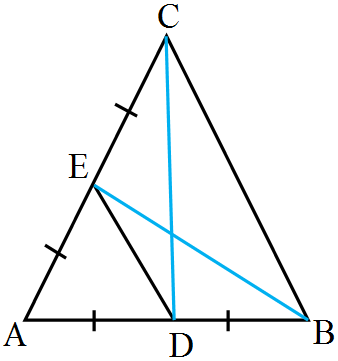
In an equilateral $\triangle\text{ABC},\text{D}$ is the midpoint of $AB$ and $E$ is the midpoint of $AC$. Then, $\text{ar}(\triangle\text{ABC}):\text{ar}(\triangle\text{ADE})=?$
  • A
    $2 : 1$
  • $4 : 1$
  • C
    $1 : 2$
  • D
    $1 : 4$
Answer
Correct option: B.
$4 : 1$


Since $D$ and $E$ are the mid-point of $AB$ and $AC$ respectively.
$\frac{\text{AB}}{\text{AD}}=\frac{\text{AC}}{\text{AE}}=\frac{2}{1}$ and $\angle\text{CAD}=\angle\text{EAD}$ ....(common angle)
$\Rightarrow\triangle\text{ABC}\sim\triangle\text{ADE}$ ....(SAS criterion for Similarity)
$\Rightarrow\frac{\text{ar}(\triangle\text{ABC})}{\text{ar}(\triangle\text{ADE})}=\frac{\text{AB}^2}{\text{AD}^2}=\frac{2^2}{1^2}=\frac{4}{1}$
So, the ratio is $4 : 1$.
View full question & answer
M.C.Q (1 Marks) - Page 2 - Maths STD 10 Questions - Vidyadip