Question 12 Marks
In the adjoining figure, find $AC.$
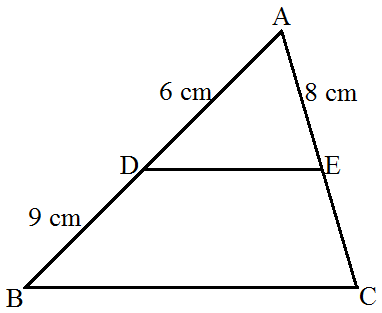
AnswerGiven: In the figure we are given $AD = 6\ cm, BD = 9\ cm, AE = 8\ cm$
To Find: $AC$
According to Basic Proportionality Theorem, if a line is drawn parallel to one side of a triangle intersecting the other two sides, then it divides the two sides in the same ratio.
In $\triangle\text{ABC}, \text{DE}||\text{BC}$
So,
$\frac{\text{AD}}{\text{DB}}=\frac{\text{AE}}{\text{EC}}$
$\frac{6}{9}=\frac{8}{\text{EC}}$
$\text{EC}=\frac{8\times9}{6}$
$EC = 12\ cm$
Now,
$AC = AE + EC$
$AC = 8 + 12$
$AC = 20\ cm.$
View full question & answer→Question 22 Marks
In the given figure, $\triangle\text{AHK}$ is similar to $\triangle\text{ABC}.$ If $AK = 10\ cm, BC = 3.5\ cm$ and $HK = 7\ cm,$ find $AC.$
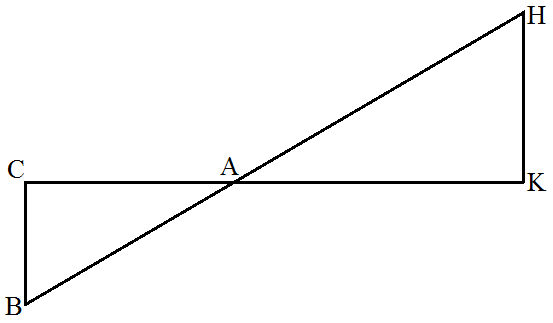
AnswerGiven: $\triangle\text{AHK}\sim\triangle\text{ABC}$
$AK = 10\ cm, BC = 3.5\ cm, HK = 7\ cm$
To find: AC
Since $\triangle\text{AHK}\sim\triangle\text{ABC},$ so their corresponding sides are proportional.
$\frac{\text{AC}}{\text{AK}}=\frac{\text{BC}}{\text{HK}}$
$\frac{\text{AC}}{10}=\frac{3.5}{7}$
$AC = 5\ cm.$
View full question & answer→Question 32 Marks
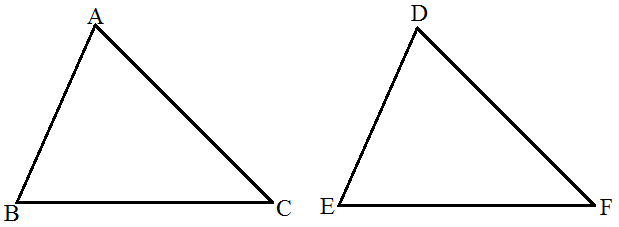
Triangle $ABC$ and $DEF$ are similar.
If area $\big(\triangle\text{ABC}\big) =16\text{cm}^2,$ area $\big(\triangle\text{DEF}\big) =25\text{cm}^2 $ and $BC = 2.3\ cm,$ find $EF.$
Answer$\because\triangle\text{ABC}\sim\triangle\text{DEF},$
$\therefore\frac{\text{area}(\triangle\text{ABC)}}{\text{area}(\triangle\text{DEF)}}=\frac{\text{BC}^2}{\text{EF}^2}$
$\Rightarrow\frac{16}{25}=\frac{(2.3)^2}{\text{EF}^2}\Rightarrow\frac{(4)^2}{(5)^2}=\frac{(2.3)^2}{\text{EF}^2}$
$\Rightarrow\frac{4}{5}=\frac{2.3}{\text{EF}}\Rightarrow\text{EF}=\frac{2.3\times5}{4}$
$\therefore\text{EF}=\frac{11.5}{4}=2.875\text{cm}$ View full question & answer→Question 42 Marks
In a $\triangle\text{ABC,D}\ \text{and E}$ are points on the sides $AB$ and $AC$ respectively such that $DE || BC.$
If $AD = 4\ cm, DB = 4.5\ cm$ and $AE = 8\ cm,$ find $AC.$
AnswerIt is given that $AD = 4\ cm, DB = 4.5\ cm$ and $AE = 8\ cm.$
We have to find $AC.$
$\frac{\text{AD}}{\text{DB}}=\frac{\text{AE}}{\text{CE}}$ (by thales theorem)
Then $\frac{4}{4.5}=\frac{8}{\text{AC}}$
$\text{AC}=\frac{4.5\times8}{4}\text{cm}$
$=9\text{cm}$
Hence $AC = 9\ cm.$
View full question & answer→Question 52 Marks
In the given figure, $LM = LN = 46^\circ .$ Express $x$ in terms of $a, b$ and $c$ where $a, b, c$ are lengths of $LM, MN$ and $NK$ respectively.
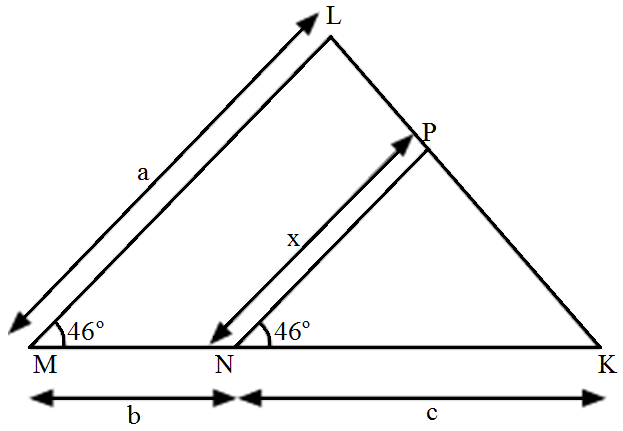
AnswerGiven: In the given figure $\angle\text{LMN}=\angle\text{PNK}=46^\circ$
To express: $x$ in terms of $a, b, c$ where $a, b$ and $c$ are the lengths of $LM, MN$ and $NK$ respectively.
Here we can see that $\angle\text{LMN}=\angle\text{PNK}=46^\circ.$ It forms a pair of corresponding angle.
Hence, $LM || PN$
In $\triangle\text{LMK}$ and $\triangle\text{PNK,}$
$\angle\text{LMK}=\angle\text{PNK}$ (Corresponding angles)
$\angle\text{LKM}=\angle\text{PKN}$ (Common)
$\therefore\triangle\text{LMK}\sim\triangle\text{PNK}$ (AA Similarity)
$\frac{\text{ML}}{\text{NP}}=\frac{\text{MK}}{\text{NK}}$
$\frac{\text{a}}{\text{x}}=\frac{\text{b}+\text{c}}{\text{c}}$
$\text{x}=\frac{\text{ac}}{\text{b}+\text{c}}$
Hence we got the result as $\text{x}=\frac{\text{ac}}{\text{b}+\text{c}}$
View full question & answer→Question 62 Marks
In FIg. check whether $AD$ is the bisector of $\angle\text{A}$ of $\triangle\text{ABC}$ in the following.
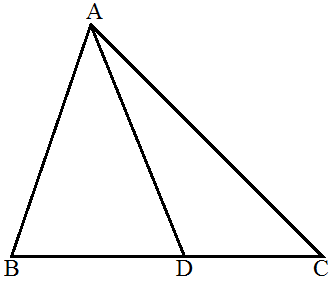
$AB = 5\ cm, AC = 12\ cm, BD = 2.5\ cm$ and $BC = 9\ cm.$ AnswerWe have,
$AB = 5\ cm, AC = 12\ cm, BD = 2.5\ cm$ and $BC = 9\ cm.$
Now, $\frac{\text{AB}}{\text{BD}}=\frac{5}{2.5}=\frac{50}{25}=\frac{2}{1}$
and, $\frac{\text{AC}}{\text{CD}}=\frac{12}{\text{BC}-\text{BD}}=\frac{12}{9-2.5}=\frac{12}{6.5}=\frac{120}{65}=\frac{24}{13}$
$\therefore\frac{\text{AB}}{\text{BD}}\neq\frac{\text{AC}}{\text{CD}}$
Hence, $AD$ is not bisector of $\angle\text{A}$.
View full question & answer→Question 72 Marks
The lengths of the diagonals of a rhombus are $30\ cm$ and $40\ cm.$ Find the side of the rhombus.
AnswerGiven: The lengths of the diagonals of a rhombus are $30\ cm$ and $40$cm$.$
To find: Side of the rhombus.
Let the diagonals $AC$ and $CD$ of the rhombus $ABCD$ meet at point $O.$
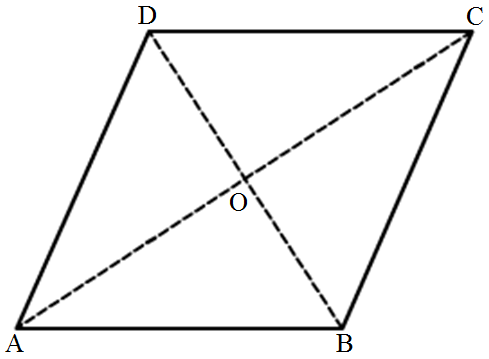
We know that the diagonals of the rhombus bisect each other perpendicularly.
Hence in right triangle $AOD,$ by Pythagoras theorem
$\text { hypotenuse }^2=\text { perpendicular }^2+\text { base }^2$
$=15^2+20^2 $
$ =225+400$
$ =625$
hypotenuse $= 25\ cm$
Hence the side of the rhombus is $= 25\ cm.$ View full question & answer→Question 82 Marks
In the following figures, you find who triangles. Indicate whether the triangles are similar. Give reasons in support of your answer.
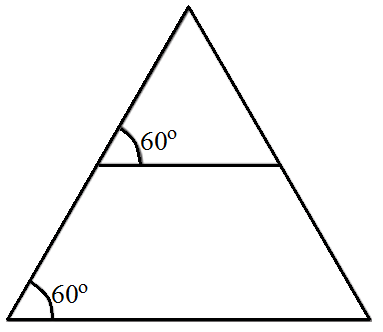
Answer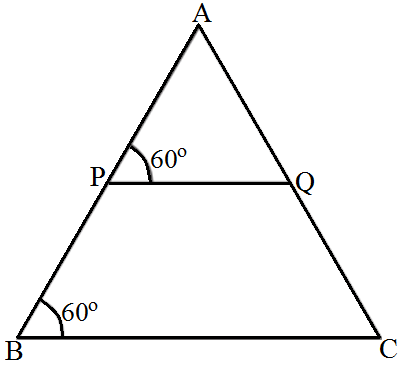
$PQ || BC ($Corresponding angles foemed are equal
In $\triangle\text{APQ}$ and $\triangle\text{ABC},$
$\angle\text{APQ}=\angle\text{B} ($Corresponding angles$)$
$\angle\text{PAQ}=\angle\text{BAC} ($Common$)$
So $\triangle\text{APQ}\sim\triangle\text{ABC} (AA $ similarity$)$
yes two triangles are similar. View full question & answer→Question 92 Marks
In a $\triangle\text{ABC, D}$ and $E$ are points on the sides $AB$ and $AC$ respectively. For the following cases show that $DE || BC:$
$AB = 5.6\ cm, AD = 1.4\ cm, AC = 7.2$ and $AE = 1.8\ cm$.
AnswerGiven $AB = 5.6\ cm, AD = 1.4\ cm, AC = 7.2\ cm$ and $AE = 1.8\ cm$
Now, $\frac{\text{AD}}{\text{AB}}=\frac{1.4}{5.6}=\frac{1}{4}$
And, $\frac{\text{AE}}{\text{AC}}=\frac{1.8}{7.2}=\frac{1}{4}$
$\therefore\frac{\text{AD}}{\text{AB}}=\frac{\text{AE}}{\text{AC}}$
Thus, $DE$ divides sides $AB$ and $AC$ of $\triangle\text{ABC}$ in the same ratio. Therefore, by converse of basic proportionality theorem, we have $DE || BC.$
View full question & answer→Question 102 Marks
If a $\triangle\text{ABC}, AD$ is the bisector of $\angle\text{A},$ Meeting side $BC$ at $D.$
If $BD = 2\ cm, AB = 5\ cm$ and $DC = 3\ cm,$ find $AC.$
AnswerIt is given that $BD = 2\ cm, AB = 5\ cm$ and $DC = 3\ cm.$
In $\triangle\text{ABC}, AD$ is the bisector of $\angle\text{A},$ meeting side $BC$ at $D.$
We have to find $AC.$
Since $AD$ is $\angle\text{A}$ bisector
So $\frac{\text{AB}}{\text{AC}}=\frac{\text{BD}}{\text{DC}}$ $(AD$ is bisector of $\angle\text{A}$ and side $BC)$
Then
$\frac{5}{\text{AC}}=\frac{2}{3}$
$⇒ 2AC = 5 × 3$
$\Rightarrow\text{AC}=\frac{15}{2}$
$= 7.5$
Hence $AC = 7.5\ cm$
View full question & answer→Question 112 Marks
In the adjoining figure, if $AD$ is the bisector of $\angle\text{A},$ what is $AC?$
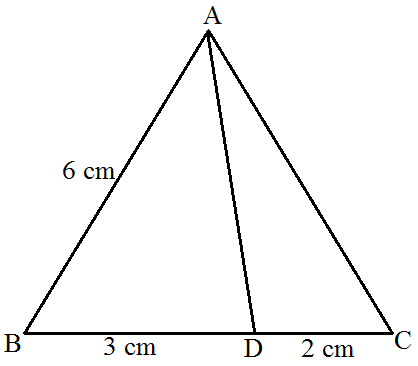
AnswerIn the figure, $AD$ is the angle bisector of $\angle\text{A}$ of $\triangle\text{ABC}$
$AB = 6\ cm, BC = 3\ cm, DC = 2\ cm$
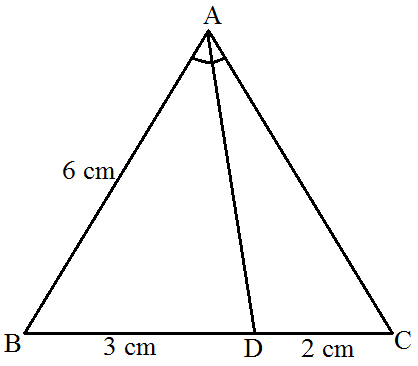
Let $AC = x$
$\therefore \frac{\text{AB}}{\text{AC}}=\frac{\text{BD}}{\text{DC}}\Rightarrow\frac{6}{\text{x}}=\frac{3}{2}$
$\Rightarrow\text{x}=\frac{6\times2}{3}=4$
$\therefore\text{AC}=4\text{cm}$ View full question & answer→Question 122 Marks
If a $\triangle\text{ABC}, AD$ is the bisector of $\angle\text{A},$ Meeting side $BC$ at $D.$
If $BD = 2.5\ cm, AB = 5\ cm$ and $AC = 4.2\ cm,$ find $DC.$
AnswerIn a $\triangle\text{ABC}, \text{AD}$ is bisector of $\angle\text{A}$
We have,
$BD = 2.5\ cm, AB = 5\ cm$ and $AC = 4.2\ cm$
Now, $\frac{\text{BD}}{\text{AB}}=\frac{\text{DC}}{\text{AC}}$
$\Rightarrow\frac{2.5}{5}=\frac{\text{DC}}{4.2}$
$\Rightarrow\text{DC}=\frac{2.5\times4.2}{5}$
$\Rightarrow\text{DC}=2.1\text{cm}$
View full question & answer→Question 132 Marks
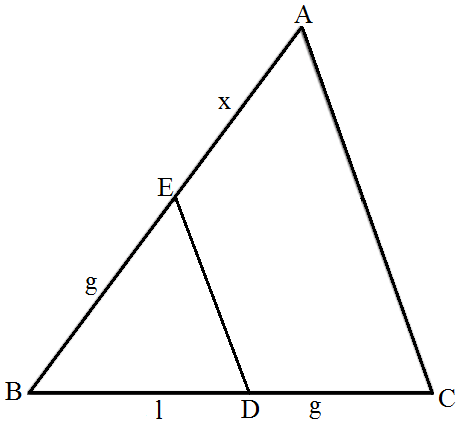
In the figure given below, a line segment is drawn parallel to one side of the triangle and the lengths of certain line-segment are marked. Find the value of $x$ in the following:
Answer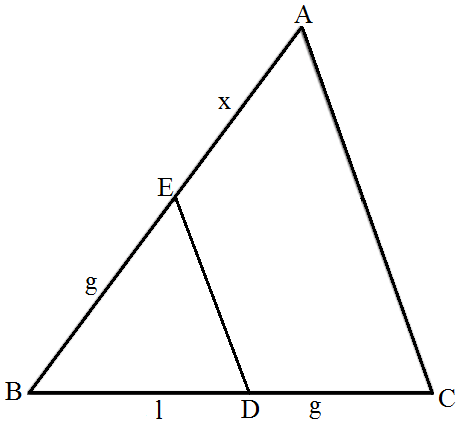
In the figure
$DE || CA$
$\therefore\frac{\text{BD}}{\text{DC}}=\frac{\text{BE}}{\text{EA}}$
$\Rightarrow\frac{1}{\text{g}}=\frac{\text{g}}{\text{x}}\Rightarrow\text{x}=\text{g}^2$
Hence $x = g^2$ View full question & answer→Question 142 Marks
The sides of certain triangles are given below. Determine which of them are right triangles.
$a = 7cm, b = 24cm$ and $c = 25cm$
AnswerWe have,
$a = 7cm, b = 24cm $ and $c = 25cm$
$ \therefore a^2+b^2=(7)^2+(24)^2=49+576=625$
$ c^2=(25)^2=625$
$\text { thus, } a^2+b^2=c^2$
Hence, it is a right-triangle.
View full question & answer→Question 152 Marks
State $SSS$ similarity criterion.
Answer$SSS$ Similarity Criterion: If the corresponding sides of two triangles are proportional, then they are similar.
In $\triangle\text{ABC}$ and $\triangle\text{DEF},$ if
$\frac{\text{AB}}{\text{DE}}=\frac{\text{BC}}{\text{EF}}=\frac{\text{AC}}{\text{DF}}$
Then, $\triangle\text{ABC}\sim\triangle\text{DEF}$
View full question & answer→Question 162 Marks
State basic proportionality theorem and its converse.
AnswerBasic Proportionality Theorem: If a line is drawn parallel to one side of a triangle intersects the other two sides in distinct points, then the other two sides are divided in the same ratio.
Conversely: In a line divides any two sides of a triangle in the same ratio, then the line is parallel to the third side of the triangle.
View full question & answer→Question 172 Marks
In FIg. check whether $AD$ is the bisector of $\angle\text{A}$ of $\triangle\text{ABC}$ in the following.
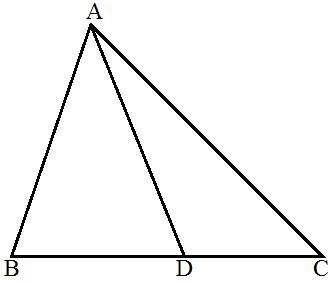
$AB = 8\ cm, AC = 24\ cm, BD = 6\ cm$ and $BC = 24\ cm.$ Answer$AB = 8\ cm, AC = 24\ cm, BD = 6\ cm$ and $BC = 24\ cm.$
Now $\frac{\text{AB}}{\text{BD}}=\frac{8}{6}=\frac{4}{3}$
and, $\frac{\text{AC}}{\text{CD}}=\frac{\text{AC}}{\text{BC}-\text{BD}}=\frac{24}{24-6}=\frac{24}{18}=\frac{4}{3}$
$\therefore\frac{\text{AB}}{\text{BD}}=\frac{\text{AC}}{\text{CD}}$
Hence, $AD$ is bisector of $\angle\text{A}$.
View full question & answer→Question 182 Marks
Triangle $ABC$ and $DEF$ are similar.
If $AB = 1.2\ cm$ and $DE = 1.4\ cm,$ find the retio of the areas of $\triangle\text{ABC}$ and $\triangle\text{DEF}.$
Answer$\because\triangle\text{ABC}\sim\triangle\text{DEF},$
$\therefore\frac{\text{area}(\triangle\text{ABC)}}{\text{area}(\triangle\text{DEF)}}=\frac{\text{AB}^2}{\text{DE}^2}$
$=\frac{(1.2)^2}{(1.4)^2}=\frac{1.44}{1.96}=\frac{144}{196}=\frac{36}{49}$
$\therefore\text{area}\ \triangle\text{ABC}:\triangle\text{DEF}=36:49$
View full question & answer→Question 192 Marks
In the following figures, you find who triangles. Indicate whether the triangles are similar. Give reasons in support of your answer.
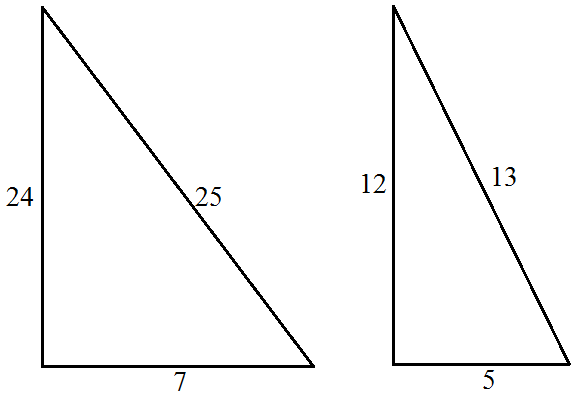
AnswerIn two triangle, we observe that
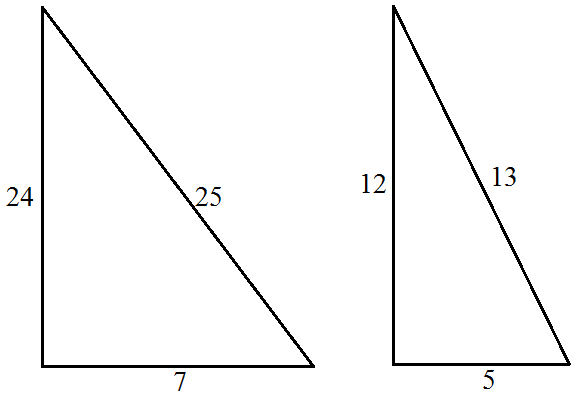
$\frac{24}{12}\neq\frac{25}{13}\neq\frac{7}{5}$
In two triangles corresponding sides are not proportional to each other.
No two triangles are not similar. View full question & answer→Question 202 Marks
In the following figures, you find who triangles. Indicate whether the triangles are similar. Give reasons in support of your answer.
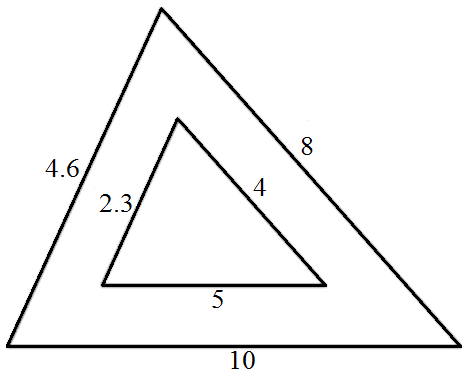
AnswerIn two triangle, we observe that
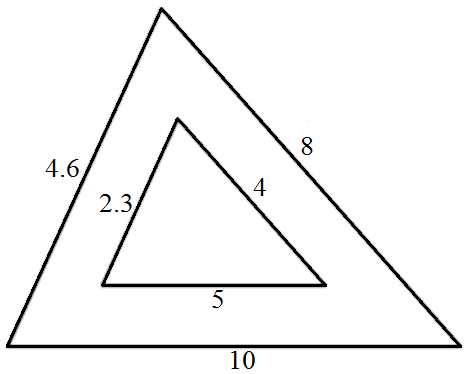
$\frac{2.3}{4.6}=\frac{4}{8}=\frac{5}{10}=\frac{1}{2}$
In similar triangle corresponding sides are proportional to each other.
Therefore, by SSS-criterion of similarity,
yes two triangles are similar. View full question & answer→Question 212 Marks
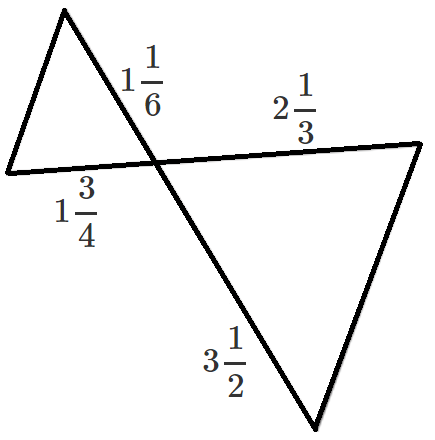
In the following figures, you find who triangles. Indicate whether the triangles are similar. Give reasons in support of your answer.
AnswerIn two triangle, we observe that
$\frac{3\frac{1}{2}}{1\frac{1}{6}}=\frac{2\frac{1}{3}}{1\frac{3}{4}}$
$\frac{\frac{7}{2}}{\frac{7}{6}}=\frac{\frac{7}{3}}{\frac{7}{4}}$
$\frac{7}{2}\times\frac{6}{7}=\frac{7}{3}\times\frac{4}{7}$
$\frac{6}{2}=\frac{4}{3}$
$\frac{3}{1}=\frac{4}{3}$
$3=\frac{4}{3}$
In two triangles corresponding sides are not proportional to each other.
No two triangles are not similar. View full question & answer→Question 222 Marks
In the figure given below $DE || BC$. If $AD = 2.4\ cm, DB = 3.6\ cm, AC = 5\ cm$. Find $AE.$
AnswerGiven: $AD = 2.4\ cm, BD = 3.6\ cm$ and $AC = 5\ cm.$
To find: $AE$
According to basic proportionality theorem If a line is drawn parallel to one side of a triangle intersecting the other two sides, then it divides the two sides in the same ratio.
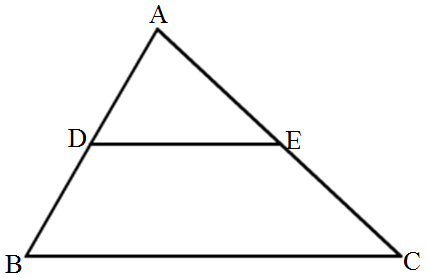
In $\triangle\text{ABC},\ \text{DE}||\text{BC}.$
$\frac{\text{AD}}{\text{AB}}=\frac{\text{AE}}{\text{AC}}$
$\frac{2.4}{2.4+3.6}=\frac{\text{AE}}{\text{AC}}$
$\frac{2.4}{6}=\frac{\text{AE}}{5}$
$\text{AE} = 2$
$\text{AE} = 2\text{cm.}$ View full question & answer→Question 232 Marks
Two isosceles triangles have equal vertical angles and their areas are in the ratio $36 : 25.$ Find the ratio of their corresponding heights.
AnswerWe know that
$($Ratio of corresponding height$)^2$= Ratio of their areas
$($Ratio of corresponding height$)^2$ $=\frac{36}{25}$
$=\frac{6}{5}$
Thus, ratio of their corresponding height is $6 : 5.$
View full question & answer→Question 242 Marks
$\triangle\text{ABD}$ is a right triangle right-angled at $A$ and $\text{AC}\perp\text{BD}.$ Show that
$AD^2= BD × CD$
Answer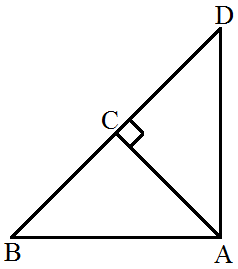
In $\triangle\text{DCA}\ \&\ \triangle\text{DAB}$
$\angle\text{DCA}=\angle\text{DAB} ($Both are equal to $90^\circ )$
$\angle\text{CDA}=\angle\text{ADB} ($Common angle$)$
$\angle\text{DAC}=\angle\text{DBA} ($Remaining angle$)$
$\triangle\text{DCA}\sim\triangle\text{DAB}(AAA$ property$)$
Therefore $\frac{\text{DC}}{\text{DA}}=\frac{\text{DA}}{\text{DB}}$
$\Rightarrow\text{AD}^2=\text{BD}\times\text{CD}$ View full question & answer→Question 252 Marks
In the figure, $\triangle\text{AMB}\sim\triangle\text{CMD};$ determine $MD$ in terms of $x, y$ and $z.$
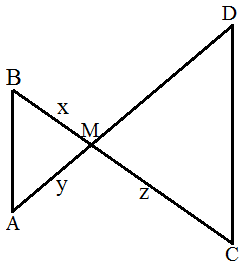
AnswerIn the figure, $BM = x, AM = y, CM = z$
$\triangle\text{AMD}\sim\triangle\text{CMD}$
$\therefore\frac{\text{AM}}{\text{CM}}=\frac{\text{BM}}{\text{DM}}$
$\frac{\text{y}}{\text{z}}=\frac{\text{x}}{\text{MD}}\Rightarrow\text{MD}=\frac{\text{xz}}{\text{y}}$
$\therefore\text{MD}=\frac{\text{xz}}{\text{y}}$
View full question & answer→Question 262 Marks
The sides of certain triangles are given below. Determine which of them are right triangles.
$a = 16\ cm, b = 3.8\ cm$ and $c = 4\ cm.$
AnswerSides of the triangle are $a = 1.6cm, b = 3.8cm, c = 4cm$
$($Longest side $)^2=(4)^2=16$
Sum of squares of shorter two sides $+(1.6)^2+(3.8)^2=2.56+14.44=17.00$
$16\neq17$
It is not a right triangle.
View full question & answer→Question 272 Marks
In $\triangle\text{ABC},$ ray $AD$ bisects $\angle\text{A}$ and intersects $BC$ in $D.$ If $BC = a, AC = b$ and $AB = c,$ prove that
$\text{DC}=\frac{\text{ab}}{\text{b}+\text{c}}$
AnswerGiven: In $\triangle\text{ABC}$ ray $AD$ bisects angle $A$ and intersects $BC$ in $D,$
If $BC = a, AC = b$ and $AB = c$
$\text{DC}=\frac{\text{ab}}{\text{b}+\text{c}}$
The corresponding figure is as follows
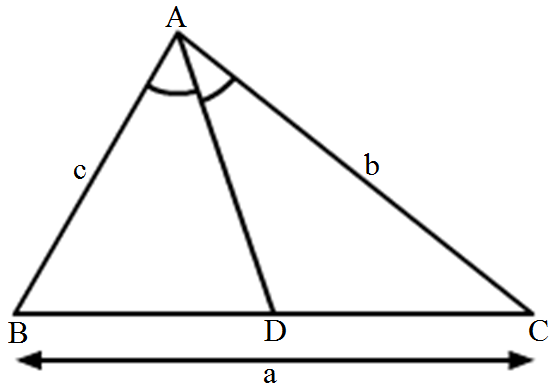
Proof: In triangle $ABC, AD$ is the bisector of $\angle\text{A}$
Since $BC = CD + BD$
$⇒ CD = BC - BD$
$\text{CD}=\text{a}-\frac{\text{ac}}{\text{b}+\text{c}}$
$=\frac{\text{ab}}{\text{b}+\text{c}}$ View full question & answer→Question 282 Marks
If the areas of two similar triangles $ABC$ and $PQR$ are in the ratio $9 : 16$ and $BC = 4.5\ cm,$ what is the length of $QR?$
AnswerGiven: $\triangle\text{ABC}\sim\triangle\text{PQR}$
$BC = 4.5\ cm$
$\frac{\text{Area}(\triangle\text{ABC})}{\text{Area}(\triangle\text{PQR})}=\Big(\frac{\text{BC}}{\text{QR}}\Big)^2$
$\Rightarrow\frac{9}{16}=\Big(\frac{4.5}{\text{QR}}\Big)^2$
$\Rightarrow\text{QR}^2=\frac{(4.5)^2\times16}{9}$
$\Rightarrow\text{QR}=\sqrt{\frac{(4.5)^2\times16}{9}}$
$\Rightarrow\text{QR}=\frac{4.5\times4}{3}$
$\Rightarrow\text{QR}=1.5\times4$
$\Rightarrow\text{QR}=6\text{cm}$
View full question & answer→Question 292 Marks
Corresponding sides of two similar triangles are in the ratio $1 : 3.$ If the area of the smaller triangle in $40cm^2$, find the area of the larger triangle.
AnswerSince the ratio of areas of two similar triangles is equal to the ratio of the squares of any two corresponding sides.
$\frac{\text{Area of smaller triangle}}{\text{Area of larger triangle}}$ $=\frac{(\text{Corresponding side of smaller triangle})^2}{(\text{Corresponding side of larger triangle})^2}$
$\frac{\text{Area of smaller triangle}}{\text{Area of larger triangle}}=\frac{1^2}{3^2}$
$\frac{40}{\text{Area of larger triangle}}=\frac{1}{9}$
Area of larger triangle $=\frac{40\times9}{1}=360\text{cm}^2$
Hence the area of the larger triangle is $360cm^2$
View full question & answer→Question 302 Marks
$\triangle\text{ABD}$ is a right triangle right-angled at $A$ and $\text{AC}\perp\text{BD}.$ Show that
$AB^2= BC × BD$
Answer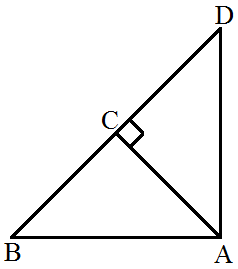
In $\triangle\text{ADB}$ and $\triangle\text{CAB}$
$\angle\text{DAB}=\angle\text{ACB}=90^\circ$
$\angle\text{ABD}=\angle\text{CBA} ($Common angle$)$
$\angle\text{ADB}=\angle\text{CAB} ($remaining angle$)$
So, $\triangle\text{ADB}\sim\triangle\text{CAB} ($by $AAA$ similarity$)$
Therefore $\frac{\text{AB}}{\text{CB}}=\frac{\text{BD}}{\text{AB}}$
$\Rightarrow\text{AB}^2=\text{CB}\times\text{BD}$ View full question & answer→Question 312 Marks
In the figure given below, a line segment is drawn parallel to one side of the triangle and the lengths of certain line-segment are marked. Find the value of $x$ in the following:
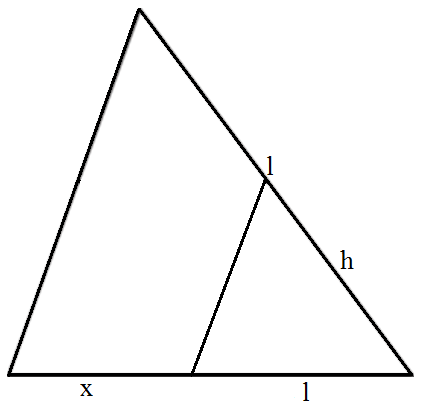
Answer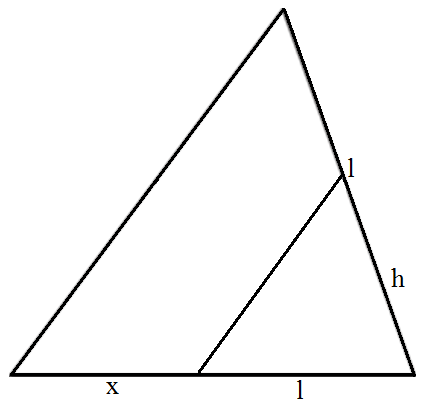
$\frac{1}{1+\text{h}}=\frac{\text{x}}{\text{x}+1}$
By cross multiplication on both sides, we get
$1\times(\text{x}+1)=\text{x}\times(1+\text{h})$
$\text{x}+1=\text{x}+\text{hx}$
$\text{x}+1-\text{x}=\text{hx}$
$1=\text{xh}$
$\frac{1}{\text{h}}=\text{x}$
Hence the value of $x$ is $\frac{1}{\text{h}}.$ View full question & answer→Question 322 Marks
In a $\triangle\text{ABC}, AB = BC = CA = 2a $ and $\text{AD}\perp\text{BC}.$ Prove that
Area $(\triangle\text{ABC})=\sqrt{3}\text{ a}^2$
Answer$\triangle\text{ABC}, AB = BC = AC = 2a$
$\text{AD}\perp\text{BC}$
$AD$ bisects $BC$ at $D$
$\text{BD}=\text{DC}=\frac{1}{2}\text{BC}=\text{a}$
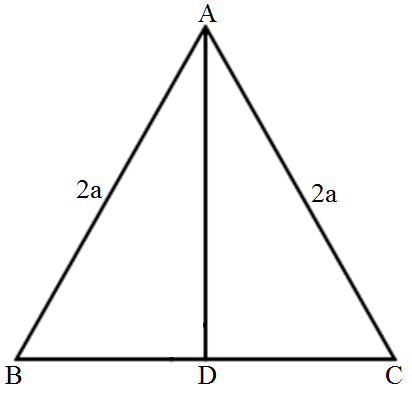
Area of $\triangle\text{ABC}$
$=\frac{1}{2}\text{BC}\times\text{AD}$
$=\frac{1}{2}\times2\text{a}\times\sqrt{3}\text{ a}=\sqrt{3}\text{ a}^2$
Hence proved. View full question & answer→Question 332 Marks
If a $\triangle\text{ABC}, AD$ is the bisector of $\angle\text{A},$ Meeting side $BC$ at $D.$
If $AD = 5.6\ cm, BC = 6\ cm$ and $BD = 3.2\ cm,$ find $AC.$
AnswerWe have,
$AB = 5.6\ cm, BC = 6\ cm$ and $BD = 3.2\ cm\ CD = BC - BD = 6 - 3.2 = 2.8\ cm.$
$\frac{\text{AC}}{\text{CD}}=\frac{\text{AB}}{\text{BD}}$
$\Rightarrow\frac{\text{AC}}{2.8}=\frac{5.6}{3.2}$
$\Rightarrow\text{AC}=\frac{5.6\times2.8}{3.2}$
$\Rightarrow\text{AC}=0.7\times7=4.9\text{cm}$
View full question & answer→Question 342 Marks
The sides of certain triangles are given below. Determine which of them are right triangles.
$a = 9cm, b = 16cm$ and $c = 18cm.$
AnswerWe have,
$a = 9cm, b = 16cm$ and $c = 18cm$
$\therefore \mathrm{a}^2=81, \mathrm{~b}^2=256$ and $\mathrm{c}^2=324$
Since, $ a^2+b^2=81+256=337$
$\neq\text{c}^2$
Then, by converse of Pythagoras theorem, given triangle is not a right triangle.
View full question & answer→Question 352 Marks
The sides of certain triangles are given below. Determine which of them are right triangles.
$a = 8cm, b = 10cm$ and $c = 6cm.$
AnswerWe have,
$a = 8cm, b = 10cm$ and $c = 6cm$
$ \therefore a^2+c^2=(8)^2+(6)^2=64+36=100 $
$ b^2=(10)^2=100$
$\text { Thus, } a^2+c^2=b^2$
Hence, it is a right triangle.
View full question & answer→Question 362 Marks
Triangle $ABC$ and $DEF$ are similar.
If area $\big(\triangle\text{ABC}\big) = 36\text{cm}^2,$ area $\big(\triangle\text{DEF}\big) = 64\text{cm}^2$ and $DE = 6.2\ cm,$ find $AB.$
Answer$\because\triangle\text{ABC}\sim\triangle\text{DEF},$
$\therefore\frac{\text{area}(\triangle\text{ABC)}}{\text{area}(\triangle\text{DEF)}}=\frac{\text{AB}^2}{\text{DE}^2}$
$\Rightarrow\frac{36}{64}=\frac{\text{AB}^2}{(6.2)^2}\Rightarrow\frac{(6)^2}{(8)^2}=\frac{\text{AB}^2}{(6.2)^2}$
$\Rightarrow\frac{\text{AB}}{6.2}=\frac{6}{8}\Rightarrow\text{AB}=\frac{6\times6.2}{8}=\frac{37.2}{8}$
$\Rightarrow\text{AB}=4.65$
Hence $AB = 4.65.$
View full question & answer→Question 372 Marks
In the given figure,
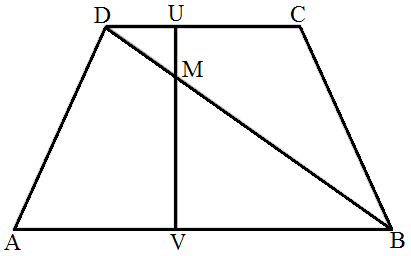
$AB || DC$ prove that
$\triangle\text{DMU}\sim\triangle\text{BMV}$ AnswerGiven, $AB || DC$
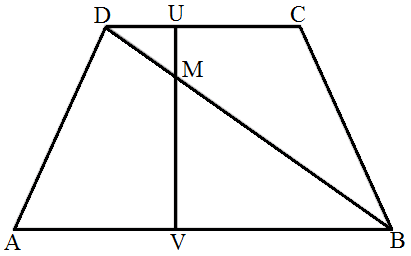
In triangle $DMU$ and $BMV$, we have
$\angle\text{MUD}=\angle\text{MVB}$
Each angle is equal to $90^\circ $
$\angle\text{UMD}=\angle\text{VMB}$
Each are vertically opposite angles.
Therefore, by $AA-$criterion of similarity $\triangle\text{DMU}\sim\triangle\text{BMV}$ View full question & answer→Question 382 Marks
What values of $x$ will make $DE || AB$ in the given figure$?$
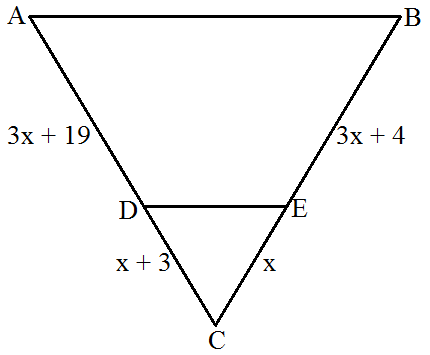
AnswerIn the figure, in $\triangle\text{ABC},$
$DE || AB$
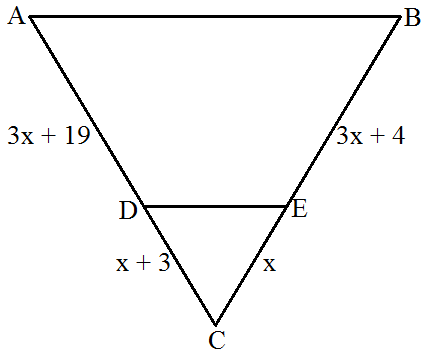
$\therefore\frac{\text{AD}}{\text{DC}}=\frac{\text{BE}}{\text{EC}}$
$\Rightarrow\frac{3\text{x}+19}{\text{x}+3}=\frac{3\text{x}+4}{\text{x} }$
$⇒ x(3x + 19) = (x + 3)(3x + 4)$
$ \Rightarrow 3 x^2+19 x=3 x^2+4 x+9 x+12 $
$ \Rightarrow 3 x^2+19 x-3 x^2-4 x-9 x=12$
$\Rightarrow6\text{x}=12\Rightarrow\text{x}=\frac{12}{6}=2$
$\therefore x = 2$ View full question & answer→Question 392 Marks
In a $\triangle\text{ABC,D}\ \text{and E}$ are points on the sides $AB$ and $AC$ respectively such that $DE || BC.$
If $AD = 2.5\ cm, BD = 3.0\ cm,$ and $AE = 3.75\ cm,$ find the length of $AC.$
AnswerIt is given that $AD = 2.5\ cm, AE = 3.75\ cm$ and $BD = 3\ cm$.
$\frac{\text{AD}}{\text{DB}}=\frac{\text{AE}}{\text{CE}} ($by thales theorem$)$
Then $\frac{2.5}{3}=\frac{3.75}{\text{CE}}$
$2.5\text{CE}=3.75\times3$
$\text{CE}=\frac{3.75\times3}{2.5}$
$=\frac{11.25}{2.5}$
$=4.50$
Now
$\text{AC}=3.75\text{cm}+4.50\text{cm}$
$=8.25\text{cm}$
View full question & answer→Question 402 Marks
Triangle $ABC$ and $DEF$ are similar.
If $AC = 19\ cm$ and $DF = 8\ cm,$ find the ratio of the area of two triangles.
Answer$\because\triangle\text{ABC}\sim\triangle\text{DEF},$
$\therefore\frac{\text{area}(\triangle\text{ABC)}}{\text{area}(\triangle\text{DEF)}}=\frac{\text{AC}^2}{\text{DF}^2}$
$\frac{(19)^2}{(8)^2}=\frac{361}{64}$
$\therefore\text{area }\triangle\text{ABC}:\text{area }\triangle\text{DEF}=361:64$
View full question & answer→Question 412 Marks
Triangle $ABC$ and $DEF$ are similar.
If area $\big(\triangle\text{ABC}\big) = 9\text{cm}^2,$ area $\big(\triangle\text{DEF}\big) = 64\text{cm}^2$ and $DE = 5.1\ cm,$ find $AB.$
Answer$\because\triangle\text{ABC}\sim\triangle\text{DEF},$
$\therefore\frac{\text{area}(\triangle\text{ABC)}}{\text{area}(\triangle\text{DEF)}}=\frac{\text{AB}^2}{\text{DE}^2}$
$\Rightarrow\frac{9}{64}=\frac{\text{AB}^2}{(5.1)^2}\Rightarrow\frac{(3)^2}{(8)^2}=\frac{\text{AB}^2}{(5.1)^2)}$
$\Rightarrow\frac{3}{8}=\frac{\text{AB}}{5.1}\Rightarrow\text{AB}=\frac{3\times5.1}{8}=\frac{15.3}{8}$
$\therefore\text{AB}=1.9125$
View full question & answer→Question 422 Marks
In the figure given below, a line segment is drawn parallel to one side of the triangle and the lengths of certain line-segment are marked. Find the value of x in the following:
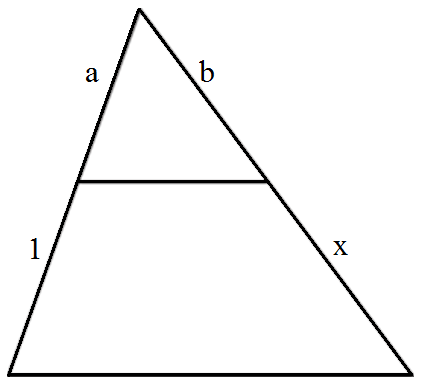
Answer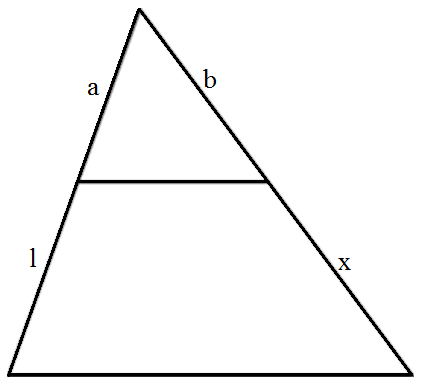
$\frac{\text{a}}{\text{a}+1}=\frac{\text{b}}{\text{b}+\text{x}}$
By cross multiplication on both sides, we get
$\text{a}\times(\text{b}+\text{x})=\text{b}\times(\text{a}+1)$
$\text{ab}+\text{ax}=\text{ab}+\text{b}$
$\text{ax}=\text{ab}+\text{b}-\text{ab}$
$\text{ax}=\text{ab}+\text{b}-\text{ab}$
$\text{ax}=\text{b}$
$\text{x}=\frac{\text{b}}{\text{a}}$
Hence the value of x is $\frac{\text{b}}{\text{a}}.$ View full question & answer→Question 432 Marks
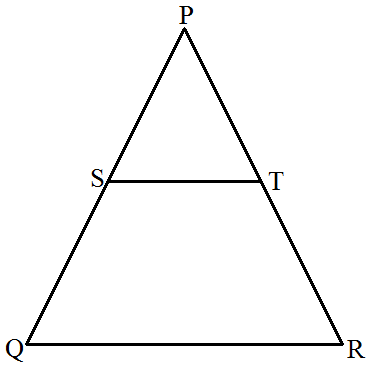
In the given figure, $S$ and $T$ are points on the sides $PQ$ and $PR$ respectively of $\triangle\text{PQR}$ such that $PT = 2\ cm, TR = 4\ cm$ and $ST$ is parallel to $QR.$ Find the ratio of the areas of $\triangle\text{PST}$ and $\triangle\text{PQR}.$
Answer
We have, $ST || QR$
$PT = 2\ cm, TR = 4\ cm$
In $\triangle\text{PST}$ and $\triangle\text{PQR,}$
$\angle\text{P}=\angle\text{P}$
$\angle\text{PST}=\angle\text{PQR}$ (corresponding angles)
$\triangle\text{PST}\sim\triangle\text{PQR}$
$\therefore\frac{\text{area}(\triangle\text{PST})}{\text{area}(\triangle\text{PQR})}=\Big(\frac{\text{PT}}{\text{PR}}\Big)^2$
$\Rightarrow\frac{\text{area}(\triangle\text{PST})}{\text{area}(\triangle\text{PQR})}=\Big(\frac{\text{PT}}{\text{PT}+\text{TR}}\Big)^2$
$\Rightarrow\frac{\text{area}(\triangle\text{PST})}{\text{area}(\triangle\text{PQR})}=\Big(\frac{2}{2+4}\Big)^2$
$\Rightarrow\frac{\text{area}(\triangle\text{PST})}{\text{area}(\triangle\text{PQR})}=\Big(\frac{2}{6}\Big)^2$
$\Rightarrow\frac{\text{area}(\triangle\text{PST})}{\text{area}(\triangle\text{PQR})}=\frac{1}{9}$
Thus, the tatio of the area of $\triangle\text{PST}$ and $\triangle\text{PQR}$ is $1 : 9.$ View full question & answer→Question 442 Marks
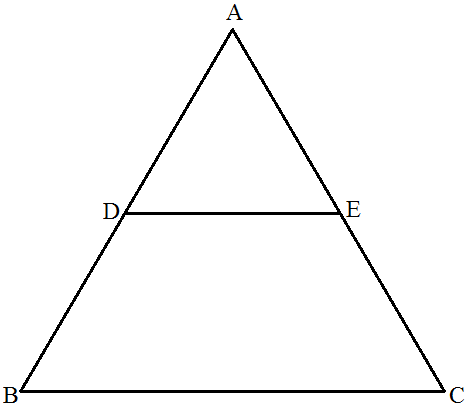
In the given figure, $DE || BC$
If $DE = 4\ cm, BC = 6\ cm$ and Area $(\triangle\text{ADE})=16\text{cm}^2$, find the area of $\triangle\text{ABC}.$
AnswerWe have,
$BC = 6\ cm, DE = 4\ cm$ and area of $\triangle\text{ADE}=16\text{cm}^2$
We know that
$\frac{\text{Area of }\triangle\text{ABC}}{\text{Area of }\triangle\text{ADE}}=\Big(\frac{\text{BC}}{\text{DE}}\Big)^2$
$\Rightarrow\frac{\text{Area of }\triangle\text{ABC}}{16}=\Big(\frac{6}{4}\Big)^2$
$\Rightarrow\text{Area of }\triangle\text{ABC}=\frac{36}{16}\times16$
$\Rightarrow\text{Area of }\triangle\text{ABC}=36\text{cm}^2$
View full question & answer→Question 452 Marks
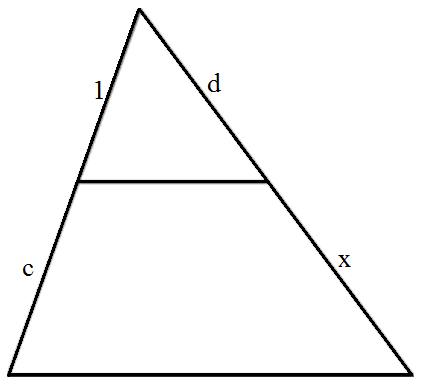
In the figure given below, a line segment is drawn parallel to one side of the triangle and the lengths of certain line-segment are marked. Find the value of $x$ in the following:
Answer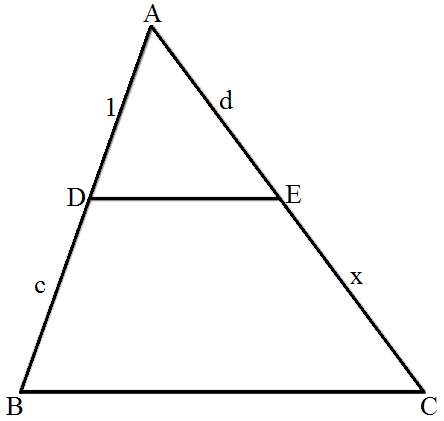
In figure $(i)$
$DE || BC$
$\therefore\frac{\text{AD}}{\text{DB}}=\frac{\text{AE}}{\text{EC}}$
$\Rightarrow\frac{1}{\text{c}}=\frac{\text{d}}{\text{x}}$
$\therefore\text{x}=\text{cd}$ View full question & answer→Question 462 Marks
In figure, $AD$ bisects $\angle\text{A}, AB = 12\ cm, AC = 20\ cm, $ and $BD = 5\ cm.$ Determine $CD.$
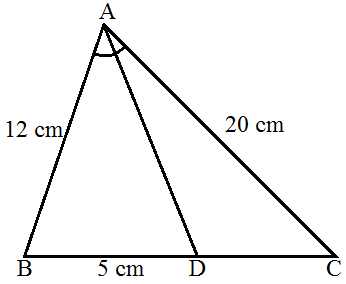
AnswerIn the $\triangle\text{ABC},$
$AD$ is the bisector of $\angle\text{A}$
$\therefore\frac{\text{AB}}{\text{AC}}=\frac{\text{BD}}{\text{CD}}$
$\Rightarrow\frac{12}{20}=\frac{5}{\text{CD}}\Rightarrow\text{CD}=\frac{20\times5}{12}$
$\Rightarrow\text{CD}=\frac{25}{3}=8.33$
$\therefore\text{CD}=8.33$
View full question & answer→Question 472 Marks
In $\triangle\text{ABC},$ points $P$ and $Q$ are on $CA$ and $CB,$ respectively such that $CA = 16\ cm, CP = 10\ cm, CB = 30\ cm$ and $CQ = 25\ cm.$ Is $PQ || AB?$
AnswerGiven: $AC = 16\ cm, CP = 10\ cm, CB = 30\ cm$ and $CQ = 25\ cm,$ we get
We will check whether $\frac{\text{CP}}{\text{AC}}=\frac{\text{CQ}}{\text{BC}}$ or not to conclude whether $PQ || AB.$
$\frac{\text{CP}}{\text{AC}}=\frac{10\text{cm}}{16\text{cm}}=\frac{5}{8}$
$\frac{\text{CQ}}{\text{CB}}=\frac{25\text{cm}}{30\text{cm}}=\frac{5}{6}$
$\therefore\frac{\text{CP}}{\text{AC}}\neq\frac{\text{CQ}}{\text{CB}}$
Hence, $PQ$ is not parallel to $AB.$
View full question & answer→Question 482 Marks
$ABCD$ is a trapezium in which $AB || CD.$ The diagonals $AC$ and $BD$ intersect at $O$. Prove that: $(i)$ $\triangle\text{AOB}\sim\triangle\text{COB}$ $(ii)$ If $OA = 6cm, OC = 8cm,$
- $\frac{\text{Area}(\triangle\text{AOB)}}{\text{Area}(\triangle\text{COD})}$
- $\frac{\text{Area}(\triangle\text{AOD)}}{\text{Area}(\triangle\text{COD})}$
Answer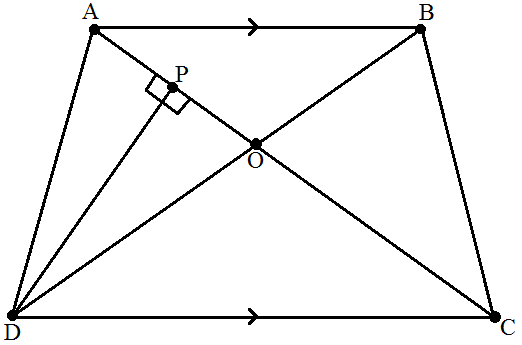
We have,
$AB || DC$
In $\triangle\text{AOB}$ and $\triangle\text{COD}$
$\angle\text{AOB}=\angle\text{COD}$ [Vertically opposite angles]
$\angle\text{OAB}=\angle\text{OCD}$ [Alternate interior angles]
Then, $\triangle\text{AOB}\sim\triangle\text{COD} [$By $AA$ similarity$]$
- By area of similar triangle theorem
$\frac{\text{ar}(\triangle\text{AOB)}}{\text{ar}(\triangle\text{COD})}=\frac{\text{OA}^2}{\text{OC}^2}=\frac{6^2}{8^2}=\frac{36}{64}=\frac{9}{16}$
- Draw $\text{DP}\perp\text{AC}$
$\frac{\text{area}(\triangle\text{AOD)}}{\text{area}(\triangle\text{COD})}=\frac{\frac{1}{2}\times\text{AO}\times\text{DP}}{\frac{1}{2}\times\text{CO}\times\text{DP}}$
$=\frac{\text{AO}}{\text{CO}}$
$=\frac{6}{8}$
$=\frac{3}{4}$ View full question & answer→Question 492 Marks
$\triangle\text{ABD}$ is a right triangle right-angled at $A$ and $\text{AC}\perp\text{BD}.$ Show that
$\frac{\text{AB}^2}{\text{AC}^2}=\frac{\text{BD}}{\text{DC}}$
Answer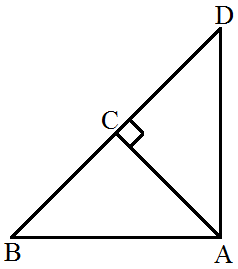
From part $(i) A B^2=C B \times B D$
From part $(ii) A C^2=D C \times B C$
Hence $\frac{\text{AB}^2}{\text{AC}^2}=\frac{\text{CB}\times\text{BD}}{\text{DC}\times\text{BC}}$
$\frac{\text{AB}^2}{\text{AC}^2}=\frac{\text{BD}}{\text{DC}}$
Hence proved. View full question & answer→Question 502 Marks
In $\triangle\text{ABC},$ ray $AD$ bisects $\angle\text{A}$ and intersects $BC$ in $D$. If $BC = a, AC = b$ and $AB = c$, prove that
$\text{BD}=\frac{\text{ac}}{\text{b}+\text{c}}$
AnswerGiven: In $\triangle\text{ABC}$ ray $AD$ bisects angle $A$ and intersects $BC$ in $D,$
If $BC = a, AC = b$ and $AB = c$
$\text{BD}=\frac{\text{ac}}{\text{b}+\text{c}}$
The corresponding figure is as follows
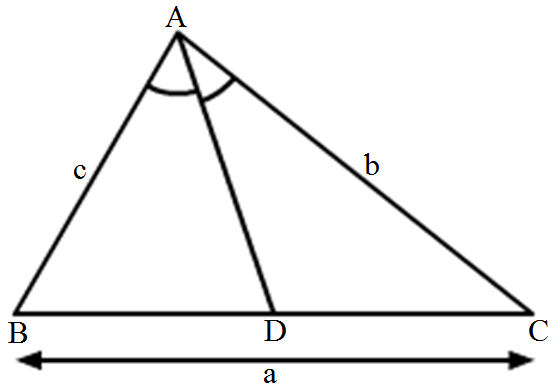
Proof: In triangle $ABC, AD$ is the bisector of $\angle\text{A}$
Therefore $\frac{\text{AB}}{\text{AC}}=\frac{\text{BD}}{\text{CD}}$
Substitute $BC = a, AC = b$ and $AB = c$ we get,
$\frac{\text{c}}{\text{b}}=\frac{\text{BD}}{\text{BC}-\text{BD}}$
$\frac{\text{c}}{\text{b}}=\frac{\text{BD}}{\text{a}-\text{BD}}$
By cross multiplication we get.
$\text{c(a}-\text{BD})=\text{b}\times\text{BD}$
$\text{ac}-\text{cBD}=\text{bBD}$
$\text{ac}=\text{bBD}+\text{cBD}$
$\text{ac}=(\text{b}+\text{c})\text{BD}$
$\frac{\text{ac}}{\text{b}+\text{c}}=\text{BD}$
We proved that $\text{BD}=\frac{\text{ac}}{\text{b}+\text{c}}$ View full question & answer→