Questions · Page 2 of 2

2 Marks Questions

Question 512 Marks
If a $\triangle\text{ABC}, AD$ is the bisector of $\angle\text{A},$ Meeting side $BC$ at $D$.
If $AB = 10\ cm, AC = 14\ cm$ and $BC = 6\ cm,$ find $BD$ and $DC$
Answer
We have,
$AB = 10\ cm, AC = 14\ cm$ and $BC = 6\ cm$
Now, $\frac{\text{BD}}{\text{AB}}=\frac{\text{CD}}{\text{AC}}$
$⇒ BD × AC = CD × AB$
$⇒ (BC - CD) AC = CD × AB (\because BD = BC - CD)$
$⇒ (6 - CD) 14 = CD × 10$
$⇒ 84 - 14CD = 10CD$
$⇒ 24CD = 84$
$\Rightarrow \text{CD} =\frac{84}{24}$
$⇒ CD = 3.5$
$\because BD = BC - CD$
$⇒ BD = 6 - 3.5$
$⇒ BD = 2.5\ cm$
View full question & answer
Question 522 Marks
The area of two similar triangles are $36\ cm^2$ and $100\ cm^2$. If the length of a side of the smaller triangle in $3\ cm,$ find the length of the corresponding side of the larger triangle.
Answer
Area of smaller triangle $= 36\ cm^2$
and area of larger triangle $= 100\ cm^2$
One side of smaller triangle $= 3\ cm$
Let the corresponding side of larger triangle $= x$
$\triangle\text{s}$ are similar
$\therefore\frac{\text{area of smaller triangle}}{\text{area of larger triangle}}=\frac{(3)^2}{\text{x}^2}$
$\Rightarrow\frac{36}{100}=\frac{9}{\text{x}^2}\Rightarrow\text{x}^2=\frac{9\times100}{36}=25=(5)^2$
$\therefore\text{x}=5$
$\therefore$ Corresponding side of larger triangle $= 5\ cm.$
View full question & answer
Question 532 Marks
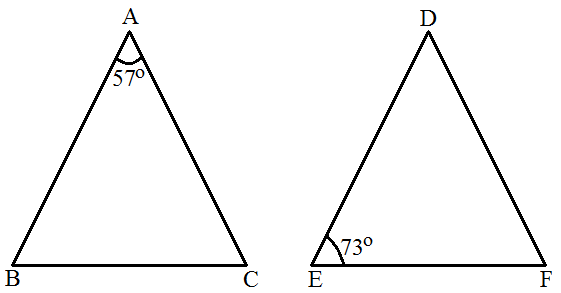
If $ABC$ and $DEF$ are similar triangles such that $\angle\text{A}=57^\circ$ and $\angle\text{E}=73^\circ,$ what is the measure of $\angle\text{C}?$
Answer
We have,

$\triangle\text{ABC}\sim\triangle\text{DEF}$
we know that corresponding angle of similar triangle are equal.
$\angle\text{A}=\angle\text{D}=57^\circ$ and $\angle\text{B}=\angle\text{E}=73^\circ$
$\angle\text{C}=\angle\text{F}=?$
$\angle\text{A}+\angle\text{B}+\angle\text{C}=180^\circ$ (Angle sum property)
$\Rightarrow57^\circ+73^\circ+\angle\text{C}=180^\circ$
$\Rightarrow130^\circ+\angle\text{C}=180^\circ$
$\Rightarrow\angle\text{C}=180^\circ-130^\circ$
$\Rightarrow\angle\text{C}=50^\circ$
Thus, $\angle\text{C}=50^\circ$
View full question & answer
Question 542 Marks
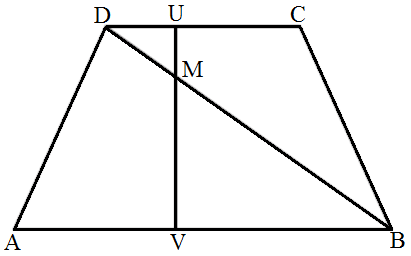
In the given figure,

$AB || DC$ prove that
$DM × BV = BM × DU$
Answer

Since $\triangle\text{DMU}\sim\triangle\text{BMV}$
$\frac{\text{DM}}{\text{BM}}=\frac{\text{MU}}{\text{MV}}=\frac{\text{DU}}{\text{BV}}$
$\frac{\text{DM}}{\text{BM}}=\frac{\text{DU}}{\text{BV}}$
By cross multiplication, we get,
$DM × BV = DU × BM$
Hence proved that $DM × BV = DU × BM.$
View full question & answer
Question 552 Marks
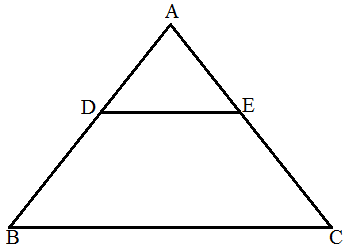
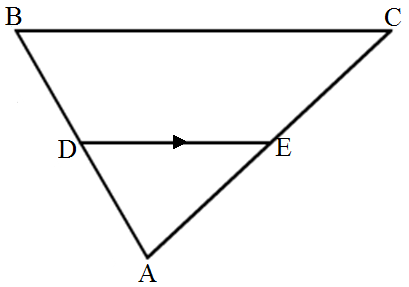
In the given figure, $DE || BC$ and $\text{AD}=\frac{1}{2}\text{BD}.$ If $BC = 4.5\ cm,$ find $DE$.
Answer
Given: In $\triangle\text{ABC},\ \text{DE}||\text{BC}.\ \text{AD}=\frac{1}{2}\text{BD}$ and $BC = 4.5\ cm.$
To find: $DE$
In $\triangle\text{ABC}$ and $\triangle\text{ADE}$
$\angle\text{B}=\angle\text{ADE}$ (Corresponding angles)
$\angle\text{A}=\angle\text{A}$ (Common)
$\therefore\triangle\text{ABC}\sim\triangle\text{ADE}$ (AA Similarity)
$\frac{\text{AD}}{\text{AB}}=\frac{\text{DE}}{\text{BC}}$
$\frac{\text{AD}}{\text{AD}+\text{BD}}=\frac{\text{DE}}{\text{BC}}$
$\frac{\frac{1}{2}\text{BD}}{\frac{1}{2}\text{BD}+\text{BD}}=\frac{\text{DE}}{\text{BC}}$
$\frac{1}{3}=\frac{\text{DE}}{\text{BC}}$
$\frac{1}{3}=\frac{\text{DE}}{4.5}$
$\text{DE} = 1.5\text{cm.}$
View full question & answer
Question 562 Marks
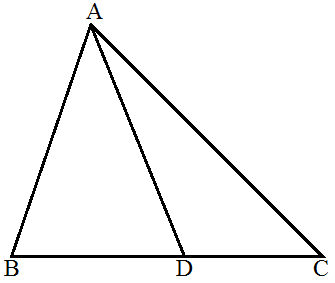
In FIg. check whether $AD$ is the bisector of $\angle\text{A}$ of $\triangle\text{ABC}$ in the following.

$AB = 6\ cm, AC = 8\ cm, BD = 1.5\ cm$ and $CD = 2\ cm.$
Answer
It is given that, $AB = 6\ cm, AC = 8\ cm, BD = 1.5\ cm$ and $CD = 2\ cm.$
We have to check whether $AD$ is bisector of $\angle\text{A}$.
First we will check proportional retio between sides.
So $\frac{\text{AB}}{\text{AC}}=\frac{\text{BD}}{\text{DC}}$
$\Rightarrow\frac{6}{8}=\frac{1.5}{2}$
$\Rightarrow\frac{3}{4}=\frac{3}{4}$
$($It is proportional$)$
Hence, $AD$ is bisector of $\angle\text{A}$.
View full question & answer
Question 572 Marks
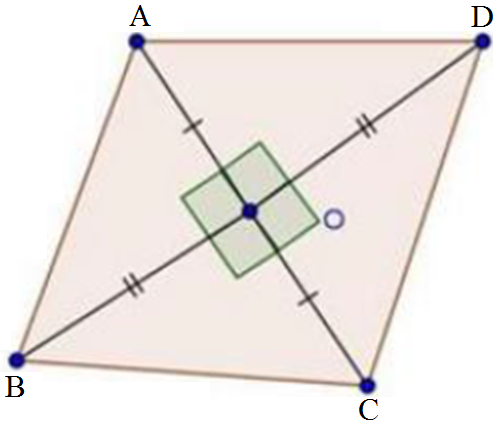
The lengths of the diagonals of a rhombus are $24\ cm$ and $10\ cm.$ Find each side of the rhombus.
Answer

We have,
$ABCD$ is a rhombus with diagonals $AC = 10\ cm$ and $BD = 24\ cm$
We know that diagonal of a rhombus bisect each other at $90^\circ $
$\therefore AO = OC = 5\ cm$ and $BO = OD = 12\ cm$
In $\triangle\text{AOB},$ by Pythagoras theorem
$ A B^2=A O^2+B O^2 $
$ \Rightarrow A B^2=5^2+12^2$
$\Rightarrow A B^2=25+144=169$
$\Rightarrow\text{AB}=\sqrt{169}=13\text{cm}$
View full question & answer
Question 582 Marks
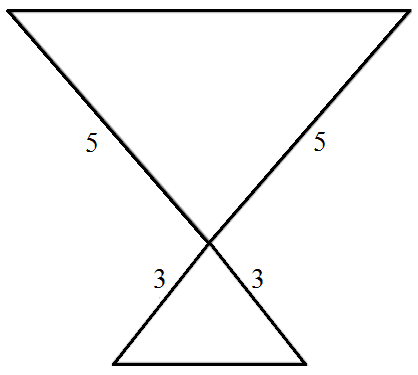
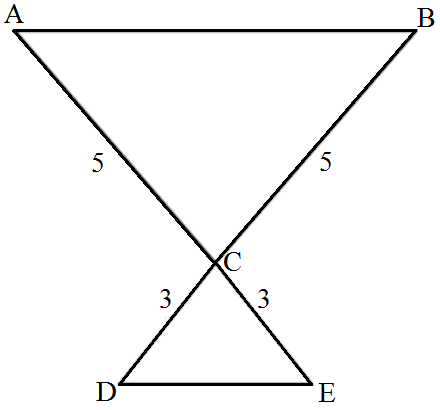
In the following figures, you find who triangles. Indicate whether the triangles are similar. Give reasons in support of your answer.​
Answer
In two triangle, we observe that

In $\triangle\text{ABC}$ and $\triangle\text{CDE}$
$\frac{\text{CD}}{\text{CE}}=\frac{\text{CB}}{\text{CA}}$
$\angle\text{ACB}=\angle\text{DCE} ($Vertically opposite angles$)$
$\triangle\text{ABC}\sim\triangle\text{CDE} (SAS$ Similarity$)$
yes two triangles are similar.
View full question & answer
Question 592 Marks
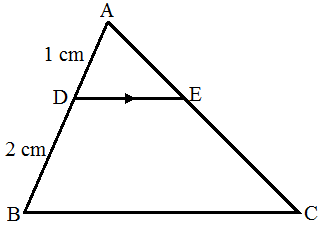
In the adjoining figure, $DE$ is parallel to $BC$ and $AD = 1\ cm, BD = 2\ cm.$ What is the ratio of the area of $\triangle\text{ABC}$ to the area of $\triangle\text{ADE}?$
Answer
In $\triangle\text{ABC},\ \text{DE}||\text{BC}$
$\therefore\triangle\text{ADE}\sim\triangle\text{ABC}$

$\therefore\frac{\text{area}\triangle\text{ABC}}{\text{area}\triangle\text{ADE}}=\frac{\text{AB}^2}{\text{AD}^2}=\frac{(\text{AD}+\text{DB})^2}{\text{AD}^2}$
$=\frac{(1+2)^2}{(1)^2}=\frac{3^2}{1}=\frac{9}{1}$
$\therefore$ Ratio $= 9 : 1$
View full question & answer
Question 602 Marks
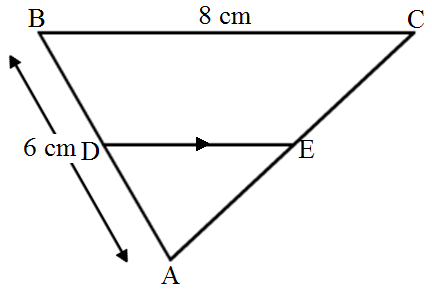
In the figure, $DE || BC$ in $\triangle\text{ABC}$ such that $BC = 8\ cm, AB = 6\ cm$ and $DA = 1.5\ cm.$ Find $DE.$
Answer
In the given figure,
$DE || BC$
$BC = 8\ cm, AB = 6\ cm$ and $DA = 1.5\ cm.$

In $\triangle\text{ABC}$ and $\triangle\text{ADE},$
$\angle\text{A}=\angle\text{A} ($Common$)$
$\angle\text{B}=\angle\text{ADE} ($Corresponding angles$)$
$\therefore\triangle\text{ABC}\sim\triangle\text{ADE} (AA$ axiom$)$
$\therefore\frac{\text{AB}}{\text{AD}}=\frac{\text{BC}}{\text{DE}}\Rightarrow\frac{6}{1.5}=\frac{8}{\text{DE}}$
$\Rightarrow\text{DE}=\frac{8\times1.5}{6}=\frac{12}{6}=2\text{cm}.$
View full question & answer
Question 612 Marks
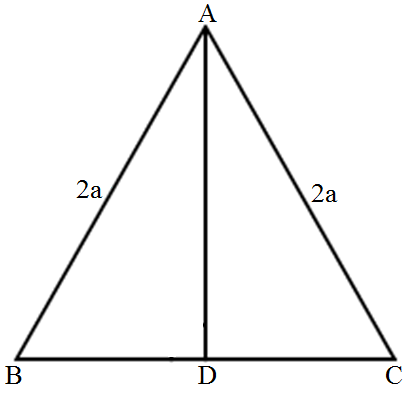
In a $\triangle\text{ABC}, AB = BC = CA = 2a$ and $\text{AD}\perp\text{BC}.$ Prove that
$\text{AD}=\text{a}\sqrt{3}$
Answer
$\triangle\text{ABC}, AB = BC = AC = 2a$
$\triangle\text{AD}\perp\text{BC}$
$AD$ bisects $BC$ at $D$
$\text{BD}=\text{DC}=\frac{1}{2}\text{BC}=\text{a}$

Now in $\triangle\text{ABD}$
$ A B^2=A D^2+B D^2$
$ \Rightarrow(2 a)^2=A D^2+a^2 \Rightarrow 4 a^2=A D^2+a^2$
$ \Rightarrow A D^2=4 a^2-a^2=3 a^2=(\sqrt{3} a)^2$
$\therefore\text{AD}=\sqrt{3}\text{a}$
View full question & answer
Question 622 Marks
state $SAS$ similarity criterion.
Answer
If in two triangles, one pair of coresponding sides are proportional and the included angle are equal then the two triangles are similar.
View full question & answer
2 Marks Questions - Page 2 - Maths STD 10 Questions - Vidyadip