Questions

[4 marks Questions]

🎯

Test yourself on this topic

5 questions · timed · auto-graded

Question 14 Marks
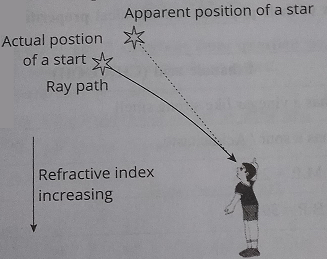
Explain about atmospheric refraction on a large scale by the example of twinkling of stars.
Answer
Image
→ Twinkling of stars is due to atmospheric refraction of starlight.
→ While entering the atmosphere of earth, the starlight undergoes refraction continuously because of changing refractive index.
→ As the starlight approaches surface of earth, it bends towards the normal and so when we see towards the star near the horizon, that star appears slightly higher than its actual position, as shown in above figure. Since atmospheric conditions of earth are not stationary, apparent position of star keeps on changing slightly. Moreover, since the stars are very far, they are like point size sources of light. Hence path of starlight goes on varying slightly, the apparent position of the star goes on fluctuating and amount of starlight entering observer's eye goes on flickering. Because of this, sometimes that star appears brighter and some other time fainter. That is why stars are said to be twinkling.
View full question & answer
Question 24 Marks
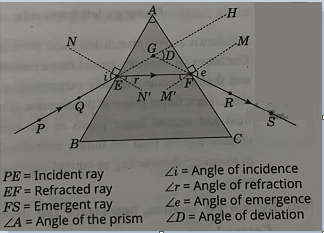
With the help of suitable figure, explain about angle of deviation.
Answer
Image
Refraction of light through a triangular glass prism
→ In above figure, $A B C$ is the cross-section of triangular prism, kept in air-medium.
→ When a ligh ray $P E$ propagating in air is made incident on refracting face $A B$ of above prism at an angle of incidence $i$, it gets refracted at angle of refraction $r$.
→ Now, refracted ray $E F$ propagating in glass medium gets refracted by refracting face $A C$ and then comes out of prism in the form of emergent ray $FS$. Here $e$ is called angle of emergence.
→ Here, incident ray would have propagated along $G H$ in the absence of prism which now in the presence of prism, propagates along $FS$. Thus, prism bends the incident ray by $\angle H G S$. Such angle is called "angle of deviation". It is shown by symbol $D$.
→ Value of angle of deviation depends on $(i)$ angle of incidence and $(ii)$ relative refractive index of material of glass medium with respect to surrounding medium.
View full question & answer
Question 34 Marks
Make a diagram to show how hypermetropia is corrected. The near point of a hypermetropic eye is $1 m$. What is the power of the lens required to correct this defect? Assume that the near point of the normal eye is $25 cm$.
Answer
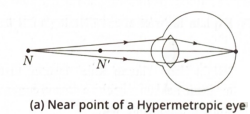
Near point of a normal eye is at $25 cm$ from eye. But for a hypermetropic eye, near point is farther away from it, say at point $N$, as shown in fig. (a), given below.
Image
Image
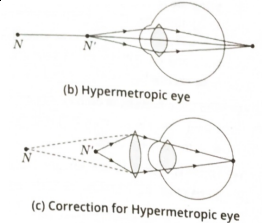
$N=$ Near point of a hypermetroipic eye.
$N^{\prime}=$ Near point of a normal eye.
→ In a hypermetropic eye, image of nearby object is formed behind the retina, as shown in fig. $(b)$ Since image is not formed on the retina, nearby object is not seen clearly by such eye.
→ This defect can be corrected by using a convex lens of suitable power, as shown in figure $(c)$, where the image is brought back on the retina, to see the nearby object clearly. Now, the new near point is at $N^{\prime}$ (at $25 cm$ ) which is closer to eye.
→ In the present case, near point a given eye is to be shifted from $1 m$ to $25 cm$ (near point of a normal eye.)
→ Hence, for given eye, $u=-25 cm =-0.25 m$
$v=-100 cm =-1 m$
→ According to lens formula,
$P=\frac{1}{f}=\frac{1}{v}-\frac{1}{u} =\frac{1}{-1}-\frac{1}{-0.25}$
$=\frac{1}{0.25}-1$
$=4-1$
$=3 m ^{-1}$
$\therefore P =3 D$
$\Rightarrow$ Convex lens of power $3 D$ should be used to correct given hypermetropic eye.
View full question & answer
Question 44 Marks
Write a short note on "Myopia".
Answer
A person with myopia can see nearby objects (i.e. objects at short distances) clearly but can not see distant objects (i.e. objects at large distances) clearly.
→ Myopia is also known as "near sightedness" or "short sightedness".
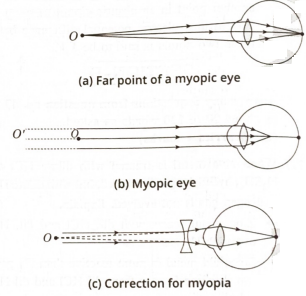
→ Far point of a myopic person is not at infinity but shorter than that, somewhere at few metres, say at point $O$ in fig. (a) given below.
Image
$O=$ Far point of a myopic eye
$O^{\prime}=$ Far point of a normal eye
→ In a myopic eye, image of distant object is formed in front of retina, as shown in fig. $(b)$. Since image is not formed on the retina, distant object is not seen clearly by such eye.
→ This defect arises due to $(i)$ excessive curvature of eye-lens (with too short focal length) or $(ii)$ bulky eyeball (elongated eyeball).
→ This defect can be corrected by using concave lens of suitable power, as shown in fig. $(c)$ where the image is brought back on the retina, to see the distant object clearly.
View full question & answer
Question 54 Marks
Draw cross-sectional lebelled diagram of human eye. Describe its construction and function of each part. Also describe how we can see through our eyes.
Answer
Image
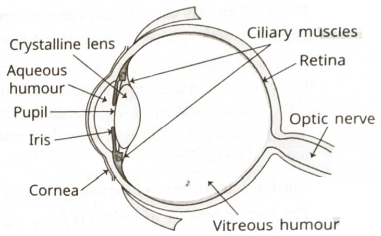
→ Human eye is like a camera. Its lens system forms a real and inverted image on the rear light sensitive screen, called "retina." $\Rightarrow$ → Light enters the eye through a thin transparent membrane called the "cornea." If forms the transparent bulge on the front surface of an eye ball as shown in above figure.
→ Eyeball is nearly spherical in shape with diameter approximately $2.3 cm$. Most of the refraction of light rays entering the eye takes place at the outer surface of comea. The crystalline lens merely provides fine adjustment of focal length which is required to produce images of objects located at different distances, on the retina.
→ Just behind the cornea, there is a dark muscular diaphragm, called "iris" which controls the size of "pupil" (an opening in the center of iris which gives colour to our eyes.)
→ The pupil regulates and controls the amount of light which enters in our eye.
→ The eye lens forms an inverted real image of every object on the retina (inner back surface of eye). The retina is a delicate membrane having enormous no. of light sensitive cells, which get activated upon the incidence of light and then they generate electrical signals. These signals are immediately sent to brain via optic nerves. The brain interprets (understands) these signals, processes the information and finally we see the objects as they are.
→ There are two types of cells in the retina
(i) Rods : These cells are sensitive to low intensity light.
(ii) Cones : These cells are sensitive to high intensity light. They help us to identify different colours.
View full question & answer
[4 marks Questions] - Science STD 10 Questions - Vidyadip