Question 12 Marks
In how many ways $3$ members of a family; husband, wife and a daughter can be arranged in a row for a group photograph ?
AnswerThere are three members in this family. For a group photograph, they can be arranged in a row in ${ }^{3} \mathrm{P}_{3}$ ways.
$ \therefore \text { Total permutations } ={ }^{3} P_{3}$
$=3 ! $
$=6 $
View full question & answer→Question 22 Marks
If $^{(n+2)} P_{3}:^{(n+1)} P_{3}=10: 7$ then find $n$.
Answer$\frac{{}^{(n+2)}{P_{3}}}{{}^{(n+1)}{P_{3}}} =\frac{10}{7}$
$\therefore \frac{(n+2)(n+1)(n)}{(n+1)(n)(n-1)}=\frac{10}{7}$
$\therefore \frac{n+2}{n-1}=\frac{10}{7}$
$\therefore 7(n+2)=10(n-1)$
$\therefore 7 n+14=10 n-10$
$\therefore 3 n=24$
$\therefore n=8 $
View full question & answer→Question 32 Marks
If $\frac{n !}{2}=60$ then find value the of $n$.
Answer$ \frac{n !}{2} =60$
$\therefore n ! =120(=1 \times 2 \times 3 \times 4 \times 5)$
$\therefore n ! =5 !$
$\therefore n =5 $
View full question & answer→Question 42 Marks
Expand $\left(x-\frac{2}{x}\right)^{5}$
Answer$\left(x-\frac{2}{x}\right)^{5}$
$={ }^{5} \mathrm{C}_{0}(x)^{5}\left(\frac{2}{x}\right)^{0}-{ }^{5} \mathrm{C}_{1}(x)^{4}\left(\frac{2}{x}\right)^{1}+{ }^{5} \mathrm{C}_{2}(x)^{3}\left(\frac{2}{x}\right)^{2}-{ }^{5} \mathrm{C}_{3}(x)^{2}\left(\frac{2}{x}\right)^{3}+{ }^{5} \mathrm{C}_{4}(x)^{1}\left(\frac{2}{x}\right)^{4}-{ }^{5} \mathrm{C}_{5}(x)^{0}\left(\frac{2}{x}\right)^{5}$
$=x^{5}-5(x)^{4}\left(\frac{2}{x}\right)+10(x)^{3}\left(\frac{4}{x^{2}}\right)-10\left(x^{2}\right)\left(\frac{8}{x^{3}}\right)+5(x)\left(\frac{16}{x^{4}}\right)-\frac{32}{x^{5}}$
$=x^{5}-10 x^{3}+40 x-\frac{80}{x}+\frac{80}{x^{3}}-\frac{32}{x^{5}}$
View full question & answer→Question 52 Marks
Expand $(2 x-a)^{5}$
Answer$(2 x-a)^{5}$
$={ }^{5} C_{0}(2 x)^{5}(a)^{0}-{ }^{5} C_{1}(2 x)^{4}(a)^{1}+{ }^{5} C_{2}(2 x)^{3}(a)^{2}-{ }^{5} C_{3}(2 x)^{2}(a)^{3}$ $+{ }^{5} C_{4}(2 x)^{1}(a)^{4}-{ }^{5} C_{5}(2 x)^{0}(a)^{5}$
$=32 x^{5}-5\left(16 x^{4}\right)(a)+10\left(8 x^{3}\right)\left(a^{2}\right)-10\left(4 x^{2}\right)\left(a^{3}\right)+5(2 x)\left(a^{4}\right)-a^{5}$
$=32 x^{5}-80 x^{4} a+80 x^{3} a^{2}-40 x^{2} a^{3}+10 x a^{4}-a^{5}$
View full question & answer→Question 62 Marks
Expand $(3 x-y)^{4}$
Answer$(3 x-y)^{4}=[3 x+(-y)]^{4}$
$={ }^{4} \mathrm{C}_{0}(3 x)^{4}(-y)^{0}+{ }^{4} \mathrm{C}_{1}(3 x)^{3}(-y)^{1}+{ }^{4} \mathrm{C}_{2}(3 x)^{2}(-y)^{2}+{ }^{4} \mathrm{C}_{3}(3 x)^{1}(-y)^{3}+{ }^{4} \mathrm{C}_{4}(3 x)^{0}(-y)^{4}$
$=81 x^{4}+4\left(27 x^{3}\right)(-y)+6\left(9 x^{2}\right)\left(y^{2}\right)+4(3 x)\left(-y^{3}\right)+y^{4}$
$=81 x^{4}-108 x^{3} y+54 x^{2} y^{2}-12 x y^{3}+y^{4}$
View full question & answer→Question 72 Marks
Expand $(3 a+2 y)^{3}$
Answer$(3 a+2 y)^{3}$
$={ }^{3} \mathrm{C}_{0}(3 a)^{3}(2 y)^{0}+{ }^{3} \mathrm{C}_{1}(3 a)^{2}(2 y)^{1}+{ }^{3} \mathrm{C}_{2}(3 a)^{1}(2 y)^{2}+{ }^{3} \mathrm{C}_{3}(3 a)^{0}(2 y)^{3}$
$=27 a^{3}+3\left(9 a^{2}\right)(2 y)+3(3 a)\left(4 y^{2}\right)+8 y^{3}$
$=27 a^{3}+54 a^{2} y+36 a y^{2}+8 y^{3}$
View full question & answer→Question 82 Marks
Expand $(1+x)^{4}$.
Answer$
\begin{aligned}
&(1+x)^{4} \\
&={ }^{4} \mathrm{C}_{0}(1)^{4}(x)^{0}+{ }^{4} \mathrm{C}_{1}(1)^{3}(x)^{1}+{ }^{4} \mathrm{C}_{2}(1)^{2}(x)^{2}+{ }^{4} \mathrm{C}_{3}(1)^{1}(x)^{3}+{ }^{4} \mathrm{C}_{4}(1)^{0}(x)^{4} \\
&=1+4 x+6 x^{2}+4 x^{3}+x^{4}
\end{aligned}
$
View full question & answer→Question 92 Marks
If ${ }^{7} P_{r}=42$ then find the value of $r$.
Answer$ { }^{n} \mathrm{P}_{r}=\frac{n !}{(n-r) !}$
$\therefore { }^{7} \mathrm{P}_{r}=\frac{7 !}{(7-r) !}$
$\therefore 42=\frac{7 !}{(7-r) !}$
$\therefore(7-r) ! =\frac{7 !}{42}$
$\therefore(7-r) ! =\frac{7 \times 6 \times 5 !}{42}$
$\therefore(7-r) ! =5 !$
$\therefore 7-r =5$
$\therefore r =2 $
View full question & answer→Question 102 Marks
Expand $(x+y)^{6}$.
Answer$(x+y)^{6}$
$={ }^{6} \mathrm{C}_{0}(x)^{6}(y)^{0}+{ }^{6} \mathrm{C}_{1}(x)^{5}(y)^{1}+{ }^{6} \mathrm{C}_{2}(x)^{4}(y)^{2}+{ }^{6} \mathrm{C}_{3}(x)^{3}(y)^{3}$ $+{ }^{6} \mathrm{C}_{4}(x)^{2}(y)^{4}+{ }^{6} \mathrm{C}_{5}(x)^{1}(y)^{5}+{ }^{6} \mathrm{C}_{6}(x)^{0}(y)^{6}$
$=x^{6}+6 x^{5} y+15 x^{4} y^{2}+20 x^{3} y^{3}+15 x^{2} y^{4}+6 x y^{5}+y^{6}$
View full question & answer→Question 112 Marks
In an interview, $6$ questions are asked to a person. In how many ways can a person give $(I)$ at least $4$ correct answers $‘.’ (2)$ at the most $3$ correct answers ?
Answer$(1)$ If a person has given at least $4$ correct answers of $6$ questions asked then it means he has given $4$ or $5$ or $6$ correct answers.
$ \therefore \text { Total Combinations } ={ }^{6} \mathrm{C}_{4}+{ }^{6} \mathrm{C}_{4}+{ }^{6} \mathrm{C}_{6}$
$ =15+6+1$
$ =22 $
$(2)$ If a person has given at the most $3$ correct answers of $6$ questions asked then it means he has given $3$ or $2$ or $l$ or $0$ correct answers.
$ \therefore \text { Total Combinations } ={ }^{6} \mathrm{C}_{3}+{ }^{6} \mathrm{C}_{2}+{ }^{6} \mathrm{C}_{1}+{ }^{6} \mathrm{C}_{0}$
$ =20+15+6+1$
$ =42 $
View full question & answer→Question 122 Marks
A person wishes to purchase $3$ mobile handsets from $10$ different handsets of a company. But $2$ mobile handsets do not fit into his budget. In how many ways can a person puchase $3$ different handsets ?
AnswerHere there are $10$ different handsets. But $2$ mobile hand sets do not fit into his budget.
So, selection of $3$ mobile handsets out of remaining $8$ mobile handsets can be done in ${ }^{8} \mathrm{C}_{3}$ ways.
$ \therefore \text { Total Combinations } ={ }^{8} \mathrm{C}_{3}$
$ =\frac{8 \times 7 \times 6}{3 \times 2 \times 1}$
$ =56 $
View full question & answer→Question 132 Marks
A boy named Kathan wants to select $5$ different flavours of ice-cream cones out of $9$ different flavours of ice-cream cones. If he wants one of the selected ice-cream cone to be of chocolate flavour then find total number of seleetions ?
AnswerKathan wants to select $5$ different flavours of ice-cream cones out of $9$ different flavours of icecream cones.
Chocolate ice-cream cone has to be selected which can be selected in ${ }^{1} C_{1}$ ways.
Now out of remaining 8 ice-cream cones, Kathan can select remaining $4$ ice-cream cones in ${ }^{8} \mathrm{C}_{4}$ ways.
$ \therefore \text { Total Combinations } ={ }^{1} \mathrm{C}_{1} \times{ }^{8} \mathrm{C}_{4}$
$ =1 \times \frac{8 \times 7 \times 6 \times 5}{4 \times 3 \times 2 \times 1}$
$ =70 $
View full question & answer→Question 142 Marks
There are $5$ yellow, $4$ white and $3$ pink flowers in a basket. ln how many ways $3$ yellow, $2$ white and $1$ pink flower can be selected from it ?
Answer$3$ yellow flowers from $5$ yellow flowers can be selected in ${ }^{5} \mathrm{C}_{3}$ ways, $2$ white flower from $4$ white flowers can be selected in ${ }^{4} \mathrm{C}_{2}$ ways and $1$ pink flower from $3$ pink flowers can be selected in ${ }^{3} \mathrm{C}_{1}$ ways.
$ \therefore \text { Total combinations } ={ }^{5} \mathrm{C}_{3} \times{ }^{4} \mathrm{C}_{2} \times{ }^{3} \mathrm{C}_{1}$
$ =10 \times 6 \times 3$
$ =180 $
View full question & answer→Question 152 Marks
If ${ }^{50} \mathrm{C}_{r+2}={ }^{50} \mathrm{C}_{2 r-3}$ then find the value of $r$.
AnswerWe know that if ${ }^{n} \mathrm{C}_{x}={ }^{n} \mathrm{C}_{y}$ then,
Option $1 :$
$ x+y=n$
$\therefore (r+2)+(2 r-3)=50$
$\therefore r+2+2 r-3=50$
$\therefore 3 r=51$
$\therefore r=17 $
Option $2 :$
$x=y$
$\therefore r+2=2 r-3$
$\therefore r=5$
View full question & answer→Question 162 Marks
If ${ }^{n} \mathbf{C}_{4}={ }^{n} \mathbf{C}_{6}$ then find the value of $n$.
Answerwe know that if ${ }^{n} \mathrm{C}_{x}={ }^{n} \mathrm{C}_{y}$ then,
Option $1 :$
$ x+y =n$
$\therefore 4+6 =n$
$\therefore n =10 $
Thus, the value of $n$ is $10 .$
Option $2 :$
$x =y$
$\therefore 4 =6$
Which is impossible.
View full question & answer→Question 172 Marks
If ${ }^{n} P_{3}=720$ then find the value of $n$.
AnswerAccording to the definition of ${ }^{n} \mathrm{P}_{r}$
$ { }^{n} \mathrm{P}_{3}=n(n-1)(n-2)$
$\therefore n(n-1)(n-2)=720$
Now, instead of expansion we shall think about the three consecutive numbers whose multiplication is $720$ . Such numbers are $10,9,8$. But we shall write it as follows :
$\therefore n(n-1)(n-2)=10(10-1)(10-2)$
$\therefore n=10$
View full question & answer→Question 182 Marks
If ${ }^{n} \mathrm{C}_{n-3}=56$, find the value of $n .$
Answer$ { }^{n} \mathrm{C}_{n-3}={ }^{n} \mathrm{C}_{3} \left[\because{ }^{n} \mathrm{C}_{r}={ }^{n} \mathrm{C}_{n-r}\right]$
$\therefore { }^{n-} \mathrm{C}_{3}=56$
$\therefore \frac{n(n-1)(n-2)}{3 \times 2 \times 1}=56$
$\therefore n(n-1)(n-2)=336$
$\therefore n(n-1)(n-2)=8(8-1)(8-2)$
$\therefore n=8$
View full question & answer→Question 192 Marks
If $3 \cdot{2}^{2 n} \mathrm{C}_{3}=44 \cdot{ }^{n} \mathrm{C}_{2}$ then find the value of $n$.
Answer$ 3 \cdot{ }^{2 n} \mathrm{C}_{3}=44 \cdot{ }^{n} \mathrm{C}_{2}$
$\therefore 3 \times 2 n(2 n-1)(2 n-2)= 44 \times n(n-1) 2 \times 1 $
$\therefore \frac{2 n(2 n-1) 2(n-1)}{2}=\frac{44 n(n-1)}{2}$
$\therefore 4(2 n-1)=44$
$\therefore 2 n-1=11$
$\therefore 2 n=12$
$\therefore n=6$
View full question & answer→Question 202 Marks
If ${ }^{n} C_{2}=45$, find the value of $n$.
Answer$ { }^{n} \mathrm{C}_{r}=\frac{n !}{r !(n-r) !}$
$\therefore { }^{n} \mathrm{C}_{2}=\frac{n !}{2 !(n-2) !}$
$\therefore 475=\frac{n(n-1)(n-2) !}{2 \times 1 \times(n-2) !}$
$\therefore 90=n(n-1)$
$\therefore n(n-1)=10(10-1)$
$\therefore n=10 $
View full question & answer→Question 212 Marks
How many arrangements can be made using all the letters of the word $CINCINNATI ?$
AnswerThere are total $10$ letters in the word $CINCINNATI$ of which $C$ is repeated $2$ times, $I$ is repeated $3$ times and $N$ is repeated $3$ times.
$ \therefore \text { Total arrangement } =\frac{10 !}{2 ! 3 ! 3 !}$
$ =\frac{3628800}{2 \times 6 \times 6}$
$ =50,400 $
View full question & answer→Question 222 Marks
In how many ways can $3$ boys and $3$ girls be arranged in a row such that boys and girls are alternately arranged ?
AnswerBoys $(B)$ and girls $(G)$ are to be arranged alternately, so they can be arranged as shown alongside:
$B G B G B G$
$OR$
$G B G B G B$
If we start arrangement with boys then that arrangement can be done in ${ }^{3} \mathrm{P}_{3}$ ways $O R$ if we start arrangement with girls then that arrangement can be done in ${ }^{3} \mathrm{P}_{3}$ ways.
$ \therefore \text { Total Permutations } =\left({ }^{3} \mathrm{P}_{3} \times{ }^{3} \mathrm{P}_{3}\right)+\left({ }^{3} \mathrm{P}_{3} \times{ }^{3} \mathrm{P}_{3}\right)$
$ =(3 ! \times 3 !)+(3 ! \times 3 !)$
$ =(6 \times 6)+(6 \times 6)$
$ =36+36$
$ =72 $
View full question & answer→Question 232 Marks
There are 3 different books of Gujarati, $4$ different books of English and $4$ different books of Sanskrit on a table. In how many ways these books can be arranged such that the books of each subject are together ?
Answer3 different books of Gujarati can be arranged in ${ }^{3} P_{3}$ ways, 4 different books of English can be arranged in ${ }^{4} \mathrm{P}_{4}$ ways and 4 different books of Sanskrit can be arranged in ${ }^{4} P_{4}$ ways. Moreover, arrangement of $3$ subjects can be done in ${ }^{3} \mathrm{P}_{3}$ ways.
$ \therefore \text { Total Permutations } ={ }^{3} \mathrm{P}_{3} \times{ }^{4} \mathrm{P}_{4} \times{ }^{4} \mathrm{P}_{4} \times{ }^{3} \mathrm{P}_{3}$
$ =3 ! \times 4 ! \times 4 ! \times 3 !$
$ =6 \times 24 \times 24 \times 6$
$ =20,736 $
View full question & answer→Question 242 Marks
What will be the ratio of number of arrangements obtained using all the letters of the word $ROLLS$ and $DOLLS ?$
AnswerIn 5 letters of the word $POLLS$. The letter $L$ comes two times.
$\therefore$ Total permutations $=\frac{5!}{2!}=\frac{120}{2}=60$
In 5 letters of the word $DOLLS$. the letter $L$ comes two times
$\therefore$ Total permutations $=\frac{5!}{2!}=\frac{120}{2}=60$
The ratio of number of arrangements of all the letters of the word $ROLLS$ and $DOLLS =\frac{60}{60}=\frac{1}{1}=1: 1$
View full question & answer→Question 252 Marks
How many numbers can be formed using all the digits of the number $1234321$ such that odd digits occupy places only ?
AnswerIn the number $1234321$ the odd digits are $1, 3, 3, 1$ and even digits are $2, 4, 2.$
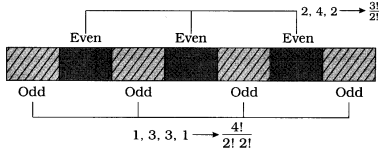
$4$ odd digits can occupy odd places in $\frac{41}{2 ! 2 !}$ ways and $3$ even digits can occupy the remaining even places in $\frac{3 !}{2 !}$ ways.
$\therefore \text { Total permutations }=\frac{4 !}{2 ! 2 !} \times \frac{3 !}{2 !}$
$=\frac{24}{2 \times 2} \times \frac{6}{2}$
$=6 \times 3$
$=18$ View full question & answer→Question 262 Marks
In how many ways can all the letters of the word $MANGO$ be arranged so that vowels are not together ?
AnswerThere are 5 letters of the word $MANGO$ of which two vowels are $A$ and $O$.
Now, 5 letters of the word $MANGO$ can be arranged in ${ }^5 \mathrm{P}_5=5!=120$ ways.
Considering two vowels as one letter. total $(3+1) 4$ letters can be arranged in $4$ ways and in each of these arrangements two vowels can be arranged in $2$ ways.
Total permutations in which vowels are together
$=4 x^2=4 \times 2=24 \times 2=48$
Now, Total permutations in which two vowels are not together
$=[\text { Total permutations for arranging all } 5 \text { letters }]-[\text { Total permutations in which two vowels are together] }$
$=[120-48]=72$
View full question & answer→Question 272 Marks
In how many ways can all the letters of the word $\text{TANI}$ be arranged so that vowels remain together ?
AnswerThere are $4$ letters In the word $\text{TANI}$ of which $2$ vowels are $A$ and $I.$
Considering $2$ vowels as $1$ letter, total $(2+1)=3$ letters can be arranged in ${ }^3 P_3$ ways and in each of these arrangements two vowels can be arranged among themselves in ${ }^2 \mathrm{P}_2$ ways.
$\text { Total permutations }={ }^3 \mathrm{p}_3 \times{ }^2 \mathrm{p}_2$
$=3!\times 2!$
$=6 \times 2=12$
View full question & answer→Question 282 Marks
How many $5$ digit numbers can be formed using all the digits $3, 8, 0, 7, 6 ?$
AnswerTo form $5$ digit numbers using all the digits $3,8.0 .7,6$.
$0$ should not be in the first place.
$\therefore$ From the remaining $4$ digits $(3,8,7,6)$ one digit can be placed at the first placed in ${ }^4 P_1$ ways.
Now, remaining $4$ digits including $0$ , can be arranged in remaining $4$ places in ${ }^4 P_4$ ways.
First place Remaining $4$ places

$\therefore$ Total permutations $={ }^4 P_1 \times{ }^4 P_4=4 \times 4!=4 \times 24=96$ View full question & answer→Question 292 Marks
In how many ways can $4$ boys and $3$ girls be arranged in a row such that no two boys and no two girls are together ?
Answer$4$ boys and $3$ girls can be arranged in a row in the order $BGG \ BGBG \ B$ so that no two boys and no two girls are together
$\therefore$ Total permutations $={ }^4 P_4 \times{ }^3 P_3$
$=4!\times 3!=24 \times 6=144$
View full question & answer→Question 302 Marks
$10$ schools participate in a science fair. In how many ways can the first, second and the third prizes be distributed among these schools ?
AnswerAmong $10$ schools the first, second and third prizes can be distributed in ${ }^{10} P_4=10 \times 9 \times 8=720$ ways.
View full question & answer→Question 312 Marks
Expand: $(y+k)^5$
Answer$(y+k)^5$
$={ }^5 C_{0 y^5} \cdot k^0+{ }^5 C_1 y^4 \cdot k^1+{ }^5 C_2 y^3 \cdot k^2+{ }^5 C_3 y^2 \cdot k^3+{ }^5 C_4 y^1 \cdot k^4+{ }^5 C_5 y^0 \cdot k^5$
$=1 \cdot y^5 \cdot 1+5 y^4 k+10 y^3 k^2+10 y^2 k^3+5 y k^4+1 \cdot 1 \cdot k^5$
$=y^5+5 y^4 k+10 y^3 k^2+10 y^2 k^3+5 y k^4+k^5$
View full question & answer→Question 322 Marks
Expand: $x -\left(\frac{1}{x}\right)^3$
Answer$x-\left(\frac{1}{x}\right) 3=3 C_0(x) 3\left(\frac{1}{x}\right) 0-3 C_1(x) 2\left(\frac{1}{x}\right)+3 C_2(x) 1\left(\frac{1}{x}\right) 2-3 C_3(x) 0\left(\frac{1}{x}\right) 3$
$=x^3-\frac{3 x^2}{x}+\frac{3 x}{x^2}-\frac{1}{x^3}$
$=x^3-3 x+\frac{3}{x}-\frac{1}{x^3}$
View full question & answer→Question 332 Marks
Expand: $(2 x+3 y)^3$
Answer$(2 x+3 y)^3$
$={ }^3 C_0(2 x)^3(3 y)^0+{ }^3 C_1(2 x)^2(3 y)^1+{ }^3 C_2(2 x)(3 y)^2+{ }^3 C_3(2 x)^0(3 y)^3$
$=8 x^3+3\left(4 x^2\right)(3 y)+3(2 x)\left(9 y^2\right)+27 y^3$
$=8 x^3+36 x^3 y+54 x y^2+27 y^3$
View full question & answer→Question 342 Marks
In how many ways can $3$ cards of same colour be selected from a well shuffled pack of $52$ cards ?
AnswerIn a pack of $52$ cards, there are ($13$ spade $+ \ 13$ club) $26$ cards of black colour and ($13$ heart $+\ 13$ diamond) $26$ cards of red colour.
$\therefore$ From a well shuffled pack of $52$ cards, $3$ cards of same colour can be selected in ${ }^{26} C_3+{ }^{26} C_3$ ways.
$\therefore \text { Total combinations }={ }^{26} C_3+{ }^{26} C_3$
$=\frac{26 \times 25 \times 24}{3 \times 2 \times 1}+\frac{26 \times 25 \times 24}{3 \times 2 \times 1}$
$=2600+2600=5200$
View full question & answer→Question 352 Marks
In how many ways can $2$ cards of queen or king can be selected from a well shuffled pack of $52$ cards ?
AnswerIn a pack of $52$ cards, there are $4$ cards of king and $4$ cards of queen.
$\therefore$ From well shuffled pack of $52$ cards, $2$ cards of queen $OR$
$2$ cards of king can be selected in ${ }^4 C_2+{ }^4 C_2$ ways.
$\therefore \text { Total combinations }={ }^4 C_2{ }^{+4} C_2$
$=\frac{4 \times 3}{2 \times 1}+\frac{4 \times 3}{2 \times 1}$
$=6+6=12$
View full question & answer→Question 362 Marks
There are $2$ defective screws in a box having $6$ screws. In how many ways can $2$ non-defective screws be selected from the box ?
Answer$2$ screws are defective in a box of 6 screws.
$\therefore$ Non-defective screws in a box $=6-2=4$
$2$ non-defective screws out of $4$ non - defective screws can be selected in ${ }^4 C_2=\frac{4 \times 3}{2 \times 1}=6$ ways.
View full question & answer→Question 372 Marks
Write the characteristics of binomial expansion.
AnswerCharacteristics of binomial expansion :
The following characteristics are seen in the expansion of $(x+a)^n$ :
$(1)$ Total number of terms in the expansion is ( $n+1$ ).
$(2)$ The coefficients of these terms are ${ }^n C_0,{ }^n C_1{ }^n C_2, \ldots \ldots{ }^{ n } C_n$ respectively.
$(3)$ The sum of the coefficient of these terms : is $2^n$, i.e., ${ }^n C_0,+{ }^n C_1+{ }^n C_2 \ldots . .+{ }^n C_n=2^n$.
$(4)$ The first term is ${ }^n C_{o x}=x^n$ and last term is ${ }^n C_n a ^n= a ^n$.
$(5)$ In the successive terms. the power of ' $x$ ' goes on decreasing by one, while power of ' $a$ ' goes on increasing by one.
$(6)$ In any term the sum of the powers of $x$ and $a$ is $n$.
$(7)$ The coefficients of the terms equidistant from the middle term are equal.
View full question & answer→Question 382 Marks
Expand: $(3 a+4 b)^3$
Answer$(3 a+4 b)^3={ }^3 C_0(3 a)^3(4 b)^0+{ }^3 C_1(3 a)^2(4 b)^1+{ }^3 C_2(3 a)(4 b)^2+{ }^3 C_3(3 a)^0(4 b)^3$
$=1.27 a^3 \cdot 1+3.9 a^2 \cdot 4 b+3.3 a \cdot 16 b^2+1.1 .64 b^3$
$=27 a^3+108 a^2 b+144 b^2+64 b^3$
View full question & answer→Question 392 Marks
There are $3$ white and $5$ pink flowers in a box. In how many ways can $(1)$ three flowers of same colour be selected ? $(2) 2$ flowers of different colours be selected ?
AnswerIn a box there are $3$ white and $5$ plnk flowers.
$(1)$ Selected three flowers are of the same colour:
$3$ whlte flowers of $3$ white flowers can be selected in ${ }^3 C_3$ ways
or
$3$ pink flowers of $6$ plnk flowers can be selected in ${ }^6 \mathrm{C}_3$ ways.
$\therefore$ Total combinations $={ }^3 \mathrm{C}_3+{ }^5 \mathrm{C}_3$
$=1+\frac{5 \times 4 \times 3}{3 \times 2 \times 1}$
$=1+10=11$
(2) Selected two flowers are of different colours:
$1$ white flowers out of $3$ whlte flowers can be selected in $3 \mathrm{C} 1$
ways and
$1$ pink flower out of $5$ plnk flowers can be selected In $5 \mathrm{C} 1$
ways.
$\therefore$ Total combinations $={ }^1 \mathrm{C}_1 \times{ }^8 \mathrm{C}_3$
$=3 \times 5$
$=15$
View full question & answer→Question 402 Marks
There are $200$ items in a box and $5 \%$ of them are defective. In how many ways can $3$ items can be selected from the box so that all the items selected are defective ?
Answer$5 \%$ of items are defective in a box of $200$ items.
$\therefore$ No. of defective items in the box $=200 \times \frac{5}{100}=10$ items.
3 items are selected from the box. Such that all three items are defective.
$\therefore \text { Total combinations }={ }^{10} \mathrm{C}_2$
$ =\frac{10 \times 9 \times 8}{3 \times 2 \times 1}$
$ =\frac{720}{6}=120$
View full question & answer→Question 412 Marks
$5$ countries participate in a cricket tournament. In the first round, every country plays a match with the other country. How many matches will be played in this round ?
Answer$5$ countries participate In a cricket tournament. Every country plays a match with the other country. Therefore, In every round two countries are selected to play a match.
$\therefore$ Total combinations $={ }^5 \mathrm{C}_2$
$=\frac{5 \times 4}{2 \times 1}$
$=10$ Matches
View full question & answer→Question 422 Marks
$8$ candidates applied for $2$ posts of peon in a school. In how many ways can $2$ peons be selected from $8$ candidates ?
AnswerTotal numbcr of combinations selecting $2$ candidates for the post of peon out of $8$ candidates
$={ }^8 \mathrm{C}_2$
$ =\frac{8 !}{2 !(8-2) !}$
$ =\frac{8 !}{2 ! 6 !}$
$ =\frac{8 \times 7 \times 6 !}{2 \times 6 !}$
$ =\frac{8 \times 7}{2}=28$
Alternative method:
${ }^8 \mathrm{C}_2=\frac{8 \times 7}{2 \times 1} =28$
View full question & answer→Question 432 Marks
Find the unknown value : $4 .{ }^{n} C_{4}=7 .{ }^{n} C_{3}$
View full question & answer→Question 442 Marks
Find the unknown value: ${ }^{n} C_{n-2}=15$
Answer$\therefore \frac{n !}{(n-2) !(n-n+2) !}=15$
$ \therefore \frac{n(n-1)(n-2) !}{(n-2) ! 2 !}=15$
$ \therefore \frac{n(n-1)}{2}=15$
$ \therefore n(n-1)=30$
$ \therefore n(n-1)=6 \times 5$
$ \therefore n(n-1)=6(6-1)$
$ \therefore n=6$
View full question & answer→Question 452 Marks
Find the unknown value : ${ }^{27} C_{r+4}={ }^{27} C_{2 r-1}$
Answer${ }^{27} C_{r+4}={ }^{27} C_{2 r-1}$
${ }^n C_x={ }^n C_y$
Or
$n=x+y$
${ }^{27} C_{r+4}={ }^{27} C_{2 r-1}$
$\therefore r+4=2 r-1$
$\therefore 4+1=2 r-r$
$\therefore r=5$
Or
$r+4+2 r-1=27$
$\therefore 3 r+3=27$
$\therefore 3 r=27-3 \therefore r=\frac{27}{3}=8$
View full question & answer→Question 462 Marks
Find the unknown value : ${ }^{n} C_{2}=28$
Answer${ }^n C_2=28$
$ \therefore \frac{n !}{2 !(n-2) !}=28$
$ \therefore \frac{n(n-1)(n-2) !}{2 \times(n-2) !}=28$
$ \therefore \mathrm{n}(\mathrm{n}-1)=28 \times 2$
$ \therefore \mathrm{n}(\mathrm{n}-1)=56$
$ \therefore \mathrm{n}(\mathrm{n}-1)=8 \times 7$
$ \therefore \mathrm{n}(\mathrm{n}-1)=8(8-1)$
$ \therefore \mathrm{n}=8$
View full question & answer→Question 472 Marks
If ${ }^{n} P_{r} \div{ }^{n} C_{r}=24$ then find the value of $\mathrm{r}$.
Answer$\frac{n \mathrm{P}_r}{n \mathrm{C}_r}=24$
$ \therefore \frac{\frac{n !}{(n-r) !}}{\frac{n !}{r !(n-r) !}}=24$
$ \therefore r !=24$
$ \therefore r !=4 \times 3 \times 2 \times 1$
$ \therefore r !=4 !$
$ \therefore r=4$
View full question & answer→Question 482 Marks
If ${ }^n P _{ 2 }+{ }^n C _{ 2 }=84$ then find the value of $n$.
Answer${ }^n P_2+{ }^n C_2=84$
$\therefore \frac{n!}{(n-2)!}+\frac{n!}{2!(n-2)!}=84$
$\therefore \frac{n!}{(n-2)!}\left[1+\frac{1}{2}\right]=84$
$\therefore \frac{n(n-1)(n-2)!3}{(n-2)!}\left[\frac{3}{2}\right]=84$
$\therefore n(n-1)=84 \times \frac{2}{3}$
$\therefore n(n-1)=28 \times 2$
$\therefore n(n-1)=56$
$\therefore n(n-1)=8 \times 7$
$\therefore n(n-1)=8(8-1)$
$\therefore n=8$
View full question & answer→Question 492 Marks
In how many ways can $5$ books be selected from $8$ different books so that.
$(1)$ a particular book is always selected ?
$(2)$ a particular books is never selected ?
Answer$(1)$ A particular book is always selected : If a particular book is always selected, then out of $7$ remaining books, the remaining $4$ books can be selected in $7$ ways.
 Total combinations $= 1 \times 7= 1 \times$
  $= 35$
$(2)$ A particular book is never selected :
If a particular book is never selected, then out of the remaining $7$ books, $5$ books can be selected in $7$ ways.
 Total combinations $= 7 =$
  $= 21$
 View full question & answer→Question 502 Marks
A person has 6 friends. In how many ways can he invite at least one friend to his house ?
AnswerA person has $6$ friends. He wants to invite at least one of his friends to his house.
He may invite his $1$ friend or $2$ friends or $3$ friends or $4$ friends or $5$ friends or $6$ friends out of his $6$ friends.
$\therefore$ Total combinations
$={ }^6 \mathrm{C}_1+{ }^6 \mathrm{C}_2+{ }^6 \mathrm{C}_3+{ }^6 \mathrm{C}_4+{ }^6 \mathrm{C}_5+{ }^6 \mathrm{C}_6$
$ =6+\frac{6 \times 5}{2 \times 1}+\frac{6 \times 5 \times 4}{3 \times 2 \times 1}+\frac{6 \times 5 \times 4 \times 3}{4 \times 3 \times 2 \times 1}+6+1$
$ =6+15+20+15+6+1=63$
View full question & answer→