MCQ 11 Mark
- A
$\text{AV}$ node.
- B
- ✓
$\text{SA}$ node.
- D
AnswerCorrect option: C. $\text{SA}$ node.
View full question & answer→MCQ 21 Mark
Lymph is colourless due to the:
- A
Absence of $\text{WBC}$
- B
Presence of $\text{WBC}$
- C
- ✓
Absence of $\text{RBC}$
AnswerCorrect option: D. Absence of $\text{RBC}$
View full question & answer→MCQ 31 Mark
Which one of the following types of cells lack nucleus in humans?
MCQ 41 Mark
Which of the following is also called the pacemaker of the heart?
AnswerCorrect option: A. $\text{SA}$ Node.
View full question & answer→MCQ 51 Mark
In veins, values are present to check backward flow to blood flowing at:
MCQ 61 Mark
Blood platelets are formed from:
MCQ 71 Mark
The thickening of walls of arteries is called.
- A
- ✓
- C
- D
Both $(a)$ and $(c).$
View full question & answer→MCQ 81 Mark
Erythroblastosis foetalis occurs when:
AnswerCorrect option: B. Mother is $Rh$ negative and father is $Rh$ positive.
View full question & answer→MCQ 91 Mark
Damage to thymus in a child may lead to:
- A
A reduction in haemoglobin content of blood.
- B
A reduction in stem cell production.
- C
Loss of antibody mediated immunity.
- ✓
Loss of cell mediated immunity.
AnswerCorrect option: D. Loss of cell mediated immunity.
View full question & answer→MCQ 101 Mark
A person with which blood group is the least worried person in terms of availability of blood for him in case of emergency?
MCQ 111 Mark
Haemoglobin is having maximum affinity with:
MCQ 121 Mark
The pulse rate can be determined from the:
MCQ 131 Mark
Life span of human $\text{RBCs}$ is:
- ✓
$120$ days.
- B
$9$ days.
- C
$20$ days.
- D
$90$ days.
AnswerCorrect option: A. $120$ days.
View full question & answer→MCQ 141 Mark
Which of the following factors is known as Christmas factor?
- A
Factor $\text{XII}$
- ✓
Factor $\text{IX}$
- C
Factor $\text{VIII}$
- D
Factor $\text{IV}$
AnswerCorrect option: B. Factor $\text{IX}$
View full question & answer→MCQ 151 Mark
Oxygenated blood occurs in:
MCQ 161 Mark
Which one of the following blood cells is involved in antibody production?
- ✓
$B-$Lymphocytes.
- B
$T-$Lymphocytes.
- C
$\text{RBCs}.$
- D
AnswerCorrect option: A. $B-$Lymphocytes.
View full question & answer→MCQ 171 Mark
Thurioside is a proteinaceous toxin which is obtained from:
MCQ 181 Mark
View full question & answer→MCQ 191 Mark
Tissue plasminogen activator:
- A
- ✓
Dissolves clot in blood vessels of heart
- C
- D
AnswerCorrect option: B. Dissolves clot in blood vessels of heart
View full question & answer→MCQ 201 Mark
Examination of blood of a person suspected of having anaemia, shows large, immature, nucleated erythrocytes without haemoglobin. Supplementing his diet with which of the following, is likely to alleviate his symptoms?
- A
- ✓
Folic acid and cobalamin.
- C
- D
AnswerCorrect option: B. Folic acid and cobalamin.
View full question & answer→MCQ 211 Mark
Blood returns from lungs to the heart into the?
MCQ 221 Mark
Name of cells which help in clotting of blood in mammals $............:$
View full question & answer→MCQ 231 Mark
Which one of the following is a correct matching pair?
- A
Dup $-$ Sudden opening of semilunar valves at the beginning of ventricular diastole.
- B
Pulsation of the radial artery valves in the blood vessels.
- C
Purkinje fibers $-$ Initiation of the heart beat.
- ✓
Lubb $-$ Sharp closure of $AV$ valves at the beginning of ventricular systole.
AnswerCorrect option: D. Lubb $-$ Sharp closure of $AV$ valves at the beginning of ventricular systole.
View full question & answer→MCQ 241 Mark
Short$-$lived immunity acquired from mother to foetus across placenta or through mother’s milk to the infant is categorised as:
View full question & answer→MCQ 251 Mark
Christmas disease is also known as:
- ✓
Haemophilia $B.$
- B
$\text{AIDS}.$
- C
Haemophilia $A.$
- D
AnswerCorrect option: A. Haemophilia $B.$
View full question & answer→MCQ 261 Mark
Which of the following correctly explains a phase$/$ event in cardiac cycle in a standard electrocardiogram?
- A
$\text{QRS}$ complex indicates atrial contraction.
- ✓
$\text{QRS}$ complex indicates ventricular contraction.
- C
Time between $S$ and $T$ represents atrial systole.
- D
$P-$wave indicates beginning of ventricular contraction.
AnswerCorrect option: B. $\text{QRS}$ complex indicates ventricular contraction.
A normal electrocardiogram $\text{(ECG)}$ is composed of a $P$ wave, a $\text{QRS}$ wave $($complex$)$ and $T$ wave. The $P$ wave represents electrical excitation or the atrial depolarization which leads to contraction of both the atria $($atrial contraction$)$. The $\text{QRS}$ wave $($complex$)$ begins after a fraction of second of the $P$ wave. It represents ventricular depolarization $($ventricular contraction$)$.
This wave is due to spread of electrical impulse through ventricles. The $T$ wave represents ventricular depolarization $($ventricular relaxation$)$. The $S – T$ interval represents the time between the end of the spread of impulse through ventricles and its depolarization. Thus, the $S-T$ segment begins at the end of the $S$ wave and terminates at the beginning of the $T$ wave.
View full question & answer→MCQ 271 Mark
Which of the following cells does not exhibit phagocytic activity?
MCQ 281 Mark
Blood platelets occur in the blood of $..........:$
View full question & answer→MCQ 291 Mark
The cells lining the blood vessels belong to the category of:
MCQ 301 Mark
Where do you find open circulatory system among the following?
MCQ 311 Mark
Which of the following is not main function of lymph glands?
- A
Forming $\text{WBC}.$
- B
- ✓
Forming $\text{RBC}.$
- D
AnswerCorrect option: C. Forming $\text{RBC}.$
View full question & answer→MCQ 321 Mark
Highest content of iron is found in:
- A
$\text{WBC}$
- B
- ✓
$\text{RBC}$
- D
AnswerCorrect option: C. $\text{RBC}$
View full question & answer→MCQ 331 Mark
Which of the following set of animals has an incomplete double circulation system?
MCQ 341 Mark
In man, blood passes from the post caval into the diastolic right atrium of the heart because of:
- A
- B
- ✓
Beating of $SA$ node
- D
Pressure difference between post caval and atrium
AnswerCorrect option: C. Beating of $SA$ node
View full question & answer→MCQ 351 Mark
What is the $\text{RBC}$ count in healthy human?
- A
$4$ million per cubic $mm.$
- ✓
$5$ million per cubic $mm.$
- C
$6$ million per cubic $mm.$
- D
$7$ million per cubic $mm.$
AnswerCorrect option: B. $5$ million per cubic $mm.$
View full question & answer→MCQ 361 Mark
Blood enters the heart because muscles of the $............:$
View full question & answer→MCQ 371 Mark
Blood group $AB$ has:
- ✓
- B
- C
Neither antigen nor antibody.
- D
Both antigen and antibody.
View full question & answer→MCQ 381 Mark
Most of our cells are surrounded by:
- A
- B
Fluid equivalent to seawater in salt composition
- ✓
- D
View full question & answer→MCQ 391 Mark
Wall of blood capillary is formed of:
MCQ 401 Mark
If due to some injury the chordae tendinae of the tricuspid valve of the human heart is partially non$-$functional, what will be the immediate effect?
- A
The flow of the blood into the aorta will be slowed down.
- B
The ‘pacemaker’ will stop working.
- C
The blood will tend to flow back into the left atrium.
- ✓
The flow of blood into the pulmonary artery will be reduced.
AnswerCorrect option: D. The flow of blood into the pulmonary artery will be reduced.
View full question & answer→MCQ 411 Mark
In the extrinsic clotting pathway, the active factor $VII$ activates which factors?
- A
$X$ and $XI$
- B
$IX$ and $XI$
- ✓
$IX$ and $X$
- D
$XI$ and $XII$
AnswerCorrect option: C. $IX$ and $X$
When there is damage to the blood vessel, the factor $VII$ leaves the circulation and comes in contact with the tissue factor $(TF),$ which is expressed on tissue$-$factor bearing cells, forming an activated $\text{TF - FVIIa}$. This $\text{TF - FVIIa}$ activates factor $IX$ and factor $X$.
View full question & answer→MCQ 421 Mark
$\text{WBC}$ is devoid of:
View full question & answer→MCQ 431 Mark
The second heart sound $($dubb$)$ is associated with the closure of
- A
- ✓
- C
- D
Tricuspid and bicuspid valves.
View full question & answer→MCQ 441 Mark
Bundle of His is a network of:
- A
Nerve fibres distributed in ventricles.
- B
Nerve fibres found throughout the heart.
- C
Muscle fibres distributed throughout the heart walls.
- ✓
Muscle fibres found only in the ventricle wall.
AnswerCorrect option: D. Muscle fibres found only in the ventricle wall.
View full question & answer→MCQ 451 Mark
Blood is poured into the left atrium by:
MCQ 461 Mark
Which of the following statement$/$statements can be related to erythroblastosis foetalis?
View full question & answer→MCQ 471 Mark
Reticulocytes may also be called:
MCQ 481 Mark
When body tissues are injured resulting in the loss of blood, the process of blood clot begins and the blood platelets release.
MCQ 491 Mark
Coronary artery supplies blood to:
MCQ 501 Mark
In closed circulatory system, blood is enclosed by:
MCQ 511 Mark
If kept in $0.8\% \ \text{NaCl, RBCs}$ will:
View full question & answer→MCQ 521 Mark
One of the common symptoms observed in people infected with dengue fever is:
AnswerCorrect option: C. Significant decrease in platelets count.
View full question & answer→MCQ 531 Mark
Heart failure occurs due to:
MCQ 541 Mark
Blood pressure is measured by:
MCQ 551 Mark
‘Dup’ sound is produced during closure of:
- ✓
- B
- C
- D
Both $(b)$ and $(c).$
View full question & answer→MCQ 561 Mark
The blood cancer is known as:
MCQ 571 Mark
Lymph differs from blood in having:
- A
No $\text{WBCs}$
- B
- ✓
No $\text{RBCs}$
- D
AnswerCorrect option: C. No $\text{RBCs}$
View full question & answer→MCQ 581 Mark
What is the normal heart rate in human?
- A
$56$ beats per minute.
- B
$62$ beats per minute.
- C
$66$ beats per minute.
- ✓
$72$ beats per minute.
AnswerCorrect option: D. $72$ beats per minute.
View full question & answer→MCQ 591 Mark
An open circulatory system occurs in:
MCQ 601 Mark
Pulmonary artery is different from pulmonary vein because it has:
MCQ 611 Mark
Cells formed in bone marrow include.
AnswerCorrect option: B. $\text{RBC}$ and leucocytes.
View full question & answer→MCQ 621 Mark
If due to some injury the chordae tendinae of the tricuspid valve of the human heart is partially non$-$functional, what will be the immediate effect?
- ✓
The flow of blood into the pulmonary artery will be reduced.
- B
The flow of blood into the aorta will be slowed down.
- C
The pacemaker will stop working.
- D
The blood will tend to flow back into the left atrium.
AnswerCorrect option: A. The flow of blood into the pulmonary artery will be reduced.
View full question & answer→MCQ 631 Mark
Which of the following organism has the highest heart rate?
MCQ 641 Mark
Carbonic anhydrase occurs in:
AnswerCorrect option: C. $\text{RBC}.$
View full question & answer→MCQ 651 Mark
Which among the followings is correct during each cardiac cycle?
- ✓
The volume of blood pumped out by the right and left ventricles is same.
- B
The volume of blood pumped out by the right and left ventricles is different.
- C
The volume of blood received by each atrium is different.
- D
The volume of blood received by the aorta and pulmonary artery is different.
AnswerCorrect option: A. The volume of blood pumped out by the right and left ventricles is same.
View full question & answer→MCQ 661 Mark
Blood circulation in insects is:
- A
Flows in arteries and veins
- B
With red blood corpuscles
- ✓
- D
View full question & answer→MCQ 671 Mark
Hepatic portal system carries.
- ✓
Deoxygenated blood from intestine to live.
- B
Oxygenated blood from liver to intestine.
- C
Oxygenated blood from intestine to liver.
- D
Deoxygenated blood from liver to intestine.
AnswerCorrect option: A. Deoxygenated blood from intestine to live.
View full question & answer→MCQ 681 Mark
Chordae tendinae are found in:
MCQ 691 Mark
Systemic heart refers to:
- ✓
Enteric heart in lower vertebrates.
- B
The two ventricles together in humans.
- C
The heart that contracts under stimulation from nervous system.
- D
Left auricle and left ventricle in higher vertebrates.
AnswerCorrect option: A. Enteric heart in lower vertebrates.
View full question & answer→MCQ 701 Mark
Coronary artery disease $\text{(CAD)}$ is often referred to as:
View full question & answer→MCQ 711 Mark
Antigen$-A$ and antibody$-B$ are present in which blood group:
View full question & answer→MCQ 721 Mark
Duration of cardiac cycle is:
- A
$0.7 \ \sec$
- B
$0.9 \ \sec$
- ✓
$0.8 \ \sec$
- D
$0.11 \ \sec$
AnswerCorrect option: C. $0.8 \ \sec$
Duration of cardiac cycle is $0.8$ seconds.
View full question & answer→MCQ 731 Mark
An adult human with average health has systolic and diastolic pressures as:
- A
$80\ mm\ Hg$ and $80\ mm\ Hg.$
- B
$70\ mm\ Hg$ and $120\ mm\ Hg.$
- ✓
$120\ mm\ Hg$ and $80\ mm\ Hg.$
- D
$50\ mm\ Hg$ and $80\ mm\ Hg$
AnswerCorrect option: C. $120\ mm\ Hg$ and $80\ mm\ Hg.$
View full question & answer→MCQ 741 Mark
Which one of the following vertebrate organs receives the oxygenated blood only?
MCQ 751 Mark
- ✓
$\text{SA}$ node.
- B
$\text{AV}$ node.
- C
- D
AnswerCorrect option: A. $\text{SA}$ node.
View full question & answer→MCQ 761 Mark
Conversion of fibrinogen to fibrin is catalysed by:
MCQ 771 Mark
If vagus nerve is cut the heart beat.
MCQ 781 Mark
A matured mammalian $\text{RBC}$ is unusual because:
View full question & answer→MCQ 791 Mark
Pace maker of the heart is:
- ✓
$S.A.$ node
- B
$A.V.$ node
- C
$A .V.$ septum
- D
$L . A.$ septum
AnswerCorrect option: A. $S.A.$ node
View full question & answer→MCQ 801 Mark
With reference to the blood in a normal person, which one of the following statements is correct?
- A
White blood cells $\text{(WBC)}$ are made by lymph nodes only.
- B
Blood cells constitute about $70$ percent of the total volume of the blood.
- C
Compared to arteries, veins are less numerous and hold less of the body’s blood at any given time.
- ✓
The blood has more platelets than $\text{WBC}.$
AnswerCorrect option: D. The blood has more platelets than $\text{WBC}.$
View full question & answer→MCQ 811 Mark
Which of the following is not a type of $\text{WBC}?$
View full question & answer→MCQ 821 Mark
In a resting person, the saturation level of haemoglobin as blood leaves the tissue capillaries is approximately:
- ✓
$75\%$
- B
$40\%$
- C
$3\%$
- D
$46\%$
AnswerCorrect option: A. $75\%$
View full question & answer→MCQ 831 Mark
What is the normal leucocyte count in human?
- A
$4000-6000$ per cubic $mm.$
- B
$5000-7000$ per cubic $mm.$
- ✓
$6000-8000$ per cubic $mm.$
- D
$7000-9000$ per cubic $mm.$
AnswerCorrect option: C. $6000-8000$ per cubic $mm.$
View full question & answer→MCQ 841 Mark
In developing embryo $\text{RBCs}$ are formed in:
View full question & answer→MCQ 851 Mark
The heart beat increases at the time of interview due to:
- A
- B
- ✓
- D
Antidiuretic hormone secretion
View full question & answer→MCQ 861 Mark
Among the following stem cells, which are found in the umbilical cord?
MCQ 871 Mark
Vitamin needed for blood coagulation is:
MCQ 881 Mark
The hepatic portal vein before reaching the liver, joins the:
- A
Dorso$-$lumbar
- B
- ✓
- D
Femoro$-$renal
View full question & answer→MCQ 891 Mark
Cardiac activity could be moderated by the autonomous neural system. Tick the correct answer:
- A
The parasympathetic system stimulates heart rate and stroke volume.
- ✓
The sympathetic system stimulates heart rate and stroke volume.
- C
The parasympathetic system decreases the heart rate but increases stroke volume.
- D
The sympathetic system decreases the heart rate but increases stroke volume.
AnswerCorrect option: B. The sympathetic system stimulates heart rate and stroke volume.
View full question & answer→MCQ 901 Mark
Thickening of arteries due to cholesterol deposition is:
MCQ 911 Mark
In humans, blood passes from the post caval to the diastolic right atrium of heart due to:
- A
Pushing open of the venous valves.
- B
- C
Stimulation of the sino auricular node.
- ✓
Pressure difference between the post caval and atrium.
AnswerCorrect option: D. Pressure difference between the post caval and atrium.
View full question & answer→MCQ 921 Mark
AnswerCorrect option: C. Return the interstitial fluid to the blood.
View full question & answer→MCQ 931 Mark
How much blood is pumped by the human heart in a minute?
- A
$4$ litres.
- ✓
$5$ litres.
- C
$6$ litres.
- D
$7$ litres.
AnswerCorrect option: B. $5$ litres.
View full question & answer→MCQ 941 Mark
What is the percentage of eosinophils in a healthy human?
- A
$1-2\%$
- ✓
$2-3\%$
- C
$3-4\%$
- D
$4-5\%$
AnswerCorrect option: B. $2-3\%$
View full question & answer→MCQ 951 Mark
View full question & answer→MCQ 961 Mark
Identify the correct statement:
- ✓
All arteries carry oxygenated blood from the heart.
- B
All veins carry oxygenated blood from the heart.
- C
All arteries carry oxygenated blood.
- D
All veins carry deoxygenated blood.
AnswerCorrect option: A. All arteries carry oxygenated blood from the heart.
View full question & answer→MCQ 971 Mark
Artificial pace maker is transplanted in:
- A
- ✓
- C
Inter ventricular septum.
- D
View full question & answer→MCQ 981 Mark
The most abundant tissue of the adenoid tonsils is:
- A
- B
Reticular connective tissue
- ✓
Elastic connective tissue
- D
AnswerCorrect option: C. Elastic connective tissue
View full question & answer→MCQ 991 Mark
The time taken for the atrial systole is:
- A
$0.56s$
- ✓
$0.1s$
- C
$0.3s$
- D
$0.8s$
AnswerCorrect option: B. $0.1s$
View full question & answer→MCQ 1001 Mark
Match the terms given under Column $‘A\ ’$ with their functions given under Column $‘B\ ’$ and select the answer from the options given below:
| |
Column $I$ |
|
Column $II$ |
| $A$ |
Lymphatic System |
$(i)$ |
Carries oxygenated blood |
| $B$ |
Pulmonary vein |
$(ii)$ |
Immune Response |
| $C$ |
Thrombocytes |
$(iii)$ |
To drain back the tissue fluid to the circulatory system |
| $D$ |
Lymphocytes |
$(iv)$ |
Coagulation of blood |
Options: - A
$\text{A-ii, B-i, C-iii, D-iv}$
- ✓
$\text{A-iii, B-i, C-iv, D-ii}$
- C
$\text{A-iii, B-i, C-iii, D-iv}$
- D
$\text{A-ii, B-i, C-iii, D-iv}$
AnswerCorrect option: B. $\text{A-iii, B-i, C-iv, D-ii}$
View full question & answer→MCQ 1011 Mark
Arteries carry oxygenated blood except.
MCQ 1021 Mark
Which of the following proteins is involved in blood clotting?
MCQ 1031 Mark
Cells which lose their nucleus during differentiation are:
MCQ 1041 Mark
View full question & answer→MCQ 1051 Mark
Which of the following statements is incorrect?
- A
A person of $’O\ ’$ blood group has anti $‘A\ ’$ and anti $‘B\ ’$ antibodies in his blood plasma.
- B
A person of $’B\ ’$ blood group cannot donate blood to a person of $’A\ ’$ blood group.
- ✓
Blood group is designated on the basis of the presence of antibodies in the blood plasma.
- D
A person of $AB$ blood group is universal recipient.
AnswerCorrect option: C. Blood group is designated on the basis of the presence of antibodies in the blood plasma.
Blood groups are designated on the basis of antigen present on the surface of their $\text{RBCs}$. e.g., Person with blood group $A$ have antigen $A$ on surface of their $\text{RBCs}$ and antibody $B$ in plasma. Incompatibility during blood transfusion leads to reaction between antigens on the cells and antibodies in plasma, which produces clots that clog Human $\text{ABO}$ blood groups and their compatibility is shown as:
| Blood group |
Geno type |
Antigens in Red Blood Corpuscles |
Antibodies in blood plama |
Can give blood to |
can get blood from |
| $A$ |
$\left|A\right|A$Or $\left|A\right|O$ |
$A$ |
$b$ |
$A,AB$ |
$A,O$ |
| $B$ |
$\left.\left.\right|{\mathrm{B}}\right|{\mathrm{B}}$ Or $\left.\left.\right|{\mathrm{B}}\right|{\mathrm{O}}$ |
$B$ |
$a$ |
$B,AB$ |
$B,O$ |
| $AB$ |
$\left.\left.\right|A\right|B$ |
$AB$ |
None |
$AB$ |
All |
| $O$ |
$\left.\left.\right|O\right|O$ |
None |
$a,b$ |
All |
$O$ |
View full question & answer→MCQ 1061 Mark
Tricuspid valve is found in between:
- A
Sinus venosus and right auricle.
- ✓
Right auricle and right ventricle.
- C
Left ventricle and left auricle.
- D
AnswerCorrect option: B. Right auricle and right ventricle.
View full question & answer→MCQ 1071 Mark
$\text{AIDS}$ is caused by $\text{HIV}$ that principally infects.
- A
- B
Activator $B-$cells.
- ✓
$T4$ lymphocytes.
- D
Cytotoxic $T-$cells.
AnswerCorrect option: C. $T4$ lymphocytes.
View full question & answer→MCQ 1081 Mark
Lymph contains $...........$ proteins than plasma.
View full question & answer→MCQ 1091 Mark
An adult human has systolic and diastolic pressures as :
- A
$80\ mm\ Hg$ and $120\ mm\ Hg.$
- ✓
$120\ mm\ Hg$ and $80\ mm\ Hg$.
- C
$50\ mm\ Hg$ and $80\ mm\ Hg.$
- D
$80\ mm\ Hg$ and $80\ mm\ Hg.$
AnswerCorrect option: B. $120\ mm\ Hg$ and $80\ mm\ Hg$.
View full question & answer→MCQ 1101 Mark
A vein possesses a large lumen because:
- A
Tunica media and tunica externa form a single coat.
- B
Tunica interna and tunica media form a single coat.
- C
Tunica interna, tunica media and tunica externa are thin.
- ✓
Tunica media is a thin coat.
AnswerCorrect option: D. Tunica media is a thin coat.
View full question & answer→MCQ 1111 Mark
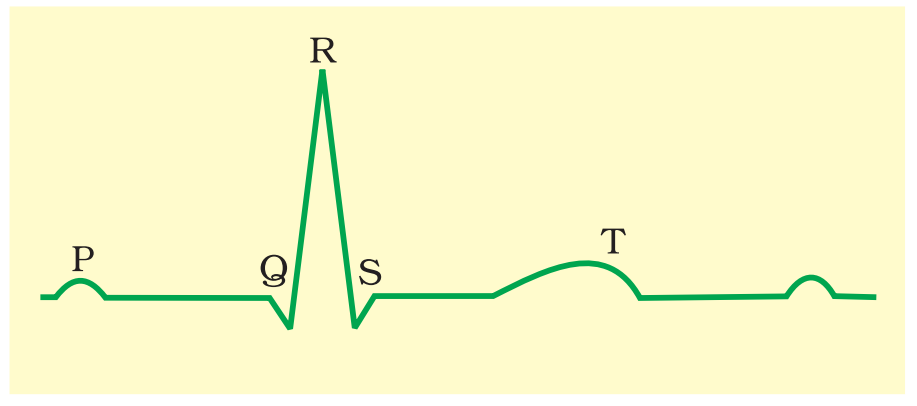
In the above picture $Q$ represents.- A
- B
Depolarisation of ventricles.
- ✓
- D
View full question & answer→MCQ 1121 Mark
If red blood cells are placed in distilled water, they will:
- A
- ✓
First increase in volume and then burst
- C
- D
AnswerCorrect option: B. First increase in volume and then burst
View full question & answer→MCQ 1131 Mark
- A
- B
Birds, reptiles and insects.
- C
- ✓
Fishes and fresh water protozoans.
AnswerCorrect option: D. Fishes and fresh water protozoans.
View full question & answer→MCQ 1141 Mark
Which is the first point where blood reaches first from systemic circulation?
MCQ 1151 Mark
What would be the cardiac output of a person having $72$ heart beats per minute and a stroke volume of $50\ mL?$
- A
$360\ mL$
- ✓
$3600\ mL$
- C
$7200\ mL$
- D
$5000\ mL$
AnswerCorrect option: B. $3600\ mL$
View full question & answer→MCQ 1161 Mark
Glucose is carried from digestive tract to liver by:
MCQ 1171 Mark
The affinity of $CO$ with $Hb$ is more than oxygen by:
- A
$20$ times.
- B
- ✓
$2000$ times.
- D
AnswerCorrect option: C. $2000$ times.
View full question & answer→MCQ 1181 Mark
The beating of the heart in a human being is heard on the left side because:
- A
Both the atria are towards the left side.
- ✓
Both the ventricles are towards the left side.
- C
Entire heart is on the left side.
- D
The aorta is on the left side.
AnswerCorrect option: B. Both the ventricles are towards the left side.
View full question & answer→MCQ 1191 Mark
The valve that guards the opening between right atrium and right ventricle, is called:
MCQ 1201 Mark
The vein that supplies nutrients from the intestine to the liver, is:
MCQ 1211 Mark
Which one of the following is not related to the clotting of blood?
- A
- B
- C
$Ca^{++}$
- ✓
$Na^+$ of the plasma
AnswerCorrect option: D. $Na^+$ of the plasma
View full question & answer→MCQ 1221 Mark
Which is the last point from where blood goes from the heart to systemic circulation?
MCQ 1231 Mark
Thromboplastin required in blood clotting is secreted by:
MCQ 1241 Mark
Which of the following statement is correct?
AnswerCorrect option: D. Both $A$ and $B.$
View full question & answer→MCQ 1251 Mark
In humans, blood passes from the post caval to the diastolic right atrium of heart due to:
- ✓
Pressure difference between the post caval and atrium.
- B
Pushing open of the venous valves.
- C
- D
Stimulation of the sino auricular node.
AnswerCorrect option: A. Pressure difference between the post caval and atrium.
View full question & answer→MCQ 1261 Mark
The pattern of contraction and relaxation of the heart is referred to as:
MCQ 1271 Mark
If a person stays on Mount Everest for some days:
- A
His body will step up production of $\text{RBC}$
- ✓
His body will step down production of $\text{RBC}$
- C
Number of $\text{RBC}$ will not change
- D
His $\text{RBC}$ will turn into very large cells
AnswerCorrect option: B. His body will step down production of $\text{RBC}$
Even at moderate elevations, many people experience headaches and shortness of breath due to lower oxygen concentrations at that level. However, if they stay at that elevation, the body will compensate by producing more red blood cells and all functions will return to normal.
View full question & answer→MCQ 1281 Mark
In a standard $\text{ECG}$ which one of the following alphabets is the correct representation of the respective activity of the human heart?
AnswerCorrect option: B. $P-$depolarisation of the atria.
View full question & answer→MCQ 1291 Mark
Which artery supplies blood to the heart muscle?
MCQ 1301 Mark
The average diameter of red blood corpuscles of man is:
- ✓
$7.2\ \mu m$
- B
$8.1\ \mu m$
- C
$9.2\ \mu m$
- D
$10.3\ \mu m$
AnswerCorrect option: A. $7.2\ \mu m$
View full question & answer→MCQ 1311 Mark
Antibodies in our body are complex.
MCQ 1321 Mark
A siderocyte is a $\text{RBC}$ containing:
AnswerA siderocyte is an abnormal $\text{RBC}$ that has iron granules that are not part of haemoglobin. Pappenheimer bodies are the abnormal granules of iron found in the $\text{RBCs}$ on routine blood stain. They are a type of inclusion body formed by phagosomes, that have engulfed excessive amounts of iron.
View full question & answer→MCQ 1331 Mark
What is the normal blood pressure of human beings?
- A
$\frac{110}{70}$
- B
$\frac{120}{70}$
- ✓
$\frac{120}{80}$
- D
$\frac{110}{80}$
AnswerCorrect option: C. $\frac{120}{80}$
$\frac{120}{80}$ is the normal measurement to blood pressure.
$22\ \text{mm Hg}$ is the systolic or pumping pressure.
$80\ \text{mm Hg}$ is the diastolic or resting pressure.
View full question & answer→MCQ 1341 Mark
Arteries are best defined as the vessels which:
- A
Carry blood from one visceral organ to another visceral organ.
- B
Supply oxygenated blood to the different organs.
- ✓
Carry blood away from the heart to different organs.
- D
Break up into capillaries which reunite to form a vein.
AnswerCorrect option: C. Carry blood away from the heart to different organs.
View full question & answer→MCQ 1351 Mark
Erythrocytes in camel are:
AnswerCamels have to live without food and water for a long time. Their $\text{RBCs}$ have an oval shape unlike those of other mammals, which are circular. This facilitates the flow of red blood cells during dehydration and makes them better at withstanding high osmotic variation without rupturing when drinking large amounts of water.
View full question & answer→MCQ 1361 Mark
Which of the following organisms has an open circulatory system?
MCQ 1371 Mark
Which one of the following statements about blood constituents and transport of respiratory gases is most accurate?
- A
$\ce{RBCs}$ transport oxygen whereas $\ce{WBCs}$ transport $\ce{CO_2}$.
- B
$\ce{RBCs}$ transport oxygen whereas plasma transports only $\ce{CO_2}$.
- C
$\ce{RBCs}$ as well as $\ce{WBCs}$ transport both oxygen and $\ce{CO_2}$.
- ✓
$\ce{RBCs}$ as well as plasma transport both oxygen and $\ce{CO_2}$.
AnswerCorrect option: D. $\ce{RBCs}$ as well as plasma transport both oxygen and $\ce{CO_2}$.
View full question & answer→MCQ 1381 Mark
Cardiac arrest is the state when:
- ✓
- B
Inadequate blood supply to the heart.
- C
Heart not pumping enough to meet the body needs.
- D
Blood pressure increases.
View full question & answer→MCQ 1391 Mark
Which one of the following human cells does not contain mitochondria?
MCQ 1401 Mark
An adult human with average health has systolic and diastolic pressures as :
- A
$70\ mm\ Hg$ and $120\ mm\ Hg.$
- B
$80\ mm\ Hg$ and $80\ mm\ Hg.$
- ✓
$120\ mm\ Hg$ and $80\ mm\ Hg.$
- D
$50\ mm\ Hg$ and $80\ mm\ Hg.$
AnswerCorrect option: C. $120\ mm\ Hg$ and $80\ mm\ Hg.$
View full question & answer→MCQ 1411 Mark
Mark the pair of substances among the following which is essential for coagulation of blood:
- A
Heparin and calcium ions.
- ✓
Calcium ions and platelet factors.
- C
- D
Platelet factors and heparin.
AnswerCorrect option: B. Calcium ions and platelet factors.
View full question & answer→MCQ 1421 Mark
If you suspect major deficiency of antibodies in a person, to which of the following would you look for confirmatory evidence?
- A
- ✓
- C
Fibrinogen in the plasma.
- D
View full question & answer→MCQ 1431 Mark
$\text{ECG}$ records:
- A
Electric current of the body
- B
- C
- ✓
Both $A$ and $B$
AnswerCorrect option: D. Both $A$ and $B$
As the heart undergoes depolarization and repolarization, the electrical currents that are generated spread not only within the heart, but also throughout the body. This electrical activity generated by the heart can be measured by electrodes placed on the body surface. The recorded tracing is called an electrocardiogram.
View full question & answer→MCQ 1441 Mark
Which of the following statements is true for lymph?
- A
$\text{WBC}$ and serum.
- ✓
All components of blood except $\text{RBCs}$ and some proteins.
- C
$\text{RBCs, WBCs}$ and plasma.
- D
$\text{RBCs}$, proteins and platelets.
AnswerCorrect option: B. All components of blood except $\text{RBCs}$ and some proteins.
View full question & answer→MCQ 1451 Mark
A clot of blood contains:
MCQ 1461 Mark
$\text{ECG}$ depicts the depolarisation and repolarisation processes during the cardiac cycle. In the $\text{ECG}$ of a normal healthy individual one of the following waves is not represented:
- A
- ✓
- C
Depolarisation of ventricles.
- D
Repolarisation of ventricles.
View full question & answer→MCQ 1471 Mark
Read the following statements and choose the correct option
Statement $1:$ Atria receive blood from all parts of the body which subsequently flows to ventricles.
Statement $2:$ Action potential generated at sino$-$atrial node passes from atria to ventricles.
- A
Action mentioned in Statement $1$ is dependent on action mentioned in Statement $2.$
- B
Action mentioned in Statement $2$ is dependent on action mentioned in Statement $1.$
- C
Action mentioned in Statements $1$ and $2$ are independent of each other.
- ✓
Action mentioned in Statements $1$ and $2$ are synchronous.
AnswerCorrect option: D. Action mentioned in Statements $1$ and $2$ are synchronous.
View full question & answer→MCQ 1481 Mark
The bicuspid and tricuspid valves close at the start of:
MCQ 1491 Mark
The cardiac impulse is initiated and conducted further upto ventricle. The correct sequence of conduction of impulse is:
- A
|
(a)
|
SA Node
|
AV Node
|
Purkinje fiber
|
AV Bundle
|
- B
|
(b)
|
SA Node
|
Purkinje fiber
|
AV Node
|
AV Bundle
|
- ✓
|
(c)
|
SA Node
|
AV Node
|
AV Bundle
|
Purkinje fiber
|
- D
|
(d)
|
SA Node
|
Purkinje fiber
|
AV Bundle
|
AV Node
|
AnswerCorrect option: C.
|
(c)
|
SA Node
|
AV Node
|
AV Bundle
|
Purkinje fiber
|
Explanation:
SA Node It is situated in the walls of the right auricle near the opening of the superior vena cava. In myogenic heart the contraction is initiated by SA node. AV Node The wave of contraction reaches AV node which is stimulated to emit an impulse of contraction spreading to the ventricular muscle via the atrio ventricular bundle and then to the Purkinje fibres stimulating heart beat.
View full question & answer→MCQ 1501 Mark
Which of the following substances, if introduce in the blood stream, would cause coagulation, at the site of its introduction?
MCQ 1511 Mark
Splenic artery arises from:
- A
Anterior mesenteric artery.
- ✓
- C
Posterior mesenteric artery.
- D
View full question & answer→MCQ 1521 Mark
What is true about $T-$lymphocytes in mammals?
AnswerCorrect option: C. There are of three main types$-$cytotoxic $T-$cells, helper $T-$cells and suppressor $T-$cells.
View full question & answer→MCQ 1531 Mark
Agranulocytes responsible for immune healthy individual one of the following waves is not represented. Response of the body are
MCQ 1541 Mark
View full question & answer→MCQ 1551 Mark
Which of the following does not help in clotting of blood?
- ✓
- B
- C
$Ca^{2+}$
- D
Exposure to $O_2$
View full question & answer→MCQ 1561 Mark
The arterial wall is thicker than that of veins, due to a comparatively thicker layer of:
MCQ 1571 Mark
Fastest distribution of some injectible material$/$ medicine and with no risk of any kind can be achieved by injecting it into the:
View full question & answer→