Questions

3 Marks Question

Take a timed test

8 questions · self-marked practice — reveal the answer and mark yourself.

Question 13 Marks
Distinguish between
i. Grey matter and White matter
ii. A stimulus and An Impulse
Answer
i. Difference between Grey matter and White matter:
Grey MatterWhite matter
It is composed of cell bodies (cytons) of a nerve cell. It is inside the brain but outside the spinal cordIt is composed of axons from the nerves cells. It is inside the brain but outside the spinal cord.
ii. Difference between A stimulus and An impulse:
A stimulusAn impulse
Any change in the environment of an organism that evokes response or impulse.It is a self-propagating wave electrochemical in nature; negatively travelling along the axon of a nerve cell.
View full question & answer
Question 23 Marks
Give the cause for the Heart sounds.
Answer
Heart sounds: These are resulted due to sharp closure of heart valves. The first sound 'lub' occurs at the onset of ventricular systole and; is caused due to sharp closure of AV valve and the ejection of blood from the ventricles.
The second heart sound 'dub' occurs at the beginning of ventricular diastole and is caused by sharp closure of the semilunar valves to the aorta and the pulmonary artery.
View full question & answer
Question 33 Marks
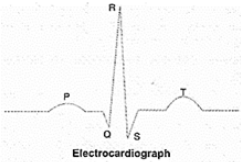
Draw a standard ECG and explain the different segments in it.
Answer
The P-wave represents the electrical excitation (or depolarisation) of the atria, which leads to the contraction of both the atria. The QRS complex represents the depolarisation of the ventricles, which initiates the ventricular contraction. The contraction starts shortly after Q and marks the beginning of the systole.
The T-wave represents the return of the ventricles from excited to the normal state (repolarization). The end of the T-wave marks the end of systole.
Obviously, by counting the number of QRS complexes that occur in a given time period, one can determine the heartbeat rate of an individual. Since the ECGs obtained from different individuals have roughly the same shape for a given lead configuration, any deviation from this shape indicates a possible abnormality or disease. Hence, it is of great clinical significance.

Image
View full question & answer
Question 43 Marks
Differentiate between a ball and socket joint and a pivot joint.
Answer
A Ball and Socket JointA pivot Joint
One bone forms a cup-like depression or socket in which ball-like structure fits.It permits movements resembling the rotation of the body around a pivot.
The head or ball can move freely in the socket.One of the two bones of the joint is always fixed in it.
e.g., Shoulder joint.e.g., Joint between atlas and axis vertebrae in man.
View full question & answer
Question 53 Marks
How are gibberellins useful in agriculture to improve productivity. Give any three points in support of your answer.
Answer
Gibberellins are useful in agriculture in the following ways:
i. Application of gibberellins increases the length of the stem and increases the yield of sugar in sugarcane.
ii. Gibberellins delay senescence and prevent the premature fruits drop.
iii. It can cause fruits like apple to elongate and improve in shape.
View full question & answer
Question 63 Marks
What are nucleotides? Describe their structure.
Answer
Nucleotides: They are small, complex molecules made of C, H, O, N, P. Each nucleotide consists of 3 units: a nitrogenous base, a pentose sugar, and phosphate groups. The nitrogenous base is a purine (adenine or guanine) or pyrimidine (thymine/cytosine/ uracil). The sugar may be ribose in ribonucleotide or deoxyribonucleotide. Combination of a nitrogenous base and a pentose sugar forms a nucleoside. Nucleotides are mono or di or triphosphates of nucleosides, e.g., Adenosine monophosphate (AMP), Adenosine diphosphate (ADP) and Adenosine triphosphate (ATP).
View full question & answer
Question 73 Marks
Write an account on skeleton of sponges.
Answer
The body of sponges contains a supporting exoskeleton. It is made up of either spicules or spongin fibres or both. Spongin fibres are protein fibres. They are either highly branched or show anastomosis. Spicules are calcareous or siliceous with hard spine-like structures. Depending on the branching the spicules are
i. monoaxons (single axis).
ii. triaxons (three-axis forming six rays of hexactinal spicules).
iii. tetraxons (four rays or tetra actinal).
iv. polyaxons (several rays).
View full question & answer
Question 83 Marks
Enlist the demerits of an artificial system of classification of plants.
Answer
Demerits of Artificial System:
i. Criteria used, though simple but arbitrary, are based on random morphological characters/traits.
ii. It lacks the natural relationship amongst the organisms.
iii. It fails to give an idea about the origin and evolution of different species.
iv. Many closely allied individuals were classified in separate groups and those with altogether different characters were placed in the same group.
View full question & answer