Question 14 Marks
Various parts of the plant such as stems leaves, and even fruits are modified into underground parts to perform various functions such as stems, leaves, and even fruits.
The stems in ginger and banana are underground and swollen due to storage of food. They are called rhizome. Rhizome of ginger is a modification of stem because it bears nodes, internodes, terminal buds, scaly leaves and buds, which give rise to aerial shoots. It is not a root because root does not have nodes and internodes. Also, rhizome does not perform the function of roots i.e. anchorage and absorption, rather it serve as reservoir for storage of food. Similarly, corm is an underground stem in Colocasia (jimikand) The tips of the underground stem in potato become swollen due to accumulation of food and forms tuber.
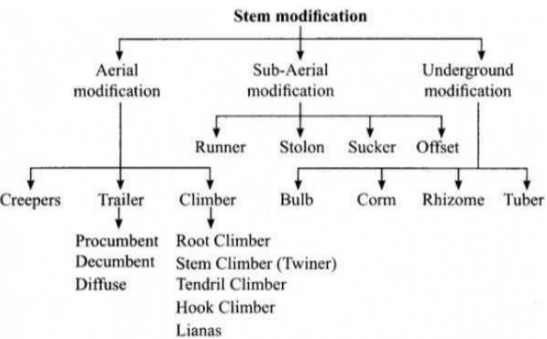
i. Observe the given flow chart and mention what are the four types of Underground stem modification also mention one example of each. (1)
ii. Ginger is an underground stem but why it is distinguished from a root? (1)
iii. Why do the tips of modified stems in potatoes become swollen? (2)
OR
Are all underground parts of a plant roots? (2)
The stems in ginger and banana are underground and swollen due to storage of food. They are called rhizome. Rhizome of ginger is a modification of stem because it bears nodes, internodes, terminal buds, scaly leaves and buds, which give rise to aerial shoots. It is not a root because root does not have nodes and internodes. Also, rhizome does not perform the function of roots i.e. anchorage and absorption, rather it serve as reservoir for storage of food. Similarly, corm is an underground stem in Colocasia (jimikand) The tips of the underground stem in potato become swollen due to accumulation of food and forms tuber.
i. Observe the given flow chart and mention what are the four types of Underground stem modification also mention one example of each. (1)
ii. Ginger is an underground stem but why it is distinguished from a root? (1)
iii. Why do the tips of modified stems in potatoes become swollen? (2)
OR
Are all underground parts of a plant roots? (2)
Answer
View full question & answer→i. • Rhizome - Ginger, turmeric.Banana
• Bulb - Tulips, Lilies, Daffodils, Onion, Garlic
• Corm - Colocasia, Yam, Saffron
• Tuber - Potato, Artichokes
ii. It has nodes and internodes. Such nodes and internodes are not found in the roots.
iii. Modified stem in the potato is underground and it becomes swollen because food gets accumulated to form tubers.
OR
No. Many different parts of plants, like the stem, leaves and fruits, get modified to act as underground structures that can perform functions other than those of roots.
• Bulb - Tulips, Lilies, Daffodils, Onion, Garlic
• Corm - Colocasia, Yam, Saffron
• Tuber - Potato, Artichokes
ii. It has nodes and internodes. Such nodes and internodes are not found in the roots.
iii. Modified stem in the potato is underground and it becomes swollen because food gets accumulated to form tubers.
OR
No. Many different parts of plants, like the stem, leaves and fruits, get modified to act as underground structures that can perform functions other than those of roots.