Questions

5 Marks Questions

Take a timed test

6 questions · self-marked practice — reveal the answer and mark yourself.

Question 15 Marks
Write the functions of the following
i. Centromere
ii. Cell wall
iii. Smooth ER
iv. Golgi Apparatus
v. Centrioles
Answer
i. Facilitates proper segregation of chromosomes.
ii. It provides structural rigidity to the plant cells. Plants cells need to be rigid because they cannot run for safety in case of any natural stress; unlike animals.
iii. Smooth ER facilitates the synthesis of lipids, metabolism of carbohydrates, regulation of calcium concentration and drug detoxification.
iv. Golgi apparatus is involved in the packaging of various substances that are manufactured in the endoplasmic reticulum.
v. They form the basal bodies of cilia and flagella and thus play an important role in the motility of certain cells. They also play an important role in cell division by forming asters. The aster as spindle pole during cell division.
View full question & answer
Question 25 Marks
What structural and functional attributes must a cell have to be called a living cell?
Answer
A cell must have the following structural and functional attributes to be called a living cell:
i. Plasma Membrane: A cell should have a plasma membrane. Without the plasma membrane, the contents of the cell cannot get a container and cells won't be able to maintain its independent existence.
ii. Functional Attributes of Plasma Membrane: The plasma membrane should be selectively permeable so as to facilitate the exchange of materials between the cell and its environment.
iii. Protoplasm: A cell must have a protoplasm to be called a living cell. It is the protoplasm which contains all the materials necessary for life to continue. If protoplasm dries up, the cell becomes dead; as in the case of sclerenchymatous cells.
iv. Endoplasmic Reticulum: Endoplasmic reticulum is necessary for the exchange of materials between nucleoplasm and cytoplasm. It is also necessary for the synthesis of various materials; like protein and lipid. Thus, a cell must have an ER to be considered a living cell.
Mitochondria are not mandatory for all living cells. For example; Red Blood Cells do not have mitochondria yet they are living cells. The prokaryotes do not have mitochondria but they are living cells.
The nucleus is not mandatory for all living cells. For example; mitochondria lack a nucleus. Similarly, prokaryotic cells lack a nucleus. Another important aspect of cells is that a cell is always formed from a pre-existing cell; as proposed in the Cell Theory.
View full question & answer
Question 35 Marks
Enumerate the assumptions that we have undertaken in making the respiratory balance sheet. Are these assumptions valid for a living system?
Answer
Respiratory Balance Sheet: Some assumptions in preparing respiratory balance sheet are:
i. None of the intermediates produced in this pathway is used to make any other compound.
ii. Only glucose is being respired-no other alternative substrates enter in the pathway at any of intermediary stages in any case.
iii. There seems to be a sequential, orderly pathway that is functioning, with a single substrate forming next as well as with glycolysis. Kreb's cycle and ETS pathway following one after the other pathway.
iv. NADH synthesised in glycolysis transferred to mitochondria; it undergoes oxidative phosphorylation also.
This assumption is not really valid in a living system since all the pathways work simultaneously; moreover, the substrates enter pathways and also are withdrawn from the pathways as and when required; ATP used when needed and enzymes control the reactions also. It is only useful in the extraction and storing energy; there is a net gain of 36 ATP mols in aerobic respiration for one mol of glucose.
View full question & answer
Question 45 Marks
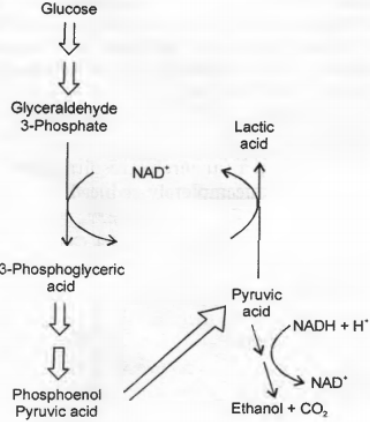
Define and explain the process of fermentation in animals, yeast and bacteria.
Answer
Fermentation: It occurs in some organisms like some bacteria that produce lactic acid from pyruvic acid. In animal cells, such as muscles during exercise, when $O _2$ is inadequate for cellular exercise, the pyruvic acid is reduced to lactic acid by lactate dehydrogenase. Reducing agent is $NADH + H ^{+}$ that is reoxidized to $NAD ^{+}$ in both processes. In both lactic acid and alcohol fermentation not much energy is released; less than seven percent of the energy in glucose released and not all of it is trapped as high energy bonds of ATP. The processes are hazardous: either the acid or alcohol is produced. Yeasts poison themselves to death when the concentration of alcohol reaches the app. 13%.

Image
View full question & answer
Question 55 Marks
Comment on the statement - Meiosis enables the conservation of specific chromosome number of each species even though the process per se, results in reduction of chromosome number.
Answer
Meiosis is called reduction division because the number of chromosomes in daughter cells becomes half of the number of chromosomes in mother cells. In spite of this, meiosis enables the conservation of specific chromosome number of each species. In fact, has there been no meiosis, organisms would not have been able to evolve to sexual mode of reproduction. We know that fertilization involves fusion of male and female gametes. Thus, zygote gets the chromosome pool from two cells and the number of chromosomes in a zygote becomes double that of the gametes. To ensure conservation of specific chromosome number after fertilization, it is necessary that the gametes should have half the number of chromosomes compared to what it is in somatic cells.
View full question & answer
Question 65 Marks
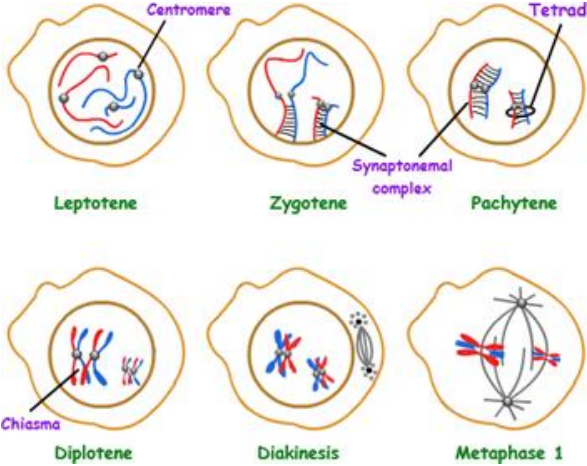
What are the various stages of meiotic prophase-I? Enumerate the chromosomal events during each stage?
Answer
Following are the various stages of meiotic prophase - 1:

Image

i. Leptotene: During this stage, chromosomes become gradually visible under the light microscope. The compaction of the chromosome continues through this stage. The sister chromatids are so tightly bound that one cannot be differentiated from another.
ii. Zygotene: At this stage, chromosomes start forming pairs. This process is called synapsis. Formation of synapsis is accompanied by the formation of synaptonemal complex. Each pair is called a bivalent or tetrad.
iii. Pachytene: At this stage, the bivalent chromosomes become distinct. Recombination nodules appear on the tetrads. The recombination nodule is the site at which crossing over takes place. Crossing over takes place between non-sister chromatids of homologous chromosomes. Crossing over facilitates the exchange of genes between two homologous chromosomes.
iv. Diplotene: At this stage, the synaptonemal complex gets dissolved. The recombined chromosomes begin to separate from each other. But they are attached at the site of crossing over. This makes an X-shaped structure called chiasmata.
v. Diakinesis: Chiasmata is terminated at this stage. The nucleolus disappears and so does the nuclear membrane.
View full question & answer