Questions

3 Marks Question

Take a timed test

38 questions · self-marked practice — reveal the answer and mark yourself.

Question 13 Marks
Suppose there were plants that had a high concentration of Chlorophyll b, but lacked chlorophyll a, would it carry out photosynthesis? Then why do plants have chlorophyll b and other accessory pigments?
Answer
Chlorophyll-a molecules act as antenna molecules. They get excited by absorbing light and emit electrons during cyclic and non-cyclic photophosphorylations. They form the reaction centers for both photosystems I and II. Chlorophyll-b and other photosynthetic pigments such as carotenoids and xanthophylls act as accessory pigments. Their role is to absorb energy and transfer it to chlorophyll-a. Carotenoids and xanthophylls also protect the chlorophyll molecule from photo-oxidation. Therefore, chlorophyll-a is essential for photosynthesis. If any plant were to lack chlorophyll-a and contain a high concentration of chlorophyll-b, then this plant would not undergo photosynthesis.
View full question & answer
Question 23 Marks
Look at leaves of the same plant on the shady side and compare it with the leaves on the sunny side. Or, compare the potted plants kept in the sunlight with those in the shade. Which of them has leaves that are darker green ? Why?
Answer
The shady side of the plant/potted plants kept in the shade will have more concentration of chlorophyll and hence a darker green colour of leaves. This is because of the following two reasons:
  1. The chloroplasts of the mesophyll cells are irregularly arranged, and their orientation is in vertical files along the walls in strong light.
  2. Photo oxidation of chloroplasts occurs in bright light and its non-oxidation occurs in shaded areas.
View full question & answer
Question 33 Marks
By looking at a plant externally can you tell whether a plant is $\mathrm{C}_3$ or $\mathrm{C}_4$ ? Why and how?
Answer
One cannot distinguish whether a plant is $\mathrm{C}_3$ or $\mathrm{C}_4$ by observing its leaves and other morphological features externally. Unlike $C_3$ plants, the leaves of $C_4$ plants have a special anatomy called Kranz anatomy and this difference can only be observed at the cellular level. For example, although wheat and maize are grasses, wheat is a $C_3$ plant, while maize is a $C_4$ plant.
View full question & answer
Question 43 Marks
By looking at which internal structure of a plant can you tell whether a plant is $\mathrm{C}_3$ or $\mathrm{C}_4$ ? Explain.
Answer
The leaves of $C_4$ plants have a special anatomy called Kranz anatomy. This makes them different from $\mathrm{C}_3$ plants. Special cells, known as bundle-sheath cells, surround the vascular bundles. These cells have a large number of chloroplasts. They are thick-walled and have no intercellular spaces. They are also impervious to gaseous exchange. All these anatomical features help prevent photorespiration in $\mathrm{C}_4$ plants, thereby increasing their ability to photosynthesis.
View full question & answer
Question 53 Marks
RuBisCO is an enzyme that acts both as a carboxylase and oxygenase. Why do you think RuBisCO carries out more carboxylation in $\mathrm{C}_4$ plants?
Answer
RuBisCO has a much greater affinity for $\mathrm{CO}_2$ than for $\mathrm{O}_2$. It is the relative concentration of $\mathrm{O}_2$ and $\mathrm{CO}_2$ which determines which of the two will bind to the enzyme.
RuBisCO functions as oxygenase only when there is a higher concentration of oxygen and lower concentration of carbon dioxide. In $\mathrm{C}_4$ plants, the enzyme RuBisCO is absent in mesophyll chloroplasts. It is present only in bundle sheath chloroplasts which get continuous supply of $\mathrm{CO}_2$ even when the stomata are closed through conversion of malic acid to pyruvic acid. Therefore, RuBisCO usually acts as carboxylase rather than oxygenase.
View full question & answer
Question 63 Marks
Give comparison between the following: Anatomy of leaf in $\mathrm{C}_3$ and $\mathrm{C}_4$ plants
Answer
Anatomy of leaf in $\mathrm{C}_3$ and $\mathrm{C}_4$ plants:
  Anatomy of leaf in $\mathrm{C}_3$ plants   Anatomy of leaf in $\mathrm{C}_4$ plants
i.
 
Plants do not posses 'Kranz' anatomy of leaves.
i.
Leaves of $\mathrm{C}_4$ plants have 'Kranz' anatomy.
ii.
Chloroplasts are not dimorphic.
ii.
Chloroplasts are dimorphic. The chloroplasts of bundle sheath cells are larger in size and arranged centripetally.
iii.
Mesophyll cells have intercellular spaces.
iii.
Mesophyll cells do not have intercellular spaces.
View full question & answer
Question 73 Marks

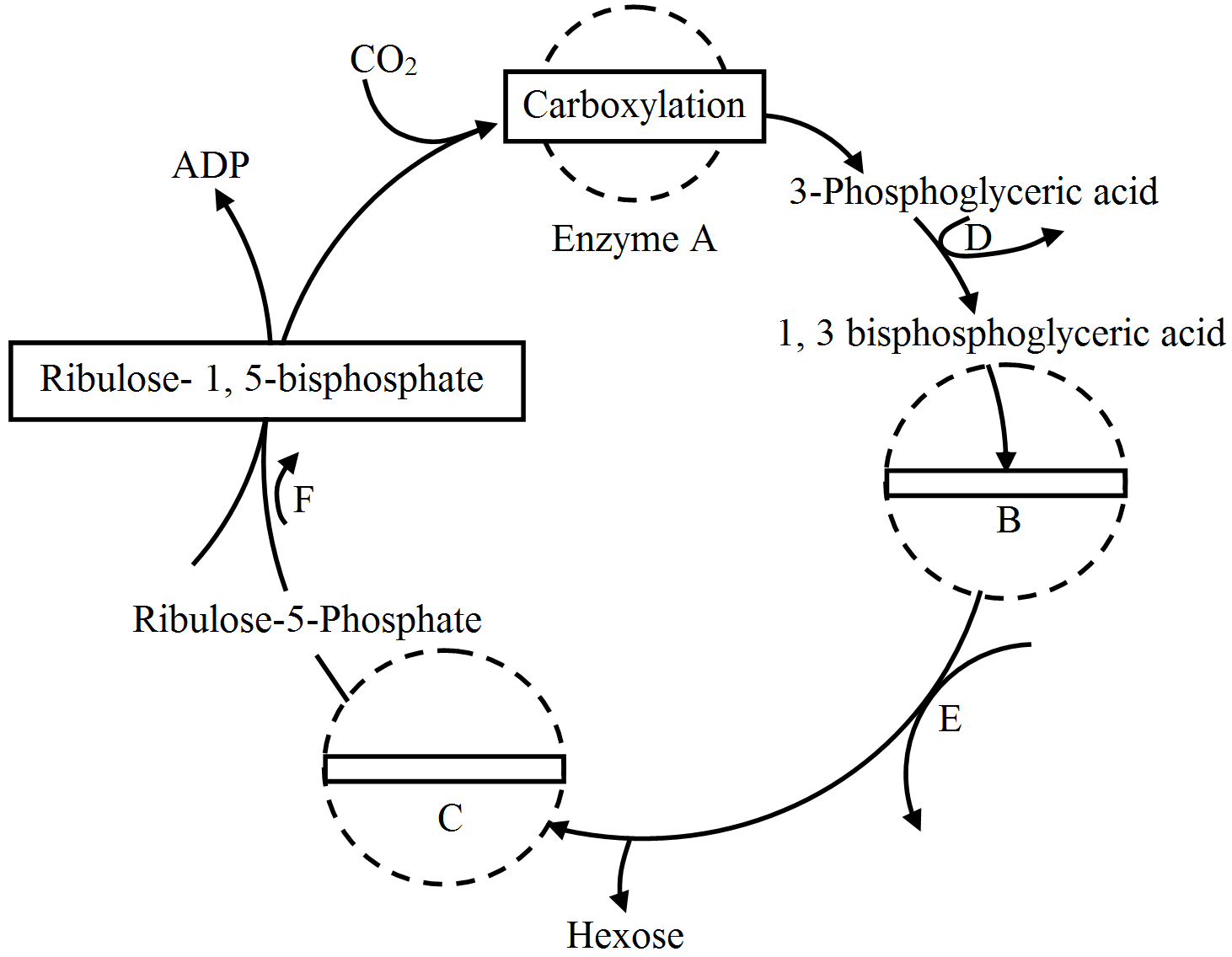
The diagram given below shows stages in the light-independent reactions of photosynthesis. Answer the following:
  1. At which stage NADPH is oxidised?
  2. What are A, B and C?
  3. At what stages ATP is converted into ADP?

Answer
  1. NADPH is oxidised at stage E.
  2. A-RuBP carboxylase oxygenase (RuBisCO), B-Reduction, C-Regeneration
  3. ATP is converted to ADP at stages D and F.
View full question & answer
Question 83 Marks
Give a brief account of light reaction.
Answer
Light reactions or the 'Photochemical' phase include following steps:
  • Light absorption
  • Water splitting
  • Oxygen release
  • The formation of high-energy chemical intermediates, ATP and NADPH.
Several complexes are involved in the process. The pigments are organised into two discrete photochemical light harvesting complexes (LHC) within the Photosystem I (PS I) and Photosystem II (PS II). These are named in the sequence of their discovery, and not in the sequence in which they function during the light reaction. The LHC are made up of hundreds of pigment molecules bound to proteins. Each photosystem has all the pigments (except one molecule of chlorophylla) forming a light harvesting system also called antennae. These pigments help to make photosynthesis more efficient by absorbing different wavelengths of light. The single chlorophyll a molecule forms the reaction centre. The reaction centre is different in both the photosystems. In PS I the reaction centre chlorophyll a has an absorption peak at 700 nm, hence is called P700, while in PS II it has absorption maxima at 680 nm, and is called P680.
View full question & answer
Question 93 Marks
A cyclic process is occurring in $\mathrm{C}_3$ plant, which is light dependent, and needs $\mathrm{O}_2$. This process doesn’t produce energy rather it consumes energy.
  1. Can you name the given process?
  2. Is it essential for survival?
  3. What are the end products of this process?
  4. Where does it occur?
Answer
  1. Photorespiration is the light dependent process of oxygenation of ribulose biphosphate (RuBP) and release of carbon dioxide by the photosynthetic organs of plant.
  2. Photorespiration does not produce energy or reducing power, rather it consumes energy. Further, it undoes the work of photosynthesis. Therefore, photorespiration is a highly wasteful process. It is not essential for survival.
  3. The end product of this process is phosphogly cerate.
  4. The site of photorespiration is chloroplast whereas; peroxisome and mitochondria are required for completing the process.
View full question & answer
Question 103 Marks
Expand PEP. Where is it produced in $\mathrm{C}_4$ plants? What is its role in the biosynthetic process?
Answer
  • PEP-phosphoenol pyruvate.
  • It is produced in the mesophyll cells of leaves of $\mathrm{C}_4$ plants.
  • It is the primary acceptor of carbon dioxide and is converted into oxaloacetic acid (OAA).
  • Thus it helps in carbon fixation in these plants.
  • By this pathway, the carbon dioxide concentration in the bundle sheath increases and photorespiration is prevented from occurring.
View full question & answer
Question 113 Marks
Give a brief explanation of photosynthesis.
Answer
Carbon dioxide is converted into sugars in a process called carbon fixation. Carbon fixation is a redox reaction, so photosynthesis needs to supply both a source of energy to drive this process, and also the electrons needed to convert carbon dioxide into carbohydrate, which is a reduction reaction. In general outline, photosynthesis is the opposite of cellular respiration, where glucose and other compounds are oxidized to produce carbon dioxide, water, and release chemical energy.
View full question & answer
Question 123 Marks
Photosynthetic organisms occur at different depths in the ocean. Do they receive qualitatively and quantitatively the same light? How do they adapt to carry out photosynthesis under these conditions?
Answer
Light is rarely a limiting factor for photosynthesis because light saturation occurs at 10% of the full sunlight. So, except for plants in shade or dense forest; light is rarely a limiting factor. Photosynthetic organisms in oceans are found at various depths and the amount of light available to them is enough for carrying out photosynthesis. Moreover, these organisms show great variations in photosynthetic pigments. These pigments help these organisms to carry out photosynthesis even in low light conditions.
View full question & answer
Question 133 Marks
Name the two important enzymes of $C_3$ and $C_4$ pathways, respectively? What important role do they play in fixing $\mathrm{CO}_2$ ?
Answer
The important enzymes of $\mathrm{C}_3$-cycle is RuBisCO and that of $\mathrm{C}_4$ pathway is PEP carboxylase. They help in the fixation of $\mathrm{CO}_2$. In $\mathrm{C}_3$-cycle the $\mathrm{CO}_2$ acceptor is Ribulose-1, 5 Biphosphate (RuBP) and the first stable product is Phosphoglyceric Acid (PGA). In $\mathrm{C}_4$-cycle, the $\mathrm{CO}_2$ acceptor is PEP carboxylase and the first stable product is Oxaloacetic Acid (OAA).
View full question & answer
Question 143 Marks
We know that photosynthesis is the only means because of which we get food. Here are two suggestions to increase the availability of food for human beings. Which of them is good and why?
  1. We should replace all plants with those plants from which we get food.
  2. We should maintain the diversity of plant species because all plants are To important for us.
Answer
The first option is wrong because growing only those plants from which we get food would disturb the ecosystem. The second option is the correct one, because a plant may not be directly useful for us, but it is useful for us in indirect way. Let us take example of grass. We do not use grass as food and hence the grass may look useless for us. But the grass is the main fodder for many herbivores. Some of those herbivores are domesticated for milk and meat. Moreover, any living being is important for maintaining the balance of the ecosystem.
View full question & answer
Question 153 Marks
Why does not photorespiration take place in $\mathrm{C}_4$ plants?
Answer
In $\mathrm{C}_4$ plants photorespiration does not occur. This is because they have a mechanism that increases the concentration of $\mathrm{CO}_2$ at the enzyme site and due to the kranz anatomy. The mesophyll cells lacks RuBis Co enzyme. The malic acid from the mesophyll is broken down in the bundle sheath cells to release $\mathrm{CO}_2$. This results in increasing the intracellular concentration of $\mathrm{CO}_2$. This ensures that the RuBis O function as a carboxylase minimizing the oxygenase activity.
View full question & answer
Question 163 Marks
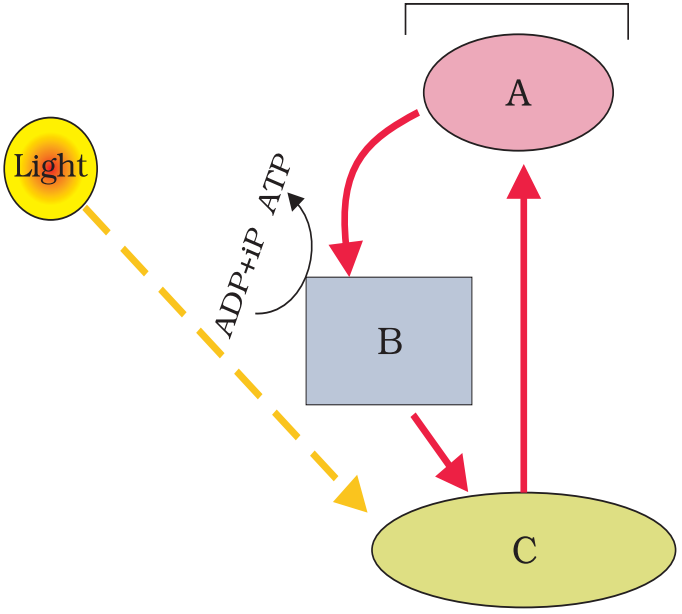
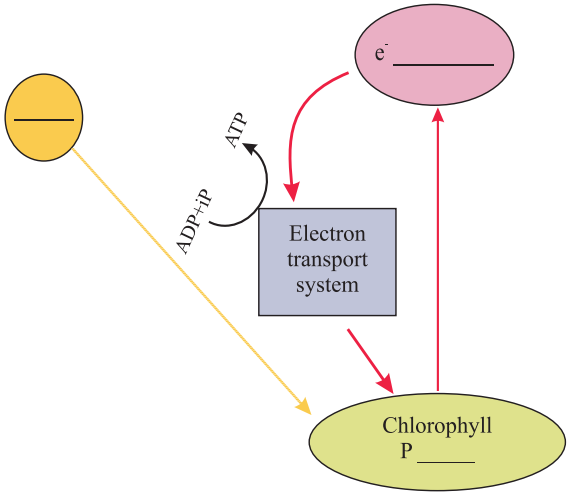
In the diagram shown below label A, B, C. What type of phosphorylation is possible in this?
Answer

The cyclic photophosphorylation is shown in the above figure.
View full question & answer
Question 173 Marks
In what kind of plants do you come across Kranz anatomy? To which conditions are those plants better adapted? How are these plants better adapted than the plants, which lack this anatomy?
Answer
$\mathrm{C}_4$ -plants are better adapted to dry tropical regions.
They have the following features:
  1. Can tolerate high temperatures.
  2. Can perform photosynthesis in high light intensities.
  3. Have overcome the problem of photorespiration and have greater productivity of biomass.
View full question & answer
Question 183 Marks
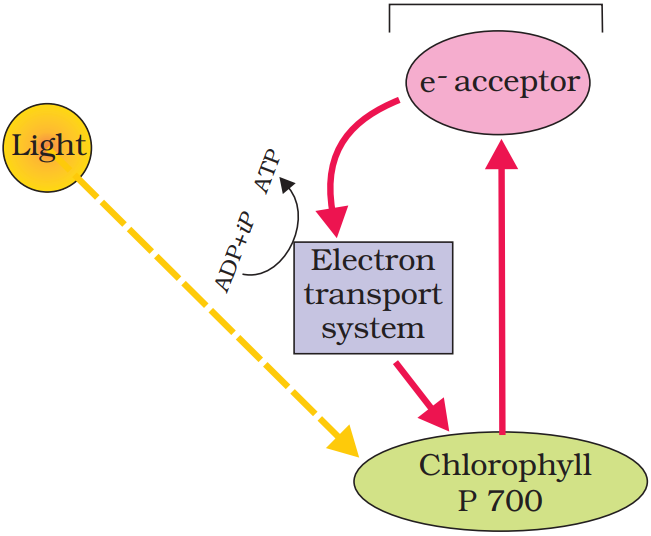
Cyclic photophosphorylation results in the production of ATPs and not NADPH. Give reasons.
Answer
Cyclic phosphorylation occurs when only 700 nm light is available and PS-I is functional. It occurs in the stroma lamellae where enzyme NADP reductase is absent and PS-II is also absent. Hence, electrons are passed on back to PS-I and not to NADP $^{+}$. So, the cyclic flow results in the formation of ATP, but not NADPH.
View full question & answer
Question 193 Marks
Explain the reasons of following.
  1. Photosynthesis can occur in the absence of light.
  2. Even non-green leaves can make the food.
  3. Photosynthesis can occur under water.
Answer
  1. Photosynthesis cannot occur in the absence of sunlight. The sunlight originally supplies the energy for conversion of $\mathrm{CO}_2$ to carbohydrate.
  2. Yes, the chlorophyll is the most prominent plant pigment, but not in all plants. Some other accessory pigments such as xanthophylls and carotenoids can also perform photosynthesis separately (in some algae).
  3. Photosynthesis can occur under water only when the water is clear and shallow. Some alga (Rhodophyta) can synthesise food at deep water layers as they can absorb the light of blue wavelength, efficiently.
View full question & answer
Question 203 Marks
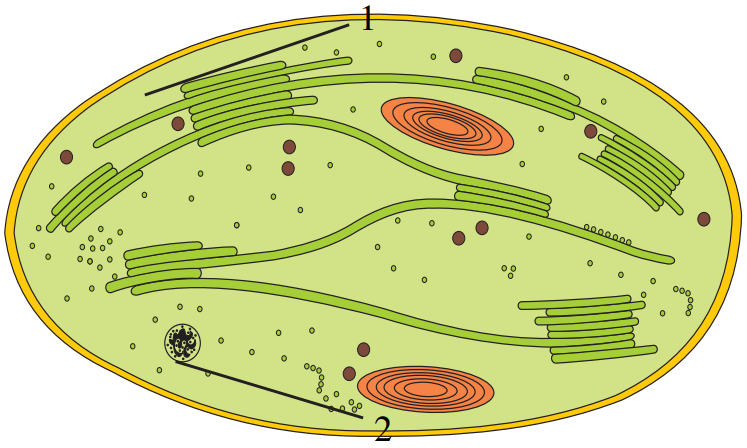
Examine the figure.
  1. Is this structure present in animal cell or plant cell?
  2. Can these be passed on to the progeny? How?
  3. Name the metabolic processes taking place in the places marked (1) and (2).
Answer
  1. The given figure represents structure of chloroplast. They are photosynthetic organelles in plants. This structure is present in plant cell.
  2. Yes, these can be passed on to the progeny. Chloroplasts are semi-autonomous cell organelles as they possess DNA. During cytokinesis chloroplast as well as other cell organelles are distributed to the daughter cells.
  3. In the given figure, part marked as (1) is stroma of chloroplast where dark reaction of photosynthesis takes place. Marked part (2) is extra nuclear DNA or chloroplast DNA. Chloroplast DNA is responsible for replication of chloroplast.
View full question & answer
Question 213 Marks


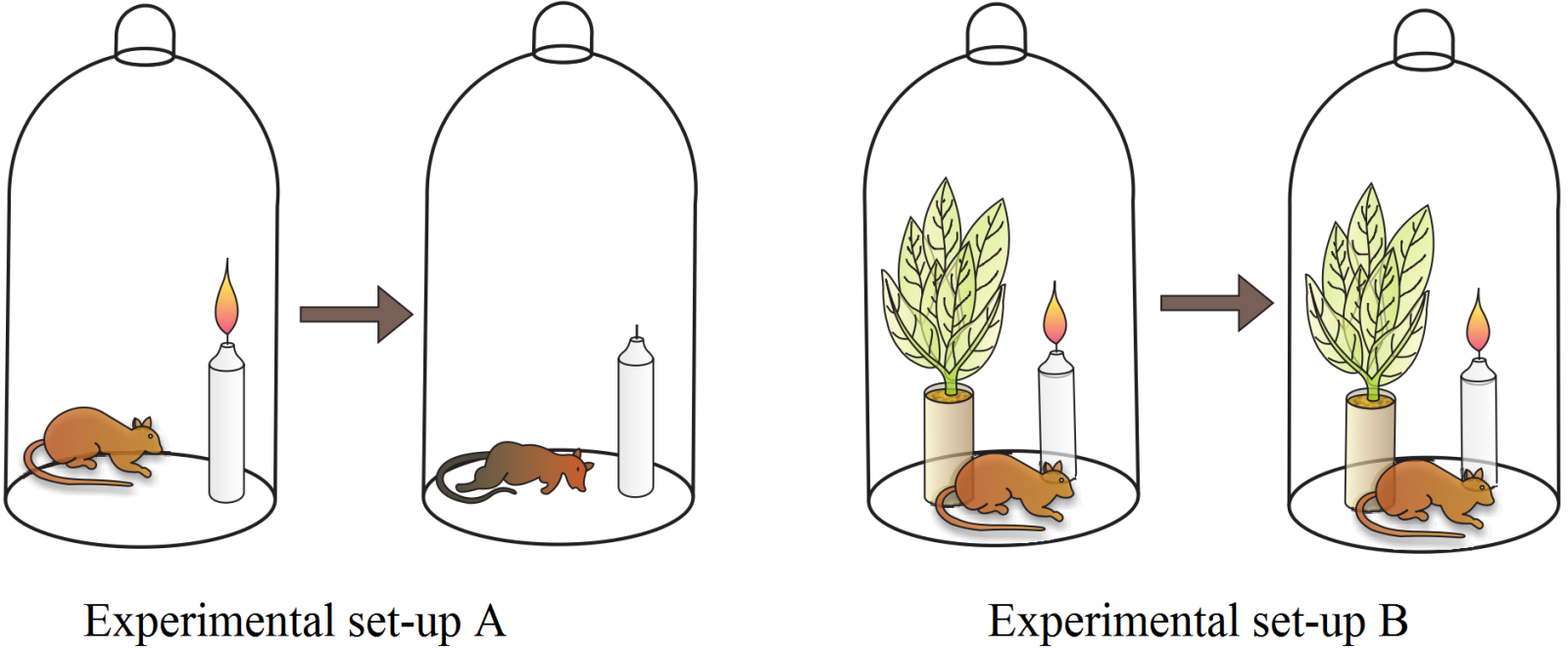
Why has the mouse survived in the set-up B but died in the first set-up A? Who conducted this experiment? What did he conclude from this experiment?
Answer
  • In set up B, the plant carries out photosynthesis, using the carbon dioxide liberated by the mouse and the burning candle and liberates oxygen.
  • Since $\mathrm{O}_2$ is made available, the mouse survived.
  • Joseph Priestley conducted this experiment.
  • He concluded that plants restore to air whatever the breathing animals and the burning candles remove.
View full question & answer
Question 223 Marks
Give reasons for the following.
  1. Plants are the lungs of nature.
  2. Chlorophyll-b and other accessory pigments are necessary for photosynthesis.
  3. In the high light intensities, the chlorophyll-a gets damaged.
Answer
  1. Plants are also called lungs of the nature because, they perform the exact function as lungs do in mammals. They produce oxygen, which is necessary for all forms of life. So, in essence since our lungs keep us alive in the same way the trees keep our lungs alive.
Thus, they are considered to be the part of our lung existence.
  1. Chlorophyll-b and other accessory pigments are necessary as these are light absorbing compounds found in photosynthetic organisms. These pigments enable a wider range of wavelength of incoming light to be utilised for photosynthesis.
  2. Chlorophyll-a structure is such that it gets damaged by bright/high light intensities. It is protected by, carotenoid pigments.
View full question & answer
Question 233 Marks
Is it correct to say that photosynthesis occurs only in leaves of a plant? Besides leaves, what are the other parts that may be capable of carrying out photosynthesis? Justify.
Answer
Although all cells in the green part of a plant have chloroplasts, most of the energy is captured in the leaves. The cells in the interior tissues of a leaf, called the mesophyll, can contain between 450000 and 800000 chloroplasts for every square millimeter of leaf (nearly 60-70 chloroplasts/ cell). The surface of the leaf is uniformly coated with a water-resistant waxy cuticle that protects the leaf from excessive evaporation of water and decreases the absorption of ultraviolet or blue light to reduce heating. The transparent epidermal layer allows light to pass through to the palisade mesophyll cells, where most of the photosynthesis takes place. The green stems are also capable of performing photosynthesis.
View full question & answer
Question 243 Marks
What conditions enable RuBisCO to function as an oxygenase? Explain the ensuring process.
Answer
Carboxylation is the most crucial step of the Calvin cycle, where $\mathrm{CO}_2$ is utilised for the carboxylation of RuBP. This reaction is catalysed by the enzyme RuBP carboxylase, which results in the formation of two molecules of 3-PGA. Since, this enzyme also has an oxygenation activity, it would be more correct to call it RuBP carboxylase oxygenase or RuBisCO.
View full question & answer
Question 253 Marks
Two groups (A and B) or bean plants of similar size and same leaf area were placed in identical conditions. Group A was exposed to light of wavelength 400-450nm and Group B to the light of wavelength of 500-550nm. Compare the photosynthetic rate of the two groups by giving reason.
Answer
Group A will show more photosynthesis. Chlorophyll absorbs maximum light in the blue region of the spectrum, i.e., 400-450nm and hence, photosynthetic rate will also be high. Group B will show negligible amount of photosynthesis or no photosynthesis. Chlorophyll does not absorb any light in the green region, i.e., 500-550nm, but reflects green so, plants appear green.
View full question & answer
Question 263 Marks
Name the internal/plant factors that determine the rate of photosynthesis.
Answer
The internal factors that affect the rate of photosynthesis are:
  1. Internal $\mathrm{CO}_2$ concentration.
  2. Amount of chlorophyll.
  3. Number, size, age and orientation of leaves.
  4. Number and size of mesophyll cells.
  5. Number and size of chloroplasts.
View full question & answer
Question 273 Marks
Describe three reasons for the generation of a proton gradient between the lumen of thylakoids and the stroma of chloroplasts.
Answer
  1. The splitting of water occurs on the inner side of the thylakoid membrane; hence protons remain in the lumen of thylakoids.
  2. The primary electron acceptor, located on the outer side of the membrane, transfers its electrons to a hydrogen acceptor; so with the electron transport, the proton also moves to the lumen of thylakoids.
  3. The NADP reductase enzyme, located on the outerside of the membrane uses protons from the stroma for the reduction of NADP, thus decreasing the concentration of protons in the stroma.
View full question & answer
Question 283 Marks
Give comparison between the $\mathrm{C}_3$ leaf anatomy and $\mathrm{C}_4$ leaf anatomy.
Answer
Comparison between anatomy of leaf in $\mathrm{C}_3$ and $\mathrm{C}_4$- plants:
S.No.
$\mathrm{C}_3$Leaf Anatomy
$\mathrm{C}_4$Leaf Atomy
(i)
Only one type of chloroplast is present.
Kranz anatomy, i.e., tYPe of cell, each with its own tYPe of chloroplast is Present.
(ii)
Less efficient in photosynthesis than $\mathrm{C}_4$ leaves.
More efficent in photosynthesis than $\mathrm{C}_3$ leaves.
(iii)
Only mesophyll cells carryout photosynthesis.
Both mesophyll cells and bundle sheath cells carryout photosynthesis.
View full question & answer
Question 293 Marks
What is photorespiration?
Answer
In $\mathrm{C}_3$ plants some $\mathrm{O}_2$ does bind to RuBisCO, and hence $\mathrm{CO}_2$, fixation is decreased. Here the RuBP instead of being converted to 2 molecules of PGA binds with $\mathrm{O}_2$ to form one molecule and phosphoglycolate in a pathway called photorespiration. In the photorespiratory pathway, there is neither synthesis of sugars, nor of ATP. Rather it results in the release of $\mathrm{CO}_2$ with the utilisation of ATP. In the photorespiratory pathway there is no synthesis of ATP or NADPH. Therefore, photorespiration is a wasteful process.
View full question & answer
Question 303 Marks
Describe chemiosmosis.
Answer
Chemiosmosis requires a membrane, a proton pump, a proton gradient and ATPase. Energy is used to pump protons across a membrane, to create a gradient or a high concentration of protons within the thylakoid lumen. ATPase has a channel that allows diffusion of protons back across the membrane; this releases enough energy to activate ATPase enzyme that catalyses the formation of ATP. Along with the NADPH produced by the movement of electrons, the ATP will be used immediately in the biosynthetic reaction taking place in the stroma, responsible for fixing $\mathrm{CO}_2$ and synthesis of sugars.
View full question & answer
Question 313 Marks
What is the basis for designating $\mathrm{C}_3$ and $\mathrm{C}_4$ pathways of photosynthesis?
Answer
In case of Cg pathways, carbon is fixed into a 3-carbon compound, i.e. 3-PGA. On the other hand, in case of $\mathrm{C}_4$ pathways, carbon is fixed into a 4-carbon compound, i.e. oxaloacetic acid. Thus, number of carbon atoms in the end product is the basis for designating $C_3$ and $C_4$ pathways of photosynthesis.
View full question & answer
Question 323 Marks
Mention the steps involved in $\mathrm{C}_4$ pathway/ Hatch and Slack pathway starting from atmospheric $\mathrm{CO}_2$ to its entry into the $C_3$ cycle.
Answer
  • The atmospheric $\mathrm{CO}_2$ entering the leaf is fixed by phosphoenol pyruvate (PEP), a 3C compound in the mesophyll cells, into a 4C compound, oxaloacetic acid (OAA) catalysed by the enzyme, PEP carboxylase (PEP case).
  • It is converted into malic or aspartic acid in the mosophyll cells and then is transported into the bundle sheath cells.
  • In the bundle sheath cells, malic acid is decarboxylated, i.e. it is broken down into a 3C compound, pyruvate with the release of $\mathrm{CO}_2$.
View full question & answer
Question 333 Marks
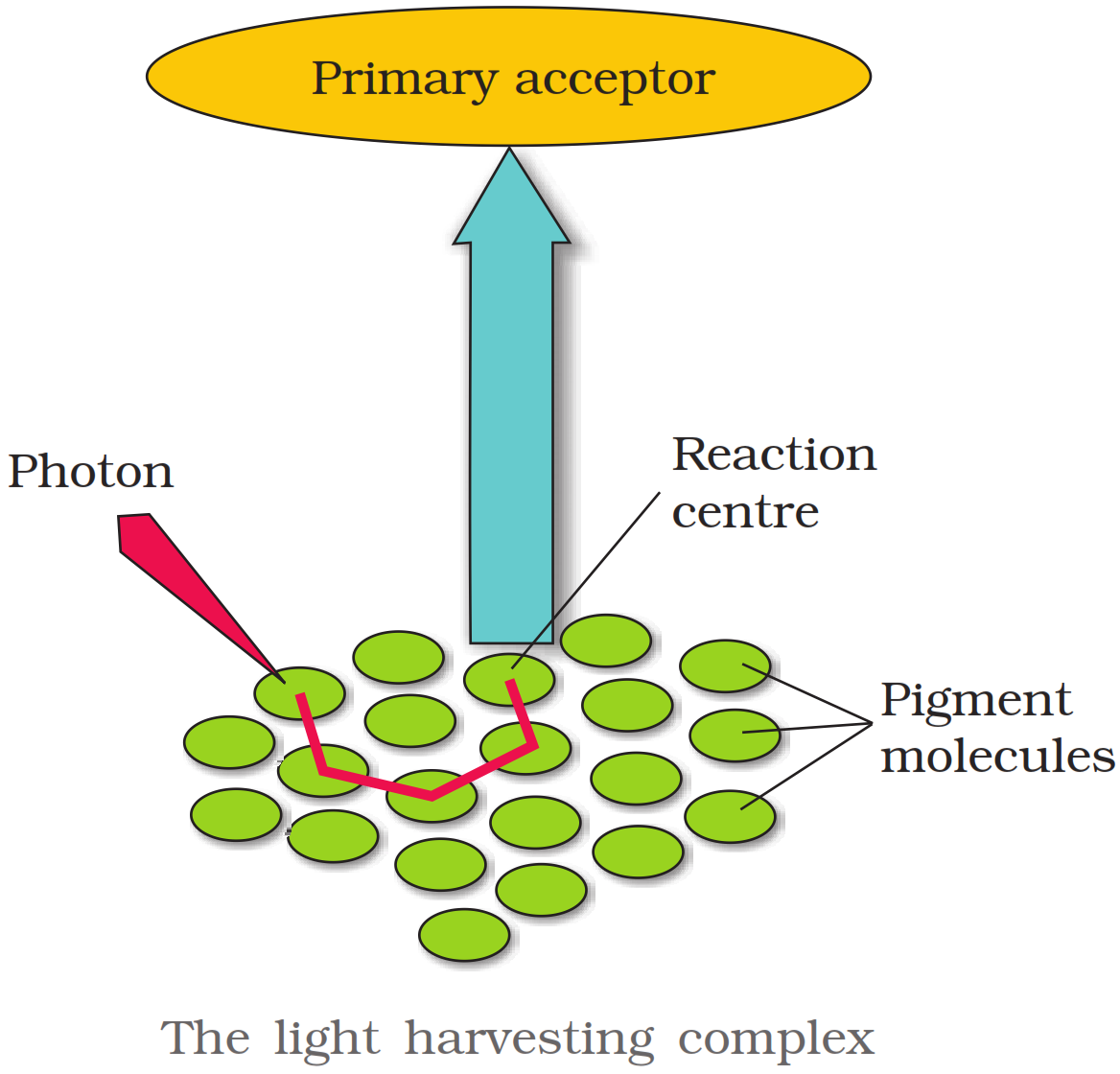
Describe the light harvesting complexes of photosystems.
Answer
  • The light harvesting complexes are aggregates of pigments organised within photosystem I and photosystem II.
  • Each LHC is made up of hundreds of pigment molecules bound to certain proteins.
  • In each LHC, one molecule of chlorophyll a forms the reaction centre, where the actual light reactions take place, while the other pigment molecules of the complex form the antennae; they absorb light at different wavelengths and pass it on to the reaction centre, to make the process more efficient.
  • In PS I, the reaction centre is $P_{700}$ which is a chlorophyll a molecule that has an absorption peak at 700 nm and in PS II, the reaction centre is PO which is a chlorophyll a molecule with an absorption peak at 680 nm.
  •  
View full question & answer
Question 343 Marks
Why does the rate of photosynthesis decrease at higher temperatures?
Answer
Temperature does not influence light reactions of photosynthesis but affects the enzyme controlled dark reactions. The optimum temperature for photosynthesis is 18 to 35°C. When temperature is increased from minimum to optimum, the rate of photosynthesis doubles for every 10°C rise in temperature. Above the optimum temperature, the rate of photosynthesis shows an initial increase for short duration but later declines.
View full question & answer
Question 353 Marks
Explain how during light reaction of photosynthesis, ATP synthesis as a chemiosmotic phenomenon takes place?
Answer
Chemiosmosis requires a membrane, a proton pump, a proton gradient and ATP synthase enzyme. Energy is used to pump protons across a membrane, to create a gradient or a high concentration of protons within the thylakoid lumen. ATP synthase enzyme catalyses the formation of ATP, along with the NADPH produced by.the movement of electrons. The energy carried by ATP molecules will be used immediately in the biosynthetic reaction taking place in the stroma for fixing $\mathrm{CO}_2$ and synthesis of sugars.
View full question & answer
Question 363 Marks
A group of plants lacks photorespiration. Answer the following questions based on these plants.
  1. Which cells in the plant have RuBisCO?
  2. Does photorespiration occur in these plants?
  3. In which cells the $\mathrm{CO}_2$ fixation initially occurs.
Answer
  1. Bundle sheath cells.
  2. Photorespiration does not occur in these plants.
  3. Atmospheric $\mathrm{CO}_2$ is first fixed into organic acid (4C) in the mesophyll cells in the presence of PEP carboxylase enzyme.
View full question & answer
Question 383 Marks
If a green plant is kept in dark with proper ventilation, can this plant carry out photosynthesis? Can anything be given as supplement to maintain its growth or survival?
Answer
Plant which is kept in dark with proper ventilation cannot carry out photosynthesis. In this case, the plant will survive till its reserve food material is not exhausted completely, afterwards, it will die. Such a plant can survive in only one condition, i.e., when provided with artificial light source like a lightened bulb or tube light along with water. So it can carry out photosynthesis and grow.
View full question & answer