Questions

2 Marks Questions

Take a timed test

56 questions · self-marked practice — reveal the answer and mark yourself.

Question 12 Marks
Describe Absolute and relative growth rates.
Answer
Absolute growth rate refers to the measurement and comparison of total growth per unit time. Relative growth rate refers to the growth of a particular system per unit time, expressed on a common basis.
View full question & answer
Question 22 Marks
Describe Sigmoid growth curve.
Answer
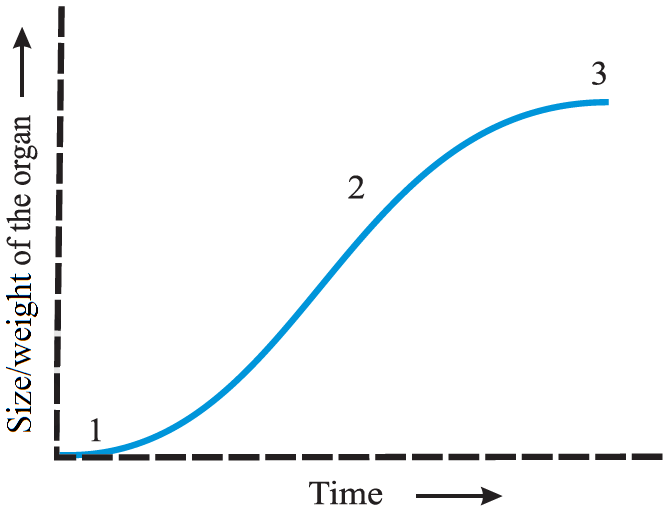
The growth of living organisms in their natural environment is characterised by an S-shaped curve called sigmoid growth curve. This curve is divided into three phases – lag phase, log phase or exponential phase of rapid growth, and stationary phase.
xponential growth can be expressed as:
$\text{W}_1=\text{W}_0\text{e}^{\text{rt}}$
Where,
$\text{W}_1​​​​​​​$ = Final size
$\text{W}_0$ = Initial size
r = Growth rate
t= Time of growth
e = Base of natural logarithms
View full question & answer
Question 32 Marks
Describe Geometric growth.
Answer
Geometric growth is characterised by a slow growth in the initial stages and a rapid growth during the later stages. The daughter cells derived from mitosis retain the ability to divide, but slow down because of a limited nutrient supply.
View full question & answer
Question 42 Marks
‘Both a short day plant and a long day plant can produce can flower simultaneously in a given place’. Explain.
Answer
The flowering response in short-day plants and long-day plants is dependent on the durations for which these plants are exposed to light. The short-day plant and long-day plant can flower at the same place, provided they have been given an adequate photoperiod.
View full question & answer
Question 52 Marks
Describe Arithmetic growth.
Answer
In arithmetic growth, one of the daughter cells continues to divide, while the other differentiates into maturity. The elongation of roots at a constant rate is an example of arithmetic growth.
View full question & answer
Question 62 Marks
‘Both growth and differentiation in higher plants are open’. Comment.
Answer
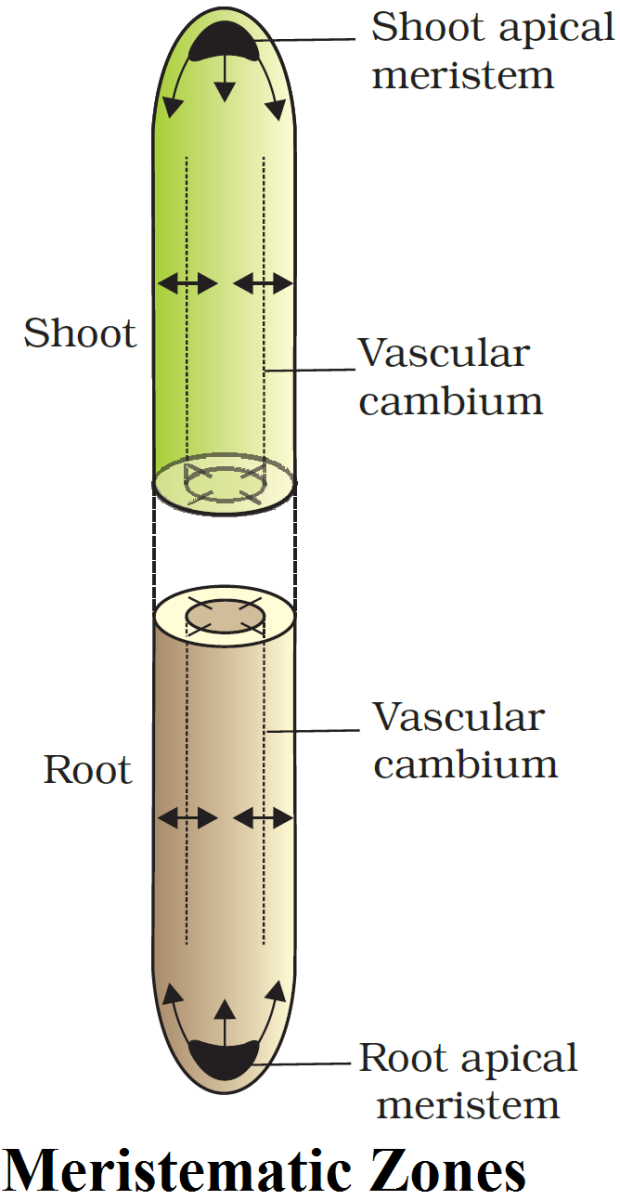
The higher plants retain the capacity for unlimited growth throughout their life. This ability of the plants is due to the presence of meristems at certain locations in their body. The cells of such meristems have the capacity to divide and self-perpetuate. Therefore, growths in higher plants are open. Also, some of these cells always undergo differentiation after some rounds of cell division. Hence, the differentiation is also open.
View full question & answer
Question 72 Marks
  1. Which phytohormone is also called a stress hormone? How does this hormone overcome stress conditions?
  2. Name the phytohormone, which is widely used to kill the dicotyledonous weeds?
Answer
  1. Abscisic acid is the stress hormone.
  • It causes closure of stomata and increases the tolerance of plant to water stress.
  • It induces dormancy in seeds and thereby helps the plant to withstand dessication and other unfavourable factors that affect plant growth.
  1. 2, 4 dichlorophenoxy aceitic acid.
View full question & answer
Question 82 Marks
Which among the following is a long day plant-sugarbeet, sugarcane, tomato? Why is it so called?
Answer
Sugarbeet is a long day plant. It is because in this plant flowering takes place when the plants are exposed to day length longer than a critical photoperiod.
View full question & answer
Question 92 Marks
Mention any six types of functions, influenced or controlled by plant growth promoters.
Answer
Plant growth promoters control activities like:
  1. Cell division.
  2. Cell enlargement.
  3. Pattern formation.
  4. Tropic movements.
  5. Flowering.
  6. Seed formation.
View full question & answer
Question 102 Marks
In most plants, the terminal bud suppresses the development of lateral buds. What is this phenomenon called? Name the phytohormone that can promote the phenomenon.
Answer
It is called apical dominance. Auxin hormone is responsible for this.
View full question & answer
Question 112 Marks
In a slide showing different types of cells, can you identify which type of the cell may be meristematic and the one which is incapable of dividing and how?
Answer
Meristematic cells are actively dividing cells which show mitotic divisions, i.e., each chromosome is split lengthwise into two homologous chromatids, which pass equally into daughter cells. Mature cells are incapable of divisions because in these cells differentiation has taken place.
View full question & answer
Question 122 Marks
If the critical photoperiod for a short-day plant is 13hrs of daylight, will it flower when there are 15hrs of daylight?
Answer
A short-day plant requires a minimum level of darkness in order to flower. In this example, the critical level of daylight is 13hrs, and any level of daylight beyond this will not allow the plant adequate hours of darkness. So the plant will, therefore, not flower when there are 15hrs of exposure of daylight.
View full question & answer
Question 132 Marks
What are the structural characteristics of: The cells in the elongation zone of the root.
Answer
The cells is elongation zone are newly formed cells which lose the power of division.They elongate rapidly and increase the length of root.The cells of this region can absorb, water and minerals from the soil.
View full question & answer
Question 142 Marks
Explain some natural means of overcoming seed dormancy.
Answer
Natural means of overcoming seed dormancy:
  1. Abrasions caused by microbial action.
  2. Abrasions because of passage through digestive tracts of animals.
View full question & answer
Question 152 Marks
The role of ethylene and abscisic acid is both positive and negative. Justify the statement.
Answer
The role of ethylene and abscisic acid is both positive and negative. Ethylene is a simple gaseous PGR. It is synthesised in large amount by tissues undergoing senescence and ripening. It also promotes senescence and abscission of plant organs especially of leaves and flowers. This is its negative effect. As its positive effect, ethylene breaks seed and bud dormancy, initiates germination in peanut seeds, sprouting of potato tubers. It promotes inter-node/ petiole elongation in deep water rice plants. It helps leaves/ inner parts of the shoot to remain above water.
View full question & answer
Question 162 Marks
Hard seed coat is one of the causes for seed dormancy. How is dormancy due to this overcome in nature?
Answer
In nature it is broken in the following ways:
  1. The hard seed coat is softened over a period of time by microbial action.
  2. When the seed passes through the alimentary canal of fruit-eating birds/ animals, the seed coat becomes soft due to the action of digestive juices on it.
  3. Abrasions on seed coat are caused by friction with soil and trampling by animals.
View full question & answer
Question 172 Marks
Gibberellins were first discovered in Japan when rice plants were suffering from bakane (the foolish seedling disease) caused by a fungus Gibberella fujikuroi.
  1. Give two functions of this phytohormone.
  2. Which property of Gibberellin caused foolish seedling disease in rice?
Answer
  1. GA3 is used to speed up the malting process in brewing industry. Gibberellins also promote bolting (internode elongation just prior to flowering) in beet, cabbages and many plants with rosette habit.
  2. Gibberellin causes foolish seedling disease in rice because it has the property of internode elongation.
View full question & answer
Question 182 Marks
Answer the following:
  1. Name the stress hormone found in plants.
  2. What causes 'bakane' disease of rice?
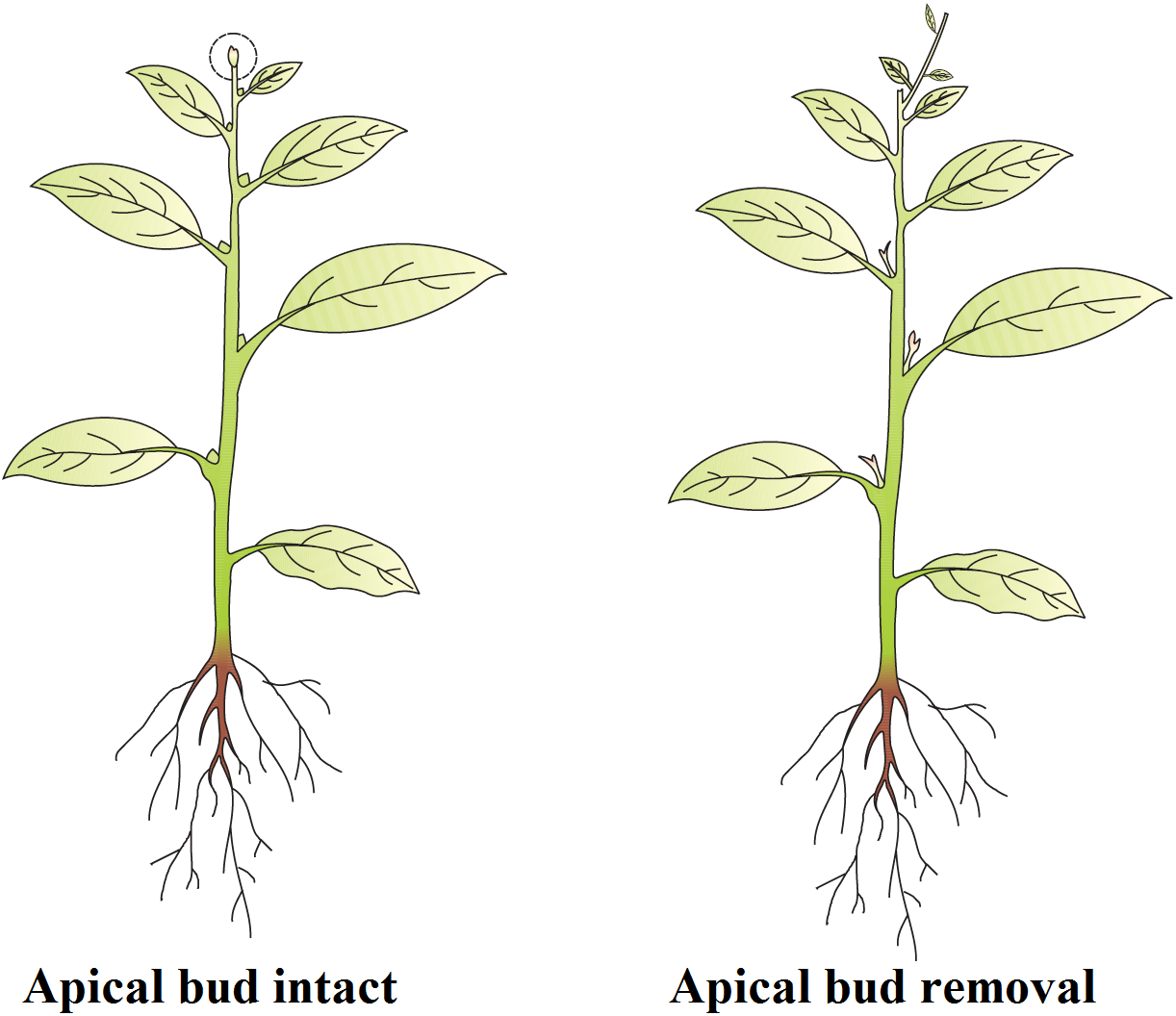
  3. Why do lateral buds start developing into branches, when apical buds are removed?
Answer
  1. Abscisic acid is the stress hormone.
  2. The 'bakane' disease is caused by Gibberella fujikuroi.
  3.  
  • When the apical buds are removed, the synthesis of auxin decreases.
  • Auxins are responsible for apical dominance, a phenomenon in which the lateral buds are suppressed to grow into branches.
  • In the absence of auxins (apical buds), there is no apical dominance and hence, the lateral buds develop into branches.
View full question & answer
Question 192 Marks
Write few lines about growth curve?
Answer
  1. It is the graphic representation of the total growth against time.
  2. The period of time in which growth takes place has been called grand period of growth by Sachs.
  3. The rate of growth is not uniform during grand period of growth.
  4. If total growth is plotted against time, a S-shaped or sigmoid curve is obtained. It consists of four parts, i.e., lag phase, exponential phase (log phase), phase of diminishing growth and stationary phase.
View full question & answer
Question 202 Marks
Differentiate between absolute growth rate and relative growth rate.
Answer
 
Absolute Growth Rate
Relative Growth Rate
1.
The total growth per unit time is absolute growth rate.
The total growth per unit time per unit parameter, is relative growth rate.
View full question & answer
Question 212 Marks
Mention any four artificial or man-made methods to overcome seed dormancy.
Answer
The following are the artificial methods of breaking seed dormancy:
  1. Abrasions are made in the seed coat mechanically using sand paper, knives, etc.
  2. Subjecting the seeds to chilling conditions removes the effect of inhibitor chemicals.
  3. The seeds are also exposed to certain light and temperature treatment.
  4. Treatment of seeds with gibberellic acid and nitrates helps to overcome the effect of chemical inhibitors.
View full question & answer
Question 222 Marks
What are the various man-made meant of overcoming seed dormancy?
Answer
Man-made means of overcoming seed dormancy:
  1. The seed-coat barrier in some seeds can be broken by mechanical abrasions using knives, sandpaper, etc. or by vigorous shaking
  2. Effect of inhibitory substances can be removed by subjecting the seeds to chilling conditions or by application of certain chemicals like gibberellic acid and nitrates.
  3. Changing environment conditions: like light and temperature.
View full question & answer
Question 232 Marks
What are the structural characteristics of: Meristematic cells near root tip.
Answer
Meristematic zone is the growing point of root and is subterminal.It is made up of compactly or closely arranged small thin walled isodiametric and meristematic cells which have dense protoplasm.They undergo repeated divisions and produce new cells for the root cap and basal region of the root. Therefore, it is essential for the growth of root.
View full question & answer
Question 242 Marks
Give two examples each of cells in a plant, that have undergone:
  1. Dedifferentiation.
  2. Redifferentiation.
Answer
  1. Cells of phellogen or cells of interfascicular cambium.
  2. Secondary cortex cells, cells of cork (phellem).
View full question & answer
Question 252 Marks
Differentiate between arithmetic growth and geometric growth.
Answer
 
Arithmetic growth
Geometric growth
1.
In this type of growth one of the two daughter cells formed cells former by mitosis continues to divide.
In this type of growth, both the progeny after mitoses continue to divide.
2.
It is seen in the elongation of root.
It is seen in organs/ issues exponential phase of growth.
View full question & answer
Question 262 Marks
What names were given to the PGRs that were discovered as inhibitors independently by three scientists? What are they all referred to as now?
Answer
  • Inhibitor-B, Abscissin II and dormin.
  • Now they are all referred to as abscisic acid.
View full question & answer
Question 272 Marks
What are the favourable conditions for seed germination?
Answer
Favourable conditions for seed germination:
  1. Proper temperature.
  2. Moisture.
  3. Sunlight.
  4. Oxygen.
View full question & answer
Question 282 Marks
  1. What is florigen?
  2. Which hormone breaks seed dormancy? State the mechanism involved.
Answer
  1. Florigen is a hypothetical hormone which induces flowering in plants.
  2. Gibberellin breaks seed dormancy. It mobilises the enzyme to hydrolyse stored food present in seed at the time of seed germination.
View full question & answer
Question 292 Marks
Suggest some ways in which inhibitors are important to plant survival in natural adverse conditions.
Answer
Inhibitors are important to the survival of higher plants in temperate zones where there are extreme variation in weather conditions prevails. Here plants become dormant during harsh winter period and become active plant on corning favourable conditions. Seeds often will not begin to germinate until they have been exposed to cold. The breaking of dormancy and the beginning of growth depend on the release from inhibition of metabolic activities.
View full question & answer
Question 302 Marks
What do you understand by apical dominance?
Answer
In most of the higher plants, growing apical bud inhibits the growth of lateral (axillary buds). This phenomenon is called apical dominance. Removal of short tips (decapitation) normally results in the growth of lateral buds. Decapitation is used in tea plantations to get more leaves from a plant.
View full question & answer
Question 312 Marks
In areas witnessing heavy flood which plant regulator should be used for better yield of rice. Give reasons.
Answer
Ethylene should be used on rice saplings. Ethylene promotes internode and petiole elongation so the height of the rice plant will be more. Additionally, ethylene also helps in maintaining aerial parts of a plant above the water.
View full question & answer
Question 322 Marks
How are gibberellins useful in agriculture to improve productivity. Give any three points in support of your answer.
Answer
Gibberellins are useful in agriculture in the following ways:
  1. Application of gibberellins increases the length of the stem and increases the yield of sugar in sugarcane.
  2. Gibberellins delay senescence and prevent the premature fruits drop.
  3. It can cause fruits like apple to elongate and improve in shape.
View full question & answer
Question 332 Marks
  1. What is meant by apical dominance? Name the phytohormone which controls it.
  2. How does abscisic acid act as a stress hormone in drought condition?
Answer
  1.  
  • Apical dominance is the phenomenon in which the presence of apical buds suppresses the growth of lateral buds into branches.
  • Auxin is responsible for this.
  1. During drought, abscisic acid signals closure of stomata and thereby checks the loss of water and increases the tolerance of plants to water stress.
View full question & answer
Question 342 Marks
What do you understand by development in plants. Mention the difference between two types of development shown by the plants.
Answer
Development is the sequence of events that occur in the life history of a cell, organ or organism, which include growth, differentiation, maturation and senescence.
  1. In homoblastic development the transition from juvenile to adult phase is gradual.
  2. In heteroblastic development the transition is abrupt.
View full question & answer
Question 352 Marks
What changes would the meristematic cell undergo to become a xylem tracheid or vessel?
Answer
  1. The cells would lose their protoplasm.
  2. They develop thick, elastic, lignocellulosic secondary cell wall.
View full question & answer
Question 362 Marks
  1. Define seed dormancy.
  2. Mention two causes for seed dormancy.
Answer
  1. Seed dormancy is defined as the inherent or endogenous blocks in the seed that do not allow the seed to germinate even under favourable conditions.
  2. It is caused by:
  1. The presence of hard seed coat, which is impervious to gases and/ or water.
  2. The presence of certain inhibitory chemicals in the seed.
  3. Immature embryo.
View full question & answer
Question 372 Marks
Define parthenocarpy. Name the plant hormone used to induce parthenocarpy.
Answer
Most fruits however develop only from the ovary and are called true fruits. Although in most of the species, fruits are the results of fertilization, there are a few species in which fruits develop without fertilization. Such fruits are called parthenocarpic fruits. Banana is one such example. Parthenocarpy can be induced through the application of growth hormones (like gibberellins and auxin) and such fruits are seedless. Auxins induce parthenocarpy in tomatoes.
View full question & answer
Question 382 Marks
What is heterophylly?
Answer
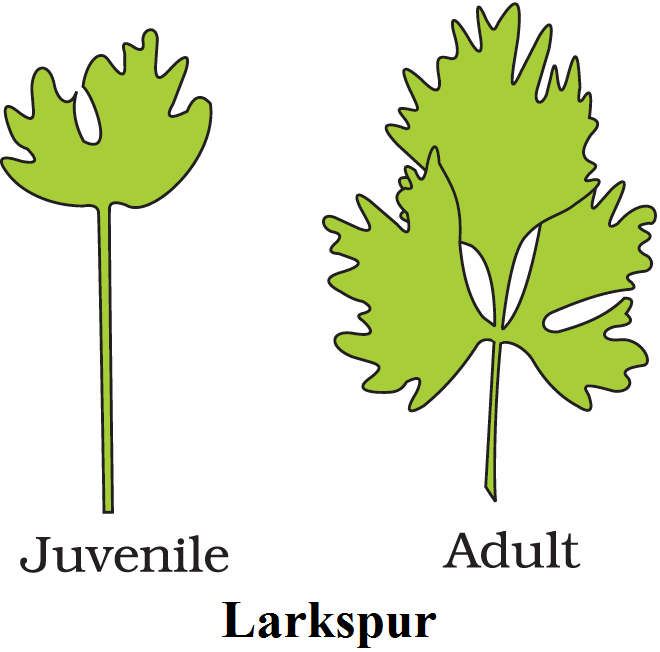
In some plants, certain structures show different forms, in response to environment or to phases of life. This ability is known as plasticity. For example, in cotton, coriander and larkspur, leaves of juvenile plant are different in shape compared to leaves in mature plants. This is called heterophylly. In buttercup shape of leaves produced in air is different from that produced in water.
View full question & answer
Question 392 Marks
Expand the following:
  1. NAAL
  2. IBA
  3. 2, 4-D
  4. ABA
Answer
  1. Naphthalene acetic acid.
  2. Indole butyric acid.
  3. 2, 4 dichlorophenoxy acetic acid.
  4. Abscisic acid.
View full question & answer
Question 402 Marks
What is apical dominance?
Answer
This is the phenomenon of more cell division taking place in shoot apex or root apex. The growth in apical regions prevents other parts from growing Horticulturists use this property to grow plants with more branches by cutting off the apex. This helps in channelizing resources to other areas of plant rather than to the apex.
View full question & answer
Question 412 Marks
  1. What is heterophylly?
  2. Name the type of heterophylly shown by:
  1. Buttercup.
  2. Cotton.
Answer
  1. Heterophylly is the phenomenon in which a plant bears different shapes of leaves.
  2.  
  1. Environmental heterophylly.
  2. Developmental heterophylly.
View full question & answer
Question 422 Marks
Which areas of plant show elongation phase? Why?
Answer
The root apex and shoot apex show elongation phase. They have apical meristem which has cells undergoing continuous cell division. This leads to elongation and growth of the apical region of shoot and root.
View full question & answer
Question 432 Marks
Define plasticity in plants. Give an example.
Answer
Plasticity is the ability of plants to follow different pathways in response to environment or phases of life to different structures. Ex.- Heterophylly in plants like cotton, buttercup, etc.
View full question & answer
Question 442 Marks
Explain whether the growth in plants is definite or indefinite.OR
State what do we call a form of growth in which newly producing cells are always being added to the body of the plant.
Answer
Growth in plants is indefinite because they have the capacity for unlimited growth throughout their life. This ability of the plants is due to the presence of meristems at certain locations. This type of growth is exhibited by roots, stem and their branches and is called open form of growth.
View full question & answer
Question 452 Marks
Explain what is meant by the terms auxin precursors, anti-auxins, free auxins and bound auxins.
Answer
The compounds, which can be converted into auxins, are called auxin precursors. The compounds, which inhibit the actions of auxins, are termed anti-auxins. The auxins, which can easily be extracted, are called free auxins. And auxins, which are hard to extract and need the use of organic solvents, are referred to as bound auxins.
View full question & answer
Question 462 Marks
An owner of an apple orchard wants to get better yield and wants to wait for good market conditions to sell his apples. Which PGR should he use to achieve his goals?
Answer
He should use Gibberellins. Gibberellins help increase the size of apples. Moreover, they also delay senescence so apple can be left on branches for a longer duration This will give the orchard owner enough time to wait for good market conditions.
View full question & answer
Question 472 Marks
Water and nutrients play important roles in the growth of plants. Justify.
Answer
Water:
  • It is necessary to maintain turgidity of cells that helps in extension of growth.
  • Water provides the medium for the biochemical or enzymatic reactions that are necessary for growth activities.
Nutrients:
  • They act as source of energy.
  • They are required for the synthesis of protoplasm as they are constituents of biomolecules.
View full question & answer
Question 492 Marks
Explain some internal causes of seed dormancy.
Answer
Internal causes of seed dormancy:
  1. Impermeable and hard seed coat.
  2. Presence of chemical inhibitors, such as absicissic acid, phenolic acid, para ascorbic acid, etc.
  3. Immature embryo.
View full question & answer
Question 502 Marks
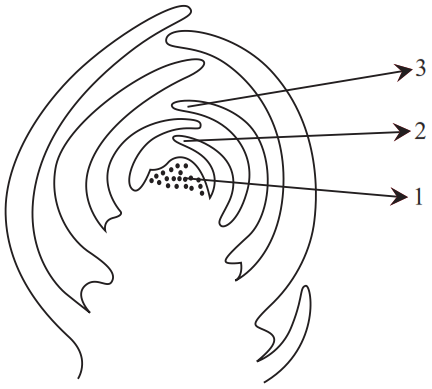
Label the diagram:
  1. This is which part of a dicotyledonous plant?
  2. If we remove part 1 from the plant, what will happen?
Answer
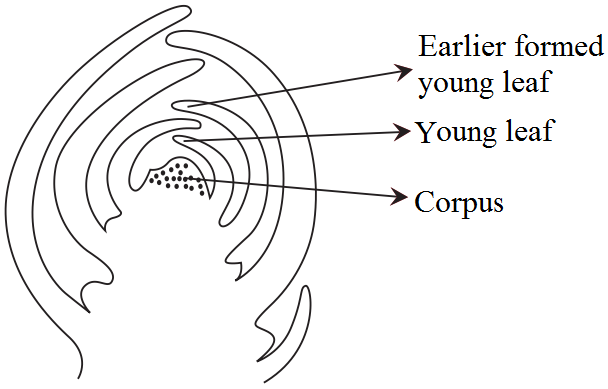
  1. The diagram shows shoot apex of a dicotyledonous plant.
  1. Part 1 is showing inner cellular mass of shoot apex known as corpus. Cells of corpus are large and divide in different planes. Cells derived from corpus form procambium and ground meristem.
View full question & answer
Question 512 Marks
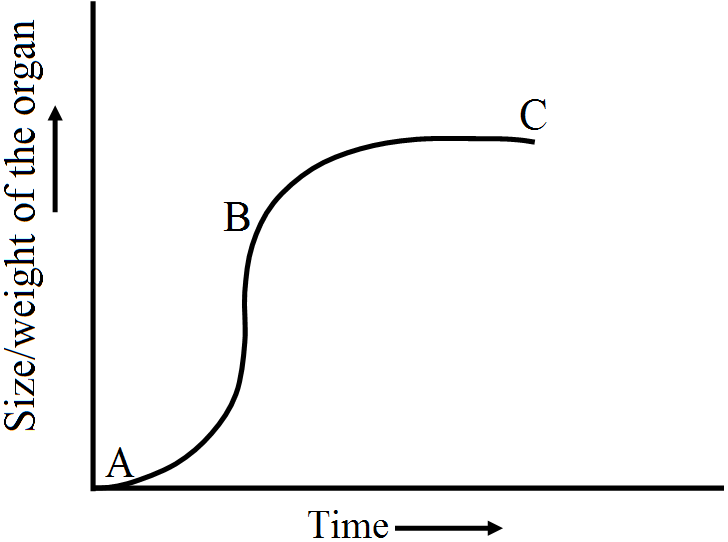
In the figure of sigmoid growth curve below label segments A, B and C.
Answer
A-Lag phase, B-Log phase and C-Steady phase.
View full question & answer
Question 532 Marks

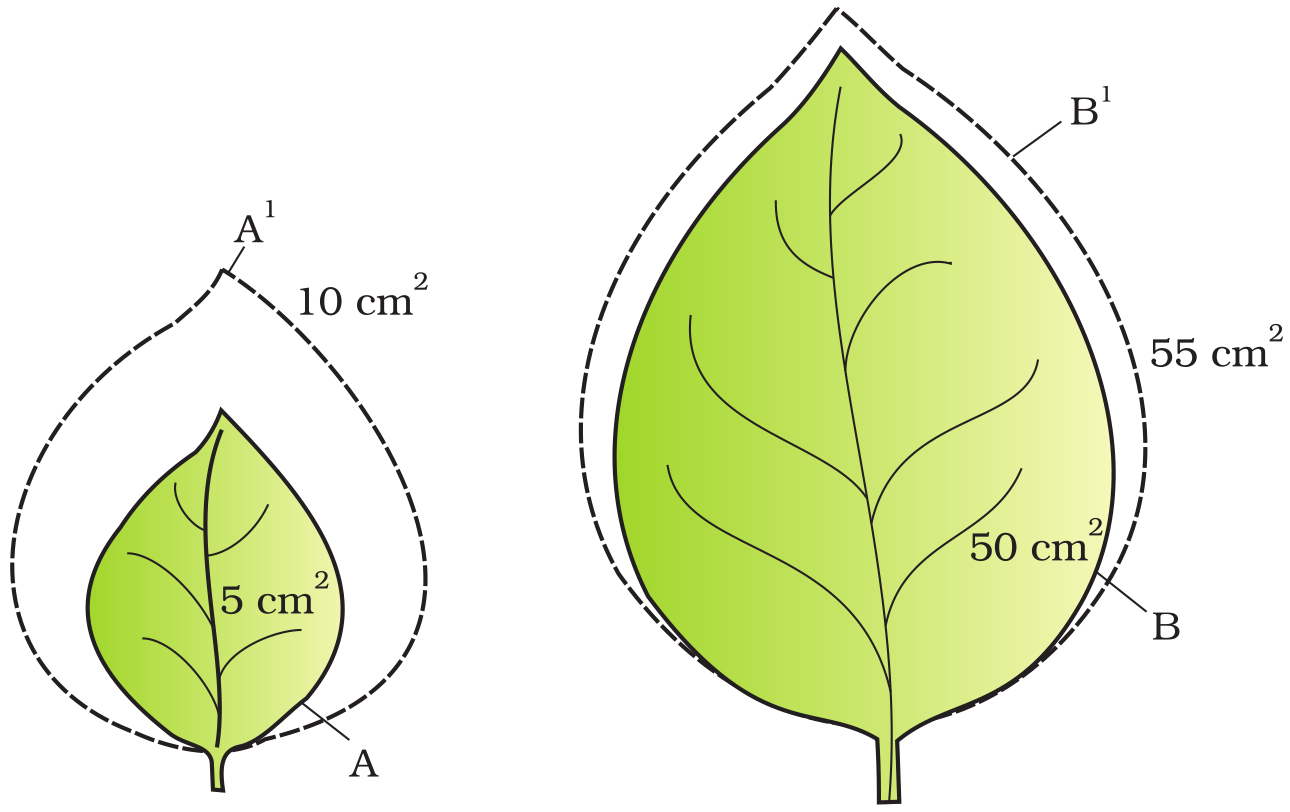
Which of them shows higher relative growth rate? Justify.
Answer
Relative growth rate of $\text{A}=\frac{10-5}{5}\times100=100\%$ Relative growth rate of $\text{B}=\frac{55-50}{50}\times100=10\%$ So, A shows higher relative growth rate.
View full question & answer
Question 542 Marks
Plant growth is unique. Justify.
Answer
  • Plant growth is indeterminate, as plants retain the capacity to grow throughout their life; this ability is due to the presence of meristems, where cells have the capacity to divide and self-perpetuate.
  • Plants show open form of growth, i.e., the form of growth, where new cells are continuously added to the plant body by the activity of meristems; hence, plant growth is unique.
View full question & answer
Question 552 Marks
Explain, how is it possible that a short-day plant and a long-day plant growing in the same location could flower on the same day of the year.
Answer
If a short day plant is artificially given long and uninterrupted dark period, it flowers even under long day conditions. Similarly, if a long day plant is artificially given long photoperiods, it flowers even under short day conditions. Thus, it is possible that a short day plant and a long-day plant growing in the same locality are made to flower on the same day of the year by providing suitable photoperiodic conditions artificially.
View full question & answer
Question 562 Marks
Which plant hormone can transform genetically dwarf plants into tall plants? State the mechanism involved with suitable example.
Answer
Cabbage and sugarbeet plants have rosette habit of leaves. The leaves in these plants are condensed because of shortening of internodal area of the stem. It is a genetic character. when we spray $GA _3$ solution on these plants, these became abnormally tall. It happens because of increase in internodal area. Thus, such genetically dwarf plant is made tall by $GA _3$.
View full question & answer