Questions

M.C.Q (1 Marks)

Take a timed test

223 questions · auto-graded multiple-choice test.

MCQ 11 Mark
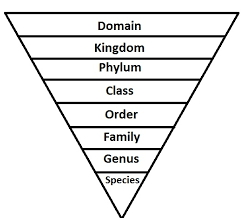
In the taxonomic categories which hierarchial arrangement in ascending order is correct in case of animals?
  • A
    Kingdom, Class, Phylum, Family, Order, Genus, Species
  • B
    Kingdom, Order, Class, Phylum, Family, Genus, Species
  • C
    Kingdom, Order, Phylum, Class, Family, Genus, Species
  • Kingdom, Phylum, Class, Order, Family, Genus, Species
Answer
Correct option: D.
Kingdom, Phylum, Class, Order, Family, Genus, Species
d
View full question & answer
MCQ 21 Mark
Which of the following is against the rules of $ICBN$?
  • A
    Hand written scientific names should be underlined
  • B
    Every species should have a generic name and a specific epithet
  • C
    Scientific names are in Latin and should be italized.
  • Generic and specific names should be written starting with small letters
Answer
Correct option: D.
Generic and specific names should be written starting with small letters
d
View full question & answer
MCQ 31 Mark
Select correctly written scientific name of Mango which was first described by Carolus Linnaeus
  • A
    Mangifera indica Car. Linn
  • Mangifera indica Linn
  • C
    Mangifera indica
  • D
    Mangifera Indica
Answer
Correct option: B.
Mangifera indica Linn
b
View full question & answer
MCQ 41 Mark
Match column $I$ with column $II$ for housefly classification and select the correct option using the codes given below.
Column $-I$ Column $-II$
$(A)$ Family $(i)$ Diptera
$(B)$ Order $(ii)$ Arthopoda
$(C)$ Class $(iii)$ Muscidae
$(D)$ Phylum $(iv)$ Insecta
  • $A­(iii), B­(i), C­(iv), D­(ii)$
  • B
    $A­(iii), B­(ii), C­(iv), D­(i)$
  • C
    $A­(iv), B­(iii), C­(ii), D­(i)$
  • D
    $A­(iv), B­(ii), C­(i), D­(iii)$
Answer
Correct option: A.
$A­(iii), B­(i), C­(iv), D­(ii)$
a
(a)
View full question & answer
MCQ 51 Mark
Nomenclature is governed by certain universal rules. Which one of the following is contrary to the rules of nomenclature?
  • A
    The names are written in Latin and are italicised.
  • B
    When written by hand the names are to be underlined.
  • Biological names can be written in any language.
  • D
    The first word in a biological name represents the genus name and the second is a specific epithet.
Answer
Correct option: C.
Biological names can be written in any language.
c
(c) : Biological names are derived either from Latin language or are latinised. This is because Latin language is a dead language and therefore it will not change in form or spellings with the passage of time.
View full question & answer
MCQ 61 Mark
The common characteristics between tomato and potato will be maximum at the level of their
  • family
  • B
    order
  • C
    division
  • D
    genus.
Answer
Correct option: A.
family
a
(a) : Potato (Solanum tuberosum) and tomato (Lycopersicum esculentum) both belong to family Solanaceae, which is commonly called as the “potato family”. Many plants belonging to this family are sources of vegetables, fruits etc.
View full question & answer
MCQ 71 Mark
Which of the following is incorrect $w.r.t.$ Species?
  • A
    A group of individual organisms with fundamental similarities
  • Two different species breed together to produce fertile offsprings
  • C
    Human beings belong to the species sapiens
  • D
    Panthera has many specific epithet as tigris, leo and pardus
Answer
Correct option: B.
Two different species breed together to produce fertile offsprings
b
Two different species cannot breed together to produce fertile offsprings.
 
View full question & answer
MCQ 81 Mark
$A :$ Biological concept of species is based on reproductive isolation.
$R :$ Most accepted species concept was given by Linnaeus.
  • A
    Assertion and Reason both are correct and also correct explanation.
  • B
    Assertion and Reason both are correct but not explanation of assertion.
  • Assertion is correct, but Reason is incorrect.
  • D
    Both Assertion and Reason are incorrect.
Answer
Correct option: C.
Assertion is correct, but Reason is incorrect.
c
Biological concept of species, given by Ernst Mayr.
View full question & answer
MCQ 91 Mark
$A :$ A group of closely related families form an order.
$R :$ The families of an order show close resemblance in certain fundamental features and also in evolutionary trends.
  • Assertion and Reason both are correct and also correct explanation.
  • B
    Assertion and Reason both are correct but not explanation of assertion.
  • C
    Assertion is correct, but Reason is incorrect.
  • D
    Both Assertion and Reason are incorrect.
Answer
Correct option: A.
Assertion and Reason both are correct and also correct explanation.
a
Assertion and reason both are correct and also correct explanation
View full question & answer
MCQ 101 Mark
$A :$ Panthera is a polytypic genera.
$R :$ Panthera has specific epithets like leo, tigris, pardus
  • Assertion and Reason both are correct and also correct explanation.
  • B
    Assertion and Reason both are correct but not explanation of assertion.
  • C
    Assertion is correct, but Reason is incorrect.
  • D
    Both Assertion and Reason are incorrect.
Answer
Correct option: A.
Assertion and Reason both are correct and also correct explanation.
a
Panthera is a polytypic genera because it has more than two specific epithets like -leo, tigris, pardus.
View full question & answer
MCQ 111 Mark
$A :$ Members of a species are reproductively isolated from the members of other species.
$R :$ Species is the basic taxonomic category.
  • A
    Assertion and Reason both are correct and also correct explanation.
  • Assertion and Reason both are correct but not explanation of assertion.
  • C
    Assertion is correct, but Reason is incorrect.
  • D
    Both Assertion and Reason are incorrect.
Answer
Correct option: B.
Assertion and Reason both are correct but not explanation of assertion.
b
Assertion & Reason both are corect but not explanation of assertion.
View full question & answer
MCQ 121 Mark
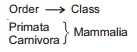
Class mammalia consists of
  • A
    Order carnivora only
  • B
    Families like felidae and canidae only
  • Related orders like carnivora, primata, etc
  • D
    All animals belonging to various phyla
Answer
Correct option: C.
Related orders like carnivora, primata, etc
c
Order                                                           Class
Carnivora                                                    Mammalia
Primata
 
View full question & answer
MCQ 131 Mark
Potato and brinjal belong to the genus Solanum, which reflects that
  • A
    They belong to single species
  • They are a group of related species
  • C
    They both are morphologically and structurally similar to each other in all respects
  • D
    They can always produce fertile hybrid
Answer
Correct option: B.
They are a group of related species
b
Potato and Brinjal are a group of related species.
View full question & answer
MCQ 141 Mark
Choose odd one out $w.r.t.$ Panthera leo
  • Common name of tiger
  • B
    Panthera represents generic name
  • C
    leo represents specific epithet
  • D
    Panthera represents higher level of taxon than leo
Answer
Correct option: A.
Common name of tiger
a
Panthera leo is common name of lion.
View full question & answer
MCQ 151 Mark
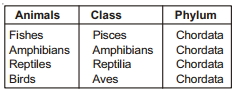
Fishes, amphibians, reptiles and birds are kept in the same
  • A
    Order
  • B
    Class
  • C
    Genus
  • Phylum
Answer
Correct option: D.
Phylum
d

View full question & answer
MCQ 161 Mark
Order primata and carnivora are placed in the same class, i.e.
  • A
    Hominidae
  • Mammalia
  • C
    Insecta
  • D
    Chordata
Answer
Correct option: B.
Mammalia
b

View full question & answer
MCQ 171 Mark
Which category comes after phylum in descending order in taxonomic hierarchy?
  • A
    Genus
  • B
    Family
  • Class
  • D
    Species
Answer
Correct option: C.
Class
c
Phylum $\rightarrow$ Class
View full question & answer
MCQ 181 Mark
The equivalent rank of Carnivora in taxonomic categories of man and housefly is respectively
  • A
    Homo and Musca
  • B
    Hominidae and Muscidae
  • C
    Mammalia and Insecta
  • Primata and Diptera
Answer
Correct option: D.
Primata and Diptera
d
Animal Order

Lion -Carnivora

Man -Primata

Housefly -Diptera

View full question & answer
MCQ 191 Mark
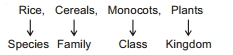
Rice, cereals, monocots and plants represent
  • Different taxa at different level
  • B
    Same taxa of different category
  • C
    Different category of same taxa
  • D
    Same category for different taxa
Answer
Correct option: A.
Different taxa at different level
a

View full question & answer
MCQ 201 Mark
Given organisms belongs to how many genera?
Wheat, Brinjal, Potato, Lion, Dog, Tiger
  • A
    Three
  • B
    Two
  • Four
  • D
    Five
Answer
Correct option: C.
Four
c
Animal Genera

Wheat -Triticum

Brinjal & Potato -Solanum $\Rightarrow$  Four genera

Lion & Tiger -Panthera

Dog -Can

View full question & answer
MCQ 211 Mark
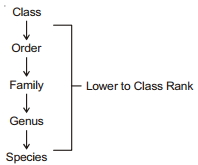
Taxonomic categories which come lower to the rank of class are
  • A
    Order, phylum, family, species
  • Order, family, genus, species
  • C
    Division, family, order, genus
  • D
    Order, division, genus, species
Answer
Correct option: B.
Order, family, genus, species
b

View full question & answer
MCQ 221 Mark
In taxonomic hierarchy, which of the following group of taxa will have less number of similarities as compared to other?
  • A
    Solanaceae, Convolvulaceae and Poaceae
  • Polymoniales, Poales and Sapindales
  • C
    Solanum, Petunia and Atropa
  • D
    Leopard, tiger and lion
Answer
Correct option: B.
Polymoniales, Poales and Sapindales
b
$(1)$ Solanaceae, Convolvulacea, Poaceae -Family

$(2)$ Polymoniales, Poales, Sapindales -Order

$(3)$ Solunum, Petunia and Atropa -Genus

$(4)$ Leopard , Tiger, Lion -Species

Less number of similarity will be in order.

View full question & answer
MCQ 231 Mark
In which of the following pair of category, greater is the difficulty of determining the relationship to other taxa at the same level, thus the problem of classification becomes more complex?
  • A
    Genus and species
  • B
    Tribe and genus
  • Division and phylum
  • D
    Species and family
Answer
Correct option: C.
Division and phylum
c
Division and Phylum are at very next higher rank and they have lower number of similarity
View full question & answer
MCQ 241 Mark
Three different genera Solanum, Petunia and Datura are placed in the family
  • A
    Poaceae
  • B
    Anacardiaceae
  • C
    Hominidae
  • Solanaceae
Answer
Correct option: D.
Solanaceae
d
Genera - Solanum, Petunia, Datura $\rightarrow$ Family -Solanaceae
View full question & answer
MCQ 251 Mark
Genus is a category which comes in between the
  • Family and Species
  • B
    Class and Family
  • C
    Order and Phylum
  • D
    Kingdom and Class
Answer
Correct option: A.
Family and Species
a
Species $\rightarrow$ Genus $\rightarrow$ Family
View full question & answer
MCQ 261 Mark
Fill in the blanks $A$ and $B$

Kingdom $\rightarrow$ Phylum $\rightarrow$ $[A]$ $\rightarrow$ Order $\rightarrow$ $[B]$

  • A
    $A -$ Genus; $B -$ Species
  • B
    $A -$ Family; $B -$ Class
  • $A -$ Class; $B -$ Family
  • D
    $A -$ Species; $B -$ Division
Answer
Correct option: C.
$A -$ Class; $B -$ Family
c
Fact based
View full question & answer
MCQ 271 Mark
______ is the assemblage of families which exhibit a few similar characters.
  • Class
  • B
    Genus
  • C
    Species
  • D
    Order
Answer
Correct option: A.
Class
a
Species $\rightarrow$ Genus $\rightarrow$ Family $\rightarrow$ Order $\rightarrow$ Class $\rightarrow$ Division $\rightarrow$ Kingdom
View full question & answer
MCQ 281 Mark
Which of the following is a class?
  • Mammalia
  • B
    Sapindales
  • C
    Primate
  • D
    Poales
Answer
Correct option: A.
Mammalia
a
Mammalia -Class
Sapindales -Order
Primata -Order
Poales -Order
View full question & answer
MCQ 291 Mark
Which of the following statements is incorrect?
  • A
    The scientific name for humans is Homo sapiens.
  • Organisms placed in the same genus are least closely related.
  • C
    Moving from species to kingdom, more different species are included in each higher category.
  • D
    Species that are in the same genus share very specific characteristics.
Answer
Correct option: B.
Organisms placed in the same genus are least closely related.
b
Genus comprises a group of related species which has more characters in common in comparison to species of other genera. Organisms placed in the same genus are most closely related.
View full question & answer
MCQ 301 Mark
Which of the following statements are correct?

$(i)$. Genus comprises a group of related species.

$(ii)$. Taxon represents a taxonomic group of individual organisms.

$(iii)$. Family comprises a group of related genera.

$(iv)$. Taxonomic category class includes related orders.

  • A
    $(i)$, $(ii)$, and $(iv)$
  • B
    $(ii)$ and $(iv)$
  • $(i)$, $(iii)$ and $(iv)$
  • D
    $(ii)$, $(iii)$ and $(iv)$
Answer
Correct option: C.
$(i)$, $(iii)$ and $(iv)$
c
The term '$taxon$' is used to refer to any rank or level or category of the classification. Based on certain observable characteristics like insects represent a group of organisms which share some common features like three pairs of jointed legs hence insects can be easily recognized and classified.
View full question & answer
MCQ 311 Mark
Match column $I$ with column $II$ and choose the correct option.
Column-$I$ Column-$II$
$A$. Family $I$. tuberosum
$B$. Kingdom $II$. Polymoniales
$C$. Order $III$. Solanum
$D$. Species $IV$. Plantae
$E$. Genus $V$. Solanaceae
  • A
    $A - IV ; B -II C - V ; D - II ; E - I$
  • $A - V ; B - IV ; C - II ; D - I ; E -III$
  • C
    $A-I V ; B-V ; C-II ; D-I ; E- III$
  • D
    $A - V ; B - III ; C -II ; D - I ; E - IV$
Answer
Correct option: B.
$A - V ; B - IV ; C - II ; D - I ; E -III$
b
$A - V ; B - IV ; C -II; D -I ; E - III$
View full question & answer
MCQ 321 Mark
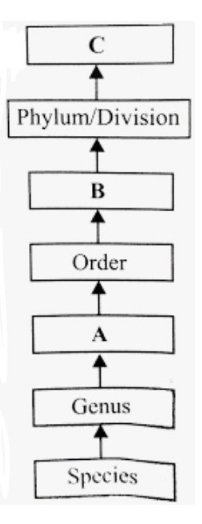
Consider following diagram and fill the following blank spaces/boxes.
  • A
    $A-$ Class, $B-$ Family, $C- $ Sub kingdom
  • $A-$ Family, $B-$Class, $C-$kingdom
  • C
    $A-$ Supra Genus, $B-$ Subclass, $C-$ SupraPhyllum
  • D
    $A-$ Kingdom, $B-$ Class, $C-$ Family
Answer
Correct option: B.
$A-$ Family, $B-$Class, $C-$kingdom
b
There are $7$ obligate hierarchial levels of taxonomic categories. These started from species, which is the unit/basis of taxonomical studies. It constitute the group of interbreeding organisms. This is natural unit of taxonomical group. Group of families with more or less similar characteristics called order. The upppermost category in which Divisions/Phylum present called Kingdom. It form the uppermost category of hierarchial system in taxonomical studies.
View full question & answer
MCQ 331 Mark
Which of the following options has all the organisms belonging to the same Genus?
  • Potato, tomato and brinjal
  • B
    Monkey, gorilla and gibbon
  • C
    Solanum, Petunia, and Datura
  • D
    Mangifera indica, Solanum tuberosum, and Panthera leo.
Answer
Correct option: A.
Potato, tomato and brinjal
a
Potato, tomato and brinjal are three different species but all belong to the genus Solanum. Monkey, Gorilla and Gibbon belong to same Order Primata Solanum, Petunia and datura are different genera that belong to same Family
View full question & answer
MCQ 341 Mark
The taxonomic unit $'phylum'$ in the classification of animals is equivalent to which hierarchial level in classification of plants?
  • A
    Class
  • B
    Order
  • Division
  • D
    Family
Answer
Correct option: C.
Division
c
Phylum is a taxonomic category higher than class and lower in rank to kingdom. The term phylum (coined by George Cuvier) is used for animals while the term division (coined by Eichler) is used for plants.
View full question & answer
MCQ 351 Mark
Genus represents
  • A
    an individual plant or animal.
  • B
    a collection of plants or animals.
  • group of closely related species of plants or animals.
  • D
    none of the above.
Answer
Correct option: C.
group of closely related species of plants or animals.
c
Genus is the first higher category above the level of species. A genus may have one to several species. A genus having a single species is called monotypic. Currently, the genus Homo is monotypic with a single species of Homo sapiens. A genus having two or more species is called polytypic. The genus Panthera is polytypic. Some species of this genus are P. leo (Lion), P. tigris (Tiger), P. onca (Jaguar) and P. pardus (Leopard).
View full question & answer
MCQ 361 Mark
Two animals which are the members of the same order must also be the members of the same
  • class
  • B
    family
  • C
    genus
  • D
    species
Answer
Correct option: A.
class
a
Class is a group of related orders. Class mammalia has orders like carnivora ( predators), lagomorpha (hare/rabbit), primata ( monkey/chimpanzee)

The organisms of a particular $taxon$ always share the common - higher taxonomic category wrt $taxon$.

View full question & answer
MCQ 371 Mark
Taxonomic hierarchy refers to
  • step-wise arrangement of all categories for classification of plants and animals.
  • B
    a group of senior taxonomists who decide the nomenclature of plants and animals.
  • C
    a list of botanists or zoologists who have worked on taxonomy of a species or group.
  • D
    classification of a species based on fossil record.
Answer
Correct option: A.
step-wise arrangement of all categories for classification of plants and animals.
a
Taxonomical hierarchy (introduced by Linneaus) is arrangement of various taxonomic levels in the descending order, starting from kingdom upto species. The hierarchy indicates the various levels of kinship. The number of similar characters of categories decreases from lowest rank to highest rank i.e., from species to kingdom. Thre are $7$ obligate categories which constitute taxonomical hierarchy. In addition to these obligate categories there are some optional categories are as follows. e.g., Tribe, subclass, superclass, etc.
View full question & answer
MCQ 381 Mark
Dicotyledons like mango, brinjal and monocotyledons like Wheat and Rice are placed under a taxonomic category known as
  • A
    Phylum - Angiospermae
  • Division - Angiospermae
  • C
    Class - Angiospermae
  • D
    Sereis - Polypetalae
Answer
Correct option: B.
Division - Angiospermae
b
Division is a category higher than that of class. Term phylum is used for animals while division is used for plants. Classes with few similar characteristics are assigned to division.
View full question & answer
MCQ 391 Mark
Select the correct statements $(i-iv)$ regarding taxonomic categories.

$(i)$ Each step or rank in hierarchy is called taxonomic category.

$(ii)$ Species is a group of individual organisms with fundamental similarities capable of breeding among themselves.

$(iii)$ Taxonomic studies of all unknown organisms have led to the development of common categories like kingdom, phylum or division, class, order, family, genus and species.

$(iv)$ Lower the category, greater is the difficulty of determining the relationship to other taxa at the same level.

  • $(i)$ & $(ii)$ only
  • B
    $(ii)$ & $(iv)$ only
  • C
    $(i)$, $(ii)$ & $(iii)$ only
  • D
    All of the above
Answer
Correct option: A.
$(i)$ & $(ii)$ only
a
View full question & answer
MCQ 401 Mark
Which of the following $statement(s)$ is/are not correct?

$(i)$ Genus comprises a group of related species which has more characters in common in comparison to species of other genera.

$(ii)$ Three different genera such as Solanum, Datura and Petunia are placed in the family malvaceae.

$(iii)$ In case of plants, classes with a few similar characters are assigned to a higher category called phylum.

  • A
    Both $(i)$ and $(ii)$
  • B
    Only $(iii)$
  • Both $(ii)$ and $(iii)$
  • D
    All of these
Answer
Correct option: C.
Both $(ii)$ and $(iii)$
c
Three different genera such as Solanum, Datura and Petunia are placed in the family solanaceae. In case of plants, classes with a few similar characters are assigned to a higher category called division. Phylum is used in case of animals.
View full question & answer
MCQ 411 Mark
Which of the following taxonomic categories is being described by the given statements $(i-iii)$?

$(i)$ It is the basic unit of classification.

$(ii)$ It is defined as the group of individuals which resemble in their morphological and reproductive characters and interbreed among themselves and produce fertile offsprings.

$(iii)$ Human beings belong to the species sapiens which is grouped in the genus Homo.

  • Species
  • B
    Genus
  • C
    Order
  • D
    Family
Answer
Correct option: A.
Species
a
All the given descriptions are related to taxonomic category called species. Species, the lowest category in the taxonomic hierarchy, is the basic unit of taxonomy. It is the group of individual organisms with fundamental similarities.
View full question & answer
MCQ 421 Mark
Which of the following statements are not correct?

$(i)$ Lower the taxon, more are the characteristics that the members within the taxon share.

$(ii)$ Order is the assemblage of genera which exhibit a few similar characters.

$(iii)$ $Cat$ and $dog$ are included in the same family Felidae.

$(iv)$ Binomial nomenclature was introduced by Carolus Linnaeus.

  • A
    $(i)$, $(ii)$ and $(iii)$
  • B
    $(ii)$, $(iii)$ and $(iv)$
  • C
    $(i)$ and $(iv)$
  • $(ii)$ and $(iii)$
Answer
Correct option: D.
$(ii)$ and $(iii)$
d
Order being higher category is the assemblage of families which exhibit a few similar characteristic. $Dog$ (Canis familaris) and $Cat$ (Felis domesticus) belong to two different families--Cancideae and Felidae respectively.
View full question & answer
MCQ 431 Mark
Match the taxonomic categories given in column $I$ with their feature given in column $II$.
Column $I$ Column $II$
$A$. Taxon $I$. Basic unit of classification
$B$. Species $II$. A taxonomic group of any rank
$C$. Phylum $III$. Division is the same category in case of plants.
$D$. Genus $IV$. Identified based on a number of similar characters
$E$. Order $V$. Group of related species having more character in common with others species
  • A
    $A-V; B-II; C-IV; D-III; E-I$
  • B
    $A-III; B-I; C-IV; D-II; E-V$
  • $A-II; B-I; C-III; D-V; E-IV$
  • D
    $A-III; B-II; C-IV; D-I; E-V$
Answer
Correct option: C.
$A-II; B-I; C-III; D-V; E-IV$
c
$A -II, B-I, C-III, D-V, E-I V .$ Taxon is a taxonomic group of any rank. Species, the lowest category in the taxonomic hierarchy, is the basic unit of taxonomy. It is the group of individual organisms with fundamental similarities. Division is similar to phylum and used in case of plants. Genus is a group of related species having more character in common with others species. Order is identified based on a number of similar characters.
View full question & answer
MCQ 441 Mark
Which of the following organisms is not correctly matched with its particular?
  • A
    Human beings - Sapiens, species
  • B
    Lion - Panthera, genus
  • Cats - Felidae, genus
  • D
    Datura - Solanaceae, family
Answer
Correct option: C.
Cats - Felidae, genus
c
Cats belong to the family Felidae.
View full question & answer
MCQ 451 Mark
Which of the following taxonomic category of housefly is incorrectly matched?
  • A
    Genus - Musca
  • B
    Family - Muscidae
  • Order - Primata
  • D
    Class - Insecta
Answer
Correct option: C.
Order - Primata
c
Housefly, Musca domestica, is a fly of the order Diptera. It is the most common of all domestic flies. Primate is a mammal of the order primata.
View full question & answer
MCQ 461 Mark
Match column-$I$ (Biological name) with column-$II$ (Class) and choose the correct option.
Column-$I$ (Biological name) Column-$II$ (Class)
$A$. Homo sapien $I$. Dicotyledonae
$B$. Musca domestica $II$. Mammalia
$C$. Mangifera indica $III$. Monocotyledonae
$D$. Triticum aestivum $IV$. Insects
  • $A-I V ; B-I I ; C-I ; D-I I I$
  • B
    $A-II ; B-I V ; C-I I I ; D-I$
  • C
    $A-II ; B-I V ; C-I ; D-I I I$
  • D
    $A-II ; B-I ; C-I V ; D-I I I$
Answer
Correct option: A.
$A-I V ; B-I I ; C-I ; D-I I I$
a
$A -II ; B - IV ; C -I ; D -III $
View full question & answer
MCQ 471 Mark
Match the common name given in column $I$ with their taxonomic category family given in column $II$ and choose the correct combination from the options given below.
Column-$I$ Column-$II$
(Common Name) (Taxonomic category- Family)
$A$. Man $I$. Poaceae
$B$. Datura $II$. Anacardiaceae
$C$. Mango $III$.Solanaceae
$D$. Wheat $IV$. Hominidae
  • $A-I V ; B-III; C-II ; D-I$
  • B
    $A-I V ; B-III; C-I ; D-II$
  • C
    $A-I ; B-II; C-III ; D-I V$
  • D
    $A-I ; B-III ; C-II ; D-I V$
Answer
Correct option: A.
$A-I V ; B-III; C-II ; D-I$
a
$A-I V ; B-I I I ; C-II ; D-I$
View full question & answer
MCQ 481 Mark
Match the common name given in column $I$ with their taxonomic category order given in column $II$ and choose the correct combination from the options given below.
Column-$I$ Column-$II$
(Common name) (Taxonomic category-Order)
$A$. Wheat $I$. Primata
$B$. Mango $II$. Diptera
$C$. Housefly $III$. Sapindales
$D$. Man $IV$. Poales
  • A
    $A - I ; B - II ; C - IV ; D - III$
  • $A-I V ; B-I I I ; C-II ; D-I$
  • C
    $A - II ; B - IV ; C - I ; D - III$
  • D
    $A - III ; B - IV ; C - II ; D - I$
Answer
Correct option: B.
$A-I V ; B-I I I ; C-II ; D-I$
b
$A - IV ; B -III; C - II ; D - I$
View full question & answer
MCQ 491 Mark
The order generally ends with
  • ales
  • B
    aceae
  • C
    eae
  • D
    none of these
Answer
Correct option: A.
ales
a
The order generally ends with ales. Order being a higher category is the assemblage of families which exhibit a few similar characters.
View full question & answer
MCQ 501 Mark
Families are characterized on which of the following features of plant species?
  • A
    External morphology
  • B
    Anatomy of parts
  • Vegetative and reproductive parts
  • D
    Seasonal similarities and variations
Answer
Correct option: C.
Vegetative and reproductive parts
c
A family is a subdivision of an order consisting of a group of related genera which in turn are composed of groups of related species. Families are characterized on the basis of vegetative and

$EBD$ _$7209$

Biology $44$ reproductive parts of the plants species. Suffix added in families of both plants and animals may be -aceae or -ae.

View full question & answer
MCQ 511 Mark
$"X"$ being a higher category is the assemblage of families which exhibit a few $"Y"$ characters. The $"Z"$ characters are less in a number as compared to different genera included in a family. Identify $"X"$, $"Y"$, and $"Z"$.
  • $X -$ Order; $Y -$ Similar; $Z -$ Similar
  • B
    $X -$ Genus; $Y -$ Similar; $Z -$ Different
  • C
    $X -$ Species; $Y -$ Different; $Z -$ Similar
  • D
    $X-$ Class; $Y -$ Different; $Z -$ Different
Answer
Correct option: A.
$X -$ Order; $Y -$ Similar; $Z -$ Similar
a
Order being a higher category is the assemblage of families which exhibit a few similar characters. The similar characters are less in number as compared to different genera included in a family.
View full question & answer
MCQ 521 Mark
Which of the following shows the correct example of taxonomic category - Genus?
  • Potato, tomato and brinjal belong to Solanum.
  • B
    Monkey, gorilla and gibbon are placed in Mammalia.
  • C
    Solanum, Petunia, and Datura are placed in Solanacea.
  • D
    Mangifera indica, Solanum tuberosum, and Panthera leo.
Answer
Correct option: A.
Potato, tomato and brinjal belong to Solanum.
a
Potato, tomato and brinjal are three different species but all belong to the genus Solanum. Genus is an assembly of related species which evolved from a common ancestor and have certain common characters. Solanum is a polytypic genera with more than one species.
View full question & answer
MCQ 531 Mark
Which of the following characters given below displays the description of lowest taxonomic category of organisms in the plant and animal kingdom?
  • A
    It includes one or more than one order.
  • B
    It is a group containing one or more families.
  • It is a group of related organisms that resemble one another.
  • D
    It is a group of organisms that are closely related and share similar characteristics.
Answer
Correct option: C.
It is a group of related organisms that resemble one another.
c
Species is the lowest category in taxonomic hierarchy. Species is a group of animals, plants or other living things that all share common characteristics and that are all classified as alike in some manner.
View full question & answer
MCQ 541 Mark
Refer the botanical name of wheat "$Triticum\; aestivum$" and identify the statement which correctly describes it.
  • A
    The second word belongs to genus and starts with a small letter.
  • B
    Both the words "$Triticum\; aestivum$" denote the specific epithet.
  • The first word Triticum denotes the genus which starts with a capital letter.
  • D
    The first word Triticum denotes the specific epithet while the second word denotes the genus.
Answer
Correct option: C.
The first word Triticum denotes the genus which starts with a capital letter.
c
Genus is an assembly of related species which evolved from a common ancestor and have certain common characters. In the botanical name of wheat (Triticum aestivum), the first word Triticum denotes the genus which starts with a capital letter.
View full question & answer
MCQ 551 Mark
If an organism is in the same class but not in the same family then it may belong to same
  • A
    genus
  • B
    Species
  • C
    variety
  • order
Answer
Correct option: D.
order
d
Order is a higher taxon and is the assemblage of families having similar characteristics. However, the common characteristic will be fewer than at family or genus level. In mammals the common orders are primates (monkey, gorilla and human), carnivora, rodentia and cetacea (whale and dolphin).
View full question & answer
MCQ 561 Mark
As we go from species to kingdom in a taxonomic hierarchy, the number of common characteristics
  • will decrease.
  • B
    will increase.
  • C
    remain same.
  • D
    may increase or decrease.
Answer
Correct option: A.
will decrease.
a
All the members of a taxonomic category possess some similar characters which are different from those of others. The placement of individuals or organisms in species, genus, family, order, class and phylum are determined by their specific similar characters and relationships. Maximum similarity occurs in species which is also the lowest category in the hierarchy of categories. Similarity of characters decreases with the ascent in hierarchy.
View full question & answer
MCQ 571 Mark
Which of the following is the only taxonomic categories that has a real existence?
  • A
    Phylum
  • Species
  • C
    Genus
  • D
    Kingdom
Answer
Correct option: B.
Species
b
Species is the lowest or basic taxonomic category which consists of one or more natural populations of individuals that resemble one another more closely than individuals of other species, interbreed freely, have a distinct genetic set up and are reproductively isolated from others e.g., Panthera Leo ($Lion$), Mangifera indica ($Mango$), Solanum tuberosum ($Potato$).
View full question & answer
MCQ 581 Mark
$'Taxa'$ differs from $'taxon'$ due to being
  • A
    a higher taxonomic category than taxon.
  • B
    lower taxonomic category than taxon.
  • the plural of taxon.
  • D
    the singular of taxon.
Answer
Correct option: C.
the plural of taxon.
c
Taxa is a plural form of taxon. Taxon is a grouping of organisms of any level in hierarchial classification which is based on some common characteristics. It represents real biological objects placed in any category while category itself is an abstract term.
View full question & answer
MCQ 591 Mark
Identify the correct sequence of taxonomic categories.
  • A
    Species $\rightarrow$ Genus $\rightarrow$ Order $\rightarrow$ Class $\rightarrow$ Family $\rightarrow$ Phylum/Division $\rightarrow$ Kingdom
  • B
    Species $\rightarrow$ Genus $\rightarrow$ Family $\rightarrow$ Class $\rightarrow$ Phylum/ Division $\rightarrow$ Order $\rightarrow$ Kingdom
  • C
    Species $\rightarrow$ Genus $\rightarrow$ Family $\rightarrow$ Order  $\rightarrow$ Class $\rightarrow$ Phylum/Division $\rightarrow$ Kingdom
  • Species $\rightarrow$ Genus $\rightarrow$ Family $\rightarrow$ Order $\rightarrow$ Class $\rightarrow$ Phylum/Division $\rightarrow$ Kingdom
Answer
Correct option: D.
Species $\rightarrow$ Genus $\rightarrow$ Family $\rightarrow$ Order $\rightarrow$ Class $\rightarrow$ Phylum/Division $\rightarrow$ Kingdom
d
Species is the lowest category in basic taxonomic hierarchy and has the maximum common characterstics with other species under the same genus. The genus is an aggregate or a group of closely related species. Family is the group of closely related genera, and has less common characterstics than species or genus rank. Order is a higher taxon and is the assemblage of families having similar characterstics. Class is a group of related orders. Phylum: The classes with similar features are grouped into phylum in animals and division in plants. The phyla are grouped into still broader categories, called kingdom.
View full question & answer
MCQ 601 Mark
Match the following columns

 $\begin{array}{|l|l|} \hline Column\,\,I & Column\,\,II \\ \hline P.\,\,Kingdom & 1.\,\,indica \\ \hline Q.\,\,Order & 2.\,\,Musca \\ \hline R.\,\,Famiy & 3.\,\,Fungi \\ \hline S.\,\,Genus & 4.\,\,Canidae \\ \hline T.\,\,Species & 5.\,\,Polymoneales \\ \hline \end{array}$

$P \ \ Q\ \ R \ \ S\ \ T $

  • $3\ \ 5\ \ 4 \ \ 2\ \ 1 $
  • B
    $3\ \ 4 \ \ 5\ \ 2\ \ 1 $
  • C
    $3\ \ 5 \ \ 2\ \ 4\ \ 1 $
  • D
    $1\ \ 5\ \ 2\ \ 4\ \ 3$
Answer
Correct option: A.
$3\ \ 5\ \ 4 \ \ 2\ \ 1 $
a
View full question & answer
MCQ 611 Mark
Solanum and Homo are respectively....
  • A
    genus and species
  • genus and genus
  • C
    species and species
  • D
    only species
Answer
Correct option: B.
genus and genus
b
View full question & answer
MCQ 621 Mark
Class is placed between.........and..........in taxonomy
  • A
    Kingdom, order
  • B
    Kingdom, Family
  • Phylum/Division, order
  • D
    genus, family
Answer
Correct option: C.
Phylum/Division, order
c
View full question & answer
MCQ 631 Mark
Match the correct pair(order-phyhum/division)
  • Poales - Angiosperm
  • B
    Insecta - Mangifera
  • C
    Diptera - Chordata
  • D
    Sapindales - Triticum
Answer
Correct option: A.
Poales - Angiosperm
a
View full question & answer
MCQ 661 Mark
Choose correct pair (family-order).
  • A
    Muscidae - musca
  • B
    Hominidae - Mammalia
  • C
    Diptera - insect
  • Anacardiaceae - Sapindales
Answer
Correct option: D.
Anacardiaceae - Sapindales
d
View full question & answer
MCQ 671 Mark
Included in Solanum.
  • Melongena, Nigrum
  • B
    Mangifera, Panthera
  • C
    Felidae, Canidae
  • D
    Nigrum, Felis
Answer
Correct option: A.
Melongena, Nigrum
a
View full question & answer
MCQ 681 Mark
Moving towards species to kingdom variationis......... and number of species......... 
  • A
    Increase, decrease
  • B
    Decrease, decrease
  • C
    Decrease, increase
  • Increase, increase
Answer
Correct option: D.
Increase, increase
d
View full question & answer
MCQ 701 Mark
Delete odd one for wheat.
  • A
    Poaceae
  • B
    Monocotyledonae
  • C
    Angiospermae
  • Dicotyledonae
Answer
Correct option: D.
Dicotyledonae
d
View full question & answer
MCQ 741 Mark
Match the following

 $\begin{array}{|l|l|} \hline Col\,\,A & Col\,\,B  \\ \hline 1.\,\,Species & P.\,\,Solanum \\ \hline 2.\,\,Genus & Q.\,\,Leo \\ \hline 3.\,\,Family & R.\,\,Polymoniales \\ \hline 4.\,\,Order & S.\,\,Felidae \\ \hline \end{array}$


  • A
    $1-P, 2-Q, 3-R, 4-S $
  • $1-Q, 2-P, 3-S, 4-R$
  • C
    $1-P, 2-S, 3-Q, 4-R $
  • D
    $1-Q, 2-R, 3-P, 4-S$
Answer
Correct option: B.
$1-Q, 2-P, 3-S, 4-R$
b
View full question & answer
MCQ 761 Mark
Felidae and Canidae included in which order?
  • A
    Primata
  • B
    Mammalia
  • C
    Diptera
  • Carnivora
Answer
Correct option: D.
Carnivora
d
View full question & answer
MCQ 811 Mark
Choose correct pair (Genus - Family).
  • A
    Homo - Muscidae
  • Mangifera - Anacardiaceae
  • C
    Triticum - Hominidae
  • D
    Musca -Poaceae
Answer
Correct option: B.
Mangifera - Anacardiaceae
b
View full question & answer
MCQ 821 Mark
Scientific name of wheat.
  • Triticum aestivum
  • B
    Anacardiaceae
  • C
    Musca domestica
  • D
    Mangifera indica
Answer
Correct option: A.
Triticum aestivum
a
View full question & answer
MCQ 851 Mark
Choose correct one.
  • A
    Species name should be written in capital letters always.
  • B
    The first word in biological name represents species.
  • C
    Solanum and Panthera indicates species
  • Human beings belong to the species sapiens which is grouped in the genus homo.
Answer
Correct option: D.
Human beings belong to the species sapiens which is grouped in the genus homo.
d
View full question & answer
MCQ 871 Mark
A group of individual organisms with fundamental similarities as a........
  • Species
  • B
    order
  • C
    kingdom
  • D
    Phylum
Answer
Correct option: A.
Species
a
View full question & answer
MCQ 881 Mark
Match the following

 $\begin{array}{|l|l|} \hline Column\,\,-\,\,I & Column\,\,-\,\,II \\ \hline 1.\,\,Solanaceae & A.\,\,Species \\ \hline 2.\,\,Felis & B.\,\,genus \\ \hline 3.\,\,Tuberosum & C.\,\,family \\ \hline & D.\,\,order \\ \hline \end{array}$


  • A
    $(1-C),(2-D),(3-A) $
  • B
    $(1-B),(2-A),(3-C) $
  • C
    $(1-D),(2-B),(3-C)$
  • $(1-C),(2-B),(3-A) $
Answer
Correct option: D.
$(1-C),(2-B),(3-A) $
d
View full question & answer
MCQ 891 Mark
Canidae and felidae are family of ........ and........ respectively.
  • Dogs, Cats
  • B
    Cats, Dogs
  • C
    Cats, Human
  • D
    Human, Dogs.
Answer
Correct option: A.
Dogs, Cats
a
View full question & answer
MCQ 901 Mark
Order being a higher category, is the assemblage of................. Which exhibit a few similar characters.
  • Family
  • B
    Genus
  • C
    Species
  • D
    Kingdom
Answer
Correct option: A.
Family
a
View full question & answer
MCQ 911 Mark
What is correct for fishes, amphibians, reptiles, Aves and mammals?
  • A
    All are taxa from different phylum
  • B
    All are included in same class.
  • All are taxa of same kingdom.
  • D
    All are taxa from different kingdom.
Answer
Correct option: C.
All are taxa of same kingdom.
c
View full question & answer
MCQ 921 Mark
Sapindales word indicates.......
  • Order of Mangifera indica
  • B
    Family of Triticum aestivum
  • C
    Family of Mangifera indica
  • D
    Order of Triticum aestivum
Answer
Correct option: A.
Order of Mangifera indica
a
View full question & answer
MCQ 961 Mark
Order primata contains
  • A
    Shrew and hedge hog
  • B
    Bats and vampire
  • Monkeys and man
  • D
    Horses and zebra
Answer
Correct option: C.
Monkeys and man
c
(c)Order Primata includes lemurs, loris, tarsiers, monkeys, apes and man.
View full question & answer
MCQ 971 Mark
The zoological name of lion is
  • A
    Felis leo
  • B
    Panthera tigris
  • C
    Panthera pardus
  • Panthera leo persica
Answer
Correct option: D.
Panthera leo persica
d
It’s obvious
View full question & answer
MCQ 981 Mark
In which order human is placed
  • A
    Carnivora
  • B
    Rodentia
  • Primate
  • D
    None of the above
Answer
Correct option: C.
Primate
c
It’s obvious ‘
View full question & answer
MCQ 991 Mark
Hierarchical classification means
  • A
    To divide division into classes
  • B
    To divide classes into orders
  • C
    To divide orders into families
  • To rank things one above the other
Answer
Correct option: D.
To rank things one above the other
d
(d) Hierarchy ($G. \,\, Hierarches = rank$) is an system in which member of a type are organised in ranks one above the other.
View full question & answer
MCQ 1001 Mark
In hierarchical classification class is interpolated between
  • A
    Family and genus
  • Phylum and order
  • C
    Order and family
  • D
    Kingdom and phylum
Answer
Correct option: B.
Phylum and order
b
(b) Because phylum, class and species are taxonomic category.
View full question & answer
MCQ 1011 Mark
Which one is not a category
  • A
    $Species$
  • B
    $Class$
  • C
    $Phylum$
  • $Glumaccae$
Answer
Correct option: D.
$Glumaccae$
d
It's Obvious.
View full question & answer
MCQ 1021 Mark
Descending arrangements of categories is called
  • A
    Classification
  • B
    Taxonomy
  • Hierarchy
  • D
    Key
Answer
Correct option: C.
Hierarchy
c
It's Obvious.
View full question & answer
MCQ 1031 Mark
Which covers the largest number of organisms
  • A
    Genus
  • B
    Family
  • Phylum
  • D
    Class
Answer
Correct option: C.
Phylum
c
(c) In phylum included one or more related classes. All the classes of a phylum possess some common correlated traits. So the phylum covers the largest numbers of organism.
View full question & answer
MCQ 1041 Mark
Characteristics which delimit a family are more general than those which delimit a
  • A
    Cohort
  • B
    Phylum
  • C
    Class
  • Genus
Answer
Correct option: D.
Genus
d
It's Obvious
View full question & answer
MCQ 1051 Mark
Which one is the species
  • A
    Carnivora
  • B
    Canis
  • C
    Familiaris
  • Canis familiaris
Answer
Correct option: D.
Canis familiaris
d
In option C only species given without genus.

In option D species given with genus.

so that right ans is option D. 

View full question & answer
MCQ 1061 Mark
The suffix-phyta indicates
  • A
    Family
  • B
    Order
  • C
    Class
  • Division
Answer
Correct option: D.
Division
d
(d) Division is a major group in the Linnean hierarchy used in the classification of plant (equivalent to phylum in animal classification). The suffix of division is -phyta.
View full question & answer
MCQ 1071 Mark
Genus is a group of similar and related
  • A
    Order
  • B
    Genera
  • C
    Families
  • Species
Answer
Correct option: D.
Species
d
(d) Genus is a group of similar species. All species of some genus are surely similar in some characters. These characters are not found in different species.
View full question & answer
MCQ 1081 Mark
In a hierarchical system of plant classification, which one of the following taxonomic ranks generally ends in ‘$ceae$’
  • Family
  • B
    Genus
  • C
    Order
  • D
    Class
Answer
Correct option: A.
Family
a
(a) Family is a taxonomic category between the division and order. It includes one or more genera. It suffix is '$aceae$'.
View full question & answer
MCQ 1091 Mark
Which of the following taxonomical ranks contain organisms least similar to one another
  • Class
  • B
    Genus
  • C
    Family
  • D
    Species
Answer
Correct option: A.
Class
a
(a) The closely related orders are grouped into a class (named as a taxonomical rank in classification) which have least similar organisms to another.
View full question & answer
MCQ 1101 Mark
$A :$ Scientific names for plants have been standarized through $ICBN.$
$R :$ Naming system which uses three word format was given by Linnaeus.
  • A
    Assertion and Reason both are correct and also correct explanation.
  • B
    Assertion and Reason both are correct but not explanation of assertion.
  • Assertion is correct, but Reason is incorrect.
  • D
    Both Assertion and Reason are incorrect.
Answer
Correct option: C.
Assertion is correct, but Reason is incorrect.
c
Trinomial nomenclature was given by Lamark.
View full question & answer
MCQ 1111 Mark
Systematics is the study of
  • Diversity amongst groups of organisms
  • B
    Grouping of organisms
  • C
    Identification and grouping of organisms
  • D
    Identification, classification and taxonomy
Answer
Correct option: A.
Diversity amongst groups of organisms
a
Systematics, study of diversity amongst groups of organisms.
View full question & answer
MCQ 1121 Mark
Carolus Linnaeus is the father of taxonomy because of one of his contributions
  • A
    Genera Plantarum
  • Binomial nomenclature
  • C
    Described nearly ten thousand plants and animal species
  • D
    Die Naturlichen Pflanzen Familien
Answer
Correct option: B.
Binomial nomenclature
b
Carolus Linnaeus’s contribution in taxonomy is -Binomial nomenclature
View full question & answer
MCQ 1131 Mark
Which one of the following statements given below is not included in universal rules of nomenclature?
  • A
    Generic names and specific epithet should be in Latin words
  • Generic name is immediately followed by name of taxonomists who described it firstly
  • C
    Generic name must begin with capital letter
  • D
    All letters of the specific name must be small
Answer
Correct option: B.
Generic name is immediately followed by name of taxonomists who described it firstly
b
Fact based
View full question & answer
MCQ 1141 Mark
According to binomial nomenclature, every living organism has
  • A
    Two scientific names with single component
  • One scientific name with two components
  • C
    Two names, one Latin and other common
  • D
    One common name with three components
Answer
Correct option: B.
One scientific name with two components
b
Every living organism has one scientific name with two components.
View full question & answer
MCQ 1151 Mark
Which of the following is incorrect regarding scientific names?
  • These are also known as common names
  • B
    These ensure that each organism has only one name
  • C
    These have two components -the generic name and specific epithet
  • D
    These are universally accepted names
Answer
Correct option: A.
These are also known as common names
a
Scientific names are given by biologist based upon agreed rules and criteria.
View full question & answer
MCQ 1161 Mark
What do $A, B$ and $C$ represent in the given scientific name respectively?
Mangifera indica Linn
$C$ $B$ $A$
  • A
    Generic name, specific name and author’s name
  • B
    Specific name, generic name and author’s name
  • Author’s name, specific name and generic name
  • D
    Generic name, author’s name and specific name
Answer
Correct option: C.
Author’s name, specific name and generic name
c
In binomial nomenclature, $I^{st}$ name is genus, $2^{nd}$ is species epithet and $3^{rd}$ is author's name (optional).
View full question & answer
MCQ 1171 Mark
Which of the following is incorrect $w.r.t.$ Binomial nomenclature?
  • A
    Biological names are generally in Latin
  • B
    The first word in a biological name represents the genus
  • C
    Biological names are printed in italics
  • The first word of the genus starts with a small letter
Answer
Correct option: D.
The first word of the genus starts with a small letter
d
In Binomial nomenclature, genus always starts with a capital letter.
View full question & answer
MCQ 1181 Mark
Local names of various plants and animals
  • A
    Help in recognizing organisms worldwide
  • B
    Are used universally
  • C
    Are specific and distinct names
  • Vary from place to place
Answer
Correct option: D.
Vary from place to place
d
Local names of various plants and animals are non-universal
View full question & answer
MCQ 1191 Mark
In printed scientific names, only the______is capitalized.
  • A
    class
  • B
    species
  • genus
  • D
    family
Answer
Correct option: C.
genus
c
In printed scientific names, only the genus is capitalized. Genus is an assembly of related species which evolved from a common ancestor and have certain common characters. Eg, Solanum tuberosum and Solanum melongena are two species which belongs to the same genus of Solanum.
View full question & answer
MCQ 1201 Mark
Which of the following $statement (s)$ is/are correct?

$(i)$ Classification is providing standardized names to organisms such that a particular organism known by the same all over the world.

$(ii)$ Taxonomy is the correct description of an organism and to recognition in its scientific name.

$(iii)$ The system of naming with two components (binomial nomenclature) is proposed by Carolus Linneaus.

$(iv)$ Zoological names are based on International Code for Zoological Nomenclature $(ICZN)$.

  • A
    Only $(i)$
  • Both $(iii)$ and $(iv)$
  • C
    Only $(iv)$
  • D
    All of these
Answer
Correct option: B.
Both $(iii)$ and $(iv)$
b
Nomenclature is the providing of standardize names to the organisms such that a particular organism known by the same name all over the world. Identification is the correct descripton of an organism and its recognition in its scientific name. The branch of science which deals with the study of principle and procedure of classification known as taxonomy. It is of two types. $(i)$ Classical taxonomy - Based on observable morphological characters. $(ii)$ Modern taxonomy - Based on external and internal features of organisms.
View full question & answer
MCQ 1211 Mark
Which one of the following statements is correct about biodiversity?
  • A
    It is the occurrence of varied type of organisms on earth.
  • B
    Each different kind of plant, animal or organism represents a species.
  • C
    The number of species that are known and described range between $1.7-1.8\; million.$
  • All of the above
Answer
Correct option: D.
All of the above
d
Biodiversity is the term used to describe the variety of life found on Earth and all of the natural processes. This includes ecosystem, genetic and cultural diversity, and the connections between these and all species. The different aspects of biodiversity all have a very strong influence on each other.
View full question & answer
MCQ 1221 Mark
Which of the following statements regarding nomenclature is correct?
  • A
    Generic name always begins with capital letter whereas specific name with small letter.
  • B
    Scientific name should be printed in italics.
  • C
    Scientific name when typed or handwritten should be underlined.
  • All of the above
Answer
Correct option: D.
All of the above
d
All the statements regarding nomenclature are correct. Nomenclature is giving distinct scientific names to various structures including living organisms for their identification. It is a set of rules used for forming the names or terms in a particular field of arts or sciences. Nomenclature is only possible when the organism is described correctly and we know to what organisms the name is attached to (called identification).
View full question & answer
MCQ 1231 Mark
The practical purpose of classification of living organisms is to
  • A
    explain the origin of living organsims.
  • B
    trace the evolution of living organsims.
  • C
    name the living organisms.
  • facilitate identification of unknown organisms.
Answer
Correct option: D.
facilitate identification of unknown organisms.
d
Biological classification is the scientific arrangement of organisms in a hierarchial series of groups and subgroups on the basis of similarities and differences in their traits. It helps in building evolutionary pathways and in identifying new organisms.
View full question & answer
MCQ 1241 Mark
Taxon is a
  • A
    unit of classification.
  • B
    species.
  • C
    highest rank of classification.
  • group of closely related organisms.
Answer
Correct option: D.
group of closely related organisms.
d
Taxon (Plural: taxa) is a grouping of organisms of any level in hierarchial classification which is based on some common characteristics. It represents real biological objects placed in any category while category itself is an abstract term.
View full question & answer
MCQ 1251 Mark
Systematics refers to the
  • A
    identification and classification of plants and animals.
  • B
    nomenclature and identification of plants and animals.
  • diversity of kinds of organisms and their relationship.
  • D
    different kinds of organisms and their classification.
Answer
Correct option: C.
diversity of kinds of organisms and their relationship.
c
Systematics, often used interchangeably with taxonomy, is the study of diversity of organisms, their comparative and evolutionary relationships on the basis of findings from various fields of biology.
View full question & answer
MCQ 1261 Mark
Each category of taxonomic hierarchy refers to as a unit of______.
  • A
    systematic
  • B
    identification
  • C
    nomenclature
  • classification
Answer
Correct option: D.
classification
d
Taxonomic hierarchy is the sequence of arrangements of taxonomic categories in a descending order during the classification of organisms. Each category of taxonomic hierarchy refers to as a unit of classification.
View full question & answer
MCQ 1271 Mark
Which of the following term is used to refer the number of varieties of plants and animals on earth ?
  • A
    Taxonomy
  • B
    Identification
  • Biodiversity
  • D
    Classification
Answer
Correct option: C.
Biodiversity
c
The term biodiversity is used for the variety and variability among all forms of living organisms like plants, animals, and micro-organisms present in a given region under natural conditions. Biodiversity can be defined as the totality of genes, species and ecosystem of a region. India is very rich in biodiversity.
View full question & answer
MCQ 1281 Mark
Choose correct sentences for nomenclature

$(1)$ Biological names are given in two words

$(2)$ Genus starts with a capital letter while Species name starts with a small letter

$(3)$ Name of author appears first in the nomenclature

  • A
    $1, 2, 3 $
  • $1, 2 $
  • C
    $2,3 $
  • D
    $3, 1$
Answer
Correct option: B.
$1, 2 $
b
View full question & answer
MCQ 1291 Mark
Select the correct option on the basis of following sentences

$I.$ Biological names are generally in Franch

$II.$ First word in biological name represents the genus

$III.$ Second word in biological name is written in capital letter

$IV.$ When the scientific name is hand written underline should be done.

  • A
    Only $I$
  • B
    $I$ and 11
  • C
    $II, III$, and $IV$
  • $II$ and $IV $
Answer
Correct option: D.
$II$ and $IV $
d
View full question & answer
MCQ 1301 Mark
Which is odd rule related to nomenclature?
  • A
    Organisms nomenclature should be in Latin language.
  • B
    Organisms nomenclature involve being by two name.
  • The genus name is written after the name of species.
  • D
    Name of the researcher after the name of the species is briefly written.
Answer
Correct option: C.
The genus name is written after the name of species.
c
View full question & answer
MCQ 1311 Mark
Which two taxon are mentioned in scientific name of organism?
  • A
    Phylum, species
  • B
    Genus, class
  • Species, genus
  • D
    Class, kingdom
Answer
Correct option: C.
Species, genus
c
View full question & answer
MCQ 1321 Mark
Universal rules of nomenclature is......
  • A
    Biological names are given in any language
  • B
    The first word in biological name represents the species while second denotes genus
  • C
    First letter of species is capital and genus start with a small letter
  • Both the words in biological name when hand written are separately underlined.
Answer
Correct option: D.
Both the words in biological name when hand written are separately underlined.
d
View full question & answer
MCQ 1331 Mark
The system of providing a name with two components is called...
  • A
    Identification
  • Binomial nomenclature
  • C
    Classification
  • D
    Systema
Answer
Correct option: B.
Binomial nomenclature
b
View full question & answer
MCQ 1341 Mark
Taxonomy is based on..
  • A
    Characterization and identification
  • B
    Identification and classification
  • C
    Classification and nomenclature
  • All of above
Answer
Correct option: D.
All of above
d
View full question & answer
MCQ 1351 Mark
Which is correct for dogs, rice, mammals ?
  • A
    All characters are similar.
  • B
    All three included in one kingdom
  • In scientific term these categories called taxa.
  • D
    None of the above
Answer
Correct option: C.
In scientific term these categories called taxa.
c
View full question & answer
MCQ 1361 Mark
Binomial nomenclature is
  • Two words in name of a species
  • B
    Two names local and specific
  • C
    Two names of a species
  • D
    Two phases, asexual and sexual, in the life cycle of a species
Answer
Correct option: A.
Two words in name of a species
a
It's Obvious.
View full question & answer
MCQ 1371 Mark
What is correct
  • A
    apis\,\, Indica
  • B
    trypasoma\,\, gambiense
  • C
    Ficus\,\, Bengalensis
  • Mangifera\,\, indica
Answer
Correct option: D.
Mangifera\,\, indica
d
(d) Because Mangifera indica is a correct representation of scientific name. According to bionomial nomenclature.
View full question & answer
MCQ 1381 Mark
Systema Naturae was written by
  • A
    Lamarck
  • B
    Cuvier
  • C
    Aristotle
  • Linnaeus
Answer
Correct option: D.
Linnaeus
d
(d) In $1735$, Carolus Linnaeus published the first edition of his classification of living things in his Systema Naturae.
View full question & answer
MCQ 1391 Mark
Branch connected with nomenclature, identification and classification is
  • A
    Ecology
  • Taxonomy
  • C
    Morphology
  • D
    Physiology
Answer
Correct option: B.
Taxonomy
b
(b) Taxonomy is a branch of biology which deals with the study of principles and procedures of classification, nomenclature and identification. The term taxonomy was coined by De Candolle ($1813$).
View full question & answer
MCQ 1401 Mark
In the scientific name of Mangifera indica $L$.
  • A
    Letter $L$. signifies latin language
  • B
    The name is reverse with Indica preceeding mangifera
  • Letter $L$. signifies taxonomist Linnaeus
  • D
    Letter $L$. is superfluous
Answer
Correct option: C.
Letter $L$. signifies taxonomist Linnaeus
c
It's Obvious.
View full question & answer
MCQ 1411 Mark
A scientist having made significant contribution in the field of classification is
  • A
    Pasteur
  • B
    Oparin
  • C
    Darwin
  • Linnaeus
Answer
Correct option: D.
Linnaeus
d
It's Obvious.
View full question & answer
MCQ 1421 Mark
The main purpose of classification is
  • A
    To locate animals
  • B
    To study facts of evolution
  • To establish relationships
  • D
    To study ecology of animals
Answer
Correct option: C.
To establish relationships
c
It's Obvious.
View full question & answer
MCQ 1431 Mark
International code of “$Biological\, nomenclature$” is applicable to
  • A
    Plants
  • B
    Animals
  • Both animals and plants
  • D
    None of the above
Answer
Correct option: C.
Both animals and plants
c
It's Obvious.
View full question & answer
MCQ 1441 Mark
In zoological name of an organism the first word will be
  • Generic name
  • B
    Specific name
  • C
    Name of the order
  • D
    Family name
Answer
Correct option: A.
Generic name
a
(a) Zoological name of a organism is made up of two word first is generic name and second is specific name.
View full question & answer
MCQ 1451 Mark
The language used in writing the name of animals is
  • A
    French
  • Latin
  • C
    German
  • D
    English
Answer
Correct option: B.
Latin
b
(b) The language used in writing the name of animals is latin because in whole world there would be only one name for one animal.
View full question & answer
MCQ 1461 Mark
Scientific name of organisms is written
  • A
    $Underlined$
  • B
    $In\, capital\, letters$
  • $Itallicised$
  • D
    All of the above
Answer
Correct option: C.
$Itallicised$
c
It's Obvious.
View full question & answer
MCQ 1471 Mark
In which book has “binomial nomenclature” been used for the first time
  • A
    Histoire naturelle
  • Systema naturae
  • C
    Historia naturalis
  • D
    Historia plantarum
Answer
Correct option: B.
Systema naturae
b
(b) Carolus Linnaeus introduced binomial nomenclature in his tenth edition of 'system naturae'.
View full question & answer
MCQ 1481 Mark
Systema Naturae is concerned with
  • A
    Solar system
  • B
    Ecosystem
  • Classification of plants and animals
  • D
    Natural selection
Answer
Correct option: C.
Classification of plants and animals
c
It's Obvious.
View full question & answer
MCQ 1491 Mark
Binomial nomenclature means
  • A
    Indication of the name by its order and family
  • B
    Indication of the name by its family and genus
  • Indication of the name by its genus and species
  • D
    Indication of the name by its species and variety
Answer
Correct option: C.
Indication of the name by its genus and species
c
It's Obvious.
View full question & answer
MCQ 1501 Mark
In plants Latin names are suggested because
  • A
    Latin is a simple language
  • In whole world there would be only one name for one plant
  • C
    It is easy to write
  • D
    Most of the names in other languages are not correct
Answer
Correct option: B.
In whole world there would be only one name for one plant
b
It's Obvious.
View full question & answer
MCQ 1511 Mark
A system of classification is needed
  • A
    To deal with anything in large numbers
  • B
    To understand biological diversity
  • C
    For better understanding of living things
  • All the above
Answer
Correct option: D.
All the above
d
It's Obvious.
View full question & answer
MCQ 1521 Mark
What criteria one has to follow for naming a plant technically at present
  • A
    Name should not be too long
  • B
    Name should not be difficult to pronounce
  • C
    Name should be latinised
  • None of the above
Answer
Correct option: D.
None of the above
d
It's Obvious.
View full question & answer
MCQ 1531 Mark
In Botanical nomenclature of plants
  • A
    Genus is written after the species
  • B
    Both in genus and species the first letter is a capital letter
  • C
    Genus and species may be same name
  • Both genus and species are printed in italics
Answer
Correct option: D.
Both genus and species are printed in italics
d
(d) In botanical nomenclature of plants generic name always being with capital letter and the specific name with a small letter and printed with italics.
View full question & answer
MCQ 1541 Mark
Who amongst the following is regarded as the "Father of Taxonomy''
  • A
    Takhtajan
  • Linnaeus
  • C
    Bentham and Hooker
  • D
    Theophrastus
Answer
Correct option: B.
Linnaeus
b
It's Obvious.
View full question & answer
MCQ 1551 Mark
$ICBN$ stands for
  • A
    International Code for Botanical Nature
  • International Code for Botanical Nomenclature
  • C
    Indian Code of Botanical Nomenclature
  • D
    None of the above
Answer
Correct option: B.
International Code for Botanical Nomenclature
b
It's Obvious.
View full question & answer
MCQ 1561 Mark
The branch of Botany concerned with the classification, nomenclature and identification of plants is
  • Systematic Botany
  • B
    Ecology
  • C
    Morphology
  • D
    Physiology
Answer
Correct option: A.
Systematic Botany
a
It's Obvious.
View full question & answer
MCQ 1571 Mark
The science of naming the plant is known as
  • A
    Classification
  • B
    Identification
  • Nomenclature
  • D
    Taxonomy
Answer
Correct option: C.
Nomenclature
c
(c) Nomenclature (Nomen = name; clature = to call) is giving distinct scientific names to various structures, including living organisms, so they can be easily identified.
View full question & answer
MCQ 1581 Mark
Which statement is false about the growth shown by non-living objects?
  • A
    The growth occurs from outside
  • B
    The growth is reversible
  • C
    The growth is due to the accumulation of material on the surface
  • The growth is intrinsic
Answer
Correct option: D.
The growth is intrinsic
d
The growth shown by non-living objects is extrinsic
View full question & answer
MCQ 1591 Mark
Mark the incorrect statement $w.r.t.$ metabolism.
  • A
    Microbes exhibit the metabolism
  • B
    It is the property of all living forms
  • C
    The metabolic reactions can be demonstrated in-vitro
  • It is not a defining feature of life forms
Answer
Correct option: D.
It is not a defining feature of life forms
d
Metabolism is a defining feature.
View full question & answer
MCQ 1601 Mark
Which of the following is incorrect for reproduction?
  • A
    Unicellular organisms reproduce by cell division
  • Reproduction is a characteristic of all living organisms
  • C
    In unicellular organisms, reproduction and growth are linked together
  • D
    Non-living objects are incapable of reproducing
Answer
Correct option: B.
Reproduction is a characteristic of all living organisms
b
Reproduction is absent in sterile organism like mule, hinny, sterile/infertile human couples, worker bees etc.
View full question & answer
MCQ 1611 Mark
Mark the incorrect pair
  • A
    Hydra -Budding
  • B
    Flatworm -Regeneration
  • Amoeba -Fragmentation
  • D
    Yeast -Budding
Answer
Correct option: C.
Amoeba -Fragmentation
c
Amoeba divides by binary fission
View full question & answer
MCQ 1621 Mark
Which of the following pair is correctly matched.

$(i)$. Fungi - Regeneration

$(ii)$. Mossess - Fragmentation

$(iii)$. Planaria - Budding

  • A
    $(i)$ and $(ii)$
  • B
    $(i)$ and $(iii)$
  • only $(ii)$
  • D
    only $(iii)$
Answer
Correct option: C.
only $(ii)$
c
Fungi shows Fragmentation, budding, etc but not regeneration while Planaria truely regenerate during its life cycle.Mossess shows fragmentation for propagation of their progenies. Thallus tip, protonema fragments and even rhizoids can grow into new moss thallus.
View full question & answer
MCQ 1631 Mark
Which of the following two are known as the twin characteristics of growth?

$(i)$ Irreversible increase in mass   $(ii)$ Uncontrolled $\&$ Repeated Cell Division     $(iii)$ Increase in no. of Individuals   $(iv)$ Reproduction  

  • A
    $(i)$ and $(ii)$
  • B
    $(i)$ and $(iv)$
  • C
    $(ii)$ and $(iii)$
  • $(i)$ and $(iii)$
Answer
Correct option: D.
$(i)$ and $(iii)$
d
Increase in mass and increase in number of individuals are twin characteristics of growth. 
View full question & answer
MCQ 1641 Mark
Which of the following factors exclusively affects reproduction in seasonal breeders, both plants and animals?
  • A
    Water
  • B
    Temperature
  • Photoperiod
  • D
    All of these
Answer
Correct option: C.
Photoperiod
c
Photoperiodism is the physiological reaction of organisms to the length of day or night. It occurs in plants and animals. It can also be defined as the developmental responses of plants to the relative lengths of light and dark periods. Photoperiod exclusively affects the reproduction in seasonal breeders, both plants and animals.
View full question & answer
MCQ 1651 Mark
Non-living objects

$(i)$ Grows from external surface by collecting substance on it.

$(ii)$ Grows from internal surface like living.

$(iii)$ Do not grow at all.

Which of the followings option is correct?

  • $(i)$ only
  • B
    $(ii)$ only
  • C
    $(iii)$ only
  • D
    None of these
Answer
Correct option: A.
$(i)$ only
a
Non-living objects have characteristic growth called extrinsic growth in which object grows after accumulating substance over its surface. Living organisms show intrinsic growth (i.e., grows from inside).
View full question & answer
MCQ 1661 Mark
In unicellular organisms,

$(i)$ Reproduction is synonymous with growth

$(ii)$ Grow by cell division.

$(iii)$ Growth and reproduction are mutually exclusive events With respect to growth and reproduction, which all statements are true

  • A
    $(i)$ & $(iii)$
  • $(i)$ & $(ii)$
  • C
    $(ii)$ & $(iii)$
  • D
    $(i)$,$(ii)$ & $(iii)$
Answer
Correct option: B.
$(i)$ & $(ii)$
b
In unicellular organisms, both Growth and Reproduction are inclusive events as unicellular organisms simply grow by cell division, in which their population size also increases. Both the features are exclusive in higher multicellular organisms.
View full question & answer
MCQ 1671 Mark
Which of the following pairs is defining features of living organisms?
  • A
    Growth and Cellular Organization
  • B
    Metabolism and Ability to sense change in environment
  • Cellular Organisation and Ability to respond to stimuli
  • D
    Reproduction and Movement
Answer
Correct option: C.
Cellular Organisation and Ability to respond to stimuli
c
All living organisms share certain unified and basic characteristics (includin energy utilization, regulation or homeostasis, growth, development, reproduction, adaptation) metabolism and interaction.
View full question & answer
MCQ 1681 Mark
Which of the following statements regarding growth is incorrect?
  • A
    In animals growth is seen up to a certain age.
  • B
    Increase in body mass is considered as growth.
  • Growth by cell division occurs continuously throughout their life span in animals.
  • D
    Increase in mass and number of individuals is the characteristics feature of animal growth.
Answer
Correct option: C.
Growth by cell division occurs continuously throughout their life span in animals.
c
Growth may be defined as a positive change in size, often over a period of time. It can occur as a stage of maturation or a process toward fullness or fulfillment. Growth by cell division occurs continuously throughout their life span in plants.
View full question & answer
MCQ 1691 Mark
Which of the following $statement(s)$ is/are correct ?

$(i)$ All living organisms have ability to respond the environment stimuli which could be physical, chemical or biological.

$(ii)$ Plants respond to external factors like light, water, temperature, other organisms, pollutants, etc.

$(iii)$ Photoperiod affects the process of reproduction.

$(iv)$ Human being is the only organism who has self consciousness.

  • A
    Only $(i)$
  • B
    Both $(ii)$ and $(iii)$
  • C
    Both $(i)$ and $(iv)$
  • All of these
Answer
Correct option: D.
All of these
d
All the given statements are correct. All living organisms have the ability to respond the environment stimuli which could be physical, chemical or biological. Plant responds to external factors like light, water, temperature etc. Photoperiod is defined as the developmental responses of plants to the relative lengths of light and dark periods. It exclusively affects the reproduction in seasonal breeders, both plants and animals. Human being is the only organism who has self - consciousness.
View full question & answer
MCQ 1701 Mark
Which of the following $statement(s)$ is/are not correct?

$(i)$ Reproduction is the production of progeny possessing features dissimilar to their parents.

$(ii)$ The fungi, the filamentous algae, the protonema of mosses, all multiply by budding.

$(iii)$ Many organisms like mules,sterile worker bees do not reproduce.

$(iv)$ Reproduction is not an all-inclusive defining characteristic of living organisms.

  • A
    Only $(i)$
  • Both $(i)$ and $(ii)$
  • C
    Both $(ii)$ and $(iv)$
  • D
    All of these
Answer
Correct option: B.
Both $(i)$ and $(ii)$
b
Reproduction refers to the production of progeny possessing features more or less similar to those of parents. The fungi, the filamentous algae, the protonema of mosses, all easily multiply by fragmentation.
View full question & answer
MCQ 1711 Mark
Which of the following $statement(s)$ is/are correct for Metabolism?
  • A
    It is the sum total of all physical reactions taking place inside a living system.
  • All plants, animals, fungi and microbes exhibit metabolism.
  • C
    Isolated metabolic reactions in-vitro are not living but are living reactions.
  • D
    All of the above
Answer
Correct option: B.
All plants, animals, fungi and microbes exhibit metabolism.
b
Metabolism is defined as the sum total of all the chemical reactions occurring in our body. All plants, animals, fungi and microbes exhibit metabolism. Isolated metabolic reactions in vitro are not living things but are nonliving reactions.
View full question & answer
MCQ 1721 Mark
Which of the following statements regarding growth is incorrect?
  • In plants, growth by cell division is seen only upto a certain stage.
  • B
    Growth exhibited by non-living objects is by accumulation of material on the surface.
  • C
    A multicellular organism grows by cell division.
  • D
    Growth in in vitro culture of unicellular organisms can be observed by counting the number of cells.
Answer
Correct option: A.
In plants, growth by cell division is seen only upto a certain stage.
a
In plants, growth by cell division occurs continuously throughout their life span.This continuos growth in plant is axial (i.e., takes place on two axes) and unique. Plant growth consists of primary and secondary growth, on the basis of time when it occurs.
View full question & answer
MCQ 1731 Mark
Which two points are known as the twin characteristics of growth?

$(i)$ Increase in mass $(ii)$ Differentiation $(iii)$ Increase in number of individuals $(iv)$ Response to stimuli

  • A
    $(i)$ and $(ii)$
  • B
    $(i)$ and $(iv)$
  • C
    $(ii)$ and $(iii)$
  • $(i)$ and $(iii)$
Answer
Correct option: D.
$(i)$ and $(iii)$
d
Increase in mass and increase in number of individuals are twin characteristics of growth. Growth is defined as increase in size and mass during the development of an organism over a period of time. It is measured as an increase in biomass and is associated with cell division by mitosis, subsequent increases in cell size, and with the differentiation of cells to perform particular functions.
View full question & answer
MCQ 1741 Mark
Growth in living organisms occurs by
  • A
    division of cells.
  • B
    increase in biomass.
  • C
    accumulation of materrial by external agency.
  • both $(a)$ and $(b)$.
Answer
Correct option: D.
both $(a)$ and $(b)$.
d
Accumulation of material by external agency cause extrinsic growth which can not be the feature of living organism.
View full question & answer
MCQ 1751 Mark
Which of the following $statement(s)$ is/are correct?
  • A
    Only living organisms grow.
  • B
    Plants grow only up to a certain age.
  • The growth in living organisms is from inside.
  • D
    All of the above.
Answer
Correct option: C.
The growth in living organisms is from inside.
c
Growth is the act or process, or a manner of growing; development; gradual increase. It is an exclusive event in majority of the higher animals and plants. In plants, growth occurs continuously throughout their life span and in animal, growth is seen only up to a certain age. In living organisms, growth is from inside. Therefore, it cannot be taken as a defining property of living organisms.
View full question & answer
MCQ 1761 Mark
In the given columns, column $I$ contains the terms and column $II$ contains its description. Select the correct match from the option given below.
Column $I$ Column $II$
$A$. Growth $I$. Production of offspring.
$B$. Reproduction $II$. Composed of one or more cells.
$C$. Metabolism $III$. Increase in mass and increase in number of individuals.
$D$. Cellular organization $IV$. Sum total of all chemical reactions occurring in body.
  • A
    $A-I; B-II; C-III; D-IV$
  • B
    $A-III; B-I; C-II; D-IV$
  • $A-III; B-I; C-IV; D-II$
  • D
    $A-II; B-IV; C-III; D-I$
Answer
Correct option: C.
$A-III; B-I; C-IV; D-II$
c
$A - III , B - I , C - IV , D - II .$ Growth may be defined as a positive change in size, often over a period of time. Reproduction is the process by which living organisms produce young on of their own type. Metabolism is defined as the sum total of all the chemical reactions occurring in our body. Cellular organization refers to the components of a cell and how these individual parts are arranged within the cell.
View full question & answer
MCQ 1771 Mark
The sum total of all the chemical reactions occurring in our body is known as
  • metabolism
  • B
    growth
  • C
    regeneration
  • D
    reproduction
Answer
Correct option: A.
metabolism
a
Catabolism - breakdown of substances eg., Respiration Anabolism - Formation of substances. eg., Photosynthesis. Catabolism + Anabolism = Metabolism. These are defining features of all life forms. Simultaneous Catabolism and Anabolism called as Amphibolism.
View full question & answer
MCQ 1781 Mark
The fungi, the filamentous algae, the protonema of mosses, all easily multiply by____.
  • A
    budding
  • B
    fission
  • C
    regeneration
  • fragmentation
Answer
Correct option: D.
fragmentation
d
Fragmentation is a sexual mode of reproduction in which an organism is split into fragments. Each of these fragments develops into mature, fully grown individuals that are clones of the original organism. The fungi, the filamentous algae and the protonema of mosses all easily multiply by fragmentation.
View full question & answer
MCQ 1791 Mark
In multicellular organisms, refers to the production of progeny possessing features more or less similar to those of parents.
  • A
    growth
  • reproduction
  • C
    metabolism
  • D
    consciousness
Answer
Correct option: B.
reproduction
b
Reproduction ensures the continuity of the species, generation after generation. Genetic variations are created and inherited during reproduction. "Like begets like" is the phrase to explain the similarity between parents and offsprings.
View full question & answer
MCQ 1801 Mark
In majority of higher animals and plants,_____ and_____ are mutually exclusive events.
  • A
    growth; nutrition
  • B
    nutrition; consciousness
  • growth; reproduction
  • D
    reproduction; consciousness
Answer
Correct option: C.
growth; reproduction
c
Growth and reproduction are mutually exclusive events in majority of the higher animals and plants. Growth may be defined as a positive change in size, often over a period of time. Reproduction leads to production of progenies, possesing features more or less similar to those of parents.
View full question & answer
MCQ 1811 Mark
In unicellular organisms, with respect to growth and reproduction following can be true.

$(1)$ Growth and Reproduction are inclusive events.

$(2)$ unicellular organisms grow by cell division.

$(3)$ Both are exclusive

  • A
    Only $(1)$ correct
  • B
    Only $(2)$ correct 
  • Both $(1)$ and $(2)$ correct 
  • D
    Only $(3)$ correct
Answer
Correct option: C.
Both $(1)$ and $(2)$ correct 
c
In unicellular organisms, both Growth and Reproduction are inclusive events as unicellular organisms simply grow by cell division, in which their population size also increases. Both the features are exclusive in higher organisms.
View full question & answer
MCQ 1821 Mark
Cell division occurs
  • continuously, only upto a certain age
  • B
    only upto a certain age, continuously
  • C
    continuously, never
  • D
    once, twice
Answer
Correct option: A.
continuously, only upto a certain age
a
All cells arise from pre-existing cells by a process of cell division. Cell division is the phenomenon of production of daughter cell from parent cell. It occurs continuously in plants and only up to a certain age in animals. The continuous growth in plants termed $"unique"$, while in animals, cells divide up to a certain stage.
View full question & answer
MCQ 1831 Mark
Which of the following are unique features of living organisms?
  • A
    Growth and reproduction
  • B
    Reproduction and ability to sense environment
  • C
    Metabolism and interaction
  • All of the above
Answer
Correct option: D.
All of the above
d
All living organisms share certain unified and basic characteristics (includin energy utilization, regulation or homeostasis, growth, development, reproduction, adaptation) metabolism and interaction.
View full question & answer
MCQ 1841 Mark
Which of the following aspects is an exclusive characteristic of living things?
  • A
    Isolated metabolic reactions occur in vitro
  • B
    Increase in mass from inside only
  • Ability to sense their surroundings
  • D
    Increases in mass by accumulation of material both on surface as well as internally
Answer
Correct option: C.
Ability to sense their surroundings
c
View full question & answer
MCQ 1851 Mark
Which of the following set of organisms reproduce by fragmentation ?
  • A
    Amoeba, fungi, earthworm
  • Fungi, filamentous fungi, protonema of mosses
  • C
    Hydra, cockroach, mule
  • D
    Earthworm, fungi, bacteria
Answer
Correct option: B.
Fungi, filamentous fungi, protonema of mosses
b
View full question & answer
MCQ 1861 Mark
Metabolism can be best defined as
  • A
    the process in which chemicals are formed inside a body
  • B
    the process in which chemicals are destroyed inside a body
  • the sum total all of chemical reactions occurring in a body
  • D
    a complex construction process only
Answer
Correct option: C.
the sum total all of chemical reactions occurring in a body
c
View full question & answer
MCQ 1871 Mark
Select the correct option from the following
  • A
    Mule can reproduce
  • B
    Worker bee undergoes reproduction to generate new progeny
  • Mule and worker bee cannot reproduce
  • D
    None of above
Answer
Correct option: C.
Mule and worker bee cannot reproduce
c
View full question & answer
MCQ 1891 Mark
Choose correct option for sentence.

$(i)$ Every organism can grow.

$(ii)$ Every organism gives birth to a child without any exception.

$(iii)$ Amoeba like organism can reproduce

  • A
    $ii, iii $
  • B
    $i, ii$
  • $i, iii $
  • D
    $i, ii, iii $
Answer
Correct option: C.
$i, iii $
c
View full question & answer
MCQ 1901 Mark
Unicellular organisms are capable of.........

$(i)$ Have an independent life.

$(ii)$ Organs development.

$(iii)$ Perform metabolic activity for life.

$(iv)$ Tissue constitute

  • $i, iii$
  • B
    $ii, iii $
  • C
    $iii, iv $
  • D
    $ i, iv$
Answer
Correct option: A.
$i, iii$
a
View full question & answer
MCQ 1911 Mark
Choose correct sentence.
  • A
    Reproduction is character of all organism on earth.
  • B
    Metabolism is not character of every organism.
  • In Amoeba reproduction can called its growth,
  • D
    Growth is not be characteristic of non-living.
Answer
Correct option: C.
In Amoeba reproduction can called its growth,
c
View full question & answer
MCQ 1921 Mark
......... are reproduction types in organisms.
  • A
    Sexual
  • B
    Asexual
  • C
    Regeneration
  • All above
Answer
Correct option: D.
All above
d
View full question & answer
MCQ 1931 Mark
Identify incorrect sentence.
  • A
    Living organisms are made of chemicals
  • B
    Chemicals are constantly being made and changed into some other biomolecules
  • C
    All plant, animals and fungi and microbes exhibit metabolism
  • Non-living object exhibit metabolisms
Answer
Correct option: D.
Non-living object exhibit metabolisms
d
View full question & answer
MCQ 1941 Mark
$X$ - Mountains, boulders and sand mounds do grow even they are non-living

$Y$ - Growth is character of only non-living.

  • A
    $X-Y$ correct
  • B
    $X-Y$ incorrect
  • $X$ - correct, $Y$ - incorrect
  • D
    $X$ - incorrect, $Y$ - correct
Answer
Correct option: C.
$X$ - correct, $Y$ - incorrect
c
View full question & answer
MCQ 1951 Mark
In which organisms reproduction is synonymous with growth?
  • A
    Amoeba
  • B
    Unicellular algae
  • C
    Bacteria
  • All correct
Answer
Correct option: D.
All correct
d
View full question & answer
MCQ 1961 Mark
Fungi reproduced through
  • A
    Fragmentation
  • B
    Spores
  • Both $(A) $ & $(B)$ correct
  • D
    Both $(A) $ & $(B)$ incorrect
Answer
Correct option: C.
Both $(A) $ & $(B)$ correct
c
View full question & answer
MCQ 1971 Mark
Choose false statement..
  • A
    In unicellular algae reproduction is synonymous with growth
  • In plants, growth is seen only up to a certain age
  • C
    In animals growth do not occurs continuously throughout their life span
  • D
    A multicellular organism grows by cell division
Answer
Correct option: B.
In plants, growth is seen only up to a certain age
b
View full question & answer
MCQ 1981 Mark
$X$ - No non-living objects exhibits metabolism

$Y$ - Metabolic reactions can be demonstrated outside the body in cell free system

  • $X-Y$ correct
  • B
    $X$- incorrect, $Y$ - correct
  • C
    $X-Y$ incorrect
  • D
     $X$ - correct, $Y $ - incorrect
Answer
Correct option: A.
$X-Y$ correct
a
View full question & answer
MCQ 1991 Mark
Reproduction means....
  • Production of progeny possessing features more or less similar to those of parents
  • B
    Only sexual reproduction
  • C
    Only asexual reproduction
  • D
    The character not found in lower
Answer
Correct option: A.
Production of progeny possessing features more or less similar to those of parents
a
View full question & answer
MCQ 2001 Mark
Choose correct sentence/sentences for organisms to sense their environments respond to stimuli

$1.$ It is character of non living

$2.$ It is character of living organism

$3.$ It could not be physical, chemical or biological

  • A
    Only $3$
  • B
    Only $1$
  • C
    $1$ and $2$
  • Only $2$
Answer
Correct option: D.
Only $2$
d
View full question & answer
MCQ 2011 Mark
........... in yeast and hydra.
  • A
    Reproduction not occur
  • B
    Metabolism not occur
  • Budding is seen
  • D
    None of the above
Answer
Correct option: C.
Budding is seen
c
View full question & answer
MCQ 2021 Mark
They are reproduced by fragmentation.
  • A
    Fungi
  • B
    The filamentous algae
  • C
    Protonema of mosses
  • All correct
Answer
Correct option: D.
All correct
d
View full question & answer
MCQ 2031 Mark
..... and ...... are characteristics of cells.
  • A
    Growth and reproduction
  • B
    Development and reproduction
  • C
    Metabolism and development
  • All of above
Answer
Correct option: D.
All of above
d
View full question & answer
MCQ 2041 Mark
Plants belonging to different classes, with a few similar characters are assigned to a category called
  • A
    Phylum
  • B
    Order
  • Division
  • D
    Genus
Answer
Correct option: C.
Division
c
Class $\rightarrow$ Division $\rightarrow$ Kingdom
View full question & answer
MCQ 2051 Mark
Which one of the following animals is correctly matched with its particular taxonomic category?
  • Tiger ­ Tigris, species
  • B
    Cuttlefish ­ mollusca, class
  • C
    Humans ­ primata, family
  • D
    Housefly ­ Musca, order
Answer
Correct option: A.
Tiger ­ Tigris, species
a
(a) : Binomial nomenclature system of naming organisms using a two­part Latinized (or scientific) name that was devised by the Swedish botanist Linnaeus (Carl Linne); it is also known as the Linnaean system. The first part is the generic name, the second is the specific name. Zoological name of tiger is Panthera tigris. So, tigris is species name of Tiger.
View full question & answer
MCQ 2061 Mark
The living organisms can be unexceptionally distinguished from the non­living things on the basis of their ability for
  • A
    interaction with the environment and progressive evolution
  • B
    reproduction
  • C
    growth and movement
  • responsiveness to touch.
Answer
Correct option: D.
responsiveness to touch.
d
(d)
View full question & answer
MCQ 2071 Mark
Species are considered as
  • A
    Real units of classification devised by taxonomists
  • Real basic units of classification
  • C
    The lowest units of classification
  • D
    Artificial concept of human mind which cannot be defined in absolute terms
Answer
Correct option: B.
Real basic units of classification
b
It's Obvious.
View full question & answer
MCQ 2081 Mark
The meaning of taxon in the classification of animals
  • A
    A group of same species
  • B
    A group of animals on the basis of number of chromosomes
  • A group of same type of animals
  • D
    A group of similar genera
Answer
Correct option: C.
A group of same type of animals
c
It's Obvious.
View full question & answer
MCQ 2091 Mark
Binomial nomenclature means writing the name of plant / animal in two words, which designate
  • Genus and species
  • B
    Species and variety
  • C
    Order and family
  • D
    Family and genus
Answer
Correct option: A.
Genus and species
a
(a) According to bionomial system of nomenclature the name of plant and animal is composed of two latin or latinized word. e.g., Potato is Solanum tuberosum. The first word (Solanum) indicate the generic name and second word (tuberosum) denotes the specific name.
View full question & answer
MCQ 2101 Mark
Binomial nomenclature system of Linnaeus means that every organism has
  • A
    One name given by two scientist
  • B
    Two names one Latin and other of a person
  • C
    Two names one scientific and other popular
  • One scientific name with generic and other with specific epithet
Answer
Correct option: D.
One scientific name with generic and other with specific epithet
d
It's Obvious.
View full question & answer
MCQ 2111 Mark
Linnaeus is credited for introduction of
  • Binomial system of nomenclature
  • B
    The principle of independent assortment
  • C
    The concept of inheritance of acquired characters
  • D
    The law of limiting factors
Answer
Correct option: A.
Binomial system of nomenclature
a
(a) The 'Binomial system of nomenclature' was explained by carl Linnaeus in his book 'species plantarum' in $1753$. According to this system name of any organism/plant consist of two words. First represents its 'genera' and second its 'species'.
View full question & answer
MCQ 2121 Mark
Sequence of taxonomic categories is
  • A
    Class -phylum -tribe -order -family -genus -species
  • B
    Division -class -family -tribe -order -genus -species
  • Division -class -order -family -tribe -genus -species
  • D
    Phylum -order -class -tribe -family -genus -species
Answer
Correct option: C.
Division -class -order -family -tribe -genus -species
c
It's Obvious.
View full question & answer
MCQ 2141 Mark
Who proposed the Binomial Nomenclature System
  • A
    Whittaker
  • B
    Mendel
  • Carolus Linnaeus
  • D
    Tippo
Answer
Correct option: C.
Carolus Linnaeus
c
It's Obvious.
View full question & answer
MCQ 2151 Mark
A group of plants with similar traits of any rank is
  • A
    Species
  • B
    Genus
  • C
    Order
  • Taxon
Answer
Correct option: D.
Taxon
d
It's Obvious.
View full question & answer
MCQ 2161 Mark
The basic unit of classification /taxonomy is
  • A
    Genus
  • Species
  • C
    Family
  • D
    Order
Answer
Correct option: B.
Species
b
(b) Species occupies a key position in classification. It is a basic unit of classification/taxonomy.
View full question & answer
MCQ 2171 Mark
Static concept of species was put forward by
  • A
    De Candolle
  • Linnaeus
  • C
    Theophrastus
  • D
    Darwin
Answer
Correct option: B.
Linnaeus
b
(b) The static concept of species was given by Linnaeus in systema naturae.
View full question & answer
MCQ 2181 Mark
Match column $I$ with column $II$ and choose the correct option.

  Column $-I$   Column $-II$
$A$ Family $I$ tuberosum
$B$ Kingdom $II$ Polymoniales
$C$ Order $III$ Solanum
$D$ Species $IV$ Plantae
$E$ Genus $V$ Solanaceae


  • A
    $A -IV; B -III; C -V; D -II; E -I$
  • $A -V; B -IV; C -II; D -I; E -III$
  • C
    $A -IV; B -V; C -II; D -I; E -III$
  • D
    $A -V; B -III; C -II; D -I; E -IV$
Answer
Correct option: B.
$A -V; B -IV; C -II; D -I; E -III$
b
$A - V; B - IV; C - II; D - I; E - III$
View full question & answer
MCQ 2191 Mark
Choose the correct one

$(i)$ Growth cannot be taken as a defining property of living organism.
$(ii)$ Dead organism does not grow.
$(iii)$ Reproduction cannot be an all inclusive defining characteristic of living organisms.
$(iv)$ No non-living object is capable of replicating itself.
$(v)$ Metabolism in a test tube is non-living.
$(vi)$ Metabolism is a defining feature of all living organisms.

  • A
    $(i)$ and $(iii)$
  • All except $(v)$
  • C
    All except $(iii)$
  • D
    All of these
Answer
Correct option: B.
All except $(v)$
b
Metabolism takes place only inside the body of a living organism
View full question & answer
MCQ 2201 Mark
Assertion : Taxon and category are different things.
Reason : Category shows hierarchical classification
  • If both Assertion and Reason are correct and the Reason is a correct explanation of the Assertion.
  • B
    If both Assertion and Reason are correct but Reason is not a correct explanation of the Assertion.
  • C
    If the Assertion is correct but Reason is incorrect.
  • D
    If both the Assertion and Reason are incorrect.
Answer
Correct option: A.
If both Assertion and Reason are correct and the Reason is a correct explanation of the Assertion.
a
A category is a rank or level in the hierarchial classification of organisms. Taxon is a unit in classification which may represent any level of grouping of organisms based on certain common characteristics. There is some confusion in the use of taxon and category, for example Bryophyta is a taxon while division is a category.
View full question & answer
MCQ 2211 Mark
Which of the following is less general in characters as compared to genus?
  • Species
  • B
    Division
  • C
    Class
  • D
    Family
Answer
Correct option: A.
Species
a
Species is the lowest taxonomic category. Class is a category made of one or more related orders possessing similar correlated characters. Family is composed of one to many related genera. Division comprises of several related classes
View full question & answer
MCQ 2221 Mark
Assertion: Systematics is the branch of biology that deals with classification of living organisms.
Reason: The aim of classification is to group the organisms
  • A
    If both Assertion and Reason are correct and the Reason is a correct explanation of the Assertion.
  • If both Assertion and Reason are correct but Reason is not a correct explanation of the Assertion.
  • C
    If the Assertion is correct but Reason is incorrect.
  • D
    If both the Assertion and Reason are incorrect.
Answer
Correct option: B.
If both Assertion and Reason are correct but Reason is not a correct explanation of the Assertion.
b
Systematics is the science of identification, naming and classification of the organisms into groups
View full question & answer
MCQ 2231 Mark
First act in taxonomy is
  • A
    Description
  • Identification
  • C
    Naming
  • D
    Classification
Answer
Correct option: B.
Identification
b
(b) Identification is assigning an organism its correct name and placing it in its proper taxonomic category.
View full question & answer