MCQ 11 Mark
Formation of interfascicular cambium from fully developed parenchyma cells is an example for
Answerb
The phenomenon of formation of interfascicular cambium from fully differentiated parenchyma cells is called dedifferentiation.
View full question & answer→MCQ 21 Mark
Auxin is used by gardeners to prepare weed-free lawns. But no damage is caused to grass as auxin
- A
promotes abscission of mature leaves only.
- B
does not affect mature monocotyledonous plants.
- C
can help in cell division in grasses, to produce growth.
- D
promotes apical dominance.
AnswerbSol. Auxin does not affect mature monocot plants. In monocots, especially grasses show limited translocation and cause rapid degradation of external auxin.
View full question & answer→MCQ 31 Mark
Spraying sugarcane crop with which of the following plant growth regulators, increases the length of stem, thus, increasing the yield?
Answera
Sugarcanes store carbohydrate as sugar in their stems. Spraying sugarcane crop with gibberellins increases the length of the stem, thus increasing the yield.
View full question & answer→MCQ 41 Mark
In tissue culture experiments, leaf mesophyll cells are put in a culture medium to form callus. This phenomenon may be called as
Answerc
In tissue culture experiments, leaf mesophyll cells are put in a culture medium to form callus. This phenomenon may be called as dedifferentiation.
Dedifferentiation is a phenomenon by which the living differentiated plant cells, that by now have lost the capacity to divide can regain the capacity of division under certain conditions.
View full question & answer→MCQ 51 Mark
Spraying of which of the following phytohormone on juvenile conifers helps hastening the maturity period, that leads early seed production?
Answerc
Spraying juvenile conifers with gibberellins (GAs) hastens the maturity period, thus leading to early seed production.
View full question & answer→MCQ 61 Mark
Which hormone promotes internode/petiole elongation in deep water rice?
Answerd
Ethylene promotes rapid internode/petiole elongation in deep water rice plants.
View full question & answer→MCQ 71 Mark
Which one of the following plants does not show plasticity ?
MCQ 81 Mark
The gaseous plant growth regulator is used in plants to :
- ✓
promote root growth and roothair formation to increase the absorption surface
- B
help overcome apical dominance
- C
kill dicotyledonous weeds in the fields
- D
speed up the malting process
AnswerCorrect option: A. promote root growth and roothair formation to increase the absorption surface
View full question & answer→MCQ 91 Mark
Production of Cucumber has increased manifold in recent years. Application of which of the following phytohormones has resulted in this increased yield as the hormone is known to produce female flowers in the plants:
MCQ 101 Mark
The plant hormone used to destroy weeds in a field is :
- A
$IAA$
- B
$NAA$
- ✓
$2,4-D$
- D
$IBA$
AnswerCorrect option: C. $2,4-D$
View full question & answer→MCQ 111 Mark
The process of growth is maximum during
MCQ 121 Mark
Who coined the term 'Kinetin'?
Answerb
Kinetin (Cytokinin) term was coined by Skoog and Miller.
View full question & answer→MCQ 131 Mark
Name the plant growth regulator which upon spraying on sugarcane crop, increases the length of stem, thus increasing the yield of sugarcane crop.
MCQ 141 Mark
Match the following concerning the activity function and the phytohormone involved.
| Column $I$ |
Column $II$ |
| ($a$) Fruit ripener |
($i$) Abscisic acid |
| ($b$) Herbicide |
($ii$) Polysaccharide |
| ($c$) Bolting agent |
($iii$) $GA _{3}$ |
| ($d$) Stress hormone |
($iv$) Ethephon |
Select the correct option from following
- A
$( a )-( iv ),( b )-( ii ),( c )-( i ),( d )-( iii )$
- B
$( a )-( ii ),( b )-( iii ),( c )-( iv ),( d )-( i )$
- C
$( a )-( iii ),( b )-( iv ),( c )-( ii ),( d )-( i )$
- ✓
$( a )-( iv ),( b )-( iii ),( c )-( ii ),( d )-( i )$
AnswerCorrect option: D. $( a )-( iv ),( b )-( iii ),( c )-( ii ),( d )-( i )$
d
(a) Fruit ripener- Ethephon (Ethylene helps in ripening of fruits)
(b) Herbicide $-2,4-D($ Auxin $)$
(c) Bolting agent $- GA _{3}$ (Gibberellin) [Helps in internode elongation]
(d) Stress hormone - Abscisic acid (ABA)
View full question & answer→MCQ 151 Mark
It takes very long time for pineapple plants to produce flowers. Which combination of hormones
can be applied to artificially induce flowering in pineapple plants throughout the year to increase yield?
- ✓
- B
Gibberellin and Cytokinin
- C
Gibberellin and Abscisic acid
- D
Cytokinin and Abscisic acid
View full question & answer→MCQ 161 Mark
In order to increase the yield of sugarcane crop, which of the following plant growth regulators should be sprayed?
MCQ 171 Mark
Fruit and leaf drop at early stages can be prevented by the application of
Answerb
(b) : In low concentrations, auxins such as $2, 4-D(2,4 -$ Dichlorophenoxy acetic acid ) is useful in preventing, preharvest fruit drop and leaf drop.
View full question & answer→MCQ 181 Mark
The Avena curvature is used for bioassay of
Answera
(a) : Avena curvature test is a test based on the experiments of Went $(1928)$ which can measure auxin upto $300\ mg/litre$. Indole $3$ - Acetic Acid $(IAA)$ is a universal natural auxin and Avena curvature test may serve as an accurate bioassay for this plant hormone.
View full question & answer→MCQ 191 Mark
Typical growth curve in plants is
Answerc
(c) : Geometric growth cannot be sustained for long in natural condition. Limited nutrient availability slows down the growth. It leads to a stationary phase or even a decline. Plotting the growth against time, gives a typical sigmoid or Scurve. Sigmoid curve of growth is typical of most organisms in their natural environment including plants.An idealised sigmoid growth curve is drawn below:
View full question & answer→MCQ 201 Mark
What causes a green plant exposed to the light, on only one side, to bend towards the source of light as it grows?
- A
Light stimulates plant cells on the lighted side to grow faster.
- ✓
Auxin accumulates on the shaded side, stimulating greater cell elongation there.
- C
Green plants need light to perform photosynthesis.
- D
Green plants seek light because they are phototropic.
AnswerCorrect option: B. Auxin accumulates on the shaded side, stimulating greater cell elongation there.
b
(b) : Auxins induce cell elongation. In a differentially illuminated plant, they accumulate in the shaded part, causing elongation of the cells in the shaded part. This unequal elongation on two sides causes the plant to curve or bend towards the light source $i.e.$, phototropic curvature.
View full question & answer→MCQ 211 Mark
Dr. F. Went noted that if coleoptile tips were removed and placed on agar for one hour, the agar would produce a bending when placed on one side of freshlycut coleoptile stumps. Of what significance is this experiment ?
AnswerCorrect option: A. It made possible the isolation and exact identification of auxin.
View full question & answer→MCQ 221 Mark
The pineapple which under natural condition is difficult to blossom has been made to produce fruits throughout the year by application of
- ✓
$NAA, 2, 4-D$
- B
- C
- D
$IAA, IBA$
AnswerCorrect option: A. $NAA, 2, 4-D$
a
(a) : $NAA$ ($\alpha$-Naphthalene acetic acid) and $2,4\ D-(2, 4$ dichlorophenoxy acetic acid) are synthetic auxins. Normally, auxins inhibit flowering. In lettuce, it delays flowering and the plants can be kept in their vegetative phase for longer periods of time. In litchi and pineapple, however, application of auxin promotes flowering.
View full question & answer→MCQ 231 Mark
During seed germination its stored food is mobilized by
Answerb
(b) : Gibberellins are plant growth substances chemically related to terpenes and occurring naturally in plants and fungi. They promote elongation of stems, $e.g.$, bolting in cabbage plants, and the mobilization of food reserves in germinating seeds and are influential in inducing flowering and fruit development.
View full question & answer→MCQ 241 Mark
Apical dominance in higher plants is due to
- ✓
Balance between auxin and cytokinin
- B
Enzyme activity and metabolism
- C
- D
AnswerCorrect option: A. Balance between auxin and cytokinin
a
(a) Presence of auxin causes apical dominance in plants and cytokinins are responsible for breaking of apical dominance.
View full question & answer→MCQ 251 Mark
By which of the following method seed dormancy can be broken or its duration can be reduced
- A
- B
- C
Change in the light, pressure and temperature
- ✓
View full question & answer→MCQ 261 Mark
Cytokinin is a hormone whose main function is
- ✓
Induction of cell division and delay in senescence
- B
To take part in cell division
- C
- D
AnswerCorrect option: A. Induction of cell division and delay in senescence
a
(a)The cytokinin is a true cell division factor, promotes meristematic tissue regions. The cytokinin prevents distruction of chlorophyll in leaves.
View full question & answer→MCQ 271 Mark
For plant tissue culture, among the following which one is required
Answerb
(b)Kinetin promotes cytokinesis and kariokinesis.
View full question & answer→MCQ 281 Mark
Which of the following is capable of delaying yellowing of leaves
Answerb
(b) Cytokinin prevents degeneration of chlorophyll and protein.
View full question & answer→MCQ 291 Mark
Answerc
(c)Zeathin, promotes meristematic tissue division.
View full question & answer→MCQ 301 Mark
Which of the following is indispensable in all culture
Answerb
(b)Kinetin induced cell division.
View full question & answer→MCQ 311 Mark
Answerb
(b)Bio -chemically the cytokinin is aminopurines.
View full question & answer→MCQ 321 Mark
Which of the following exerts Richmond-Lang effect i.e. prevents loss of chlorophyll
- ✓
Kinetin $/BA$
- B
Auxin $/ AA$
- C
- D
AnswerCorrect option: A. Kinetin $/BA$
View full question & answer→MCQ 331 Mark
Answerb
(b)Cytokinesis -formation of cell after the kariokinesis in the cytoplasm of cell.
View full question & answer→MCQ 341 Mark
Which of the following induces cell division in a cell
Answera
(a)Cytokinine stimulates cellular division by hastening the transition of cell from $ G_2 $ phase to the $M-$ phase of the cell.
View full question & answer→MCQ 351 Mark
The cut flowers and vegetables can be kept fresh a long period by this plant hormone
Answerb
(b)Cytokinin increase shelf life of vegetables and cut flowers and keep them fresh for longer time by preventing deterioration of protein chlorophyll.
View full question & answer→MCQ 361 Mark
Senescence is inhibited by
Answerc
(c)Prevents decolouration of chlorophyll $(Richmond -Lang effects).$
View full question & answer→MCQ 371 Mark
Answera
(a)Cytokinin concentration are highest in meristematic regions and area of continuous growth such as root, young leaves, developing fruits and seed.
View full question & answer→MCQ 381 Mark
It helps the overcome apical dominance ?
MCQ 391 Mark
You are given a tissue with its potential for differentiation in an artifical culture. Which of the following pairs of hormones would you add to the medium to secure shoots as well as roots?
- A
$IAA$ and gibberelin
- ✓
- C
- D
Gibberelin & abscisic acid
View full question & answer→MCQ 401 Mark
- A
Helps to produce new cells
- B
Helps to produce chloroplasts in leaves
- C
Helps to overcome the apical dominance
- ✓
View full question & answer→MCQ 411 Mark
AnswerCorrect option: A. Gibberellic acid - leaf fall
View full question & answer→MCQ 421 Mark
Choose incorrect sentence.
- A
Natural cytokinins are synthesized in regions where rapid cell division occurs.
- B
Kinetin is a modified form of adenine, purine.
- ✓
Cytokinins induce parthenocarpy e.g. intomatoes
- D
Cytokinins promote nutrient mobilization which helps in the delay of leaf senescence.
AnswerCorrect option: C. Cytokinins induce parthenocarpy e.g. intomatoes
View full question & answer→MCQ 431 Mark
Which hormone is synthesized in root apices, developing shoot buds, young fruits?
MCQ 441 Mark
Natural cytokinins are synthesized in tissue that are
Answerb
Cytokinins are produced in actively growing tissues such as embryos, developing fruits and roots. cytokinins have so far been extracted from coconut milk (liquid endosperm), tomato juice, ect. In conjugation With auxins, they stimulate cell division even in permanent tissue. The root and auxin ratio.
View full question & answer→MCQ 451 Mark
A hormone delaying senescence is
Answerb
Senescence is the process of ageing which is caused by increased entropy, cellular breakdown, reduced anabolic process and increased catabolic process. Cytokinins are amino purine derivatives which promote cell division and delay senescence by controlling protein synthesis.
View full question & answer→MCQ 461 Mark
The cut flowers and vegetables can be kept fresh for a long period by this plant hormone.
Answerb
Cytokinins increase shelf life of vegetables and cut flowers.
View full question & answer→MCQ 471 Mark
Difference between kinetin and zeatin is
- A
Kinetin is active zeatin, is non-active
- B
Zeatin is active kinetin, is non-active
- C
Zeatin is synthetic, kinetin is natural
- ✓
Zeatin is natural, kinetin is synthetic
AnswerCorrect option: D. Zeatin is natural, kinetin is synthetic
d
The first cytokinin was discovered as kinetin (A modified form of adenine). Kinetin does not occur naturally in plants. Search for natural substances with cytokinin like activity led to the isolation of zeatin from corn-kernels and coconut milk
View full question & answer→MCQ 481 Mark
The hormone present in the liquid endosperm of coconut is
Answera
In coconut, the endosperm is multicellular in the outer part and free nuclear in the centre (i.e., liquid endosperm). The endosperm of coconut contains hormone cytokinin.
View full question & answer→MCQ 491 Mark
Which of the following functions is/are not the function $/ s$ of cytokinin?
$I.$ New leaves formation
$II.$ Chloroplast formation in leaves
$III.$ Lateral shoot formation
$IV.$ Adventitious shoot formation
$V.$ Rooting on stem cuttings
Choose the correct option
- A
Only $I$
- B
$II$ and $III$
- C
Only $IV$
- ✓
Only $V$
AnswerCorrect option: D. Only $V$
d
Rooting on stem cutting is the function of auxin not cytokinin. Rooting on stem cutting is widely used for generation of new plants in short period of time
View full question & answer→MCQ 501 Mark
Cytokinin helps in delaying the leaf falling/senescence mainly by
- ✓
Promoting nutrient mobilisation
- B
- C
Promoting cell elongation
- D
Promoting cell differentiation
AnswerCorrect option: A. Promoting nutrient mobilisation
a
Cytokinin promotes the nutrient mobilisation, which helps in the delay of leaf senescence
View full question & answer→MCQ 511 Mark
Study the following statement
$I.$ Cytokinins are formed primarily in roots
$II.$ Auxin and cytokinin are antagonistic in apical dominance
$III.$ Kinetin (a modified $DNA$ purine) was discovered from herring sperm
$IV.$ Zeatin is auxin
$V.$ Zeatin was firstly extracted from herring
Choose the incorrect one
- A
$I$ and $II$
- B
$III$
- C
$II$ and $V$
- ✓
$IV$ and $V$
AnswerCorrect option: D. $IV$ and $V$
d
Zeatin was the first natural cytokinin discovered from the corn-kernels and coconut milk. Cytokinin is formed in roots and have opposite affect to auxin action in response to apical dominance. Kinetin was first extracted from herring sperm $DNA$
View full question & answer→MCQ 521 Mark
Apical dominance is stimulated by auxin whereas it is inhibited by
Answerd
Cytokinine is antagonistic to auxin.
View full question & answer→MCQ 531 Mark
The plant hormone which is basic in nature?
Answerc
Cytokinin is basic in nature while auxin, gibberelliness and abscisic acid are acidic in nature.
View full question & answer→MCQ 541 Mark
Shelf life of vegetables and cut flowers can be increased by commercial application of
- ✓
- B
$AMO1618$
- C
- D
Phosphon-$D$
Answera
Cytokinin acts as overcoming of senescence.
View full question & answer→MCQ 551 Mark
The phytohormone combination which is the key regulator of cell differentiation and morphogenesis is
- ✓
Cytokinin & $IAA$
- B
$IAA \,\& \,ABA$
- C
$IAA\, \& \,GA_3$
- D
AnswerCorrect option: A. Cytokinin & $IAA$
a
Auxin and Cytokinin hormones help in morphogenesis.
View full question & answer→MCQ 561 Mark
Cytokinins are said to be antiageing hormone because they delay the senescence by
- A
Controlling mobilisation of resources
- B
Controlling protein synthesis
- C
Decreased morphogenesis and high respiration
- ✓
Both $(a)\, \& \,(b)$
AnswerCorrect option: D. Both $(a)\, \& \,(b)$
d
Cytokinin helps in delay of senescence by mobilisation of resources and control of protein synthesis.
View full question & answer→MCQ 571 Mark
$A$ : Cytokinins are anti ageing hormones.
$R$ : They cause changes in osmotic potential by increasing the volume of mature cells.
- A
Assertion and Reason both are correct and also correct explanation.
- ✓
Assertion and Reason both are correct but not explanation of assertion.
- C
Assertion is correct, but Reason is incorrect.
- D
Both Assertion and Reason are incorrect.
AnswerCorrect option: B. Assertion and Reason both are correct but not explanation of assertion.
b
Cytokinins delay the senescence i.e., antiageing hormone and increase the mobilisation of elements.
View full question & answer→MCQ 581 Mark
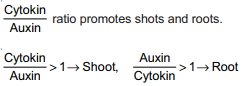
$A$ : Cytokinin along with the auxin are required for morphogenesis.
$R$ : More cytokinin to auxin ratio promote root initiation during micropropagation.
- A
Assertion and Reason both are correct and also correct explanation.
- B
Assertion and Reason both are correct but not explanation of assertion.
- ✓
Assertion is correct, but Reason is incorrect.
- D
Both Assertion and Reason are incorrect.
AnswerCorrect option: C. Assertion is correct, but Reason is incorrect.
c
View full question & answer→MCQ 591 Mark
In which of the following, growth is sub-apical
MCQ 601 Mark
In root the maximum growth occurs
- A
In the presence of high temperature
- B
- C
- ✓
Answerd
(d) Apex portion of root is root cap and apical meristem is present just below this root cap.
View full question & answer→MCQ 611 Mark
The matured tissues are characterized by
- A
- B
Less vacuolated cytoplasm
- C
- ✓
View full question & answer→MCQ 621 Mark
A cap like region of slowly dividing or inactive cells in the middle of highly meristematic cells (between meristem and root cap) is
Answerc
(c) Quiescent centre is present at the apex of roots.
View full question & answer→MCQ 631 Mark
Growth of plant is different from the growth of animals in
- A
- ✓
- C
Having a definite life span
- D
Having an indefinite span
Answerb
(b) In plants, growth occurs in localized area i.e., apical, lateral and intercalary region while in animals growth takes place in whole body.
View full question & answer→MCQ 641 Mark
Apical growth of the lower vascular plants takes place by an apical cell. This cell is generally pyramidal. Though four-sided in shape, it is often referred to as three-sided cell because
AnswerCorrect option: B. In a $T.S.$ it appears as three-sided cell
View full question & answer→MCQ 651 Mark
Maximum growth in roots occurs
Answerc
(c)Apex portion of root is made up of protective tissue ‘root cap’ and region of cell division is situated below the root cap.
View full question & answer→MCQ 661 Mark
Which two factors primarily affect the developmental phase of growth of plants
- ✓
- B
- C
- D
Temperature and relative humidity
Answera
(a)Differential length of light and temperature influence the developmental phase of plant. Photoperiodism and vernalization are the two important factors responsible for the flowering of plants.
View full question & answer→MCQ 671 Mark
Answerd
(d)First phase of growth is cell division, second phase is cell enlargement and third phase is cell maturation.
View full question & answer→MCQ 681 Mark
Where would you look for active cell division in plant
- A
- B
- C
- ✓
At the tip of root and shoot
AnswerCorrect option: D. At the tip of root and shoot
d
(d)In apical meristem tissue actively dividing cells are present.
View full question & answer→MCQ 691 Mark
Plant growth in length is increased by
Answera
(a)Apical meristem are found at shoot and root apex. As a result of activity of these meristems plants increases in length.
View full question & answer→MCQ 701 Mark
Answerc
(c)Because growth is a irreversible process.
View full question & answer→MCQ 711 Mark
If a leaf segment of Bryophyllum plant is in soil, it produces new plants. This is because its leaf has
- A
- ✓
- C
High concentration of auxins and cytokinins
- D
High concentration of cytokinins
View full question & answer→MCQ 721 Mark
The rate of growth of any organism follows
Answerc
(c)The growth of an organism/organ passes through different phases. If the growth rate of a plant part is plotted against time on a graph paper, a sigmoid/$S-$ shaped growth curve is obtained.
View full question & answer→MCQ 731 Mark
The process of growth is determined by
- A
- ✓
Increase in size and dry weight
- C
- D
AnswerCorrect option: B. Increase in size and dry weight
b
(b)Growth is a physiological process of irreversible increase in size, dry weight and volume of an organism.
View full question & answer→MCQ 741 Mark
A bifacial organ bends towards, where
MCQ 751 Mark
In which of the stage, the enzymatic actions start in plant
- ✓
- B
At the time of photosynthesis
- C
At the time of flower establishment
- D
At the time of fertilization
Answera
(a)Seed germination is imbibition of water by hydrophilic substances of seed coat. Seed coat becomes soft, embryo cells get activated and some long lived $RNA $ forms enzymes and growth promotors. Respiratory enzymes resume their activity.
View full question & answer→MCQ 761 Mark
Answera
(a)It represents intial stage of growth. The rate of growth is very slow in lag phase.
View full question & answer→MCQ 771 Mark
The effect of oxygen supply on growth is
- ✓
- B
- C
In some plants it is positive while in others it is negative
- D
Answera
(a)Normal growth of most plants occurs only when abundant oxygen is present since ${O_2}$ is important for respiration.
View full question & answer→MCQ 781 Mark
When food supply is poor, the rate of growth is
Answerb
(b)In poor food supply metabolic activities are slow, thus rate of growth will be lowered.
View full question & answer→MCQ 791 Mark
The rate of growth is highest in
Answerb
(b)Log phase is the rapid growing phase of plants between lag and stationary phase.
View full question & answer→MCQ 801 Mark
By arc auxanometer, we measure the growth in
- ✓
- B
- C
Both $ (a) $ and $(b)$
- D
Answera
(a)In arc auxanometer actual growth in length of a plant is measured as actual growth
=$\frac{{{\rm{distance}}\,{\rm{travelled}}\,{\rm{by}}\,{\rm{pointer}}\, \times \,{\rm{radius}}\,{\rm{of}}\,{\rm{pulley}}}}{{{\rm{Length}}\,{\rm{of}}\,{\rm{pointer}}\,{\rm{from}}\,{\rm{centre}}\,{\rm{of}}\,{\rm{pulley}}}}$
View full question & answer→MCQ 811 Mark
Which of the following is used to measure the growth in elongation
Answerc
(c)Horizontal or travellers microscope to measure growth in length in fields.
View full question & answer→MCQ 821 Mark
Different growth phases results in a
AnswerCorrect option: A. $‘S’ $ shaped curve on graph
a
(a)The rate of growth varies in different species and different organs. The mathematical curve which represents variation in growth rate is some what flattened $S-$ shaped curve or sigmoid curve.
View full question & answer→MCQ 831 Mark
The correct sequence of cellular growth stages is
- A
Division $→$ differentiation $→$ elongation
- ✓
Division $→$ elongation $→$ differentiation
- C
Differentiation $→$ division $→$ elongation
- D
Elongation $→$ differentiation $→$ division
AnswerCorrect option: B. Division $→$ elongation $→$ differentiation
b
(b)In phase of cell division, cells divide mitotically in apical meristem to increase mass. In phase of cell elongation, cells increase in size due to vacuolation i.e., by absoption of water. In phase of cell differentiation, cells start maturing to gain a permanent size and function.
View full question & answer→MCQ 841 Mark
Growth is defined as a change which is
AnswerCorrect option: D. Irreversible at constant turgidity
View full question & answer→MCQ 851 Mark
How growth takes place in an organism
- A
- B
By chemical reaction in cell
- ✓
By biochemical conversion of food into living matter
- D
By multiplication of cells or tissues
AnswerCorrect option: C. By biochemical conversion of food into living matter
View full question & answer→MCQ 861 Mark
The growth pattern of a plant is different from the growth pattern of an animal in having
MCQ 871 Mark
The usual shape of growth curve is
Answerc
(c)Sigmoid curve is a $S-$ shaped curve.
View full question & answer→MCQ 881 Mark
The $S-$ shaped growth curve and ‘grand period of growth’ may change with
- A
Sudden fluctuation in light intensity
- B
- C
- ✓
View full question & answer→MCQ 891 Mark
In a vascular plant, the exponential phase represents the phase of
MCQ 901 Mark
Most important division for the growth of a plant is
Answera
(a)Mitosis is simple division of somatic cells and it is responsible for growth of plant.
View full question & answer→MCQ 911 Mark
Deeply sown seeds do not germinate and do not come up over due to the deficiency of
Answerc
(c)Most plants require oxygen for seed germination. That is why soil is ploughed before sowing the seeds.
View full question & answer→MCQ 921 Mark
Most dominant direct factor which influences the growth of plants is
Answerb
(b)A temperature of $28° -30°C$ is optimum for proper growth in most plants. Lower temperature in activates enzymes as well as increases density enzymes as well as increases density of protoplasm.
View full question & answer→MCQ 931 Mark
The excess amount of $CO_2 $
- A
- ✓
- C
Affects the growth slowly
- D
View full question & answer→MCQ 941 Mark
Growth is maximum in the zone of
MCQ 951 Mark
View full question & answer→MCQ 961 Mark
View full question & answer→MCQ 971 Mark
Geotropic response of roots is due to
- A
Inhibition of stem growth
- B
More growth on lower side
- ✓
More growth on upper side
- D
AnswerCorrect option: C. More growth on upper side
View full question & answer→MCQ 981 Mark
Tropic movement is due to
- ✓
- B
- C
Both $ (a)$ and $ (b)$
- D
Answera
(a)Tropic movement are caused by cell elongation and do not affect the whole plant.
View full question & answer→MCQ 991 Mark
Typical growth curve in plants is
MCQ 1001 Mark
It provides medium for enzymatic activities needed for growth.
MCQ 1011 Mark
Characteristic of cell in cell division phage......
MCQ 1021 Mark
In $W_1 = W_0 e^{rt}r = $ ?
- ✓
- B
- C
Initial size at the beginning of the period.
- D
View full question & answer→MCQ 1031 Mark
Match the following (Condition for growth)
|
$P$
|
$Q$
|
|
$1.$ Nutrients (Macro and Micro)
|
$a.$ Medium for enzymatic activities
|
|
$2.$ Oxygen
|
$b.$ Synthesis of protoplasm and act as a source of energy
|
|
$3.$ Water
|
$c.$ Releasing metabolic energy for growth activities
|
- A
$1-b ,2-a ,3-c$
- B
$1-c ,2-b ,3-a$
- C
$1-a ,2-b ,3-c $
- ✓
$1-b, 2-c, 3-a $
AnswerCorrect option: D. $1-b, 2-c, 3-a $
View full question & answer→MCQ 1041 Mark
Plant growth is unique because
- ✓
Plant retains the capacity for unlimited growth throughout their life.
- B
Plant retains the capacity for limited growth.
- C
Plants have less growth that differs from animals.
- D
Plants growth is seen only in juvenile phase.
AnswerCorrect option: A. Plant retains the capacity for unlimited growth throughout their life.
View full question & answer→MCQ 1051 Mark
Growth at cellular level is the increase in the amount of
MCQ 1061 Mark
Growth in plants is measured by the increase in
$I.$ Fresh weight. $II.$ Dry weight
$III.$ Length, area and volume $IV.$ Cell number
Choose the correct option.
- A
All except $I$ and $II$
- B
All except $III $
- ✓
All except $IV$
- D
$I, II, III$ and $IV$
AnswerCorrect option: C. All except $IV$
View full question & answer→MCQ 1071 Mark
Growth period of plant is generally divided into
MCQ 1081 Mark
Constantly dividing cells, both at the root apex and shoot apex represents.
- A
Elongation phase of growth
- ✓
Meristematic phase of the growth
- C
Maturation phase of the growth
- D
Base of natural logarithms.
AnswerCorrect option: B. Meristematic phase of the growth
View full question & answer→MCQ 1091 Mark
In geometrical growth, lag phase is represented by
MCQ 1101 Mark
In the expression, $W_1 = W_0 e^{rt}, W_1, W_0, r,t$ represent
$W_0 -W_1-r-t$
- ✓
Initial size $-$ Final size $-$ Growth rate $-$ Time $-$ of growth
- B
Final size $-$ initial size $-$ Growth rate $-$ Time of growth
- C
Final size $-$ Initial size $-$ Growth rate $-$ Time of dividing
- D
Initial size $-$ Final size $-$ Growth rate $-$ Time of dividing
AnswerCorrect option: A. Initial size $-$ Final size $-$ Growth rate $-$ Time $-$ of growth
View full question & answer→MCQ 1111 Mark
Efficiency index in the exponential phase of geometrical growth is the ability of plants to produce.
- A
- B
- ✓
- D
Young ones through mitosis
View full question & answer→MCQ 1121 Mark
Which of the following is essential for plant growth
MCQ 1131 Mark
The final structure at maturity of a cell/tissue is
- A
- B
- ✓
Location of cell within tissue
- D
AnswerCorrect option: C. Location of cell within tissue
View full question & answer→MCQ 1141 Mark
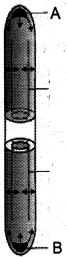
Identify $A$ and $B$ in the given figure and choose the correct option.
- A
$A-$ Root apical meristem; $B -$ Shoot apical meristem
- ✓
$A-$ Shoot apical meristem; $B -$ Root apical meristem
- C
$A-$ Seed coat; $B -$ Radicle tissue
- D
$A-$ Radical tissue; $B -$ Root
AnswerCorrect option: B. $A-$ Shoot apical meristem; $B -$ Root apical meristem
View full question & answer→MCQ 1151 Mark
Typical growth curve in plants is
MCQ 1161 Mark
Turgidity of cell help in
MCQ 1171 Mark
Specific areas in the higher plants which takes part in the formation of new cells are called
Answerc
Higher plants possess specific areas, which take part in the formation of new cells. These area are called meristems. Meristems are of three types
$(i)$ Apical meristem
$(ii)$ Intercalary meristem
$(ii)$ Lateral meristem
View full question & answer→MCQ 1181 Mark
Constantly dividing cells, both at the root apex and shoot apex represents
- A
Elongation phase of the growth
- ✓
Meristematic phase of the growth
- C
Maturation phase of the growth
- D
AnswerCorrect option: B. Meristematic phase of the growth
b
Meristematic Phase This phase is also called the formative or cell formation phase. In this phase there are constantly dividing cells present at the root and shoot apex. The cells in this region are rich in protoplasm, possess large conspicuous nuclei and the cell walls are, thin and cellulosic with abundant plasmodesmatal connections
View full question & answer→MCQ 1191 Mark
Growth period of plant is generally divided into
Answerb
The period of growth is generally divided in to three phases
$(i)$ Meristematic phase
$(ii)$ Elongation phase
$(iii)$ Maturation phase
View full question & answer→MCQ 1201 Mark
Grand place of growth is an another name of
Answerd
The log phase or exponential growth is also called the grand phase of growth. The rate of maximum growth in the log phase is maintained for some time. It is then known as linear phase. It appears as upright line in growth curve
View full question & answer→MCQ 1211 Mark
Opening of floral buds into flowers, is a type of
- A
Autonomic movement of locomotion
- B
Autonomic movement of variation
- C
Paratonic movement of growth
- ✓
Autonomic movement of growth
AnswerCorrect option: D. Autonomic movement of growth
d
Opening of floral buds into flower is a type of autonomic movement of growth (nastic movement). This is non-directional movement in which the response is determined by the responsive organ and not to the direction of stimulus. Greater growth on one side causes the organ to bend to the opposite side.
View full question & answer→MCQ 1221 Mark
Increased growth per unit time is termed as
Answerb
The increased growth per unit time is termed as growth rate. Thus, rate of growth can be expressed mathematically. An organism, or a part of an organism can produce more cells in a variety of ways. The growth rate shows an increase that may be $(i)$ Arithmetic and $(ii)$ Geometrical
View full question & answer→MCQ 1231 Mark
Growth at cellular level is the increase in the amount of
Answerc
Growth, at cellular level, is principally a consequence of increase in the amount of protoplasm. Since, increase in protoplasm is difficult to measure directly, one generally measures some quantity which is more or less proportional to it. Growth is, therefore, measured by a variety of parameters some of which are; increase in fresh weight, dry weight, length, area, volume and cell number
View full question & answer→MCQ 1241 Mark
Water is required in plant growth for
Answerd
All of the above.
Water, oxygen, nutrients and other factors are very essential elements for growth
$(i)$ The plant cells grow in size by cell enlargement, which in turn requires water. Turgidity of cells help in extension growth. Thus, plant growth and further development are intimately linked to the water status of the plant
$(ii)$ Water also provides the medium for enzymatic reaction
$(iii)$ Oxygen helps in releasing metabolic energy essential for growth activities
$(iv)$ Nutrients are required by plants for the synthesis of protoplasm and all as sources of energy
View full question & answer→MCQ 1251 Mark
AnswerCorrect option: C. Both $(a)$ and $(b)$
c
Most plants structures have a determinate, limited growth with a definite final shape. Stems and roots show indeterminate growth, which have not a precisely established limit of growth fixed in advance.
Some exception are as follows determinate growth pattern of segmented stem of certain cactus and determined growth of root in many monocotyledons
View full question & answer→MCQ 1261 Mark
In geometrical growth, log phase is represented by
- A
Rapid consumption of nutrient
- B
Rapid increment of cell number
- C
- ✓
Answerd
In the exponential phase of growth (S-shaped), there is a rapid increase in size, cell number and mass of an organism, due to the rapid consumption of nutrients. Due to rapid consumption of nutrient, the growth rate is highest at this phase
View full question & answer→MCQ 1271 Mark
Developing embryo (in vitro) shows
- A
- B
- ✓
Geometric and arithmetic growth
- D
AnswerCorrect option: C. Geometric and arithmetic growth
c
Developing embryo shows both type of growth; geometrical and arithmetic.
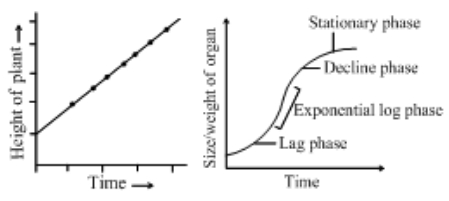
Arithmetic Growth Rate The expression of arithmetic growth is exemplified by roots (or organ) elongating at constant rate. On plotting the length of an organ against time, a linear curve is obtained. Mathematically it is expressed as
Constant linear growth, a plot of length L against time
$L_{t}=L_{0}+r t$
$L_{t}=$ Length of time ' $t$ '
$L_{0}=$ Length of time to
$r=$ Growth rate or elongation per unit time
Geometrical Growth In most system the initial growth is slow (lag phase), and it increases there after at a exponential rate (log or exponential phase). Both the progeny cells following mitotic cell division retains the ability to divide and continue to do so. However due to the limited nutrient supply, the growth slows down leading to stationary phase. If we plot the parameter of growth against time, a typical sigmoid curve is obtained.
It has following stages
$1.$ During lag phase, organism adapt themselves to growth conditions. It is the period where the individual organism are maturing and not yet able to divide. During the lag phases of the bacterial growth cycle, synthesis of $RNA$, enzyme and other molecules occurs
$2.$ The log phase (sometimes called the logarithmic phase or the exponential phase) is a period characterised by cell doubling. The number of new organism appering per unit time is proportional to the present population.
$3.$ The stationary phase is often due to a growth-limiting factor such as the depletion of an essential nutrient, and/or the formation of an inhibitory product such as an organic acid. Stationary phase results from a situation in which growth rate and death rate are equal
$4.$ Death phase, organism run out of nutrients and die
View full question & answer→MCQ 1281 Mark
The cells in the root and shoot apex
- A
- B
- C
Have their cell wall which are primary in nature, thin and cellulosic with abundant plasmodesmatal connections
- ✓
Answerd
The cells in the root and shoot apex shows the following characteristics
$(i)$ rich in protoplasm
$(ii)$ conspicuous nuclei
$(iii)$ cell wall are primary in nature, thin and cellulosic with abundant plasmodesmata connection
View full question & answer→MCQ 1291 Mark
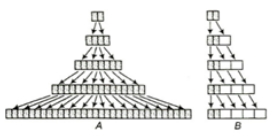
In the given diagram, what does $A$ and $B$ indicates?
Choose the correct option
- A
$A-$ Mitosis; $B-$ Meiosis
- B
$A-$ Arithmetic growth; $B-$ Geometric growth
- ✓
$A-$ Geometric growth; $B-$ Arithmetic growth
- D
$A-$ Multiplicative phase; $B-$ Replicative growth
AnswerCorrect option: C. $A-$ Geometric growth; $B-$ Arithmetic growth
View full question & answer→MCQ 1301 Mark
Phase of maturation is characterised by
$I.$ Cells attaining their maximal size
$II.$ Proper wall thickening and protoplasmic modification
$III.$ Rapid cell division
Select the correct option
- ✓
$I$ and $II$
- B
$II$ and $III$
- C
$I$ and $III$
- D
$I, II$ and $III$
AnswerCorrect option: A. $I$ and $II$
a
Further away from the apex, i.e., more proximal to the phase of elongation, lies the portion of axis which is undergoing the phase of maturation. The cells of this zone, attain their maximal size in terms of wall thickening and protoplasmic modifications
View full question & answer→MCQ 1311 Mark
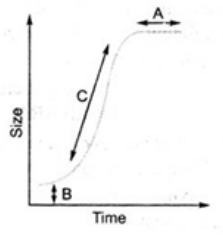
Given below is a graph drawn on the parameters of growth versus time. $A, B$ and $C$ respectively represent
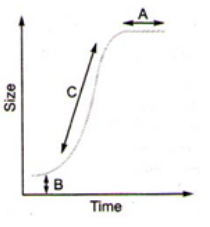
- A
Exponential phase, log phase and steady state phase
- ✓
Steady state phase, lag phase and log phase
- C
Slow growing phase/lag phase, log phase and steady state phase
- D
Lag phase, steady state phase and log phase
AnswerCorrect option: B. Steady state phase, lag phase and log phase
b
It is the graphic representation of growth against time. If total growth is plotted against time, an S-shaped or sigmoid curve is obtained. Where, $A$ is the steady state phase. $B$ is the lag phase and $C$ is the log phase.
View full question & answer→MCQ 1321 Mark
In most of the higher plants, the growing ...$A$... bud inhibits the growth of ...$B$... bud, a phenomenon called apical dominance. Removal of the shoot tips usually results in growth of $\ldots$...$C$......buds.
- A
$A-$ lateral, $B-$ axillary, $C-$ axillary
- B
$A-$ apical, $B-$ lateral, $C-$ apical
- ✓
$A-$ apical, $B-$ lateral, $C-$ lateral
- D
$A-$ lateral, $B-$ apical, $C-$ lateral
AnswerCorrect option: C. $A-$ apical, $B-$ lateral, $C-$ lateral
View full question & answer→MCQ 1331 Mark
Plant growth is unique because
- ✓
Plant retains the capacity for unlimited growth
- B
Plant retains the capacity for limited growth
- C
Plants have diffused growth that differs from animals
- D
AnswerCorrect option: A. Plant retains the capacity for unlimited growth
a
Plant growth is unique as they retain the capacity for unlimited growth which is mainly due to the presence of meristems. The cells of such meristems have the capacity to divide and self-perpetuate. This form of growth wherein new cells are always being added to the plant body by the activity of the meristem is called the open form of growth
View full question & answer→MCQ 1341 Mark
$I.$ Increased vacuolation
$II.$ Cell enlargement
$III.$ New cell wall deposition
Which of the above are the characteristics of phase of elongation?
Choose the correct option accordingly
- A
$I$ and $II$
- B
$II$ and $III$
- C
$I$ and $III$
- ✓
$I, II$ and $III$
AnswerCorrect option: D. $I, II$ and $III$
d
Characters of phase of elongation phase are
$(i)$ cell enlargement
$(ii)$ new cell wall deposition
$(iii)$ increased vacuolation
View full question & answer→MCQ 1351 Mark
Study the following statements
$I.$ $O_{2}$ helps in releasing metabolic energy, which is essential for growth
$II.$ Nutrients are required by plants for the synthesis of protoplasm
$III.$ Change in temperature could be the detrimental for the survival of an organism
$IV$. Light and gravity don't affect the stages of growth
Choose the correct option
- A
$I, II, III$ and $IV$
- ✓
$I, II$ and $III$
- C
$I, III$ and $IV$
- D
$I, II$ and $IV$
AnswerCorrect option: B. $I, II$ and $III$
b
Every organism has an optimum temperature range best studies for its growth. Any deviation from this range could be detrimental to its survival. Environmental signals such as light and gravity also affect certain phases/stages of growth
View full question & answer→MCQ 1361 Mark
Geotropic response is perceived by
Answerc
Geotropic response is perceived by root cap
View full question & answer→MCQ 1371 Mark
Exponential growth can't be sustained for much time due to
$I.$ limited space and nutrient
$II.$ accumulation of toxic agent
$III.$ unlimited space and nutrient
$IV.$ accumulation of nutrient agent
Choose the correct combination of options
- A
$I$ and $III$
- B
$III$ and $IV$
- ✓
$I$ and $II$
- D
$IV$ and $II$
AnswerCorrect option: C. $I$ and $II$
c
Exponential or log phase can not sustain for long period because the nutrients and space are limited and there is competition as well.
Microorganisms, when nutrients get exhausted, secrete toxic chemicals which inhibit the growth of other organisms
View full question & answer→MCQ 1381 Mark
Which of the following structures show unlimited growth in plants?
Answerd
Roots, stems show continuous, indeterminate growth due to presence of apical meristem.
Leaves, fruits, flowers show closed, determinate growth due to intercalary meristem.
View full question & answer→MCQ 1391 Mark
Growth of an organ is defined as
- A
Infinite increase in size
- ✓
Irreversible increase in size
- C
Reversible increase in size
- D
Infinite and reversible increase in size
AnswerCorrect option: B. Irreversible increase in size
b
Organs show limited growth and growth is irreversible.
View full question & answer→MCQ 1401 Mark
Which type of cells have the capacity of self perpetuation?
Answera
These cells are in state of continuous division i.e, they are capable of self perpetuation, have power to continue indefinitely through division.
View full question & answer→MCQ 1411 Mark
Plant growth is unique in being
Answerb
Plants show indeterminate or unlimited growth, throughout their, life. Hence, we say that plant growth is unique in being unlimited.
View full question & answer→MCQ 1421 Mark
Increase in the girth of plant is known as/done by
Answerd
Increase in girth is secondary growth.
Increase in height is primary growth.
View full question & answer→MCQ 1431 Mark
Which parameter is used to measure the growth in flat organs like leaves?
Answerc
The parameter is used for measuring growth in flat organs like leaves are surface area.
View full question & answer→MCQ 1441 Mark
Which of the following is difficult to measure directly?
- ✓
Increase in protoplasm content
- B
- C
- D
AnswerCorrect option: A. Increase in protoplasm content
a
Increase in protoplasm content is difficult to measure, while surface area, volume and dry weight measurement are easy.
View full question & answer→MCQ 1451 Mark
Deposition of new materials inside the cell wall of cells starts in
Answerd
During this phase cell elongates due to deposition of new materials inside cell wall of cell.
View full question & answer→MCQ 1461 Mark
Which phase of a sigmoid curve explains the initial phase of growth when growth rate is very slow?
Answerb
Starting or initial phase.
View full question & answer→MCQ 1471 Mark
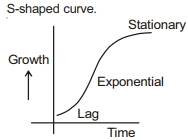
______ curve is obtained for cells in culture.
- A
$J$-shaped
- B
- C
$V$-shaped
- ✓
$S$-shaped
AnswerCorrect option: D. $S$-shaped
d
View full question & answer→MCQ 1481 Mark
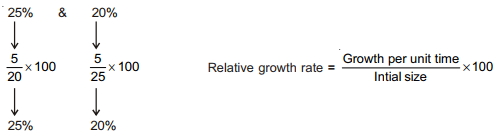
$A$ Leaf of $20 \;cm ^{2}$ grows $5 \;cm ^{2}$ per hour and $B$ Leaf of $25 \;cm ^{2}$ grows $5 \;cm ^{2}$ per hour The relative growth rate of leaf $A$ and $B$ respectively is
- ✓
$25 \%$ and $20 \%$
- B
$20 \%$ and $25 \%$
- C
$50 \%$ and $100 \%$
- D
$25 \%$ and $50 \%$
AnswerCorrect option: A. $25 \%$ and $20 \%$
a
View full question & answer→MCQ 1491 Mark
What happens to the growth of roots during water logging conditions?
- A
- ✓
- C
- D
First growth is accelerated and then stops
Answerb
Oxygen deficiency occurs due to water logging, thus growth is inhibited.
View full question & answer→MCQ 1501 Mark
Which of the following is not a function of water in plants?
- A
It is responsible for cell elongation
- B
It maintains the turgidity of cells
- ✓
It acts as a source of energy
- D
It provides medium for enzymatic activities
AnswerCorrect option: C. It acts as a source of energy
c
It is not producing energy. It helps in maintaining turgidity, cell elongation and in enzymatic activities.
View full question & answer→MCQ 1511 Mark
Which abiotic factor is not essential for early growth of the plant but growth is sustained only in its presence?
Answerd
Abiotic means non-living. Light is not required for early growth but growth will continue only in its presence. Water, nutrients, oxygen are required for early growth.
View full question & answer→MCQ 1521 Mark
Which factor determines the direction of movement of main root and stem?
Answerb
Root is positive geotropic while stem is negative geotropic.
View full question & answer→MCQ 1531 Mark
Growth in plant organs is
- A
Qualitative and extrinsic
- ✓
Quantitative and intrinsic
- C
Qualitative and intrinsic
- D
Quantitative and extrinsic
AnswerCorrect option: B. Quantitative and intrinsic
b
Organs made up different tissues inside the plant body
View full question & answer→MCQ 1541 Mark
Find out the correct statement(s).
$(a)$ Growth in plants is internal/intrinsic and open ended
$(b)$ Formation of cellular materials is called real or protoplasmic growth
$(c)$ Plant growth is diffused only during the early embryonic stage
- A
Only $(a)\, \& \,(b)$
- B
$(b)$ only
- C
Only $(b)\, \& \,(c)$
- ✓
$(a), (b)\, \& \,(c)$
AnswerCorrect option: D. $(a), (b)\, \& \,(c)$
View full question & answer→MCQ 1551 Mark
After achieving its maximum, the growth decreases slowly during the phase of
MCQ 1561 Mark
In vascular plants, light promotes
MCQ 1571 Mark
Change in form and physiological activity is termed as
MCQ 1581 Mark
Formation of meristem intrafascicular cambiun and cork cambium from fully differentiated parenchyma cell. This is example of.
MCQ 1591 Mark
The living differentiated cells, regain capacity of division under certain condition which called ....
MCQ 1601 Mark
All given tissues are formed as a result of redifferentiation process, except
Answerd
It is formed due to dedifferentiation of parenchyma of medullary rays.
View full question & answer→MCQ 1611 Mark
Select wrong statement regarding secondary phloem
- ✓
Arise due to activity of procambium
- B
Occurs during secondary growth
- C
No distinction between protophloem and metaphloem
- D
Secondary permanent tissue
AnswerCorrect option: A. Arise due to activity of procambium
a
Secondary phloem arises due to activity of vascular cambium.
View full question & answer→MCQ 1621 Mark
$I.$ Cell elongation
$II.$ Cell division
$III.$ Cell differentiation
Among the above mentioned, what is/are the function(s) of auxin?
- A
$I$ and $II$
- B
$III$ and $I$
- C
$II$ and $III$
- ✓
$I, II$ and $III$
AnswerCorrect option: D. $I, II$ and $III$
d
Auxin elongates the cells present just below the apical part of shoot. It also do cell division and cell differentiation
View full question & answer→MCQ 1631 Mark
Development includes (plants)
$I.$ Differentiation
$II.$ Redifferentiation
$III.$ Dedifferentiation
Select the right combination from the given option
- A
$I$ and $II$
- B
$II$ and $III$
- C
$III$ and $I$
- ✓
$I, II$ and $III$
AnswerCorrect option: D. $I, II$ and $III$
d
Development cannot take place without growth, and growth takes place by differentiation, dedifferentiation and redifferentiation. Hence, through these processes development takes place
View full question & answer→MCQ 1641 Mark
The cells derived from cambium, root apical and shoot apical meristem differentiate and mature to perform specific functions. This act is called
Answera
Growth is invariably associated with differentiation. For example, when a seed germinates it does not simply increases in size but form seedlings. Differentiation is a permanent, localised qualitative change in size, biochemistry, structure and function of cells, tissues or organs, $e \cdot g .$, fibres, vessels, tracheids, sieve tubes, mesophyll, leaf, etc.
View full question & answer→MCQ 1651 Mark
- A
Removal of old material from cell wall
- ✓
Deposition of new material into cell wall during differentiation
- C
Deposition of new material into cell wall during cell division
- D
Another name of cell division
AnswerCorrect option: B. Deposition of new material into cell wall during differentiation
b
During the phase of elongation/enlargement the cell wall of the enlarging cell shows plastic extension through enzymatic loosening of microfibrils and deposition of new material. This deposition of new material into cell wall is called intussusception
View full question & answer→MCQ 1661 Mark
During differentiation of tracheary elements
- A
The cells lose its protoplasm
- B
Cells develop very strong elastic lignocellulosic secondary cell walls
- ✓
Both $(a)$ and $(b)$
- D
The cell increases its protoplasm
AnswerCorrect option: C. Both $(a)$ and $(b)$
c
During differentiation, cells undergoes few to major structural changes both in their cell wall and protoplasm. For example, to form tracheary elements, the cells would loose their protoplasm. They also develop a very strong, elastic, lignocellulosic secondary cell walls to carry water to long distances even under extreme tension
View full question & answer→MCQ 1671 Mark
During differentiation, the cells undergo few to major structural changes in their
AnswerCorrect option: C. Both $(a)$ and $(b)$
c
During differentiation, cells undergoes few to major structural changes both in their cell wall and protoplasm. For example, to form tracheary elements, the cells would loose their protoplasm. They also develop a very strong, elastic, lignocellulosic secondary cell walls to carry water to long distances even under extreme tension
View full question & answer→MCQ 1681 Mark
Tracheids do not collapse under extreme tension due to the presence of
- ✓
Strong, elastic lignocellulosic secondary cell wall
- B
Thick, cellulosic primary cell wall
- C
Thin, elastic, cellulosic primary cell wall
- D
Thick, hard suberised secondary cell wall
AnswerCorrect option: A. Strong, elastic lignocellulosic secondary cell wall
a
Because tracheids have made themselves strong, elastic etc by process of differentiation i.e., specialised for particular function.
View full question & answer→MCQ 1691 Mark
Cork, secondary cortex and secondary xylem are formed through
Answerb
Cork, secondary cortex and secondary xylem all are secondary structure formed from dedifferentiated cell by redifferentiation and are responsible for secondary growth.
View full question & answer→MCQ 1701 Mark
Which of the following is formed after dedifferentiation?
- A
- B
- C
- ✓
Interfascicular vascular cambium
AnswerCorrect option: D. Interfascicular vascular cambium
View full question & answer→MCQ 1711 Mark
Find odd one w.r.t. differentiation
- A
- B
Death of protoplasm in tracheary elements
- ✓
- D
Answerc
Mass of undifferentiated cells.
View full question & answer→MCQ 1721 Mark
Which of the given is/are examples of differentiation?
- A
Loss of nucleus and perforations in some sieve tube members
- B
Lignin deposition in tracheids and vessels
- C
Differential wall thickening in guard cells
- ✓
More than one option is correct
AnswerCorrect option: D. More than one option is correct
d
Permanent change in structure, biochemistry, size and physiology of cell is called differentiation.
View full question & answer→MCQ 1731 Mark
The sequence of steps in the history of an organism is called
Answerb
(b)Development is the sequence of events that occurs in the life history of a cell organ or organism which includes growth differentiation, maturation and senescence.
View full question & answer→MCQ 1741 Mark
Sleep movements of leaves in certain plants are or photonasty is due to
- A
- B
The leaves getting tired of carrying on photosynthesis
- ✓
Decrease in the intensity of light
- D
Differential growth at the base of leaf
AnswerCorrect option: C. Decrease in the intensity of light
View full question & answer→MCQ 1751 Mark
Plasticity can be observed in the leaf of
MCQ 1761 Mark
Identify figure.
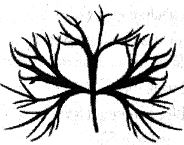
MCQ 1771 Mark
Heterophylly can be observed in
$I.$ cotton $II.$ coriander
$III.$ Larkspur
Select the right option
- ✓
$I, II$ and $III$ only
- B
$I$ and $II$ only
- C
$II$ and $III$ only
- D
$I$ and $III$ only
AnswerCorrect option: A. $I, II$ and $III$ only
View full question & answer→MCQ 1781 Mark
Which of them is not an extrinsic factor?
- A
Light, $O_2 $
- B
Temperature, $CO_2 $
- C
- ✓
Growth regulator and genetic factor
AnswerCorrect option: D. Growth regulator and genetic factor
View full question & answer→MCQ 1791 Mark
In roots, absorption of water and minerals mostly occurs in the :
MCQ 1801 Mark
In arithmetic growth, mitotic cell division, only one daughter cell continues to divide while the other ...........
- A
- ✓
Differentiates and matures
- C
- D
Divides and suddenly dead
AnswerCorrect option: B. Differentiates and matures
View full question & answer→MCQ 1811 Mark
The cells in this region are rich in protoplasm, possess large conspicuous nuclei
- A
- B
- ✓
- D
Maturation and meristamatic
View full question & answer→MCQ 1821 Mark
Growth is measured by variety of parameters some of which are increase in
$a.$ Dry weight $b.$ Fresh weight
$c.$ Volume $d.$ Cell number
- A
$a$ and $b$ only
- B
$b$ and $d$ only
- C
$a, b$ and $d$ only
- ✓
All given $a, b, c, d$
AnswerCorrect option: D. All given $a, b, c, d$
View full question & answer→MCQ 1831 Mark
Exponential growth can be expressed as
- A
$W_0= W_1. e^{rt}$
- B
$W_1 = e. st. W_0$
- ✓
$W_1 = W_0. e^{rt}$
- D
$W_0 = W_1 (e + rt)$
AnswerCorrect option: C. $W_1 = W_0. e^{rt}$
View full question & answer→MCQ 1841 Mark
AnswerCorrect option: B. Growth is expressed as increase in cell number and in size of the cell.
View full question & answer→MCQ 1851 Mark
The cells in this zone, attain their maximal size in terms of wall thickening and protoplasmic modifications.
- ✓
- B
Cell division and cell elongation zone
- C
- D
View full question & answer→MCQ 1861 Mark
What are the characteristics of the cells present in the root apex and shoot apex ?
$a.$ Constantly dividing cells.
$b.$ Cell walls are primary in nature.
$c.$ New cell wall deposition.
$d.$ Increased vacuolation.
$e.$ Possess large conspicuous nuclei.
- A
$a, b, c $
- B
$a, b, d $
- C
$c, d, e $
- ✓
$a, b, e$
AnswerCorrect option: D. $a, b, e$
View full question & answer→MCQ 1871 Mark
When growth is exemplified by a root elongation at a constant rate. Mathematically, it is expressed as
- A
$rt =L_1 + L_0$
- B
$W_1 = W_0.e^{rt}$
- ✓
$Lt = L_0 + rt$
- D
$W_0 = W_1. E^{rt}$
AnswerCorrect option: C. $Lt = L_0 + rt$
View full question & answer→MCQ 1881 Mark
What is $r$ in $W_1=W_0.e^{rt}$?
- A
- ✓
- C
- D
Initial size at the beginning of the period.
View full question & answer→MCQ 1891 Mark
$I.$ Plasmatic growth
$II.$ Differentiation
$III.$ Maturation
$IV.$ Senescence
Identify the correct sequence of the following events occurring in plants and choose the correct option accordingly
- ✓
$I \rightarrow II \rightarrow III \rightarrow IV$
- B
$I \rightarrow II \rightarrow IV \rightarrow III$
- C
$IV \rightarrow III \rightarrow II \rightarrow I$
- D
$IV \rightarrow I \rightarrow II \rightarrow III$
AnswerCorrect option: A. $I \rightarrow II \rightarrow III \rightarrow IV$
a
Development is a term that includes all changes that an organism goes through during its life cycle from germination of the seed to senescence. Diagrammatic representation of the sequence of processes, which constitutes the development of a cell of a higher plant is given in figure. It is also applicable to tissues/organs
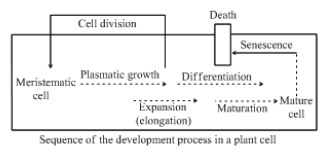
View full question & answer→MCQ 1901 Mark
Plants follow ...$A$... pathways in response to environment or phases of life to form different kind of structures. This ability is called ...$B$...
Complete the given statement with the correct combination of options
- A
$A-$ same; $B-$ elasticity
- B
$A-$ elasticity; $B-$ same
- ✓
$A-$ different; $B-$ plasticity
- D
$A-$ same; $B-$ plasticity
AnswerCorrect option: C. $A-$ different; $B-$ plasticity
c
$A -$ different, $B -$ plasticity.
Plant follows different pathways in response to environment or phases of life to form different kind of structures. This ability is called plasticity, $e . g$., heterophylly in cotton, coriander and larkspur
View full question & answer→MCQ 1911 Mark
Environment heterophylly wrt habitat is seen in-
Answerd
Heterophylly was recently defined as leaf form alteration in response to environmental conditions
Heterophylly is an adaptation for the plant to adapt in different conditions which can be its growth stages, or Habitat
Environmental heterophylly wrt habitat is the difference in shapes of leaves produced in air and water. eg:Buttercup
Buttercup (Ranunculus aquatilis) leaves that form when the shoot tip is under water are thin and more deeply lobed; those that form in the air are thicker and less lobed.
The plants cotton, coriander and larkspur exhibit intrinsic plasticity or heterophylly because the leaves of juvenile plants are quite different in shape from those of mature plants.
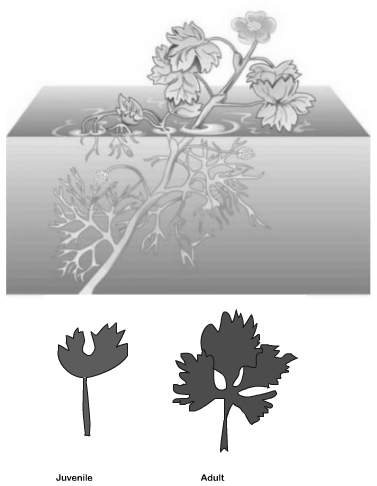
View full question & answer→MCQ 1921 Mark
The ability of a plant to follow different pathways and produce different structores in response to environment is known as
MCQ 1931 Mark
- ✓
The appearance of different forms of leaves on the same plant species
- B
The appearance of same form of leaves on different plants
- C
The appearance of same form of flowers on different plants
- D
The appearance of different forms of fruits on the same plant
AnswerCorrect option: A. The appearance of different forms of leaves on the same plant species
a
Presence of more than one type of leaves on the same plant is called heterophylly.
View full question & answer→MCQ 1941 Mark
Larkspur, Ranunculus and cotton plants are similar in the presence of
- A
Developmental heterophylly
- ✓
- C
Environmental heterophylly
- D
Answerb
Plasticity : Ability of plant to follow different pathways in response to environment to form different kinds of structures.
View full question & answer→MCQ 1951 Mark
The natural plant hormones were first isolated from
- ✓
Corn germ oil and human urine
- B
Cotton fruits, spinach leaves and rice plants
- C
Avena coleoptile spinach leaves and the fungus gibberella
- D
Human urine and rice seedlings
AnswerCorrect option: A. Corn germ oil and human urine
View full question & answer→MCQ 1961 Mark
Which of the following is plant hormone
MCQ 1971 Mark
Grass coleoptile tip bend towards source of light because
- A
- B
- C
- ✓
Due to some secretion from tip
AnswerCorrect option: D. Due to some secretion from tip
d
(d)Darwin and his son found that bending movement of coleoptile of Canary grass was due to exposure of tip of unilateral light. Boysen-Jensen found that the tip produces a chemical which was later named auxin.
View full question & answer→MCQ 1981 Mark
In which of the following respect, the plant hormones differ from enzymes
- ✓
Required in less quantity
- B
They are expanded in the process
- C
- D
AnswerCorrect option: A. Required in less quantity
a
(a)Growth of the plant is very much regulated by certain chemical substances $(hormones),$ which are synthesized by the plant in very small quantities. They are needed in small quantities at very low concentrations as compared to enzyme.
View full question & answer→MCQ 1991 Mark
Phytohormones are used in
MCQ 2001 Mark
Which of the following substances act as a key growth regulator
Answerb
(b)Hormones are also called growth inhibitors or growth promotors.
View full question & answer→MCQ 2011 Mark
Plant hormones are usually
MCQ 2021 Mark
Substances which originate at the tip of stem and root and control the growth of different organs are
MCQ 2031 Mark
Certain chemical substances having profound effect on growth, are called
MCQ 2041 Mark
Auxins were discovered by
MCQ 2051 Mark
Who among the following discovered the Avena curvature test to find out the concentration of auxins
MCQ 2061 Mark
Most of the information regarding auxins have been obtained from
MCQ 2071 Mark
The place where auxins are active is
MCQ 2081 Mark
According to F. Went, auxins transmit
- ✓
- B
Opposite to $ A$
- C
- D
Opposite to $C$
Answera
(a)Auxins show polar movement.
View full question & answer→MCQ 2091 Mark
View full question & answer→MCQ 2101 Mark
The presence of auxins in a solution could be tested by
- ✓
Avena sativa stem tip test
- B
Carbon tetrachloride test
- C
- D
AnswerCorrect option: A. Avena sativa stem tip test
View full question & answer→MCQ 2111 Mark
Gibberellin was first extracted from
Answera
(a)Gibberellins was extracted from rice seedling suffering from ’backanae disease’ which is caused by Gibberella fujikuroi fungus.
View full question & answer→MCQ 2121 Mark
Gibberellin is obtained from a
MCQ 2131 Mark
Zeatin has been obtained from
Answerc
(c)Zeatin, obtained from corn milk by Letham in $ 1963.$
View full question & answer→MCQ 2141 Mark
Which of the following is a kinetin derivative
Answera
(a)Kinetin has been found to be a derivative of the purine base adenine which bears furfuryl group at $ 9th$ position.
View full question & answer→MCQ 2151 Mark
Discovery of which one of following is connected with the use of an old sample of $ DNA$ in a culture medium
View full question & answer→MCQ 2161 Mark
$6-$ furfuryl adenine is
Answerc
(c)The furfuryl substituent attached with adenine at $9th $ position.
View full question & answer→MCQ 2171 Mark
Which of the following is a plant hormone
MCQ 2181 Mark
Answerc
(c)Abscisic acid is also called stress hormone or dormin. $\lambda $ Eagle and Wareing $(1963) $ discovered another substance ‘Dormin’ from dormant buds of Acer (Birch) plants, capable of causing dormancy of seeds.
View full question & answer→MCQ 2191 Mark
View full question & answer→MCQ 2201 Mark
A plant placed near a window bends outwards because
- A
Its tip is able to get more oxygen
- B
Its tip is able to obtain more light
- C
Its tip is able to receive necessary warmth
- ✓
The auxin contents on the shadow side is higher than that on the lighter side and as a result the shaded side elongate more than the cells on the illuminated side and the tip bends outwards
AnswerCorrect option: D. The auxin contents on the shadow side is higher than that on the lighter side and as a result the shaded side elongate more than the cells on the illuminated side and the tip bends outwards
d
(d)Plant bends outwards when it placed near window because auxin responsible for the phototropism movement.
View full question & answer→MCQ 2211 Mark
What causes a green plant to bend towards light as it grows
- A
Because green plants need light to carry on photosynthesis
- B
Because green plants are phototropic
- C
Light stimulates, plant cells on the lighted side to grow faster
- ✓
Auxin accumulates on shaded side stimulating greater cell elongation
AnswerCorrect option: D. Auxin accumulates on shaded side stimulating greater cell elongation
View full question & answer→MCQ 2221 Mark
Which of the following was isolated and identified by Skoog and Miller?
MCQ 2231 Mark
Foolish seedling disease of rice led to the discovery of
- A
$ABA $
- B
$2,4-D$
- C
$IAA $
- ✓
$GA$
View full question & answer→MCQ 2241 Mark
He isolated auxin from tips of coleoptile of oat seedling
MCQ 2251 Mark
Match the following columns
$\begin{array}{|l|l|} \hline Column\,\,-I & Column\,\,-II \\ \hline A.\,\,Plant\,\,growth\,\,promoters & 1.\,\,Auxin \\ \hline B.\,\,Plant\,\,growth\,\,inhibitor & 2.\,\,Gibberellin \\ \hline & 3.\,\,Abscisic\,\,acid \\ \hline & 4.\,\,Cytokinin \\ \hline \end{array}$
$A - B$
- A
$1,2,3$ $-$ $4$
- B
$3$ $-$ $1,2,4$
- C
$4$ $-$ $1,2,3 $
- ✓
$1,2,4$ $-$ $3$
AnswerCorrect option: D. $1,2,4$ $-$ $3$
View full question & answer→MCQ 2261 Mark
Choose the incorrect statement.
- A
$PGR$ has diverse physiological effects on plants.
- B
$PGR$ may act synergically or antagonistically
- C
Two $PGR$ can have same effect.
- ✓
$PGRs$ are divided into three groups based on their functions in a living plant body.
AnswerCorrect option: D. $PGRs$ are divided into three groups based on their functions in a living plant body.
View full question & answer→MCQ 2271 Mark
Charles Darwin and Francis Darwin are related with
MCQ 2281 Mark
Match the following columns.
$\begin{array}{|l|l|} \hline Column\,\,-I & Column\,\,-II \\ \hline A.\,\,F.\,\,W.\,\,went & 1.\,\,Kinetin \\ \hline B.\,\,E.\,\,Kurosawa & 2.\,\,Gibberellin\,\,acid \\ \hline C.\,\,Skoog\,\,and\,\,Miller & 3.\,\,Auxin \\ \hline D.\,\,Cousin & 4.\,\,Ethylene \\ \hline \end{array}$
$A - B - C - D$
- A
$1 - 2 - 3 - 4$
- ✓
$3 - 2 - 1 - 4$
- C
$4 - 3 -2 - 1$
- D
$3 - 2 - 4 - 1$
AnswerCorrect option: B. $3 - 2 - 1 - 4$
View full question & answer→MCQ 2291 Mark
Who isolated auxin from tips of coleoptiles of oat seedling?
MCQ 2301 Mark
Which of the following was isolated and identified by Skoog and Miller?
MCQ 2311 Mark
Foolish seedling disease of rice led to the discovery of
- A
$ABA $
- B
$2,4-D $
- C
$IAA $
- ✓
$GA$
View full question & answer→MCQ 2321 Mark
View full question & answer→MCQ 2331 Mark
View full question & answer→MCQ 2341 Mark
$PGR$ which was discovered by Cousins .........
- A
- ✓
- C
- D
Stimulate phototropic movement
View full question & answer→MCQ 2351 Mark
They are chemically identical.
AnswerCorrect option: D. Abscisin $- II$ and Dormin
View full question & answer→MCQ 2361 Mark
What should be added with auxin to hastens cell division in callus ?
MCQ 2371 Mark
Auxin was isolated by ................ from tips of coleoptile of ....
MCQ 2381 Mark
Fungal pathogens which is responsible for foolish seeding disease of rice seeding?
MCQ 2391 Mark
In plants, phototropism is the movement
- ✓
- B
Away from the light source
- C
Parallel to the light source
- D
Lateral to the light source
Answera
Phototropism movement of plants towards the light is called phototropism. Charles Darwin and his son observed that the coleoptiles of canary grass respond to unilateral illumination by growing towards the light source (phototropism)
View full question & answer→MCQ 2401 Mark
Which of the following movements in plants is due to the increased concentration of auxin?
- ✓
Movement of shoot towards the source of light
- B
- C
Movement of sunflower towards sun
- D
AnswerCorrect option: A. Movement of shoot towards the source of light
a
Auxin concentration increases in shaded area. i.e., auxins are collected in the opposite side of light. Increased auxin concentration is stimulatory for shoot growth and for this reason, shaded side shows more growth than the lighted side. Hence, bending of shoot takes place towards light.
View full question & answer→MCQ 2411 Mark
Increase in the girth of plant (organ) takes place by
- A
- B
- ✓
Both $(a)$ and $(b)$
- D
Root and shoot apical meristem
AnswerCorrect option: C. Both $(a)$ and $(b)$
c
Increase in the girth of plants ($organ$) takes place by vascular and cork cambium.
Root Apical Meristem ($RAM$), Shoot Apical Meristem ($SAM$) and intercalary meristem are responsible for the primary growth to the plants and they principally contributes to the elongation of the plants along their axis.
In the dicotyledons and gymnosperms, the lateral meristems, vascular cambium and cork cambium appear later in life. These are the meristems that causes increase in the girth of the organ in which they are active. This is known as the secondary growth of the plant
View full question & answer→MCQ 2421 Mark
After a series of experiments, it was concluded that the ...$A$... of coleoptile was the site of transmittable influence that caused the ...$B$... of the entire coleoptile.
Complete the given statement with the correct combination of options given in the codes below
- A
$A-$ root site; $B-$ bending
- B
$A-$ lateral side; $B-$ bending
- C
$A-$ side-shoot ; $B-$ bending
- ✓
$A-$ tip; $B-$ bending
AnswerCorrect option: D. $A-$ tip; $B-$ bending
View full question & answer→MCQ 2431 Mark
Bakane' (foolish seedling) disease of rice seedlings, was caused by
Answera
The effect of gibberellins had been know in Japan for over a century where a certain rice plant were found to suffer from 'Bakane' (foolish seedlings) disease. The disease was found by Kurosawa ($1926$) and it is caused by a fungus (Gibberellafujikuroi)
View full question & answer→MCQ 2441 Mark
Initially, the $ABA$ was identified as
- A
Inhibitor $B$
- B
Abscission $II$
- C
- ✓
Answerd
During mid $1960$ s, three independent researches reported the purification and chemical characterisation of three different kind of inhibitors as inhibitor $B$, abscission II and dormin. Later, three were proved chemically identical. It was named Abscisic Acid ($ABA$)
View full question & answer→MCQ 2451 Mark
Charles Darwin and Francis Darwin are related with
- A
- B
- C
- ✓
Effect of plant hormones (auxin)
AnswerCorrect option: D. Effect of plant hormones (auxin)
d
Darwin and his son were studying phototropism (growing plant toward light source) in canary grass. They deduced that the chemical produced in apical part of Canary grass is responsible for phototropism
View full question & answer→MCQ 2461 Mark
Which hormone was first isolated from human urine?
Answera
Auxin (derived from Greek work auxin, which means to grow) was first isolated from human urine. Kogl and Heagen Smith ($1931$) isolated three chemicals from human urine and named them as auxin
View full question & answer→MCQ 2471 Mark
The Plant Growth Regulator ($PGR$), ethylene comes under the category of
- A
- B
- ✓
Plant growth inhibitor hormone
- D
Plant growth promoter hormone
AnswerCorrect option: C. Plant growth inhibitor hormone
c
Plant growth inhibitor hormone
View full question & answer→MCQ 2481 Mark
Which one of the following pairs is not correctly matched?
AnswerCorrect option: C. Terpenes-$IAA$
c
Indole-$3$-Acetic Acid ($IAA$)is indole compound while gibberellic acid ($GA$) is terpene
View full question & answer→MCQ 2491 Mark
Plant growth Regulators ($PGR$) or plant hormones are generally
- ✓
Produced from many parts of plant
- B
Produced from shoot apices and stem apices
- C
- D
AnswerCorrect option: A. Produced from many parts of plant
a
$(i)$ Generally, the plant hormones are same in function and chemical composition produced by different plant species
$(ii)$ Generally, single plant hormone produce many effects
$(iii)$ $ABA$, auxins, $GA$ are acidic in nature
$(iv)$ One hormone is generally produced by many parts of a plants
View full question & answer→MCQ 2501 Mark
Auxin originates at the tip of the stem and controls growth elsewhere. The movement of auxin is largely
AnswerCorrect option: C. Both $(a)$ and $(b)$
c
The movement of auxins is basipetal in stem, i.e., from apex to base and acropetal in roots, i.e., from tip towards shoot
View full question & answer→MCQ 2511 Mark
Plant growth regulators $(PGRs)$ are
- ✓
Simple organic substances of different chemical composition
- B
Complex organic substances of different chemical composition
- C
Simple and complex organic substances of same chemical composition
- D
Small organic substances of same chemical composition
AnswerCorrect option: A. Simple organic substances of different chemical composition
a
$PGRs$ are simple organic substances of different chemical composition.
View full question & answer→MCQ 2521 Mark
hich type of phytohormone is made up of indole compounds?
Answerc
Indole $3$-acetic acid - $IAA$
Indole butyric acid - $IBA$
View full question & answer→MCQ 2531 Mark
Which of the following phytohormone is a derivative of carotenoids?
Answerb
$ABA$ - It is derivative of carotenoids, precursor of $ABA$ is violaxanthin.
View full question & answer→MCQ 2541 Mark
If an etiolated stem could be first saturated with auxin by spraying and then exposed to a streak of light from one side, it will
- ✓
- B
- C
- D
Be prevented from growing
Answera
Auxin causes phototropic response.
View full question & answer→MCQ 2551 Mark
$A$ : Phytochrome, a protein, has regulatory function.
$R$ : Various morphogenetic processes are regulated by it.
- ✓
Assertion and Reason both are correct and also correct explanation.
- B
Assertion and Reason both are correct but not explanation of assertion.
- C
Assertion is correct, but Reason is incorrect.
- D
Both Assertion and Reason are incorrect.
AnswerCorrect option: A. Assertion and Reason both are correct and also correct explanation.
a
Phytochrome is a protein, regulates. Flowering in short day and long day plants.
View full question & answer→MCQ 2561 Mark
Maximum amount of growth in roots occurs due to
MCQ 2571 Mark
Cell elongation in plants is caused by
Answera
(a)Auxins promote elongations and growth of stems and roots and enlargement of many fruits by stimulating elongation of cells in all direction.
View full question & answer→MCQ 2581 Mark
Indole $-3$$ -$ acetic acid called as auxin was first isolated from
Answera
(a)Th first naturally accurring auxin i.e., Indole $3-$ acetic acid was isolated by Kogl and Haagen-Smit from human urine.
View full question & answer→MCQ 2591 Mark
High concentration of synthetic auxins would
- A
- ✓
Prevent lateral buds to grow
- C
- D
AnswerCorrect option: B. Prevent lateral buds to grow
b
(b)In many plants, the apical bud grows and the lower axillary buds are suppressed. Removal of apical bud results in the growth of lower buds. The auxin $(IAA)$ of the terminal bud inhibits the growth of lateral buds.
View full question & answer→MCQ 2601 Mark
Which of the following is not naturally occurring plant hormone
AnswerCorrect option: A. $2, 4-D$
a
(a) $2, 4-D$ $ (2, 4$ dichlorophenoxy acetic acid) is a artificial auxin.
View full question & answer→MCQ 2611 Mark
A well known naturally occuring auxin is or A natural growth regulator $(hormone) $ is
View full question & answer→MCQ 2621 Mark
A high concentration of synthetic auxin is generally used for
- A
Control of cell enlargement
- ✓
- C
Prevention of the growth of lateral buds
- D
Enhancing root initiation
Answerb
(b)Weeds are undesirable in a field with a crop that causes poor yeild. $2-4-D $ is a famous herbicide or weedicide by which broad-leaved weeds can be destroyed but does not affect mature monocotyledonous plants.
View full question & answer→MCQ 2631 Mark
Auxins inhibits the growth of
- A
- ✓
- C
- D
Parthenocarpic development of fruits
View full question & answer→MCQ 2641 Mark
Phototropism in shoots is attributed to
MCQ 2651 Mark
In unisexual plants, sex can be changed by the application of
Answerb
(b)In unisexual plants such as Cannabis sativa, with the help of auxins, male flowers could be produced on female plant and vice-versa. This event is called as sex-change.
View full question & answer→MCQ 2661 Mark
$NAA$ is
- A
- B
- ✓
- D
Naphthalene acetic anhydride
View full question & answer→MCQ 2671 Mark
Which of the following is $2, 4-D$
- A
$2, 4 $ dichloroacetic acid
- B
$2, 4$ dichloroacetaldehyde
- C
$2, 4$ dichloropropane
- ✓
$2, 4$ dichlorophenoxy acetic acid
AnswerCorrect option: D. $2, 4$ dichlorophenoxy acetic acid
View full question & answer→MCQ 2681 Mark
A practical application of an auxin is to induce
MCQ 2691 Mark
The fruits and leaves fall before maturity in absence of
Answera
(a)In some plants sheddling of leaves and fruits takes place due to the formation of abscission layer. Treatment of auxin upon plant fruit fall may be delayed until they are fully matured
View full question & answer→MCQ 2701 Mark
$IBA $ is a
View full question & answer→MCQ 2711 Mark
Which of the following effects of auxins on plants is the basis for commercial application
- A
- B
- C
Induction of root formation in stem cuttings
- ✓
View full question & answer→MCQ 2721 Mark
$2, 4-D$ is a
Answerb
(b) $2, 4-D$ is a selective weedkiller. It is highly toxic to broad-leaved plants. It increases carbohydrate metabolism to such an extent that the plants burn themselves to death in dicots.
View full question & answer→MCQ 2731 Mark
Substances which originate at the tip of the stem and control growth elsewhere are
Answerb
(b)Hormones are secreted by cells in one part of the plant and produce their effect in other part of the plant.
View full question & answer→MCQ 2741 Mark
A substance which accelerates the growth in stem is
MCQ 2751 Mark
In plants auxin synthesis occurs in
MCQ 2761 Mark
Which of the following is not a characteristic of auxin
- A
- B
- C
- ✓
Induce lateral bud formation
AnswerCorrect option: D. Induce lateral bud formation
View full question & answer→MCQ 2771 Mark
Apical dominance is caused by
MCQ 2781 Mark
$IAA$ stands for
- A
Indole $-3-$ acetic anhydride
- ✓
Indole $-3-$ acetic acid
- C
Indole $-3-$ acetic acetate
- D
Indole $-3-$ acetoacetic acid
AnswerCorrect option: B. Indole $-3-$ acetic acid
b
(b) $IAA$ is a auxin hormone.
View full question & answer→MCQ 2791 Mark
Low concentration of auxin lowers the growth of
Answerb
(b)Because auxins are present in higher concentration at the apex of stem.
View full question & answer→MCQ 2801 Mark
Which of the following accelerates apical meristem and exerts direct effect on the growth of plant axis in length
MCQ 2811 Mark
What happens when auxin is applied to the tip of a cut stump
- A
- B
- C
Leaves are instantly developed
- ✓
View full question & answer→MCQ 2821 Mark
Which one of the following plant function is not generally governed or controlled by auxin
Answerc
(c)Because photosynthesis is enzymatic reaction and it is anabolic process.
View full question & answer→MCQ 2831 Mark
Seedless fruits can be obtained by treating a plant with
Answerb
(b) Because auxin causes parthenocarpy in plants.
View full question & answer→MCQ 2841 Mark
Banana is a parthenocarpic fruit because
- A
It is $3^n$
- B
It is vegetatively propagated
- ✓
Its ovary has high levels of auxin
- D
It is treated with hormones
AnswerCorrect option: C. Its ovary has high levels of auxin
c
(c)Auxin induce parthenocarpic development of fruits and such fruits are ‘seedless’ e.g., Banana, oranges and grapes. Auxin are applied in lanolin paste on stigma for inducing parthenocarpy.
View full question & answer→MCQ 2851 Mark
Flowering in pineapple is promoted by
MCQ 2861 Mark
During germination, stem grows upward and root goes downward because
- A
- ✓
- C
It does not depend on light
- D
Of epinasty and hyponasty
View full question & answer→MCQ 2871 Mark
One of the preventive methods of fruit drop is by spraying
Answera
(a)Abscission layer is produced when the auxin content falls below a minimum. Application of auxin retards the abscission of leaves, fruits, branches, etc.
View full question & answer→MCQ 2881 Mark
Which of the following is an auxin
Answerd
(d) $IAA$ is a true natural auxin of plants.
View full question & answer→MCQ 2891 Mark
Abscission of fruits is prevented by
MCQ 2901 Mark
- A
$NAA$
- B
$IAA$
- ✓
$2,4-D$
- D
$IBA$
AnswerCorrect option: C. $2,4-D$
c
(c) $2,4-D$ is a herbicide or weedicide (especially kills broad leaved seeds).
View full question & answer→MCQ 2911 Mark
The hormone involved in metabolism of food material in cereal grain during germination, is
MCQ 2921 Mark
Both in callus and suspension cultures commonly used auxin is
AnswerCorrect option: C. $2-4 D$
View full question & answer→MCQ 2931 Mark
If a planter is interested in obtaining a good crop of tea leaves from a single plant, he should
- A
Feed auxin to the plant through soil
- ✓
Remove the apical bud of the main shoot and the branches
- C
Cut off the tip of the plant and then apply auxins to the cut end
- D
Supply auxin from the tip of the plant as well as through roots
AnswerCorrect option: B. Remove the apical bud of the main shoot and the branches
View full question & answer→MCQ 2941 Mark
Which of the following statement is false with respect to application of auxins
- A
Control direction of growth of plants
- B
Inhibits lateral bud growth
- ✓
Initiate and promote cell division actively particularly in tissue culture
- D
Produce hyperelongation effect
AnswerCorrect option: C. Initiate and promote cell division actively particularly in tissue culture
c
(c) Because cytokinins initiate and promote cell division actively in plants tissue and tissue culture.
View full question & answer→MCQ 2951 Mark
A green plant bends towards the source of light when exposed to the light on only one side, it bends towards the source of light as it grows. Which of the following is the best explanation of the phenomenon
- A
The apices of their stems are attracted by light
- B
They need light for photosynthesis
- ✓
Some auxins accumulates on the shaded side to induce greater cell elongation on that side
- D
Light stimulates the cells on the illuminated side to increase in length
AnswerCorrect option: C. Some auxins accumulates on the shaded side to induce greater cell elongation on that side
c
(c)Accumulation of auxin at the apex of the plant, which is responsible for the phototropism movement so that plants cell are elongated.
View full question & answer→MCQ 2961 Mark
AnswerCorrect option: D. Both $(b)$ and $(c)$
View full question & answer→MCQ 2971 Mark
Which hormone was first isolated from human urine ?
MCQ 2981 Mark
Parthnocarpy in tomatoes is induced by
MCQ 2991 Mark
Phototropic curvature is the result of uneven 'Auxin' term is applied to the
- ✓
$IBA $
- B
$C_2H_4$
- C
$ABA $
- D
$GA_3$
AnswerCorrect option: A. $IBA $
View full question & answer→MCQ 3001 Mark
Match the following columns.
$\begin{array}{|l|l|} \hline Column\,\,-I & Column\,\,-II \\ \hline A.\,\,Natural\,\,auxin & 1.\,\,IAA \\ \hline B.\,\,Synthetic\,\,auxin & 2.\,\,NAA \\ \hline & 3.\,\,IBA \\ \hline & 4.\,\,2-4-D \\ \hline \end{array}$
$A - B$
- A
$1, 2$ $-$ $3, 4$
- B
$3,4$ $-$ $1, 2$
- ✓
$1,3$ $-$ $2,4 $
- D
$2,4$ $-$ $1,3$
AnswerCorrect option: C. $1,3$ $-$ $2,4 $
View full question & answer→MCQ 3011 Mark
Phototropic curvature is the result of uneven distribution of
MCQ 3021 Mark
The pineapple which under natural conditions is difficult to blossom has been made to produce fruits throughout the year by application of
- ✓
$IAA, IBA $
- B
$NAA, GA $
- C
$2,4-D$ and $NAA$
- D
$IAA$ and $2,4-D$
AnswerCorrect option: A. $IAA, IBA $
View full question & answer→MCQ 3031 Mark
It is not an effect of auxin
- A
It promotes flowering e.g. in pineapple.
- B
Help to initiate rooting in stem cutting.
- C
Widely applied in tea plantation.
- ✓
Promotes bolting in beet.
AnswerCorrect option: D. Promotes bolting in beet.
View full question & answer→MCQ 3041 Mark
- ✓
- B
- C
- D
Inhibition of root growth
Answera
Auxins induce cell elongation. $IAA$ is true auxin. Auxins are generally acidic in nature.
View full question & answer→MCQ 3051 Mark
Apical dominance is caused by
Answera
Apical dominance is a condition in plants where the stem apex prevents the development of side shoots from lateral buds near the apex. The dominance is controlled by the presence of high concentration of plant hormone auxin at the apex, produced by the apical bud.
View full question & answer→MCQ 3061 Mark
Which of the following hormones does not naturally occur in plants?
- ✓
$2,4-D$
- B
$IAA$
- C
$GA$
- D
$ABA$
AnswerCorrect option: A. $2,4-D$
a
Synthetic auxins are synthetic compounds which cause various physiological responses common to $IAA$. $2, 4-D$ ($2, 4-$dichlorophenoxy acetic acid) is a synthetic auxin and used as a weedicide.
View full question & answer→MCQ 3071 Mark
Answerd
The most common auxin is Indole Acetic Acid ($IAA$), which is the principle naturally occurring auxin in all higher plants. It performs many functions in plants.
View full question & answer→MCQ 3081 Mark
If shoot cuttings are treated with auxin then
- ✓
Root production takes place
- B
Shoot elongation takes place
- C
Both $(a)$ and $(b)$
- D
Lateral dominance takes place
AnswerCorrect option: A. Root production takes place
a
Auxin helps to initiate root production in stem cuttings. This property of auxin is used widely son in the propagation of new plants
View full question & answer→MCQ 3091 Mark
- A
Cell growth and enlargement
- B
- C
- ✓
Answerd
Cell enlargement, cell division, increasement in the cells of vascular cambium, apical dominance and root formation in callus are the characteristic feaatures of auxins. Degree of cambial activity is directly proportional to auxin concentration.
View full question & answer→MCQ 3101 Mark
Phototropic curvature is the result of uneven distribution of
Answerd
Phototropic movement is the result of uneven distribution of auxin.
View full question & answer→MCQ 3111 Mark
Which of the following is not an influence of auxin?
Answerd
Auxins induce parthenocarpy in a number of plants, e.g, tomatoes, apples, cucumber, etc.
F W Went isolated a substance from the coleoptile tip of Avena sativa, which is capable of promoting the cell elongation, phototropic curvature and growth.
View full question & answer→MCQ 3121 Mark
Member of auxin, which is widely used to kill the dicotyledonous weed is
- A
$IAA$
- B
$IBA$
- C
$NAA$
- ✓
$2-4-D$
AnswerCorrect option: D. $2-4-D$
d
Auxins are widely used as herbicides, $2-4-D$ is widely used to kill dicotyledonous weeds. It does not affect mature monocotyledonous plants
View full question & answer→MCQ 3131 Mark
In coleoptile tissue, auxin is
- A
Not transported because it is used where it is made
- B
- C
Transported from the base to tip by osmosis
- ✓
Produced by growing apices of stem, which migrate to the region of its action
AnswerCorrect option: D. Produced by growing apices of stem, which migrate to the region of its action
d
Auxin is produced by growing apical part of the plant, i.e., apices of stems and roots. Then, it goes to the lateral parts (basipetal) and causes, the apical (root and shoot) parts of the plant to elongate
View full question & answer→MCQ 3141 Mark
Natural and synthetic-auxin ($IAA, NAA, IBA, 2-4-D$) have been used extensively in
AnswerCorrect option: C. Both ($a$) and ($b$)
c
Due to their wide application, auxins have been used extensively in agriculture and horticulture
View full question & answer→MCQ 3151 Mark
Which of the following movement in plants is not related to change in auxin level?
- ✓
Nyctinastic leaf movement
- B
Movement of root towards soil
- C
Movement of sunflower, tracking the direction of sun
- D
Movement of shoot towards light
AnswerCorrect option: A. Nyctinastic leaf movement
a
Nyctinastic or sleep movement is brought about by the alternation of day and night. These are also caused by the presence or absence of light (photonastic) as well as by the changes in temperature of the surrounding atmosphere (thermonastic).
View full question & answer→MCQ 3161 Mark
Identify the functions of auxin and choose the correct option
$I.$ Initiate rooting in stem cuttings
$II.$ Promote flowering in pineapples
$III.$ Controls xylem differentiation
- A
$I$ and $II$
- B
$II$ and $III$
- C
$III$ and $I$
- ✓
$I, II$ and $III$
AnswerCorrect option: D. $I, II$ and $III$
d
Functions of Auxin
$(i)$ Auxin helps to initiate rooting in stem cuttings, an application widely used for plant propagation
$(ii)$ Auxin promotes flowering, e.g., in pineapples
$(iii)$ It helps to prevent fruit and leaf drop at early stages
$(iv)$ They promote the abscission of older mature leaves and fruits
$(v)$ Apical dominance
$(vi)$ Induce parthenocarpy in tomatoes
$(vii)$ Controls xylem differentiation and helps in cell division
View full question & answer→MCQ 3171 Mark
- A
$IAA$ and $IBA$
- ✓
$2$, $4-D$ and $NAA$
- C
$IAA$ and $NAA$
- D
$2$, $4-D$ and $IBA$
AnswerCorrect option: B. $2$, $4-D$ and $NAA$
b
$2$, $4-D$ i.e., $2$, $4$-Dichlorophenoxyacetic acid
$NAA$ i.e., Napthalene acetic acid are produced artificially
View full question & answer→MCQ 3181 Mark
Which phytohormone promotes falling of old leaves whereas inhibits falling of young leaves?
Answerd
Auxin hormone prevent falling of young leaves but promotes falling of old leaves.
View full question & answer→MCQ 3191 Mark
Which auxins are used in diluted form to produce parthenocarpic fruits?
- ✓
$IAA$ and $IBA$
- B
$2$, $4-D$ and $IBA$
- C
$NAA$ and $GA$
- D
$2$, $4-D$ and $IAA$
AnswerCorrect option: A. $IAA$ and $IBA$
a
$IAA$ and $IBA$ used in parthenocarpy. Parthenocarpic i.e., seedless fruits are produced by using diluted form of $IAA$ and $IBA$ e.g., tomato.
View full question & answer→MCQ 3201 Mark
Which of the following auxin is widely used as weedicide?
- A
$IAA$
- B
$IBA$
- ✓
$2$, $4-D$
- D
$NAA$
AnswerCorrect option: C. $2$, $4-D$
c
It is used to remove unwanted weeds/plants, having broad leaves.
View full question & answer→MCQ 3211 Mark
Which is not a physiological effect of auxins?
- A
- B
Development of parthenocarpic fruits
- C
Prevention of abscission of leaves and fruits
- ✓
Reversal of genetic dwarfism
AnswerCorrect option: D. Reversal of genetic dwarfism
d
It is shown by Gibberellins
View full question & answer→MCQ 3221 Mark
he direction of the transport of auxins is
Answera
Auxin movement is polar, it is basipetal in stem.
View full question & answer→MCQ 3231 Mark
Pruning of tea plants is done to discard the effects of
Answerb
To get rid of apical dominance we do trimming of tea plant.
View full question & answer→MCQ 3241 Mark
Which of the following hormone is weak organic acid having unsaturated ring structures and derived from amino acid?
Answerb
Tryptophan is the amino acid from which auxin is derived.
View full question & answer→MCQ 3251 Mark
$A$ : If a plant is kept horizontally, auxin accumulates on lower surface.
$R$ : Displacement of statoliths and other cell organelles to lower surface modifies the translocation pattern of auxin.
- ✓
Assertion and Reason both are correct and also correct explanation.
- B
Assertion and Reason both are correct but not explanation of assertion.
- C
Assertion is correct, but Reason is incorrect.
- D
Both Assertion and Reason are incorrect.
AnswerCorrect option: A. Assertion and Reason both are correct and also correct explanation.
a
At tip of each root there are cells that contain membrane bound starch grain called statoliths $\rightarrow$ Gravity sensor in plants.
View full question & answer→MCQ 3261 Mark
$A$ : $2$, $4-D$ is widely used by farmers in agricultural and horticultural practices.
$R$ : Flowering in most plants can be initiated by using high concentration of Auxin.
- A
Assertion and Reason both are correct and also correct explanation.
- B
Assertion and Reason both are correct but not explanation of assertion.
- C
Assertion is correct, but Reason is incorrect.
- D
Both Assertion and Reason are incorrect.
Answerc$2$, $4D$ $\longrightarrow$ to remove weeds.
Florigen $\longrightarrow$ flowers
View full question & answer→MCQ 3271 Mark
Specific property attributed to gibberellins is
- A
Shortening of genetically tall plants
- ✓
Elongation of genetically dwarf plant
- C
- D
Yellowing of young leaves
AnswerCorrect option: B. Elongation of genetically dwarf plant
b
(b) Gibberellins are weakly acidic hormones having gibbane ring structure which cause cell elongation of intact plants in general and increased internodal lenght of genetically dwarfed plants $(i.e., corn, pea)$ in particular.
View full question & answer→MCQ 3281 Mark
Which of the following plant hormone substitutes for long photoperiods in flowering plants
Answerb
(b)The $GA$ induced bolting in rosettes is exploited commercially to induce early production of seeds.
View full question & answer→MCQ 3291 Mark
Which of the following is used to sprout the potato in winter
Answerd
(d)In winters, the use of gibberellins in rapid potato germination is useful.
View full question & answer→MCQ 3301 Mark
- ✓
- B
- C
- D
Initiation of lateral roots
Answera
(a) $GA$ stimulate intercalary meristem which promotes elongation of internode. This is called Bolting effects.
View full question & answer→MCQ 3311 Mark
Gibberellins differ from auxins since they produce
Answerb
(b)Auxins stimulate apical meristam but the $GA $ stimulate intercalary meristem.
View full question & answer→MCQ 3321 Mark
Gibberellic acid is a product of
Answerb
(b)Gibberellic acid is produced by Gibberella fujikuroi fungus.
View full question & answer→MCQ 3331 Mark
Bioassay for gibberellin is
- A
Green leaf test/Richmond-Lang effect
- B
Cell division/Bud induction test
- ✓
Dwarf maize/Barley aleurone test
- D
AnswerCorrect option: C. Dwarf maize/Barley aleurone test
c
(c)Dwarf maize leaf sheath elongation bioassay Barley half seed endosperm test or $\alpha $-amylase bioassay.
View full question & answer→MCQ 3341 Mark
The habit of a cabbage or acaulescent plant can be changed drastically by the application of
- A
$IAA$
- ✓
$GA$$_3$
- C
$ABA$
- D
$2, 4-D$
AnswerCorrect option: B. $GA$$_3$
b
(b) $GA$ promote stem elongation. Recorded on rice, rose, cabbage etc.
View full question & answer→MCQ 3351 Mark
Gibberellin is helpful in
Answera
(a) $GA$ promote division of inter calary meristem.
View full question & answer→MCQ 3361 Mark
Which of the following breaks the dormancy of potato tubers
Answerd
(d) Dormancy of seed are breaking by $\alpha $-amylase synthesis.
View full question & answer→MCQ 3371 Mark
Dormancy of seed is broken by
Answerb
(b)Aleurone layered $\alpha $-amylase promotes breaking of seed dormancy.
View full question & answer→MCQ 3381 Mark
Answerd
(d) $GA$, acidic in nature.
View full question & answer→MCQ 3391 Mark
Elongation of internodes is inhibited by
- A
- ✓
- C
Both $ (a)$ and $(b)$
- D
Answerb
(b)Morphactins have inhibitory efficient on the stem elongation. Increased concentration produces dwarfing in the plants.
View full question & answer→MCQ 3401 Mark
A genetically dwarf plant can be converted into a tall plant by the use of
- A
- ✓
$GA$$_3$
- C
$IAA/X-rays$
- D
$2, 4-D$
AnswerCorrect option: B. $GA$$_3$
b
(b) $GA$ is sprayed on these single gene dwarf plants, genetic dwarfism is overcome and plants become long e.g., maize, pea.
View full question & answer→MCQ 3411 Mark
To remove seed dormancy, we can treat seed by using this chemical.
MCQ 3421 Mark
Which effects are of gibberellins ?
$(a)$ It help overcome the apical dominance
$(b)$ Delay senescence, Thus the fruits can be left on the tree longer so as
$(c)$ Increase in length of axis
$(d)$ It is used to speed up the maltingprocess in brewing industries
$(e)$ It induces parthenocarpy
$(f)$ Promotes female flowers in cucumbers
- A
$a,e,f$
- B
$b, e, f $
- ✓
$d, b, c$
- D
$a,c,d $
AnswerCorrect option: C. $d, b, c$
View full question & answer→MCQ 3431 Mark
Which was discovered first ?
- A
$GA_1$
- B
$GA_2$
- ✓
$GA_3$
- D
$GA_4$
AnswerCorrect option: C. $GA_3$
View full question & answer→MCQ 3441 Mark
Dwarfness can be controlled by treating the plant with
MCQ 3451 Mark
All $GAs$ are .............
View full question & answer→MCQ 3461 Mark
It promotes bolting in beet, cabbages and many plants with rosette habit.
MCQ 3471 Mark
Cell elongation in intermodal regions of the green plants takes place due to
Answerc
Gibberellin promotes internodal elongation in a wide range of species. This internodal elongation phenomenon is known as blotting. Giberellin is a plant growth hormone, which was first obtained from a fungus
Gibberella fujikuroi(Fusarium moniliformi).
View full question & answer→MCQ 3481 Mark
Bolting may be induced by
Answera
The rapid growth of internodes of rosette plants prior to flowering is called Bolting. It needs long days or cold nights. The exogenous application of gibberellin induces bolting.
View full question & answer→MCQ 3491 Mark
The chemical nature of gibberellins is
Answera
Gibberellins (Tabuta; $1935$) are weakly acidic plant growth hormones.
View full question & answer→MCQ 3501 Mark
Rapid and dramatic increase in shoot length is called
Answerb
Rapid and dramatic increase in shoot length is called bolting. Gibberellins induce stem elongation in 'rosette plants'. E.g., cabbage, henane, etc, such plants show retarded internodal growth and profuse leaf development. In these plants, just prior to the reproductive phase, the internodes elongate enormously causing a marked increase in stem height, i.e., bolting.
View full question & answer→MCQ 3511 Mark
The hormone involved in metabolism of food material in cereal grains during germination is
Answerc
Germination of seeds especially in cereals is triggered by soaking the seeds in water. After imbibition of water, the embryo seretesgibberellin which diffuses into aleurone layer and stimulates synthesis of amylase, protease, and lipase enzyme. The enzymes solubilize the reserve food of the seed.
View full question & answer→MCQ 3521 Mark
To make stored food available for germination, with which hormone seed should be treated?
Answera
Gibberellins hormone induces seed germination. These hormones produce $m RNA$ and hydrolytic enzymes like amylases, lipases, proteases, that decomposes the reserve food and supply the nutrients for seed germination
View full question & answer→MCQ 3531 Mark
Genetically dwarf plants can be induced to grow tall by using
Answera
The application of gibberellins to certain dwarf mutant is known to restore the normal growth and development in many plants, e.g., dwarf pea, dwarf maize. Cytokinins promote cell division and organ formation.
View full question & answer→MCQ 3541 Mark
Which was discovered first?
- A
$G A_{1}$
- B
$G A_{2}$
- ✓
$G A_{3}$
- D
$G A_{4}$
AnswerCorrect option: C. $G A_{3}$
c
$G A_{3}$
More than $100$ gibberellins, reported from widely different organisms such as fungi and higher plants. They are denoted as $G A_{1}, G A_{2}, G A_{3}$ and so on. however, $G A_{3}$ was one the gibberellic acid to be discovered first and mostly intensively studied form
View full question & answer→MCQ 3551 Mark
The rosette habit of cabbage can be changed by application of
Answerb
Gibberellic acids induce sub-apical meristem to develop faster. This causes elongation of reduced stem or bolting in case of rosette plants (e.g,,Hanbane cabbage) and root crops, e.g., radish.
View full question & answer→MCQ 3561 Mark
Fruits can be left on the tree longer, so as to increase the market period. This is due to the function of
AnswerCorrect option: D. Delay senescence by $GA$
d
Gibberellin delay senescence. Thus, the fruit can be left on tree longer so as to extend the market period
View full question & answer→MCQ 3571 Mark
Which one of the following is not a effect of gibberellin?
- A
- B
Delay senescence of fruit
- ✓
- D
Answerc
Functions of Gibberellin are
$(i)$ Increase in the length of axis (used to increase the length of grapes stalk)
$(ii)$ Causes fruit like apple to elongate
$(iii)$ Delay senescence of fruits
$(iv)$ Used to speed up the malting process in brewing industry
$(v)$ Spraying on sugarcane increases the stem height
$(vi)$ Early seed production
$(vii)$ Promotes blotting
View full question & answer→MCQ 3581 Mark
A phytohormone, which increases the production of starch hydrolyzing enzymes during the germination of maize seeds, is employed for the following
- A
Increasing the vase-life period of flowers
- ✓
Induction of seedless fruits in grapes
- C
Acceleration of ripening of banana fruits
- D
Eradication of dicot weeds
AnswerCorrect option: B. Induction of seedless fruits in grapes
b
Gibberellin is a phytohormone, which increases the production of starch hydrolyzing enzymes in germinating maize seeds. It is also responsible for the production of seedless fruit in grapes and tomatoes.
View full question & answer→MCQ 3591 Mark
Which of the following is not a function of gibberellic acid?
MCQ 3601 Mark
Specific property attributed to $GA$ is
- A
Shortening of genetically tall plants
- ✓
Elongation of genetically dwarf plants
- C
- D
Promotion of leaf and fruit fall
AnswerCorrect option: B. Elongation of genetically dwarf plants
b
Gibberellines promote the internodal elongation
View full question & answer→MCQ 3611 Mark
$A$ : Gibberellic acid increases the yield of malt from barley grain.
$R$ : Gibberellins stimulate the synthesis of amylase, protease and other hydrolytic enzymes for mobilisation of reserve food.
- ✓
Assertion and Reason both are correct and also correct explanation.
- B
Assertion and Reason both are correct but not explanation of assertion.
- C
Assertion is correct, but Reason is incorrect.
- D
Both Assertion and Reason are incorrect.
AnswerCorrect option: A. Assertion and Reason both are correct and also correct explanation.
a
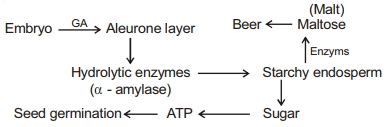
View full question & answer→MCQ 3621 Mark
Pineapple can be made to flower in off season by
AnswerCorrect option: A. Ethylene $/NAA$
a
(a) Ethylene retards the flowering in most of the plants but increase flowering in pineapple in off season.
View full question & answer→MCQ 3631 Mark
- A
Is a saturated hydrocarbon
- B
Slows down the ripening of apples
- C
Retards ripening of tomatoes
- ✓
Speeds up maturation of fruits and early ripening of some fruits
AnswerCorrect option: D. Speeds up maturation of fruits and early ripening of some fruits
View full question & answer→MCQ 3641 Mark
Answera
(a)Ethylene is gaseous hormone which stimulates transverse or isodiamteric growth but retards the longitudinal one.
View full question & answer→MCQ 3651 Mark
A higher proportion of ethylene is found in
MCQ 3661 Mark
Ripening of banana is accompanied with
- A
- B
- ✓
- D
Sudden rise in gibberellin
Answerc
(c)Because ethylene works as hormone in plants and responsible for ripening of fruits.
View full question & answer→MCQ 3671 Mark
The ripening of fruits can be hastened by treatment with
Answerd
(d)Ethylene is a gaseous plant hormone and it is responsible for fruit ripening.
View full question & answer→MCQ 3681 Mark
Which of the following is called as phytogerontological hormone
MCQ 3691 Mark
Which one of the following responses of plants to growth hormones is true for ethylene
- A
Increase in cell elongation
- B
Decrease in the formation of female flowers
- ✓
Increase in ripening of fruits
- D
Decrease in abscission of flowers
AnswerCorrect option: C. Increase in ripening of fruits
View full question & answer→MCQ 3701 Mark
Answerb
(b)In most of the plants there is sharp rise in respiration rate at the time of ripening. This sharp rise is called climacteric rise or climacteric.
View full question & answer→MCQ 3711 Mark
Which hormone induces fruit ripening
MCQ 3721 Mark
Which hormone causes stunted growth in pea
Answerd
(d)As ethylene inhibits longitudinal growth but stimulates transverse growth.
View full question & answer→MCQ 3731 Mark
The ripening of fruits can be accelerated by
- A
Reducing the supply of water to plant when fruits are maturing
- B
Increasing the supply of nitrogen to the atmosphere surrounding them
- C
Warming up the surroundings artificially
- ✓
Artificially adding ethylene gas to the atmosphere surrounding them
AnswerCorrect option: D. Artificially adding ethylene gas to the atmosphere surrounding them
d
(d)Ethylene is unique in that it it found only in gaseous form, are accelerated ripening of fruits, leaves abscission and promotes senescence.
View full question & answer→MCQ 3741 Mark
It hastens fruit ripening in tomatoes and apples
MCQ 3751 Mark
Identify growth inhibitor hormone.
MCQ 3761 Mark
Which plant hormone is found in gaseous form?
MCQ 3771 Mark
- A
- B
delaying fruit's abscission
- ✓
- D
stopping the leaf abscission
View full question & answer→MCQ 3781 Mark
It is used to initiate flowering and for synchronizing fruit-set in pineapples.
MCQ 3791 Mark
Identify the correct option for $A$ and $B$
| Compound |
Function |
| $2,4-D$ |
$A$ |
| $B$ |
Fruit ripening |
- A
$A -$ Insecticide $B-$ Auxin
- B
$A-$ Insecticide $B-$ Cytokinin
- C
$A-$ Insecticide $B-$ GA
- ✓
$A-$ Weedicide $B-$ Ethylene
AnswerCorrect option: D. $A-$ Weedicide $B-$ Ethylene
d
$(i)$ $2-4- D$ is an auxin, which is widely used as weedicide for dicotyledonous Weeds.
$(ii)$ Ethylene causes fruit ripening
View full question & answer→MCQ 3801 Mark
The ripening of fruits can be fastened by treatment with
Answerc
Ethylene is a simple gaseous hydrocarbon and is naturally occurring plant hormone. It induces artifical ripening of fruits
View full question & answer→MCQ 3811 Mark
Name of a gaseous plant hormone is
Answerc
Ethylene is a simple, gaseous hydrocarbon and is a naturally occurring plant hormone. It acts for fruit development and ripening, controls leaves and flower abscission.
View full question & answer→MCQ 3821 Mark
- A
Hasten fruit ripening in tomatoes
- B
- C
Promote female flower cucumbers
- ✓
Answerd
Ethepton hastens fruit ripening in tomatoes and apples and accelerates abscission in flowers and fruits. It promotes female flowers in cucumbers thereby increasing the yield
View full question & answer→MCQ 3831 Mark
Which hormone causes stunted growth in pea?
Answerd
Ethylene is a growth inhibitor, which is found in gaseous form and inhibits the growth of pea plant.
View full question & answer→MCQ 3841 Mark
Most widely used compound as a source of ethylene is
Answerc
The most widely used compound as a source of ethylene is ethepton. Ethepton, in an aqueous solution is readily absorbed and transported within the plant and releases ethylene slowly
View full question & answer→MCQ 3851 Mark
Which one is not an ethylene effect?
- A
- B
Apical hook formation in dicot seedlings
- C
Horizontal growth of seedlings
- ✓
Answerd
Effects of Ethylene
$(i)$ Horizontal growth of seedling
$(ii)$ Swelling of axis
$(iii)$ Apical hook formation in dicot seedling
$(iv)$ Promotes senescence and abscission of plants
$(v)$ Break seed and bud dormancy
$(vi)$ Initiate flowering in pineapple and flowering in mango
Apical dominance is the effect of auxin hormone
View full question & answer→MCQ 3861 Mark
Which plant growth regulator is responsible for triple response?
- ✓
$C _{2} H _{4}$
- B
$IAA$
- C
$IBA$
- D
$ABA$
AnswerCorrect option: A. $C _{2} H _{4}$
a
Firstly, a Russian Physiologist Dimitry N Nelijubow who established ethylene's triple response on pea seedling. These triple responses are
$(a)$ inhibited stem elongation
$(b)$ increased stem thickening
$(c)$ horizontal growth habit
View full question & answer→MCQ 3871 Mark
$I.$ More female flowers in cucumber
$II.$ $\alpha$-amylase production is barley grain
$III.$ Acceleration of fruit ripening in tomato
$IV.$ Delayed in sprouting in potato tubers
From the given effects find out the effects of ethylene and choose the correct option accordingly
- A
$I$ and $II$
- ✓
$I$ and $III$
- C
$II$ and $IV$
- D
$III$ and $IV$
AnswerCorrect option: B. $I$ and $III$
b
Ethylene causes acceleration of fruit ripening in tomato and maleic hydrazine (an auxin) delays sprouting of potato tubers. Ethylene promotes the female flowers in cucumbers. Amylase production is the function of $GA$
View full question & answer→MCQ 3881 Mark
Which of the following is incorrect about ethylene?
- A
Promotes root hair formation
- ✓
It is natural and derivative of carotenoids
- C
It increases the number of female flowers
- D
It causes synchronisation of flowering and fruit set in pineapples
AnswerCorrect option: B. It is natural and derivative of carotenoids
b
Ethylene synthesized from methionine.
View full question & answer→MCQ 3891 Mark
AnswerCorrect option: A. $GA_3$ -Early seed production in conifers.
a
In conifers, $GA_3$ induced the early seed production.
View full question & answer→MCQ 3901 Mark
$CH_2$ = $CH_2$ is mainly responsible for
Answerc
Ethylene is helpful in ripening of fruits.
View full question & answer→MCQ 3911 Mark
Which of the following is produced during water stress and causes closure of stomata
Answerd
(d) In the case of hydroactive control abscisic acid $(ABA)$ plays an important role in the closure of stomata, when ever there is shortage of water $ABA$ is synthesized resulting in the closure of stomata.
View full question & answer→MCQ 3921 Mark
The following is a naturally occuring growth inhibitors
Answerb
(b)Because $ IAA, NAA$ and $GA $ are growth promoters and $ABA$ is growth inhibitor.
View full question & answer→MCQ 3931 Mark
Abscissic acid $(ABA) $ promotes
Answerb
(b)Abscissic acid promotes the formation of abscission layer in leaves and fruits.
View full question & answer→MCQ 3941 Mark
Which hormone is present in the pulp of fruit, seed coat and resting buds
MCQ 3951 Mark
Which of the following hormone is produced during leaf fall
MCQ 3961 Mark
One of the most commonly detected inhibitor of germination is
Answerb
(b) Seed germination is limited and hence abscisic acid induces dormony of seeds and buds.
View full question & answer→MCQ 3971 Mark
Abscisic acid $(ABA)$ is a stress related hormone and it also
- A
Aids in fruit development
- B
Accelerates fruit ripening
- C
- ✓
Mediated stomatal closure
AnswerCorrect option: D. Mediated stomatal closure
View full question & answer→MCQ 3981 Mark
Which one of the following plant hormones is known as a stress hormone
Answerd
(d)The synthesis of abscisic acid is stimulated by drought, water logging and other adverse environmental condition. Therefore, it is also called as stress hormone.
View full question & answer→MCQ 3991 Mark
Leaf abscission, fruit fall, bud dormancy occurs by which phytohormone
MCQ 4001 Mark
Hormone causing stomatal closure is
Answerc
(c)Application of minute quantity of $ ABA $ to leaves reduces transpiration to a great extent through partial closure of stomata. It thus conserves water and reduces the requirement of irrigation.
View full question & answer→MCQ 4011 Mark
- A
$ABA $ open stomata
- B
$ABA$ and cytiokinin does not effect on stomata
- C
$ABA$ open, cytokinin close stomata
- ✓
$ABA $ close and cytokinin open the stomata
AnswerCorrect option: D. $ABA $ close and cytokinin open the stomata
View full question & answer→MCQ 4021 Mark
In the extreme drought condition which of the following plant hormone is produced due to which stomata closes
MCQ 4031 Mark
View full question & answer→MCQ 4041 Mark
Abscission and dormancy are caused by
- ✓
$ABA $
- B
$NAA $
- C
$IAA $
- D
$IBA $
AnswerCorrect option: A. $ABA $
View full question & answer→MCQ 4051 Mark
$I.$ The increased growth per unit time is termedas ....$A$...
$II.$ Abscisic acid .....$B$..... the stomata.
Choose the correct option and fill in the blanks.
- A
$A -$ Plasticity, $B -$ Close
- B
$A-$ Growth rate, $B -$ open
- C
$A-$ Plasticity, $B -$ open
- ✓
$A-$ Growth rate , $B -$ close
AnswerCorrect option: D. $A-$ Growth rate , $B -$ close
View full question & answer→MCQ 4061 Mark
Seed dormancy is due to the
MCQ 4071 Mark
Match column$-I$ with column$-II$ and select the correct option using codes given below.
$\begin{array}{|p{0.3\linewidth}|p{0.6\linewidth}|} \hline Column\,\,-I & Column\,\,-II \\ \hline A.\,\,Cytokinin & i.\,\,Stimulates\,\,closure\,\,of\,\,stomata \\ \hline B.\,\,Ethylene & ii.\,\,Increases\,\,stem\,\,length \\ \hline C.\,\,Gibberellin & iii.\,\,Promotes\,\,lateral\,\,shoot\,\,grow \\ \hline D.\,\,Abscisic\,\,acid & iv.\,\,Found\,\,in\,\,large\,\,amount\,\,in\,\,tissues\,\,undergoing\,\,senescence. \\ \hline \end{array}$
$a - b - c - d$
- A
$(ii) - (ii) - (iv) - (i) $
- B
$(iv) - (i) - (ii) - (ii)$
- C
$(ii) - (iv) - (i) - (iii) $
- ✓
$(iii) - (iv) - (ii) - (i) $
AnswerCorrect option: D. $(iii) - (iv) - (ii) - (i) $
View full question & answer→MCQ 4081 Mark
Match the following.
$\begin{array}{|p{0.3\linewidth}|p{0.6\linewidth}|} \hline Column\,\,-I & Column\,\,-II \\ \hline A.\,\,Ethaphon & P.\,\,Inhibits\,\,seed\,\,germination \\ \hline B.\,\,ABA & Q.\,\,They\,\,all\,\,are\,\,acidic \\ \hline C.\,\,GA & R.\,\,Help\,\,over\,\,come\,\,the\,\,apical\,\,dominance \\ \hline & S.\,\,Hastens\,\,fruit\,\,ripening\,\,in\,\,tomatoes\,\,and\,\,apples. \\ \hline \end{array}$
- A
$A-S, B-R, C-Q $
- B
$A-Q, B-R, C-P$
- C
$A-P, B-S,C-R $
- ✓
$A-S, B-P, C-Q$
AnswerCorrect option: D. $A-S, B-P, C-Q$
View full question & answer→MCQ 4091 Mark
$ABA$ acts as an antagonist to.......
View full question & answer→MCQ 4101 Mark
Which plant hormone promotes seed dormancy, bud dormancy and causes stomatal closure?
Answerb
Abscisic acid is a natural growth inhibitor. It promotes stomatal closure, i.e., it is a stress hormone and helps the plant to cope with adverse enviromental conditions especially drought. It also induces dormancy of seeds and buds. These seeds sprout only when $ABA$ is overcome y $GA.$
View full question & answer→MCQ 4111 Mark
The stress hormone that helps plant to respond drought is
Answerb
Abscisic acid ($ABA$) is called as stress hormone or dormin, as it induces dormancy and helps to overcome conditions of stress. Its function is stomatal closure in plants.
View full question & answer→MCQ 4121 Mark
Leaf abscission, fruit fall, and bud dormancy occurs by which phytohormone?
Answerd
Abscisic acid also called stress hormone, is responsible for bud dormancy, seed dormancy, abscission, leaf senescence, etc.
View full question & answer→MCQ 4131 Mark
$I.$ Antagonist to $GA$
$II.$ Promoted bud dormancy
$III.$ Promoted stomatal closure
$IV.$ Promoted abscission layer
Identify the hormone/s which promote/s all these events in plants and choose the correct option
Answerc
Abscisic acid ($ABA$). Its important functions are
($i$) Promot abscission ($ii$) Promot dormancy
($iii$) Plant growth inhibitor ($iv$) Inhibit seed germination
($vi$) Seed development ($vi$) Antagonist to $GA$
($vii$) Stomata closure
View full question & answer→MCQ 4141 Mark
Which of the following is an anti-gibberellin?
Answerb
The $ABA$ inhibits gibberellin-induced growth activities. On account of this antagonistic behaviour, it is often called anti-gibberellin.
View full question & answer→MCQ 4151 Mark
Which phytohormone has viral inhibitory property?
- A
$IAA$
- B
$G A_{3}$
- ✓
$ABA$
- D
$2,4-D$
Answerc
Abscisic acid ($ABA$) inhibits synthesis of $RNA$ and proteins. It has been shown that ABA regulate the expression of certain genes during seed maturation and certain stress condition such as heat shock, adaptation to low temperature and tolerance
View full question & answer→MCQ 4161 Mark
Dormancy of seeds is broken by ethylene whereas it is induced by
Answera
Dormancy of seeds is induced by abscisic acid.
View full question & answer→MCQ 4171 Mark
The plant hormone which closes the stomata in stressful conditions is
Answerd
To prevent transpiration in stressfull condition.
View full question & answer→MCQ 4181 Mark
Both ethylene and $ABA$ are responsible for
- ✓
Promoting the abscission of leaves and fruits
- B
Inducing dormancy of seeds
- C
Stimulation of apical dominance
- D
AnswerCorrect option: A. Promoting the abscission of leaves and fruits
a
Ethylene and $ABA$ causing shedding of leaves and fruits, flowers.
View full question & answer→MCQ 4191 Mark
Which is not true for abscisic acid?
- A
- B
Synthesized in chloroplast from carotenoids
- C
Increases stress tolerance in plants
- ✓
Induces epinasty of leaves and flowers
AnswerCorrect option: D. Induces epinasty of leaves and flowers
d
Epinasty induces by ethylene.
View full question & answer→MCQ 4201 Mark
$A$ : Seeds do not sprout when $ABA$ is overcome by Gibberellins.
$R$ : $GA$ inhibits protein and $RNA$ synthesis.
- A
Assertion and Reason both are correct and also correct explanation.
- B
Assertion and Reason both are correct but not explanation of assertion.
- C
Assertion is correct, but Reason is incorrect.
- ✓
Both Assertion and Reason are incorrect.
AnswerCorrect option: D. Both Assertion and Reason are incorrect.
d
Seeds/buds sprout only when $ABA$ is overcome by gibberellins. $ABA$ inhibits protein and $RNA$ synthesis.
View full question & answer→MCQ 4211 Mark
Match the following
$‘A’ $ $ ‘B’$
$(1) $ Auxin $(I)$ Ripening and maturity of fruits
$(2)$Gibberellin $(II)$Differentiation of xylem elements
$(3) $ Cytokinin $(III)$ Prevention of genetic and physiological dwarfism
$(4) $ Ethylene $(IV)$ Found from tumour tissue of tobacco
$(1)$ $(2)$ $(3)$ $(4)$
- A
$IV$ $III$ $II$ $I$
- B
$IV$ $II$ $III$ $I$
- ✓
$II$ $III$ $IV$ $I$
- D
$III$ $IV$ $II$ $I$
AnswerCorrect option: C. $II$ $III$ $IV$ $I$
View full question & answer→MCQ 4221 Mark
Study the following statements.
$I.$ $“X”$ hormone promotes root growth and root hair formation thus helping the plants to increase their absorption surface.
$II.$ $“Y”$ hormone induces flowering in mango and also promotes rapid internode/petiole elongation in deep plants and hence helping leaves or upper parts of shoot above water.
$III.$ $“Z”$ hormone inhibits the seed germination, increase the tolerance of plant to various stresses, play import in seed development, maturation and dormancy.
Identify the correct names of hormones marked as $‘X’, ‘Y’$ and $‘Z’.$
- A
$Y = ABA; X = Auxin; Z = GA$
- B
$Z = GA; X = Auxin; Y = C_2H_4$
- C
$Y = Auxin; X = C_2H_4; Z = GA$
- ✓
$Y = C_2H_4; X = C_2H_4; Z = ABA$
AnswerCorrect option: D. $Y = C_2H_4; X = C_2H_4; Z = ABA$
d
Gibberellins stimulate the production of some $mRNAs$ and then hydrolytic enzymes like amylase, lipase ribonuclease and proteases. The enzymes solubilise the reserve food of the seeds and the same is transferred to embryo axis for its growth.
View full question & answer→MCQ 4231 Mark
Choose the correct statement
$I.$ Cytokinin - Delay of leaf senescence
$II.$ Auxin - Apical dominance
$III.$ Ethylene - Seed germination
$IV.$ Gibberellins - Immature falling of leaves
- ✓
$I$ and $II$
- B
$I$ and $IV$
- C
$II$ and $III$
- D
$II$ and $IV$
AnswerCorrect option: A. $I$ and $II$
a
Ethylene is a gaseous hormone responsible for fruit ripening. Germination of seed is triggered by soaking of seeds in water. After imbibing water, the embryo secretes gibberellin which stimulates the synthesis of $\alpha$ amylase. Gibberellin is not responsible for falling of leaves. Apical dominance of plants occur due to auxin hormone
View full question & answer→MCQ 4241 Mark
Which of the following pairs, is not correctly matched?
AnswerCorrect option: B. Gibberellic acid - Leaf fall
b
Gibberellins help in cell growth of stem, leaves and other aerial parts.
View full question & answer→MCQ 4251 Mark
Choose the incorrect pair.
AnswerCorrect option: D. Abscisic acid - Flowering hormone
d
Abscisic acid is a naturally occurring growth inhibitor. It acts as a 'stress hormone'. It causes abscission of leaves and promotes senescence. It initiates flowering only in certain short day plants.
View full question & answer→MCQ 4261 Mark
Which of the following is incorrectly matched?
- A
Explant - Excised plant part used for callus formation
- ✓
Cytokinins - Root initiation in callus
- C
Somatic embryo- Embryo produced from a vegetative cell
- D
Anther culture-Haploid plants
AnswerCorrect option: B. Cytokinins - Root initiation in callus
b
Root initiation in callus is the function of auxin. Cytokinins delay the senescence of leaves and other organs and also induce shoot formation.
View full question & answer→MCQ 4271 Mark
The following statements are given about plant growth hormones:
$I.$ Cytokinins suppress the synthesis of chlorophyll.
$II.$ Auxins control apical dominance.
$III.$ Gibberellins promote shoot elongation.
$IV.$ Abscisic acid enabling seeds to withstand desiccation.
Which of the above statements are correct
- A
$I$ and $II$
- B
$II$ and $III$
- C
$I$ and $III$
- ✓
$II, III$ and $IV$
AnswerCorrect option: D. $II, III$ and $IV$
d
'Cytokinin' delay the senescence of leaves and prevents chlorophyll degradation. It can be shown by rapid bioassay technique.
Cytokinin treated leaf tips retards the process of chlorophyll degradation as compared to untreated leaf discs.
View full question & answer→MCQ 4281 Mark
Identify to which plant hormone, the given function belongs
$I.$ Initiates flowering in pineapples
$II.$ Induces flowering in mango
$III.$ Root growth and root hair promotion
$I, II, III$
- ✓
$C _{2} H _{4} C _{2} H _{4} C _{2} H _{4}$
- B
$C _{2} H _{4}\; IAA\; GA$
- C
$C _{2} H _{4}\; GA\; IAA$
- D
$GA\; IAA\; IBA$
AnswerCorrect option: A. $C _{2} H _{4} C _{2} H _{4} C _{2} H _{4}$
a
Ethylene is used to initiate flowering and for synchronising fruit set in pineapples. It also induces flowering in mango. It is the most widely used $PGR$ in agriculture
View full question & answer→MCQ 4291 Mark
Pick out the correct statements.
$I.$ Cytokinins especially help in delaying senescence.
$II.$ Auxins are involved in regulating apical dominance.
$III.$ Ethylene is especially useful in enhancing seed germination.
Gibberellins are responsible for immature falling of leaves
- A
$I$ and $III$
- B
$I$ and $IV$
- C
$II$ and $III$
- ✓
$I$ and $II$
AnswerCorrect option: D. $I$ and $II$
d
Ethylene is a gaseous hormone responsible for fruit ripening. Germination of seed is triggered by soaking the seed in water. After imbibing water the embryo secretes gibberellin, which diffuses to the aleurone layer and stimulates the synthesis of several enzymes including $\alpha$-amylase. These enzymes catalyze the breakdown of food reserve in endosperm
View full question & answer→MCQ 4301 Mark
Identify two of the following phytohormones, which regulate the stomatal movements?
$I.$ $IAA$ $II.$ $G A_{3}$ $III.$ $Zeatin$ $IV.$ $ABA$
- A
$I$ and $III$
- B
$II$ and $III$
- ✓
$III$ and $IV$
- D
$II$ and $IV$
AnswerCorrect option: C. $III$ and $IV$
c
Cytokinins(zeatin) are essential for opening of stomata, while abscisic acid takes part in closing of stomata
View full question & answer→MCQ 4311 Mark
$6-$ furfuryl amino purine $(A) 2,4$ dichlorophenoxy acetic acid($B$) $\&$ indole$-3$ acetic acid($C$) are examples respectively for
- A
$A -$ Synthetic auxin
$B-$ Kinetin
$C-$ Natural Auxin
- B
$A-$ Gibberellins
$B-$ natural auxin
$C-$ kinetin
- C
$A-$ Natural auxin
$B-$ Kinetin
$C-$ Synthetic auxin
- ✓
$A-$ Kinetin
$B-$ synthetic auxin
$C-$ natural auxin
AnswerCorrect option: D. $A-$ Kinetin
$B-$ synthetic auxin
$C-$ natural auxin
d
The first cytokinin was discovered from, degraded autoclaved herring sperm $DNA$ by Miller et al. $1995 .$ It is called kinetin ($6$-furfurly aminopurine). Kinetin does not occur naturally.
Natural Auxin = Indole Acetic Acid
Many synthetic auxins are also manufactured. The important ones are $2,4 , D$ ($2, 4 $-dichlorophenoxy acetic acid). $2,4,5-(2,4,5$-Trichlorophenoxyacetic acid) and Naphthalene acetic acid ($NAA$).
View full question & answer→MCQ 4321 Mark
$I.$ Kinetin is a degradative substance from $DNA$
$II.$ $ABA$ is present in all plants including lower plants
$III.$ Low ratio of cytokinin to auxin favours root formation only
$IV.$ $ABA$ is synthesized catabolically through glycolysis pathway Choose the correct combination of options
- A
$I$ and $II$
- B
$II$ and $III$
- ✓
$I$ and $III$
- D
$III$ and $IV$
AnswerCorrect option: C. $I$ and $III$
c
$ABA$ is produced in many parts of green plants. Its presence is suspicious in lower plants (bryophytes and pteridophytes).
$ABA$ is formed by mevalonic acid pathway, not by glycolysis
View full question & answer→MCQ 4331 Mark
$I.$ Auxin $II.$ Cytokinin $III.$ $GA$ $IV.$ $ABA$
Which of the above mentioned PGR are acidic in nature? Choose the correct option accordingly
- A
$I$ and $II$
- ✓
$I, III$ and $IV$
- C
$I, II$ and $III$
- D
$I, II, III$ and $IV$
AnswerCorrect option: B. $I, III$ and $IV$
b
Auxin, $GA$, and $ABA$ are acidic in nature
View full question & answer→MCQ 4341 Mark
Phytohormones responsible for cell division in callus are ______ and ______.
Answerc
Auxin stimulates root formation and cytokinin promotes shoot formation during morphogenesis.
View full question & answer→MCQ 4351 Mark
Match the following (Column - $I$ with Column $II$)
| Column $I$ |
Column $II$ |
| $a.$ Ethephon |
$(i)$ $GA$ |
| $b.$ Terpene |
$(ii)$ Ethylene |
| $c.$ Zeatin |
$(iii)$ Natural auxin |
| $d.$ $IAA$ |
$(iv)$ Cytokinin |
- A
$a(ii), b(i), c(iii), d(iv)$
- ✓
$a(ii), b(i), c(iv), d(iii)$
- C
$a(iv), b(ii), c(iii), d(iv)$
- D
$a(i), b(ii), c(iii), d(iv)$
AnswerCorrect option: B. $a(ii), b(i), c(iv), d(iii)$
b
Ethephon (source of ethylene) $\rightarrow$ Ethylene
Terpene $\rightarrow$ $GA$ (derivative of terpenes)
Zeatin $\rightarrow$ Cytokinin
$IAA$ $\rightarrow$ Natural auxinEthephon
View full question & answer→MCQ 4361 Mark
Match the following (Column - $I$ with Column $II$)
| Column $I$ |
Column $II$ |
| $a.$ Weedicide |
$(i)$ $GA_3$ |
| $b.$ Bolting |
$(ii)$ Cytokinin |
| $c.$ Thinning of cotton |
$(iii)$ Ethylene |
| $d.$ Lateral shoot growth |
$(iv)$ $2$, $4-D$ |
- A
$a(iii), b(ii), c(iv), d(i)$
- ✓
$a(iv), b(i), c(iii), d(ii)$
- C
$a(iv), b(i), c(ii), d(iii)$
- D
$a(iv), b(ii), c(iii), d(i)$
AnswerCorrect option: B. $a(iv), b(i), c(iii), d(ii)$
b
Weedicide $\rightarrow$ Auxin i.e., $2$, $4$, $D$
Bolting $\rightarrow$ $GA$
Thining of cotton $\rightarrow$ Ethylene
Lateral shoot growth $\rightarrow$ Cytokinin (Stimulate shoot formation)
View full question & answer→MCQ 4371 Mark
The growth in plants differs from growth in animals in
- ✓
Being localized and indefinite
- B
- C
Having indefinite life span
- D
Having definite life span
AnswerCorrect option: A. Being localized and indefinite
a
Growth in plant is unlimited, indeterminate and indefinite.
View full question & answer→MCQ 4381 Mark
Match the following
| Column $I$ |
Column $II$ |
| $a.$ Auxin |
$(i)$ Root hair formation |
| $b.$ Cytokinin |
$(ii)$ Seed development |
| $c.$ Ethylene |
$(iii)$ Xylem differentiation |
| $d.$ $ABA$ |
$(iv)$ Nutrient mobilisation |
- A
$a(iv), b(ii), c(iii), d(i)$
- B
$a(ii), b(iii), c(i), d(iv)$
- C
$a(i), b(iii), c(ii), d(iv)$
- ✓
$a(iii), b(iv), c(i), d(ii)$
AnswerCorrect option: D. $a(iii), b(iv), c(i), d(ii)$
View full question & answer→MCQ 4391 Mark
What is obtained, when propene is treated with $N-$ bromo succinimide
- A
$\begin{array}{*{20}{c}}
{C{H_3} - C = C{H_2}} \\
| \\
{Br}
\end{array}$
- ✓
$BrC{H_2} - CH = C{H_2}$
- C
$BrC{H_2} - CH = CHBr$
- D
$\begin{array}{*{20}{c}}
{BrC{H_2} - CH - C{H_2}Br} \\
{|\,\,\,\,\,} \\
{Br\,\,\,}
\end{array}$
AnswerCorrect option: B. $BrC{H_2} - CH = C{H_2}$
b
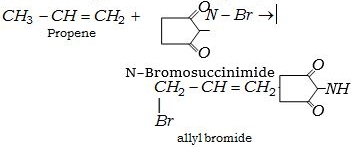
View full question & answer→MCQ 4401 Mark
Which one of the following generally acts as an antagonist to gibberellins?
Answerc
(c) : Abscisic acid or $ABA$ is an antagonist to gibberellins. This is discussed in the table given below:
| Abscisic acid |
Gibberellic acid |
| It inhibits growth. |
It promotes growth. |
|
It promotes the dormacy of seeds, of buds and tubers.
|
It overcomes the natural dormancy seeds, tuber etc.
|
| It inhibits the synthesis of $RNA$ and proteins. |
It promotes the synthesis of $RNA$ and proteins. |
| Causes abscission of flowers and fruits. |
Promotes development of fruits. |
| Promotes leaf senescene. |
Prevents leaf senescene. |
| Promotes stomatal closure. |
Promotes stomatal opening. |
| Prevents amylase activity. |
Promotes amylase activity during seed germination. |
View full question & answer→MCQ 4411 Mark
Root development is promoted by
Answerd
(d) : Ethylene promotes root growth and root hair formation. In low concentration ethylene is used for initiation of roots and also of lateral roots.
View full question & answer→MCQ 4421 Mark
The annular and spirally thickened conducting elements generally develop in the protoxylem when the root or stem is
Answerc
(c) : The protoxylem differentiates in the parts of the primary body that have not completed their growth and differentiation. In fact in the shoot, the protoxylem matures among actively elongating tissues and is, therefore subjected to stresses. In the root, the protoxylem elements persist longer because here they mature beyond the region of maximum growth. In this differentiation annular and spiral thickening take place.
View full question & answer→MCQ 4431 Mark
Which one of the following acids is a derivative of carotenoids?
- A
Indole-$3$-acetic acid
- B
- ✓
- D
Answerc
(c) : Biosynthesis of abscisic acid $(ABA)$ in most plants occur indirectly by degradation of certain carotenoids present in chloroplasts or other plastids. The biosynthetic pathway follow mevalonic acid pathway for their synthesis. The sites of synthesis are fruits, tissues, leaves, roots and seeds.
View full question & answer→MCQ 4441 Mark
One of the synthetic auxin is
- A
$IA$
- B
$NAA$
- C
$IBA$
- D
Both $(b) $ and $(c)$
Answerd(d) : Many auxins have been synthesized which have similar properties with natural auxin and some examples of synthetic auxins are indole-$3$-butyric acid $(IBA)$, naphthalene acetic acid $(NAA)$, $2,4$-dichloro phenoxy acetic acid $(2,4-D), 2,4,5-$ trichloro phenoxyacetic acid $(2,4,5-T)$.
View full question & answer→MCQ 4451 Mark
Which one of the following pairs, is not correctly matched?
AnswerCorrect option: A. Gibberellic acid Leaf fall
a
(a) : Gibberellic acid is a simple weakly acidic plant growth hormone which promotes cell elongation of both leaves and stems in general and internodal length of genetically dwarf plants in particular. It is in general a growth promoting hormone and does not inhibit growth. So leaf abscission is not associated with gibberellic acid but with abscisic acid.
View full question & answer→MCQ 4461 Mark
How does pruning help in making the hedge dense?
- A
It releases wound hormones.
- B
It induces the differentiation of new shoots from the rootstock.
- ✓
It frees axillarybuds from apical dominance.
- D
The apical shoot grows faster after pruning.
AnswerCorrect option: C. It frees axillarybuds from apical dominance.
c
(c) : Prunning is the process of cutting shoot tips to promote lateral growth of branches. Removal of shoot tips involves removal of apical buds. In the shoot tips auxins are produced. Auxins are growth promoting phytohormones. They cause apical dominance by promoting the growth of apical buds and suppressing the growth of axillary buds. So when the auxins produced in the shoot tips are removed by decapitation it results in lateral growth and plants thus show bushy appearance. This is because of a relatively high concentration of auxin in the apical bud than in the lateral buds.
View full question & answer→MCQ 4471 Mark
In a longitudinal section of a root, starting from the tip upward, the four zones occur in the following order
- A
Cell division, cell enlargement, cellmaturation, root cap
- B
Cell division, cell maturation, cell enlargement, root cap
- ✓
Root cap, cell division, cell enlargement, cell maturation
- D
Root cap, cell division, cell maturation, cell enlargement
AnswerCorrect option: C. Root cap, cell division, cell enlargement, cell maturation
View full question & answer→MCQ 4481 Mark
The maximum growth rate occurs in
MCQ 4491 Mark
Cell elongation in internodal region takes place due to
Answera
(a)The gibberellins induce elongation of the internodes. The elongation of stem results due to rapid cell division and cell elongation induced by gibberellins.
View full question & answer→MCQ 4501 Mark
Which of the following is a coconut milk factor
Answerb
(b)In liquid endosperm of coconut kinetin (cytokinins) are present.
View full question & answer→MCQ 4511 Mark
Differentiation of shoot is controlled by
- A
High gibberellin : Cytokinin ratio
- B
High cytokinin : auxin ratio
- ✓
High auxin : cytokinin ratio
- D
High gibberellin : auxin ratio
AnswerCorrect option: C. High auxin : cytokinin ratio
View full question & answer→MCQ 4521 Mark
Which of the following cell is totipotent
Answera
(a) Meristem posses the capacity of division. That is why plants keep growing in length whole life time.
View full question & answer→MCQ 4531 Mark
$ABA$ is involved in
Answera
(a)Abscisic acid acts as growth inhibitor and induces dormany of buds towards the approach of winter.
View full question & answer→MCQ 4541 Mark
A plant hormone used for inducing morphogenesis in plant tissue culture is
Answerc
(c) Cytokinin is a plant hormone which plays a part in organ formation $ (morphogenesis) $ with auxin.
View full question & answer→MCQ 4551 Mark
Which one among the following chemical is used for causing defoliation of forest trees
- A
Amo $-1618$
- B
Phosphon $-D$
- C
- ✓
$2, 4-D$
AnswerCorrect option: D. $2, 4-D$
d
(d) $2,4-$ Dichlorophenoxyacetic acid is used as a defoliant for broad-leaved plants.
View full question & answer→MCQ 4561 Mark
$2, 4-D$ is an effective
Answerb
(b)$2,4-D$ is a derivatives of auxin herbicides.
View full question & answer→MCQ 4571 Mark
Answera
(a)The growth and development in plants is controlled by a special class of chemical substance called hormone and phytohormone.
View full question & answer→MCQ 4581 Mark
Highest concentration of auxins exist in
- A
At the base of various plant organs
- ✓
- C
- D
In xylem and phloem cells only
View full question & answer→MCQ 4591 Mark
- A
Hormones regulating growth from seed to adulthood
- ✓
Growth regulators synthesised by plants and influencing physiological processes
- C
Hormones regulating flowering
- D
Hormones regulating secondary growth
AnswerCorrect option: B. Growth regulators synthesised by plants and influencing physiological processes
b
(b)Phytohormones are bio-chemical substances which regulates physiology of the plants.
View full question & answer→MCQ 4601 Mark
Auxins are abundantly produced in
- A
- B
Meristematic region of the root
- C
- ✓
Meristematic region of the shoot
AnswerCorrect option: D. Meristematic region of the shoot
View full question & answer→MCQ 4611 Mark
- A
- B
Cell elongation and cell wall formation
- C
- ✓
Answerd
(d) Spray of abscisic acid causes very fast abscission of leaves, and also causes dormancy of buds and seeds.
View full question & answer→MCQ 4621 Mark
Leaf fall can be prevented by
Answerc
(c)Cytokinins help in delaying senescence.
View full question & answer→MCQ 4631 Mark
Which hormone is concerned chiefly with cell division in plants
Answerb
(b) In presence of kinin the rate of mitotic cell division gets increased.
View full question & answer→MCQ 4641 Mark
An excised leaf does not turn yellow if it is induced to root. This is attributed to synthesis in root of or Leaf aging is retarded by
Answerb
(b)Cytokinin prevent decolouration of chlorophyll study under Richmond -lang effects.
View full question & answer→MCQ 4651 Mark
Which increase shoot growth in callus culture?
Answera
Cytokinin is a phytohormone that promotes cytokinesis in shoots and roots.
View full question & answer→MCQ 4661 Mark
Which hormone inhibit morphogenesis
Answera
$ABA$ (abscisic acid) is a hormone that generally acts as a growth inhibitor. It inhibits the process of morphogenesis.
View full question & answer→MCQ 4671 Mark
Which of the following set is not natural plant growth regulator
- A
$GA _{3}, IAA , 2 IP$
- ✓
$IAA , 2 IP , Zn$
- C
$ABA , IBA , GA _{3}$
- D
$ABA , GA _{3}, IAA$
AnswerCorrect option: B. $IAA , 2 IP , Zn$
b
Indole acetic acid $(IAA)$ and $2$ - isopentenyl adenine ( $2 IP$ ) are known as plant growth hormones, but zinc $(Zn)$ is not a plant growth hormone. It is one of the micronutrients that are required in fewer amounts, but still play a crucial role in their development.
View full question & answer→MCQ 4681 Mark
Which of the following are plant growth promoters?
- ✓
$NAA, IBA,$ Zeatin, $GA_{3}$
- B
$NAA, ABA,$ Zeatin, $GA_{3}$
- C
$IBA , IAA , ABA , 2,4- D$
- D
$IBA, BAP, ABA,$ Zeatin
AnswerCorrect option: A. $NAA, IBA,$ Zeatin, $GA_{3}$
a
Naphthalic acetic acid $(NAA),$ Indole -$3$ - butyric acid $(IBA),$ Zeatin, and gibberellic acid $(GA_3)$ are known as plant growth promoters.
View full question & answer→MCQ 4691 Mark
Apical dominance is caused by
Answera
Auxin hormone is responsible for apical dominance process as it inhibits the growth of lateral buds.
View full question & answer→MCQ 4701 Mark
Assertion : Auxins help to prevent fruit and leaf drop at early stages.
Reason : Auxins promote the abscission of older mature leaves and fruits.
- A
If both Assertion and Reason are correct and the Reason is a correct explanation of the Assertion.
- ✓
If both Assertion and Reason are correct but Reason is not a correct explanation of the Assertion.
- C
If the Assertion is correct but Reason is incorrect.
- D
If both the Assertion and Reason are incorrect.
AnswerCorrect option: B. If both Assertion and Reason are correct but Reason is not a correct explanation of the Assertion.
b
Auxin delays abscission of young leaves and fruits. Its effect is through nonformation of abscission zone below a leaf or fruit. Abscission zone cuts off nutrients and water supply. However, auxin promotes the abscission of mature or older leaves and fruits.
View full question & answer→MCQ 4711 Mark
Identify the correct and incorrect statements from the following.
$(i)$ $17,500$ new cells are produced per hour by a single maize root apical meristem.
$(ii)$ With the help of length, growth of pollen tube is measured.
$(iii)$ The growth of the leaf is measured in term of volume.
$(iv)$ Cells in a watermelon may increase in size by upto $3,50,000$ times.
- A
$(i), (ii), (iii)$ are correct and $(iv)$ is incorrect.
- ✓
$(i), (ii), (iv)$ are correct and $(iii)$ is incorrect.
- C
$(ii), (iii)$ are correct and $(i), (iv)$ are incorrect
- D
$(i), (iv)$ are correct and $(ii), (iii)$ are incorrect
AnswerCorrect option: B. $(i), (ii), (iv)$ are correct and $(iii)$ is incorrect.
b
The growth of the leaf is measured in term of surface area
View full question & answer→MCQ 4721 Mark
Induction of cell division and delay in senescence is done by
Answera
Cytokinins promote cell division and inhibit the degradative reactions in detached leaves and slow down senescence in intact leaves. The effect of cytokinin in retarding ageing is called the Richmond Lang Effect
View full question & answer→MCQ 4731 Mark
Avena curvature test is a bioassay for examining the activity of
Answera
Went $(1928)$ performed Avena curvature test for auxins.
View full question & answer→MCQ 4741 Mark
Pruning of plants promotes branching because the axillary buds get sensitized to
MCQ 4751 Mark
Which of the following causes delaying of senescence
Answera
(a)Under this effect when green leaves are kept in cytokinin solution then they become green for long time. So this effect of cytokinin is called as Richmond-Lang effect of senescence.
View full question & answer→MCQ 4761 Mark
Bud dormancy is induced by
Answera
(a) Abscisic acid acts as growth inhibitor and induces dormancy of buds towards the approach of winter.
View full question & answer→MCQ 4771 Mark
The hormone which was discovered through ‘foolish seedling’ disease of rice is
- A
Indole $-3-$ acetic acid
- B
- ✓
- D
Answerc
(c)In $19th$ century, Japanese farmers observed that the seedlings of rice were abnormally elongated due to infection of fungus Gibberella fujikuroi. This effect is called as foolish seedling disease.
View full question & answer→MCQ 4781 Mark
Leaf fall occurs on abscission layer is formed when the content of
- A
- ✓
- C
- D
Gibberellic acid decreases
Answerb
(b)Auxin inhibits abscission of leaves and fruits. Abscission layer is produced when the auxin content falls below a minimum.
View full question & answer→MCQ 4791 Mark
Parthenocarpy is induced by
Answerb
(b)In presence of auxins unfertilized overy get changed into fruit.
View full question & answer→MCQ 4801 Mark
Exogenous application of gibberellins induces male flower formation on genetically female plants in
MCQ 4811 Mark
The gibberellins are plant growth hormones. They cause elongation of stems. Gibberellin was first isolated by Japanese workers from
Answerc
(c)Gibberella fujikuroi is the ascomycetous fungus, which is parasitic in nature.
View full question & answer→