MCQ 11 Mark
Which of the following factors are favourable for the formation of oxyhaemoglobin in alveoli?
- ✓
High $\mathrm{pO}_2$ and Lesser $\mathrm{H}^{+}$concentration
- B
Low $\mathrm{pCO}_2$ and High $\mathrm{H}^{+}$concentration
- C
Low $\mathrm{pCO}_2$ and High temperature
- D
High $\mathrm{pO}_2$ and High $\mathrm{pCO}_2$
AnswerCorrect option: A. High $\mathrm{pO}_2$ and Lesser $\mathrm{H}^{+}$concentration
a
The correct answer is option ($1$) as
Conditions favourable for formation of oxyhaemoglobin in alveoli are high $\mathrm{pO}_2$, less $\mathrm{H}^{+}$concentration low $\mathrm{pCO}_2$ and low temperature.
Option ($2$), ($3$) and ($4$) are not correct as they do not favour the formation of oxyhaemoglobin.
View full question & answer→MCQ 21 Mark
Match List $I$ with List $II$ :
| List $I$ |
List $II$ |
| $A.$ Expiratory capacity |
$-$ Expiratory reserve volume $+$ Tidal volume $+$ Inspiratory reserve volume |
| $B.$ Functional residual capacity |
$-$ Tidal volume $+$ Expiratory reserve volume |
| $C.$ Vital capacity |
$-$ Tidal volume $+$ Inspiratory reserve volume |
| $D.$ Inspiratory capacity |
$-$ Expiratory reserve volume $+$ Residual volume |
Choose the correct answer from the options given below :
- A
$ A-III, B-II, C-IV, D-I$
- B
$ A-II, B-I, C-IV, D-III$
- C
$A-I, B-III, C-II, D-IV$
- ✓
$A-II, B-IV, C-I, D-III$
AnswerCorrect option: D. $A-II, B-IV, C-I, D-III$
d
Expiratory capacity $=$ Tidal volume $+$ Expiratory reserve volume
Functional residual capacity $=$ Expiratory reserve volume $+$ Residual volume
Vital capacity $=$ Expiratory reserve volume $+$ Tidal volume $+$ Inspiratory reserve volume
Inspiratory capacity $=$ Tidal volume $+$ Inspiratory reserve volume
View full question & answer→MCQ 31 Mark
Vital capacity of lung is $...........$
- ✓
- B
- C
- D
IRV + ERV + TV $-R V$
Answera
Option (1) is the correct answer because vital capacity is the maximum volume of air a person can breathe in after forced expiration. This includes ERV, TV and IRV.
View full question & answer→MCQ 41 Mark
Which of the following is not the function of conducting part of respiratory system ?
AnswerCorrect option: C. Provides surface for diffusion of $O _{2}$ and $CO _{2}$
View full question & answer→MCQ 51 Mark
Under normal physiological conditions in human being every $100 ml$ of oxygenated blood can deliver $ml$ of $O _{2}$ to the tissues.
- ✓
$5\,ml$
- B
$4\,ml$
- C
$10\,ml$
- D
$2\,ml$
AnswerCorrect option: A. $5\,ml$
View full question & answer→MCQ 61 Mark
Select the favourable conditions required for the formation of oxyhaemoglobin at the alveoli.
- ✓
High $\mathrm{pO}_{2}$, low $\mathrm{pCO}_{2}$, less $\mathrm{H}^{+}$, lower temperature
- B
Low $\mathrm{pO}_{2}$, high $\mathrm{pCO}_{2}$, more $\mathrm{H}^{+}$, higher temperature
- C
High $\mathrm{pO}_{2}$, high $\mathrm{pCO}_{2}$, less $\mathrm{H}^{+}$, higher temperature
- D
Low $\mathrm{pO}_{2}$, low $\mathrm{pCO}_{2}$, more $\mathrm{H}^{+}$, higher temperature
AnswerCorrect option: A. High $\mathrm{pO}_{2}$, low $\mathrm{pCO}_{2}$, less $\mathrm{H}^{+}$, lower temperature
View full question & answer→MCQ 71 Mark
The partial pressures (in $\mathrm{mm}\, \mathrm{Hg}$ ) of oxygen $\left(\mathrm{O}_{2}\right)$ and carbon dioxide $\left(\mathrm{CO}_{2}\right)$ at alveoli (the site of diffusion) are:
- ✓
$\mathrm{pO}_{2}=104$ and $\mathrm{pCO}_{2}=40$
- B
$\mathrm{pO}_{2}=40$ and $\mathrm{pCO}_{2}=45$
- C
$\mathrm{pO}_{2}=95$ and $\mathrm{pCO}_{2}=40$
- D
$\mathrm{pO}_{2}=159$ and $\mathrm{pCO}_{2}=0.3$
AnswerCorrect option: A. $\mathrm{pO}_{2}=104$ and $\mathrm{pCO}_{2}=40$
View full question & answer→MCQ 81 Mark
Match the following columns and select the correct option
| Column $I$ |
Column $II$ |
| ($a$) Pneumotaxic Centre |
($i$) Alveoli |
| ($b$) $O _{2}$ Dissociation curve |
($ii$) Pons region of brain |
| ($c$) Carbonic Anhydrase |
($iii$ Haemoglobin |
| ($d$) Primary site of exchange of gases |
($iv$) $R.B.C.$ |
- A
$(a)-(iv), (b)-(i), (c)-(iii), (d)-(ii)$
- B
$(a)-(i), (b)-(iii), (c)-(ii), (d)-(iv)$
- ✓
$(a)-(ii), (b)-(iii), (c)-(iv), (d)-(i)$
- D
$(a)-(iii), (b)-(ii), (c)-(iv), (d)-(i)$
AnswerCorrect option: C. $(a)-(ii), (b)-(iii), (c)-(iv), (d)-(i)$
c
The correct answer is option (3) because pneumotaxic centre is present in the pons region of the brain.
In $O _{2}$ dissociation curve, percentage saturation of haemoglobin is plotted against the $pO _{2}$. Carbonic anhydrase is mainly present in the RBCs and its minute quantity is present in the plasma.
Alveoli are the primary sites of exchange of gases.
View full question & answer→MCQ 91 Mark
Identify the wrong statement with reference to transport of oxygen.
- A
Low $pCO _{2}$ in alveoli favours the formation of oxyhaemoglobin.
- B
Binding of oxygen with haemoglobin is mainly related to partial pressure of $O _{2}$.
- C
Partial pressure of $CO _{2}$ can interfere with $O _{2}$ binding with haemoglobin.
- ✓
Higher $H ^{+}$ conc. in alveoli favours the formation of oxyhaemoglobin.
AnswerCorrect option: D. Higher $H ^{+}$ conc. in alveoli favours the formation of oxyhaemoglobin.
d
Higher $H ^{+}$ conc. in alveoli favours the formation of oxyhaemoglobin.
View full question & answer→MCQ 101 Mark
The total Lung Capacity ($TLC$) is the total volume of air accomodated in the lungs at the end of a forced inspiration. This includes
- ✓
$RV$ (Residual Volume); $ERV$ (Expiratory Reserve Volume); $TV$ (Tidal Volume); and $IRV$ (Inspiratory Reserve Volume)
- B
$RV ;$ $IC$ (Inspiratory Capacity); $EC$ (Expiratory Capacity); and $ERV$
- C
$RV; ERV; IC$ and $EC$
- D
$RV; ERV; VC$ (Vital Capacity) and $FRC$ (Functional Residual Capacity)
AnswerCorrect option: A. $RV$ (Residual Volume); $ERV$ (Expiratory Reserve Volume); $TV$ (Tidal Volume); and $IRV$ (Inspiratory Reserve Volume)
a
The correct answer is option (1) as, total volume of air accomodated in the lungs at the end of a forced inspiration is called total lung capacity (TLC). It includes RV, ERV, TV and IRV.
View full question & answer→MCQ 111 Mark
Select the correct events that occur during inspiration.
$(a)$ Contraction of diaphragm
$(b)$ Contraction of external inter-costal muscles
$(c)$ Pulmonary volume decreases
$(d)$ Intra pulmonary pressure increases
- A
only $(d)$
- ✓
$(a)$ and $(b)$
- C
$(c)$ and $(d)$
- D
$(a),$ $(b)$ and $(d)$
AnswerCorrect option: B. $(a)$ and $(b)$
b
$(a)$ and $(b)$
View full question & answer→MCQ 121 Mark
Due to increasing air-borne allergens and pollutants, many people in urban areas are suffering from respiratory disorder causing wheezing due to
- A
benign growth on mucous lining of nasal cavity.
- ✓
inflammation of bronchi and bronchioles.
- C
proliferation of fibrous tissues and damage of the alveolar walls.
- D
reduction in the secretion of surfactants by pneumocytes.
AnswerCorrect option: B. inflammation of bronchi and bronchioles.
View full question & answer→MCQ 131 Mark
The maximum volume of air a person can breathe in after a forced expiration is known as
MCQ 141 Mark
Select the correct statement
- A
Expiration occurs due to external intercostal muscles
- ✓
Intrapulmonary pressure is lower than the atmospheric pressure during inspiration.
- C
Inspiration occurs when atmospheric pressure is less than intrapulmonary pressure.
- D
Expiration is initiated due to contraction of diaphragm
AnswerCorrect option: B. Intrapulmonary pressure is lower than the atmospheric pressure during inspiration.
View full question & answer→MCQ 151 Mark
Tidal Volume and Expiratory Reserve Volume of an athlete is $500 \;\mathrm{mL}$ and $1000\; \mathrm{mL}$ respectively. What will be his Expiratory Capacity if the Residual Volume is $1200 \;\mathrm{mL} ?$ ........$mL$
- ✓
$1500 $
- B
$1700$
- C
$2200$
- D
$2700$
AnswerCorrect option: A. $1500 $
View full question & answer→MCQ 161 Mark
Which of the following options correctly represents the lung conditions in asthma and emphysema, respectively?
- ✓
Inflammation of bronchioles; Decreased respiratory surface
- B
Decreased respiratory surface; Inflammation of bronchioles
- C
Increased respiratory surface; Inflammation of bronchioles
- D
Increased number of bronchioles; Increased respiratory surface
AnswerCorrect option: A. Inflammation of bronchioles; Decreased respiratory surface
View full question & answer→MCQ 171 Mark
Match the items given in Column $I$ with those in Column $II$ and select the correct option given below:
|
Column $I$
|
Column $II$
|
|
$(a)$Tidal volume
|
$(i)$ $2500-3000\,mL$
|
|
$(b)$Inspiratory Reserve volume
|
$(ii)$ $1100 -1200\,mL$
|
|
$(c)$Expiratory Reserve volume
|
$(iii)$ $500 -550\,mL$
|
|
$(d)$ Residual volume
|
$(iv)$ $1000-1100\,mL$
|
- A
$a-iv,b-iii,c-ii,d-i$
- ✓
$a-iii,b-i,c-iv,d-ii$
- C
$a-i,b-iv,c-ii,d-iii$
- D
$a-iii,b-ii,c-i,d-iv$
AnswerCorrect option: B. $a-iii,b-i,c-iv,d-ii$
View full question & answer→MCQ 181 Mark
Name the chronic respiratory disorder caused mainly by cigarette smoking.
Answerc
(c) : Emphysema is a chronic obstructive pulmonary disease $(COPD)$ caused due to cigarette smoking. It is an inflation or abnormal distention of the bronchioles or alveolar sacs of the lungs which causes irreversible distension and loss of elasticity of alveoli of the lungs.
View full question & answer→MCQ 191 Mark
Reduction in $pH$ of blood will
- ✓
decrease the affinity of haemoglobin with oxygen
- B
release bicarbonate ions by the liver
- C
reduce the rate of heart beat
- D
reduce the blood supply to the brain.
AnswerCorrect option: A. decrease the affinity of haemoglobin with oxygen
a
(a) : Reduction in $pH$ of blood causes oxygen haemoglobin dissociation curve to shift to right which indicates dissociation of oxygen from haemoglobin. This decreases affinity of haemoglobin for oxygen.
View full question & answer→MCQ 201 Mark
The partial pressure of oxygen in the alveoli of the lungs is
- A
equal to that in the blood
- ✓
more than that in the blood
- C
less than that in the blood
- D
less than that of carbon dioxide.
AnswerCorrect option: B. more than that in the blood
b
(b) : The partial pressure of oxygen in alveolar air is $104\ mm\ Hg$ whereas it is $40\ mm\ Hg$ in deoxygenated blood and $95\ mm\ Hg$ in oxygenated blood.
View full question & answer→MCQ 211 Mark
Lungs do not collapse between breaths and some air always remains in the lungs which can never be expelled because
- A
there is a negative pressure in the lungs
- ✓
there is a negative intrapleural pressure pulling at the lung walls
- C
there is a positive intrapleural pressure
- D
pressure in the lungs is higher than the atmospheric pressure.
AnswerCorrect option: B. there is a negative intrapleural pressure pulling at the lung walls
b
(b) : Intrapleural pressure is the pressure of air within the pleural cavity. Intrapleural pressure is always negative, which acts like a suction to keep the lungs inflated and prevent them from collapsing. The negative intrapleural pressure is due to three main factors: surface tension of the alveolar fluid; elasticity of lungs; elasticity of thoracic wall. Normally, there is a difference between intrapleural and intrapulmonary pressure, which is called transpulmonary pressure. This transpulmonary pressure creates the suction to keep the lungs inflated. If there is no pressure difference, there is no suction and lungs will collapse.
View full question & answer→MCQ 221 Mark
Name the pulmonary disease in which alveolar surface area involved in gas exchange is drastically reduced due to damage in the alveolar walls.
Answerd
(d) : Emphysema is an inflation or abnormal distension of the bronchioles or alveolar sacs of the lungs. Many of the septa between the alveoli are destroyed and much of the elastic tissue of the lungs is replaced by connective tissue. As the alveolar septa collapse, the surface area for gas exchange is greatly reduced. There is loss of elasticity in the walls of bronchioles or alveolar sacs. As a result the alveolar sacs remain filled with air even after expiration. The exhalation becomes more difficult. The lungs remain inflated. Major causes of emphysema are cigarette smoking and the inhalation of smoke or other toxic substances over a period of time.
View full question & answer→MCQ 231 Mark
The figure shows a diagrammatic view of human respiratory system with labels $A, B, C$ and $D$. Select the option which gives correct identification and main function and / or characteristic.
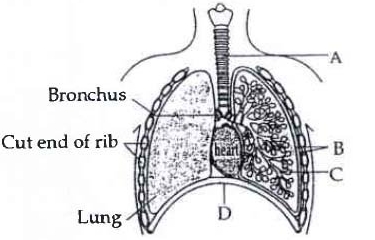
- ✓
$C$ - Alveoli - Thin walled vascular bag like structures for exchange of gases.
- B
$D$ - Lower end of lungs - Diaphragm pulls it down during inspiration.
- C
$A$ - Trachea - Long tube supported by complete cartilaginous rings for conducting inspired air.
- D
$B$ - Pleural membrane - Surround ribs on both sides to provide cushion against rubbing.
AnswerCorrect option: A. $C$ - Alveoli - Thin walled vascular bag like structures for exchange of gases.
a
(a) : In the given figure $A$ is trachea. It is supported by incomplete cartilaginous rings which prevent its collapse during inspiration. $B$ is pleural membrane. It encloses lungs. $C$ are alveoli. They are thin walled sacs having extensive network of capillaries for gaseous exchange. $D$ is diaphragm.
View full question & answer→MCQ 241 Mark
$A$ : When a person starts doing exercise, rate and depth of breathing increase even before these are changes in $pO _{2}, pCO _{2}$ or $H ^{*}$ concentration.
$R$ : The main stimulus for these quick changes is due to input from the proprioreceptors, which monitor movements of joints and muscles.
- ✓
Assertion and Reason both are correct and also correct explanation.
- B
Assertion and Reason both are correct but not explanation of assertion.
- C
Assertion is correct, but Reason is incorrect.
- D
Both Assertion and Reason are incorrect.
AnswerCorrect option: A. Assertion and Reason both are correct and also correct explanation.
View full question & answer→MCQ 251 Mark
In humans, exchange of gases occurs
- A
- B
- C
Between alveoli and pulmonary blood capillary
- ✓
Answerd
Alveoli are the primary site of exchange of gases. Exchange of gases also occur between the blood and tissue. $O_{2}$ and $C O_{2}$ are exchanged in these sites by simple diffusion, mainly based on pressure concentration gradient Pressure/Concentration gradient, solubility of gases as well as the thickness of the membranes involved in diffusion are some important factors that affects the rate of diffusion
View full question & answer→MCQ 261 Mark
Arrange the given steps of respiration mechanism in the order, they occur in the human body
$I.$ Breathing or pulmonary ventilation
$II.$ Diffusion of $O _{2}$ and $CO _{2}$ between blood and tissues
$III.$ Transport of gases by blood
$IV.$ Utilisation of $O_{2}$ by cells
$V.$ Diffusion of $O _{2}$ and $CO _{2}$ across the alveolar membrane
Choose the correct option
- A
$I \rightarrow II \rightarrow III \rightarrow IV \rightarrow V$
- B
$I \rightarrow IV \rightarrow III \rightarrow V \rightarrow II$
- ✓
$I \rightarrow V \rightarrow III \rightarrow II \rightarrow IV$
- D
$I \rightarrow III \rightarrow II \rightarrow IV \rightarrow V$
AnswerCorrect option: C. $I \rightarrow V \rightarrow III \rightarrow II \rightarrow IV$
c
Respiration involves the following steps
$(i)$ Breathing or pulmonary ventilation by which atmospheric air is drawn in and $CO _{2}$ rich alveolar air is released out
$(ii)$ Diffusion of gases, i.e., $O_{2}$ and $C O_{2}$ across alveolar membrane
$(iii)$ Transport of the gases by blood
$(iv)$ Diffusion of $O _{2}$ and $CO _{2}$ between the blood and tissue
$(v)$ Utilisation of $O_{2}$ by the cells for catabolic reactions and the resultant release of $CO _{2}$
View full question & answer→MCQ 271 Mark
If a large number of people are enclosed in a room, then
- ✓
Oxygen decreases and carbon dioxide increases
- B
Oxygen increases and carbon dioxide decreases
- C
Both oxygen and carbon dioxide decreases
- D
Both oxygen and carbon dioxide increases
AnswerCorrect option: A. Oxygen decreases and carbon dioxide increases
a
Respiration is an intracellular catabolic process of oxidation reduction, in which the complex organic food materials are broken down to form $CO _{2}, H _{2} O$ and energy. If a large number of people are enclosed in a room the $O_{2}$ of room is utilized in respiration and $CO _{2}$ released.
View full question & answer→MCQ 281 Mark
Chose the correct option
$(1)$ On and average a healthy human breaths ...$X$....times/minutes
$(2)$ Every $100\, ml$ of oxygenated blood can deliver around ....$Y$.... of $O_2$ of the tissues under normal physiological conditions.
$X-Y$
- A
$20-25$ $,$ $10 \,ml$
- ✓
$12-16$ $,$ $5 \,ml $
- C
$20,000$ $,$ $100\, ml $
- D
$30-35$ $,$ $5\, ml$
AnswerCorrect option: B. $12-16$ $,$ $5 \,ml $
View full question & answer→MCQ 291 Mark
Respiration is the physiological process in which
- A
- B
Breathing and external respiration occur
- ✓
Breathing, external respiration and cellular respiration occur
- D
AnswerCorrect option: C. Breathing, external respiration and cellular respiration occur
View full question & answer→MCQ 301 Mark
$A$ : Emphysema is a chronic obstructive disease of lung, causing irreversible distension and loss of elasticity of alveoli.
$R$ : Emphysema is preventable if chronic exposure to smoke (cigarette and others) and pollutants is avoided.
- A
Assertion and Reason both are correct and also correct explanation.
- ✓
Assertion and Reason both are correct but not explanation of assertion.
- C
Assertion is correct, but Reason is incorrect.
- D
Both Assertion and Reason are incorrect.
AnswerCorrect option: B. Assertion and Reason both are correct but not explanation of assertion.
b
Emphysema is due to inflation of alveoli.
View full question & answer→MCQ 311 Mark
Which of the following is not a symptom of asthma?
- A
- B
Breathing noisily / wheezing
- ✓
Alveolar walls are damaged
- D
Inflammation of bronchi and bronchioles
AnswerCorrect option: C. Alveolar walls are damaged
c
Wall of allevoli gets damaged due to excessive smoking is a symptom of chronic disorder, emphysema.
View full question & answer→MCQ 321 Mark
Tobacco smoke contains carbon monoxide, which
- ✓
Reduces the oxygen-carrying capacity of blood
- B
- C
- D
AnswerCorrect option: A. Reduces the oxygen-carrying capacity of blood
a
Carbon monoxide has higher affinity to combine with haemoglobin of blood han oxygen. Tobacco smoke also contains carbon monoxide, so it reduces the oxygen carrying capacity of blood.
View full question & answer→MCQ 331 Mark
Emphysema is a chronic disorder which is caused due to
Answerc
Emphysema is a chronic disorder in which the alveolar walls are damaged due to which the respiratory surface is decreased. One of the major causes of this condition is smoking
View full question & answer→MCQ 341 Mark
....... is a chronic disorder in which alveolar walls are damaged due to which respiratory surface is decreased.
MCQ 351 Mark
What is correct for emphysema ?
- A
Occurs due to only bacteria infection.
- ✓
One of the major causes is cigarette smoking.
- C
Peoples working in stone breaking industries are most affected.
- D
Inflammation of bronchi and bronchioles.
AnswerCorrect option: B. One of the major causes is cigarette smoking.
View full question & answer→MCQ 361 Mark
Which of the following are the correct statement for respiration in human
AnswerCorrect option: C. Workers in grinding and stone-breaking industries may suffer from lung fibrosis
View full question & answer→MCQ 371 Mark
Asthma is a respiration disease concerned with
- A
Infection in alveolar wall
- ✓
Inflammation of brochi and brochioles
- C
Proliferation of fibrous tissue
- D
AnswerCorrect option: B. Inflammation of brochi and brochioles
View full question & answer→MCQ 381 Mark
Asthama is a respiratory disease caused by
- A
- B
- C
Bleeding into pleural cavity
- ✓
Spasm in bronchial muscle
AnswerCorrect option: D. Spasm in bronchial muscle
d
(d)In asthma, the allergen reagin reaction occurs in the bronchioles of the lungs. During this reaction, mast cells release a substance which causes muscular spasm.
View full question & answer→MCQ 391 Mark
All are the disease of lungs except
Answerc
(c) It is a disease of brain or encephalon.
View full question & answer→MCQ 401 Mark
$A$ : Pneumotaxic centre controls rate of respiration.
$R$ : Primarily it controls switch off point of inspiration.
- ✓
Assertion and Reason both are correct and also correct explanation.
- B
Assertion and Reason both are correct but not explanation of assertion.
- C
Assertion is correct, but Reason is incorrect.
- D
Both Assertion and Reason are incorrect.
AnswerCorrect option: A. Assertion and Reason both are correct and also correct explanation.
a
Pneumotaxic centre are switch off centre of inspiration.
View full question & answer→MCQ 411 Mark
Pneumotaxic centre can moderate the functions of respiratory rhythm centre by
- ✓
Reducing the duration of inspiration
- B
Increasing the duration of inspiration only
- C
First increasing and then reducing the duration of expiration
- D
Increasing the duration of expiration only
AnswerCorrect option: A. Reducing the duration of inspiration
a
Pneuomotaxic centre is present in the pons region of hind brain. It is also known as "switch off point of inspiration" i.e. it reduces the duration of inspiration and alter the respiratory rate and depth of breathing.
View full question & answer→MCQ 421 Mark
Which substances when present in high level can activate the chemosensitive area present adjacent to rhythm centre?
- A
$CO_2$ and $O_2$
- B
$HCO _{3}^{-}$ions and $O _{2}$
- ✓
$CO _{2}$ and $H ^{+}$ions
- D
$H ^{+}$and $HCO _{3}^{-}$ions
AnswerCorrect option: C. $CO _{2}$ and $H ^{+}$ions
c
Chemosensitive area i.e. sensitive for chemicals and is located adjacent to the rhythm centre which contains chemoreceptors which are sensitive for $CO _{2}$ and $H ^{+}$ions. The respiratory centre is stimulated by concentration or partial pressure of $CO _{2}$ and $H ^{+}$ions in blood and body fluids.
View full question & answer→MCQ 431 Mark
A specialised centre known as respiratory rhythm centre regulates respiration. It is located in
Answerb
Respiratory rhythm centre are present in medulla which regulates the normal rhythm of respiration.
View full question & answer→MCQ 441 Mark
A chemosensitive area is situated adjacent to the rhythm centre in the brain. This area is highly sensitive to
- A
$CO _{2}$ concentration
- B
$O _{2}$ concentration
- C
$H ^{+}$concentration
- ✓
Both $(a)$ and $(c)$
AnswerCorrect option: D. Both $(a)$ and $(c)$
d
Chemical Control of Respiration
A chemosensitive area is situated near the respiratory centre, medulla. It is highly sensitive to the change of $CO _{2}$ concentration or change in blood $pH$ as blood $CO _{2}$ concentration influences its $pH$ by forming $HC O _{3}^{-}$, within the $RBCs$ using the enzyme, carbonic anhydrase
View full question & answer→MCQ 451 Mark
The breathing centre initiates the ventilation in response to
AnswerCorrect option: C. Increase of $CO _{2}$ in arterial blood
c
Breathing centre initiates the ventilation in response to
$(i)$ High $CO _{2}$ in arterial blood
$(ii)$ Less $pH$ in arterial blood
$(iii)$ High $H^{+i i}$ concentration in arterial blood
View full question & answer→MCQ 461 Mark
Receptors associated with the aortic arch and carotid artery can recognize the changes in ...$A$... and $H^{+i i}$ concentration and send necessary signals to the ...$B$... for remedial actions
Select the right choice for $A$ and $B$ to complete the given $NCERT$ statement
- A
$A -$ $H ^{-} ;$ $B-$ rhythm centre
- B
$A -$ $O _{2} ;$ $B-$ rhythm centre
- ✓
$A -$ $CO _{2} ;$ $B-$ rhythm centre
- D
$A-$ blood circulation; $B-$ rhythm
AnswerCorrect option: C. $A -$ $CO _{2} ;$ $B-$ rhythm centre
View full question & answer→MCQ 471 Mark
Which part of the brain is called respiratory rhythm centre?
Answerc
Neural system in humans regulates and modulates the respiratory rhythm. Respiratory centreis located in the medulla oblongata and pons varoli. These centre regulates the rate and the depth of breathing by controlling the contraction of diaphragm and other respiratory muscles
Medulla oblongata contains inspiratory rhythm centre in the dorsal portion of the respiratory centre or in ventral portion of the brain
View full question & answer→MCQ 481 Mark
Rate of respiration is directly proportional to
- A
Concentration of oxygen in blood
- ✓
Concentration of carbon dioxide in blood
- C
- D
AnswerCorrect option: B. Concentration of carbon dioxide in blood
b
(b) Due to direct chemical control on respiratory centres, $C{O_2}$ stimulates respiratory centres in $CNS$.
View full question & answer→MCQ 491 Mark
Pneumotaxis centre is associated with
MCQ 501 Mark
Which of the following conditions is responsible for increase in ventilation rate of lungs
- ✓
Increase of $CO_2$ content in inhaled air
- B
Increase of $CO_2$ content in exhaled air
- C
Decrease of $O_2$ content in inhaled air
- D
Decrease of $O_2$ content in exhaled air
AnswerCorrect option: A. Increase of $CO_2$ content in inhaled air
View full question & answer→MCQ 511 Mark
Rate of breating is controlled by
- A
The amount of freely available oxygen
- ✓
- C
Muscular function of the body
- D
View full question & answer→MCQ 521 Mark
Respiratory centre of brain is sensitive to
AnswerCorrect option: B. More $CO_2$ conc. in blood
b
(b) A chemosensitive area located close to the respiratory centre in medulla is highly sensitive changes in ${P_{C{O_2}}}$ or $pH$ of the blood.
View full question & answer→MCQ 531 Mark
Daily respiratory activities are controlled by
MCQ 541 Mark
Which factors favour the binding of $CO_2$ with $Hb$ in tissues?
- A
High $pCO_2$ and high $pO_2$
- B
Low $pCO_2$ and high $pO_2$
- C
Low $pCO_2$ and low $pO_2$
- ✓
High $pCO_2$ and low $pO_2$
AnswerCorrect option: D. High $pCO_2$ and low $pO_2$
d
Condition favourable for the binding of $CO_2$ with $Hb$ or we can say dissociation of $O_2$ from $Hb$ are : $(a)$ Low $pO_2$ $(b)$ High $pCO_2$ (c) More $H+$ concentration and low $pH$ $(d)$ High temperature
In these conditions, oxygen dissociation curve will shift to right.
View full question & answer→MCQ 551 Mark
What is the percentage of $O_2$ transported in dissolved form through the plasma?
- A
About $7\%$
- ✓
About $3\%$
- C
About $20-25\%$
- D
About $15\%$
AnswerCorrect option: B. About $3\%$
b
Oxygen transport by plasma = $3\%$
Oxygen transport by oxyhaemoglobin = $97\%$
View full question & answer→MCQ 561 Mark
Which enzyme is present in $RBC$s and plasma to catalyse the given reaction?
Answera
Because carbonic anhydrase is present in very high concentration in $RBC$ and in small quantity in plasma.
View full question & answer→MCQ 571 Mark
Which factor in tissues favours the formation of $HCO _{3}^{-}$and $H ^{+}$ ions in the blood?
- A
Low $pCO _{2}$
- B
High $pO _{2}$
- ✓
High $pCO _{2}$
- D
AnswerCorrect option: C. High $pCO _{2}$
c

View full question & answer→MCQ 581 Mark
High percentage of $CO _{2}$ is transported in dissolved form as compared to $O _{2} .$ This is because
- A
$O _{2}$ has high solubility in plasma
- ✓
$CO _{2}$ has high solubility in plasma
- C
$pCO _{2}$ is high in blood than $pO _{2}$
- D
$CO _{2}$ has low solubility in plasma
AnswerCorrect option: B. $CO _{2}$ has high solubility in plasma
b
Ratio of $CO _{2}$ and $O _{2}$ solubility in plasma is $25: 1\left( CO _{2}: O _{2}\right)$.
View full question & answer→MCQ 591 Mark
Which factors affect the dissociation of $O _{2}$ from $Hb$ ?
- ✓
$pH , pO _{2}, pCO _{2}$ and temperature
- B
Only $pH$
- C
Salinity, temperature and $pCO _{2}$
- D
$HCO _{3}^{-}$ions concentration, $pH$ and salinity
AnswerCorrect option: A. $pH , pO _{2}, pCO _{2}$ and temperature
a
Factors responsible for the dissociation of oxygen from $Hb$ which occurs in the body tissues : $(a)$ Low partial pressure of oxygen $(c)$ High partial pressure of carbon dioxide $(c)$ Low $pH$ $(d)$ High temperature
View full question & answer→MCQ 601 Mark
A graph is plotted between $pO _{2}$ and percentage saturation of $Hb$ with $O _{2}$ is known as
- A
$O _{2}$ association curve
- B
$CO _{2}- O _{2}$ dissociation curve
- ✓
$O _{2}$ dissociation curve
- D
$CO _{2}- O _{2}$ association curve
AnswerCorrect option: C. $O _{2}$ dissociation curve
c
$A$ graphical representation of relationship between $pO _{2}$ and percentage saturation of haemoglobin with $O _{2}$ is known as oxygen dissociation curve or oxygen haemoglobin dissociation curve. It is sigmoid or $S$-shaped curve.
View full question & answer→MCQ 611 Mark
Select $(1)$ and $(2)$ from the given options
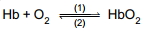
- A
$(1)$ is tissues and $(2)$ is lungs
- B
$(1)$ is lungs and $(2)$ is blood
- C
$(1)$ is blood and $(2)$ is lungs
- ✓
$(1)$ is lungs and $(2)$ is tissues
AnswerCorrect option: D. $(1)$ is lungs and $(2)$ is tissues
d
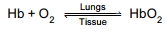
View full question & answer→MCQ 621 Mark
Partial pressure for oxygen and $CO_2$ is represented as
AnswerCorrect option: C. $pO _{2}$ and $pCO _{2}$
c
Gaseous exchange depends on partial pressure of gases.
View full question & answer→MCQ 631 Mark
Which fact suggests that most oxygen is transported from lungs to the tissues combined with haemoglobin rather than dissolved in blood plasma?
- ✓
Oxygen carrying capacity of whole blood is much higher than that of plasma and oxygen content of blood leaving the lungs is greater than that of blood entering the lungs
- B
Haemoglobin can combine with oxygen
- C
Oxyhaemoglobin can dissociate into haemoglobin and oxygen
- D
Increase in carbon dioxide concentration decreases the oxygen affinity of haemoglobin
AnswerCorrect option: A. Oxygen carrying capacity of whole blood is much higher than that of plasma and oxygen content of blood leaving the lungs is greater than that of blood entering the lungs
a
Oxygen carrying capacity of whole blood is much higher than that of plasma and oxygen content of blood leaving the lungs is greater than that of blood entering the lungs thus, most oxygen is transported from lungs to the tissue combined with haemoglobin rather than dissolved in blood plasma.
View full question & answer→MCQ 641 Mark
$I.$ $p O _{2}$ is the major factor which affects the binding of $CO _{2}$ with haemoglobin
$II.$ $p CO _{2}$ is low and $p O _{2}$ is high in tissues
$III.$ $RBC$ contains a very high concentration of carbonic anhydrase
$IV.$ Every $100\; mL$ of deoxygenated blood delivers approximately $4\; mL$ of $CO _{2}$ to alveoli
Select the combination of right statements
- ✓
$I, III$ and $IV$
- B
$I, II$ and $IV$
- C
$I, II$ and $III$
- D
$II, III$ and $IV$
AnswerCorrect option: A. $I, III$ and $IV$
a
In tissues $\rho CO _{2}$ is high and $\rho O _{2}$ is low
$\rho CO _{2}$ in tissues $-45\; mm\; of\; Hg$
$\rho O _{2}$ in tissues $-40 mm\; of\; Hg$
Partial pressure of respiratory gases in-mm Hg
| Respir atory gases |
Inspired air on atmos pheric air |
Alveolar air |
Deoxy genated blood |
nxyge nated blood |
Expired air |
Tissue cells |
|
$\rho O _{2}$
$\rho CO _{2}$
|
$158$
$0.3$
|
$100$
$40$
|
$40$
$45$
|
$95$
$40$
|
$116$
$32$
|
$40$
$45$
|
View full question & answer→MCQ 651 Mark
$I.$ Increased partial pressure of $O_{2}$
$II.$ Increased partial pressure of $CO _{2}$
$III.$ Increased partial pressure of $H^{+i i}$
$IV.$ Decreased partial pressure of $O_{2}$
All the above situations favours the dissociation of oxyhaemoglobin except
- A
$I$ and $II$
- B
$II$ and $III$
- C
$I$ and $IV$
- ✓
Only $I$
AnswerCorrect option: D. Only $I$
d
High pressure of $O_{2}$ increases the oxygenation of haemoglobin
View full question & answer→MCQ 661 Mark
Binding of $O_{2}$ with haemoglobin is primarily depended upon
$I.$ partial pressure of $O_{2}$
$II.$ partial pressure of $CO _{2}$
$III.$ hydrogen ion concentration
$IV.$ temperature
Choose the correct option
- A
$I, II$ and $IV$
- B
$II, III$ and $IV$
- C
$I, III$ and $IV$
- ✓
Answerd
Four molecules of $O _{2}$
Each haemoglobin molecule can carry a maximum of four molecules of $O_{2}$
$Hb _{4}+4 O _{2} \rightarrow Hb _{4} O _{8}$
Binding of oxygen with haemoglobin is primarily related to the partial pressure of $O_{2}$, partial pressure of $C O_{2}$, hydrogen ion concentration and temperature
View full question & answer→MCQ 671 Mark
Dissociation of $CO _{2}$ from carbamino haemoglobin takes place when
- A
$\rho CO _{2}$ is less in alveoli and $\rho O _{2}$ is high
- ✓
$\rho CO _{2}$ is low and $\rho O _{2}$ is high in alveoli
- C
$\rho CO _{2}$ is equal to $\rho O _{2}$ in lungs, i.e., low
- D
$\rho CO _{2}$ is equal to $\rho O _{2}$ in tissue, i.e., high
AnswerCorrect option: B. $\rho CO _{2}$ is low and $\rho O _{2}$ is high in alveoli
b
$\rho CO _{2}$ is low and $\rho O _{2}$ is high in alveoli.
When $\rho CO _{2}$ is high and $\rho O _{2}$ is low as in the tissues, more binding of $CO _{2}$ occurs whereas when the $\rho CO _{2}$ is low and $\rho O _{2}$ is high as in the alveoli, dissociation of $CO _{2}$ from carbamino haemoglobin takes place, i.e., $CO _{2}$ which is bound to haemoglobin from the tissues is delivered to alveoli
View full question & answer→MCQ 681 Mark
Under which condition, dissociation of oxygen from oxyhaemoglobin in tissues occurs?
- A
Low $\rho O_{2}$
- B
High $\rho CO _{2}$
- C
High $H ^{+}$
- ✓
Answerd
In the tissues, there is
$(a)$ Low $\rho O _{2}$ $(b)$ High $\rho CO _{2}$
$(c)$ High $H ^{+}$ $(d)$ High temperature
All these conditions are favourable for the dissociation of oxygen from oxyhaemoglobin
View full question & answer→MCQ 691 Mark
Carbonic anhydrase is found in
AnswerCorrect option: C. Both $(a)$ and $(b)$
c
Carbonic anhydrase is found in the blood and the minute quantity of same is in plasma
View full question & answer→MCQ 701 Mark
Blood is a medium to transport $O _{2}$ and $CO _{2} .$ About ...$A$... per cent of $O _{2}$ is transported by ...$B$... in the blood and the remaining ...$C$... per cent of $O_{2}$ is carried in a dissolved state through the ...$D$...
Select the right options for $A, B, C$ and $D$ to the complete the given statement
- A
$A -$ 50, $B -$ RBC , $C -$ 50, $D-$ plasma
- ✓
$A-$ 97, $B-$ RBC, $C-$ 3, $D-$ plasma
- C
$A-$ 90, $B-$ RBC, $C-$ 10, $D-$ plasma
- D
$A-$ 80, $B-$ RBC, $C-$ 20, $D-$ plasma
AnswerCorrect option: B. $A-$ 97, $B-$ RBC, $C-$ 3, $D-$ plasma
View full question & answer→MCQ 711 Mark
$\rho CO _{2}$ is higher in tissues due to
- A
- ✓
- C
Building up of carbohydrates
- D
Answerb
In the tissues, where partial pressure of $CO _{2}$ is high due to catabolism, $CO _{2}$ diffuses into blood ($RBCs$ and plasma) and forms
$HC O _{3}^{-}$and $H ^{+}$. At the alveolar site, where $\rho CO _{2}$ is low, the reaction proceeds in the opposite direction, leading to the formation of $H _{2} O$ and $CO _{2} .$ Thus, $CO _{2}$ gets trapped as bicarbonate at the tissue level and transported to the alveoli and released as $CO _{2}$
View full question & answer→MCQ 721 Mark
Name the enzymes $A$ and $B$ in the above equation
$CO _{2}+ H _{2} O \stackrel {A} {\rightleftharpoons} H _{2} CO _{3} \stackrel {B} {\rightleftharpoons} \rightleftharpoons HCO _{3}^{-}+ H ^{+}$
- A
$A-$ Carbonic anhydrase, $B-$ Carbonic hydrolase
- B
$A-$ Carbonic hydrolase, $B-$ Carbonic anhydrase
- ✓
$A-$ Carbonic anhydrase, $B-$ Carbonic anhydrase
- D
$A-$ Carbonic hydroxylase, $B-$ Carbonic hydrolase
AnswerCorrect option: C. $A-$ Carbonic anhydrase, $B-$ Carbonic anhydrase
c
$RBCs$ contain very high concentration of enzymes, carbonic anhydrase and minute quantities of the same is present in the plasma too. This enzyme facilities the following reaction in both directions
$CO _{2}+ HO _{2} \stackrel{\text { carbonic anhydrase }}{\rightleftharpoons} H _{2} CO _{3} \stackrel{\text {carbonic anhydrase }}{\rightleftharpoons} HCO _{3}^{-}+ H ^{+}$
Dolphins are aquatic mammals which breath by lungs.
View full question & answer→MCQ 731 Mark
Identify the correct statement with reference to transport of respiratory gases by blood?
- A
Haemoglobin is necessary for transport of carbon dioxide and carbonic anhydrase for transport of oxygen
- ✓
Haemoglobin is necessary for transport of oxygen and carbonic anhydrase for transport of carbon dioxide
- C
Only oxygen is transported by blood
- D
Only carbon dioxide is transported by blood
AnswerCorrect option: B. Haemoglobin is necessary for transport of oxygen and carbonic anhydrase for transport of carbon dioxide
b
Transportation of oxygen from lungs to body tissues and of $CO _{2}$ from tissues to the lungs is vital role of blood.
Transport of carbon dioxide : Most of the $CO _{2}$ that dissolves in blood plasma reacts with water to form carbonic acid :
$CO _{2}+ H _{2} O \rightarrow H _{2} CO _{3}$
An enzyme carbonic anhydrase present in RBCs, which accelerates the carbonic acid formation about 5000 times. About $70 \%$ of the $CO _{2}$ received by blood from the tissue immediately enter into RBCs and hydrated to carbonic acid. All carbonic acid of RBCs dissociates into hydrogen and bicarbonate ions 6 The $H^{+i i}$ mostly combine with haemoglobin for keeping the pH of blood ($7.4$) in steady state, whereas the bicarbonate ion diffuse from RBCs into the plasma. To maintain electrostatic neutrality of plasma many chloride ions in turn diffuse from plasma into RBCs. This is termed chloride or Hamburger shift.
View full question & answer→MCQ 741 Mark
Every $100\; mL$ of deoxygenated blood delivers approximately?
- A
$3\; mL$ of $CO _{2}$
- B
$2\; mL$ of $CO _{2}$
- ✓
$4\; mL$ of $CO _{2}$
- D
$1\; mL$ of $CO _{2}$
AnswerCorrect option: C. $4\; mL$ of $CO _{2}$
c
Every $100\; mL$ of deoxygenated blood delivers approximately $4\; mL$ of $CO _{2}$ to alveoli under the normal physiological conditions
View full question & answer→MCQ 751 Mark
Oxyhaemoglobin in the blood is formed when
AnswerCorrect option: B. $O_{2}$ binds with $RBC$
b
$O_{2}$ binds with $RBC$
Haemoglobin is a red coloured iron containing pigment, present in the $RBCs.$
$O _{2}$ binds with haemoglobin in reversible manner to from oxyhaemoglobin
View full question & answer→MCQ 761 Mark
Why do human beings face difficulty to breath in high elevations?
- A
Lower $\%$ of $O _{2}$
- B
- C
- ✓
Low $\rho O _{2}$
AnswerCorrect option: D. Low $\rho O _{2}$
d
Inspiration takes place when those is negative pressure of $O_{2}$ inside the body than outside. In the mountains, there is less pressure of $O_{2}$ (negative) than inside, that's why, breathing is difficult in mountain regions
View full question & answer→MCQ 771 Mark
$CO _{2}$ is transported in blood combined with haemoglobin as
Answerb
$CO _{2}$ is carried by haemoglobin as carbaminohaemoglobin (about $20-25 \%$ ).
This binding is related to the partial pressure of $CO _{2} \cdot \rho O _{2}$ is a major factor, which could effect this binding
View full question & answer→MCQ 781 Mark
$CO _{2}$ dissociates in alveoli from carbohaemoglobin when
- A
$\rho O _{2}=\text { low, } \rho CO _{2}=\text { high }$
- B
$\rho O_{2}= high, \rho C O_{2}= high$
- C
$\rho O _{2}= low, \rho CO _{2}= low$
- ✓
$\rho O _{2}=\text { high, } \rho CO _{2}=\text { low }$
AnswerCorrect option: D. $\rho O _{2}=\text { high, } \rho CO _{2}=\text { low }$
d
Carbohaemoglobin dissociates in the alveoli, where there is high $O_{2}$ partial pressure and low $\rho CO _{2} .$ Due to the pressure gradient, $CO _{2}$ dissociates from the haemoglobin and $O_{2}$ combines to from oxyhaemoglobin
View full question & answer→MCQ 791 Mark
Identify the correct group of statements
$I.$ Oxygen is carried by haemoglobin
$II.$ Oxygen is carried by carbonic anhydrase
$III.$ $C O_{2}$ is carried by haemoglobin
$IV.$ $SO _{2}$ is carried by haemoglobin
$V.$ Only oxygen is transported by the blood
$VI.$ Only $C O_{2}$ is transported by the blood
Choose the correct option
- A
$I$ and $VI$
- B
$II$ and $III$
- C
$IV$ and $V$
- ✓
$I$ and $III$
AnswerCorrect option: D. $I$ and $III$
d
$CO _{2}$ and $O _{2}$ both are carried by haemoglobin
View full question & answer→MCQ 801 Mark
Transport of $CO _{2}$ by the blood is primarily dependent upon
- A
Solubility of $CO _{2}$ in blood
- ✓
- C
Binding of haemoglobin to $CO _{2}$
- D
Binding of haemoglobin to $O_{2}$
Answerb
$CO _{2}$ Transport Transport of $CO _{2}$ by blood is much easier than oxygen due to high solubility of $CO _{2} .$ About $7 \%$ of $CO _{2}$ is transported dissolved in plasma, $23 \%$ loosely bind with the haemoglobin and forms bicarbonates and about $70 \%$ of $C O_{2}$ reacts with water to form carbonic acid in erythrocytes in the presence of enzyme carbonic anhydrase. The carbonic acid $\left( H _{2} CO _{3}\right)$ dissociates into $H^{+i i}$ and $H C O_{3}^{-i i}$ ions
$CO _{2}+ H _{2} O$ Carbonic Anhydrase $H _{2} CO _{3} \rightleftharpoons HC O _{3}^{-i+H^{\mu i}}$
View full question & answer→MCQ 811 Mark
Haemoglobin $(Hb)$ is a
Answerb
Haemoglobin is an iron containing deep red coloured respiratory pigment. It becomes bright red when combined with oxygen.
View full question & answer→MCQ 821 Mark
Carbon dioxide is transported in blood in the form of
Answerd
About $7 \%$ of carbon dioxide is transported as dissolved in plasma, $23 \%$ as carbaminohaemoglobin and $70 \%$ as bicarbonates. Most of the carbon dioxide that dissolved in blood plasma reacts with water to form carbonic acid. All carbonic acid of RBCs dissociates into hydrogen and bicarbonate ions, that bicarbonate ions diffuse from RBCs to blood plasma.
View full question & answer→MCQ 831 Mark
Under normal conditions, what amount of $O_{2}$ is delivered to the tissues by $100\; mL$ of the oxygenated blood?
- ✓
$5\; mL$
- B
$4\; mL$
- C
$3\; mL$
- D
$2\; mL$
AnswerCorrect option: A. $5\; mL$
a
Under the normal physiological conditions, $100\; mL$ of the oxygenated blood can deliver around $5\; mL$ $O _{2}$ to the body. $(4 \%)$
View full question & answer→MCQ 841 Mark
$CO _{2}$ diffuses into ...$A$... and forms $H C O_{3}^{-i i}$ and $H^{+i i}$. At the ...$B$... site where $p C O_{2}$ is low, the reaction proceeds in the opposite direction.
Thus, $C O_{2}$ is trapped as ...$C$... at the tissue level and transported to alveoli is released out as ...$D$...
Select the right choice for $A, B, C$ and $D$ to complete the given $NCERT$ statement
- A
$A-$ WBC, $B-$ diffusion, $C-$ carbonate, $D-$ $O_{2}$
- ✓
$A-$ RBC, $B-$ alveolar, $C-$ bicarbonate, $D-$ $CO_{2}$
- C
$A-$ RBC, $B-$ alveolar, $C-$ bicarbonate, $D-$ $O_{2}$
- D
$A-$ RBC, $B-$ alveolar, $C-$ carbonate, $D -$ $CO _{2}$
AnswerCorrect option: B. $A-$ RBC, $B-$ alveolar, $C-$ bicarbonate, $D-$ $CO_{2}$
View full question & answer→MCQ 851 Mark
Haemoglobin is red colored iron containing pigment present is $RBCs,$ $O_2$ bind with it in reversible manner to form..........
View full question & answer→MCQ 861 Mark
............$\%$ of $O_2$ transported through the plasma in a dissolved state and nearly ...........$\%$ of $CO_2$ is transported by $RBC,$ whereas ...................$\%$ of $CO_2$ is carried as bicarbonate.
- A
$97\%, 70\%, 20 -25\% $
- ✓
$3\%, 20 -25\%, 70\% $
- C
$7\%, 3\%, 20 -25\%$
- D
$20 - 25\%, 3\%, 70\%$
AnswerCorrect option: B. $3\%, 20 -25\%, 70\% $
View full question & answer→MCQ 871 Mark
$CO_2$ is carried by haemoglobin as carbamino haemoglobin. This binding $CO_2$ with $Hb$ is related to the partial pressure of …....
- ✓
$O_2,$ $CO_2$
- B
$Hb, RBC$
- C
$O_2, Hb$
- D
$CO_2, H_2O$
AnswerCorrect option: A. $O_2,$ $CO_2$
View full question & answer→MCQ 881 Mark
Choose the incorrect sentence from given below.
- A
$3 \%$ $O_2$ transported by blood plasma when $97\%$ of $O_2$ transported by $RBC. $
- ✓
$25$ to $30 \%$ of $O_2$ transported by hemoglobin in the form of carbamino haemoglobin
- C
$100\, ml$ deoxygenated blood transport $4 \,ml $$CO_2$ towards the alveolar sac.
- D
$70 \%$ of $CO_2$ carried as bicarbonate.
AnswerCorrect option: B. $25$ to $30 \%$ of $O_2$ transported by hemoglobin in the form of carbamino haemoglobin
View full question & answer→MCQ 891 Mark
Identify correct sentence.
- ✓
When $PCO_2$ is high and $PO_2$ is low as in the tissue, more binding of carbon dioxide occurs.
- B
Fibrosis is a disorder of digestive system.
- C
Solubility of $CO_2$ is $20 -25$ times lower than that of $O_2$
- D
Carbonic anhydrase is very less in $RBC$ than that of plasma.
AnswerCorrect option: A. When $PCO_2$ is high and $PO_2$ is low as in the tissue, more binding of carbon dioxide occurs.
View full question & answer→MCQ 901 Mark
Match the following:
$\begin{array}{|l|l|} \hline Column\,\,-I & Column\,\,-II \\ \hline 1.\,\,97\,\,percent\,\,of\,\,O_2\,\,is\,\,transported & p.\,\,Bicarbonate \\ \hline 2.\,\,70\,\,percent\,\,of\,\,CO_2\,\,is\,\,transported & q.\,\,RBC \\ \hline 3.\,\,100\,\,\,ml\,\,of\,\,oxygenated\,\,blood & r.\,\,4\,\,\,ml\,\, \\ \hline 4.\,\,100\,\,\,ml\,\,of\,\,deoxygenated\,\,blood & s.\,\,5\,\,\,ml \\ \hline \end{array}$
- A
$(1-p),(2-q),(3-r),(4-s)$
- ✓
$(1-q),(2-p),(3-s),(4-r)$
- C
$(1-r),(2-p),(3-q),(4-s)$
- D
$(1-s),(2-q),(3-p),(4-r)$
AnswerCorrect option: B. $(1-q),(2-p),(3-s),(4-r)$
View full question & answer→MCQ 911 Mark
$A= CO_2$ is carried in the plasma mainly as $HCO_3^-$ ions.
$R =$ Carbonic anhydrase catalyzes the formation of $HCO_3^-$ ions.
- A
$A$ is true and $R$ is false
- B
$A$ is false and $R$ is true
- ✓
Both $A$ and $R$ are true
- D
Both $A$ and $R$ are false
AnswerCorrect option: C. Both $A$ and $R$ are true
View full question & answer→MCQ 921 Mark
In blood $C{O_2}$ is mainly transported through
View full question & answer→MCQ 931 Mark
AnswerCorrect option: B. $RBCs$
View full question & answer→MCQ 941 Mark
If $pH$ of blood is artificially changed to $8$, what is most likely to happen
- A
The tissues will not get oxygen as oxyhaemoglobin will not dissociate into oxygen and haemoglobin
- B
The carbon dioxide will not be released from carbonic acid and carbonates
- ✓
The carbonic anhydrase will be completely inhibited
- D
It will generate carbon monoxide and the animal will die of carbon monoxide poisoning
AnswerCorrect option: C. The carbonic anhydrase will be completely inhibited
View full question & answer→MCQ 951 Mark
Rate and depth of respiration shall increase when
- A
Oxygen concentration increases
- ✓
$C{O_2}$ concentration increases
- C
$HC{O_3}$ concentration increases
- D
$HC{O_3}$ concentration decreases
AnswerCorrect option: B. $C{O_2}$ concentration increases
b
(b) Activity of respiratory centres is directly proportional to the level of free $C{O_2}$ in blood.
View full question & answer→MCQ 961 Mark
In which form $C{O_2}$ is mostly carried by blood
Answera
(a) $C{O_2}$ is transported by blood in three forms, $7\%$ as dissolved in plasma, $23\%$ as carbaminohaemoglobin and $70\%$ as bicarbonates.
View full question & answer→MCQ 971 Mark
How much $C{O_2}$ is present per $100\,ml$ of venous blood
- A
$52.1\,\,ml$
- ✓
$3.7\,ml$
- C
$40\,ml$
- D
$20\,ml$
AnswerCorrect option: B. $3.7\,ml$
b
(b) Every $100\,\, ml$ of blood receives an average $3.7\,\, ml$ of $C{O_2}$ from tissues.
View full question & answer→MCQ 981 Mark
Ascent of high mountains may cause altitude sickness in men. Prime cause of this is
AnswerCorrect option: C. Decreased partial pressure of oxygen
View full question & answer→MCQ 991 Mark
After fast running, man has fast heart beat, slow pulse and shallow breathing, in such conditions he has
- ✓
- B
Poisoning due to lactic acid
- C
- D
Answera
(a)Rate of ${O_2}$ supply by lungs into muscles falls down during active work or in exercise. Muscles accumulate lactic acid and slowly breathing becomes hard so as to increase ${O_2}$ intake in lungs. This stage is called oxygen debt.
View full question & answer→MCQ 1001 Mark
In human blood, the oxygen carrier is
Answera
(a)Haemoglobin, an iron containing red pigment is responsible for transport of ${O_2}$ and $C{O_2}$ in human blood.
View full question & answer→MCQ 1011 Mark
The dissociation curve is associated with
MCQ 1021 Mark
Under a given concentration in blood, dissociation of oxyhaemoglobin will increase if
AnswerCorrect option: A. $pH$ of blood falls
a
(a) Under a given oxygen concentration in blood, dissociation of oxyhaemoglobin will increase if $pH$ of blood falls.
View full question & answer→MCQ 1031 Mark
Constant flow of $C{O_2}$ from the tissues into the blood is due to
- A
Less amount of $C{O_2}$ in tissue cells than in the blood
- ✓
More amount of $C{O_2}$ in tissue cells than in the blood
- C
Equal amount of $C{O_2}$ in tissue cells and blood
- D
AnswerCorrect option: B. More amount of $C{O_2}$ in tissue cells than in the blood
View full question & answer→MCQ 1041 Mark
Choose the wrong statement
- A
Respiratory pigments are coloured pigments
- B
Respiratory pigments have special affinity for respiratory gases
- C
Respiratory pigments are the coloured proteins which contain a metallic ion
- ✓
View full question & answer→MCQ 1051 Mark
In lungs there is definite exchange of ions between $RBC$ and plasma. Removal of $CO_2$ from blood involves
- A
Influx of $Cl^-$ ions into $RBC$
- B
Influx of $HCO_3^-$ ions into $RBC$
- C
Efflux of $Cl^-$ ions into $RBC$
- ✓
Efflux of $HCO_3^-$ ions into $RBC$
AnswerCorrect option: D. Efflux of $HCO_3^-$ ions into $RBC$
View full question & answer→MCQ 1061 Mark
If ${O_2}$ concentration in tissue was almost as high as at the respiratory surface
- A
Oxyhaemoglobin would dissociate to supply to the tissue
- B
Haemoglobin would combine with more ${O_2}$ at respiratory surface
- ✓
Oxyhaemoglobin would not dissociate to supply ${O_2}$ to the tissue
- D
$C{O_2}$ will interfere the ${O_2}$ transport
AnswerCorrect option: C. Oxyhaemoglobin would not dissociate to supply ${O_2}$ to the tissue
View full question & answer→MCQ 1071 Mark
Body tissues obtain ${O_2}$ from oxyhaemoglobin because of its dissociation caused by
- A
high ${O_2}$ concentration
- B
Low ${O_2}$ concentration
- ✓
Low ${O_2}$ and high $C{O_2}$ concentration
- D
High $C{O_2}$ concentration
AnswerCorrect option: C. Low ${O_2}$ and high $C{O_2}$ concentration
c
(c)Body tissues obtain oxygen from oxyhaemoglobin because of its dissociation caused by low ${O_2}$ and high $C{O_2}$ concentration.
View full question & answer→MCQ 1081 Mark
Oxyhaemoglobin is an unstable compound because
- A
Haemoglobin is a complex pigmented protein
- B
There is a physical bonding between oxygen and haemoglobin
- ✓
There is a chemical bonding between oxygen and haemoglobin
- D
One molecule of haemoglobin combines with four molecules of oxygen
AnswerCorrect option: C. There is a chemical bonding between oxygen and haemoglobin
c
(c)Haemoglobin is an iron containing respiratory pigment occuring in red blood cells. It is a tetrameric conjugated protein and can find four oxygen molecule by co-ordination bonds.
View full question & answer→MCQ 1091 Mark
Oxygen is transported to every cell of the body through
MCQ 1101 Mark
Haemoglobin forms compound with
- A
$C{O_2}$
- ✓
$A$ and $D$ both
- C
$N{O_2}$
- D
${O_2}$
AnswerCorrect option: B. $A$ and $D$ both
View full question & answer→MCQ 1111 Mark
${O_2}$ dissociation curve is
Answera
(a)${O_2}$ dissociation curve for haemoglobin is sigmoid in shape.
View full question & answer→MCQ 1121 Mark
Ratio of oxyhaemoglobin and haemoglobin in the blood is based upon
MCQ 1131 Mark
Oxy-haemoglobin dissociates into oxygen and deoxy-haemoglobin at
- ✓
Low ${O_2}$ pressure in tissue
- B
High ${O_2}$ pressure in tissue
- C
Equal ${O_2}$ pressure inside and outside tissue
- D
All times irrespective of ${O_2}$ pressure
AnswerCorrect option: A. Low ${O_2}$ pressure in tissue
a
(a)More active tissue has much lower ${P_O}_{_2}$. Therefore much more oxygen is released from oxyhaemoglobin in the active tissue.
View full question & answer→MCQ 1141 Mark
$A$ : Human blood always contains more amount of $CO_2$ than blood oxygen.
$R$ : Solubility coefficient of $CO_2$ is more than $O_2$.
- ✓
Assertion and Reason both are correct and also correct explanation.
- B
Assertion and Reason both are correct but not explanation of assertion.
- C
Assertion is correct, but Reason is incorrect.
- D
Both Assertion and Reason are incorrect.
AnswerCorrect option: A. Assertion and Reason both are correct and also correct explanation.
a
In $100 \;ml$ oxygenated blood, amount of $O_2$ is about $20 \;ml$ while of $CO_2$ is about $48 \;ml$.
View full question & answer→MCQ 1151 Mark
$A$ : Diffusion of carbondioxide is $20$ times faster than oxygen.
$R$ : It is due to difference in partial pressure as well as solubility of diffusing gases.
- ✓
Assertion and Reason both are correct and also correct explanation.
- B
Assertion and Reason both are correct but not explanation of assertion.
- C
Assertion is correct, but Reason is incorrect.
- D
Both Assertion and Reason are incorrect.
AnswerCorrect option: A. Assertion and Reason both are correct and also correct explanation.
a
Solubility of $CO_2$ is $20$ times faster than $O_2$.
View full question & answer→MCQ 1161 Mark
Which are the three main layers that form the diffusion membrane?
- A
Thin squamous epithelium of alveoli, basement membrane of bronchioles and basement substance
- ✓
Thin squamous epithelium of alveoli, endothelium of alveolar capillaries and the basement substance
- C
Basement substance, cuboidal epithelium of alveoli and stratified epithelium of bronchiole
- D
Ciliated epithelium of trachea, endothelium of capillaries and basement substance
AnswerCorrect option: B. Thin squamous epithelium of alveoli, endothelium of alveolar capillaries and the basement substance
b
Diffusion of $O_2$ and $CO_2$ depends on the thickness of diffusion membrane.
View full question & answer→MCQ 1171 Mark
What is the value of $pO _{2}$ in alveoli and tissues respectively?
- A
$104 \;mm \;Hg$ and $150 \;mm \;Hg$
- B
$45 \;mm \;Hg$ and $0.3 \;mm \;Hg$
- ✓
$104 \;mm \;Hg$ and $40 \;mm \;Hg$
- D
$95 \;mm \;Hg$ and $159 \;mm \;Hg$
AnswerCorrect option: C. $104 \;mm \;Hg$ and $40 \;mm \;Hg$
c
| Respiratory gas |
Atmospheric air |
Alveoli |
Blood
(oxygenated)
|
Blood
(Deoxygenated)
|
Tissue |
| $O_2$ |
$159$ |
$104$ |
$40$ |
$95$ |
$40$ |
| $CO_2$ |
$0.3$ |
$40$ |
$45$ |
$40$ |
$45$ |
View full question & answer→MCQ 1181 Mark
What is the value of $pCO _{2}$ in atmospheric air, alveoli and tissues respectively?
- A
$0.3 \;mm Hg , 40 \;mm Hg$ and $95 \;mm Hg$
- B
$95 \;mm Hg , 40 \;mm Hg$ and $159 \;mm Hg$
- C
$45 \;mm Hg , 0.3 \;mm Hg$ and $40 \;mm Hg$
- ✓
$0.3 \;mm Hg , 40 \;mm Hg$ and $45 \;mm Hg$
AnswerCorrect option: D. $0.3 \;mm Hg , 40 \;mm Hg$ and $45 \;mm Hg$
d
| Respiratory gas |
Atmosheric air |
Alveoli |
Blood
(oxygenated)
|
Blood
(Deoxygenated)
|
Tissue |
| $O_2$ |
$159$ |
$104$ |
$40$ |
$95$ |
$40$ |
| $CO_2$ |
$0.3$ |
$40$ |
$45$ |
$40$ |
$45$ |
View full question & answer→MCQ 1191 Mark
Which of the following statements are not correct?
$I.$ Diffusion membrane is made up of $3$ layers
$II.$ Solubility of $CO _{2}$ in blood is higher than $O _{2}$ by $25$ times
$III.$ Breathing volumes are estimated by spirometer
$IV.$ High $H ^{+}$ in blood favours oxygen dissociation
Choose the correct option
- A
$I$ and $III$
- B
$III$ and $IV$
- C
$I$ and $IV$
- ✓
Answerd
$I.$ Diffusion membrane is made-up of the three layers
$II.$ Solubility of $CO _{2}$ in blood is higher than $O _{2}$ by $25$ times
$III.$ Breathing volumes are estimated by spirometer
$IV.$ High $H^{+i i}$ in blood favours oxygen dissociation
View full question & answer→MCQ 1201 Mark
Which of the following statements is not true?
- A
The partial pressure of oxygen in deoxygenated blood is $40\; mm\; Hg$
- B
The partial pressure of oxygen in oxygenated blood is $95\; mm\; Hg$
- C
The partial pressure of oxygen in the alveolar air is $104\; mm\; Hg$
- ✓
The partial pressure of carbon dioxide in deoxygenated blood is $95\; mm\; Hg$
AnswerCorrect option: D. The partial pressure of carbon dioxide in deoxygenated blood is $95\; mm\; Hg$
d
Each gas in the mixture exerts a part of the total pressure proportional to its concentration, ie, the partial pressure. This is denoted as $p, e \cdot g \cdot, p_{o_{2}}, p_{C O_{z}}$
Partial pressure $( mm\; Hg )$ of respiratory gases
Gas Inspi-red
Air Alve-olar
Air Deoxyg-enated
Blood Oxyge-nated
Blood Exp-ired
Air
$\begin{array}{lllll} O _{2} 158 & 100 & 40 & 95 & 116\end{array}$
$\begin{array}{lllll} CO _{2} 0.3 & 40 & 46 & 40 & 32\end{array}$
View full question & answer→MCQ 1211 Mark
Almost same $pCO _{2}$ in humans is found in
- A
Oxygenated blood and tissues
- B
Deoxygenated blood and oxygenated blood
- ✓
Deoxygenated blood and tissues
- D
AnswerCorrect option: C. Deoxygenated blood and tissues
c
Deoxygenated blood and tissues both have the same partial pressure of $O _{2}$ and $CO _{2}$
View full question & answer→MCQ 1221 Mark
Identify $A, B$ and $C$ in the given diagram and choose the correct option accordinglya
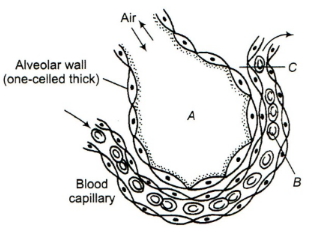
- A
$A-$ Alveolar cavity, $B-$ WBC, $C-$ Capillary wall
- B
$A-$ Alveolar cavity, $B-$ RBC, $C-$ Systemic wall
- ✓
$A-$ Alveolar cavity, $B-$ RBC, $C-$ Basement substance
- D
$A-$ Alveolar cavity, $B-$ WBC, $C-$ Systemic wall
AnswerCorrect option: C. $A-$ Alveolar cavity, $B-$ RBC, $C-$ Basement substance
View full question & answer→MCQ 1231 Mark
Partial pressure (in mm Hg) of oxygen and carbon dioxide at different part involved in diffusion in comparison to those in atmosphere. Identify $A$ and $B$ and choose the correct option accordingly
| Gas |
Atmospheric Air |
Alveoli |
| $O_{2}$ |
$159$ |
$A$ |
| $CO _{2}$ |
$0.3$ |
$B$ |
- A
$A -50 ; B -50$
- ✓
$A -104 ; B -40$
- C
$A -40 ; B -104$
- D
$A -101 ; B -45$
AnswerCorrect option: B. $A -104 ; B -40$
b
Respiratory Atmospheric Alveoli
Gases Air Air
$\rho O_{2}\; 159\; 104$
$\rho CO _{2}\; 0.3\; 40$
View full question & answer→MCQ 1241 Mark
Factors affecting the rate of diffusion is/are
Answerd
Pressure/Concentration gradient, solubility of gases as well as the thickness of the membranes involved in
View full question & answer→MCQ 1251 Mark
Partial pressure of $O _{2}$ and $CO _{2}$ in atmospheric air as compared to those in alveolar air is
| |
Alveolar Air |
Atmospheric Air |
| $p O _{2}$ |
$ X$ |
$ Y$ |
| $pCO _{2}$ |
$A$ |
$B$ |
- A
$X>Y \& A>B$
- B
$X < Y \& A < B$
- C
$X > Y \& A < B$
- ✓
$X < Y \& A > B$
AnswerCorrect option: D. $X < Y \& A > B$
d
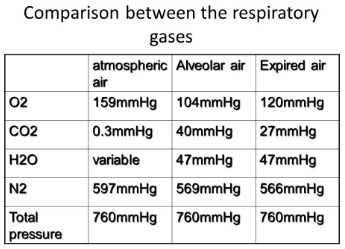
Partial pressure of $O_{2}$ is higher in atmosphere as compared to the alveolar air. Due to this pressure gradient, $O_{2}$ goes inside the body and same phenomena happens in case of $C O_{2}$ but in opposite direction
View full question & answer→MCQ 1261 Mark
The solubility of $CO _{2}$ in the blood is
- A
$10-15$ times higher than that of $O_{2}$
- ✓
$20-25$ times higher than that of $O _{2}$
- C
Slightly higher than that of $O_{2}$
- D
Slightly lower than that of $O_{2}$
AnswerCorrect option: B. $20-25$ times higher than that of $O _{2}$
b
The solubility of $CO _{2}$ is $20-25$ times higher than that of $O _{2}$. The amount of $CO _{2}$ that can diffuse through the diffusion membrane per unit difference in partial pressure is much higher as compared to that of $O_{2}$
View full question & answer→MCQ 1271 Mark
The partial pressure of oxygen in the alveolar air is
- A
$45\; mm\; Hg$
- B
$95\; mm\; Hg$
- ✓
$104\; mm\; Hg$
- D
$110\; mm\; Hg$
AnswerCorrect option: C. $104\; mm\; Hg$
c
The partial pressure of oxygen in the alveolar air is $100-105\; mm\; Hg$.
View full question & answer→MCQ 1281 Mark
Diffusion membrane is made up of
- A
Thin squamous epithelium of alveoli
- B
Endothelium of alveolar capillaries
- C
Basement substance in between the two mentioned above
- ✓
Answerd
Diffusion membrane is made up of three layers
$(i)$ Thin sequamous epithelium of alveoli. $(ii)$ Endothelium of alveolar capillaries. $(iii)$ Basement substance in between the squamous in epithelium of alveoli and endothelium of alveolar capillaries
View full question & answer→MCQ 1291 Mark
How many layers are present in the diffusion membrane of alveolus capillary?
Answerb
The diffusion membrane is made up of three major layers (figure) namely, the thin squamous epithelium of alveoli, the endothelium of alveolar capillaries and the basement substance in between them. However, its total thickness is much less than a millimeter. Therefore, all the factors in our body are favourable for the diffusion of $O_{2}$ from alveoli to tissues and that of $C O_{2}$ from the tissues to alveoli
View full question & answer→MCQ 1301 Mark
Exchange of $O_{2}$ and $C O_{2}$ between the blood and tissue is based on
- ✓
Pressure/concentration gradient
- B
- C
- D
AnswerCorrect option: A. Pressure/concentration gradient
a
Alveoli are the primary site of exchange of gases. Exchange of gases also occur between the blood and tissue. $O_{2}$ and $C O_{2}$ are exchanged in these sites by simple diffusion, mainly based on pressure concentration gradient
View full question & answer→MCQ 1311 Mark
Partial pressure of the gas is the pressure contributed by
AnswerCorrect option: B. Individual gas in a mixture
b
Pressure contributed by the individual gas in a mixture of gases is called partial pressure and is represented as $\rho O _{2}$ for oxygen and $\rho CO _{2}$ for carbon dioxide
View full question & answer→MCQ 1321 Mark
What is correct at alveoli ?
- ✓
High $PO_2$
- B
High $PCO_2$
- C
High $H^+$ concentration
- D
AnswerCorrect option: A. High $PO_2$
View full question & answer→MCQ 1331 Mark
Arrange the appropriate pair.
$\begin{array}{|p{0.3\linewidth}|p{0.5\linewidth}|} \hline Column-I & Column-II\,\,(Amount\,\,of\,\,CO_2\,\,mm\,Hg) \\ \hline (a)\,\,Alveoli & (1)\,\,40 \\ \hline (b)\,\,Tissue & (2)\,\,45 \\ \hline (c)\,\,Blood\,\,without\,\,O_2 & (3)\,\,40 \\ \hline (d)\,\,Blood\,\,with\,\,O_2 & (4)\,\,45 \\ \hline \end{array}$
- ✓
$a-1, b-2, c-4, d-3 $
- B
$a-2, b-1, c-3, d-4 $
- C
$a-4, b-3, c-1, d-2$
- D
$a-4, b-1, c-2, d-3 $
AnswerCorrect option: A. $a-1, b-2, c-4, d-3 $
View full question & answer→MCQ 1341 Mark
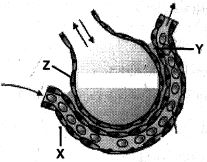
Identify $X, Y, Z$ from figure
- A
$X-$ $RBC,$ $Y-$ Blood capillary, $Z-$ Air
- ✓
$X-$ Blood Capillary, $Y-$ Basement substance $Z-$ Alveolar wall
- C
$X-$ Air, $Y-$ Alveolar cavity, $Z-RBC $
- D
$X-$ Basement substance, $Y-$ Air, $Z-RBC$
AnswerCorrect option: B. $X-$ Blood Capillary, $Y-$ Basement substance $Z-$ Alveolar wall
View full question & answer→MCQ 1351 Mark
....... are the primary sites of exchange of gases
MCQ 1361 Mark
Select the incorrect sentence for respiration.
AnswerCorrect option: B. Transport of gases by the tissue
View full question & answer→MCQ 1371 Mark
The blood coming out of lungs than entering into lungs is richer in
MCQ 1381 Mark
Which is true for $CO_2$ concentration
- ✓
More in alveolar air than in expired air
- B
More in expired air than in alveolar air
- C
More in inspired air than in expired air
- D
More in inspired air than in alveolar air
AnswerCorrect option: A. More in alveolar air than in expired air
View full question & answer→MCQ 1391 Mark
When the affinity of ${O_2}$ and $C{O_2}$ for haemoglobin is compared, it is
- A
More for ${O_2}$
- ✓
More for $C{O_2}$
- C
- D
AnswerCorrect option: B. More for $C{O_2}$
View full question & answer→MCQ 1401 Mark
The blood leaving the lungs has all its haemoglobin oxygenated and gives up to the tissue because
AnswerCorrect option: B. ${O_2}$ concentration is lower than in the lungs
View full question & answer→MCQ 1411 Mark
If a person exhales out forcefully by applying all his efforts. What will the pulmonary volume inhaled by him immediately under normal condition without applying any extra effort?
- A
$TV + IRV$
- B
$TV$ only
- ✓
$TV + ERV$
- D
$TV + IRV + ERV$
AnswerCorrect option: C. $TV + ERV$
c
After a normal inspiration, the total volume of air a person can expire is known as expiratory capacity
$( EC )= TV + ERV$
Exhaled forcefully $\Rightarrow$ $TV$ goes out, $ERV$ goes out
Normal inspiration $\Rightarrow$ $ERV + TV$ has to be filled
View full question & answer→MCQ 1421 Mark
Volume of air remains in the lungs after normal expiration is
- ✓
$ERV + RV$
- B
$IRV + RV$
- C
$RV + IRV + ERV$
- D
$TV$
AnswerCorrect option: A. $ERV + RV$
a
Volume of air remains in the lungs after normal expiration is known as functional residual capacity $(FRC)$.
$FRC = ERV + RV = 2500 \;ml$
View full question & answer→MCQ 1431 Mark
An additional volume of air, a person can inspire by a forceful inspiration is known as
- A
- B
- C
Expiratory reserve volume
- ✓
Inspiratory reserve volume
AnswerCorrect option: D. Inspiratory reserve volume
d
$IRV$ is the additional volume of air a person can inspire by a forceful inspiration.
$IRV = 2500 -300 \;ml$
$IC = IRV + TV$
$3000 -3500 \;ml$
View full question & answer→MCQ 1441 Mark
What is the value of tidal volume in a normal healthy man?
AnswerCorrect option: A. Approximately $6000-8000$ ml/min
a
Minute volume = $TV\; ×$ Breathing rate
$500$ ml $×$ $12-16$ /min $\Rightarrow$ $\sim$$6000 -8000$ ml
Minute volume is also known as pulmonary ventilation.
View full question & answer→MCQ 1451 Mark
Which of the following volume is not included in vital capacity
Answerd
Because $VC = ERV + TV + IRV$
or $VC = ERV + IC$
Here, $RV$ = Residual volume $IRV$ = Inspiratory reserve volume
$VC$ = Vital capacity $IC$ = Inspiratory capacity
$ERV$ = Expiratory reserve volume $TV$ = Tidal volume
View full question & answer→MCQ 1461 Mark
Arrange the following in the order of increasing volume
$I.$ Tidal volume
$II.$ Residual volume
$III.$ Expiratory reserve volume
$IV.$ Vital capacity
- A
$I < II < III < IV$
- ✓
$I < III < II < IV$
- C
$I < IV < III < II$
- D
$I < IV < II < III$
AnswerCorrect option: B. $I < III < II < IV$
b
$TV (500\; mL )< ERV (1100\; mL )< RV (1200\; mL )< VC (4600\; mL )$
View full question & answer→MCQ 1471 Mark
Answerd
Total Lung Capacity Total volume of the air accommodated in the lungs at the end of forced inspiration. This includes $RV, ERV, TV$ and $IRV.$ It is the sum of vital capacity and the residual volume
View full question & answer→MCQ 1481 Mark
- ✓
Volume of air inspired or expired
- B
Additional volume of air, a person can inspire by a forcible inspiration
- C
Additional volume of air, a person can expire by a forcible expiration
- D
Remaining volume of air in the lungs even after a forcible expiration
AnswerCorrect option: A. Volume of air inspired or expired
a
Volume of the air inspired or expired. Pulmonary volume is the volume of air present in the lungs it is divided into four different types according to the volume of air present in the lungs
$(i)$ Tidal Volume ($TV$) The volume of the air inspired or expired involuntarily in each normal breath. It is about $500\; mL$ of air in average young adult man
$(ii)$ Inspiratory Reserve Volume ($IRV$) The maximum volume of the air, which a person can inhale over and above tidal volume by deepest, possible voluntary inspiration. It is about $3000\; mL$
$(iii)$ Expiratory Reserve Volume ($ERV$) The volume of the air which can be expired over and above the tidal volume with maximum effort. It is about $1100\; mL$
$(iv)$ Residual Volume ($RV$) The volume of the air left in the lungs even after the maximum forceful expiration. It is about $1200\; mL$
diffusion are some important factors that affects the rate of diffusion
View full question & answer→MCQ 1491 Mark
Identify the type of pulmonary volume/capacity on the basis of quantity of air present in the lungs given below.
$I.$ $1100\; mL -1200\; mL$
$II.$ $500\; mL$
$III.$ $5000\; mL -6000\; mL$
Choose the correct option
- A
$I -$ VC, $II -$ FRC, $III -$ RV
- ✓
$I -$ RV, $II -$ TV, $III -$ TLC
- C
$I -$ EC, $II -$ IC, $III -$ RV
- D
$I -$ TV, $II -$ IRV, $III -$ ERV
AnswerCorrect option: B. $I -$ RV, $II -$ TV, $III -$ TLC
b
$I.$ Residual volume $II.$ Tidal volume $III.$ Total lung capacity
View full question & answer→MCQ 1501 Mark
- A
- B
Greater than inspiratory volume
- C
Greater than vital capacity
- ✓
Greater than tidal volume
AnswerCorrect option: D. Greater than tidal volume
d
Residual volume $(1200\; mL )$ is greater than tidal volume $(500\; mL )$.
View full question & answer→MCQ 1511 Mark
The expiratory reserve volume will be
- ✓
$1000\; mL$
- B
$2000\; mL$
- C
$4000\; mL$
- D
$5000\; mL$
AnswerCorrect option: A. $1000\; mL$
a
Expiratory reserve volume is the extra amount of air that can be expired forcibly after a normal expiration. It is about $1000-1500\; mL$. Inspiratory Reserve Volume $=2000\; mL$.
Vital capacity $=4000\; mL$
Total lung capacity $=5000\; mL$
View full question & answer→MCQ 1521 Mark
The vital capacity of human lung is equal to
- A
$500\; mL$
- ✓
$4600\; mL$
- C
$5800\; mL$
- D
$2300\; mL$
AnswerCorrect option: B. $4600\; mL$
b
Vital Capacity $( VC )= IRV + TV + ERV$
$=3000+500+1100=4600\; mL$
View full question & answer→MCQ 1531 Mark
About $1200\; mL$ of air is always known to remain inside the human lungs. It is described as
- A
Inspiratory reserve volume
- B
Expiratory reserve volume
- ✓
- D
Answerc
Residual Volume($RV$) is the volume of air present in lungs even after a forcible expiration, averaging about $1200\; mL$.
View full question & answer→MCQ 1541 Mark
$EC =$ ..........
- A
$TV + IRV $
- ✓
$TV + ERV$
- C
$ERV + RV $
- D
$TV + IRV$
AnswerCorrect option: B. $TV + ERV$
View full question & answer→MCQ 1551 Mark
Its volume is between $2500-3000\, ml.$
AnswerCorrect option: A. $IRV $
View full question & answer→MCQ 1561 Mark
How much amount of air released by healthy humans in every minute during expiration?
- A
$5000$ to $6000\, ml$
- ✓
$6000$ to $8000\, ml$
- C
$6000$ to $7000 \,ml$
- D
$7000$ to $8000\, ml$
AnswerCorrect option: B. $6000$ to $8000\, ml$
View full question & answer→MCQ 1571 Mark
Which is correct sentence from given below?
- A
$EC$ is sum of $ERV$ and $RV.$
- B
$TV$ is sum of $ERV$ and $IC. $
- C
Generally $IRV$ is between $3000 -3500\, ml.$
- ✓
$ERV$ is approximately in between $1000 -1100\, ml.$
AnswerCorrect option: D. $ERV$ is approximately in between $1000 -1100\, ml.$
View full question & answer→MCQ 1581 Mark
A man breath $12$ time in a minute during this he achieves $2$ time $TLC.$ so what amount of total air this man has inspired ?
- ✓
$15,200$ to $16,600 $
- B
$13,500$ થી $14,300 $
- C
$10,200$ થી $12,500 $
- D
AnswerCorrect option: A. $15,200$ to $16,600 $
View full question & answer→MCQ 1591 Mark
$TV + IRV + ERV =$ ........
- A
$IRV + ERV $
- B
$EC + TLC$
- ✓
$VC $
- D
$TLC + RV$
View full question & answer→MCQ 1601 Mark
Listed below are four respiratory Capacities and four respiratory volumes of a normal human adult
$\begin{array}{|p{0.4\linewidth}|p{0.4\linewidth}|} \hline Respiratory\,\,capacities & Respiratory\,\,Volumes \\ \hline (i)\,\,RV\,\, & 2500\,\,\,mL \\ \hline (ii)\,\,VC\,\, & 2500\,\,-\,\,3000\,\,\,mL \\ \hline (iii)\,\,IRV\,\, & 1100\,\,-\,\,1200\,\,\,mL \\ \hline (iv)\,\,IC & 4500\,\,\,mL \\ \hline \end{array}$
Which one of the following is the correct matching of two copacities and volumes?
- A
$(i)$ $2500\, ml,$ $(ii)\, 4500\, ml$
- B
$(iii)$ $1100-1200\, ml,$ $(iv) \,2500\, ml $
- ✓
$(iii) 2500-3000 ml, $ $(i)\, 1100-1200 \,ml$
- D
$(i) 4500 \,ml,$ $(ii)\, 2500-3000 \,ml $
AnswerCorrect option: C. $(iii) 2500-3000 ml, $ $(i)\, 1100-1200 \,ml$
View full question & answer→MCQ 1611 Mark
Functional residual capacity includes.
$(1)$ $TV$ $(2)$ $IRV$
$(3)$ $RV$ $(4)$ $ERV$
- A
$1$ and $3$
- ✓
$3$ and $4$
- C
$1$ and $4$
- D
$1,2,3$ and $4$
AnswerCorrect option: B. $3$ and $4$
View full question & answer→MCQ 1621 Mark
What is Functional Residual Capacity $(FRC)$?
- ✓
$ERV+RV $
- B
$IRV+RV$
- C
$VC+ERV $
- D
$TV+ERV $
AnswerCorrect option: A. $ERV+RV $
View full question & answer→MCQ 1631 Mark
$A =$ Gas exchange continues non stop in the lungs even during exhalation.
$R =$ Lungs have residual air
- A
$A$ is true and $R$ is false
- B
$A$ is false and $R$ is true
- ✓
Both $A$ and $R$ are true
- D
Both $A$ and $R$ are false
AnswerCorrect option: C. Both $A$ and $R$ are true
View full question & answer→MCQ 1641 Mark
Tidal air in mammalian lungs is
- A
The total maximum air that can be driven into the lungs
- ✓
The air that normally goes in and comes out of the lungs during breathing
- C
The air that is left in the lungs after normal expiration
- D
The air that can be expelled out forcibly after the normal expiration
AnswerCorrect option: B. The air that normally goes in and comes out of the lungs during breathing
View full question & answer→MCQ 1651 Mark
The air which is taken in or given out during a single breath is known as
Answerc
(c)Tidal volume is the volume of air inspired or expired with each breath. This is about 500 ml in an adult person.
View full question & answer→MCQ 1661 Mark
How much amount of air can be inspired or expired during normal breathing
- ✓
$0.5$ $l$
- B
$2.5$ $l$
- C
$1.5$ $l$
- D
$5.5$ $l$
AnswerCorrect option: A. $0.5$ $l$
a
(a) Tidal volume is the volume of air breathed in and out during normal respiration and is equal to about $500\,\,ml{\rm{ \,\,or \,\,}}0.5 \,l$
View full question & answer→MCQ 1671 Mark
Capacity of human lung for air
- ✓
$6000\,\, ml$
- B
$1500 \,\,ml$
- C
$1000 \,\,ml$
- D
$500 \,\,ml$
AnswerCorrect option: A. $6000\,\, ml$
View full question & answer→MCQ 1681 Mark
The vital capacity of lung is equal to
- ✓
$4000\,\, ml$
- B
$2200\,\, ml$
- C
$1100\,\, ml$
- D
$500 \,\,ml$
AnswerCorrect option: A. $4000\,\, ml$
View full question & answer→MCQ 1691 Mark
Maximum expiratory volume is
- A
$100 \,\,ml$
- ✓
$1000\,\, ml$
- C
$1500\,\, ml$
- D
$3000 \,\,ml$
AnswerCorrect option: B. $1000\,\, ml$
View full question & answer→MCQ 1701 Mark
The largest quantity of air that can be expired after a maximum inspiratory effort is
Answerc
(c) Vital capacity of lungs to expire maximum volume of air after a deep inspiration. The largest quantity of air that can be expired after a maximal inspiratory. Vital capacity is equal the sum of the tidal complemental and supplemental air $(500 + 3100 + 1200 = 4800\,\, ml)$.
View full question & answer→MCQ 1711 Mark
The volume of air present in the lungs after forceful expiration is called as
MCQ 1721 Mark
What happens when pressure within the pulmonary cavity is higher than the atmospheric pressure?
- A
- ✓
- C
No inhalation and expulsion of air occurs
- D
Lungs inflate and rupture
Answerb
High pressure in pulmonary cavity compared to atmosphere results in explusion of air. Air moves high pressure to low pressure.
View full question & answer→MCQ 1731 Mark
What happens to the volume of pulmonary cavity when there is an increase in the volume of thoracic chamber?
- A
- ✓
- C
- D
First decreases and then increases
Answerb
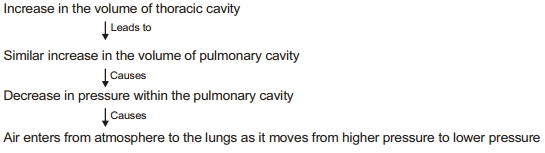
View full question & answer→MCQ 1741 Mark
Which instrument helps in clinical assessment of pulmonary functions?
Answerc
Sphygomomanometer $\rightarrow$ Use to measure the blood pressure.
Stethoscope $\rightarrow$ To check the normal rhythm of heart (i.e., to listen normal and abnormal heart sound)
Spirometer $\rightarrow$ To assess pulmonary function
Electrocardiograph $\rightarrow$ Instrument use for taking $ECG$(electrocardiagram)
View full question & answer→MCQ 1751 Mark
During inspiration, the volume of thoracic cavity increases because of
- ✓
Contraction of diaphragm and external intercostal muscles
- B
Relaxation of diaphragm and external intercostal muscles
- C
Contraction of diaphragm and relaxation of external intercostal muscles
- D
Relaxation of diaphragm and contraction of external intercostal muscles
AnswerCorrect option: A. Contraction of diaphragm and external intercostal muscles
a
During inspiration, the contraction of diaphragm muscle causes it to become flat and lowered down, thereby increasing the volume of thoracic cavity in antero-posterior axis. The contraction of external intercostal muscle, lift ribs and sternum up and outward causing an increase in volume of thoracic cavity in the dorso-ventral axis i.e., backward-forward direction.
View full question & answer→MCQ 1761 Mark
Which muscles help us to increase the strength of inspiration and expiration?
- A
- B
- C
Internal intercostal muscles
- ✓
Both $(b)\, \& \,(c)$
AnswerCorrect option: D. Both $(b)\, \& \,(c)$
d
Cardiac muscle i.e., muscle of heart, it do not have any role in inspiration and expiration.
Rest two muscles i.e., abdominal and internal intercostal muscle undergo contraction and increase the strength of expiration.
View full question & answer→MCQ 1771 Mark
Inspiration occurs when intra-pulmonary pressure is
- A
Higher than atmospheric pressure
- ✓
Lower than atmospheric pressure
- C
Equal to atmospheric pressure
- D
Zero compared to atmospheric pressure
AnswerCorrect option: B. Lower than atmospheric pressure
b
Air can flow to lungs, when the pressure within the lungs is less than the atomospheric pressure.
View full question & answer→MCQ 1781 Mark
Arrange the given steps by which the Lungs show Inpiration, in the sequence of events occurring first
$I.$ Increase in the volume of the thoracic chamber in dorsoventral axis
$II.$ Upward and outward movement of the ribs
$III.$ Contraction of intercostal muscles
$IV.$ Entry of air inside the lungs
$V.$ Contraction of the diaphragm
$VI.$ Increase in the volume of the thoracic chamber in antero-posterior axis
Choose the correct option
- A
$I \rightarrow II \rightarrow III \rightarrow IV \rightarrow V \rightarrow VI$
- B
$IV \rightarrow I \rightarrow II \rightarrow III \rightarrow V \rightarrow VI$
- ✓
$III \rightarrow II \rightarrow I \rightarrow V \rightarrow VI \rightarrow IV$
- D
$VI \rightarrow III \rightarrow IV \rightarrow II \rightarrow V \rightarrow I$
AnswerCorrect option: C. $III \rightarrow II \rightarrow I \rightarrow V \rightarrow VI \rightarrow IV$
c
$(i)$ Contraction of intercostal muscle
$(ii)$ Lifting of the ribs and Sternum causing an increase in the volume of thoracic chamber in dorso ventral axis
$(iii)$ Contrction of diaphragm and increase in the volume of thoracic cavity anterioposteriorly
$(iv)$ Decrease in the intra pulmonary pressure leading to entry of air inside
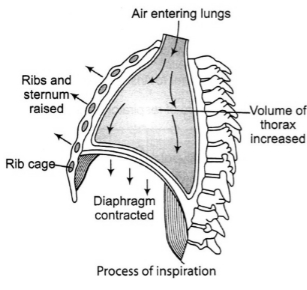
View full question & answer→MCQ 1791 Mark
An ...$A$... in the pulmonary volume ...$B$... the intra pulmonary pressure to less than the atmospheric pressure which forces the air from ...$C$... to move into the lungs, i.e., ...$D$...
Choose the correct options for the blanks $A, B, C$ and $D$ to complete the above statement with reference to NCERT textbook
- A
$A-$ increase, $B-$ decrease, $C-$ outside, $D-$ expiration
- B
$A-$ decrease, $B-$ increase, $C-$ outside, $D-$ expiration
- C
$A-$decrease, $B-$ increase, $C-$ inside, $D-$ inspiration
- ✓
$A-$ increase, $B-$ decrease, $C-$ outside, $D-$ inspiration
AnswerCorrect option: D. $A-$ increase, $B-$ decrease, $C-$ outside, $D-$ inspiration
View full question & answer→MCQ 1801 Mark
$I.$ Intra pulmonary pressure remains less than the atmospheric pressure
$II.$ There is negative pressure in the lungs than the atmospheric pressure In which of the above two situations inspiration takes place? Choose the correct option accordingly?
- A
Only $I$
- B
Only $II$
- ✓
Both $I$ and $II$
- D
$I$ or $II$
AnswerCorrect option: C. Both $I$ and $II$
c
The movement of the air into and out of the lungs is carried out by creating a pressure gradient between the lungs and the atmosphere. Inspiration can occur if the pressure within the lungs (intra pulmonary pressure) is
less than the atmospheric pressure, i.e., there is a negative pressure in the lungs with respect to the atmospheric pressure.
Expiration takes place when the intra pulmonary pressure is higher than the atmospheric pressure, i.e., there is positive pressure in the lungs with respect to the atmospheric pressure
View full question & answer→MCQ 1811 Mark
Arrange the given steps of expiration in the sequence of event occurring first
$I.$ Relaxation of the diaphragm and sternum
$II.$ Reduction of the pulmonary volume
$III.$ Expulsion of air from the lungs
$IV.$ Increase in intra pulmonary pressure
Choose the correct option
- A
$I \rightarrow II \rightarrow III \rightarrow IV$
- ✓
$I \rightarrow II \rightarrow IV \rightarrow III$
- C
$IV \rightarrow III \rightarrow II \rightarrow I$
- D
$IV \rightarrow II \rightarrow III \rightarrow I$
AnswerCorrect option: B. $I \rightarrow II \rightarrow IV \rightarrow III$
b
Relaxation of the diaphragm and intercostal muscles returns the diaphragm and sternum to their normal positions and reduces the thoracic volume and thereby the pulmonary volume. This leads to an increase in intrapulmonary pressure to slightly above the atmospheric pressure, causing the expulsion of air from the lungs, i.e., expiration
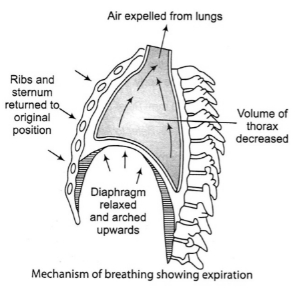
View full question & answer→MCQ 1821 Mark
State wheather the given statements are true or false
$I.$ Ventillation in humans is an active process
$II.$ Diaphragm helps in generating the pressure gradient in the lungs
Choose the correct option
AnswerCorrect option: B. $I -$ True, $II -$ True
b
- Breathing involves Inhalation an active process involving contraction of diaphragm muscles and intercostal muscle and Exhalation a passive process, where the muscles relax without expenditure of energy. Overall becomes active.
- diphragm muscle contraction pulls diaphragm down increasing the anterioposterior volume of thoracic cavity creating a pressure gradient in lungs wrt air in the atmosphere.
View full question & answer→MCQ 1831 Mark
Breathing involves ...$A$... during which atmospheric air is drawn in and ...$B$... by which the alveolar air is released out.
Choose the correct option for $A$ and $B$ to complete the given $NCERT$ statement
- A
$A-$ expiration; $B-$ osmosis
- B
$A-$ expiration; $B-$ inspiration
- ✓
$A-$ inspiration; $B-$ expiration
- D
$A-$ inspiration; $B-$ diffusion
AnswerCorrect option: C. $A-$ inspiration; $B-$ expiration
View full question & answer→MCQ 1841 Mark
Additional muscles in the ...... impacts the ability of humans to increase the strength of inspiration and expiration Complete the given $NCERT$ statement with an appropriate option
Answerc
We can voluntarily take deep breath by an effort. In the process of deep inspiration, chest distention is brought about by the external intercostal muscles and the abdominal muscles
View full question & answer→MCQ 1851 Mark
The ventilation movements of the lungs in mammals is governed by
AnswerCorrect option: C. Both ($a$) and ($b$)
c
The ventilation movement of the lungs is governed by diaphragm and intercoastal muscles
View full question & answer→MCQ 1861 Mark
Inspiration is initiated by
- A
Relaxation of the diaphragm
- ✓
Contraction of the diaphragm
- C
Relaxation of the intercostal muscles
- D
AnswerCorrect option: B. Contraction of the diaphragm
b
Inspiration is initiated by the contraction of diaphragm, which increases the volume of thoracic chamber in the antero-posterior axis. The contraction of the external inter-costal muscles lifts up the ribs and the sternum causing an increase in the volume of thoracic chamber in the dorso-ventral axis. The overall increase in the thoracic volume causes a similar increase in the pulmonary volume
View full question & answer→MCQ 1871 Mark
What is false for inspiration process?
- A
Inspiration can occur if the pressure within the lungs (intra - pulmonary pressure) is less than the atmospheric pressure.
- ✓
There is a positive pressure in the lungs with respect to atmosphere.
- C
Intra pulmonary pressure is lower than atmospheric pressure.
- D
Inspiration is initiated by the contraction of diaphragm.
AnswerCorrect option: B. There is a positive pressure in the lungs with respect to atmosphere.
View full question & answer→MCQ 1881 Mark
On an average, healthy human breathes …… times / minutes.
- A
$8 -10$
- B
$10 -16$
- ✓
$12 - 16 $
- D
$14 - 18 $
AnswerCorrect option: C. $12 - 16 $
View full question & answer→MCQ 1891 Mark
An increase in pulmonary volume decreases the intra pulmonary pressure to less than the atmospheric pressure which forces the air from outside to move into lungs. i.e.........
MCQ 1901 Mark
Intercostal muscles occur in
MCQ 1911 Mark
During inspiration the diaphragm
- A
Relaxes to become dome-shaped
- ✓
- C
- D
View full question & answer→MCQ 1921 Mark
The intake and output of air from the lungs is helped by
- A
- B
- ✓
Muscles of ribs and diaphragm
- D
Ribs are intercoastal muscles
AnswerCorrect option: C. Muscles of ribs and diaphragm
View full question & answer→MCQ 1931 Mark
Air moves into the lungs when
- A
Atmospheric pressure is less than pressure within the lungs
- ✓
Atmospheric pressure is greater than pressure within the lungs
- C
Atmospheric pressure is equal to the pressure within the lungs
- D
AnswerCorrect option: B. Atmospheric pressure is greater than pressure within the lungs
View full question & answer→MCQ 1941 Mark
In a minute normal man respires
- A
$10$ times
- ✓
$16$ times
- C
$30$ times
- D
$4$ times
AnswerCorrect option: B. $16$ times
b
(b) During normal breathing the respiratory movement in $25$ years old is about $16$ min.
View full question & answer→MCQ 1951 Mark
In expiration condition, diaphragm becomes
Answerb
(b)During expiration diaphragm relaxes and becomes dome-shaped thereby reducing intrathoracic volume to pass out the air from body.
View full question & answer→MCQ 1961 Mark
Which structure in mammals does not help in respiration
Answerd
(d)Because larynx is a sound producing organ.
View full question & answer→MCQ 1971 Mark
What structures are responsible for breathing process
- A
- B
- C
Ribs and intercostal muscles
- ✓
Intercostal muscles and diaphragm
AnswerCorrect option: D. Intercostal muscles and diaphragm
View full question & answer→MCQ 1981 Mark
The most important function of diaphragm of the mammals is
- A
To divide the body cavity into compartment
- B
- C
- ✓
View full question & answer→MCQ 1991 Mark
$A$ : The passage starting with the external nostrils upto the terminal bronchiole constitute the respiratory part.
$R$ : The respiratory part transport the air to the alveoli, clears it from the foreign material, humidified and brings the air to body temperature.
- A
Assertion and Reason both are correct and also correct explanation.
- B
Assertion and Reason both are correct but not explanation of assertion.
- C
Assertion is correct, but Reason is incorrect.
- ✓
Both Assertion and Reason are incorrect.
AnswerCorrect option: D. Both Assertion and Reason are incorrect.
d
The passage starting with the external nostils upto the terminal bronchiole constitute the conducting part.
View full question & answer→MCQ 2001 Mark
Ventrally and laterally, the thoracic chamber is formed by
- A
Diaphragm and sternum respectively
- B
Ribs and sternum respectively
- ✓
Sternum and ribs respectively
- D
Vertebral column and diaphragm respectively
AnswerCorrect option: C. Sternum and ribs respectively
c
Thoracic cavity is formed :
Dorsally -By the vertebral column
Ventrally -By the sterum
Laterally -By the ribs
View full question & answer→MCQ 2011 Mark
What is the function of respiratory part of human respiratory system?
AnswerCorrect option: D. It exchanges $O_2$ and $CO_2$ between blood and atmospheric air
d
Respiratory part of human respiratory system includes alveoli and their ducts.
It is the main site of human respiratory system where diffusion of gases ($O_2$ and $CO_2$) occurs.
View full question & answer→MCQ 2021 Mark
What are the characteristics of alveoli?
- ✓
Very thin, irregular walled and highly vascularised
- B
Thick and smooth membrane
- C
Network of blood capillaries and thick-walled
- D
Thick, regular walled and lack of blood vessels
AnswerCorrect option: A. Very thin, irregular walled and highly vascularised
a
Alveoli membrane is very thin, irregular, richly supplied with blood vessels because of which exchange of gases easily occurs here.
View full question & answer→MCQ 2031 Mark
A pair of external nostrils present in humans opens out
- A
- ✓
- C
Between upper and lower lips
- D
View full question & answer→MCQ 2041 Mark
Where are lungs situated in human body?
Answerb
A pair of lungs are present in humans, lie in an air-tight chamber known as thoracic cavity or chest cavity.
View full question & answer→MCQ 2051 Mark
Trachea divides into right and left
Answerd
The trachea divides into right and left primary bronchi at the level of $5^{\text {th }}$ thoracic vertebra.
View full question & answer→MCQ 2061 Mark
At which level of thoracic vertebra, trachea divides
- A
$2^{\text {nd }}$ thoracic vertebra
- ✓
$5^{\text {th }}$ thoracic vertebra
- C
$3^{\text {rd }}$ thoracic vertebra
- D
$4^{\text {th }}$ thoracic vertebra
AnswerCorrect option: B. $5^{\text {th }}$ thoracic vertebra
b
The trachea divides into right and left primary bronchi at the level of $5^{\text {th }}$ thoracic vertebra.
View full question & answer→MCQ 2071 Mark
$A$ thin-elastic cartilaginous flap which prevents the entry of food into the larynx is known as
Answerc
Epiglottis covers the glottis during swallowing of food.
View full question & answer→MCQ 2081 Mark
Pick the correct statement.
AnswerCorrect option: C. The thoracic cavity is anatomically an air tight chamber
c
The anatomical setup of lungs in the thorax is such that any change in volume of thoracic cavity will be reflected in the lung.
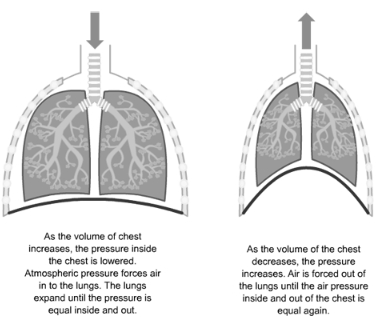
View full question & answer→MCQ 2091 Mark
During swallowing, glottis can be covered by a thin elastic cartilaginous flap called ...$A$... to prevent the entry of food into laryn $x$. Trachea is a straight tube extending up to ...$B$... cavity, which divides at the level of $5 th$ thoracic vertebra into right and left primary ...$C$...
Choose the correct option for $A, B$ and $C$ from the given four options to complete the above statement with reference to NCERT textbook
- A
$A-$ epiglottis, $B-$ bronchi, $C-$ bronchioles
- ✓
$A-$ epiglottis, $B-$ mid thoracic, $C-$ bronchi
- C
$A-$ epiglottis, $B-$ hind thoracic, $C-$ bronchi
- D
$A-$ epiglottis, $B-$ pre thoracic, $C-$ bronchi
AnswerCorrect option: B. $A-$ epiglottis, $B-$ mid thoracic, $C-$ bronchi
View full question & answer→MCQ 2101 Mark
Air entering the lungs is
Answera
Air entering the lungs is warm and filtered.
Nasal Cavity It is the first part of the respiratory system. It opens to the exterior through nostrils. The small hairs present in the cavity helps to filter the particles of dust and other foreign matter. The air in the nasal cavity gets warmed (because nasal cavity has very good blood supply) and moistened before it enters to the lungs
View full question & answer→MCQ 2111 Mark
At which thoracic vertebra does trachea divide into right and left primary bronchi?
Answera
Trachea is a straight tube extending upto the mid thoracic cavity, which divides at the level of $5 th$ thoracic vertebra into the right and left bronchi. Each bronchi undergoes repeated division to form secondary and tertiary bronchi ending up to very thin terminal bronchioles
View full question & answer→MCQ 2121 Mark
Which structure of the lungs is directly involved in $O _{2} / CO _{2}$ exchange between air and blood capillary?
Answerc
Primary bronchus of lungs divide to form secondary bronchi which divide to form tertiary bronchi. The tertiary bronchi subdivided into bronchioles. The bronchioles open to alveol through alveolar duct, atria and alveolar sacs. The alveoli have very thin wall consisting of squamous epithelium. The wall of alveoli has extensive network of blood capillaries. Due to very intimate contact of blood capillaries with the alveoli, the exchange of gases takes place easily.
View full question & answer→MCQ 2131 Mark
Answerb
Vocal cords occur in larynx (sound box)
View full question & answer→MCQ 2141 Mark
Which of the following structure is present inside the larynx of the respiratory system?
Answerc
Vocal cords Vocal cords are two pairs of folds of mucous membrane that extends into the lumen from the sides of larynx. Sound is produced by the vocal cords
View full question & answer→MCQ 2151 Mark
Identify the component of respiratory system which displays the features given below and choose the correct option
$I.$ Double layered
$II.$ Fluid contained in it reduces the friction on the lung surface
$III.$ Its outer layer is in contact with thoracic wall
$IV.$ Its inner layer is in contact with lungs
Answerd
Humans have two lungs, which are covered by a double layered pleura with pleural fluid between them. Pleural fluid reduces the friction on the lungsurface. The outer pleural membrane is in close contact with the thoracic lining whereas, the inner pleural membrane is in the contact with the lung surface
View full question & answer→MCQ 2161 Mark
Which portion of the human respiratory system is called sound box?
Answera
Larynx is a cartilaginous box, which helps in sound production and hence called sound box. Until puberty, there is a little difference in the size of larynx (sound box) in males and females. Thereafter, it grows larger and become prominent in males. Therefore, it is called Adam's apple in man. It is the first part of the trachea present in the neck
View full question & answer→MCQ 2171 Mark
Correct sequence of the air passage in humans is
- A
Nose $\rightarrow$ Larynx $\rightarrow$ Pharynx $\rightarrow$ Bronchioles $\rightarrow$ Alveoli
- B
Nose $\rightarrow$ Pharynx $\rightarrow$ Larynx $\rightarrow$ Bronchioles $\rightarrow$ Bronchi
- C
Nose $\rightarrow$ Pharynx $\rightarrow$ Laryn $x \rightarrow$ Bronchioles $\rightarrow$ Trachea
- ✓
External nostril $\rightarrow$ Nasal passage $\rightarrow$ Internal nostril $\rightarrow$ Pharyn $x \rightarrow$ Larynx $\rightarrow$ Trachea $\rightarrow$ Bronchi Bronchiole $\rightarrow$ Alveoli
AnswerCorrect option: D. External nostril $\rightarrow$ Nasal passage $\rightarrow$ Internal nostril $\rightarrow$ Pharyn $x \rightarrow$ Larynx $\rightarrow$ Trachea $\rightarrow$ Bronchi Bronchiole $\rightarrow$ Alveoli
d
Pair of external nostrils opens above the upper lips, which leads to nasal passage. It opens into the nasopharynx. Nasopharynx opens through the glottis of the larynx region into the trachea. Trachea is a straight tube extending upto mid-thoracic cavity, which divides at the right and left bronchi. Each bronchi undergoes repeated division to form secondary and tertiary bronchi and bronchioles ending up in very thin terminal bronchioles, which gives rise to a number of very thin, irregular walled, vascularized bag like structure called alveoli
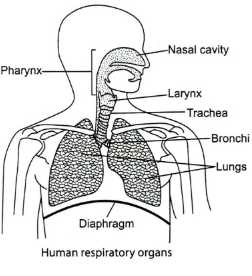
View full question & answer→MCQ 2181 Mark
Pleural membrane is covering of
Answerb
Each lung is enclosed in two membranes called pleurae (sing. Pleura).
View full question & answer→MCQ 2191 Mark
Friction on the lungs surface reduces by
- ✓
- B
- C
- D
Mucous membrane surrounding the lungs
Answera
Humans have two lungs, which are covered by a double membrane called pleura, with pleural fluid between them. Pleural fluid reduces the friction on the lung surface. The outer pleural membrane is in close contact with the thoracic lining whereas the inner pleural membrane is in the contact with the lung surface
View full question & answer→MCQ 2201 Mark
Which of the following statement is false?
MCQ 2211 Mark
View full question & answer→MCQ 2221 Mark
Choose correct sentence for conducting part of respiratory system.
$(I)$ Transports the atmospheric air to the alveoli.
$(II)$ Clears it from foreign particles.
$(III)$ Humidifies respiratory system.
$(IV)$ Brings air to body temperature
- A
Only $I,II,III$
- B
Only $I, IV $
- C
Only $II, III $
- ✓
$I, II, III, IV $
AnswerCorrect option: D. $I, II, III, IV $
View full question & answer→MCQ 2231 Mark
Which structure opens in alveolar sac ?
MCQ 2241 Mark
Identify $X$ from figure.
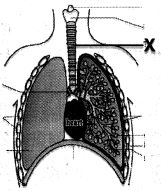
View full question & answer→MCQ 2251 Mark
Larynx is present in between.
MCQ 2261 Mark
The thoracic chamber is formed of ........
- A
- B
Ribs and vertebral column
- C
- ✓
Verterbral column, sternum, ribs and diaphram.
AnswerCorrect option: D. Verterbral column, sternum, ribs and diaphram.
View full question & answer→MCQ 2271 Mark
Outer pleural membrane is in close contact with the …..
MCQ 2281 Mark
Food does not normally enter the trachea because during swallowing of food
- ✓
The epiglottis and tongue cover the glottis
- B
The nodule called cartilage of Santorini plug the larynx
- C
The cartilage called arytinoids lie between the larynx and the glottis
- D
The circular muscles at the front end of trachea contract and close its opening
AnswerCorrect option: A. The epiglottis and tongue cover the glottis
View full question & answer→MCQ 2291 Mark
The laryngopharynx opens into
MCQ 2301 Mark
Which features distinguish bronchioles from bronchi
AnswerCorrect option: C. Larger bronchioles are supported by connective tissue alone which extend from the interlobular septa
View full question & answer→MCQ 2311 Mark
What are the functions that are performed by the nasal cavity when air passes through it
MCQ 2321 Mark
The narrowest and most numerous tubes of lungs are termed as
MCQ 2331 Mark
The structure which prevents the entry of food into respiratory tract is
Answerd
(d)It serves to close the glottis during deglutition thereby preventing entry of food into respiratory tract.
View full question & answer→MCQ 2341 Mark
There is a membrane covering the lungs, called
Answerb
(b) Each lung is enclosed in two membranous called pleurae. The outer covering is adhered to chest wall and diaphragm and is called parietal pleura. The inner covering membrane, which closely covers the lung, is called visceral pleura.
View full question & answer→MCQ 2351 Mark
The normal shape of diaphragm is
MCQ 2361 Mark
Which is a common passage in swallowing food and breathing
Answerd
(d)The pharynx provides passage to both air and food.
View full question & answer→MCQ 2371 Mark
In man and mammals, air passes from outside into the lungs through
- A
Nasal cavity, larynx, pharynx, trachea bronchi, alveoli
- B
Nasal cavity, larynx, pharynx, trachea, bronchioles, alveoli
- C
Nasal cavity, pharynx, larynx, trachea, bronchioles, bronchi, alveoli
- ✓
Nasal cavity, pharynx, larynx, trachea, bronchi, bronchioles, alveoli
AnswerCorrect option: D. Nasal cavity, pharynx, larynx, trachea, bronchi, bronchioles, alveoli
View full question & answer→MCQ 2381 Mark
Which one of the following has the smallest diameter
MCQ 2391 Mark
Which group of animals respire through lungs?
- A
- B
Sponges, coelenterates and flatworms
- C
Fishes and aquatic arthropods
- ✓
Reptiles, birds and mammals
AnswerCorrect option: D. Reptiles, birds and mammals
d
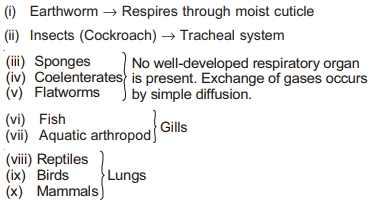
View full question & answer→MCQ 2401 Mark
Which of the following has most well-developed respiratory system?
Answera
The respiratory system is well developed in the vertebrates as they have more complex body. In between amphibians and mammals, the mammals have more well-developed respiratory organ i.e., lungs.
View full question & answer→MCQ 2411 Mark
Respiratory organs in aquatic arthropods like cray fish, prawn and molluscs like Unio are
Answerd
Aquatic arthropods (Crustacean) respire through gills.
View full question & answer→MCQ 2421 Mark
Which animal among the following respires via buccal cavity, moist skin and lungs?
Answerb
Frogs can respire by their moist skin, buccal cavity and lungs as they live on land and its larval form i.e. tadpole which lives in water respire through gills.
Hydra, Sycon : No well-developed respiratory system, exchange of gases by simple diffusion.
Earthworm : Moist cuticle.
View full question & answer→MCQ 2431 Mark
Which of the following are the respiratory organs of insects?
Answera
Insect $(e . g .$ Cockroach $) \rightarrow$ Tracheal system
Gills $\rightarrow$ Aquatic animal (fish, amphibian)
Cuticle $\rightarrow$ Earthworm
Lungs $\rightarrow$ Birds, reptiles, mammals
View full question & answer→MCQ 2441 Mark
The respiratory organs vary in different animals due to their
- A
- ✓
Habitat and level of organisation
- C
- D
AnswerCorrect option: B. Habitat and level of organisation
b
Because of different habitat (place where an animal live) and level of organisation, the breathing mechanism varies, hence the respiratory organ also get vary in different animals.
View full question & answer→MCQ 2451 Mark
Among vertebrates, ...$A$... use gills whereas reptiles, birds and mammals respire through the ...$B$... Amphibians like frogs can respire through ...$C$... also. Mammals have a well adapted respiratory system
Select appropriate choice for the blanks $A, B$ and $C$ to complete the given $NCERT$ statement
- A
$A-$ fishes, $B-$ lungs, $C-$ gills
- B
$A-$ fishes, $B-$ lungs, $C-$ dry skin
- ✓
$A-$ fishes, $B-$ lungs, $C-$ moist skin
- D
$A-$ mammals, $B-$ gills, $C-$ moist skin
AnswerCorrect option: C. $A-$ fishes, $B-$ lungs, $C-$ moist skin
View full question & answer→MCQ 2461 Mark
Skin is an accessory organ of respiration in
Answerb
Respiration by skin is called cutaneous respiration. Skin is an additional respiratory organ in amphibians, $e \cdot g .$, toads and frogs.
View full question & answer→MCQ 2471 Mark
$O_{2}$ exchange with $C O_{2}$ by simple diffusion over the entire body surface takes place in
$I.$ sponges $II.$ Coelenterates $III.$ Flatworms
Select the correct option to complete the given statement
- A
$I$ and $II$
- B
$II$ and $III$
- C
$I$ and $III$
- ✓
Answerd
Mechanism of breathing varies among the different groups of animals depending mainly on their habitats and level of organization. Lower invertebrates like sponges, coelenterates, flatworms, etc., exchange of $O_{2}$ with $CO _{2}$ by simple diffusion over their entire body surface
View full question & answer→MCQ 2481 Mark
Choose correct option.
$\begin{array}{|p{0.3\linewidth}|p{0.6\linewidth}|} \hline Column\,\,-I & Column\,\,-II \\ \hline (p)\,\,Sponges & (I)\,\,Through\,\,tracheal\,\,tubes \\ \hline (q)\,\,Insects & (II)\,\,Through\,\,lungs \\ \hline (r)\,\,Molluscs & (III)\,\,Vascularized\,\,gills \\ \hline (s)\,\,Reptiles & (IV)\,\,Simple\,\,diffusion\,\,over\,\,their\,\,entire\,\,body\,\,surface \\ \hline & (V)\,\,by\,\,their\,\,moist\,\,cuticle \\ \hline \end{array}$
$p - q - r - s$
- A
$I - III - IV - V$
- ✓
$IV - I - III - II$
- C
$II -III-IV-I$
- D
$I-II-III-IV$
AnswerCorrect option: B. $IV - I - III - II$
View full question & answer→MCQ 2491 Mark
In the lower order of invertebrate animals how the respiration process take place?
- ✓
- B
By the respiratory trachea.
- C
- D
By the lung and book lungs.
View full question & answer→MCQ 2501 Mark
Select the correct option:
- A
Sponges - Respire through Respiratory system
- B
Earthworm - Respire through gills tube
- C
Aquatic arthropods - Respire through network tubs
- ✓
Terrestrial arthropods Respire through lungs
AnswerCorrect option: D. Terrestrial arthropods Respire through lungs
View full question & answer→MCQ 2511 Mark
With respect to respiratory apparatus, pick out the incorrect pair/pairs
- A
- B
Amphibians -Skin and lungs
- C
Starfish -Dermal bronchial
- ✓
Answerd
(d)Crustaceans respire usually by gills and sometimes by general body surface and rarely by pseudotracheae.
View full question & answer→MCQ 2521 Mark
In which of the following animals, respiration occurs with out any respiratory organ
Answerd
(d)Earthworm respires, but has no respiratory organs, exchange of gases takes place through moist skin.
View full question & answer→MCQ 2531 Mark
The process of oxidation of glucose during which $CO_2$, $H_2O$ and energy are produced is known as
Answerc
Breathing = Inspiration (Inhalation of air) + Expiration (Exhalation of air)
Respiration is the process of oxidation of food in which $CO_2$, $H_2O$ and energy is/are produced.
View full question & answer→MCQ 2541 Mark
Process of exchange of $O_{2}$ from the atmosphere with ...$A$... produced by the cells is called ...$B$..., which is commonly known as ...$C$...
Choose the appropriate options for the blanks $A$, $B$ and $C$ to complete the given $NCERT$ statement
- A
$A -$ $H _{2} O$, $B-$ breathing, $C-$ respiration
- B
$A -$ $O _{2}$, $B-$ breathing, $C-$ respiration
- ✓
$A -$ $CO _{2}$, $B-$ breathing, $C-$ respiration
- D
$A -$ $NO _{2}$, $B-$ breathing, $C-$ respiration
AnswerCorrect option: C. $A -$ $CO _{2}$, $B-$ breathing, $C-$ respiration
View full question & answer→MCQ 2551 Mark
Find out the false statement.
- A
The overall exchange of gases between atmosphere, blood and cell is called respiration.
- ✓
Excretory system and respiratory system involve in exchange of respiratory gases.
- C
Cells need a continuous supply of oxygen to carry out activities for their existence.
- D
Cellular respiration is the part of catabolism.
AnswerCorrect option: B. Excretory system and respiratory system involve in exchange of respiratory gases.
View full question & answer→MCQ 2561 Mark
Breathing differs from respiration by
AnswerCorrect option: C. Breathing refers to chest movements due to inhalation of ${O_2}$ and exhalation of carbon dioxide whereas respiration refers to gaseous exchange
View full question & answer→MCQ 2571 Mark
Which of the following statement is correct
AnswerCorrect option: C. Respiration means the oxidation of food material
View full question & answer→MCQ 2581 Mark
During cellular respiration the energy produced is stored in
Answerc
(c)In the form of phosphate bond energy.
View full question & answer→MCQ 2591 Mark
The process of respiration is concerned with
- A
Intake of ${O_2}$
- B
Liberation of ${O_2}$
- C
Liberation of $C{O_2}$
- ✓
View full question & answer→MCQ 2601 Mark
Which one of the following is the correct statement for respiration in humans?
AnswerCorrect option: C. Workers in grinding and stonebreaking industries may suffer, from lung fibrosis.
c
(c) : In certain industries, especially those involving grinding or stone breaking so much dust is produced that the defense mechanism of the body cannot fully cope with the situation. Long exposure can give rise to inflammation leading to fibrosis (proliferation of fibrous tissues) and thus causing serious lung damage. Workers in such industries should wear protective masks.
View full question & answer→MCQ 2611 Mark
The figure given below shows a small part of human lung where exchange of gases takes place. Select the option which represents labelled part $(A, B, C$ or $D)$ correctly identified along with its function.
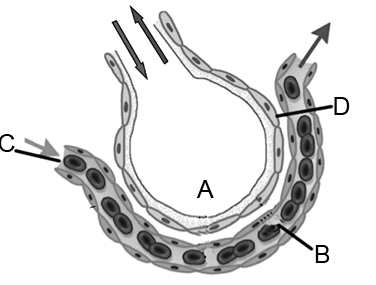
- A
$C$ : arterial capillary passes oxygen to tissues
- ✓
$A$ : alveolar cavity main site of exchange of respiratory gases
- C
$D$ : capillary wall exchange of $ O_2 $ and $CO_2$ takes place here
- D
$B$ : red blood cells transport of $CO_2$ mainly.
AnswerCorrect option: B. $A$ : alveolar cavity main site of exchange of respiratory gases
View full question & answer→MCQ 2621 Mark
Bulk of carbon dioxide $(CO_2)$ released from body tissues into the blood is present as
- ✓
bicarbonate in blood plasma and RBCs
- B
free $CO_2$ in blood plasma
- C
$70\%$ carbaminohaemoglobin and $30\%$ as bicarbonate
- D
carbaminohaemoglobin in $RBCs.$
AnswerCorrect option: A. bicarbonate in blood plasma and RBCs
a
(a) : At the tissue site where partial pressure of $CO_2$ is high due to catabolism, $CO_2$ diffuses into blood ($RBCs$ and plasma) and forms $HCO^-$ and $H^+$. At the alveolar site where $pCO_2$ is low, the reaction proceeds in the opposite direction leading to the formation of $CO_2$ and $H_2O$. Thus, $CO_2$ trapped as bicarbonate at the tissue level and transported to the alveoli is released out as $CO_2$.
View full question & answer→MCQ 2631 Mark
What is true about $RBCs$ in humans?
- ✓
They carry about $20-25$ percent of $CO_2.$
- B
They transport $99.5 $ percent of $O_2.$
- C
They transport about $80$ percent oxygen only and the rest $20$ percent of it is transported in dissolved state in blood plasma.
- D
They do not carry $CO_2$ at all.
AnswerCorrect option: A. They carry about $20-25$ percent of $CO_2.$
a
(a) : Blood is the medium of transport for $O_2$ and $CO_2$. About $97$ percent of $O_2$ is transported by $RBCs$ in the blood. The remaining $3 $ percent of $O_2$ is carried in a dissolved state through the plasma. Nearly $20-25$ percent of $CO_2$ is transported by $RBCs$ whereas $70$ percent of it is carried as bicarbonate. About $7$ percent of $CO_2$ is carried in a dissolved state throughplasma.
View full question & answer→MCQ 2641 Mark
What is vital capacity of our lungs?
- A
Inspiratory reserve volume plus expiratory reserve volume
- ✓
Total lung capacity minus residual volume
- C
Inspiratory reserve volume plus tidal volume
- D
Total lung capacity minus expiratory reserve volume
AnswerCorrect option: B. Total lung capacity minus residual volume
b
(b) : Vital capacity is the amount of air which one can inhale or exhale with maximum effort. It is the sum of tidal volume, inspiratory reserve volume and expiratory reserve volume, while total lung capacity is the total amount of air present in the lungs and the respiratory passage after a maximum inspiration. It is the sum of the vital capacity and the residual volume. $TLC = VC + RV$. So, vital capacity is also total lung capacity $(TLC)$ -residual volume $(RV)$.
View full question & answer→MCQ 2651 Mark
The majority of carbon dioxide produced by our body cells is transported to the lungs as
Answerc
(c) : When systemic arterial blood flows through capillaries, carbon dioxide diffuses from the tissues into the blood. Some carbon dioxide is dissolved in the blood. Some carbon dioxide reacts with haemoglobin to form carbaminohaemoglobin. The remaining carbon dioxide is converted to bicarbonate and hydrogen ions. Most carbon dioxide is transported through the blood in the form of bicarbonate ions.
View full question & answer→MCQ 2661 Mark
During forced expiration, actively contracting muscles include the
- A
- B
- ✓
- D
Diaphragm and intestinal muscle
Answerc
(c) In forced expiration internal intercostal muscles and some abdominal muscles contract to reduce the volume of thorax.
View full question & answer→MCQ 2671 Mark
The exchange of gases in the alveoli of the lungs takes place by
Answerb
(b)The gaseous exchange is the simple diffusion of oxygen from alveolar air into the blood and diffusion of $C{O_2}$ from blood to alveolar air.
View full question & answer→MCQ 2681 Mark
$500\,\,ml$ respiratory volume in a normal adult human is related to
- A
- B
- C
Respiratory reserve volume
- ✓
Answerd
(d)The volume of air inhaled or exhaled with each inhalation without any extra effort. Its value is $500\,\, ml$ in a normal adult.
View full question & answer→MCQ 2691 Mark
Carbon dioxide is transported via blood to lungs mostly
- ✓
As carbaminohaemoglobin and as carbonic acid
- B
In the form of carbonic acid only
- C
In combination with haemoglobin only
- D
Dissolved in blood plasma
AnswerCorrect option: A. As carbaminohaemoglobin and as carbonic acid
View full question & answer→MCQ 2701 Mark
The respiratory centre in brain which controls inspiration and expiration is situated in
Answera
(a) Breathing is controlled by pneumotaxic and appeustic centres in pons varoli and expiratory and inspiratory centres in medulla oblongata.
View full question & answer→MCQ 2711 Mark
During oxygen transport the oxyhaemoglobin at the tissue level liberates oxygen to the cells because in tissue
- A
$O_2$ concentration is high and $CO_2$ is low
- B
$O_2$ concentration is low and $CO_2$ is high
- C
$O_2$ tension is high and $CO_2$ tension is low
- ✓
$O_2$ tension is low and $CO_2$ tension is high
AnswerCorrect option: D. $O_2$ tension is low and $CO_2$ tension is high
View full question & answer→MCQ 2721 Mark
Approximately seventy percent of carbondioxide absorbed by the blood will be transported to the lungs
- ✓
- B
in the form of dissolved gas molecules
- C
by binding to $RBC$
- D
as carbamino - haemoglobin
Answera
$CO_2$ from the respiratory tissues to the lungs is transported by the blood in $3$ ways:
$(i)$ In dissolved state or as a physical solution: Very small amount is physically dissolved in plasma ($7\%$ i.e. $0.3\, ml$ of $CO_2$ by each $100\, ml$ of blood).
$(ii)$ Bicarbonate ions: About $70\%$ (i.e. $@\, 2.5\, ml$ per $100\, ml$ of blood) $CO_2$ diffuses in plasma and then into $RBCs$ where it (in the presence of carbonic anhydrase) combines with $H_2O$ to form carbonic acid which is almost spontaneously dissociated into hydrogen ion and bicarbonate ions.
$(iii)$ Carbaminohaemoglobin : $23\%$ (i.e. $1\, ml$ of $CO_2$ per $100\, ml$ of blood) combines with haemoglobin forming an unstable compound.
View full question & answer→MCQ 2731 Mark
The presence of $CO_2$ in blood will lower $pH$ because $CO_2$ combines with____, with the rate of reaction increased by_____ .
- ✓
$H_2O$ to form $H^+$ and $HCO_3^-$, carbonic anhydrase
- B
$H_2O$ to form only $HCO_3^-$, carbonic anhydrase
- C
$H_2O$ to form only $H^+$, carbonic ions
- D
$H^+$ to form $HCO_3^-$, oxyhaemoglobin
AnswerCorrect option: A. $H_2O$ to form $H^+$ and $HCO_3^-$, carbonic anhydrase
a
Carbon dioxide combines with $H_2O$ in the plasma to form $H^+$ and $HCO_3^-$. The enzyme carbonic anhydrase catalyzes the reaction
View full question & answer→MCQ 2741 Mark
Assertion : Inspiration occurs due to muscular relaxation.
Reason : During inspiration, the diaphragm and external intercostal muscle contract simultaneously.
- A
If both Assertion and Reason are correct and the Reason is a correct explanation of the Assertion.
- B
If both Assertion and Reason are correct but Reason is not a correct explanation of the Assertion.
- ✓
If the Assertion is correct but Reason is incorrect.
- D
If both the Assertion and Reason are incorrect.
AnswerCorrect option: C. If the Assertion is correct but Reason is incorrect.
c
Inspiration is the result of muscular contraction. The diaphragm and external intercostal muscles contract simultaneously. The lateral thoracic wall moves outward and upward.
View full question & answer→MCQ 2751 Mark
Volume of air breathed in and out during normal breathing is called
Answerd
Volume of air breathed in and out during normal breathing is called tidal volume. It is approximately $500\, ml$ i.e., a healthy person can expire or inspire approximately $6000$ to $8000\, ml$ of air per minute as breathing rate is $12-16\, times/minute.$
View full question & answer→MCQ 2761 Mark
Which of the following match is correct?
- ✓
Emphysema: reduction of surface area of alveoli and bronchi
- B
Pneumonia: occupational disease with asbestos
- C
Silicosis: inflammation of alveoli
- D
Asthma: excessive secretion of bronchial mucus
AnswerCorrect option: A. Emphysema: reduction of surface area of alveoli and bronchi
a
Cigarette smoking leads to the disease emphysema. In this disease, terminal bronchioles get obstructed. This reduces the ventilation of the alveoli connected to them. Many alveoli coalesce together to form large chambers due to destruction of their walls. This change of smaller alveoli to large chambers reducing the area of alveolar surface across which gases are exchanged. All these changes reduce both oxygen uptake and carbon dioxide elimination.
View full question & answer→MCQ 2771 Mark
Assertion: In mammals, complex respiratory system has developed.
Reason: Mammalian skin is impermeable to gases
- A
If both Assertion and Reason are correct and the Reason is a correct explanation of the Assertion.
- ✓
If both Assertion and Reason are correct but Reason is not a correct explanation of the Assertion.
- C
If the Assertion is correct but Reason is incorrect.
- D
If both the Assertion and Reason are incorrect.
AnswerCorrect option: B. If both Assertion and Reason are correct but Reason is not a correct explanation of the Assertion.
b
Mammalian skin is impermeable so that water loss through it is minimised. But mammals need far more oxygen to maintain their high metabolic rates than lower animals; so they need a more extensive respiratory surface. Thus, a complex mammalian respiratory system consists of the nasal cavity, nasopharynx, larynx, trachea, bronchi, bronchiole and lungs
View full question & answer→MCQ 2781 Mark
In humans, the concentration of carbon dioxide in the plasma
- A
causes increased production of hydrochloric acid
- B
regulates gastric acid production by forming carbonic acid.
- ✓
regulates breathing rate by its effect on the medulla.
- D
causes inflammation of the tissues of the bronchial tubes.
AnswerCorrect option: C. regulates breathing rate by its effect on the medulla.
c
The medulla oblongata at the base of the brain increases breathing rate if the amount of carbon dioxide increases. It does not regulate breathing rate by checking oxygen content.
View full question & answer→MCQ 2791 Mark
Quantity of $C{O_2}$ transported in the form of bicarbonates by blood is (both plasma and $RBC$)
- ✓
$75\%$
- B
$85\%$
- C
$2\%$
- D
$98\%$
AnswerCorrect option: A. $75\%$
View full question & answer→MCQ 2801 Mark
The vital capacity of the lung signifies the volume of air
- A
Breathed in during normal inspiration
- B
Breathed out with forcible expiration
- C
Breathed in with forcible inspiration
- ✓
With deep inspiration and forcible expiration
AnswerCorrect option: D. With deep inspiration and forcible expiration
View full question & answer→