Question types

STD 11 - 5. Morphology flowering plants question types

683 questions across 1 question group — pick any mix to generate a BIOLOGY paper with step-by-step answer keys.

683
Questions
1
Question groups
5
Question types
Sample Questions

STD 11 - 5. Morphology flowering plants questions

One sample from each question group in this chapter. Select any group above to see the full set with answer keys.

Match List $I$ with List $II$

List $I$ List $II$
$A$. Rose $I$. Twisted aestivation
$B$. Pea $II$. Perigynous flower
$C$. Cotton $III$. Drupe
$D$. Mango $IV$. Marginal placentation

Choose the correct answer from the options given below :

  • A
    $A-I, B-II, C-III, D-IV$
  • B
    $A-IV, B-III, C-II, D-I$
  • C
    $A-II, B-III, C-IV, D-I$
  • $A-II, B-IV, C-II, D-III$

Answer: D.

View full solution
Match List $I$ with List $II$

List $I$ (Types of Stamens) List $II$ (Example)
$A$. Monoadelphous $I$. Citrus
$B$. Diadelphous $II$. Pea
$C$. Polyadelphous $III$. Lily
$D$. Epiphyllous $IV$. China-rose

Choose the correct answer from the options given below:

  • A
    $A-IV, B-II, C-II, D-III$
  • B
    $A-I, B-II, C-IV, D-III$
  • C
    $A-III, B-I, C-IV, D-II$
  • $A-IV, B-II, C-I, D-III$

Answer: D.

View full solution
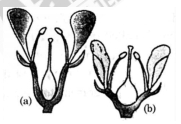
Identify the type of flowers based on the position of calyx, corolla and androecium with respect to the ovary from the given figures ($a$) and ($b$)
  • A
    Hypogynous; ($b$) Epigynous
  • B
    Perigynous; ($b$) Epigynous
  • Perigynous; ($b$) Perigynous
  • D
    Epigynous; ($b$) Hypogynous

Answer: C.

View full solution

Generate a STD 11 - 5. Morphology flowering plants paper free

Pick question groups from the list above, set marks and difficulty, and export a branded PDF with step-by-step answer keys. First 3 chapters free — no signup.

Download App