Questions

M.C.Q (1 Marks)

Take a timed test

500 questions · auto-graded multiple-choice test.

MCQ 11 Mark
Match List $I$ with List $II$

List $I$ List $II$
$A$. Rose $I$. Twisted aestivation
$B$. Pea $II$. Perigynous flower
$C$. Cotton $III$. Drupe
$D$. Mango $IV$. Marginal placentation

Choose the correct answer from the options given below :

  • A
    $A-I, B-II, C-III, D-IV$
  • B
    $A-IV, B-III, C-II, D-I$
  • C
    $A-II, B-III, C-IV, D-I$
  • $A-II, B-IV, C-II, D-III$
Answer
Correct option: D.
$A-II, B-IV, C-II, D-III$
d
Rose have half-inferior ovary, thus it is known as Perigynous flower.

In Pea, the placenta form a ridge along the ventral suture of the ovary and ovules are borne on this ridge forming two rows.

In Cotton, twisted aestivation is present.

In Mango, fruit is drupe.
View full question & answer
MCQ 21 Mark
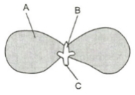
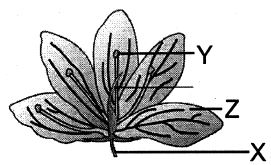
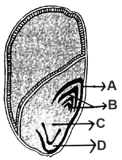
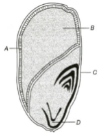
Identify the part of the seed from the given figure which is destined to form root when the seed germinates.
  • A
    $B$
  • $C$
  • C
    $D$
  • D
    $A$
Answer
Correct option: B.
$C$
b
Radicle is destined to form root.

In the given diagram '$C$' represent radicle

View full question & answer
MCQ 31 Mark
Match List $I$ with List $II$

List $I$ (Types of Stamens) List $II$ (Example)
$A$. Monoadelphous $I$. Citrus
$B$. Diadelphous $II$. Pea
$C$. Polyadelphous $III$. Lily
$D$. Epiphyllous $IV$. China-rose

Choose the correct answer from the options given below:

  • A
    $A-IV, B-II, C-II, D-III$
  • B
    $A-I, B-II, C-IV, D-III$
  • C
    $A-III, B-I, C-IV, D-II$
  • $A-IV, B-II, C-I, D-III$
Answer
Correct option: D.
$A-IV, B-II, C-I, D-III$
d
In China rose monoadelphous androecium is present.

Diadelphous androecium is found in pea plant.

Polyadelphous androecium is found in citrus.

Epiphyllous androecium is found in lily.

View full question & answer
MCQ 41 Mark
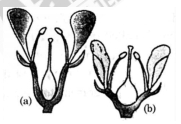
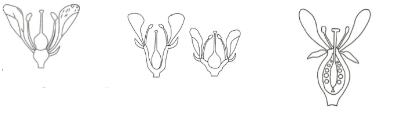
Identify the type of flowers based on the position of calyx, corolla and androecium with respect to the ovary from the given figures ($a$) and ($b$)
  • A
    Hypogynous; ($b$) Epigynous
  • B
    Perigynous; ($b$) Epigynous
  • Perigynous; ($b$) Perigynous
  • D
    Epigynous; ($b$) Hypogynous
Answer
Correct option: C.
Perigynous; ($b$) Perigynous
c
If gynoecium is situated in the centre and other parts of the flower are located on the rim of the thalamus almost at the same level, it is called perigynous.

Both diagram shows perigynous condition.

View full question & answer
MCQ 51 Mark
Which of the following is an example of actinomorphic flower?
  • A
    Cassia
  • B
     Pisum
  • C
    Sesbania
  • Datura
Answer
Correct option: D.
Datura
d
Datura shows actinomorphic flower. In Cassia, Pisum and Sesbania, zygomorphic flowers are seen.
View full question & answer
MCQ 61 Mark
Family Fabaceae differs from Solanaceae and Liliaceae. With respect to the stamens, pick out the characteristics specific to family Fabaceae but not found in Solanaceae or Liliaceae.
  • A
    Epiphyllous and Dithecous anthers
  • Diadelphous and Dithecous anthers
  • C
    Polyadelphous and epipetalous stamens
  • D
    Monoadelphous and Monothecous anthers
Answer
Correct option: B.
Diadelphous and Dithecous anthers
b
Fabaceae $\rightarrow$ Diadelphous and dithecous anther.

Solanaceae $\rightarrow$ Polyandrous, epipetalous and dithecous anther.

Liliaceae $\rightarrow$ Polyandrous, epiphyllous and dithecous anther.

View full question & answer
MCQ 71 Mark
Given below are two statements: One is labelled as Assertion $A$ and the other is labelled as Reason $R$:

Assertion $A$: A flower is defined as modified shoot wherein the shoot apical meristem changes to floral meristem.

Reason $R$: Internode of the shoot gets condensed to produce different floral appendages laterally at successive node instead of leaves.

In the light of the above statements, choose the correct answer from the options given below :

  • A
    $A$ is false but $R$ is true
  • Both $A$ and $R$ are true and $R$ is the correct explanation of $A$
  • C
    Both $A$ and $R$ are true but $R$ is NOT the correct explanation of $A$
  • D
    $A$ is true but $R$ is false
Answer
Correct option: B.
Both $A$ and $R$ are true and $R$ is the correct explanation of $A$
b
A flower is a modified shoot wherein the shoot apical meristem changes to floral meristem.

Internodes do not elongate and the axis gets condensed. The apex produces different kinds of floral appendages laterally at the successive nodes instead of leaves.

Therefore, both $A$ and $R$ are true and $R$ is correct explanation of $A$.

View full question & answer
MCQ 81 Mark
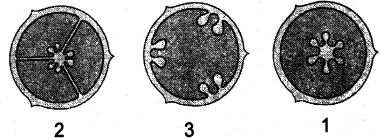
Axile placentation is observed in
  • China rose, Petunia and Lemon
  • B
    Mustard, Cucumber and Primrose
  • C
    China rose, Beans and Lupin
  • D
    Tomato, Dianthus and Pea
Answer
Correct option: A.
China rose, Petunia and Lemon
a
China rose, Tomato, Petunia and Lemon show axile placentation.

Dianthus and Primrose show free central placentation.

Pea, Lupin and Beans show marginal placentation.

Cucumber and mustard show parietal placentation.

View full question & answer
MCQ 91 Mark
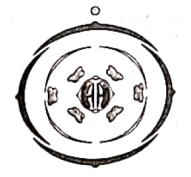
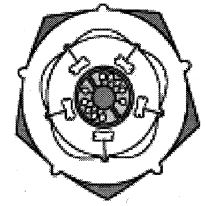
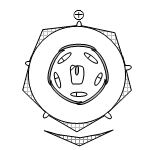
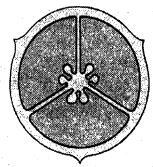
The Floral Diagram represents which one of the following families ?
  • A
    Fabaceae
  • Brassicaceae
  • C
    Solanaceae
  • D
    Liliaceae
Answer
Correct option: B.
Brassicaceae
b
View full question & answer
MCQ 101 Mark
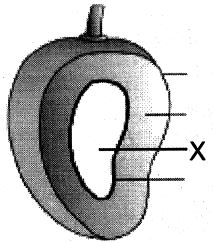
Which part of the fruit, labelled in the given figure makes it a false fruit?
  • A
    $B \rightarrow$ Endocarp
  • $C \rightarrow$ Thalamus
  • C
    $D \rightarrow$ Seed
  • D
    $A \rightarrow$ Mesocarp
Answer
Correct option: B.
$C \rightarrow$ Thalamus
b
View full question & answer
MCQ 111 Mark
The flowers are Zygomorphic in 

$(a)$ Mustard   $(b)$ Gulmohar    $(c)$ Cassia    $(d)$ Datura      $(e)$ Chilly

Choose the correct answer from the options given below:

  • $(b), (c)$ Only
  • B
    $(d), (e)$ Only
  • C
    $(c), (d), (e)$ Only
  • D
    $(a), (b), (c)$ Only
Answer
Correct option: A.
$(b), (c)$ Only
a
View full question & answer
MCQ 121 Mark
Which one of the following plants shows vexillary aestivation and diadelphous stamens ?
  • Pisum satioum
  • B
    Allium cepa
  • C
    Solanum nigrum
  • D
    Colchicum autumnale
Answer
Correct option: A.
Pisum satioum
a
View full question & answer
MCQ 131 Mark
Identify the correct set of statements :

$(a)$ The leaflets are modified into pointed hard thorns in Citrus and Bougainvillea

$(b)$ Axillary buds form slender and spirally coiled tendrils in cucumber and pumpkin

$(c)$ Stem is flattened and fleshy in Opuntia and modified to perform the function of leaves

$(d)$Rhizophora shows vertically upward growing roots that help to get oxygen for respiration

$(e)$ Subaerially growing stems in grasses and strawberry help in vegetative propagation

Choose the correct answer from the options given below:

  • A
    $(a)$ and $(d)$ Only
  • $(b), (c), (d)$ and $(e)$ Only
  • C
    $(a), (b), (d)$ and $(e)$ Only
  • D
    $(b)$ and $(c)$ Only
Answer
Correct option: B.
$(b), (c), (d)$ and $(e)$ Only
b
View full question & answer
MCQ 141 Mark
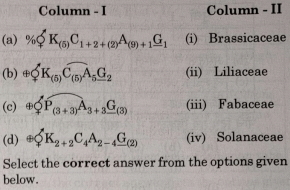
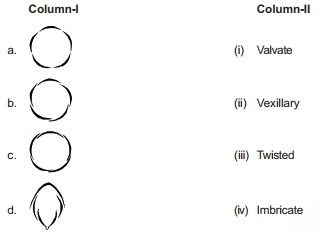
Match Column $- I$ with Column $- II.$

$[Image]$

Select the correct answer from the options given below.

$(a) -(b)- (c)- (d)$

  • $(iii)- (iv) -(ii)- (i)$
  • B
    $(i) -(ii) -(iii) -(iv)$
  • C
    $(i) -(ii) -(iii) -(iv)$
  • D
    $(iv)- (ii) -(i) -(iii)$
Answer
Correct option: A.
$(iii)- (iv) -(ii)- (i)$
a
View full question & answer
MCQ 151 Mark
Correct position of floral parts over thalamus in mustard plant is
  • A
    Gynoecium is situated in the centre, and other parts of the flower are located at the rim of the thalamus, at the same level.
  • Gynoecium occupies the highest position, while the other parts are situated below it.
  • C
    Margin of the thalamus grows upward, enclosing the ovary completely, and other parts arise below the ovary.
  • D
    Gynoecium is present in the centre and other parts cover it partially.
Answer
Correct option: B.
Gynoecium occupies the highest position, while the other parts are situated below it.
b
Mustard has hypogynous flower in which ovary/gynoecium occupies the highest position while other parts are situated below it.
View full question & answer
MCQ 161 Mark
Identify the correct features of Mango and Coconut fruits.
($i$) In both fruit is a drupe
($ii$) Endocarp is edible in both
($iii$) Mesocarp in Coconut is fibrous, and in Mango it is fleshy
($iv$) In both, fruit develops from monocarpellary ovary
Select the correct option from below 
  • A
    ($i$) and ($ii$) only
  • ($i$), ($iii$) and ($iv$) only
  • C
    ($i$), ($ii$) and ($iii$) only
  • D
    ($i$) and ($iv$) only
Answer
Correct option: B.
($i$), ($iii$) and ($iv$) only
b
Both Mango and Coconut fruits are drupe. They develop from monocarpellary ovary, but in both fruits edible part is different as shown below.
$\quad$ $\quad$ $\quad$ $\quad$$\quad$ Mango $\quad$ $\quad$ $\quad$ $\quad$ Coconut

Epicarp $\quad$ $\quad$ Skinny $\quad$ $\quad$ $\quad$ $\quad$ Skinny

Mesocarp $\quad$ $\quad$ Edible $\quad$ $\quad$ $\quad$ $\quad$ Fibrous

Endocarp $\quad$ $\quad$Hard & stony $\quad$ $\quad$ Hard & stony

Endosperm $\quad$ $\quad$ Not edible $\quad$ $\quad$ $\quad$ $\quad$ Edible

View full question & answer
MCQ 171 Mark
In some plants thalamus contributes to fruit formation. Such fruits are termed as
  • A
    Parthenocarpic fruit
  • False fruits
  • C
    Aggregate fruits
  • D
    True fruits
Answer
Correct option: B.
False fruits
b
In some plants like apple and pear fruits are formed by thalamus along with ovary. They are called false fruits.
View full question & answer
MCQ 191 Mark
Ray florets have
  • A
    Half inferior ovary
  • Inferior ovary
  • C
    Superior ovary
  • D
    Hypogynous ovary
Answer
Correct option: B.
Inferior ovary
b
Inferior ovary
View full question & answer
MCQ 201 Mark
The roots that originate from the base of the stem are
  • A
    Lateral roots
  • Fibrous roots
  • C
    Primary roots
  • D
    Prop roots
Answer
Correct option: B.
Fibrous roots
b
Fibrous roots
View full question & answer
MCQ 211 Mark
Bicarpellary ovary with obliquely placed septum is seen in
  • A
    Brassica
  • B
    Aloe
  • Solanum
  • D
    Sesbania
Answer
Correct option: C.
Solanum
c
View full question & answer
MCQ 221 Mark
Placentation, In which ovules develop on the inner wall of the ovary or in peripheral part, is 
  • A
    Basal
  • B
    Axile
  • Parletal
  • D
    Free central
Answer
Correct option: C.
Parletal
c
View full question & answer
MCQ 231 Mark
Which of the following shows whorled phyllotaxy ?
  • A
    Mustard
  • B
    China rose
  • Alstonia
  • D
    Calotropis
Answer
Correct option: C.
Alstonia
c
View full question & answer
MCQ 241 Mark
Match the placental types (Column$-I$) with their examples (Column$-II$)

Column$-I$ Column$-II$
$(a)$ Basal $(i)$ Mustard
$(b)$ Axile $(ii)$ China rose
$(c)$ Parietal $(iii)$ Dianthus
$(d)$ Free central $(iv)$ Sunflower

Choose the correct answer from the following options

  • A
    $(a)-(ii), (b)-(iii), (c)-(iv), (d)-(i)$
  • B
    $(a)-(i), (b)-(ii), (c)-(iii), (d)-(iv)$
  • $(a)-(iv), (b)-(ii), (c)-(i), (d)-(iii)$
  • D
    $(a)-(iii), (b)-(iv), (c)-(i), (d)-(ii)$
Answer
Correct option: C.
$(a)-(iv), (b)-(ii), (c)-(i), (d)-(iii)$
c
View full question & answer
MCQ 251 Mark
Sweet potato is a modified
  • A
    Rhizome
  • Adventitious root
  • C
    Tap root
  • D
    Stem
Answer
Correct option: B.
Adventitious root
b
Sweet potatoes (Ipomoea batatas) are modified adventitious roots. They are swollen and contain high amount of starch. Other examples of modified adventitious roots include cassava, dahlia.
View full question & answer
MCQ 261 Mark
Coconut fruit is a
  • A
    berry
  • B
    nut
  • C
    capsule
  • drupe.
Answer
Correct option: D.
drupe.
d
(d) : Coconut fruit is fibrous drupe with a fibrous mesocarp.
View full question & answer
MCQ 271 Mark
The morphological nature of the edible part of coconut is
  • A
    cotyledon
  • endosperm
  • C
    pericarp
  • D
    perisperm.
Answer
Correct option: B.
endosperm
b
(b)
View full question & answer
MCQ 281 Mark
In Bougainvillea, thorns are the modifications of
  • A
    adventitious root
  • stem
  • C
    leaf
  • D
    stipules.
Answer
Correct option: B.
stem
b
(b)
View full question & answer
MCQ 291 Mark
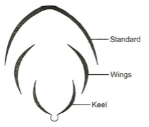
The standard petal of a papilionaceous corolla is also called
  • vexillum
  • B
    corona
  • C
    carina
  • D
    pappus.
Answer
Correct option: A.
vexillum
a
(a) : The posterior large bilobed petal of a papilionaceous corolla is called standard or vexillum. It overlaps the two smaller lateral petals known as wings or alae.
View full question & answer
MCQ 301 Mark
Cotyledon of maize grain is called
  • A
    coleoptile
  • scutellum
  • C
    plumule
  • D
    coleorhiza.
Answer
Correct option: B.
scutellum
b
(b)
View full question & answer
MCQ 311 Mark
Free­central placentation is found in
  • Dianthus
  • B
    Argemone
  • C
    Brassica
  • D
    Citrus.
Answer
Correct option: A.
Dianthus
a
(a) : Free central placentation is found in Dianthus. Parietal placentation is present in Argemone and Brassica whereas Citrus has axile placentation in ovary.
View full question & answer
MCQ 321 Mark
Radial symmetry is found in the flowers of
  • Brassica
  • B
    Trifolium
  • C
    Pisum
  • D
    Cassia.
Answer
Correct option: A.
Brassica
a
(a) : The flowers of Brassica are radially symmetrical whereas flowers of Trifolium, Pisum and Cassia are zygomorphic.
View full question & answer
MCQ 331 Mark
Stems modified into flat green organs performing the functions of leaves are known as
  • phylloclades
  • B
    scales
  • C
    cladodes
  • D
    phyllodes.
Answer
Correct option: A.
phylloclades
a
(a) : Phylloclades are flattened green stems which have taken over the function of photosynthesis while cladodes are only the branches of stem that are modified to take over the function of leaves. Cladodes may not be flattened as in Ruscus aculeatus, cladodes are leaf­like with spinytip whereas in Asparagus, they are slightly flattened, fleshy, straight or curved pointed structures which develop in clusters in the axil of scale leaves.
View full question & answer
MCQ 341 Mark
Which of the following is not a stem modification?
  • A
    Tendrils of cucumber
  • B
    Flattened structures of Opuntia
  • Pitcher of Nepenthes
  • D
    Thorns of citrus
Answer
Correct option: C.
Pitcher of Nepenthes
c
(c) : Pitcher of Nepenthes is a modification of leaf. In Nepenthes, the pitchers are meant for catching and digesting insects. The lamina is modified into pitcher. The leaf apex gives rise to a coloured lid for attracting the insects.
View full question & answer
MCQ 351 Mark
Keel is the characteristic feature of flower of
  • A
    Aloe
  • B
    tomato
  • C
    tulip
  • Indigofera.
Answer
Correct option: D.
Indigofera.
d
(d) : The flowers of Family Papilionaceae have butterfly shaped corolla (papilionaceous corolla). Posterior or outermost petal is the largest and is called standard or vexillum, two lateral petals are similar and generally clawed, are called wings or alae and the two anterior petals called keel are fused enclosing stamens and carpels. This type of petal arrangement is found in bean, gram, pea, Indigofera etc.
View full question & answer
MCQ 361 Mark
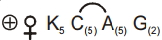
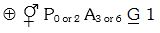
Tthe floral formula of
  • Petunia
  • B
    Brassica
  • C
    Allium
  • D
    Sesbania.
Answer
Correct option: A.
Petunia
a
(a) : The given floral formula is of Family Solanaceae. Among the given options, only Petunia belongs to Family Solanaceae. Allium is a member of Family Liliaceae, Sesbania is of Family Leguminosae and Brassica is a member of Family Brassicaceae or Cruciferae.
View full question & answer
MCQ 371 Mark
The wheat grain has an embryo with one large, shield shaped cotyledon known as
  • scutellum
  • B
    coleoptile
  • C
    epiblast
  • D
    coleorhiza.
Answer
Correct option: A.
scutellum
a
(a) : The seeds of monocotyledonous plants have only one cotyledon. In family Poaceae ($e.g.$, wheat, maize etc.), this cotyledon is called scutellum, situated towards lateral side of embryonal axis. It provides nourishment to the developing embryo.
View full question & answer
MCQ 381 Mark
Perigynous flowers are found in
  • A
    China rose
  • rose
  • C
    guava
  • D
    cucumber.
Answer
Correct option: B.
rose
b
(b) : If gynoecium is situated in the centre and other parts of the flower are located on the rim of the thalamus almost at the same level, it is called perigynous. The ovary here is said to be half inferior, $e.g.$, plum, rose, peach.
View full question & answer
MCQ 391 Mark
Axile placentation is present in
  • A
    pea
  • B
    Argemone
  • C
    Dianthus
  • lemon.
Answer
Correct option: D.
lemon.
d
(d) : Axile placentation occurs in syncarpous pistils. The ovary is partitioned into two or more chambers. Placentae occur in the central region where the septa meet so that an axile column bearing ovules is formed $e.g.$, shoe flower (pentalocular), lemon (multilocular), etc.
View full question & answer
MCQ 401 Mark
Among China rose, mustard, brinjal, potato, guava, cucumber, onion and tulip, how many plants have superior ovary?
  • A
    Three
  • B
    Four
  • C
    Five
  • Six
Answer
Correct option: D.
Six
d
(d) : China rose, mustard, brinjal, potato, onion and tulip are the plants that have superior ovary whereas in guava and cucumber, ovary is inferior.
View full question & answer
MCQ 411 Mark
Leaves become modified into spines in
  • A
    onion
  • B
    silk cotton
  • Opuntia
  • D
    pea.
Answer
Correct option: C.
Opuntia
c
(c) : In xerophytic plants, the leaves modify into sharp, pointed spines $e.g$. Aloe, Solanum surattense, Opuntia, Asparagus etc. This modification is either for protection of plant or to lessen transpiration, or for both.
View full question & answer
MCQ 421 Mark
Which one of the following statements is correct?
  • A
    The seed in grasses is not endospermic.
  • B
    Mango is a parthenocarpic fruit.
  • A proteinaceous aleurone layer is present in maize grain.
  • D
    A sterile pistil is called a staminode.
Answer
Correct option: C.
A proteinaceous aleurone layer is present in maize grain.
c
(c) : Grass seeds are endospermic. Mango is a seeded fruit. A sterile pistil is called pistillode and a sterile stamen is called staminode. Maize grains consist of fruit wall, seed coat, endosperm and embryo. The endosperm occupies most of the grains interior and consists of two parts, hornyaleurone layer and mainly storage layers. The aleurone layer lies immediately below the grain covering and is $1­3$ cell thick. Aleurone cells are thick walled with cytoplasm filled with aleurone grains which produce enzymes during seed germination to mobilise stored nutrients.
View full question & answer
MCQ 431 Mark
When the margins of sepals or petals overlap one another without any particular direction, the condition is termed as
  • A
    vexillary
  • imbricate
  • C
    twisted
  • D
    valvate.
Answer
Correct option: B.
imbricate
b
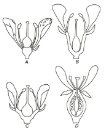
(b) : Aestivation is the arrangements of accessory floral organs (sepals or petals) in relation to one another in floral bud. It may be of open, valvate, twisted or imbricate type. In imbricate aestivation there is an irregular overlapping of petals by one another. It has three subtypes besides imbricate proper $i.e.$, quincuncial, ascending imbricate and descending imbricate or vexillary. Cassia, Pisum, etc., show imbricate aestivation.
View full question & answer
MCQ 441 Mark
Placenta and pericarp are both edible portions in
  • A
    apple
  • B
    banana
  • tomato
  • D
    potato.
Answer
Correct option: C.
tomato
c
(c) : A true fruit consists of a pericarp (fruit wall) formed from ovary wall and seeds formed from ovules. Pericarp is divisible into epicarp, mesocarp and endocarp. Tomato is a berry fruit derived from bicarpellary, syncarpous, bi­to tetralocular ovary with swollen placentae. Berry consists of a membranous skin represented by epicarp. Mesocarp is the middle fleshy part. Endocarp, septa and placentae are pulpy and edible. All parts of the fruit, except the small seeds, are edible.
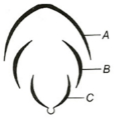
View full question & answer
MCQ 451 Mark
An example of edible underground stem is
  • A
    carrot
  • B
    groundnut
  • C
    sweet potato
  • potato.
Answer
Correct option: D.
potato.
d
(d) : Carrot and sweet potato are root modifications while edible part of groundnut is seeds. Potato is an edible underground stem.
View full question & answer
MCQ 461 Mark
Among flowers of Calotropis, tulip, Sesbania, Asparagus, Colchicum, sweet pea, Petunia, Indigofera, mustard, soybean, tobacco and groundnut, how many plants have corolla with valvate aestivation?
  • A
    Six
  • Seven
  • C
    Eight
  • D
    Five
Answer
Correct option: B.
Seven
b
(b) : The mode of arrangement of the sepals or petals with respect to one another in the floral bud is termed as aestivation. Aestivation is of different types- valvate, twisted or contorted, imbricate, quincuncial, vexillary, convolute, and plicate. In valvate aestivation, sepals or petals or tepals just touch each other without any overlapping. Calotropis, tulip, Asparagus, Colchicum, Petunia, mustard and tobacco have valvate aestivation.
View full question & answer
MCQ 471 Mark
In China rose the flowers are
  • A
    zygomorphic, hypogynous with imbricate aestivation
  • B
    zygomorphic, epigynous with twisted aestivation
  • actinomorphic, hypogynous with twisted aestivation
  • D
    actinomorphic, epigynous with valvate aestivation
Answer
Correct option: C.
actinomorphic, hypogynous with twisted aestivation
c
(c) : In China rose the flowers are actinomorphic $i.e.$, it can be divided into two equal radial halves in any radial plane passing through the centre? they are hypogynous, $i.e.$, the gynoecium occupies the highest position, while the other parts are situated below it; they have twisted aestivation $i.e.$, one margin of petal overlaps that of the next one and so on.
View full question & answer
MCQ 481 Mark
Among bitter gourd, mustard, brinjal, pumpkin, china rose, lupin, cucumber, sunhemp, gram, guava, bean, chilli, plum, petunia, tomato, rose, Withania, potato, onion, aloe and tulip how many plants have hypogynous flower?
  • Fifteen
  • B
    Eighteen
  • C
    Six
  • D
    Ten
Answer
Correct option: A.
Fifteen
a
(a) : In the hypogynous flower the gynoecium occupies the highest position while the other parts are situated below it. The ovary in such flowers is said to be superior, $e.g.$, mustard, China rose and brinjal. All the given plants except bitter gourd, pumpkin, cucumber, guava, plum and rose have hypogynous flower.
View full question & answer
MCQ 491 Mark
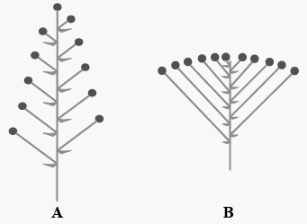
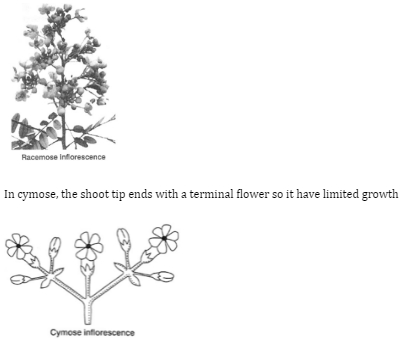
In a cymose inflorescence the main axis
  • A
    has unlimited growth
  • B
    bears a solitary flower
  • C
    has unlimited growth but lateral branches end in flowers
  • terminates in a flower.
Answer
Correct option: D.
terminates in a flower.
d
(d) : Cymose inflorescence is also called definite or determinate inflorescence. Growth of the peduncle is definite. Here, the terminal bud is modified into a flower. Flowers develop in basipetal succession, $i.e.$, mature flowers are towards the apex and young flower buds are towards the base. Flowers open in centrifugal sequence, $i.e.$, flowers open from centre to the periphery of the inflorescence $e.g.$, Solanum, Ranunculus, Datura, Gossypium, etc.
View full question & answer
MCQ 501 Mark
Inflorescence is racemose in
  • A
    brinjal
  • B
    tulip
  • C
    aloe
  • soybean.
Answer
Correct option: D.
soybean.
d
(d) : Racemose inflorescence is also called indefinite and indeterminate type. Growth of the peduncle is indefinite. Here the terminal bud will not modify into a flower. Flowers develop in acropetal succession $i.e.$, mature flowers are towards the base and the younger ones towards the tip of the peduncle. Flowers open in centripetal succession $i.e.$, opening of flowers proceeds from the periphery to the centre of the inflorescence. Peduncle may be unbranched or branched. Soybean belongs to family Fabaceae which has racemose inflorescence.
View full question & answer
MCQ 511 Mark
How many plants among China rose, Ocimum, sunflower, mustard, Alstonia, guava, Calotropis and Nerium (oleander) have opposite phyllotaxy?
  • Three
  • B
    Four
  • C
    Five
  • D
    Two
Answer
Correct option: A.
Three
a
(a) : In opposite phyllotaxy, two leaves are borne on the opposite sides of a single node. It is of two types; $(a)$ opposite and superposed, $(b)$ opposite and decussate. Ocimum, guava and Calotropis have opposite decussate phyllotaxy.
View full question & answer
MCQ 521 Mark
$A$ : Staminal tube is present in Malvaceae.

$R$ : It is due to monadelphous condition.

  • Assertion and Reason both are correct and also correct explanation.
  • B
    Assertion and Reason both are correct but not explanation of assertion.
  • C
    Assertion is correct, but Reason is incorrect.
  • D
    Both Assertion and Reason are incorrect.
Answer
Correct option: A.
Assertion and Reason both are correct and also correct explanation.
a
Fact based and reason is correct explanation of assertion.
View full question & answer
MCQ 531 Mark
Most primitive and advanced families of dicots are respectively
  • A
    Solanaceae and Asteraceae
  • B
    Leguminosae and Poaceae
  • Ranunculaceae and Asteraceae
  • D
    Asteraceae and Cucurbitaceae
Answer
Correct option: C.
Ranunculaceae and Asteraceae
c
Primitive families (dicot) - Ranunculaceae
Advanced dicot families - Asteraceae
View full question & answer
MCQ 541 Mark
Butterfly shaped corolla, monocarpellary ovary and zygomorphic flowers are found in family
  • A
    Caesalpinoideae
  • B
    Solanaceae
  • Papilionaceae
  • D
    Graminae
Answer
Correct option: C.
Papilionaceae
c
Papilionaceae / Fabaceae
-Butterfly shaped corolla
-Monocarpellary ovary
-Zygomorphic
View full question & answer
MCQ 551 Mark
Family fabaceae is concerned with
  • A
    Diadelphous stamen, marginal placentation, obliquely placed ovary and vexillary corolla
  • Diadelphous stamen, marginal placenta and large posterior petal
  • C
    Basal placentation, versatile stamens, spikelet inflorescence
  • D
    Axile placentation, non-endospermic seed, legume fruit
Answer
Correct option: B.
Diadelphous stamen, marginal placenta and large posterior petal
b
Fabaceae
-Diadelphous stamen
-Marginal placentation
-Large posterior petal
View full question & answer
MCQ 561 Mark
Find out a set of common $N_2$ fixing fodder plants
  • A
    Trifolium, Atropa
  • B
    Withania, Abrus
  • Sesbania, Trifolium
  • D
    Aloe, Gloriosa
Answer
Correct option: C.
Sesbania, Trifolium
c
Sesbania, Trifolium -Nitrogen-fixing fodder plants
View full question & answer
MCQ 571 Mark
There are given some plants below, select among the options that, to how many families they belong? Plants are - Crotolaria, Atropa, Solanum, Arachis, Bambusa and Chrysanthemum
  • $4$ families
  • B
    $6$ families
  • C
    $2$ families
  • D
    $3$ families
Answer
Correct option: A.
$4$ families
a
Solanaceae - Solanum, Atropa
Leguminaceae - Crotolaria, Arachis
Poaceae - Bambusa
Asteraceae - Chrysanthemum
View full question & answer
MCQ 581 Mark
Most common fruits of fabaceae and brassicaceae are respectively
  • A
    Lomentum and Siliqua
  • B
    Legume and Samara
  • C
    Lomentum and Silicula
  • Legume and Siliqua
Answer
Correct option: D.
Legume and Siliqua
d
Family -Fruits
Fabaceae - Legume
Siliqua - Brassicaceae
View full question & answer
MCQ 591 Mark
Flowers with monadelphous condition and pentacarpellary ovary are present in
  • China rose family
  • B
    Pea family
  • C
    Potato family
  • D
    Yucca family
Answer
Correct option: A.
China rose family
a
Malvaceae family
-Monadelphous
-Pentacarpellary
$e.g.$, China rose
View full question & answer
MCQ 601 Mark
In Head or Capitulum inflorescence
  • A
    Ray florets : pistillate and neuter; actinomorphic
  • B
    Disc florets : bisexual; zygomorphic
  • Ray florets : pistillate or neuter; zygomorphic
  • D
    Disc florets : pistillate; actinomorphic
Answer
Correct option: C.
Ray florets : pistillate or neuter; zygomorphic
c
Ray florets                             Disc florets
Pistillate and neuter               Bisexual
Zygomorphic                          Actinomorphic
View full question & answer
MCQ 611 Mark
Which of the following plants is used to extract the blue dye?
  • A
    Trifolium
  • B
    Lupin
  • Indigofera
  • D
    Cassia
Answer
Correct option: C.
Indigofera
c
Indigofera is used to extract the blue dye.
View full question & answer
MCQ 621 Mark
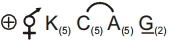
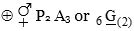
The plants belonging to the family Solanaceae is represented by the floral formula
  • A

  • B


  • D

Answer
Correct option: C.

c
Floral formula of Solanaceae
View full question & answer
MCQ 631 Mark
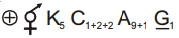
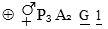
The floral formula of the plants belonging to the family Fabaceae is
  • A

  • B

  • C


Answer
Correct option: D.

d
Floral formula of fabaceae
View full question & answer
MCQ 641 Mark
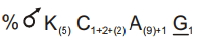
$ K _{(5)} C _{1+2+(2)} A _{(9)+1} G _{1}$ is the floral diagram of the family
  • Fabaceae
  • B
    Solanaceae
  • C
    Liliaceae
  • D
    Papaveraceae
Answer
Correct option: A.
Fabaceae
a
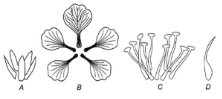
Floral characters of family-Fabaceae Inflorescence Racemose Flower Bisexual, zygomorphic Calyx Sepals five, gamosepalous, imbricate, aestivation Corolla Petals five, polypetalous, papilionaceous, consisting of a posterior standard, two lateral wings, two anterior ones forming a keel (enclosing stamens and pistil), vexillary aestivation Androecium Ten, diadelphous, anther dithecous Gynoecium Ovary superior, monocarpellary, unilocular with many ovules, style single Fruit Legume, seed, one to many, non-endospermic
View full question & answer
MCQ 651 Mark
Inflorescence in jowar is
  • A
    Corymb
  • B
    Spike
  • Panicle
  • D
    Head
Answer
Correct option: C.
Panicle
c
In jowar (Sorghum vulgare), inflorescence is usually compact panicle, sometime loose and spreading panicle.
View full question & answer
MCQ 661 Mark
In the members of family-Malvaceae, anthers are described as
  • A
    Diadelphous and dithecous
  • B
    Diadelphous and monothecous
  • Monodelphous and monothecous
  • D
    Monadelphous and dithecous
Answer
Correct option: C.
Monodelphous and monothecous
c
The androecium of family-Malvaceae consists of indefinite stamens. The stamens are monodelphous, i.e, united into one bundle by filaments and monothecous, i.e, single celled anther. The anther dehisce transversely. $(iv)$ The stem differentiated into nodes and internodes
View full question & answer
MCQ 671 Mark
The fruit of Solanaceae is
  • Berry of capsule
  • B
    Pome
  • C
    Legume of pod
  • D
    Drupe
Answer
Correct option: A.
Berry of capsule
a
In family-Solanaceae, the fruits are berry or bacca. They have a thin Epicarp, fleshy mesocarp and a think - Calyx, sepal Std - Staminodes
View full question & answer
MCQ 681 Mark
Bicarpellary, syncarpous ovary with axile placentation is seen in
  • Solanaceae
  • B
    Caesalpinaceae
  • C
    Asteraceae
  • D
    Malvaceae
Answer
Correct option: A.
Solanaceae
a
In Solanaceae, gynoecium is bicarpellary, syncarpous, ovary superior, bilocular, unilocular in Henoonia, axile placentation, placentae swollen, many ovules in each locule, ovary obliquely placed, posterior carpel to the high about $45^{\circ}$ from median and the anterior to the left. In some cases, nectariferous disc is present, style simple, stigma bifid or capitate.
View full question & answer
MCQ 691 Mark
The economically important plant of Malvaceae is
  • A
    Gossypium hirsutum
  • B
    Hibiscus cannabis
  • C
    Abelmoschus esculentum
  • All the above
Answer
Correct option: D.
All the above
d
View full question & answer
MCQ 701 Mark
Which of the following pairs is not correct?
  • A
    Corymb-Candytuft
  • B
    Capitulum-Sunflower
  • C
    Catkin-Mulberry
  • Raceme-Wheat
Answer
Correct option: D.
Raceme-Wheat
d
Wheat has the inflorescence called compound spikelet.
View full question & answer
MCQ 711 Mark
Which of the following is a wheat fruit?
  • A
    Achene
  • B
    Cypsella
  • Caryopis
  • D
    Endosperm
Answer
Correct option: C.
Caryopis
c
Caryopsis is a fruit of family-Gramineae, $e_{. g}$, wheat. Caryopsis fruit is characterized by fused fruit and seed wall.
View full question & answer
MCQ 721 Mark
Tobacco and Petunia belong to the family
  • A
    Poaceae
  • B
    Fabaceae
  • Solanaceae
  • D
    Brassicaceae
Answer
Correct option: C.
Solanaceae
c
Tobacco plant (Nicotiana tabacum) yields tobacco, while Petunia violacea is an ornamental plant. Both the plants are the member of family-Solanaceae.
View full question & answer
MCQ 731 Mark
The most advanced family is
  • A
    Cruciferae
  • B
    Cucurbitaceae
  • Compositae
  • D
    Euphorbiaceae
Answer
Correct option: C.
Compositae
c
Some taxonomists believed that Compositae is most advanced family.
View full question & answer
MCQ 741 Mark
Capitulum inflorescence is found in
  • Compositae (Asteraceae)
  • B
    Cruciferae (Brassicaceae)
  • C
    Solanaceae
  • D
    Malvaceae
Answer
Correct option: A.
Compositae (Asteraceae)
a
In family-Compositae or Asteraceae, inflorescence is head or capitulum
View full question & answer
MCQ 751 Mark
Diadelphous condition is found in
  • A
    Rosaceae
  • Papilionaceae
  • C
    Leguminosae
  • D
    Cucurbitaceae
Answer
Correct option: B.
Papilionaceae
b
Diadelphous condition is found in family $-6$ Papilionaceae.
View full question & answer
MCQ 761 Mark
Which of the following is a fatty oil yielding plant?
  • Sunflower
  • B
    Acacia
  • C
    Butea
  • D
    Casuarina
Answer
Correct option: A.
Sunflower
a
Sunflower oil is a semi-drying oil obtained from Helianthus annuus which belongs to the family-Asteraceae. It's seed contains $40-50 \%$ oil contents. On hydration it yields vegetable 'ghee'. Sunflower oil is used in cooking and in manufacturing of paints and soaps.
View full question & answer
MCQ 771 Mark
Sunflower belongs to the family
  • A
    Liliaceae
  • Asteraceae
  • C
    Cruciferae
  • D
    Fabaceae
Answer
Correct option: B.
Asteraceae
b
Sunflower (Helianthus annuus) belongs to family-Asteraceae (Compositae). It possesses involucrate head or capitulum inflorescence with ray florets and disc florets.
View full question & answer
MCQ 781 Mark
Jowar belongs to family
  • A
    Glumaceae
  • Gramineae/Poaceae
  • C
    Asteraceae/Compositae
  • D
    Malvaceae
Answer
Correct option: B.
Gramineae/Poaceae
b
Jowar, maize, sugarcane, wheat and rice belong to family-Gramineae or Poaceae
View full question & answer
MCQ 791 Mark
Tetradynamous condition is found in
  • A
    Asteraceae
  • B
    Malvaceae
  • C
    Papilionatae
  • Brassicaceae
Answer
Correct option: D.
Brassicaceae
d
In tetradynamous condition out of six stamens, four are long and two are short, e.g., Brassicaceae (Cruciferae).
View full question & answer
MCQ 811 Mark
Which of the following characters are not true about solanaceae
  • A
    It is herbaceous rarely wood, aerial and erect
  • B
    Leaves are alternate, simple, rarely pinnately compounds
  • C
    Inflorescence is solitary
  • Flower is bisexual zygomorphic
Answer
Correct option: D.
Flower is bisexual zygomorphic
d
View full question & answer
MCQ 821 Mark
The characteristic fruit of family - liliaceae is
  • A
    Legume
  • Capsule
  • C
    Drupe
  • D
    None of the above
Answer
Correct option: B.
Capsule
b
View full question & answer
MCQ 831 Mark
Select the correct option on the basis of following character

$(I)$ Inflorescence - rasemose

$(II)$ Gynoecium - ovary superior, monocarpellary

$(III)$ Seed - non-endospermic

  • Pulses, dye, fibres, fodder
  • B
    Ornamental, medicine, veretable
  • C
    Spice, medicine, fumigatory
  • D
    All of the above
Answer
Correct option: A.
Pulses, dye, fibres, fodder
a
View full question & answer
MCQ 861 Mark
Tobacco belongs to ....... family.
  • A
    Fabaceae
  • Solanaceae
  • C
    Liliaceae
  • D
    Poaceae
Answer
Correct option: B.
Solanaceae
b
View full question & answer
MCQ 871 Mark
Given family indicates ......... family.
  • A
    Fabaceae
  • Solanaceae
  • C
    Liliaceae
  • D
    Poaceae
Answer
Correct option: B.
Solanaceae
b
View full question & answer
MCQ 881 Mark
Choose incorrect pair.
  • A
    Source of food - potato
  • B
    Spices - chilli
  • Ornaments - colchicine
  • D
    Fumigatory - tobacco
Answer
Correct option: C.
Ornaments - colchicine
c
View full question & answer
MCQ 891 Mark
….. family is have sign $C_{1+2+ (2)}$ for ........
  • Fabaceae ; petal
  • B
    Liliaceae ; perianth tepal
  • C
    Solanaceae ; petal
  • D
    Fabaceae ; sepal
Answer
Correct option: A.
Fabaceae ; petal
a
View full question & answer
MCQ 911 Mark
Which type of sepal aestivation is found in Solanaceae family?
  • Valvet
  • B
    Vaxillary
  • C
    Imbricate
  • D
    Twisted
Answer
Correct option: A.
Valvet
a
View full question & answer
MCQ 921 Mark
Choose correct pair.
  • A
    Ashwagandha - Fabaceae
  • B
    Soyabean - Liliaceae
  • C
    Tulip - Solanaceae
  • Mustard - Brassicaceae
Answer
Correct option: D.
Mustard - Brassicaceae
d
View full question & answer
MCQ 931 Mark
Choose correct option from the given sentences.

$(a)$ Bisexual flower

$(b)$ Zygomorphic flower

$(c)$ Imbricate aestivation

  • Fabaceae
  • B
    Solanaceae
  • C
    $A$ and $B$ correct
  • D
    $A$ and $B$ incorrect
Answer
Correct option: A.
Fabaceae
a
View full question & answer
MCQ 951 Mark
It is known as "potato family".
  • Solanaceae
  • B
    Fabaceae
  • C
    Poaceae
  • D
    All correct
Answer
Correct option: A.
Solanaceae
a
View full question & answer
MCQ 961 Mark
Epipetalous androecium is found in
  • A
    Mung
  • B
    Pea
  • Solanum nigrum
  • D
    Groundnut
Answer
Correct option: C.
Solanum nigrum
c
View full question & answer
MCQ 991 Mark
Scientific name of pea plant
  • A
    Solanum nigrum
  • B
    Allium cepa
  • Pisum sativum
  • D
    Zea mays
Answer
Correct option: C.
Pisum sativum
c
View full question & answer
MCQ 1001 Mark
In this family fruit is capsule, rarely berry.
  • Gloriosa
  • B
    Brinjal
  • C
    Petunia
  • D
    Groundnut
Answer
Correct option: A.
Gloriosa
a
View full question & answer
MCQ 1011 Mark
Choose correct one :
  • A
    Solanaceae - Sepals are free
  • Brassicaceae - Six stamens
  • C
    Fabaceae - Six stamens
  • D
    Solanaceae - Unisexual flower
Answer
Correct option: B.
Brassicaceae - Six stamens
b
View full question & answer
MCQ 1021 Mark
Androeium is epipetalous in this family
  • Solanaceae
  • B
    Brassicaceae
  • C
    Liliaceae
  • D
    None
Answer
Correct option: A.
Solanaceae
a
View full question & answer
MCQ 1031 Mark
Flower is zygomorphic in this family
  • Fabaceae
  • B
    Solanaceae
  • C
    Liliaceae
  • D
    All given
Answer
Correct option: A.
Fabaceae
a
View full question & answer
MCQ 1061 Mark
Stem is herbaceous in family.
  • Solanaceae
  • B
    Liliaceae
  • C
    Fabaceae
  • D
    Brassicaceae
Answer
Correct option: A.
Solanaceae
a
View full question & answer
MCQ 1071 Mark
Chief features of family Brassicaceae/Cruciferae is presence of
  • A
    Latex
  • B
    Pectin
  • C
    Alkaloids
  • Myrosin enzyme
Answer
Correct option: D.
Myrosin enzyme
d
(d) In members of Cruciferae $(Brassicaceae)$, secretory cells are found which contains myrosin enzyme.

This also accompanies the sulphur containing glucosides which hydrolyses them in to glucose and isothiocynates $(oil)$.

View full question & answer
MCQ 1081 Mark
The floral formula for Malvaceae is
  • A

  • B


  • D

Answer
Correct option: C.

c
(c) Actinomorphic, bisexual, epicalyx $ 3$  to $7,$  calyx $ 5$  gamosepalous, corolla  $ 5 $ polypetalous usually adnate at the base to the staminal tube,

Androecium indefinite stamens, gynoecium pentacarpellary to indefinite. syncarpous, ovary superior.

View full question & answer
MCQ 1091 Mark
The condition of stamens in Cruciferae family is correctly expressed as
  • A
    $A_6$
  • $A_{2+4}$
  • C
    $A_{4+2}$
  • D
    All of these
Answer
Correct option: B.
$A_{2+4}$
b
(b)6 stamens, polyandrous, tetradynamous condition, i.e.,$ 4+2$  or in two whorls. $4 $ inner long and $ 2$  outer short.
View full question & answer
MCQ 1101 Mark
Parachute mechanism of fruit dispersal as found in compositae is due to structure named
  • A
    Bract
  • Pappus
  • C
    Coma
  • D
    Barbs
Answer
Correct option: B.
Pappus
b
(b)Pappus is persistent hairy calyx which functions as parachute for dispersal.
View full question & answer
MCQ 1111 Mark
Basifixed monothecous anthers $(OR)$ anthers with two microsporangia is characteristics of
  • A
    Leguminosae/Pea
  • Malvaceae/Cotton
  • C
    Solanaceae/Tomato
  • D
    Liliaceae/Onion
Answer
Correct option: B.
Malvaceae/Cotton
b
(b) In Malvaceae/cotton anther single-lobed, $2$ chambered $(bisporangiate)$, connective is absent. Filament is attached to the base of the anther.
View full question & answer
MCQ 1121 Mark
Persistant calyx is characteristics of
  • A
    Allium/Liliaceae
  • B
    Hibiscus/Malvaceae
  • C
    Dalbergia/Papilionatae
  • Solanum/Solanaceae
Answer
Correct option: D.
Solanum/Solanaceae
d
(d) Persistent : Sepals persist till the fruit formation and are present even in the mature fruit.

It can be accrescent (sepals grow in size, remain green and may cover the fruit, e.g.,$ Brinjal, Chillies$) or marcescent (sepals do not grow with the growth of fruit and become dry, e.g., $Guava, Piper$).

View full question & answer
MCQ 1131 Mark
Diadelphous stamens occur in
  • A
    Gramineae
  • B
    Cucurbitaceae
  • Papilionatae
  • D
    Malvaceae
Answer
Correct option: C.
Papilionatae
c
(c) Diadelphous : The filaments are united forming two bundles, e.g., in Lathyrus $(sweet \,\,pea)$, Pisum $(edible\,\, pea)$ there are $10$ stamens;

filaments of $ 9 $ stamens are fused forming one bundle and the other bundle is represented by the filament of the tenth free stamen $ (A_1 + (9)).$

View full question & answer
MCQ 1141 Mark
Papilionaceous flower with large vexillum covering two wings and the wings covering the keel has corolla aestivation of
  • Descending imbricate
  • B
    Ascending imbricate
  • C
    Twisted
  • D
    Valvate
Answer
Correct option: A.
Descending imbricate
a
(a) Descending imbricate or Vexillary aestivation : The posterior large standard petals overlaps the lateral petals called wings or alae on the margins while the lateral wings overlap the anterior keel or carinal petals, e.g., Pea, Gram.
View full question & answer
MCQ 1151 Mark
Fruit in members of solanaceae is
  • A
    Drupe
  • Capsule or berry
  • C
    Siliqua
  • D
    Pod or achene
Answer
Correct option: B.
Capsule or berry
b
It’s obvious.

View full question & answer
MCQ 1161 Mark
Which of the following represents the condition seen in the family composite
  • A
    Superior ovary, syngenesious, single basal ovule
  • B
    Inferior ovary, monoadelphous, basal placentation
  • C
    Inferior ovary, syngenesious, axile, placentation
  • Syngenesious, basal placentation and epigynous
Answer
Correct option: D.
Syngenesious, basal placentation and epigynous
d
It’s obvious.
View full question & answer
MCQ 1171 Mark
Botanical name of 'chana' is
  • Cicer arietinum
  • B
    Phaseolus aureus
  • C
    Lablab purpureus
  • D
    Dolichos
Answer
Correct option: A.
Cicer arietinum
a
It’s obvious.
View full question & answer
MCQ 1181 Mark
Lady finger belongs to family
  • Malvaceae
  • B
    Cucurbitaceae
  • C
    Liliaceae
  • D
    Brassicaeae
Answer
Correct option: A.
Malvaceae
a
It’s obvious.
View full question & answer
MCQ 1191 Mark
Which of the following are not characteristic features of fabaceae
  • A
    Tap root system, compound leaves and receme inflorescence
  • Flowers actinomorphic, twisted aestivation and gamopetalous
  • C
    Stamens 10, introrse, basifixed, dithecous
  • D
    Monocarpellary, ovary superior and bent stigma
Answer
Correct option: B.
Flowers actinomorphic, twisted aestivation and gamopetalous
b
It’s obvious.
View full question & answer
MCQ 1201 Mark
The division of Leguminosae into its sub families is based upon $(or)$ the Leguminosae is distinguished on the basis of
  • A
    $K $ and   $C$
  • B
    $K$  and  $A$
  • $C$  and  $A$
  • D
    $A $ and  $G$
Answer
Correct option: C.
$C$  and  $A$
c
(c) On the basis of characters of corolla (symmetry of flower, type of petals and their fusion and aestivation) and androecium $(No.\, of\,\, arrangement)$, this family is divided in to $3$  sub families.
View full question & answer
MCQ 1211 Mark
Bilocular oblique ovary with numerous shining ovule on swollen axile placenta is the characteristics of
  • A
    Cruciferae
  • Solanaceae
  • C
    Liliaceae
  • D
    Malvaceae
Answer
Correct option: B.
Solanaceae
b
(b) In solanaceae bilocular, Axile placentation, ovary obliquely placed due to rotation of posterior ovary towards right side and anterior carpel to left side by $ 45^o$.

Placentae highly swollen, ovules are maximum per locule in this family.

View full question & answer
MCQ 1221 Mark
Underground food is stored in
  • A
    Solanaceae and Leguminosae
  • B
    Liliaceae and Cruciferae
  • Cruciferae and Solanaceae
  • D
    Solanaceae and Malvaceae
Answer
Correct option: C.
Cruciferae and Solanaceae
c
It’s obvious.
View full question & answer
MCQ 1231 Mark
Oblique ovary is found in family
  • A
    Brassicaceae
  • B
    Compositae
  • C
    Leguminosae
  • Solanaceae
Answer
Correct option: D.
Solanaceae
d
(d) In family Solanaceae gynoecium is bicarpellary, syncarpous, bilocular axile placentation, ovary obliquely placed in the flower.
View full question & answer
MCQ 1241 Mark
Diadelphous stamens are the characteristic features of
  • A
    Ranunculaceae
  • Fabaceae
  • C
    Poaceae
  • D
    Malvaceae
Answer
Correct option: B.
Fabaceae
b
(b) In diadelphous condition, stamens are arranged in two bundles.

Diadelphous stamens are the characteristic features of family Fabaceae.

View full question & answer
MCQ 1251 Mark
Tetradynamous condition is found in
  • A
    Hibiscus rosa-sinesis
  • B
    Petunia hybrida
  • C
    Helianthus annuus
  • Brassica campestris
Answer
Correct option: D.
Brassica campestris
d
(d) Tetradynamous condition of stamens is found in mustard $(Brassica\,\, campestris)$ plant of family Cruciferae $(Brassicaceae)$.

In tetradynamous conditions four stamens remain long and two short.

View full question & answer
MCQ 1261 Mark
Monadelphous condition of stamens is found in
  • Malvaceae
  • B
    Cyperaceae
  • C
    Cruciferae
  • D
    Solanaceae
Answer
Correct option: A.
Malvaceae
a
It’s obvious.
View full question & answer
MCQ 1271 Mark
Inflorescence of family compositae is
  • A
    Perianth
  • B
    Iodicule
  • Capitulum
  • D
    Hypanthodium
Answer
Correct option: C.
Capitulum
c
It’s obvious.
View full question & answer
MCQ 1281 Mark
Perigynous condition is common among
  • A
    Liliaceae
  • B
    Solanaceae
  • Leguminosae
  • D
    Malvaceae
Answer
Correct option: C.
Leguminosae
c
The flowers in Leguminosae are perigynous and zygomorphic. They have the stamens and other floral parts at the same level of the carpels. The pistil is simple and consists of a single style and stigma and a superior ovary with one locule containing many marginal ovules. The fruit is usually a legume.
Thus, the correct answer is option C.
View full question & answer
MCQ 1291 Mark
Which of the family does not possess axile placentation
  • A
    Solanaceae
  • B
    Malvaceae
  • Leguminosae/Cruciferae
  • D
    Liliaceae
Answer
Correct option: C.
Leguminosae/Cruciferae
c
(c)Leguminosae family possess marginal and Cruciferae possess parietal placentation.
View full question & answer
MCQ 1301 Mark
Potato, tomato, brinjal, mustard and cauliflowers belong to how many genera
  • A
    Five
  • B
    Four
  • C
    Three
  • Two
Answer
Correct option: D.
Two
d
It’s obvious.
View full question & answer
MCQ 1311 Mark
Datura belongs to
  • A
    Compositae
  • B
    Labiatae
  • C
    Malvaceae
  • Solanaceae
Answer
Correct option: D.
Solanaceae
d
It’s obvious.
View full question & answer
MCQ 1321 Mark
Lycopersicun esculentum belongs to
  • A
    Malvaceae
  • B
    Cruciferae
  • Solanaceae
  • D
    None of the above
Answer
Correct option: C.
Solanaceae
c
It’s obvious.
View full question & answer
MCQ 1331 Mark
Potato belongs to the family
  • Solanaceae
  • B
    Compositae
  • C
    Gramineae
  • D
    Cruciferae
Answer
Correct option: A.
Solanaceae
a
It’s obvious.
View full question & answer
MCQ 1341 Mark
In family Gramineae, the inflorescence is
  • A
    Capitulum
  • B
    Verticellaster
  • C
    Hypanthodium
  • Spike of spikelet
Answer
Correct option: D.
Spike of spikelet
d
It’s obvious.
View full question & answer
MCQ 1351 Mark
In Gramineae, the perianth is represented by small scaly Iodicules which are generally
  • Two
  • B
    Three
  • C
    Four
  • D
    Five
Answer
Correct option: A.
Two
a
(a)Parianth is reduced to  $ 2-3$  boat shaped membranous lodicules.
View full question & answer
MCQ 1371 Mark
Mark the correct statement for Gramineae
  • A
    The carpel has two styles
  • B
    Spikelets are always in pairs
  • Palea is the bracteole
  • D
    Awn is an appendage of the palea
Answer
Correct option: C.
Palea is the bracteole
c
(c) Bracteoles modify in to palea.
View full question & answer
MCQ 1381 Mark
Which of the following is correct with reference to flowers of family solanaceae
  • A
    Pentamerous, actinomorphic, unisexual, hypogynous
  • B
    Pentamerous, zygomorphic, bisexual, epigynous
  • Pentamerous, bisexual, actinomorphic, hypogynous
  • D
    Trimerous, actinomorphic, bisexual, hypogynous
Answer
Correct option: C.
Pentamerous, bisexual, actinomorphic, hypogynous
c
(c) Flower of family Solanaceae is bracteate or ebracteate, pedicellate, complete, hermaphrodite, actinomorphic, pentamerous, hypogynous.
View full question & answer
MCQ 1391 Mark
Which is false about Asteraceae
  • A
    Cypsela fruit
  • B
    Syngenesious androecium
  • C
    Head inflorescence
  • Hypogynous flower
Answer
Correct option: D.
Hypogynous flower
d
It’s obvious.
View full question & answer
MCQ 1401 Mark
Bicarpellary, syncarpous, unilocular ovary with basal placentation occurs in
  • A
    Liliaceae
  • B
    Solanaceae
  • Asteraceae
  • D
    Fabaceae
Answer
Correct option: C.
Asteraceae
c
It’s obvious.
View full question & answer
MCQ 1411 Mark
Raphanus belongs to
  • A
    Asteraceae
  • Brassicaceae
  • C
    Solanaceae
  • D
    Liliaceae
Answer
Correct option: B.
Brassicaceae
b
It’s obvious.
View full question & answer
MCQ 1421 Mark
Carbohydrate rich food is got from
  • A
    Brassicaceae
  • Poaceae
  • C
    Fabaceae
  • D
    Asteraceae
Answer
Correct option: B.
Poaceae
b
(b) Cereals are one seeded fruit called caryopsis.

They are rich in carbohydrate, poor in lysine and tryptophan.

Cereals comes under family Poaceae.

View full question & answer
MCQ 1431 Mark
Scientific name of Sunflower is
  • A
    Brassica compesteris
  • B
    Pisum sativum
  • Helianthus annuus
  • D
    Gossypium herbaceum
Answer
Correct option: C.
Helianthus annuus
c
It’s obvious.
View full question & answer
MCQ 1441 Mark
Which one is odd
  • Allium cepa
  • B
    Helianthus annuus
  • C
    Brassica juncea
  • D
    Arachis hypogea
Answer
Correct option: A.
Allium cepa
a
(a)Allium cepa belongs to monocot family -Liliaceae, when remaining three are dicot.
View full question & answer
MCQ 1451 Mark
Largest family of flowering plants is
  • A
    Fabaceae
  • B
    Liliaceae
  • C
    Poaceae
  • Asteraceae
Answer
Correct option: D.
Asteraceae
d
(d)Commonly called sunflower, largest family of plant kingdom, represented by  $950$ genera and  $20000$ species.
View full question & answer
MCQ 1461 Mark
Four sepals arranged in two whorls is characteristic of family
  • A
    Solanaceae
  • B
    Fabaceae
  • Brassicaceae
  • D
    Liliaceae
Answer
Correct option: C.
Brassicaceae
c
(c) Sepals $ 4$ , Polysepalous, arranged in two whorls, outer of antero-posterior sepals and inner of lateral sepals, lateral sepals generally saccate or pouched at the base, green or petaloid, inferior.
View full question & answer
MCQ 1471 Mark
Compositae is also known as [
  • A
    Fabaceae
  • Asteraceae
  • C
    Liliaceae
  • D
    Poaceae
Answer
Correct option: B.
Asteraceae
b
It’s obvious.
View full question & answer
MCQ 1481 Mark
In fabaceae, one of the following immediately encloses the essential organs
  • Anterior petals
  • B
    Posterior petal
  • C
    Lateral petals
  • D
    Sepals
Answer
Correct option: A.
Anterior petals
a
(a)Anterior petals are fused to form a boat-shaped structure called keel or carina.
View full question & answer
MCQ 1491 Mark
Flower of Fabaceae is
  • Complete, zygomorphic, pentamerous
  • B
    Complete, actinomorphic, trimerous
  • C
    Incomplete, zygomorphic, trimerous
  • D
    Incomplete, actinomorphic, pentamerous
Answer
Correct option: A.
Complete, zygomorphic, pentamerous
a
It’s obvious.
View full question & answer
MCQ 1501 Mark
A diagnostic trait for identification of fabaceous flower is
  • A
    Tetradynamous androecium
  • B
    Inferior ovary
  • C
    Cruciform corolla
  • Vexillary aestivation
Answer
Correct option: D.
Vexillary aestivation
d
(d) In Fabaceous $(Papilionaceous)$ corolla has petals $5$ , polypetalous, the posterior petal is largest $(standard)$ and two laterals are wing and inner two anterior are fused to form a boat shaped structure called kell or carina.
View full question & answer
MCQ 1511 Mark
Axile placentation occurs in
  • A
    Asteraceae and Fabaceae
  • B
    Brassicaeae and Solanaceae
  • Solanaceae and Liliaceae
  • D
    None of these
Answer
Correct option: C.
Solanaceae and Liliaceae
c
(c) Axile placentation : In a multicarpellary syncarpous gynoecium the fusing margins grow inwards to meet in the center of the ovary to form an axis thus making the ovary multilocular.

The ovules are borne on the central axis. e.g., Family Solanaceae and Liliaceae.

View full question & answer
MCQ 1521 Mark
A family belongs to inferae of gamopetalae
  • A
    Fabaceae
  • B
    Liliaceae
  • Asteraceae
  • D
    Brassicaceae
Answer
Correct option: C.
Asteraceae
c
(c) Family Asteraceae belongs to subclass -Gamopetalae (The petals are fused, stamens are epipetalous, carpel may be syncarpous or apocarpous) and series -Inferae (ovary is inferior and stamen usually equal to petal lobes).
View full question & answer
MCQ 1531 Mark
Plants are always herbs in
  • A
    Fabaceae
  • B
    Solanaceae
  • Brassicaceae
  • D
    None of these
Answer
Correct option: C.
Brassicaceae
c
(c)Commonly called mustard family : Plants predominantly herbs and sulphur smelling being rich in sulphur rich glucosides like sinigrin and hence are pungent.
View full question & answer
MCQ 1541 Mark
Commissural stigma $(Along\,\, carpellary\,\, cohesion\,\, plane)$ occurs in family
  • A
    Solanaceae
  • B
    Liliaceae
  • Cruciferae
  • D
    Fabaceae
Answer
Correct option: C.
Cruciferae
c
It’s obvious.
View full question & answer
MCQ 1551 Mark
Millets belong to
  • A
    Fabaceae
  • Poaceae
  • C
    Liliaceae
  • D
    Asteraceae
Answer
Correct option: B.
Poaceae
b
(b) Poaceae $(Gramineae)$ is the $3^{rd}$ largest but economically most valuable family as it provides cereals and millets.
View full question & answer
MCQ 1561 Mark
Botanical name of Radish is
  • A
    Brassica nigra
  • B
    Brassica oleracea
  • Raphanus sativus
  • D
    None of these
Answer
Correct option: C.
Raphanus sativus
c
(c) Raphanus sativus belongs to family Cruciferae $(Brassicaceeae)$.

Its root and leaves are used as vegetables.

View full question & answer
MCQ 1571 Mark
Red Gram is
  • A
    Phaseolus aureus
  • B
    Cicer arietinum
  • Cajanus cajan
  • D
    Phaseolus mungo
Answer
Correct option: C.
Cajanus cajan
c
(c) Cajanus cajan $(Pigeon\, pea / Red gram / Arhar)$ belong to family Leguminosae $(fabaceae)$.
View full question & answer
MCQ 1581 Mark
Which statement is wrong for compositae
  • $5-$ lobed stamens
  • B
    Syngenesious stamens
  • C
    Basal ovule
  • D
    Ligulate ray florets
Answer
Correct option: A.
$5-$ lobed stamens
a
(a) In family Compositae $(Asteraceae)$ $ 2$ stamens, epipetalous, syngenesious, dithecous, bilobed, introse, filament free.
View full question & answer
MCQ 1591 Mark
The androecium of Malvaceae is
  • A
    Didynamous
  • B
    Tetradynamous
  • C
    Diadelphous
  • Monadelphous
Answer
Correct option: D.
Monadelphous
d
(d) All stamens of a flower fuse by their filaments to form a single staminal tube e.g., family Malvaceae $(Hibiscus)$.
View full question & answer
MCQ 1601 Mark
Which of the following is phylogenetically most advanced of the dicotyledonous families
  • A
    Acanthaceae
  • B
    Scrophulariaceae
  • Compositae
  • D
    Umbelliferae
Answer
Correct option: C.
Compositae
c
(c) Compositae $(Asteraceae)$ is the largest family of plant kingdom, represented by $950 $ genera and  $20000$  species,

plants mostly herbs stem with latex / oil ducts and most evolved and advanced among dicot.

View full question & answer
MCQ 1611 Mark
Fruits in Asteraceae are generally dispersed by
  • A
    Water
  • B
    Insects
  • Wind
  • D
    Birds
Answer
Correct option: C.
Wind
c
It’s obvious.
View full question & answer
MCQ 1621 Mark
………. type of fruit is present in rice
  • A
    Cypsela
  • B
    Capsule
  • Caryopsis
  • D
    Cremocarp
Answer
Correct option: C.
Caryopsis
c
It’s obvious.
View full question & answer
MCQ 1631 Mark
Which of the following is a wheat fruit
  • A
    Achene
  • B
    Cypsella
  • Caryopsis
  • D
    Endosperm
Answer
Correct option: C.
Caryopsis
c
(c) Caryopsis is one-seeded dry indehiscent fruit developed from a monocarpellary, unilocular and superior ovary. e.g., Wheat, Maize, Paddy.
View full question & answer
MCQ 1641 Mark
Leafy or vegetative bract is characteristics of the flower of
  • A
    Cruciferae
  • Malvaceae
  • C
    Liliaceae
  • D
    Papilionatae
Answer
Correct option: B.
Malvaceae
b
(b) An additional whorl of  $3-9$  leafy structures is present out side calyx,

called epicalyx $(hypocalyx)$ which is modification of bracteoles is characteristic of the Malvaceae flowers.

View full question & answer
MCQ 1651 Mark
In Hibiscus rosa-sinensis there is an additional floral whorl known as
  • A
    Calyx
  • B
    Involucre
  • Epicalyx
  • D
    Obdiplostemonous layer
Answer
Correct option: C.
Epicalyx
c
It’s obvious.
View full question & answer
MCQ 1661 Mark
Parachute like pappus is found in
  • A
    Liliaceae/Cotton
  • B
    Gramineae/Paddy
  • Compositae/Marigold
  • D
    Solanaceae/Calotropis
Answer
Correct option: C.
Compositae/Marigold
c
(c) Pappus : $(Hairy\,\, or\,\, feathery \,\,sepals)$ sometimes sepals are modified in to hairy structures which are useful in dispersal of seeds. e.g., Compositae / Marigold.
View full question & answer
MCQ 1671 Mark
Flowers of Liliaceae, Malvaceae and Solanaceae are
  • Hypogynous
  • B
    Perigynous
  • C
    Epigynous
  • D
    Amphigynous
Answer
Correct option: A.
Hypogynous
a
(a) Hypogynous flower $(hypo = below; gyny = ovary)$.

Thalamus is conical or convex with gynoecium at top and other part below it,

ovary is superior and other parts inferior.

e.g., Liliaceae, Malvaceae and Solanaceae.

View full question & answer
MCQ 1681 Mark
Ray florets of sunflower $(Compositae)$ are
  • A
    Bisexual
  • Unisexual
  • C
    Asexual
  • D
    None of these
Answer
Correct option: B.
Unisexual
b
(b) Ray florets are always unisexual pistillate or neuter in heterogamous head inflorescence. In homogamous head, these are bisexual.
View full question & answer
MCQ 1691 Mark
Ligulate corolla found in compositae is
  • A
    Wheel-shaped
  • Strap-shaped
  • C
    Masked
  • D
    Two-lipped
Answer
Correct option: B.
Strap-shaped
b
It’s obvious.
View full question & answer
MCQ 1701 Mark
Epicalyx is
  • A
    A whorl of bracts
  • A whorl of bracteoles
  • C
    Involucre
  • D
    Additional whorl of calyx
Answer
Correct option: B.
A whorl of bracteoles
b
(b) It is an additional whorl of sepal like structure formed by bracteoles.

It is present outer to calyx whorl and is found in Malvaceae.

A flower with epicalyx whorl is called pentacyclic.

View full question & answer
MCQ 1711 Mark
Ligulate/strap-shaped corolla occurs in sunflower in
  • A
    Disc florets
  • B
    Immature florets
  • Ray florets
  • D
    Both ray and disc florets
Answer
Correct option: C.
Ray florets
c
(c)The fused petals form a strap-shaped structure towards the upper end. A small hairy outgrowth, the ligule is present at the junction of the strap and the tube, e.g., ray florets of Helianthus.
View full question & answer
MCQ 1721 Mark
The capitulum type of inflorescence is found in
  • Marigold
  • B
    Salvia
  • C
    Euphorbia
  • D
    Jasmine
Answer
Correct option: A.
Marigold
a
It’s obvious.
View full question & answer
MCQ 1731 Mark
The unit of inflorescence in grasses / gramineae $(poaceae)$ is
  • A
    Thyrsis
  • B
    Spike
  • Spikelet
  • D
    Raceme
Answer
Correct option: C.
Spikelet
c
(c) Spikelet is a compact spike having a few flowers borne an axis called rachilla and surrounded by two bracts called glumes.

e.g., Wheat, Oat, Grass. Each flower or floret has at its base a bract called lemma and a bracteole complex called palea.

View full question & answer
MCQ 1741 Mark
Characteristic inflorescence of family compositae sunflower is
  • Capitulum
  • B
    Cymose head
  • C
    Catkin
  • D
    Spadix
Answer
Correct option: A.
Capitulum
a
It’s obvious.
View full question & answer
MCQ 1751 Mark
Actinomorphic nature of flower is represented by which of the following symbols?
  • A
    $A$
  • B
    $\%$
  • $-\oplus$
  • D

Answer
Correct option: C.
$-\oplus$
c
Actinomorphic symbol $-\oplus$
View full question & answer
MCQ 1761 Mark
Select the correct option.
Column$-I$ Column$-II$
$(a). Br$ $(i)$ Corolla
$(b). K$ $(ii)$ Perianth
$(c). C$ $(iii)$ Calyx
$(d). P$ $(iv)$ Bracteate
  • A
    $a(iv), b(ii), c(iii), d(i)$
  • B
    $a(iv), b(ii), c(iii), d(ii)$
  • $a(iv), b(iii), c(i), d(ii)$
  • D
    $a(i), b(ii), c(iii), d(iv)$
Answer
Correct option: C.
$a(iv), b(iii), c(i), d(ii)$
c
$Br$ - Bracteate
$K$ - Calyx
$C$ - Corolla
$P$ - Parianth
View full question & answer
MCQ 1771 Mark
In floral formula, ${ }^{\prime} K ^{\prime}$ and ' $C ^{\prime}$ stands for
  • A
    $K-Corolla, C-Calyx$
  • $K-Calyx, C-Corolla$
  • C
    $K-Calyx, C-Calyx$
  • D
    $K-Corolla, C-Corolla$
Answer
Correct option: B.
$K-Calyx, C-Corolla$
b
Symbols used for floral formula

$B$r- Bracteate $EB$r - Ebracteate

$B$rl- Bracteolate $EB$rl - Ebracteolate

$\oplus$ - Actinomorphic $\%$ - Zygomorphic

- Perfect or bisexual $N$ - Necter

- Female $C$-Corolla, petals

$0$ - Male $A$- Androecium, stamens $P$ - Parianth, tepal $G$ - Gunnecium. Carnel

View full question & answer
MCQ 1781 Mark
Vivipary is seen in
  • Mangroves
  • B
    Xerophytes
  • C
    Hydrophytes
  • D
    Mesophytes
Answer
Correct option: A.
Mangroves
a
Vivipary (germination of seed inside the fruit) is an important character of mangrove plants.
View full question & answer
MCQ 1791 Mark
$G(\underline{2})$ represents
  • A
    Gynoecium, bicarpellary, apocarpous, superior
  • B
    Gynoecium, monocarpellary, syncarpous, inferior
  • C
    Gynoecium, bicarpellary, syncarpous, inferior
  • Gynoecium, bicarpellary, syncarpous, superior
Answer
Correct option: D.
Gynoecium, bicarpellary, syncarpous, superior
d
$G _{2}$ Represents gynoecium, bicarpellary, syncarpous and superior
View full question & answer
MCQ 1801 Mark
In floral formula the ( $千$ ) symbol stands for
  • A
    Staminate flower
  • Bisexual flower
  • C
    Pistillate Flower
  • D
    Imperfect flower
Answer
Correct option: B.
Bisexual flower
b
Bisexual flower. Symbols used for floral formula Brl- Bracteolate $EB$rl - Ebracteolate

$\oplus$ - Actinomorphic $\%$ - Zygomorphic $\oint-$ Bisexual $K$ - Calyx

$C$- Corolla (Petals) $A$- Androecium, stamens $P$ - Parianth, tepal $G$ - Gynoecium, Carpel

View full question & answer
MCQ 1811 Mark
Percentage ( $\%$ ) sign is used for
  • A
    Actinomorphic flower
  • Zygomorphic flower
  • C
    Incomplete flower
  • D
    Epigynous flower
Answer
Correct option: B.
Zygomorphic flower
b
When the flower is bilaterally symmetrical, ie, divisible into only two equal halves by a single vertical plane, it is termed as zygomorphic, e.g. Adhatoda, pea, Larkspur; Ocimum, etc, the zygomorphic condition of flower is represented by the sign $\%$
View full question & answer
MCQ 1831 Mark
What is correct for $\underline G $?
  • A
    Inferior ovary
  • Superior ovary
  • C
    Syncarpous ovary
  • D
    Male flower
Answer
Correct option: B.
Superior ovary
b
View full question & answer
MCQ 1841 Mark
Choose the correct description depicted by floral diagram
  • A
    United valvate sepals, free twisted petals, free stamens, unilocular ovary with marginal placenta
  • B
    United valvate sepale, free imbricate petals, free stamens, unilocular ovary with axile placenta
  • C
    United valvate sepals, free imbricate petals, epipetalous stamens, unilocular ovary with marginal placenta
  • United valvate sepals, free imbricate petals, free stamens, unilocular ovary with marginal placentation
Answer
Correct option: D.
United valvate sepals, free imbricate petals, free stamens, unilocular ovary with marginal placentation
d
It’s obvious.
View full question & answer
MCQ 1851 Mark
The side of a flower facing the mother axis is called
  • A
    Anterior side
  • Posterior side
  • C
    Dorsal side
  • D
    Ventral side
Answer
Correct option: B.
Posterior side
b
(b)Mother axis : The shoot on which the flower is borne is called mother axis. The side of the mother axis is always posterior while the side of the bract is anterior.
View full question & answer
MCQ 1861 Mark
Which of the character does not become apparent in floral formula
  • Placentation and aestivation
  • B
    Number of floral parts
  • C
    Whorls of floral parts
  • D
    Position of ovary
Answer
Correct option: A.
Placentation and aestivation
a
It’s obvious.
View full question & answer
MCQ 1871 Mark
If any following part of flower is involved in the formation of fruit is called false fruit such part is
  • A
    Thalamus
  • B
    Tepal
  • C
    Calyx
  • All of these
Answer
Correct option: D.
All of these
d
It’s obvious.
View full question & answer
MCQ 1881 Mark
${{\rm{A}}_{{\rm{1}} + {\rm{(9)}}}}$ stands for
  • A
    Adelphous
  • B
    Synantherous
  • Diadelphous
  • D
    None of these
Answer
Correct option: C.
Diadelphous
c
(c)Filaments of a stamens are fused forming one bundle and the other bundle is represented by the filament of the tenth free stamen $ A_1 + (9)$
View full question & answer
MCQ 1891 Mark
Select the correct statement w.r.t. Mango and coconut
  • They develop from monocarpellary superior ovaries
  • B
    They develop from monocarpellary inferior ovaries
  • C
    They have fibrous epicarp
  • D
    They have fleshy edible mesocarp
Answer
Correct option: A.
They develop from monocarpellary superior ovaries
a
Mango and coconut develop from monocarpellary superior ovaries.
View full question & answer
MCQ 1901 Mark
The stony hard part of the mango represents
  • A
    Mesocarp
  • B
    Epicarp
  • C
    Endosperm
  • Endocarp
Answer
Correct option: D.
Endocarp
d
The stony hard part of the mango represents endocarp.
View full question & answer
MCQ 1911 Mark
Maize grain is
  • A
    Seed
  • B
    Embryo
  • C
    Ovule
  • Fruit
Answer
Correct option: D.
Fruit
d
Fruit is defined as fertilized ovary, which consists of fruit wall (pericarp) developing from ovary wall and seed, which develops from ovule. Maize grain is a caryopsis fruit, in which fruit wall is fused with seed coat (i.e., one seeded fruit).
View full question & answer
MCQ 1921 Mark
Fruit is
  • A
    Mature ovary developed before fertilisation
  • B
    Ripened ovary developed before fertilisation
  • Ripened ovary developed after fertilisation
  • D
    Mature undeveloped ovary
Answer
Correct option: C.
Ripened ovary developed after fertilisation
c
The fruit is a characteristic feature of the flowering plant. It is a mature or ripened ovary developed after the fertilisation. Simple Fruit A simple fruit is that fruit which is derived from the ovary a single flower: Depending upon the state of pericarp in the ripe fruit, a simple fruit can be dry or succulent
View full question & answer
MCQ 1931 Mark
Fleshy fruits with stony endocarp are called
  • A
    Capsules
  • B
    Berries
  • C
    Pomes
  • Drupes
Answer
Correct option: D.
Drupes
d
Drupe is fleshy, single seeded, indehiscent fruit with the seed enclosed in a stony endocarp, e.g., peach, plum, mango, coconut, etc
View full question & answer
MCQ 1941 Mark
Angiosperms differ from gymnosperms in
  • A
    Seeds
  • Fruits
  • C
    Male gametophyte
  • D
    Female gametophyte
Answer
Correct option: B.
Fruits
b
Fruit formation is the characteristic feature of angiosperms. There is no fruit formation in gymnosperms because there is no ovary.
View full question & answer
MCQ 1951 Mark
$A$- Fruit is a mature or ripened ovary, developed after fertilization

$R $- If a fruit is formed without fertilization of the t ovary, it is called a parthenocarpic fruit

  • $A$ and $R$ both correct
  • B
    $A$ and $R$ both incorrect
  • C
    $A$ correct and $R$ incorrect
  • D
    $A$ incorrect and $R$ correct
Answer
Correct option: A.
$A$ and $R$ both correct
a
View full question & answer
MCQ 1971 Mark
Identified below figure and $X$ in it.
  • Drupe, seed
  • B
    Berry, endocarp
  • C
    Drupe, endocarp
  • D
    Berry, seed
Answer
Correct option: A.
Drupe, seed
a
View full question & answer
MCQ 1991 Mark
The ....... is a scar on the seed coat through which the developing seeds were attached to the fruit.
  • Hilum
  • B
    Micropyle
  • C
    Plumule
  • D
    Aleurone layer
Answer
Correct option: A.
Hilum
a
View full question & answer
MCQ 2001 Mark
After fertilization, ovary transform into......
  • A
    Seed
  • Fruit
  • C
    Inflorescence:
  • D
    Seed coat
Answer
Correct option: B.
Fruit
b
View full question & answer
MCQ 2021 Mark
Edible part of Apple is
  • A
    Mesocarp
  • B
    Calyx
  • Thalamus
  • D
    Pericarp
Answer
Correct option: C.
Thalamus
c
It’s obvious.
View full question & answer
MCQ 2041 Mark
$A$ : The storage region of maize grain is whitish or yellow.

$R$ : It is rich in protein granules.

  • A
    Assertion and Reason both are correct and also correct explanation.
  • B
    Assertion and Reason both are correct but not explanation of assertion.
  • Assertion is correct, but Reason is incorrect.
  • D
    Both Assertion and Reason are incorrect.
Answer
Correct option: C.
Assertion is correct, but Reason is incorrect.
c
The storage region of maize grain is rich in starch granules.
View full question & answer
MCQ 2051 Mark
Scutellum is a
  • A
    Food storing haploid structure in grass embryo
  • B
    Remnant of cotyledon in maize
  • Shield shaped and large cotyledon of grasses
  • D
    Protective covering of plumule in grasses
Answer
Correct option: C.
Shield shaped and large cotyledon of grasses
c
Scutellum -Shield shaped and large cotyledon of grasses.
View full question & answer
MCQ 2061 Mark
Which of the following plant has endospermic seed?
  • A
    Bean
  • B
    Gram
  • C
    Pea
  • Castor
Answer
Correct option: D.
Castor
d
Castor has endospermic seed.
View full question & answer
MCQ 2071 Mark
Which of the following parts of the embryo contains radicle and plumule?
  • A
    Cotyledon
  • B
    Seed coat
  • Embryonal axis
  • D
    Endosperm
Answer
Correct option: C.
Embryonal axis
c
Embryonal axis contains radicle and plumule.
View full question & answer
MCQ 2081 Mark
The inner layer of the seed coat is called
  • A
    Testa
  • B
    Hilum
  • C
    Micropyle
  • Tegmen
Answer
Correct option: D.
Tegmen
d
The inner layer of the seed coat is tegmen.
View full question & answer
MCQ 2091 Mark
Identify $A, B$ and $C$ in the given diagram
  • A
    $A-Plumule, B-Cotyledon, C-Radicle$
  • B
    $A- Radicle, B-Cotyledon, C-Plumule$
  • $A-Cotyledon, B-Plumule, C-Radicle$
  • D
    $A-Cotyledon, B-Radicle, C-Plumule$
Answer
Correct option: C.
$A-Cotyledon, B-Plumule, C-Radicle$
c
Seed coat The seed is covered by two coverings (layers). The outer layer is thick and tough called testa. The inner one is thin and whitish called tegmen. Hilum The concave side of seed is darker with a whitish elongated oval scar called hilum. Micropyle It is the small pore present at the end of hilum. It takes part in absorbing the water during seed germination. Cotyledons They are also called seed leaves. The two cotyledons are attached to embryo axis in between the plumule and radicle. Cotyledons are large, white, kidney-shaped. They store food
View full question & answer
MCQ 2101 Mark
Identify $A, B, C$ and $D$ in the given diagram
  • $A-Aleurone layer, B-Endosperm, C-Coleoptile, D-Coleorhiza$
  • B
    $A- Aleurone layer, C-Coleoptile, C-Endosperm, D-Coleorhiza$
  • C
    $A-Coleoptile, B-Aleurone layer, C-Endosperm, D-Coleorhiza$
  • D
    $A-Coleoptie, B-Aleurone layer, C-Coleorhiza, D-Endosperm$
Answer
Correct option: A.
$A-Aleurone layer, B-Endosperm, C-Coleoptile, D-Coleorhiza$
a
View full question & answer
MCQ 2111 Mark
In a cereal grain, the single cotyledon of embryo is represented by
  • A
    Coleorhiza
  • Scutellum
  • C
    Prophyll
  • D
    Coleoptile
Answer
Correct option: B.
Scutellum
b
In a cereal grain ( $e . g$. wheat), the single cotyledon of embryo is represented by the Scutellum. Scutellum is specialised for nutrient absorption from the endosperm.
View full question & answer
MCQ 2121 Mark
Endosperm is consumed by developing embryo in the seed of
  • A
    Coconut
  • B
    Castor
  • Pea
  • D
    Maize
Answer
Correct option: C.
Pea
c
In pea seed, endosperm is consumed by developing embryo.
View full question & answer
MCQ 2131 Mark
In the monocotyledon seeds, the endosperm is separated from the embryo by a distinct layer known as
  • A
    Testa
  • Aleurone
  • C
    Tegmen
  • D
    Epithelium
Answer
Correct option: B.
Aleurone
b
The outermost layer of endosperm monocotyledonous seeds is called aleurone layer, which is rich in protein. The endosperm is separated from the embryo by a distinct layer called Aleurone.
View full question & answer
MCQ 2141 Mark
In mature seeds of some plant (such as gram pea and ground nut) endosperm is completely consumed by the embryo. Such seeds are called
  • A
    Single
  • B
    Albuminous
  • C
    Endospermic
  • Non-endospermic
Answer
Correct option: D.
Non-endospermic
d
In non-endospermic seed such as Pisum, Arachis, Cucurbita, etc., endosperm is consumed up by growing embryo and is no longer seen in mature seed. Such seeds are also called ex-albuminous seed
View full question & answer
MCQ 2151 Mark
Monocot embryo consists of one large shieled shaped cotyledon known as
  • Scutellum
  • B
    Coleoptile
  • C
    Coleorhiza
  • D
    Endosperm
Answer
Correct option: A.
Scutellum
a
View full question & answer
MCQ 2161 Mark
In dicot seed,
  • A
    Cotyledons are absent
  • Endosperm is absent
  • C
    Embryo axis is absent
  • D
    Seed coat is absent
Answer
Correct option: B.
Endosperm is absent
b
View full question & answer
MCQ 2181 Mark
Shield shaped cotyledon seen is....... .
  • Maize
  • B
    Bean
  • C
    $A$ and $B$ correct
  • D
    $A$ and $B$ incorrect
Answer
Correct option: A.
Maize
a
View full question & answer
MCQ 2191 Mark
Identify false for dicot seed.
  • A
    Possess two cotyledons
  • B
    Food storage in cotyledons
  • Absence of embryonic axis
  • D
    Possess seed coat
Answer
Correct option: C.
Absence of embryonic axis
c
View full question & answer
MCQ 2201 Mark
Maize seed possess.
  • A
    Scutellum
  • B
    Aleurone layer
  • C
    Seed coat and fruit wall
  • Given all
Answer
Correct option: D.
Given all
d
View full question & answer
MCQ 2211 Mark
All structures within the seed coat are called
  • A
    Endosperm
  • B
    Cotyledon
  • C
    Embryo
  • Kernel
Answer
Correct option: D.
Kernel
d
(d) The structure present with in the seed coat is called kernel.

Endosperm, embryo and cotyledon are the part of kernel.

View full question & answer
MCQ 2221 Mark
Vivipary means
  • A
    Fruits are not formed
  • Germination of seed on mother plant
  • C
    Formation of fruits directly by embryo
  • D
    Production of fruitless plant
Answer
Correct option: B.
Germination of seed on mother plant
b
(b) Vivipary is germination of seeds with in fruit $(in\, situ)$ while attached to the parent plant.

Hypocotyl elongates and pushes the radicle but the seed and fruit hangs like Damocle's sword from the tree.

It is found in mangroves (e.g., $Rhizophora, Sonneratia$).

View full question & answer
MCQ 2231 Mark
In non-endospermic seeds, food is stored in
  • A
    Seed coat
  • B
    Endosperm
  • Cotyledons
  • D
    Ovule
Answer
Correct option: C.
Cotyledons
c
(c) Non-endospermic or Exalbuminous seed : Endosperm is completely consumed by the developing embryo and the mature seeds are without endosperm.

The food is stored in cotyledons. e.g., Gram, pea, Bean etc.

View full question & answer
MCQ 2241 Mark
Which one of the following is an endospermic seed
  • A
    Pea
  • B
    Bean
  • C
    Gram
  • Castor
Answer
Correct option: D.
Castor
d
(d) Castor is an endospermic $(Albuminous\,\, seed)$.

In albuminous seeds, embryo not consumed all endosperm. So it persists in the mature seed.

In these seeds food stored in endosperm.

View full question & answer
MCQ 2251 Mark
In the cereals, the cotyledon is called
  • A
    Coleorrhiza
  • B
    Pericarp
  • Scutellum
  • D
    None of these
Answer
Correct option: C.
Scutellum
c
(c) The embryo consists of an upper shieldshaped scutellum which is actually a reduced cotyledon.

The scutellum is closely pressed against the endosperm and helps in the translocation of nutrients from endosperm to the growing embryo at the time of germination and seedling growth.

View full question & answer
MCQ 2261 Mark
Micropyle in seed helps in the entry of
  • A
    Pollen tube
  • Water
  • C
    Male gamete
  • D
    None of these
Answer
Correct option: B.
Water
b
(b)A small pore lies adjacent to the hilum called micropyle, which performs the function of absorbing water during germination.
View full question & answer
MCQ 2271 Mark
After fertilization, the seed coats of seed develop from
  • Integuments
  • B
    Embryo sac
  • C
    Chalaza
  • D
    Ovule
Answer
Correct option: A.
Integuments
a
(a)The main body of the ovule is covered with one or two envelopes called integuments.
View full question & answer
MCQ 2281 Mark
The megasporangium of the angiosperms on maturation gives rise to
  • A
    A fruit
  • Seed
  • C
    An embryo
  • D
    Cotyledons
Answer
Correct option: B.
Seed
b
(b) Seed is a fertilized and ripened ovule $(mature\,\, integumented \,\,megasporangium)$ found in phanerogams $(spermatophytes)$.
View full question & answer
MCQ 2291 Mark
In coconut, black covering $(thin\,\, layer)$ adherent to the kernel around the endosperm is
  • A
    Mesocarp
  • B
    Endocarp
  • Seed coat
  • D
    None of these
Answer
Correct option: C.
Seed coat
c
(c) Seed coat is protective and derived from integuments of ovule which in turn is derived from chalaza of ovule.
View full question & answer
MCQ 2301 Mark
$A$ : In head inflorescence florets are arranged centrifugally.

$R$ : There always occurs two types of florets in a head.

  • A
    Assertion and Reason both are correct and also correct explanation.
  • B
    Assertion and Reason both are correct but not explanation of assertion.
  • C
    Assertion is correct, but Reason is incorrect.
  • Both Assertion and Reason are incorrect.
Answer
Correct option: D.
Both Assertion and Reason are incorrect.
d
In head inflorescence florets are arranged centripetally.
View full question & answer
MCQ 2311 Mark
In ______ placentation, the placenta forms a ridge along the ventral suture of the ovary.
  • A
    Axile
  • B
    Basal
  • C
    Free central
  • Marginal
Answer
Correct option: D.
Marginal
d
In marginal placentation, the placenta forms a ridge along the ventral suture of the ovary.
View full question & answer
MCQ 2321 Mark
Carpels are fused in the flowers of
  • A
    Lotus
  • Tomato
  • C
    Rose
  • D
    Both $(a)$ and $(c)$
Answer
Correct option: B.
Tomato
b
Carpels are fused in the flowers of tomato.
View full question & answer
MCQ 2331 Mark
Match the column$-I$ with column$-II$ w.r.t. aestivation.
  • A
    $a(ii), b(i), c(iv), d(iii)$
  • B
    $a(iii), b(ii), c(iv), d(i)$
  • C
    $a(iv), b(ii), c(iii), d(i)$
  • $a(i), b(iii), c(iv), d(ii)$
Answer
Correct option: D.
$a(i), b(iii), c(iv), d(ii)$
d
Correct match.
$(a)$ Valvate
$(b)$ Twisted
$(c)$ Imbricate
$(d)$ Vexillary
View full question & answer
MCQ 2341 Mark
Mark the incorrect match
  • A
    Calotropis -Valvate
  • B
    Lady’s finger -Twisted
  • Cassia -Valvate
  • D
    Gulmohur -Imbricate
Answer
Correct option: C.
Cassia -Valvate
c
Cassia shows imbricate aestivation
View full question & answer
MCQ 2351 Mark
The ray florets of sunflower has
  • A
    Superior ovary
  • B
    Half inferior ovary
  • C
    Half superior ovary
  • Inferior ovary
Answer
Correct option: D.
Inferior ovary
d
The ray florets of sunflower have inferior ovary.
View full question & answer
MCQ 2361 Mark
Which of the following plant has epigynous flower?
  • Cucumber
  • B
    Brinjal
  • C
    Mustard
  • D
    Peach
Answer
Correct option: A.
Cucumber
a
Cucumber has epigynous flower
View full question & answer
MCQ 2371 Mark
Which of the following plant has a superior ovary?
  • A
    Peach
  • B
    Guava
  • China rose
  • D
    Rose
Answer
Correct option: C.
China rose
c
Guava - Inferior ovary
Peach & Rose - Perigynous
China rose - Superior ovary
View full question & answer
MCQ 2381 Mark
The flower of which of the following plant is zygomorphic?
  • Bean
  • B
    Datura
  • C
    Mustard
  • D
    Canna
Answer
Correct option: A.
Bean
a
The flower of bean is zygomorphic.
View full question & answer
MCQ 2391 Mark
Radial symmetry is found in flowers of
  • A
    Cassia
  • Chilli
  • C
    Gulmohur
  • D
    Canna
Answer
Correct option: B.
Chilli
b
Radial symmetry is found in flowers of chilli.
View full question & answer
MCQ 2401 Mark
The four whorls of a flower are arranged on the
  • Thalamus
  • B
    Petiole
  • C
    Corolla
  • D
    Stamens
Answer
Correct option: A.
Thalamus
a
Four whorls of a flower are arranged on the thalamus.
View full question & answer
MCQ 2411 Mark
Mark the incorrect statement
  • A
    Flower is a modified shoot
  • B
    In cymose inflorescence, the main axis terminates in a flower
  • Flowers are borne on successive internodes on the stems and roots
  • D
    When a shoot tip transforms into a flower, the flower is always solitary
Answer
Correct option: C.
Flowers are borne on successive internodes on the stems and roots
c
Flowers are borne on successive nodes on the stems.
View full question & answer
MCQ 2421 Mark
In the diagram of types of placentation given above ${ }^{\prime} A^{\prime},{ }^{\prime} B ^{\prime},{ }^{\prime} C ^{\prime}$, and $^{\prime} D ^{\prime}$ respectively represent
  • A
    Basal, axile, parietal and free central
  • B
    Free central, parietal, basal and axile
  • Axile, basal, parietal and free central
  • D
    Parietal, axile, free central and basal
Answer
Correct option: C.
Axile, basal, parietal and free central
c
$A$-Axile   $B$-Basa   $C$-Parietal    $D$-Free central
View full question & answer
MCQ 2431 Mark
Identify the position of gynoecium in the given diagrams $A$ to $D$
  • A
    $A-Perigynous, B-Perigynous, C-Hypogynous, D-Epigynous$
  • B
    $A-Epigynous, B-Perigynous, C-Hypogynous, D-Perigynous$
  • $A-Hypogynous, B-Perigynous, C-Perigynous,D-Epigynous$
  • D
    $A-Hypogynous, B-Epigynous, C-Perigynous, D-Perigynous$
Answer
Correct option: C.
$A-Hypogynous, B-Perigynous, C-Perigynous,D-Epigynous$
c
$(i)$ Hypogynousflower Gynoecium occupies its highest position. This is called the superior ovary e.ge mustard, China rose, brinjal $(ii)$ Perigynous flower Gynoecium is situated in the centre and other parts are situated at the same level. This condition is called half inferior ovary e.gy plum, rose, peach $(iii)$ Epigynous flower The other part lies above the ovary: This condition is called the inferior ovary e.g., of epigynous ovary cucumber, sunflower
View full question & answer
MCQ 2441 Mark
Identify the order of plants showing alternate, opposite and whorled phyllotaxy
  • China rose, Calotropis and Nerium
  • B
    China rose, Nerium and Calotropis
  • C
    Nerium, China rose and Calotropis
  • D
    Nerium, Calotropis and China rose
Answer
Correct option: A.
China rose, Calotropis and Nerium
a
Phyllotaxy is the arrangement of leaves on the stem or its branches, $e . g$. spiral or alternate in China rose, opposite decussate in Calotropis and whorled in Nerium
View full question & answer
MCQ 2451 Mark
Identify the type of petals in the given diagrams $(A, B$ and $C)$
  • A
    $A-Wings, B-Keel, C-Standard$
  • B
    $A-Keel, B-Wings, C-Standard$
  • $A-Standard, B-Wings, C-Keel$
  • D
    $A-Standard, B-Keel, C-Wings$
Answer
Correct option: C.
$A-Standard, B-Wings, C-Keel$
c
In pea and bean flowers, there are five petals, the largest (standard) ovarlaps the two lateral petals (wings) which in turn overlap the two smallest anterior petals (keel); this type of aestivation is known as vexillary or papilionaceous
View full question & answer
MCQ 2461 Mark
Consider the following statements

$I$.In racemose inflorescence, the flowers are brone in a basipetal order:

$II$.Epigynous flowers are seen in rose plant.  $III$.In brinjal, the ovary is superior:

Of these statements

  • A
    $I$ and $II$ are true but $III$ is false
  • B
    $I$ and $III$ are true but $II$ is false
  • $I$ and $II$ are false but $III$ is true
  • D
    $I$ and $III$ are false but $II$ is true
Answer
Correct option: C.
$I$ and $II$ are false but $III$ is true
c
In racemose inflorescence, the flowers borne in acropetal manner (younger flowers towards the apex and older ones towards the base). Perigynous flowers are seen in rose plants
View full question & answer
MCQ 2471 Mark
Identify flower parts $A$ to $D$ in the given diagrams correctly
  • A
    $A-Corolla, B-Calyx, C-Androecium, D-Gynoecium$
  • $A-Calyx, B-Corolla, C-Androecium, D-Gynoecium$
  • C
    $A-Calyx, B-Corolla, C-Gynoecium, D-Androecium$
  • D
    $A-Corolla, B-Calyx, C-Gynoecium, D-Androecium$
Answer
Correct option: B.
$A-Calyx, B-Corolla, C-Androecium, D-Gynoecium$
b
Calyx Outer part of flower which is generally used for the protection of flower: It is sometime fused with the corolla and used for special functions. Corolla It is the brightly coloured (generally) which is used for the attraction of insect for pollination. Androecium Male reproductive part containing stamen. In stamen, three are pollen sac which contain pollens. Gynoecium Female reproductive part which contains stigma, style and ovary
View full question & answer
MCQ 2481 Mark
In plants like mint and jasmine, a selender lateral branch arises from the base of the main axis and after growing aerially for sometimes, arch downwards to touch the ground. This slender branch is called
  • A
    Sucker
  • Stolon
  • C
    Offset
  • D
    Scramblers
Answer
Correct option: B.
Stolon
b
They are elongated horizontal or arched runners, which can cross over small obstacles. Each stolon has one or more nodes possessing scale leaves and axillary buds
View full question & answer
MCQ 2491 Mark
$\oint$ stands for $\ldots A \ldots$  $\oplus$ stands for ...$B$...  $\%$ stands for ...$C$...

Here, $A$ to $C$ refers to

  • $A-bisexual plant, B-actinomorphic, C-zygomorphic$
  • B
    $A-unisexual, B-actinomorphic, C-zygomorphic$
  • C
    $A-unisexual, B-zygomorphic, C-actinomorphic$
  • D
    $A-bisexual plant, B-zygomorphic, C-actinomorphic$
Answer
Correct option: A.
$A-bisexual plant, B-actinomorphic, C-zygomorphic$
a
Symbols used for floral formula

$B$r- Bracteate $EB$r - Ebracteate

$Br$l- Bracteolate $EB$rl - Ebracteolate

$\oplus$ - Actinomorphic $\%$ - Zygomorphic

$\oint_{1}^{\prime}-$ Perfect or bisexual $N$ - Necter

$0$- Male $A$- Androecium, stamens $K$ - Calyx, sepal Std - Staminodes

$P$ - Parianth, tepal $G$ - Gynoecium, Carpel

View full question & answer
MCQ 2501 Mark
Perigynous type of ovary is found in
  • A
    Plum
  • B
    Rose
  • C
    Pearch
  • All of these
Answer
Correct option: D.
All of these
d
In perigynous ovary, the gynoecium is situated in the centre and other part are located on the rim of thalamus having same level. This type of ovary is called half inferior: $e . g .$ plum, rose and peach
View full question & answer
MCQ 2511 Mark
Which of these is an example for zygomorphic flower with imbricate aestivation?
  • A
    Calotropis
  • B
    Mustard
  • C
    Canna
  • Cassia
Answer
Correct option: D.
Cassia
d
Cassia belongs to family-Fabaceae. The flower is bracteates, pedicellate, hermapharodite, complete, zygomorphic and hypogynous. Descending imbricate aestivation is found.
View full question & answer
MCQ 2521 Mark
In the flowers of a plant, the ovarian part is fused, but styles and stigmas are free. Its ovary becomes unilocular due to breakdown of partition wall and the ovules are attached to a central axis. Identify the plant.
  • Dianthus
  • B
    Abutilon
  • C
    Nymphaea
  • D
    Michelia
Answer
Correct option: A.
Dianthus
a
In the flower of Dianthus, the ovarian part is fused but styles and stigma are free. Its ovary becomes unilocular due to breakdown of partition wall and the ovules are attached to a central axis, i.e. the ovary is syncarpous, superior, unilocular, with many ovules and free central placentation.
View full question & answer
MCQ 2531 Mark
Perianth is the condition in which
  • A
    Calyx and corolla are fused
  • B
    Calyx is present but corolla is absent
  • C
    Corolla is present but calyx is absent
  • Calyx and corolla are not distinct
Answer
Correct option: D.
Calyx and corolla are not distinct
d
Sometimes calyx and corolla of the flower are not distinct. The condition is called parianth
View full question & answer
MCQ 2541 Mark
China rose is called shoeflower because
  • A
    The flowers are showy
  • B
    The flowers produce black dye
  • C
    The flowers are shoe shaped
  • Petals are used for blackening the
Answer
Correct option: D.
Petals are used for blackening the
d
China rose or gurhal (Hibiscus rosa-sinensis) is called shoeflower because petals of this flower are used for blackening the shoes.
View full question & answer
MCQ 2551 Mark
Main axis continues to grow, the flowers are borne laterally in acropetal succession. This is a characteristic of which type of inflorescence?
  • A
    Cymose
  • Racemose
  • C
    Either $(a)$ or $(b)$
  • D
    Both $(a)$ and $(b)$
Answer
Correct option: B.
Racemose
b
Racemose. Inflorescence Depending on whether the apex gets converted into flower or continues to grow Racemose Cymose Main axis continues to grow flower grow laterally, e. $g_{n}$ radish, mustard The main axis terminates in flower hence limited growth, $e . g$., jasmine, Calotropis
View full question & answer
MCQ 2561 Mark
Offset is a type of stem present in
  • Pistia
  • B
    Colocasia
  • C
    Oxalis
  • D
    Potato
Answer
Correct option: A.
Pistia
a
Offsets are only one internode long, thicker, small runners bearing a cluster of leaves in rosette manner above the water or ground level and adventitious roots below the water or ground level arising from all nodes, e.g., Pistia (water lettuce), Eichhorniacrassipes (water hyacinth), etc.
View full question & answer
MCQ 2571 Mark
A flower which can be divided into equal vertical halves by more than one plane of division is
  • Actinomorphic
  • B
    Zygomorphic
  • C
    Heteromorphic
  • D
    Cyclic
Answer
Correct option: A.
Actinomorphic
a
When the flowers are divisible into two equal halves by any radial plane, they are called actinomorphic.
View full question & answer
MCQ 2581 Mark
$I.$ Standard petals    $II.$ Wing petal    $III.$ Keel petals

Above petals are found in

  • A
    Valvate aestivation
  • B
    Twisted aestivation
  • C
    Imbricate aestivation
  • Vexillary aestivation
Answer
Correct option: D.
Vexillary aestivation
d
Vexillary aestivation has unique type of aestivation in which the largest petals is called standard, which overlaps the two lateral petal, called wings. Wings overlaps the two smallest anterior petal called keel. $e . g$., pea and bean
View full question & answer
MCQ 2591 Mark
The plant having monadelphous stamens and axile placentation is
  • A
    Lemon
  • B
    Pea
  • C
    Tomato
  • China rose
Answer
Correct option: D.
China rose
d
In monodelphous stamens, fliments units to form one bundle, e.g., Malvaceae. In axile placentation, placentae are axial and the ovules are attached to it multilocular ovary, as in China rose, tomato and lemon
View full question & answer
MCQ 2601 Mark
United sepals are called ...$A$...   Free sepals are called ...$B$....

Here, $A$ and $B$ refers to

  • A
    $A-polysepalous; B-gamosepalous$
  • $A-gamosepalous; B-polysepalous$
  • C
    $A-gamopetalous; B-polypetalous$
  • D
    $A-polypetalouos; B-gamopetalus$
Answer
Correct option: B.
$A-gamosepalous; B-polysepalous$
b
The calyx is the outermost whorl of the flower and the members are called sepals. Generally, sepals are green, leaf like and protect the flower in the bud stage. The calyx may be gamosepalous (sepals united) or polysepalous (sepals free)
View full question & answer
MCQ 2611 Mark
Type of aestivation shown by Pisum is
  • A
    Imbricate
  • Vexillary
  • C
    Twisted
  • D
    Quincuncial
Answer
Correct option: B.
Vexillary
b
In pea (Pisum sativum), been (Dolichos lablab), etc, there are five petals, the largest (standard or Vexillum) overlaps the two lateral petals (wings or alae) which in turns overlap the two smallest, anterior but united petals (keel or carina). This type of aestivation is known as vexillary or papillionaceous.
View full question & answer
MCQ 2621 Mark
Arrangement of sepals or petals with respect to the other members of same whorl is known as
  • A
    Gamopetalous
  • B
    Polypetalous
  • Aestivation
  • D
    Vernation
Answer
Correct option: C.
Aestivation
c
Aestivation The mode of arrangement of sepals or petals in floral buds with respect to other members of the same whorl is known as aestivation

Main types of aestivation are

$(i)$ Valvate When sepals or petals in a whorl just touch one another at margin without overlapping e.g." Calotropis

$(ii)$ Twisted If one margin of the appendages ovarlaps that of the next one and so on. e. $g .$, China rose, cotton, lady's finger

$(ii)$ Imbricate If the margins of sepals or petals overlap one another but not in any particular direction, $e \cdot g .$ Cassia and gulmohar

$(iv)$ Vexillary In pea and bean flowers, there are five petals, the largest (standard) overlaps the two lateral petals (wings) which in turn overlap the two smallest anterior petals (keel) this type of aestivation is known as vexillary or papilionaceous

View full question & answer
MCQ 2631 Mark
Male reproductive organ (flower) consists of
  • A
    Stalk
  • B
    Thalamus
  • C
    Anther
  • Both $(a)$ and $(c)$
Answer
Correct option: D.
Both $(a)$ and $(c)$
d
Male reproductive organ stamin is consisted of stalk and anther. Androecium is composed of stamens. Each stamen which represents the male reproductive organ consists of stalk or a filament and an anther
View full question & answer
MCQ 2641 Mark
In unilocular ovary with a single ovule, the placentation is
  • A
    Marginal
  • Basal
  • C
    Free central
  • D
    Axile
Answer
Correct option: B.
Basal
b
In basal placentation, ovary is bicarpellary syncarpous and unilocular, and a single ovule is borne at $5$ the base of ovary, eg, marigold.
View full question & answer
MCQ 2651 Mark
Flowers and lateral branches arise from the
  • Lateral buds
  • B
    Lentices
  • C
    Stomata
  • D
    Cuticle
Answer
Correct option: A.
Lateral buds
a
The flower and lateral branches usually develop as a branch from a bud growing in the axil of a small leaf-like structure known as bract; such buds are known as lateral buds
View full question & answer
MCQ 2661 Mark
The following diagrams represent the type of placentation in ovary. Identify the correct combination of labelling

$1 - 2 - 3$

  • A
    Free central - Axile - Parietal 
  • B
    Parietal - Axile - Free central
  • Axile - Parietal - Free central
  • D
    Axile - Free central - Parietal
Answer
Correct option: C.
Axile - Parietal - Free central
c
View full question & answer
MCQ 2681 Mark
Which of the following is not correct?
  • A
    Actinomorphic - datura
  • B
    Zygomorphic - bean
  • C
    Asymmetric - canna
  • Vexillary - cassia
Answer
Correct option: D.
Vexillary - cassia
d
View full question & answer
MCQ 2691 Mark
When one margin of the appendage overlaps that of the next one, the condition is termed as.
  • A
    Valvate
  • Twisted
  • C
    Imbricate
  • D
    Vexillary
Answer
Correct option: B.
Twisted
b
View full question & answer
MCQ 2701 Mark
Among plum, rose, peach, guava, cucumber, mustard, china rose and brinjal, how many plants have hypogynous flower
  • A
    Eight
  • B
    Seven
  • C
    Five
  • Three
Answer
Correct option: D.
Three
d
View full question & answer
MCQ 2711 Mark
Epigynous flowers means
  • A
    Thalamus grow upwards
  • B
    Enclosing the ovary completely
  • C
    Other parts of flower arise above the ovary
  • All of the above
Answer
Correct option: D.
All of the above
d
View full question & answer
MCQ 2721 Mark
What type of placentation is seen in argemone ?
  • A
    Marginal
  • B
    Axile
  • Parietal
  • D
    Basal
Answer
Correct option: C.
Parietal
c
View full question & answer
MCQ 2741 Mark
Perianth means..........
  • A
    Androecium and gynoecium are similar in flower.
  • B
    Gynoecium and corolla are similar in flower.
  • Corolla and calyx are not different in that flower.
  • D
    Androecium and calyx are similar in flower.
Answer
Correct option: C.
Corolla and calyx are not different in that flower.
c
View full question & answer
MCQ 2771 Mark
Match the following.
Column $- I$ Column $- II$
$(1)$ Marginal $(p)$ Argemone
$(2)$ Axile $(q)$ Dianthus
$(3)$ Parietal $(r)$ Pea
$(4)$ Free central $(s)$ Lemon
  • A
    $(1-p),(2-q),(3-r),(4-s) $
  • B
    $(1-q),(2-r),(3-s),(4-p) $
  • $(1-r),(2-s),(3-p),(4-q)$
  • D
    $(1-s),(2-p),(3-q),(4-r)$
Answer
Correct option: C.
$(1-r),(2-s),(3-p),(4-q)$
c
View full question & answer
MCQ 2781 Mark
Choose incorrect pair

(Aestivation - example).

  • A
    Valvet - calotropis
  • B
    Twisted - cotton
  • C
    Imbricate - Gulmohur
  • Vaxillary - china rose
Answer
Correct option: D.
Vaxillary - china rose
d
View full question & answer
MCQ 2791 Mark
Choose correct sentences for petal.
  • A
    Petals only having green color.
  • It attract pollinators for pollination.
  • C
    It only has the same number of three.
  • D
    It is inside of the androceium and gynoecium.
Answer
Correct option: B.
It attract pollinators for pollination.
b
View full question & answer
MCQ 2801 Mark
If the margins of sepals or petals overlap one another but not in any particular direction is called.
  • A
    Valvet
  • B
    Twisted
  • Imbricate
  • D
    Vaxillary
Answer
Correct option: C.
Imbricate
c
View full question & answer
MCQ 2811 Mark
Carpels are found in......... plants.
  • Tomato, mustard
  • B
    Lotus, rose
  • C
    Pea, rose
  • D
    Mustard, lotus
Answer
Correct option: A.
Tomato, mustard
a
View full question & answer
MCQ 2821 Mark
Which is correct group of half interior flower ?!
  • A
    Plum, Datura, rose
  • B
    Plum, rose, cucumber, china rose
  • C
    Guava, cucumber, brinjal
  • Rose, peach, plum
Answer
Correct option: D.
Rose, peach, plum
d
View full question & answer
MCQ 2841 Mark
Which type of placentation is formed in plants which having vaxillary aestivation ?
  • A
    Axile
  • B
    Basal
  • C
    Free central
  • Marginal
Answer
Correct option: D.
Marginal
d
View full question & answer
MCQ 2851 Mark
...... is the enlarged basal part of the gynoecium.
  • A
    Anther
  • B
    Stigma
  • C
    Thalamus
  • Ovary
Answer
Correct option: D.
Ovary
d
View full question & answer
MCQ 2861 Mark
Unites of............ are united or tree.
  • A
    Calyx
  • B
    Corolla
  • C
    Stamen
  • All correct
Answer
Correct option: D.
All correct
d
View full question & answer
MCQ 2871 Mark
When flower is hypogynous then place of ovary is....
  • Superior
  • B
    Half interior
  • C
    Interior
  • D
    $B$ and $C$ both
Answer
Correct option: A.
Superior
a
View full question & answer
MCQ 2881 Mark
Choose correct pair.
  • A
    Valvet - cassia
  • Twisted - lady's finger
  • C
    Imbricate - pea
  • D
    Vaxillary - caltrops
Answer
Correct option: B.
Twisted - lady's finger
b
View full question & answer
MCQ 2901 Mark
Which type of placentation is found in prime rose and lemon respective.
  • Free central and axile
  • B
    Marginal and axile
  • C
    Basal and free central
  • D
    Parietal and axile
Answer
Correct option: A.
Free central and axile
a
View full question & answer
MCQ 2911 Mark
Placentation found in china rose and tomato.
  • A
    Marginal.
  • B
    Parietal
  • C
    Free central
  • Axile
Answer
Correct option: D.
Axile
d
View full question & answer
MCQ 2931 Mark
Accessory whorl of flower which attract insects for pollination.
  • A
    Calyx
  • Corolla
  • C
    Gynoecium
  • D
    Androecium
Answer
Correct option: B.
Corolla
b
View full question & answer
MCQ 2951 Mark
The arrangement of .......... within the ovary is known as placentation.
  • Ovule
  • B
    Pollen grain
  • C
    Stigma
  • D
    Style
Answer
Correct option: A.
Ovule
a
View full question & answer
MCQ 2961 Mark
Choose the correct pair.
  • Androecium - reproductive organ
  • B
    Gynoecium - accessory organ
  • C
    Calyx - reproductive organ
  • D
    Corolla - reproductive organ
Answer
Correct option: A.
Androecium - reproductive organ
a
View full question & answer
MCQ 2971 Mark
Basal placentation is found in
  • A
    Dianthus and prime rose
  • B
    Mustard and argemone
  • Marigold and sunflower
  • D
    Tomatoes and lemon
Answer
Correct option: C.
Marigold and sunflower
c
View full question & answer
MCQ 2981 Mark
Similarity between calyx and corolla.
  • A
    They are inner whorl.
  • B
    Always leaf like and green
  • C
    They are attractive and attract insects for pollination.
  • Members of both whorls are united or free.
Answer
Correct option: D.
Members of both whorls are united or free.
d
View full question & answer
MCQ 2991 Mark
What is correct for mustard ?
  • A
    It possess zygomorphic flower
  • It has hypogynous flower
  • C
    It is fleshy fruit
  • D
    It has five androecium in flower
Answer
Correct option: B.
It has hypogynous flower
b
View full question & answer
MCQ 3001 Mark
Match the following
Column $- I$ Column $- II$
$(1)$ Mustard $(A)$ Opposite phyllotaxy
$(2)$ Guava $(B)$ Pinnately compound leaf
$(3)$ Neem $(C)$ Alternate phyllotaxy
$(D)$ Palmately compound leaf
  • A
    $1-C, 2-A, 3-D$
  • B
    $1-A, 2-C, 3-B $
  • C
    $1-D, 2-B, 3-C$
  • $1-C, 2-A, 3-B $
Answer
Correct option: D.
$1-C, 2-A, 3-B $
d
View full question & answer
MCQ 3011 Mark
Aestivation in cassia calotropis is respectively......
  • Imbricate, Valvate
  • B
    Vexillary, twisted
  • C
    Valvate, Twisted
  • D
    Vexillary, valvate
Answer
Correct option: A.
Imbricate, Valvate
a
View full question & answer
MCQ 3021 Mark
Sunflower
  • Possess alternate phyllotaxy
  • B
    Possess opposite phyllotaxy
  • C
    Possess whorled phyllotaxy.
  • D
    Stores food in leaf.
Answer
Correct option: A.
Possess alternate phyllotaxy
a
View full question & answer
MCQ 3031 Mark
Choose the correct sentence.
  • A
    Free central placentation is found in mustard.
  • B
    Mango is a dry fruit.
  • C
    Maize is dicot seed.
  • Twisted estivation is found in china rose.
Answer
Correct option: D.
Twisted estivation is found in china rose.
d
View full question & answer
MCQ 3041 Mark
Identify $X, Y, Z$ from the figure.

$X - Y - Z$

  • A
    Pedicel - gynoecium - calyx
  • Pedicel - androecium - corolla
  • C
    Calyx - androecium - gynoecium
  • D
    Pedicel - corolla - androecium
Answer
Correct option: B.
Pedicel - androecium - corolla
b
View full question & answer
MCQ 3051 Mark
Identify the correct group for perigynous flower.
  • A
    Guava, Mustard, china rose
  • Rose, plum, peach
  • C
    Cucumber, brinjal, mustard
  • D
    Plum, brinjal, guava
Answer
Correct option: B.
Rose, plum, peach
b
View full question & answer
MCQ 3061 Mark
Placentation in the given figure is found in which plant?
  • China rose
  • B
    Dianthus
  • C
    Marigold
  • D
    Argemone
Answer
Correct option: A.
China rose
a
View full question & answer
MCQ 3071 Mark
Match the correct pair.
Column $- I$ Column $- II$
$(1)$ Imbricate $(P)$ Gulmohur
$(2)$ Velvet $(Q)$ Cotton
$(3)$ Twisted $(R)$ Caltrops
  $(S)$ Pea
  • A
    $(1-P),(2-Q),(3-R) $
  • B
    $(1-Q),(2-S),(3-P) $
  • $(1-P),(2-R),(3-Q) $
  • D
    $ (1-S),(2-R),(3-P)$
Answer
Correct option: C.
$(1-P),(2-R),(3-Q) $
c
View full question & answer
MCQ 3081 Mark
Zygomorphy in Cassia flower is due to
  • A
    Calyx
  • B
    Corolla
  • Staminodes
  • D
    Placentation
Answer
Correct option: C.
Staminodes
c
(c) $10$  stamens or staminodes are found as in Cassia.

Staminode is Under-developed, sterile stamens nonfunctional that do not produce pollens.

View full question & answer
MCQ 3091 Mark
Vexillum, alea and keel are
  • A
    Androecium
  • B
    Gynoecium
  • Corolla
  • D
    Calyx
Answer
Correct option: C.
Corolla
c
(c) Odd petal largest, posterior and outer most called vexillum $(standard)$.

It covers two wings $(Alae)$ which in turn covers two small, fused petals called keel $(carinae)$.

View full question & answer
MCQ 3101 Mark
Tetradynamous condition is related to
  • Androecium
  • B
    Inflorescence
  • C
    Perianth
  • D
    Gynoecium
Answer
Correct option: A.
Androecium
a
(a) Tetradynamous : There are six free stamens, inner four are large and outer two are small, e.g., Brassica $(mustard)$.
View full question & answer
MCQ 3111 Mark
Divergent multicostate reticulate venation is found in leaves of
  • A
    Castor
  • B
    Luffa
  • C
    Cotton
  • All of these
Answer
Correct option: D.
All of these
d
(d) There are several main veins which start from base and proceed either towards tip or towards margins (divergent multicostate reticulate venation, e.g., Luffa, Castor).
View full question & answer
MCQ 3121 Mark
The corolla of Hibiscus is
  • A
    Gamopetalous, valvate
  • B
    Gamopetalous, twisted
  • C
    Polypetalous, valvate
  • Polypetalous, twisted
Answer
Correct option: D.
Polypetalous, twisted
d
(d) The corolla of Hibiscus is polypetalous and twisted.

Hibiscus is the member of family Malvaceae.

Malvaceae comes under series thalamiflorae of class polypetalae.

The petals are $5$  and free.

The aestivation of coralla is twisted in this family.

View full question & answer
MCQ 3131 Mark
Corolla in China rose are :
  • A
    $5$ , gamopetalous, contorted
  • B
    $5$ , gamopetalous valvate
  • C
    $5$ , polypetalous valvate
  • $5$ , polypetalous, twisted
Answer
Correct option: D.
$5$ , polypetalous, twisted
d
(d)Petals are $5$ , free, and twisted aestivation are found in china rose.
View full question & answer
MCQ 3141 Mark
When both sexes are absent from a flower or are non-functional, the flower is said to be
  • Neutral
  • B
    Incomplete
  • C
    Unisexual
  • D
    Intersexual
Answer
Correct option: A.
Neutral
a
(a) A flower when both stamens and pistils are absent or nonfunctional, e.g., ray florets of Helianthus annus.
View full question & answer
MCQ 3151 Mark
When the anthers do not possess pollen grains at all, these are known as
  • Staminodes
  • B
    Basifixed anthers
  • C
    Antheroids
  • D
    Petalloid
Answer
Correct option: A.
Staminodes
a
(a)Under- developed, sterile stamens nonfunctional that do not produce pollens, e.g., Salvia.
View full question & answer
MCQ 3161 Mark
Corolla with four diagonally arranged petals is
  • A
    Vexillary
  • Cruciform
  • C
    Gamopetalous
  • D
    Caryophyllaceous
Answer
Correct option: B.
Cruciform
b
(b) Corolla of four, free, regular clawed or unguiculate petals arranged diagonally to form a cross. e.g., Brassica.
View full question & answer
MCQ 3171 Mark
Polyadelphous anthers are present in
  • A
    Sunflower
  • Lemon
  • C
    Lady's finger
  • D
    Peanut
Answer
Correct option: B.
Lemon
b
It’s obvious.
View full question & answer
MCQ 3181 Mark
Which is present in monocot flowers
  • A
    Sepals
  • B
    Petals
  • Tepals
  • D
    None of these
Answer
Correct option: C.
Tepals
c
(c)The term "tepals" is used to describe the perianth lobes which appear like petals, e.g., most of the monocots.
View full question & answer
MCQ 3191 Mark
Which is correct about flower ? It is modified
  • A
    Root
  • Shoot
  • C
    Leaf
  • D
    Inflorescence
Answer
Correct option: B.
Shoot
b
(b) A number of evidences prove that flower is a modified shoot. They are as follows :
$(1)$ A flower develops from a bud, either axillary or terminal.

$(2)$ Tip of the thalamus can prolong to form another flower or vegetative shoot.

$(3)$ Flowers may get modified in to fleshy buds or bulbils. e.g., Onion.

View full question & answer
MCQ 3201 Mark
Flower is a modified shoot as
  • Thalamus may elongate to show internodes
  • B
    There is aggregation into inflorescence
  • C
    It bears essential organs
  • D
    It may have epicalyx
Answer
Correct option: A.
Thalamus may elongate to show internodes
a
(a)Thalamus may show internodes, between various types of floral organs anthophore, androphore, gynophore. This evidence proves that flower is a modified shoot.
View full question & answer
MCQ 3211 Mark
A flower is zygomorphic when
  • A
    Any transverse section divides it into two equal halves
  • B
    Only one transverse section divides it into two equal halves
  • C
    Every vertical section passing through its centre divides it into two equal halves
  • Only one vertical section passing through its centre divides it into two equal halves
Answer
Correct option: D.
Only one vertical section passing through its centre divides it into two equal halves
d
It’s obvious.
View full question & answer
MCQ 3221 Mark
A flower is actinomorphic when it is divisible into two
  • A
    Halves having equal number of sepals and petals
  • Similar halves by a vertical division in any plane
  • C
    Similar halves by a vertical division in one plane only
  • D
    Halves having similar parts by a transverse division
Answer
Correct option: B.
Similar halves by a vertical division in any plane
b
(b) A flower that can be vertically divided in two equal halves by any vertical division passing through centre.

Such flowers are also called radially symmetrical, e.g., Brassica.

View full question & answer
MCQ 3231 Mark
The perianth is the term used when
  • A
    Androecium and gynoecium are similar
  • B
    Androecium and calyx are similarCorolla and gynoecium are similar
  • C
    corolla and gynoecium are similar
  • Calyx and corolla are similar
Answer
Correct option: D.
Calyx and corolla are similar
d
(d) Perianth is the collective name of the nonessential floral organs if there is no distinction between sepals and petals.
View full question & answer
MCQ 3241 Mark
Aestivation of corolla in Pea is
  • A
    Contorted
  • B
    Valvate
  • C
    Imbricate
  • Vexillary
Answer
Correct option: D.
Vexillary
d
(d) Vexillary aestivation : The posterior large standard petal overlaps the lateral petals called wings or,

alae on the margins while the lateral wings overlap the anterior keel or carinal petals, e.g., Pea, Gram.

View full question & answer
MCQ 3251 Mark
Part of pistil which receives pollen is
  • A
    Ovary
  • B
    Style
  • Stigma
  • D
    Ovule
Answer
Correct option: C.
Stigma
c
(c) The terminal receptive portion of the style is called the stigma. It receptive pollen grain during pollination.
View full question & answer
MCQ 3261 Mark
Monadelphous androecium occurs in
  • A
    Pea
  • Hibiscus
  • C
    Brassica
  • D
    Helianthus
Answer
Correct option: B.
Hibiscus
b
It’s obvious.
View full question & answer
MCQ 3271 Mark
A longitudinal or vertical section of the flower indicates
  • A
    Type of pollination
  • B
    Arrangement of members in a whorl
  • C
    Number of floral parts in whorls
  • Manner of insertion of parts in different whorls
Answer
Correct option: D.
Manner of insertion of parts in different whorls
d
It’s obvious.
View full question & answer
MCQ 3281 Mark
Most important part in the life cycle of a plant is
  • A
    Leaf
  • B
    Root
  • Flower
  • D
    All of these
Answer
Correct option: C.
Flower
c
It’s obvious.
View full question & answer
MCQ 3301 Mark
Aestivation in which members of a whorl lie close but do not overlap
  • A
    Vexillary
  • Valvate
  • C
    Imbricate
  • D
    Twisted
Answer
Correct option: B.
Valvate
b
It’s obvious.
View full question & answer
MCQ 3311 Mark
Polyadelphous condition is related to
  • A
    Calyx
  • Androecium
  • C
    Corolla
  • D
    Gynoecium
Answer
Correct option: B.
Androecium
b
(b) The stamens are united by their filaments to form more thane two groups. e.g., Citrus $(orange)$.
View full question & answer
MCQ 3321 Mark
Stamens attached to petals are
  • A
    Antipetalous
  • Epipetalous
  • C
    Epiphyllous
  • D
    Episepalous
Answer
Correct option: B.
Epipetalous
b
(b) When stamens adnate or unite with petals.

This condition is known as epipetalous. e.g., Petunia, Datura.

View full question & answer
MCQ 3331 Mark
In monoadelphous condition, stamens have
  • Filaments of all united in one group but anthers are free
  • B
    Filaments united in groups but all anthers are free
  • C
    Anthers are fused but filaments are free
  • D
    Both anthers and filaments are fused
Answer
Correct option: A.
Filaments of all united in one group but anthers are free
a
(a)Monoadelphous : Filaments of all the stamens are fused to form a tube around the gynaecium. Anthers are free. e.g., China rose.
View full question & answer
MCQ 3341 Mark
Flower is complete when it has
  • Calyx, corolla, androecium and gynoecium
  • B
    Calyx and corolla
  • C
    Androecium and gynoecium
  • D
    Corolla, androecium and gynoecium
Answer
Correct option: A.
Calyx, corolla, androecium and gynoecium
a
(a)The flower may be described as complete if it bears all the floral whorls or floral parts.
View full question & answer
MCQ 3351 Mark
Floral formula represents
  • A
    Position of flower
  • B
    Symmetry of a flower
  • C
    Functions of a flower
  • Diagrammatic notation of floral characters
Answer
Correct option: D.
Diagrammatic notation of floral characters
d
(d)Floral formula is a symbiotic and numerical way to provide information about : Number, position, cohesion and adhesion of floral parts, symmetry of the flower and sexuality of the flower.
View full question & answer
MCQ 3361 Mark
A characteristic of angiosperms is
  • Flower
  • B
    Root
  • C
    Seed
  • D
    All of these
Answer
Correct option: A.
Flower
a
(a)Flower is highly modified and condensed shoot meant for sexual reproduction. It is characteristic of angiosperms.
View full question & answer
MCQ 3371 Mark
Synandrous condition is fusion of
  • A
    Filaments only
  • Both filaments and anthers
  • C
    Anthers only
  • D
    Petals
Answer
Correct option: B.
Both filaments and anthers
b
(b) Synandrous : Stamens are fused in the region of both there filaments and anthers, e.g., Cucurbita, Luffa.
View full question & answer
MCQ 3381 Mark
Thalamus is
  • Base of flower
  • B
    Base of ovary
  • C
    Modification of pollen
  • D
    Modification of petal
Answer
Correct option: A.
Base of flower
a
(a)The broadened base of flower which lies at the tip of pedicel is called torus or thalamus or receptacle.
View full question & answer
MCQ 3391 Mark
Match the columns

$(i)$ Acicular $(1)$ Grass
$(ii)$ Linear $(2)$ Nerium
$(iii)$ Lanceolate $(3)$ Banana
$(iv)$ Oblong $(4)$ Pine


  • $(i)\,4\,\, (ii)\, 1\,\, (iii)\, 2\,\, (iv) \,3$
  • B
    $(i)\, 4\,\, (ii)\, 1\,\, (iii)\, 3\,\,(iv) 2$
  • C
    $(i)\, 4\,\, (ii)\, 2 \,\,(iii) \,3 \,\,(iv)\, 1$
  • D
    $(i) \,4 \,\,(ii)\ 3 \,\,(iii) \,2\,\, (iv) \,1$
Answer
Correct option: A.
$(i)\,4\,\, (ii)\, 1\,\, (iii)\, 2\,\, (iv) \,3$
a
It’s obvious.
View full question & answer
MCQ 3401 Mark
Identify the type of inflorescence in the given diagrams ( $A$ and $B$ )
  • $A-Racemose; B-Cymose$
  • B
    $A-Cymose; B-Racemose$
  • C
    $A-Cymose; B-Cymose$
  • D
    $A-Racemose; B-Racemose$
Answer
Correct option: A.
$A-Racemose; B-Cymose$
a
In the given diagram, there is no flower at the tip of shoot. So, it have indefinitely growth. The flower borne laterally
View full question & answer
MCQ 3411 Mark
Modified shoots wherein the shoot apical meristem changes to floral meristem is called
  • Flower
  • B
    Inflorescence
  • C
    Shoot buds
  • D
    Both $(a)$ and $(c)$
Answer
Correct option: A.
Flower
a
Flower is a modified shoot, which performs the function of reproduction. The arrangement and distribution of flower over a plant is called inflorescence. Inflorescence is the name of modified shoot that is specialised to bear flower. The axis of inflorescence is called peduncle. A flattened peduncle is called receptacle
View full question & answer
MCQ 3421 Mark
Flower is always solitary when
  • A
    Shoot bud transforms into flower
  • Shoot tip transforms into flower
  • C
    Lateral shoot transforms into flower
  • D
    Horizontal shoot transforms into flower
Answer
Correct option: B.
Shoot tip transforms into flower
b
When shoot tip transforms into flower, it is always solitary
View full question & answer
MCQ 3431 Mark
The flowers are borne in acropetal order in.
  • A
    Cymose inflorescence
  • Racemose inflorescence
  • C
    Actinomorphic flower
  • D
    Bisexual flower
Answer
Correct option: B.
Racemose inflorescence
b
View full question & answer
MCQ 3441 Mark
In ........... flowers are arranged in basipetal
  • Cymose inflorescence
  • B
    Racemose inflorescence
  • C
    $A$ and $B$ correct
  • D
    $A$ and $B$ incorrect
Answer
Correct option: A.
Cymose inflorescence
a
View full question & answer
MCQ 3451 Mark
Identify given figure.
  • A
    Racemose inflorescence
  • Cymose inflorescence
  • C
    Superior ovary
  • D
    Perianth
Answer
Correct option: B.
Cymose inflorescence
b
View full question & answer
MCQ 3461 Mark
Capitulum is a modification of
  • Raceme
  • B
    Spike
  • C
    Spadix
  • D
    Hypanthodium
Answer
Correct option: A.
Raceme
a
(a) Capitulum $(Head)$ : It is a modified raceme in which the main axis is flattened, called receptacle.
View full question & answer
MCQ 3471 Mark
The flowers in the raceme/racemose are arranged
  • Acropetally
  • B
    Basipetally
  • C
    Centripetally
  • D
    Centrifugally
Answer
Correct option: A.
Acropetally
a
(a) Flowers are arranged in acropetal succession, i.e., older flowers are towards the base and younger ones are towards the apex of the peduncle.
View full question & answer
MCQ 3481 Mark
The most important function of inflorescence is to help in
  • A
    Forming large number of fruits
  • Attracting insects for cross pollination
  • C
    Dispersal of seeds
  • D
    Release of pollen grains
Answer
Correct option: B.
Attracting insects for cross pollination
b
(b) The most important function of inflorescence is it makes flower more conspicuous to pollinating agents $(insects/birds)$ so that chances of cross pollination are high.
View full question & answer
MCQ 3491 Mark
Inflorescence is
  • A
    Arrangement of flowers on peduncle
  • B
    A system of branches bearing flowers
  • C
    A branch bearing flowers in definite manner
  • All the above
Answer
Correct option: D.
All the above
d
It’s obvious.
View full question & answer
MCQ 3501 Mark
Inflorescence is collection of
  • Flowers
  • B
    Carpels
  • C
    Fruits
  • D
    Seeds
Answer
Correct option: A.
Flowers
a
It’s obvious.
View full question & answer
MCQ 3511 Mark
The branch system of the shoot bearing a group of flowers is called as
  • A
    Placentation
  • B
    Venation
  • Inflorescence
  • D
    Phyllotaxy
Answer
Correct option: C.
Inflorescence
c
(c)Arrangement of flowers on floral axis is called inflorescence. Inflorescence is of great taxonomic significance and plays an important role in identification of plants.
View full question & answer
MCQ 3521 Mark
Select a correct set.
Plant Organ Function
  • A
    Vanda $-$Tap root$-$ Moisture absorption
  • B
    Jasmine $-$Offset$-$ Photosynthesis
  • Pineapple$-$ Sucker $-$Propagation
  • D
    Nepenthes$-$ Leaf tip$-$ Photosynthesis
Answer
Correct option: C.
Pineapple$-$ Sucker $-$Propagation
c
Pineapple has modified stem as sucker which helps its propagation in parallel to the beneath of surface of the ground.
View full question & answer
MCQ 3531 Mark
Select an incorrect match
  • A
    Whorled phyllotaxy -Alstonia, Nerium
  • Decussate phyllotaxy -Quisqualis, Psidium, Syzygium
  • C
    Alternate phyllotaxy -Mustard, China rose, Sunflower
  • D
    Opposite phyllotaxy -Zinnia, Calotropis
Answer
Correct option: B.
Decussate phyllotaxy -Quisqualis, Psidium, Syzygium
b
Decussate phyllotaxy is an opposite phyllotaxy.
$eg$. Zinnia, Calotropis etc.
View full question & answer
MCQ 3541 Mark
Leaflet tendril and entire leaf tendril are found in respectively
  • A
    Cucurbita, Smilax
  • Pisum, Lathyrus sativus
  • C
    Passiflora, Vitis
  • D
    Luffa, Pisum
Answer
Correct option: B.
Pisum, Lathyrus sativus
b
Leaflet tendril and entire leaf tendril are found in Pisum and Lathyrus sativus.
View full question & answer
MCQ 3551 Mark
Thorns, spines and prickles work as _____ in plants.
  • A
    Respiratory organs
  • B
    Excretory organs
  • C
    Organs of offense
  • Defensive organs
Answer
Correct option: D.
Defensive organs
d
Thorns, spines and prickles work as defensive organs in plants
View full question & answer
MCQ 3561 Mark
Find odd one w.r.t radicle leaves
  • Maize
  • B
    Radish
  • C
    Carrot
  • D
    Turnip
Answer
Correct option: A.
Maize
a
Radicle leaves primary root which is present in radish, carrot and turnip except maize.
View full question & answer
MCQ 3571 Mark
The petiole expand and become green to synthesize food in
  • A
    Solanum
  • B
    Pisum sativum
  • C
    Venus-fly trap
  • Australian Acacia
Answer
Correct option: D.
Australian Acacia
d
Petiole expand and become green, structure called phyllode to synthesize food.
View full question & answer
MCQ 3581 Mark
Swollen leaf base found in leguminous plants is called
  • A
    Leaf blade
  • B
    Petiole
  • C
    Stipules
  • Pulvinus
Answer
Correct option: D.
Pulvinus
d
Swollen leaf base found in leguminous plants is called pulvinus.
View full question & answer
MCQ 3591 Mark
Leaf base may bear two lateral small leaf like structures called
  • A
    Lamina
  • B
    Pulvinus
  • Stipules
  • D
    Sepals
Answer
Correct option: C.
Stipules
c
Leaf base may bear two lateral small stipules.
View full question & answer
MCQ 3601 Mark
Which of the following is not a part of a leaf?
  • Pedicel
  • B
    Leaf base
  • C
    Petiole
  • D
    Lamina
Answer
Correct option: A.
Pedicel
a
Pedicel is not a part of leaf.
View full question & answer
MCQ 3611 Mark
Leaves originate from ______ and are arranged in an ______ order.
  • A
    Root apical meristem, acropetal
  • B
    Floral meristem, basipetal
  • Shoot apical meristem, acropetal
  • D
    Internodes, basipetal
Answer
Correct option: C.
Shoot apical meristem, acropetal
c
Leaves originate from shoot apical meristem and are arranged in an acropetal order.
View full question & answer
MCQ 3621 Mark
The leaf parts gets modified into spines in order to
  • A
    Reduce transpiration
  • B
    Reduce surface area
  • C
    Protect the plant from grazing animals
  • All of the above
Answer
Correct option: D.
All of the above
d
View full question & answer
MCQ 3631 Mark
Thorn is a modified branch because
  • A
    It is hard, straight and pointed
  • B
    It is a part of the plant
  • It arises in the axil of a leaf
  • D
    It is a defensive organ
Answer
Correct option: C.
It arises in the axil of a leaf
c
Thorn is a modified branch because it arises in the axil of a leaf
View full question & answer
MCQ 3641 Mark
In a plant, the peduncle is elongated and it bears pedicillate flowers. The older flowers lie towards the base and the younger ones near the apex. The growth of the peduncle continues and more flowers are added. The inflorescence is
  • Raceme
  • B
    Corymb
  • C
    Umbel
  • D
    Head
Answer
Correct option: A.
Raceme
a
Raceme is a type of racemose inflorescence, in which pedicellate or stalked bisexual flowers are found acropetaly on an unbranched, continuously growing peduncle, e.g, mustard, radish, etc. They usually develop from a superior ovary and their seeds get detached from the palcenta at maturity.
View full question & answer
MCQ 3651 Mark
Leaf blade is spinous in case of
  • A
    Nerium
  • B
    Ziziphus
  • Argemone
  • D
    Cannabis
Answer
Correct option: C.
Argemone
c
The leaf blades become spinous in Argemone (Papaver)
View full question & answer
MCQ 3661 Mark
The bladder of Utricularia and pitchers of Nepenthes are modification of
  • A
    Stems
  • Leaves
  • C
    Roots
  • D
    Flowers
Answer
Correct option: B.
Leaves
b
In insectivorous plant Nepenthes, the lamina forms the pitcher, the lid represents the apex, and the petiole is tendrilar, whereas leaf base is flattened. In Utricularia, which is submerged floating hydrophyte, the leaves are dissected and some of the leaf segments get modified into tiny bladders.
View full question & answer
MCQ 3671 Mark
A compound leaf, which appears as simple leaf due to the suppression of one or two leaflets is found in one of the following plants
  • A
    Hardwickia
  • B
    Parkinsonia
  • C
    Coriandrum
  • Citrus
Answer
Correct option: D.
Citrus
d
A composed leaf has a blade which is divided into small, leaf like leaflet. Citrus plant contains compound leaves, which look like simple leaves due to fall or suppression of its one or two leaflets.
View full question & answer
MCQ 3681 Mark
Nodes are the region of stem where
  • A
    Roots are born
  • Leaves are born
  • C
    Both $(a)$ and $(b)$
  • D
    Prop root are born
Answer
Correct option: B.
Leaves are born
b
The stem bears nodes and internodes. The region of the stem where leaves are borne are called nodes while internodes are the portions between two nodes. The stem bears buds, which may be terminal or axillary. Stem is generally green when young and later often become woody and dark brown
View full question & answer
MCQ 3691 Mark
Generally, the parallel venation is found in
  • A
    Gymnosperm
  • B
    Pteridophytes
  • Monocotyledons
  • D
    Dicotyledons
Answer
Correct option: C.
Monocotyledons
c
Venation The arrangement of veins and the veinlets in the lamina of leaf is termed as venation. When the veinlets form a network, the venation is termed as reticulate. When the veins run parallel to each other within a lamina the venation is termed as parallel. Leaves of dicotyledonous plants generally possess reticulate venation, while parallel venation is the characteristic of most monocotyledons in reticulate venation vein form network
View full question & answer
MCQ 3701 Mark
Structure of leaf which provide channels of transport for water, minerals and food materials is called
  • A
    Midrib
  • B
    Margin
  • C
    Lamina
  • Veins
Answer
Correct option: D.
Veins
d
The lamina or the leaf blade is the green expanded part of the leaf with veins and veinlets. There is usually, a middle prominent vein, which is known as the midrib. Veins provide rigidity to the leaf blade and acts as channels of transport for water, minerals and food materials, the shape, margin, apex, surface and extent of incision of lamina varies in different leaves
View full question & answer
MCQ 3711 Mark
Leaves of dicotyledon plants generally exhibits
  • A
    Oblique venation
  • B
    Lateral venation
  • Reticulate venation
  • D
    Parallel venation
Answer
Correct option: C.
Reticulate venation
c
Reticulate venation. Venation The arrangement of veins and the veinlets in the lamina of leaf is termed as venation. When the veinlets form a network, the venation is termed as reticulate. When the veins run parallel to each other within a lamina the venation is termed as parallel. Leaves of dicotyledonous plants generally possess reticulate venation, while parallel venation is the characteristic of most monocotyledons in reticulate venation vein form network
View full question & answer
MCQ 3721 Mark
Which of the following is the modification of leaf?
  • A
    Cladode
  • Phyllode
  • C
    Corm
  • D
    Phylloclade
Answer
Correct option: B.
Phyllode
b
Phyllode is the modification of leaf. It is an expanded petiole resembling and having the function of a leaf, e.g., Parkinsonia.
View full question & answer
MCQ 3731 Mark
Select the correct pair :
  • A
    Alternate type - calotropis
  • B
    Palmately - Neem
  • C
    Opposite type - china rose
  • Whorled - Alstonia
Answer
Correct option: D.
Whorled - Alstonia
d
View full question & answer
MCQ 3741 Mark
$A$-Leaves originate from lateral meristem and arranged in an acropetal order

$R$- They are the most important vegetative organ for photosynthesis

  • A
    $A$ and $R$ both correct
  • B
    $A$ and $R$ both incorrect
  • C
    $A$ correct and $R$ incorrect
  • $A$ incorrect and $R$ correct
Answer
Correct option: D.
$A$ incorrect and $R$ correct
d
View full question & answer
MCQ 3771 Mark
If the ......$X$.... of the lamina reach up to the ... $Y$...breaking it into a number of ......$Z$...... the leaf is called compound leaf.
  • $X $- incisions, $Y$ - midrib, $Z$ - leaflets
  • B
    $X$- midrib, $Y$ - leaflets, $Z$ - incisions
  • C
    $X$-leaf, $Y$ - midrib, $Z$- incisions
  • D
    $X$ - incisions, $Y$ - midrib, $Z$ - leaf
Answer
Correct option: A.
$X $- incisions, $Y$ - midrib, $Z$ - leaflets
a
View full question & answer
MCQ 3781 Mark
In........., the leaflets are attached at a common point.
  • Silk cotton
  • B
    Neem
  • C
    Calotropis
  • D
    China rose
Answer
Correct option: A.
Silk cotton
a
View full question & answer
MCQ 3791 Mark
Alstonia shows.
  • Whorled phyllotaxy
  • B
    Alternate phyllotaxy
  • C
    Opposite phyllotaxy
  • D
    Parallel venation
Answer
Correct option: A.
Whorled phyllotaxy
a
View full question & answer
MCQ 3801 Mark
Part of leaves having veins and veinlets
  • A
    Peteiole
  • Lamina
  • C
    Leaf base
  • D
    All given
Answer
Correct option: B.
Lamina
b
View full question & answer
MCQ 3811 Mark
The petioles in this plant expands, become green and synthesize food
  • Australian acasia
  • B
    Pea
  • C
    Pitcher plant
  • D
    Calotropis
Answer
Correct option: A.
Australian acasia
a
View full question & answer
MCQ 3831 Mark
Pulvinus means....
  • A
    Expandable leaf base
  • B
    Contractile leaf base
  • Swollen leaf base
  • D
    Covering leaf base
Answer
Correct option: C.
Swollen leaf base
c
View full question & answer
MCQ 3851 Mark
Simple leaf...
  • Possess axillary bud
  • B
    Possess leaf lets.
  • C
    Lamina is not complete
  • D
    All given
Answer
Correct option: A.
Possess axillary bud
a
View full question & answer
MCQ 3861 Mark
Identify in order, the plants showing alternate, opposite and whorlled phyllotaxy
  • China rose, Calotropis, Nerium
  • B
    China rose, Nerium, Calotropis
  • C
    Nerium, China rose, Calotropis
  • D
    Nerium, Calotropis, China rose
Answer
Correct option: A.
China rose, Calotropis, Nerium
a
It’s obvious.
View full question & answer
MCQ 3871 Mark
The reticulate venation is commonly found in the leaves of
  • A
    Monocot plants
  • Dicot plants
  • C
    Bryophytes
  • D
    Thallophytes
Answer
Correct option: B.
Dicot plants
b
(b)In this type of venation main veins divide into various branches and make a net-like structure in the lamina. It is found in most of the dicot plants.
View full question & answer
MCQ 3881 Mark
Isobilateral leaf is found in
  • A
    Dicots
  • Monocots
  • C
    Hydrophytes
  • D
    Xerophytes
Answer
Correct option: B.
Monocots
b
(b) In isobillateral leaf, both adaxial and abaxial surface are uniform in colour and show similar structure.

Both surface receive light. e.g., Monocots $(Maize)$.

View full question & answer
MCQ 3891 Mark
Leaf of which of the following plant shows circinate venation at young stage
  • Fern
  • B
    Mango
  • C
    Hydrilla
  • D
    Funaria
Answer
Correct option: A.
Fern
a
(a) Circinate ptyxis is a folding or rolling from apex to base like spring of watch, e.g., fern leaves.
View full question & answer
MCQ 3901 Mark
In Opuntia the spines are modification of
  • Leaf
  • B
    Branch
  • C
    Epidermis
  • D
    Flower
Answer
Correct option: A.
Leaf
a
(a) A pointed structure formed by the modification of entire leaf or part of a leaf is called a spine.

Leaf or entire leaf may be modified into spines. e.g., Opuntia (axillary branches are modified in to spines).

View full question & answer
MCQ 3911 Mark
In Nepenthes the pitcher is modified
  • A
    Whole leaf
  • B
    Leaf apex
  • Lamina
  • D
    Petiole
Answer
Correct option: C.
Lamina
c
(c)The lamina is modified in to broad pinkish pitcher of $1$  to $10$  inches in length.
View full question & answer
MCQ 3921 Mark
Name the plant having reticulate venation
  • A
    Musa
  • Mangifera
  • C
    Oryza
  • D
    Canna
Answer
Correct option: B.
Mangifera
b
(b) Because Mangifera $(mango)$ is a dicot plant and reticulate venation found in dicots.
View full question & answer
MCQ 3931 Mark
Parallel venation occurs in
  • Monocots
  • B
    Dicots
  • C
    All angiosperms
  • D
    Ferns
Answer
Correct option: A.
Monocots
a
(a) In parallel venation $(striate\,\, venation)$, veins and veinlets run parallel to each other.

Parallel venation is the characteristic feature of monocots.

View full question & answer
MCQ 3951 Mark
In some plants like Cotton, Eucalyptus leaves change their shape. This helps to know the
  • A
    Physical conditions of the plant
  • Physiological maturity of plant
  • C
    Adaptability of plant
  • D
    Data insufficient to predict
Answer
Correct option: B.
Physiological maturity of plant
b
It’s obvious.
View full question & answer
MCQ 3961 Mark
A unipinnate compound leaf can be differentiated from a branch having simple leaves by
  • A
    Presence of terminal bud in compound leaf
  • B
    Absence of veins in the leaflets
  • C
    Presence of buds in the axils of leaflets
  • Presence of buds in the axils of leaves
Answer
Correct option: D.
Presence of buds in the axils of leaves
d
It’s obvious.
View full question & answer
MCQ 3971 Mark
Leaf blade is spinous in case of
  • A
    Nerium
  • B
    Zizipus
  • Argemone
  • D
    Cannabis
Answer
Correct option: C.
Argemone
c
(c) In some plants leaves are modified into pointed spines which are known as leaf spines.

These protect the plant from grazing animals and reduce the rate of transpiration in xerophytic plants.

View full question & answer
MCQ 3981 Mark
In Calotropis the phyllotaxy is
  • A
    Alternate
  • B
    Verticellate
  • C
    Opposite and superposed
  • Opposite and decussate
Answer
Correct option: D.
Opposite and decussate
d
(d) A pair of leaves at one node stands at right angle to the next upper or lower pair so that four vertical rows are formed on the stem. e.g., Calotropis, Zinnia, Tulsi, Quisqualis.
View full question & answer
MCQ 3991 Mark
A unifoliate compound leaf can be differentiated from simple leaf in having
  • Joint
  • B
    Stalk
  • C
    Unicostate reticulate venation
  • D
    Multicostate reticulate venation
Answer
Correct option: A.
Joint
a
It’s obvious.
View full question & answer
MCQ 4001 Mark
In spiral phyllotaxy, the number of leaves at each node is
  • One
  • B
    Two
  • C
    Many
  • D
    Three
Answer
Correct option: A.
One
a
(a)Only one leaf is found at each node. The leaves present at successive nodes alternate with each other. The arrangement is said to be alternate or spiral.
View full question & answer
MCQ 4011 Mark
Anisophylly is
  • A
    Different types of leaves on the same plant
  • Unequal sized opposite leaves
  • C
    Presence of lobed and entire leaves
  • D
    Leaves with unequal sized basal and terminal leaflets
Answer
Correct option: B.
Unequal sized opposite leaves
b
It’s obvious.
View full question & answer
MCQ 4021 Mark
A phyllotaxy with two or more leaves present on the same node is
  • A
    Opposite
  • B
    Verticillate
  • Whorled
  • D
    Cyclic
Answer
Correct option: C.
Whorled
c
(c) It is also called cyclic or verticellate phyllotaxy. e.g., Nerium, Hydrilla and Alstonia.
View full question & answer
MCQ 4031 Mark
Unicostate venation is called as
  • A
    Palmate
  • Pinnate
  • C
    Reticulate
  • D
    Parallel
Answer
Correct option: B.
Pinnate
b
It’s obvious.
View full question & answer
MCQ 4041 Mark
Arrangement of floral leaves in a floral bud is called
  • Vernation
  • B
    Prefoliation
  • C
    Aestivation
  • D
    Ptyxis
Answer
Correct option: A.
Vernation
a
It’s obvious.
View full question & answer
MCQ 4051 Mark
The phyllotaxy in which two leaves arise from a bud at each node is
  • A
    Whorled
  • B
    Alternate
  • Opposite
  • D
    None of these
Answer
Correct option: C.
Opposite
c
it's obvious.
View full question & answer
MCQ 4061 Mark
Rachis is present in
  • Pinnate compound leaf
  • B
    Palmate compound leaf
  • C
    Both correct
  • D
    Both wrong
Answer
Correct option: A.
Pinnate compound leaf
a
(a) It is the most familiar and wide spread type of compound leaf in which the rachis is elongated and bears two rows of simple or divided leaflets.

The leaflets arranged alternately or in pairs along with the rachis.

View full question & answer
MCQ 4071 Mark
When petiole bears leaflets at its tip, it is a
  • A
    Simple leaf
  • B
    Pinnate compound leaf
  • Palmate compound leaf
  • D
    Isobilateral leaf
Answer
Correct option: C.
Palmate compound leaf
c
it's obvious.
View full question & answer
MCQ 4081 Mark
Leaf is
  • Exogenous lateral outgrowth
  • B
    Endogenous lateral outgrowth
  • C
    Superficial dorsal outgrowth
  • D
    Vascular lateral growth
Answer
Correct option: A.
Exogenous lateral outgrowth
a
(a) The leaf is a green, flat, thin expanded lateral appendage of stem which is borne at a node and bears a bud in its axil.

It is exogenous in origin and develops from the leaf primordium of shoot apex.

View full question & answer
MCQ 4091 Mark
In Ficus $(Rubber\,\, plant)$ the young leaves are protected by reddish structures called bud scales. These are
  • Stipules
  • B
    Scales
  • C
    Bracts
  • D
    Bracteols
Answer
Correct option: A.
Stipules
a
(a) Scales which protect the buds are called bud scales $(convolute)$.

.Sometimes they are the modified to stipules.

The bud scales fall off as the buds open, e.g., Artocarpus and Ficus.

View full question & answer
MCQ 4101 Mark
Heterophylly has
  • A
    Morphological significance
  • Adaptive significance
  • C
    Anatomical significance
  • D
    None of these
Answer
Correct option: B.
Adaptive significance
b
it's obvious.
View full question & answer
MCQ 4111 Mark
Petiole is winged in
  • A
    Citrus
  • B
    Pea leaf
  • C
    Dionea leaf
  • Both $(a)$ and $(c)$
Answer
Correct option: D.
Both $(a)$ and $(c)$
d
(d) Green, flattened petioles may be called winged petioles, e.g., Citrus and Dionaea.
View full question & answer
MCQ 4121 Mark
Main photosynthetic organs of Lathyrus sativus plant are
  • A
    Leaves
  • B
    Leaflets
  • Stipules
  • D
    Phyllodes
Answer
Correct option: C.
Stipules
c
(c) The stipules are the small lateral appendages present on either side of the leaf base.

.In Lathyrus sativus, green, expanded leaf like stipules are called foliaceous stipules.

They carry out photosynthesis, hence called assimilatory stipules.

View full question & answer
MCQ 4131 Mark
Leaflets are called Pinnules in
  • Twice pinnately compound leaf
  • B
    Once pinnately compound leaf
  • C
    Thrice pinnately compound leaf
  • D
    Decompound leaf
Answer
Correct option: A.
Twice pinnately compound leaf
a
It’s obvious.
View full question & answer
MCQ 4141 Mark
Which part of leaf shows venation
  • A
    Vagina
  • B
    Mesopodium
  • Epipodium
  • D
    Leaflet
Answer
Correct option: C.
Epipodium
c
(c) The green expanded portion of the leaf is called the lamina $(epipodium)$.
View full question & answer
MCQ 4151 Mark
A monocot can be distinguished from a dicot by
  • A
    Phyllotaxy
  • B
    Aestivation
  • Venation
  • D
    Vernation
Answer
Correct option: C.
Venation
c
(c) The arrangement of veins in the lamina of a leaf is called venation.

Reticulate venation is found in dicotyledons when parallel venation is found in monocotyledons.

View full question & answer
MCQ 4161 Mark
Main function of leaf is
  • Manufacture of food
  • B
    Nerve impulse conduction
  • C
    Increasing grandeur
  • D
    Exchange of gases
Answer
Correct option: A.
Manufacture of food
a
(a) The green colour of leaf is due to presence of the photosynthetic pigment -chlorophyll which helps plants to synthesize organic food.
View full question & answer
MCQ 4171 Mark
Onion stores food in
  • A
    Underground stem
  • Fleshy scales
  • C
    Root
  • D
    Shoot
Answer
Correct option: B.
Fleshy scales
b
(b) In Onion and garlic $(underground\,\, bulb)$ scale leaves store food and become fleshy.
View full question & answer
MCQ 4181 Mark
Adnate stipules occur in
  • A
    China Rose
  • B
    Gardenia
  • Rose
  • D
    Cotton
Answer
Correct option: C.
Rose
c
(c) In Rose, ground nut two lateral stipules attached to the petiole up to some distance but the anterior part remain free.
View full question & answer
MCQ 4191 Mark
A simple leaf is present in
  • Peepal
  • B
    Mimosa
  • C
    Neem
  • D
    All of these
Answer
Correct option: A.
Peepal
a
(a)The leaf having single undivided lamina is called the simple leaf. e.g., Peepal.
 
View full question & answer
MCQ 4201 Mark
Storage leaves occur in
  • Allium
  • B
    Zizyphus
  • C
    Triticum
  • D
    Trapa
Answer
Correct option: A.
Allium
a
(a)In Allium leaves become fleshy due to storage of water or food materials. Such leaves are called storage leaves.
View full question & answer
MCQ 4211 Mark
Swollen lower end of leaf stalk is
  • A
    Petiole
  • Pulvinus
  • C
    Thalamus
  • D
    Disc
Answer
Correct option: B.
Pulvinus
b
(b)In some leaves the leaf base is swollen. Such swollen leaf bases are called pulvinus leaf bases e.g., Mango, Pea, Gram, Ficus etc.
View full question & answer
MCQ 4221 Mark
A dicotyledenous plant showing parallel venation is
  • A
    Dioscorea
  • B
    Smilax
  • Calophyllum
  • D
    Hibiscus
Answer
Correct option: C.
Calophyllum
c
(c) Parallel venation is the characteristic feature of monocotyledons.

Exceptionally few dicots show parallel venation, e.g., Calophyllum and Eryngium.

View full question & answer
MCQ 4231 Mark
Presence of sheathing leaf base and ligule are characteristic of
  • A
    Cycas leaf
  • B
    Fern leaf
  • C
    Banana leaf
  • Grass leaf
Answer
Correct option: D.
Grass leaf
d
(d) In grasses and many monocots, the leaf base is broad and surrounds the stem as an envelope, such a leaf base is called sheathing leaf base.

An additional outgrowth is present between leaf base and lamina.

It is called ligule. e.g., Grasses.

View full question & answer
MCQ 4241 Mark
A leaf is identified from
  • A
    Flat green lamina
  • B
    Presence of leaf blade and petiole
  • Presence of axillary bud
  • D
    Occurrence of chlorophyll
Answer
Correct option: C.
Presence of axillary bud
c
(c)Leaf is a thin flattened out growth of the plant arising from the node of the stem and having a bud in its axil.
View full question & answer
MCQ 4251 Mark
Free lateral stipules occur in
  • A
    Mango / Mangifera
  • B
    Maize / Zea
  • C
    Rice / Oryza
  • China Rose / Hibiscus
Answer
Correct option: D.
China Rose / Hibiscus
d
(d)A pair of freely arranged stipules present on either side of the leaf base are called free lateral stipules. e.g., Hibiscus, Gossypium etc.
View full question & answer
MCQ 4261 Mark
Which of the following features would distinguish a monocot from a dicot plant
  • A
    Aestivation
  • B
    Vernation
  • C
    Phyllotaxy
  • Venation
Answer
Correct option: D.
Venation
d
(d) In monocot parallel venation and in dicot reticulate venation is present.
View full question & answer
MCQ 4271 Mark
$A$ : Corm grows vertically beneath soil surface.

$R$ : It bears nodes, internodes, buds & green leaves.

  • A
    Assertion and Reason both are correct and also correct explanation.
  • B
    Assertion and Reason both are correct but not explanation of assertion.
  • Assertion is correct, but Reason is incorrect.
  • D
    Both Assertion and Reason are incorrect.
Answer
Correct option: C.
Assertion is correct, but Reason is incorrect.
c
Corm bears nodes, internodes, buds and scaly leaves
View full question & answer
MCQ 4281 Mark
Which is not a modification of stem?
  • A
    Tuber of potato
  • Pitcher of Nepenthes
  • C
    Corm of Colocasia
  • D
    Rhizome of ginger
Answer
Correct option: B.
Pitcher of Nepenthes
b
Modification
Tuber of potato - Stem
Corm of Colocasia - Stem
Rhizome of Ginger - Stem
Pitcher of Nepenthes - Leaf
View full question & answer
MCQ 4291 Mark
Stem modified into green, flattened branches of unlimited growth for assimilatory function is
  • A
    Phyllode
  • Phylloclade
  • C
    Cladode
  • D
    Bulbil
Answer
Correct option: B.
Phylloclade
b
Phylloclade, stem modified into green, flattened branches of unlimited growth for assimilatory function.
View full question & answer
MCQ 4301 Mark
In Pistia and Eichhornia, stems are modified to form
  • Offsets
  • B
    Tendrils
  • C
    Stolons
  • D
    Suckers
Answer
Correct option: A.
Offsets
a
In Pistia and Eichhornia, stems are modified to form offsets.
View full question & answer
MCQ 4311 Mark
Chlorophyll containing fleshy cylindrical structures found in Euphorbia are modified
  • A
    Roots
  • B
    Fruit
  • C
    Leaves
  • Stem
Answer
Correct option: D.
Stem
d
Phylloclade is stem modification in Euphorbia.
View full question & answer
MCQ 4321 Mark
Stems are modified into flattened structures, which carryout photosynthesis in
  • A
    Euphorbia
  • Opuntia
  • C
    Bougainvillea
  • D
    Colocasia
Answer
Correct option: B.
Opuntia
b
In Opuntia, stems are modified into flattened structures which carryout photosynthesis.
View full question & answer
MCQ 4331 Mark
In gourds, axillary buds develop spirally coiled structures called
  • A
    Thorns
  • Tendril
  • C
    Offsets
  • D
    Suckers
Answer
Correct option: B.
Tendril
b
In gourds, axillary buds develop spirally coiled structures called tendril.
View full question & answer
MCQ 4341 Mark
Stems of potato, ginger and turmeric are modified to
  • A
    Respiration
  • B
    Perform photosynthesis
  • Store food
  • D
    Provide support
Answer
Correct option: C.
Store food
c
Stems of potato, ginger and turmeric are modified to store food.
View full question & answer
MCQ 4351 Mark
..................... are the regions of the stem that bear leaves.
  • A
    Internode
  • Nodes
  • C
    Foliar bud
  • D
    Radical bud
Answer
Correct option: B.
Nodes
b
Nodes are the regions of the stem that bear leaves.
View full question & answer
MCQ 4361 Mark
Stem develops from ______ of the embryo of a germinating seed.
  • A
    Radicle
  • Plumule
  • C
    Pedicel
  • D
    Pneumatophore
Answer
Correct option: B.
Plumule
b
Stem develops from plumule of the embryo of a germinating seed.
View full question & answer
MCQ 4371 Mark
Fibrous root system originates from the base of
  • A
    Root
  • Stem
  • C
    Leaves
  • D
    Lamina
Answer
Correct option: B.
Stem
b
In monocotyledonous plant, the primary root is short lived and is replaced by large number of roots. Those roots originate from the base of the stem and constitutes the fibrous root system, as seen in the wheat or rice plant
View full question & answer
MCQ 4381 Mark
Green leaf-like modified aerial stems/branches with a single internode are called
  • A
    Phylloclades
  • B
    Phyllodes
  • C
    Bulbils
  • Cladodes
Answer
Correct option: D.
Cladodes
d
Only one internode long typical phylloclade (i.e., green leaf-like modified stem) is called as cladode, e.g,, Asparagus.
View full question & answer
MCQ 4391 Mark
Potato and sweet potato
  • A
    Have edible parts, which are homologous organs
  • Have edible parts, which are analogous organs
  • C
    Have been introduced in India from the same place
  • D
    Are two species of the same genus
Answer
Correct option: B.
Have edible parts, which are analogous organs
b
Analogous organs have different embryonic origin but perform similar functions. Potato (stem-tuber) and sweet potato (roots) have edible parts, which are analogous organs
View full question & answer
MCQ 4401 Mark
Underground stems of potato, ginger; turmeric, Zaminkand, Colocasia are the examples of modified stem for
  • A
    Conduction of minerals
  • B
    Conduction of water
  • C
    Both $(a)$ and $(b)$
  • Storage of food
Answer
Correct option: D.
Storage of food
d
The stem may not always to be typically like what they are expected to be. They are modified to perform different functions. Underground stem of potato, ginger, turmeric, zaminkand, Colocasia are modified for storing food in them. They also acts as organs of penetration to tide over the conditions unfavaourable for
View full question & answer
MCQ 4411 Mark
$I.$ Bear leaves and branches  $II.$ Conduction of water and minerals   $III.$ Storage of food

These are the functions of

  • A
    Root
  • Stem
  • C
    Leaves
  • D
    Root cap
Answer
Correct option: B.
Stem
b
Characteristics of stem

$(i)$ Stem develops from plumule of embryo $(ii)$ Stem is ascending part of the plant axis

$(iii)$ It bears terminal bud growth $(v)$ The young stem is capable of performing photosynthesis

$(vi)$ Stem are usually positively phototropic, negatively geotropic and negatively hydrotropic

View full question & answer
MCQ 4421 Mark
Green stems of unlimited growth, which have taken over the function of photosynthesis is called
  • Phylloclades
  • B
    Tendrils
  • C
    Modified shoot
  • D
    Inflorescence
Answer
Correct option: A.
Phylloclades
a
Some plants of arid region modify their stem into flattend (Opuntia) or fleshy cylindrical (Eurphorbia) structures are called phylloclades. They contain chlorophyll and carryout photosynthesis
View full question & answer
MCQ 4431 Mark
Expanded green stem of Opuntia is called
  • Phylloclade
  • B
    Tendril
  • C
    Bulbs
  • D
    Cladode
Answer
Correct option: A.
Phylloclade
a
Phylloclade is a modified stem or branch of unlimited growth. It consists several nodes and internodes and may be flat or circular, fleshy, photosynthetic like green leaf, e.g, Opuntia.
View full question & answer
MCQ 4441 Mark
Which one of the following is an example for sub-aerial modification of stem?
  • A
    Agave
  • Oxalis
  • C
    Asparagus
  • D
    Tridax
Answer
Correct option: B.
Oxalis
b
Oxalis (wood sorrel) is an example of runners, which are the sub-aerial weak stem modification. Runners are those creepers that grow horizontal or prostrate in all directions above the ground, possess long internodes and nodes bearing scale leaves and adventitious roots on the lower side.
View full question & answer
MCQ 4451 Mark
A horizontal underground stem is a
  • A
    Corm
  • B
    Phylloclade
  • Rhizome
  • D
    Rhizoid
Answer
Correct option: C.
Rhizome
c
Rhizome is perennial, fleshy dorsiventral and horizontal underground stem growing beneath the surface of soil. These may be root stock rhizome, e.g., banana or straggling rhizome, e.g., lotus, ginger, etc.
View full question & answer
MCQ 4461 Mark
Ginger is an example of underground modified stem called
  • Rhizome
  • B
    Corm
  • C
    Tuber
  • D
    Bulb
Answer
Correct option: A.
Rhizome
a
Rhizome is an underground modification of stem. It grows horizontally forward under soil surface. It has distinct nodes and internodes with scaly leaves arising at the nodes. There are well marked apical and axillary buds also, e.g. Canna, zingiber (ginger), Curcuma, etc.
View full question & answer
MCQ 4471 Mark
Stems are
  • A
    Positively phototropic
  • B
    Negatively geotropic
  • C
    Negatively hydrotropic
  • All of the above
Answer
Correct option: D.
All of the above
d
Positively phototropic, negatively geotropic, negatively hydrotropic are fundamental characters of stem
View full question & answer
MCQ 4481 Mark
Select the correct pair :
  • Banana and pineapple - Branches originatesfrom the basal portion of stem
  • B
    Mint and jasmine - Modification of leaf
  • C
    Pistia and eichbornia - modification of leaf
  • D
    Grass and strawberry - modification of root
Answer
Correct option: A.
Banana and pineapple - Branches originatesfrom the basal portion of stem
a
View full question & answer
MCQ 4491 Mark
Identify the given figure :
  • A
    Root modified into tendril
  • Stem modified into tendril
  • C
    Leaf modified into tendril
  • D
    None of the above
Answer
Correct option: B.
Stem modified into tendril
b
View full question & answer
MCQ 4501 Mark
In which of the following plants, stem perform the function of storage and act as organ of perennation
  • A
    Sweet potato
  • B
    Asparagus
  • Ginger
  • D
    Garlic
Answer
Correct option: C.
Ginger
c
View full question & answer
MCQ 4511 Mark
Euphorbia is example of modification of stem for
  • A
    Storage
  • B
    Support
  • C
    Protection
  • Photosynthesis
Answer
Correct option: D.
Photosynthesis
d
View full question & answer
MCQ 4541 Mark
Choose incorrect sentence.
  • A
    Stem is modified for climbing in watermelon.
  • B
    Stem thorns are found in Bougainvillea.
  • Stem become flat and decrease photosynthesis in Euphorbia.
  • D
    Stem is modified for reproduction in Eichhornia.
Answer
Correct option: C.
Stem become flat and decrease photosynthesis in Euphorbia.
c
View full question & answer
MCQ 4551 Mark
Chrysan the mum ....... is modified to...... .
  • A
    Root, store food
  • Stem, reproduction
  • C
    Root, reproduction
  • D
    Stem, photosynthesis
Answer
Correct option: B.
Stem, reproduction
b
View full question & answer
MCQ 4561 Mark
Choose correct pair :

(special character - example )

  • A
    Store food - Rhizophora
  • B
    Climbing - citrus
  • Photosynthesis - Opuntia
  • D
    Protection - potato
Answer
Correct option: C.
Photosynthesis - Opuntia
c
View full question & answer
MCQ 4571 Mark
Colocasia is a
  • A
    Modification of root
  • Modification of stem
  • C
    Modification of leaf
  • D
    Given all
Answer
Correct option: B.
Modification of stem
b
View full question & answer
MCQ 4591 Mark
The lateral branches originate from the basal and underground portion of the main stem, grow horizontally beneath the soil and then come out obliquely upward giving rise to leafy shoots.
  • A
    Eichornia.
  • B
    Pistia
  • C
    Jasmine
  • Pineapple
Answer
Correct option: D.
Pineapple
d
View full question & answer
MCQ 4601 Mark
It is fleshy cylindrical modification of stem and carry photosynthesis.
  • A
    Cactus
  • B
    Neem
  • C
    Grapes
  • Euphorbia
Answer
Correct option: D.
Euphorbia
d
View full question & answer
MCQ 4611 Mark
It is not modification of stem for climbing
  • Citrus
  • B
    Pumpkins
  • C
    Cucumber
  • D
    Watermelon
Answer
Correct option: A.
Citrus
a
View full question & answer
MCQ 4621 Mark
Modification of stem for reproduction is found in.
  • A
    Opuntia and Euphorbia
  • Pineapple and mint.
  • C
    Caltrops and Bougainvillaea
  • D
    Cucumber and pumpkins.
Answer
Correct option: B.
Pineapple and mint.
b
View full question & answer
MCQ 4641 Mark
A runner of water with one thick internode, found in aquatic rosette plants like Eichhorina $(Water\,\, hyacinth)$ is called
  • A
    Stolon
  • Offset
  • C
    Both correct
  • D
    Both wrong
Answer
Correct option: B.
Offset
b
(b) An offset develops from below a tuft or rossette of leaves, grows for sometime and bears a new tuft or rossette of leaves at its tip. e.g., Eichhornia.
View full question & answer
MCQ 4651 Mark
In sweet pea, the tendrils are modified
  • A
    Stem branches
  • Leaflets
  • C
    Leaves
  • D
    Stipules
Answer
Correct option: B.
Leaflets
b
(b) Terminal leaflets modified in to tendril. e.g., Lathyrus odoratus $(Sweet\, pea)$.
View full question & answer
MCQ 4661 Mark
Multicellular hairs are found on
  • A
    Root
  • Stem
  • C
    Both $(a)$ and $(b)$
  • D
    None of the above
Answer
Correct option: B.
Stem
b
(b)Multicellular hairs is the characteristic of stem.
View full question & answer
MCQ 4671 Mark
A weak creeping stem, rooting at nodes and bear a series of plants of successive vegetative generations is called
  • A
    Trailer
  • Runner
  • C
    Stolon
  • D
    Offset
Answer
Correct option: B.
Runner
b
It’s obvious.
View full question & answer
MCQ 4681 Mark
In Garlic $(Allium\,\, sativum)$ each fleshy scale represents a bud called bulblet or clove. It is a bud because
  • A
    It is borne on stem
  • B
    It arises in the axil of tunicated leaf
  • C
    It has a growing point and immature leaves
  • All of these
Answer
Correct option: D.
All of these
d
It’s obvious.
View full question & answer
MCQ 4691 Mark
n Duranta, axillary buds and in Carrisa the apical bud is modified into stem thorns, what is correct for Ulex ? It has
  • A
    Leaf tendrils and stem spines
  • B
    Leaf spines
  • C
    Stem thorns
  • Both stem thorns as well as leaf spines
Answer
Correct option: D.
Both stem thorns as well as leaf spines
d
It’s obvious.
View full question & answer
MCQ 4701 Mark
A nongreen stem branch that grows obliquely or sometimes grows horizontally inside the soil and then comes out of the soil as a branch is called
  • A
    Stolon
  • Sucker
  • C
    Offset
  • D
    Rhizome
Answer
Correct option: B.
Sucker
b
It’s obvious.
View full question & answer
MCQ 4711 Mark
The sensitive thread-like structures found in climbers which can coil around a support are
  • A
    Twiners
  • Tendrils
  • C
    Trailers
  • D
    Scramblers
Answer
Correct option: B.
Tendrils
b
It’s obvious.
View full question & answer
MCQ 4721 Mark
Underground stem is rhizome in plant
  • A
    Allium
  • B
    Scilla
  • C
    Lilium
  • Gloriosa
Answer
Correct option: D.
Gloriosa
d
It’s obvious.
View full question & answer
MCQ 4731 Mark
Thick underground stem growing parallel to soil surface is
  • A
    Stolon
  • Rhizome
  • C
    Sucker
  • D
    Offset
Answer
Correct option: B.
Rhizome
b
It’s obvious.
View full question & answer
MCQ 4741 Mark
Phylloclade is found in
  • A
    Chrysanthemum
  • B
    Asparagus
  • C
    Ruscus
  • Opuntia
Answer
Correct option: D.
Opuntia
d
It’s obvious.
View full question & answer
MCQ 4751 Mark
One of single internodal branches are found in
  • Asparagus
  • B
    Euphorbia
  • C
    Lilium
  • D
    Casuarina
Answer
Correct option: A.
Asparagus
a
(a) Cladode are somewhat similar to phylloclade with the difference that cladode may by made up of only one internode.

e.g., Asparagus $(Satavar)$ or two internodes e.g., Ruscus.

View full question & answer
MCQ 4761 Mark
Sucker which is subaerial stem modification for vegetative propagation is seen in
  • A
    Pistia
  • B
    Jussiaea
  • Chrysanthemum
  • D
    Hydrilla
Answer
Correct option: C.
Chrysanthemum
c
It’s obvious.
View full question & answer
MCQ 4771 Mark
Rhizomes are mostly
  • A
    Sympodial
  • B
    Diageotropic
  • C
    Horizontal
  • All of these
Answer
Correct option: D.
All of these
d
It’s obvious.
View full question & answer
MCQ 4781 Mark
Stem thorns help in
  • A
    Climbing
  • B
    Protection from grazing animals
  • C
    Reduction in rate of transpiration
  • All of these
Answer
Correct option: D.
All of these
d
(d) Thorns are defensive organs against herbivorous animals and also help in climbing and reducing the loss of water $(transpiration)$ from the exposed parts of the plants.
View full question & answer
MCQ 4791 Mark
Thorn is a stem structure because it
  • A
    Develops from trunk
  • Develops from axillary bud
  • C
    Grows from external surface
  • D
    Is pointed
Answer
Correct option: B.
Develops from axillary bud
b
(b)Thorns are actually modified axillary buds or terminal buds and they possess vascular supply.
View full question & answer
MCQ 4801 Mark
Potato is $(underground)$ stem because it
  • Possesses axillary buds $(Eyes)$
  • B
    Lacks chlorophyll
  • C
    Does not bear roots
  • D
    Contains reserve food
Answer
Correct option: A.
Possesses axillary buds $(Eyes)$
a
(a) Potato is $(underground)$ stem because on the surface of potato many axillary buds or eyes are formed which are capable of growing into new plant.
View full question & answer
MCQ 4821 Mark
Thorn of Bougainvillea is modified
  • Stem
  • B
    Leaf
  • C
    Floral bud
  • D
    Root
Answer
Correct option: A.
Stem
a
It’s obvious.
View full question & answer
MCQ 4831 Mark
Ginger plant has an underground stem which is
  • Rhizome
  • B
    Bulb
  • C
    Tuber
  • D
    Corm
Answer
Correct option: A.
Rhizome
a
It’s obvious.
View full question & answer
MCQ 4841 Mark
Phylloclade is a modification of
  • A
    Leaf
  • B
    Root
  • C
    Flower
  • Stem
Answer
Correct option: D.
Stem
d
(d)Phylloclade is a modification of stem because the stem modifies into green fleshy leaf like structure having distinct nodes and internodes.
View full question & answer
MCQ 4851 Mark
Corm is
  • A
    Underground shoot
  • B
    Underground root
  • C
    Horizontal stem
  • Underground vertical stem
Answer
Correct option: D.
Underground vertical stem
d
(d)The corm is an underground modification of main stem. It grow vertically depth in the soil.
View full question & answer
MCQ 4861 Mark
In Onion, the swollen underground structure is
  • A
    Root
  • B
    Rhizome
  • Bulb
  • D
    Tuber
Answer
Correct option: C.
Bulb
c
(c)Bulb is a modification of stem.
View full question & answer
MCQ 4871 Mark
Rhizomes can be differentiated from roots is
  • Having scale leaves with axillary buds
  • B
    Being thinner
  • C
    Being thicker
  • D
    Being darker
Answer
Correct option: A.
Having scale leaves with axillary buds
a
It’s obvious.
View full question & answer
MCQ 4881 Mark
The weak stemmed plants which can climb with the help of thorns, spines, prickles are
  • Scramblers
  • B
    Stolons
  • C
    Straggling
  • D
    Lianas
Answer
Correct option: A.
Scramblers
a
(a) Scramblers the climbers cling to the support by means hard structures like prickles $(e.g., climbing roses)$, spines $(e.g., climbing\,\, Asparagus)$ curved thorns $(e.g., Bougainvillea)$.
View full question & answer
MCQ 4891 Mark
Phylloclade of Opuntia is stem because
  • A
    It bears flowers and leaves
  • B
    It arises in the axil of leaf
  • C
    Only $(b)$ is correct
  • Both $(a)$ and $(b)$ are correct
Answer
Correct option: D.
Both $(a)$ and $(b)$ are correct
d
(d)  In opuntia each segment or phylloclade represent a branch that arises in the axil of a caducous leaf and the upper segment of the plant also bears flowers and fruits.
View full question & answer
MCQ 4901 Mark
Stolon is found in
  • A
    Colocasia
  • B
    Jasmine
  • C
    Strawberry
  • All of these
Answer
Correct option: D.
All of these
d
It’s obvious.
View full question & answer
MCQ 4911 Mark
In which of the following the stem is modified into tendril
  • A
    Ruscus
  • B
    Cocoloba
  • Cucurbita
  • D
    Asparagus
Answer
Correct option: C.
Cucurbita
c
It’s obvious.
View full question & answer
MCQ 4921 Mark
The buds which arise at places other than leaf axils are called
  • A
    Accessory buds
  • B
    Latent buds
  • Adventitious buds
  • D
    Floral buds
Answer
Correct option: C.
Adventitious buds
c
(c) Adventitious buds are formed at place other than nodes.

Depending upon the organ on which they are borne, the adventitious buds are called foliar, cauline and radical.

View full question & answer
MCQ 4931 Mark
Citrus thorn is actually modification of
  • Stem
  • B
    Branch
  • C
    Leaf
  • D
    Stipule
Answer
Correct option: A.
Stem
a
It’s obvious.
View full question & answer
MCQ 4941 Mark
Axillary buds develop
  • A
    Exogenously from epidermis
  • Exogenously from inner layer of cortex
  • C
    Endogenously from inner layer of cortex
  • D
    Endogenously from pericycle
Answer
Correct option: B.
Exogenously from inner layer of cortex
b
It’s obvious.
View full question & answer
MCQ 4951 Mark
Stem takes part in storage and perennation in
  • A
    Wheat
  • B
    Groundnut
  • C
    Radish
  • Ginger
Answer
Correct option: D.
Ginger
d
(d)The rhizomes are perennial and vegetatively propagating structures and stores food materials and appear tuberous e.g., ginger, turmeric etc.
View full question & answer
MCQ 4961 Mark
In Luffa the tendrils are modified
  • Extra-axillary branches
  • B
    Stipules
  • C
    Axillary branches
  • D
    Petioles
Answer
Correct option: A.
Extra-axillary branches
a
It’s obvious.
View full question & answer
MCQ 4971 Mark
In Passiflora, the tendrils are modified
  • Axillary buds
  • B
    Upper leaflets
  • C
    Whole leaves
  • D
    Stipules
Answer
Correct option: A.
Axillary buds
a
(a)The axillary bud or terminal bud may modify to form tendrils which are specially called stem tendrils e.g., Passiflora.
View full question & answer
MCQ 4981 Mark
Which is not a rhizome
  • Colocasia
  • B
    Lotus
  • C
    Ginger
  • D
    Turmeric
Answer
Correct option: A.
Colocasia
a
(a)Colocasia is a example of corm.
View full question & answer
MCQ 4991 Mark
Ginger is a stem which can be differentiated from root because it
  • A
    Grows parallel to ground
  • B
    Stores food
  • C
    Lacks chlorophyll
  • Has nodes and internodes
Answer
Correct option: D.
Has nodes and internodes
d
(d) Ginger $(Zingiber\,\, officinale)$ is a example of underground modifications of stem $(rhizome)$ which has nodes and internodes.
View full question & answer
MCQ 5001 Mark
Potatoes develop on
  • A
    Lateral roots
  • Stolons
  • C
    Primary root
  • D
    Rhizomes
Answer
Correct option: B.
Stolons
b
It’s obvious.
 
View full question & answer