Questions

M.C.Q (1 Marks)

Take a timed test

151 questions · auto-graded multiple-choice test.

MCQ 11 Mark
Which of the following is a form of passive transport?
  • Osmosis.
  • B
    Diffusion.
  • C
    Guttation.
  • D
    Translocation.
Answer
Correct option: A.
Osmosis.
Osmosis.
View full question & answer
MCQ 21 Mark
An innovative professor who wanted to give a live demonstration of a physiological process, filled a glass bottle with previously moistened mustard seeds and water. He screwcapped the bottle and kept it away in a corner and resumed his lecture. Towards the end of his lecture there was a sudden explosion with glass pieces of bottle thrown around. Which of the following phenomena did the professor want to demonstrate?
  • A
    Diffusion.
  • B
    Osmosis.
  • C
    Anaerobic respiration.
  • Imbibition.
Answer
Correct option: D.
Imbibition.
Imbibition.
View full question & answer
MCQ 31 Mark
Water potential can be obtained by.
  • A
    $\text{OP + TP}$
  • B
    $\text{OP = WP}$
  • $\Psi_s + \Psi_s$
  • D
    $\text{OP - DPD}$
Answer
Correct option: C.
$\Psi_s + \Psi_s$
$\Psi_s + \Psi_s$
View full question & answer
MCQ 41 Mark
Two cells $A$ and $B$ are contiguous. Cell $A$ has osmotic pressure $10$ atm, turgor pressure $7$ atm and diffusion pressure deficit $3$ atm. Cell $B$ has osmotic pressure $8$ atm, turgor pressure $3$ atm and diffusion pressure deficit $5$ atm. The result will be:
  • A
    No movement of water.
  • B
    Movement of water from cell $B$ to $A.$
  • Movement of water from cell $A$ to $B.$
  • D
    Equilibrium between the two.
Answer
Correct option: C.
Movement of water from cell $A$ to $B.$
Movement of water from cell $A$ to $B$.
View full question & answer
MCQ 51 Mark
Some of the growth regulators affect stomatal opening. Closure of stomata is brought about by:
  • A
    Indole butyric acid.
  • Abscisic acid.
  • C
    Kinetin.
  • D
    Gibberellic acid.
Answer
Correct option: B.
Abscisic acid.
Abscisic acid.
View full question & answer
MCQ 61 Mark
If a plant cell is immersed in water, the water continues to enter the cell until the:
  • A
    Concentration of the salt is the same inside the cell as outside
  • B
    Cell bursts
  • C
    Diffusion pressure is the same on inside the cell as outside
  • Concentration of the water is the same inside the cell as outside
Answer
Correct option: D.
Concentration of the water is the same inside the cell as outside
Smosis is defined as the movement of solvent particles from a region of high concentration to a region of low concentration across a semipermeable membrane.
In this case, the water is the solvent, and it moves into the cells because there is a lower solvent concentration $($but high solute concentration$)$ within the cells this will take place until the concentration of water is the same inside the cell as outside.
View full question & answer
MCQ 71 Mark
Passive absorption of minerals depend on:
  • Temperature.
  • B
    Temperature and metabolic inhibitor.
  • C
    Metabolic inhibitor.
  • D
    Humidity.
Answer
Correct option: A.
Temperature.
Temperature.
View full question & answer
MCQ 81 Mark
Hydathodes are also called:
  • Water stomata
  • B
    Sunken stomata
  • C
    Guard cell
  • D
    Subsidiary cell
Answer
Correct option: A.
Water stomata
Hydathodes are also called water stomata through which guttation occurs.
The term stomata is a misnomer, because stomata is an opening, which can be regulated but the opening in hydathodes cannot be regulated. Hydathodes are the modified pores at the margin or tip of the leaves.
View full question & answer
MCQ 91 Mark
Mainly conduction of water in an angiosperm occurs through.
  • A
    Tracheids.
  • Xylem vessels.
  • C
    Sieve tubes.
  • D
    All of these.
Answer
Correct option: B.
Xylem vessels.
Xylem vessels.
View full question & answer
MCQ 101 Mark
Which of the following is an example of imbibition?
  • A
    Uptake of water by root hair.
  • B
    Exchange of gases in stomata.
  • Swelling of seed when put in soil.
  • D
    Opening of stomata.
Answer
Correct option: C.
Swelling of seed when put in soil.
swelling of seed in soil is an example of imbibitions. Imbibition is a type of diffusion process along the concentration gradient enabling the solid to absorb water and increase in volume. When seed is put in the soil it absorbs water which activates enzymes present in seed and this induces the seed germination. The other option, i.e., uptake of water by root hair is an example of absorption, exchange in of gases Stamata is an example of diffusion and opening of stomata is an example of turgor pressure or turgidity.
View full question & answer
MCQ 111 Mark
Turgor pressure become equal to the wall pressure when:
  • A
    Solute goes from cell into water.
  • B
    Water enter the cell.
  • C
    Water leaves the cell.
  • No exchange of water takes place.
Answer
Correct option: D.
No exchange of water takes place.
View full question & answer
MCQ 121 Mark
A professor kept some moist seeds in an airtight jar and started lecturing.At the end of the experiment, an explosion occurred in the jar. What did the professor want to explain:
  • A
    Osmosis
  • B
    Diffusion
  • C
    Anaerobic respiration
  • Imbibition
Answer
Correct option: D.
Imbibition
Imbibition is the process of absorption of water by the dry surface, in which there is an increase in the volume of the seeds.
The increase in volume generates an imbibitional pressure, which is responsible for the explosion of the jar in this case.
View full question & answer
MCQ 131 Mark
In plasmolysis, a plant cell:
  • A
    Swells up
  • B
    Bursts
  • Becomes flaccid
  • D
    Becomes turgid
Answer
Correct option: C.
Becomes flaccid
Plasmolysis is the shrinking of the protoplasm as a result of water loss from osmosis when a cell comes in contact with a hypertonic solution.Plant cells kept in hypertonic solution will start losing water by the process of exosmosis as there is lesser concentration of solvent molecules than the fluid inside the cell so the solvent molecules are forced outside the cell from the region of higher concentration to the lower concentration.The cell turns flaccid. On further loss of water, the protoplasm shrinks and moves away from the cell wall and the cell gets plasmolysed.
View full question & answer
MCQ 141 Mark
A cell becomes turgid, when placed in:
  • A
    Isotonic solution.
  • B
    Hypertonic solution.
  • Hypertonic solution.
  • D
    Very hot solution.
Answer
Correct option: C.
Hypertonic solution.
View full question & answer
MCQ 151 Mark
The initial stage of water absorption by root cells is:
  • A
    Absorption
  • B
    Diffusion
  • C
    Osmosis
  • Imbibition
Answer
Correct option: D.
Imbibition
Imbibition
View full question & answer
MCQ 161 Mark
What shall be the sequence of events during wilting of a plant:
  • A
    Exosmosis, deplasmolysis, wilting
  • B
    Endosmosis, plasmolysis, wilting
  • Exosmosis, plasmolysis, wilting
  • D
    Endosmosis, deplasmolysis, wilting
Answer
Correct option: C.
Exosmosis, plasmolysis, wilting
Exosmosis is a movement of water from the cell to outside.
This leads to plasmolysis. Plasmolysis is the phenomenon in which protoplasm of the cell of the leaves moves away from the cell wall and starts to shrink.
The plasmolysis leads to drooping of leaves, which is known as wilting.
View full question & answer
MCQ 171 Mark
Water is lost in a liquid state in some plants through hydathodes. These hydathodes.
  • A
    Do not show any specificity in opening and closing.
  • B
    Remain closed during day.
  • C
    Remain closed at night.
  • Remain always open.
Answer
Correct option: D.
Remain always open.
Remain always open.
View full question & answer
MCQ 181 Mark
Root system in a plant is well developed.
  • A
    Due to deficiency of auxins.
  • B
    Due to deficiency of cytokinins.
  • C
    Due to deficiency of minerals.
  • For increased absorption of water.
Answer
Correct option: D.
For increased absorption of water.
View full question & answer
MCQ 191 Mark
Which of the following opposes the osmosis:
  • A
    Concentration
  • B
    Volume
  • C
    Temperature
  • Pressure
Answer
Correct option: D.
Pressure
Concentration, volume and temperature change directs and increases the rate of osmosis.
Pressure opposes the osmosis as it prevents the flow of solvent across the membrane.
When osmotic pressure is applied to the system, the osmosis stops.
View full question & answer
MCQ 201 Mark
When rajma seeds are soaked in water overnight, they swell. What gives the explanation for this?
  • A
    Osmosis.
  • B
    Diffusion.
  • C
    Active Transport.
  • Imbibition.
Answer
Correct option: D.
Imbibition.
Imbibition.
View full question & answer
MCQ 211 Mark
Diffusion rate is affected by:
  • A
    Temperature.
  • B
    Membrane permeability.
  • C
    Gradient of concentration.
  • All of these.
Answer
Correct option: D.
All of these.
Diffusion rate is affected by the gradient of concentration, permeability of the membrane separating them, temperature and pressure.
View full question & answer
MCQ 221 Mark
Which of the following has more imbibition power:
  • A
    Cellulose
  • B
    Hemicellulose
  • C
    Fat
  • Protein
Answer
Correct option: D.
Protein
Imbibition is a physical process in which water is adsorbed on the surface.
Proteins show higher imbibition capacity than cellulose and fats.
Thus, pea seed gets swelled more due to imbibition.
View full question & answer
MCQ 231 Mark
Which of the following shows the correct relation at atmospheric pressure?
  • A
    Water Potential $=$ Solute Potential.
  • Water Potential $ > $ Solute Potential.
  • C
    Water Potential $ < $ Solute Potential.
  • D
    Water Potential $ ≠ $ Solute Potential.
Answer
Correct option: B.
Water Potential $ > $ Solute Potential.
View full question & answer
MCQ 241 Mark
When a plant is girdled $($ringed$)$.
  • A
    The root and shoot die at the same time.
  • B
    The shoot dies first.
  • The root dies first.
  • D
    Neither root nor shoot will die.
Answer
Correct option: C.
The root dies first.
View full question & answer
MCQ 251 Mark
When a potato piece is kept in a highly concentrated salt solution, then:
  • Potato is plasmolysed
  • B
    Potato is deplasmolysed
  • C
    Potato cell get bursted
  • D
    There is no effect due to isotonic solution
Answer
Correct option: A.
Potato is plasmolysed
In a highly concentrated salt solution, water is present at a low concentration as compared to the concentration inside the potato cells.
This leads to loss of water from cells of potato and potato is plasmolysed.
View full question & answer
MCQ 261 Mark
If turgidity of a cell surrounded by water increases, the wall pressure will:
  • Increase.
  • B
    Decrease.
  • C
    Fluctuate.
  • D
    Remain unchanged.
Answer
Correct option: A.
Increase.
Increase.
View full question & answer
MCQ 271 Mark
Which of the following is not a type of transpiration:
  • A
    Stomatal transpiration
  • B
    Cuticular transpiration
  • C
    Lenticular transpiration
  • Endodermal transpiration
Answer
Correct option: D.
Endodermal transpiration
View full question & answer
MCQ 281 Mark
Guttation usually occurs when the plant is put:
  • A
    In more saturated atmosphere
  • B
    In more humid soil
  • C
    In dry condition
  • Both $A$ and $B$
Answer
Correct option: D.
Both $A$ and $B$
Saturated air is the air that holds water vapor at its highest level.
Guttation is an important process that occurs when conditions are humid and transpiration loss is limited.
Under such conditions, excess water absorbed by roots oozes out through hydathodes in liquid form.
View full question & answer
MCQ 291 Mark
Cells shrink in $..........$ solution.
  • A
    Isotonic.
  • B
    Hypotonic.
  • Hypertonic.
  • D
    Hypotonic and hypertonic.
Answer
Correct option: C.
Hypertonic.
In hypertonic solution, external solution is more concentrated as compared to cytoplasm.
Cells shrink in hypertonic solutions.
View full question & answer
MCQ 301 Mark
Match the following and choose the correct option.
$A.$
Leaves
$(i)$
Anti$-$transpirant
$B.$
Seed
$(ii)$
Transpiration
$C.$
Roots
$(iii)$
Negative osmotic potential
$D.$
Aspirin
$(iv)$
Imbibition
$E.$
Plasmolysed cell
$(v)$
Absorption Optio
  • $\text{A-(ii), B-(iv), C-(v), D-(i), E-(iii)}$
  • B
    $\text{A-(iii), B-(ii), C-(iv), D-(i), E-(v)}$
  • C
    $\text{A-(i), B-(ii), C-(iii), D-(iv), E-(v)}$
  • D
    $\text{A-(v), B-(iv), C-(iii), D-(ii), E-(i)}$
Answer
Correct option: A.
$\text{A-(ii), B-(iv), C-(v), D-(i), E-(iii)}$
View full question & answer
MCQ 311 Mark
The primary difference between the apoplast and the symplast is that the:
  • A
    Apoplast relies on active transport.
  • B
    Symplast is nonliving spaces and cell walls.
  • C
    Apoplast prevents passive diffusion.
  • Apoplast is nonliving spaces and cell walls.
Answer
Correct option: D.
Apoplast is nonliving spaces and cell walls.
View full question & answer
MCQ 321 Mark
In rainy season, the doors get wet due to:
  • Imbibition
  • B
    Absorption
  • C
    Diffusion
  • D
    Endosmosis
Answer
Correct option: A.
Imbibition
Imbibition is a physical process of adsorption of water on the surface of the adsorbent material.
During the rainy season the concentration of water vapor is more in the air and if the doors are not properly protected by paints and/ or varnish the wood in them will imbibe water from water vapors present in the air.
View full question & answer
MCQ 331 Mark
Bidirectional translocation of minerals takes place in:
  • Xylem.
  • B
    Phloem.
  • C
    Parenchyma.
  • D
    Cambium.
Answer
Correct option: A.
Xylem.
Xylem.
View full question & answer
MCQ 341 Mark
Which of the following is the unit of $\Psi_s ?$
  • Pascal.
  • B
    Joule.
  • C
    Newton.
  • D
    Electron volt.
Answer
Correct option: A.
Pascal.
Psi or $\Psi_s$  is expressed in pressure units e.g. pascals.
View full question & answer
MCQ 351 Mark
Addition of a solute to pure water causes.
  • Negative water potential.
  • B
    More negative water potential.
  • C
    Positive water potential.
  • D
    More positive water potential.
Answer
Correct option: A.
Negative water potential.
View full question & answer
MCQ 361 Mark
The $Ψw$ of pure water is:
  • A
    Minimum
  • B
    Less than $\text{DPD}$
  • Maximum
  • D
    Variable
Answer
Correct option: C.
Maximum
Water potential depends on the number of water molecules in the solution.More the number of water molecules, more the water potential.Water potential of pure water is maximum.By convention the water potential of pure water is fixed as zero.Water potential of all solutions is hence negative.
View full question & answer
MCQ 371 Mark
Process of osmosis shall cease when:
  • Solution become isotonic
  • B
    Water concentration becomes equal
  • C
    There is no light
  • D
    The level of water falls
Answer
Correct option: A.
Solution become isotonic
Osmosis is a passive process.It does not requires energy.It is defined as movement of water or solvent molecules through a semipermeable membrane along the concentration gradient.If the concentration of solutions on both the sides of semipermeable membrane is same i.e., solutions are isotonic, there is no driving force for osmosis and osmosis shall cease.
View full question & answer
MCQ 381 Mark
The water potential and osmotic potential of pure water are:
  • Zero and zero
  • B
    $100$ and zero
  • C
    $100$ and $100$
  • D
    None of these.
Answer
Correct option: A.
Zero and zero
Zero and zero
View full question & answer
MCQ 391 Mark
What is the name of long distance transport of materials in plants?
  • A
    Transduction.
  • Translocation.
  • C
    Transportation.
  • D
    Transpiration pull.
Answer
Correct option: B.
Translocation.
Translocation.
View full question & answer
MCQ 401 Mark
Meaningful girdling $($ringing$)$ experiment can not be performed within sugarcane because.
  • A
    Its phloem is situated interior to xylem.
  • B
    Its stem surface is covered with waxy coating.
  • Its vascular bundles are not present in a ring.
  • D
    Its stem is thin.
Answer
Correct option: C.
Its vascular bundles are not present in a ring.
View full question & answer
MCQ 411 Mark
Why diffusion alone is not sufficient for facilitating movement of water in plants?
  • A
    Quantum of active transport is more.
  • B
    Transpiration pull is greater.
  • Diffusion results in slow speed of movement.
  • D
    Diffusion cannot cross membrane barrier.
Answer
Correct option: C.
Diffusion results in slow speed of movement.
View full question & answer
MCQ 421 Mark
The movement of water from one cell of the cortex to the adjacent one in roots is due to:
  • A
    Accumulation of inorganic salts in the cells.
  • B
    Accumulation of organic compounds in the cells.
  • Chemical potential gradient.
  • D
    Water potential gradient.
Answer
Correct option: C.
Chemical potential gradient.
Water potential gradient.
View full question & answer
MCQ 431 Mark
The casparian strip prevents water and minerals from entering the stele through the:
  • A
    Xylem vessel.
  • Apoplast.
  • C
    Plasmodesmata.
  • D
    Symplast.
Answer
Correct option: B.
Apoplast.
Apoplast.
View full question & answer
MCQ 441 Mark
What is the direction of movement in phloem in plants?
  • A
    Unidirectional.
  • B
    From roots to shoots.
  • C
    From shoots to roots.
  • Multidirectional.
Answer
Correct option: D.
Multidirectional.
Multidirectional.
View full question & answer
MCQ 451 Mark
If pressure greater than atmospheric pressure is applied to pure water, the water potential
  • Increases.
  • B
    Decreases.
  • C
    Remains same.
  • D
    Atmospheric pressure does not affect water potential.
Answer
Correct option: A.
Increases.
If a pressure greater than atmospheric pressure is applied to pure water, the water potential increases.
View full question & answer
MCQ 461 Mark
The process of guttation takes place:
  • When the root pressure is high and the rate of transpiration is low.
  • B
    When the root pressure is low and the rate of transpiration is high.
  • C
    When the root pressure equals the rate of transpiration.
  • D
    When the root pressure as well as rate of transpiration is high.
Answer
Correct option: A.
When the root pressure is high and the rate of transpiration is low.
The process of exudation of liquid drops from the edges of leaves is called guttation. Usually it occurs though special structures, called hydathodes. It is the process by which fully turgid plants remove extra water. The cause of guttation is mainly root pressure $($when the root pressure is high and rate of transpiration is low, guttation takes place$)$.
View full question & answer
MCQ 471 Mark
Osmosis means movement of:
  • Solvent from higher concentration of solution to low concentration of solution.
  • B
    Solute from higher concentration to lower concentration.
  • C
    Solvent from low concentration of solution to higher concentration of solution.
  • D
    None of these.
Answer
Correct option: A.
Solvent from higher concentration of solution to low concentration of solution.
Solvent from low concentration of solution to higher concentration of solution.
View full question & answer
MCQ 481 Mark
Which of the following is an effective adaptation for better gas exchange in plants?
  • A
    Presence of multiple epidermis.
  • B
    Presence of hair on the lower epidermis.
  • C
    Presence of waxy cuticle covering the epidermis of the leaves.
  • The location of the stomata primarily on the lower surface of the leaf, the side turned away from the direct sun rays.
Answer
Correct option: D.
The location of the stomata primarily on the lower surface of the leaf, the side turned away from the direct sun rays.
View full question & answer
MCQ 501 Mark
Opening and closing of stomata is due to:
  • A
    Hormonal change in guard cells.
  • Change in turgor pressure of guard cells.
  • C
    Gaseous exchange.
  • D
    Respiration.
Answer
Correct option: B.
Change in turgor pressure of guard cells.
View full question & answer
MCQ 511 Mark
Which of the following is true about diffusion?
  • A
    There is no expenditure of energy.
  • B
    Molecules move in Brownian motion.
  • C
    Substances moves from the region of higher concentration to the region of lower concentration.
  • Diffusion depends on the type of living system.
Answer
Correct option: D.
Diffusion depends on the type of living system.
Diffusion is a slow process, it is not dependent on the living systems.
View full question & answer
MCQ 521 Mark
The translocation of organic solutes in the sieve tube of phloem is supported by:
  • Cytoplasmic streaming.
  • B
    Transpiration pull.
  • C
    Root pressure.
  • D
    Mass flow.
Answer
Correct option: A.
Cytoplasmic streaming.
View full question & answer
MCQ 531 Mark
Stomata perform the function of:
  • Gaseous exchange.
  • B
    Oxygen evolution.
  • C
    Carbon dioxide evolution.
  • D
    $CO_2$​ absorption.
Answer
Correct option: A.
Gaseous exchange.
The stomata control gas exchange in the leaf. Each stoma can be open or closed, depending on how turgid its guard cells are.
In the light, the guard cells absorb water by osmosis, become turgid and the stoma opens.
In the dark, the guard cells lose water, become flaccid and the stoma closes.
View full question & answer
MCQ 541 Mark
The rate of transpiration in plants is dependent upon:
  • A
    Wind, temperature and light.
  • B
    Light and temperature.
  • Light, temperature, atmospheric humidity and wind.
  • D
    Temperature and soil.
Answer
Correct option: C.
Light, temperature, atmospheric humidity and wind.
View full question & answer
MCQ 551 Mark
Wilting of a plant results from excessive.
  • A
    Respiration.
  • B
    Photosynthesis.
  • C
    Absorption.
  • Transpiration.
Answer
Correct option: D.
Transpiration.
Transpiration.
View full question & answer
MCQ 561 Mark
Dry seeds when placed in water swells due to:
  • Imbibition
  • B
    Absortion
  • C
    Diffusion
  • D
    Adsorption
Answer
Correct option: A.
Imbibition
Imbibition is a special type of diffusion where solid particles absorb water, causing increase in their volume.
The movement of water is surface potential in nature and it moves along the direction of concentration gradient.
The classical example of imbibition is absorption of water by seeds and dry wood.
View full question & answer
MCQ 571 Mark
The lower surface of leaf will have more number of stomata in a:
  • Dorsiventral leaf.
  • B
    Isobilateral leaf.
  • C
    Both $(a)$ and $(b).$
  • D
    None of these.
Answer
Correct option: A.
Dorsiventral leaf.
usually, the lower surface of a dorsiventral $($dicotyledonous$)$ leaf has a greater number of stomata. On the upper surface, stomata may be even absent sometimes.
View full question & answer
MCQ 581 Mark
Which of the following is decreased during increase in humidity in the atmosphere?
  • Transpiration.
  • B
    Photosynthesis.
  • C
    Respiration.
  • D
    Glycolysis.
Answer
Correct option: A.
Transpiration.
With the increase in humidity in atmosphere, rate of transpiration decreases.
View full question & answer
MCQ 591 Mark
The excess water is lost by stomata by the process of $..........?$
  • Transpiration
  • B
    Evaporation
  • C
    Moment of water
  • D
    Absorption
Answer
Correct option: A.
Transpiration
Transpiration is the process in which plants release the water inside it in the form of moisture or water vapor to the external atmosphere.
Water is transient $($lasting only for a short time$)$ in plants. Less than $1\%$ of the water reaching the leaves is used in photosynthesis and plant growth.
Most of it is lost through the stomata in the leaves.
This water loss is known as transpiration.
Hence the excess water is lost by stomata by the process of Transpiration.
View full question & answer
MCQ 601 Mark
Choose the correct statement/ statements. Pumps in active transport are.
  1. Lipids that bind molecules to pass them through the membrane.
  2. Transport molecules uphill.
  3. These are specific transporters.
  4. These are sensitive to inhibitors.
  • A
    $i$ and $iii$
  • B
    $i, ii$ and $iv$
  • $ii, iii$ and $iv$
  • D
    $iii$ and $iv$
Answer
Correct option: C.
$ii, iii$ and $iv$
Pumps in active transport are proteins that bind molecules to pass them through the membrane.
View full question & answer
MCQ 611 Mark
Diffusion rate is affected by.
  • A
    Temperature.
  • B
    Membrane permeability.
  • C
    Gradient of concentration.
  • All of these.
Answer
Correct option: D.
All of these.
Diffusion rate is affected by the gradient of concentration, permeability of the membrane separating them, temperature and pressure.
View full question & answer
MCQ 621 Mark
In soil, water available for roots $($to plants$)$ is:
  • Capillary water.
  • B
    Hygroscopic water.
  • C
    Gravitational water.
  • D
    Chemically bound water.
Answer
Correct option: A.
Capillary water.
Capillary water.
View full question & answer
MCQ 631 Mark
Swelling of wooden frames during rains is caused by:
  • A
    Endomosis
  • Imbibition
  • C
    Capillarity
  • D
    Osmosis
Answer
Correct option: B.
Imbibition
Swelling of wooden frames during rains is caused by the process of imbibition.
The process of adsorption of water by solid particles of a substance without forming a solution is called imbibition.
The water potential gradient between the absorbent $($wooden frame$)$ and the liquid imbibed $($water$)$ is essential for imbibition.
View full question & answer
MCQ 641 Mark
Which of the following require $\text{ATP}$ energy?
  • A
    Simple Diffusion.
  • B
    Facilitated Diffusion.
  • C
    Active transport.
  • Both $(b)$ and $(c)$.
Answer
Correct option: D.
Both $(b)$ and $(c)$.
Both $(b)$ and $(c).$
View full question & answer
MCQ 651 Mark
Which of the following statements does not apply to reverse osmosis?
  • A
    It is used for water purification.
  • B
    In this technique, pressure grater than osmotic pressure is applied to the system.
  • It is a passive process.
  • D
    It is an active process.
Answer
Correct option: C.
It is a passive process.
If pressure greater than the osmotic pressure is applied to the membrane can be reverse. This is called reverse osmosis. higher concentration, the direction of water flow through the Reverse osmosis occurs when water is moved across the membrane against the concentration gradient, from lower concentration to higher concentration. Reverse osmosis is an active process.
View full question & answer
MCQ 661 Mark
When water moves through a semipermeable membrane, which of the following is created:
  • $OP$
  • B
    $SP$
  • C
    $TP$
  • D
    $WP$
Answer
Correct option: A.
$OP$
Osmotic pressure of a solution is equivalent to the pressure, which must be exerted upon it to prevent the flow of solvent into it across a semipermeable membrane.
View full question & answer
MCQ 671 Mark
The movement of water up the stems of tall plants is least dependent on which of the following factors?
  • Guttation.
  • B
    Transpiration.
  • C
    Cohesiveness of water molecules.
  • D
    Tension within column of water molecules.
Answer
Correct option: A.
Guttation.
Guttation.
View full question & answer
MCQ 681 Mark
Conversion of starch to organic acid is essential for.
  • A
    Stomatal closure.
  • Stomatal opening.
  • C
    Stomatal initiation.
  • D
    Stomatal growth.
Answer
Correct option: B.
Stomatal opening.
Stomatal opening.
View full question & answer
MCQ 691 Mark
Water entering root due to diffusion is part of:
  • A
    Endosmosis.
  • B
    Osmosis.
  • Passive absorption.
  • D
    Active absorption.
Answer
Correct option: C.
Passive absorption.
Passive absorption.
View full question & answer
MCQ 701 Mark
The presence of fluid on the edges of leaves in early morning is due to:
  • A
    Transpiration
  • Guttation
  • C
    Exudation of water
  • D
    Condensation of moisture
Answer
Correct option: B.
Guttation
Guttation is the excretion of drops of xylem sap on the tips or edges of leaves of some vascular plants through hydathode, such as grasses.
It occurs in the absence of light.
i.e., at night and thus it is present on the edge of leaves in the early morning.
View full question & answer
MCQ 711 Mark
Translocation of carbohydrate nutrients usually occurs in the form of:
  • A
    Glucose.
  • B
    Maltose.
  • C
    Starch.
  • Sucrose.
Answer
Correct option: D.
Sucrose.
Sucrose.
View full question & answer
MCQ 721 Mark
Stomata open and close due to:
  • A
    Pressure of gases inside the leaves.
  • B
    Genetic clock.
  • C
    Ircadian rhythm.
  • Turgor pressure of guard cells.
Answer
Correct option: D.
Turgor pressure of guard cells.
View full question & answer
MCQ 731 Mark
Choose the correct option.Mycorrhiza is a symbiotic association of fungus with root system which helps in:
  1. Absorption of water.
  2. Mineral nutrition.
  3. Translocation.
  4. Gaseous exchange.
  • A
    Only $A$
  • B
    Only $B$
  • Both $A$ and $B$
  • D
    Both $B$ and $C$
Answer
Correct option: C.
Both $A$ and $B$
The roots of some higher plants are associated with fungal mycelia. Such an association is called mycorrhiza. It represents a mutualistic $($symbiotic$)$ association between the root system of higher plants and fungal hyphae. The fungal hyphae form a network around the young root and invade the root cells. The external hyphae greatly increase the surface area for absorption of minerals and water from a much larger volume of soil that perhaps the roots alone cannot do.
View full question & answer
MCQ 741 Mark
Wheat grains/gram before germination absorb water by:
  • A
    Endosmosis
  • B
    Exosmosis
  • C
    Plasmolysis
  • Imbibition
Answer
Correct option: D.
Imbibition
Imbibition
View full question & answer
MCQ 751 Mark
Guttation occurs by:
  • A
    Stomata.
  • B
    Lenticels.
  • Hydathodes.
  • D
    Wounds.
Answer
Correct option: C.
Hydathodes.
Guttation is the loss of water in liquid form as a dilute solution from the leaf tips.
The uninjured leaf tips have hydathodes or water stomata.
Under conditions of low transpiration dilute solution of minerals oozes out through them under the influence of increased root pressure.
View full question & answer
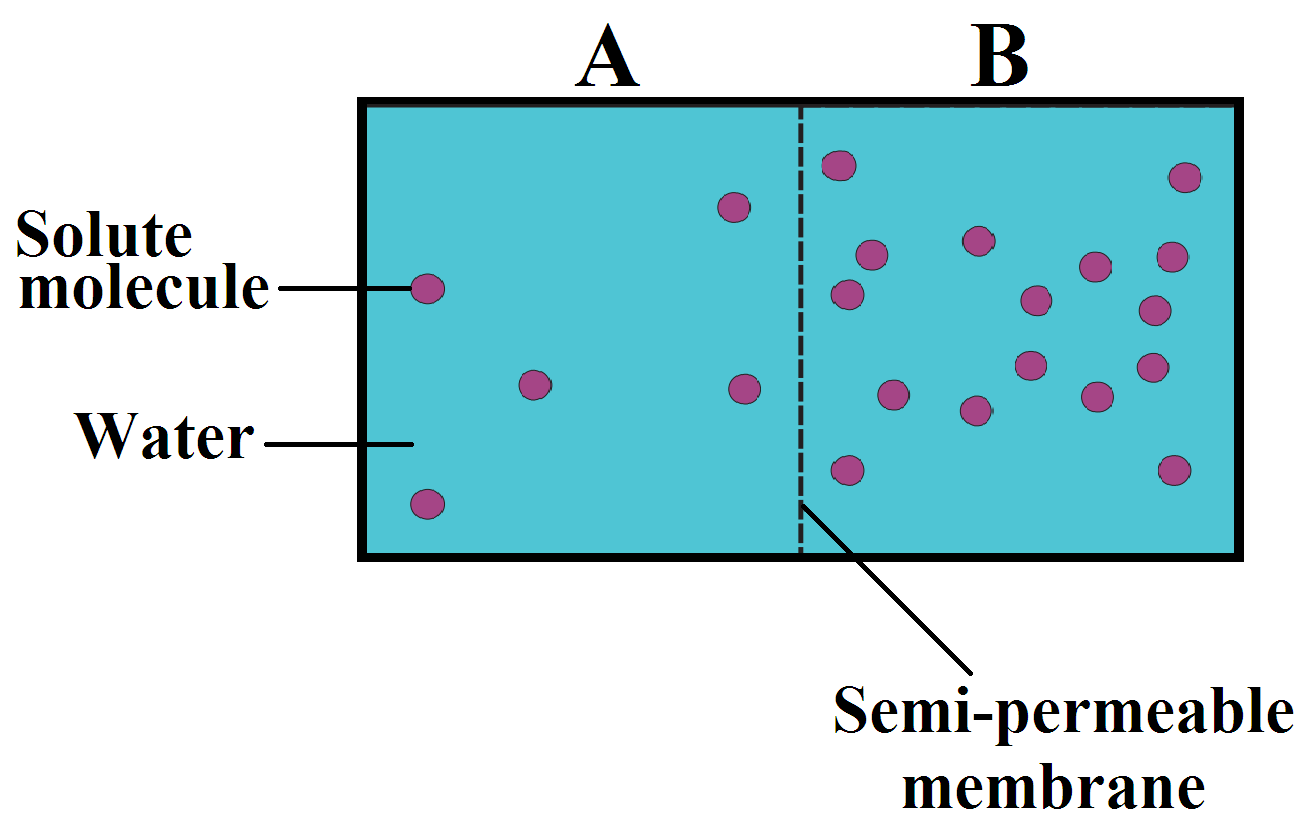
MCQ 761 Mark
Based on the figure given below which of the following statements is not correct?
  • A
    Movement of solvent molecules will take place from chamber $A$ to $B.$
  • Movement of solute will take place from $A$ to $B.$
  • C
    Presence of a semipermeable is a pre$-$requisite for this process to occur.
  • D
    The direction and rate of osmosis depends on both the pressure gradient and concentration gradient.
Answer
Correct option: B.
Movement of solute will take place from $A$ to $B.$
Movement of solvent always takes place from high solvent concentration to low solvent concentration. Solute never moves through a semipermeable membrane.
View full question & answer
MCQ 771 Mark
In case of osmosis the movement of water takes place in which direction?
  • From high chemical concentration to low chemical concentration.
  • B
    From low chemical concentration to high chemical concentration.
  • C
    There is random movement of water molecules.
  • D
    None of these.
Answer
Correct option: A.
From high chemical concentration to low chemical concentration.
View full question & answer
MCQ 781 Mark
Which of the following factor is responsible for regulating the size of the potato slices during osmosis:
  • Increased salt concentration
  • B
    Increased pressure
  • C
    Increased temperature
  • D
    Increased humidity
Answer
Correct option: A.
Increased salt concentration
View full question & answer
MCQ 791 Mark
The movement of water from one cell to the next in the root cortex, is due to:
  • Water potential gradient.
  • B
    Accumulation of inorganic salts.
  • C
    Accumulation of organic compounds.
  • D
    All of the above.
Answer
Correct option: A.
Water potential gradient.
View full question & answer
MCQ 801 Mark
Dry seeds kept in water swell due to:
  • A
    Absorption.
  • B
    Diffusion.
  • Imbibition.
  • D
    None of these.
Answer
Correct option: C.
Imbibition.
Imbibition is a type of diffusion in which water is absorbed by solids or colloids which leads to increase in volume. This happens in case of dry wood and seeds.
View full question & answer
MCQ 811 Mark
Which is correct about transport or conduction of substances?
  • A
    Organic food moves up through phloem.
  • B
    Organic food moves up through xylem.
  • C
    Inorganic food moves upwardly and downwardly through xylem.
  • Organic food moves upwardly and downwardly through phloem.
Answer
Correct option: D.
Organic food moves upwardly and downwardly through phloem.
View full question & answer
MCQ 821 Mark
In rainy season, door gets swelled due to:
  • Imbibition.
  • B
    Transpiration.
  • C
    Diffusion.
  • D
    Respiration.
Answer
Correct option: A.
Imbibition.
Imbibition.
View full question & answer
MCQ 831 Mark
In the process of plasmolysis:
  • A
    Endosmosis occurs
  • Exosmosis occurs
  • C
    Imbibition occurs
  • D
    Diffusion occurs
Answer
Correct option: B.
Exosmosis occurs
Plasmolysis occurs due to shrinkage of protoplasm when a plant cell is kept in a hypertonic medium.
In a hypertonic medium, water flows out from a cell to the surrounding medium is called as exosmosis leading to plasmolysis.
View full question & answer
MCQ 841 Mark
$\Psi_s$ is always:
  • A
    Positive.
  • B
    Zero.
  • Negative.
  • D
    One.
Answer
Correct option: C.
Negative.
$\Psi_s$ is always negative.
View full question & answer
MCQ 851 Mark
Guttation is common among the plants of $..........$ climate:
  • A
    Hot and wet
  • B
    Hot and windy
  • Cold and humid
  • D
    Cold and windy
Answer
Correct option: C.
Cold and humid
The exudation of xylem sap at the edges or tips of the leaves of some vascular plants, like grasses is called guttation.
Unlike transpiration, it takes place only in certain conditions like cool and highly humid atmosphere.
It is because plants can absorb up a limited amount of water.
The excess water is secreted from the roots through the xylem and out through the hydathodes or water glands.
View full question & answer
MCQ 861 Mark
Which of the following statement is correct:
  • Osmotic pressure of solution is greater than pure solvent.
  • B
    Osmotic pressure of solution is lower than the pure water.
  • C
    Osmotic pressure of solution is equal.
  • D
    None of the above
Answer
Correct option: A.
Osmotic pressure of solution is greater than pure solvent.
Osmotic pressure develops due to addition of solute particles.
As a solution is expected to have more solute particles as compared to a pure solvent.
The solution will always have more osmotic pressure than pure solvent.
View full question & answer
MCQ 871 Mark
Water potential of pure water at standard temperature is equal to:
  • A
    $1$
  • B
    $20$
  • Zero.
  • D
    none of these.
Answer
Correct option: C.
Zero.
By convention, water potential of pure water at standard temperature is taken as zero.
View full question & answer
MCQ 881 Mark
Movement of ions or molecules in a direction opposite to that of prevailing electrochemical gradient is known as:
  • Active transport.
  • B
    Brownian movement.
  • C
    Diffusion.
  • D
    Pinocytosis.
Answer
Correct option: A.
Active transport.
Active transport.
View full question & answer
MCQ 891 Mark
In which of the following plant sunken stomata are found?
  • Nerium.
  • B
    Hydrilla.
  • C
    Mango.
  • D
    Guava.
Answer
Correct option: A.
Nerium.
Nerium.
View full question & answer
MCQ 901 Mark
Main function of lenticel is:
  • A
    Transpiration.
  • Guttation.
  • C
    Gaseous exchange.
  • D
    Bleeding.
Answer
Correct option: B.
Guttation.
Guttation.
View full question & answer
MCQ 911 Mark
Guttation is caused by.
  • A
    Transpiration.
  • B
    Osmosis/ $\text{DPD.}$
  • Root pressure.
  • D
    Osmotic pressure.
Answer
Correct option: C.
Root pressure.
Root pressure.
View full question & answer
MCQ 921 Mark
Plasmolysis occurs when the cell is placed in:
  • A
    Isotonic solution.
  • Hypertonic solution.
  • C
    Hypotonic solution.
  • D
    None of the above.
Answer
Correct option: B.
Hypertonic solution.
View full question & answer
MCQ 931 Mark
What are the types of osmosis:
  • A
    Endosmosis
  • B
    Exosmosis
  • Both $A$ and $B$
  • D
    None of these
Answer
Correct option: C.
Both $A$ and $B$
Osmosis is regulated by the inflow and outflow of water molecules from the cell or body through a semipermeable membrane.
Endosmosis is the inflow of water or solvent whereas, exosmosis is the outflow of water or solvent from the cell through a semipermeable membrane.
View full question & answer
MCQ 941 Mark
Which of the following elements plays an important role in opening of stomata?
  • A
    Sodium.
  • Potassium.
  • C
    Calcium.
  • D
    Magnesium.
Answer
Correct option: B.
Potassium.
Potassium.
View full question & answer
MCQ 951 Mark
The phenomenon of plasmolysis is evident when cells are kept in:
  • Hypertonic solution.
  • B
    Isotonic solution.
  • C
    None of the above.
  • D
    Hypotonic solution.
Answer
Correct option: A.
Hypertonic solution.
View full question & answer
MCQ 961 Mark
When a plant undergoes senescence, the nutrients may be:
  • A
    Accumulated.
  • B
    Bound to cell wall.
  • Translocated.
  • D
    None of these.
Answer
Correct option: C.
Translocated.
Mineral ions are frequently remobilized $($translocation$)$, particularly from older senescing parts. Before the leaf fall in deciduous plants, minerals are translocated to other parts.
View full question & answer
MCQ 971 Mark
Select the odd one our w.r.t. porins:
  • Not associated with the inner membrane of plastids
  • B
    Associated with the outer membrane of mitochondria
  • C
    Found in outer membrane of gram positive bacteria
  • D
    Allow movement of low molecular weight hydrophilic substances
Answer
Correct option: A.
Not associated with the inner membrane of plastids
Porins are beta barrel proteins that cross a cellular membrane and act as a pore, through which molecules can diffuse.
Unlike other membrane transport proteins, porins are large enough to allow passive diffusion,
i.e., they act as channels that are specific to different types of molecules.
Porins from non$-$green plastids and from the outer mitochondrial membrane were re$-$constituted into planar lipid bi$-$layers.
The proteins showed high pore-forming activities and similar single$-$channel conductance.
View full question & answer
MCQ 981 Mark
Which of the following is a characteristic of mass flow movement?
  • A
    Huge mass is moved.
  • Movement is in bulk.
  • C
    Huge pressure is required.
  • D
    Larger porins helps transport large mass.
Answer
Correct option: B.
Movement is in bulk.
View full question & answer
MCQ 991 Mark
The shrinking of protoplasm in a plant cell, is called as:
  • Plasmolysis
  • B
    Deplasmolysis
  • C
    Flaccidity
  • D
    Turgidity
Answer
Correct option: A.
Plasmolysis
Plasmolysis in a plant cell is defined as the process of shrinkage of the protoplasm as a result of loss of water from the cell.
It occurs when plant cells are placed in a solution that has a higher concentration of solutes than the cell does.
In this, plant cell is kept in hypertonic solution. When cell is placed in hypotonic solution, it is called as turgidity.
If plant cell is kept in an isotonic solution so that it is neither turgid nor plasmolyzed, it is called as flaccidity.
View full question & answer
MCQ 1001 Mark
Which of the following is true about diffusion?
  • A
    There is no expenditure of energy.
  • B
    Molecules move in Brownian motion.
  • C
    Substances moves from the region of higher concentration to the region of lower concentration.
  • Diffusion depends on the type of living system.
Answer
Correct option: D.
Diffusion depends on the type of living system.
Diffusion is a slow process, it is not dependent on the living systems.
View full question & answer
MCQ 1011 Mark
In seed germination, the first phenomenon to take place is:
  • A
    Osmosis
  • B
    Active transport
  • C
    Absortion
  • Imbibition
Answer
Correct option: D.
Imbibition
Imbibition is the first phenomenon in seed germination.
Imbibition is a passive physical process and is actually adsorption of water by the dry surface.
It causes swelling of dry seeds. Water is the medium for all the metabolic reactions in the living system.
Hence, the most important requirement of seed germination is water.
Dry seeds adsorb water which marks the beginning of seed germination.
View full question & answer
MCQ 1021 Mark
When a seed is soaked overnight in water, what happens to its cells?
  • A
    They become flaccid.
  • They become turgid.
  • C
    They become either flaccid or turgid.
  • D
    No change.
Answer
Correct option: B.
They become turgid.
They become turgid.
View full question & answer
MCQ 1031 Mark
Root pressure develops as a result of:
  • Active absorption.
  • B
    Passive absorption.
  • C
    Increased rate of absorption.
  • D
    Increased rate of photosynthesis.
Answer
Correct option: A.
Active absorption.
Active absorption.
View full question & answer
MCQ 1041 Mark
The form of sugar transported through phloem is:
  • A
    Glucose.
  • B
    Fructose.
  • Sucrose.
  • D
    Ribose.
Answer
Correct option: C.
Sucrose.
Sucrose is a disaccharide. It is the most inactive form of sugar so used in transport.
View full question & answer
MCQ 1051 Mark
Which of the following will have higher concentration of solute?
  • A
    Isotonic solution.
  • B
    Hypotonic solution.
  • Hypertonic solution.
  • D
    Solution with high water potential.
Answer
Correct option: C.
Hypertonic solution.
View full question & answer
MCQ 1061 Mark
The movement of mineral ions into plant root cells as a result of diffusion is called:
  • Passive absorption.
  • B
    Active absorption.
  • C
    Osmosis.
  • D
    Endocytosis.
Answer
Correct option: A.
Passive absorption.
Passive absorption.
View full question & answer
MCQ 1071 Mark
From active hydathodes, the water comes out by:
  • A
    Osmotic pressure
  • B
    Secreted by force developed within cells
  • Root pressure
  • D
    None of the above
Answer
Correct option: C.
Root pressure
From hydathodes water is lost in liquid form through a process called as guttation.
The force responsible for guttation is root pressure.
Guttation occurs when loss of water through transpiration is less and excess water is absorbed by plant roots.
View full question & answer
MCQ 1081 Mark
Which condition favors guttation:
  • High humidity
  • B
    Low humidity
  • C
    More transpiration
  • D
    Bright sunlight
Answer
Correct option: A.
High humidity
Guttation is the phenomenon of the release of small water droplets from the pores of the plants.
It is done in order to release the extra water out of the plant in very humid conditions.
It is commonly seen in mesophytes.
During the absence of sunlight stomata are closed so there is minimal transpiration.
Hence there is a need for guttation.
View full question & answer
MCQ 1091 Mark
Sieve tubes are suited for translocation of food because they possess:
  • A
    Bordered pits.
  • B
    No ends walls.
  • Broader lumen and perforated cross walls.
  • D
    No protoplasm.
Answer
Correct option: C.
Broader lumen and perforated cross walls.
View full question & answer
MCQ 1101 Mark
Osmotic pressure in the leaf cells is positive during:
  • Excessive transpiration.
  • B
    Low transpiration.
  • C
    Excessive absorption.
  • D
    Guttation.
Answer
Correct option: A.
Excessive transpiration.
View full question & answer
MCQ 1111 Mark
Which of the following process is responsible for the loss of extra water from the plants:
  • A
    Transpiration
  • Guttation
  • C
    Both $A$ and $B$
  • D
    Translocation
Answer
Correct option: B.
Guttation
Guttation is the loss of water in liquid form as a dilute solution of water, salts, and sugars from uninjured leaf tips.
The uninjured leaf tips have hydathodes or water stomata.
Under conditions of low transpiration dilute solution of minerals oozes out through them under the influence of increased root pressure.
View full question & answer
MCQ 1121 Mark
Which of the following is responsible for passive guttation:
  • A
    Tension$-$cohesion of water molecules
  • B
    Activity of epithem tissue
  • Root pressure
  • D
    Secretion of fluid by mesophyll cells
Answer
Correct option: C.
Root pressure
Guttation is the loss of water in the form of liquid through hydathodes.
The most important force responsible for guttation is root pressure, which develops in conditions of high humidity, because when roots absorb mineral salts water follows passively but transpiration loss of water is less.
View full question & answer
MCQ 1131 Mark
Which of the following is used as antitranspirant?
  • A
    Cobalt chloride.
  • Phenyl mercuric acetate.
  • C
    Naphthol acetic acid.
  • D
    Calcium carbonate.
Answer
Correct option: B.
Phenyl mercuric acetate.
View full question & answer
MCQ 1141 Mark
What does a plant cell show if placed in sea water:
  • Plasmolysis
  • B
    Reverse osmosis
  • C
    Deplasmolysis
  • D
    Diffusion
Answer
Correct option: A.
Plasmolysis
The seawater is hypertonic to cell sap because of the higher concentration of dissolved solutes.
Thus, water will move out of the cells towards the surrounding solution i.e. from high water potential to low water potential.
This leads to the shrinking of protoplasm away from the cell wall of a plant or bacterium. This is known as plasmolysis.
Hence, if we place a plant cell in seawater it will undergo plasmolysis.
View full question & answer
MCQ 1151 Mark
Loss of water from tip of leaves is called:
  • Guttation
  • B
    Transpiration
  • C
    Evaporation
  • D
    Respiration.
Answer
Correct option: A.
Guttation
Transpiration is the process in which water vapours are released from the stomata.
Respiration is a metabolic process in which oxygen is used to break down food and carbon dioxide and energy are released.
Evaporation is the process of conversion of liquid water into water vapour.
Guttation is the process of loss of water droplets from pores known as hydathodes and tips of leaves.
View full question & answer
MCQ 1161 Mark
Mark the mismatched pair.
  • Amyloplast – Store protein granule
  • B
    Elaioplast – Store oils or fats
  • C
    Chloroplasts $-$ Contain chlorophyll pigments
  • D
    Chromoplasts – Contain coloured pigments other than chlorophyll
Answer
Correct option: A.
Amyloplast – Store protein granule
Amyloplasts are the colorless plastids which store starch but not the protein granules. Other pairs are correctly matched.
View full question & answer
MCQ 1171 Mark
Which one of the following will not directly affect transpiration?
  • A
    Temperature.
  • B
    Light.
  • C
    Wind speed.
  • Chlorophyll content of leaves.
Answer
Correct option: D.
Chlorophyll content of leaves.
External factors affecting the rate of transpiration are : atmospheric temperature, relative humidity, light, wind velocity, atmospheric pressure and available soil water. Some internal factors also affect rate of transpiration e.g., leaf area, leaf structure and age of plants. Chlorophyll content of leaves does not directly affect rate of transpiration.
View full question & answer
MCQ 1181 Mark
Which of the following is used to determine the rate of transpiration in plants?
  • A
    Porometer.
  • Potometer.
  • C
    Auxanometer.
  • D
    Tensiometer.
Answer
Correct option: B.
Potometer.
Potometer.
View full question & answer
MCQ 1191 Mark
Which one of the following process help the water$-$soluble inorganic nutrients go down into the soil horizon and get precipitated as unavailable salts?
  • Leaching.
  • B
    Fragmentation.
  • C
    Catabolism.
  • D
    None of these.
Answer
Correct option: A.
Leaching.
Leaching.
View full question & answer
MCQ 1201 Mark
Water logging of soil makes it physiologically dry because:
  • A
    This condition does not allow the capillary force to work.
  • B
    Both.
  • This condition does not allow oxygen to enter the soil.
  • D
    None of the above.
Answer
Correct option: C.
This condition does not allow oxygen to enter the soil.
View full question & answer
MCQ 1211 Mark
The process of the escape of liquid from the tip of uninjured leaf is called as:
  • A
    Evaporation
  • B
    Transpiration
  • Guttation
  • D
    None of the above
Answer
Correct option: C.
Guttation
Guttation is loss of water in liquid form as a dilute solution from uninjured leaf tips.
The uninjured leaf tips have hydathodes or water stomata.
Under conditions of low transpiration dilute solution of minerals oozes out through them under the influence of increased root pressure.
View full question & answer
MCQ 1221 Mark
Which of the following is not a controlled process:
  • A
    Transpiration
  • Guttation
  • C
    Both $A$ and $B$
  • D
    None of the above
Answer
Correct option: B.
Guttation
Transpiration is the loss of water through stomata in vapour form.
Transpiration is regulated through guard cells.
Guttation is the loss of water in liquid form through hydathodes.
Hydathodes are free ends of vascular supply of leaves.
Hydathodes are always open and not regulated by any cells.
View full question & answer
MCQ 1231 Mark
Adding solute to pure water will cause development of:
  • A
    Positive water potential
  • B
    More positive water potential
  • C
    More negative water potential
  • Negative water potential
Answer
Correct option: D.
Negative water potential
View full question & answer
MCQ 1241 Mark
Solution outside a cell has higher concentration than cytoplasm, then the solution is:
  • Hypertonic.
  • B
    Acidic.
  • C
    Isotonic.
  • D
    Hypotonic.
Answer
Correct option: A.
Hypertonic.
Hypertonic.
View full question & answer
MCQ 1251 Mark
Cells absorb water by:
  • A
    Osmosis
  • Osmosis and imbibition
  • C
    Imbibition alone
  • D
    Diffusion
Answer
Correct option: B.
Osmosis and imbibition
View full question & answer
MCQ 1261 Mark
Net movement of water from a dilute to a concentrated solution through a selectively permeable membrane is called
  • A
    Diffusion
  • B
    Dispersion
  • Osmosis
  • D
    Absorption
Answer
Correct option: C.
Osmosis
Osmosis is the process of net movement of water across a permeable membrane driven by a difference in solute concentration on two sides of the membrane.
View full question & answer
MCQ 1271 Mark
Guttation occurs in:
  • Early morning
  • B
    Noon
  • C
    Evening
  • D
    Morning $10$ O'clock
Answer
Correct option: A.
Early morning
Guttation occurs when loss of water is minimum. Usually, early morning, when transpiration is low especially when the previous night was warm and humid, plants show liquid drops on leaves.These are not dew drops but the water that has oozed out through hydathodes.
View full question & answer
MCQ 1281 Mark
Which of the following is related with transfer of food material:
  • A
    Xylem
  • B
    Collenchyma
  • Phloem
  • D
    Parenchyma
Answer
Correct option: C.
Phloem
Xylem tissue is comprised of dead cells involved in the process of transport of water and minerals.
Transport of water is under the influence of transpiration pull and is a physical process.
Phloem tissue is comprised of living cells involved in the process of translocation of sugars.
Translocation of sugars requires living cells and is a physiological process.
The sugars are transported under the influence of pressure difference between source and sink, which leads to mass flow
View full question & answer
MCQ 1291 Mark
The water potential and osmotic potential of pure water are.
  • A
    $100$ and zero
  • Zero and zero
  • C
    $100$ and $200$
  • D
    Zero and $100$
Answer
Correct option: B.
Zero and zero
Zero and zero
View full question & answer
MCQ 1301 Mark
When a flaccid cell is placed in water:
  • Its $\text{OP}$ increses
  • B
    Its $\text{TP}$ increses
  • C
    Its $\text{DPP}$ increses
  • D
    All of these
Answer
Correct option: A.
Its $\text{OP}$ increses
$\text{OP}$ is Osmotic pressure which is the hydrostatic pressure developed in a solution when it is separated from pure solvent by a semi permeable membrane in a rigid vessel.
When the flaccid cell is placed in water then the pure solvent is water, the cytoplasm of the cell is solution and the sell membrane is semi permeable membrane.
View full question & answer
MCQ 1311 Mark
Two types of molecules cross the membrane in the same direction, it is called as:
  • A
    Uniport.
  • Symport.
  • C
    Antiport.
  • D
    Multiport.
Answer
Correct option: B.
Symport.
In symport, two types of molecules cross the membrane in the same direction.
View full question & answer
MCQ 1321 Mark
In soil, the water available for root absorption is:
  • A
    Combined water.
  • B
    Gravitational water.
  • C
    Hygroscopic water.
  • Capillary water.
Answer
Correct option: D.
Capillary water.
Capillary water.
View full question & answer
MCQ 1331 Mark
Death of protoplasm is a pre-requisite for a vital function like.
  • Transport of sap.
  • B
    Transport of food.
  • C
    Aabsorption of water.
  • D
    Gaseous exchange.
Answer
Correct option: A.
Transport of sap.
Transport of sap.
View full question & answer
MCQ 1341 Mark
Opening and closing of stomata is due to:
  • A
    Hormonal changes in the guard cells.
  • Changes in the turgor pressure of guard cells.
  • C
    Respiration of guard cells.
  • D
    Cytoplasmic streaming.
Answer
Correct option: B.
Changes in the turgor pressure of guard cells.
View full question & answer
MCQ 1351 Mark
Tension is a result of which of the following?
  • A
    The cohesive nature of water.
  • B
    The narrowness of the xylem tube.
  • Transpiration at the leaf surface.
  • D
    All of the above.
Answer
Correct option: C.
Transpiration at the leaf surface.
View full question & answer
MCQ 1361 Mark
Guttation is caused due to:
  • A
    Imbibition
  • B
    Osmosis
  • Positive root pressure
  • D
    Transpiration
Answer
Correct option: C.
Positive root pressure
Guttation is the loss of water in liquid form as a dilute solution from uninjured leaf tips.
The uninjured leaf tips have hydathodes or water stomata. Under conditions of low transpiration dilute solution of minerals oozes out through them under the influence of increased root pressure.
View full question & answer
MCQ 1371 Mark
In guard cells when sugar is converted into starch the stomatal pore.
  • A
    Opens fully.
  • B
    Opens partially.
  • Closes completely $S P.$
  • D
    Remains unchanged.
Answer
Correct option: C.
Closes completely $S P.$
View full question & answer
MCQ 1381 Mark
Choose the correct statement$/$ statements. Pumps in active transport are:
  1. Lipids that bind molecules to pass them through the membrane.
  2. Transport molecules uphill.
  3. These are specific transporters.
  4. These are sensitive to inhibitors.
  • A
    $i$ and $iii$
  • B
    $i, ii$ and $iv$
  • $ii, iii$ and $iv$
  • D
    $iii$ and $iv$
Answer
Correct option: C.
$ii, iii$ and $iv$
Pumps in active transport are proteins that bind molecules to pass them through the membrane.
View full question & answer
MCQ 1391 Mark
Guttation is caused by:
  • A
    Osmotic pressure.
  • B
    Transpiration.
  • C
    Diffusion pressure deficit.
  • Root pressure.
Answer
Correct option: D.
Root pressure.
Root pressure.
View full question & answer
MCQ 1401 Mark
Substances which need facilitated diffusion have which kind of moiety?
  • A
    Hydrophobic.
  • Hydrophilic.
  • C
    Lipophilic.
  • D
    Lipophobic.
Answer
Correct option: B.
Hydrophilic.
Hydrophilic.
View full question & answer
MCQ 1411 Mark
Choose the correct sequence of water movement in the plants.
  • A
    Cortex, protoxylem, endodermis, root hair, pericycle, metaxylem.
  • Root hair, cortex, endodermis, pericycle, protoxylem, metaxylem.
  • C
    Root hair, protoxylem, metaxylem, pericycle, cortex, endodermis.
  • D
    Root hair, pericycle, endodermis, cortex, protoxylem, metaxylem.
Answer
Correct option: B.
Root hair, cortex, endodermis, pericycle, protoxylem, metaxylem.
Water is absorbed from soil by root hair. This is then carried by cortex, then passed to endodermis.
Endodermis passes water to Perivale then to protoxylem and metaxylem.
View full question & answer
MCQ 1421 Mark
If a soft stemmed plant, is cut horizontally near the base of its stem with a sharp blade on early morning of a humid day, drops of solution ooze through cut stem. This is due to:
  • Root pressure.
  • B
    Bleeding.
  • C
    Guttation.
  • D
    Transpiration pull.
Answer
Correct option: A.
Root pressure.
Root pressure.
View full question & answer
MCQ 1431 Mark
The direction and rate of water movement from cell to cell is based on:
  • A
    $\text{WP}$
  • B
    $\text{TP}$
  • $\text{DPD}$
  • D
    Incipient plasmolysis.
Answer
Correct option: C.
$\text{DPD}$
$\text{DPD}$
View full question & answer
MCQ 1441 Mark
Cohesion theory of water movement in plants was put forth by.
  • Henry Dixon.
  • B
    F. F. Blackman.
  • C
    Melvin cycle.
  • D
    Hans. A. Krebs.
Answer
Correct option: A.
Henry Dixon.
Henry Dixon.
View full question & answer
MCQ 1451 Mark
Due to plasmoysis, the plant cell:
  • A
    Bursts
  • B
    Swells up
  • C
    Become turgid
  • Become flaccid
Answer
Correct option: D.
Become flaccid
The cell will burst, swell or become turgid when endosmosis occurs i.e., water enters the cell.
In case exosmosis occurs water moves from inside the cell to surrounding solution and the plant cell becomes flaccid.
View full question & answer
MCQ 1461 Mark
A plasmolysed cell can be deplasmolysed by placing it in:
  • A
    Isotonic solution
  • B
    Hypertonic solution
  • C
    Saturated solution
  • Pure water or hypotonic solution
Answer
Correct option: D.
Pure water or hypotonic solution
When a plasmolyzed cell is kept in pure water or hypotonic medium, the cell will uptake water due to the process of endosmosis.
This water uptake will increase turgor inside the cell and cell will become deplasmolysed.
View full question & answer
MCQ 1471 Mark
The initial stage of water absorption by root cells is by:
  • A
    Adsorption
  • B
    Absorption
  • C
    Osmosis
  • Imbibition
Answer
Correct option: D.
Imbibition
The initial stage of water absorption is always imbibition.
Imbibition is a process of absorption water by dry surface and causing them to enormously increase in volume.
The classical examples of imbibition are the absorption of water by seeds and dry wood.
View full question & answer
MCQ 1481 Mark
Which one of the following is not related to guttation:
  • A
    Water is given out in the form of droplets
  • B
    Water given out is impure
  • C
    Water is given out early morning
  • Guttation is of universal occurrence
Answer
Correct option: D.
Guttation is of universal occurrence
Guttation is the loss of water in a dilute solution form which consists salts and minerals and waters when transpiration is low.
Guttation is not shown by all the plants and is especially common in humid tropics.
It occurs in the absence of light or at night and thus present at the tip of leaves in early morning.
View full question & answer
MCQ 1491 Mark
When plant cells are kept in a concentrated salt solution, they are
  • A
    Deplasmolysed
  • Plasmolysed
  • C
    Remain as such
  • D
    Become turgid
Answer
Correct option: B.
Plasmolysed
Plasmolysed
View full question & answer
MCQ 1501 Mark
Which of the following is not a function of water in cell:
  • It provides energy for chemical reaction.
  • B
    It act as a solvent.
  • C
    It provides medium for chemical reaction.
  • D
    It releases hydrogen ions on ionisation.
Answer
Correct option: A.
It provides energy for chemical reaction.
Water is universal solvent and acts as medium for chemical reactions.
It can release hydrogen ions on ionisation but does not provides energy.
$\text{ATP}$ provides energy in living system.
$\text{ATP}$ is universal energy currency.
In fact energy is required to break water, because otherwise water is a very stable molecule and has the capacity to form hydrogen bonds.
View full question & answer
MCQ 1511 Mark
Apoplast movement of water occurs:
  • Through cell wall
  • B
    Through plasma membrane
  • C
    Through cytoplasm
  • D
    Through middle lamella only
Answer
Correct option: A.
Through cell wall
Through cell wall
View full question & answer