Questions

5 Marks Questions

Take a timed test

5 questions · self-marked practice — reveal the answer and mark yourself.

Question 15 Marks
Image
Answer
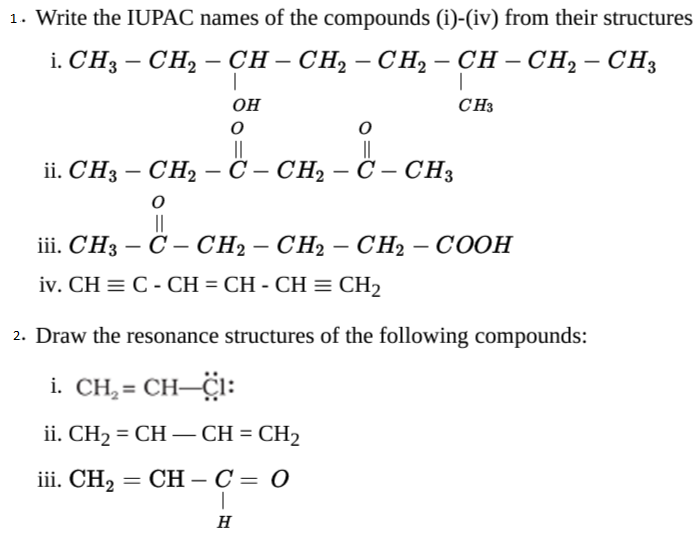
1. i. 6-methyl octan-3-ol,
ii. Hexane-2,4-dione,
iii. 5-oxohexanoic acid,
iv. Hexa-1, 3-dien-5-yne
2. Resonance structure of the given compounds are as follows:

View full question & answer
Question 25 Marks
i. Which bond is more polar in the following pairs of molecules:
a. $H _3 C - H , H _3 C - Br$
b. $H _3 C - NH _2, H _3 C - OH$
c. $H _3 C - OH , H _3 C - SH$
ii. Explain the principle of paper chromatography.
Answer
i. a. $CH _3- Br$, since Br is more electronegative than H
b. $H _3 C - OH$, since O is more electronegative than N .
c. $H _3 C - OH$, since O is more electronegative than S .
ii. This is the simplest form of chromatography. Here a strip of paper acts as an adsorbent. It is based on the principle which is partly adsorption. The paper is made of cellulose fibres with molecules of water adsorbed on them. This acts as stationary phase. The mobile phase is the mixture of the components to be identified prepared in a suitable solvent.
View full question & answer
Question 35 Marks
Calculate the degree of ionization of 0.05 M acetic acid if its $pK _{ a }$ value is 4.74 . How is the degree of dissociation affected when its solution also contains
a. 0.01 M
b. $0.1 M HCl ?$
Answer
$
pK_{a}=-\log K_{a}=4.74
$
or $\log K _{ a }=-4.74=\overline{5} .26 \therefore K_a=1.82 \times 10^{-5}$
$
\alpha=\sqrt{K_a / C}=\sqrt{\left(1.82 \times 10^{-5}\right) /\left(5 \times 10^{-2}\right)}=1.908 \times 10^{-2}
$
In presence of HCl , due to high concentration of $H ^{+}$ion, dissociation equilibrium will shift backward, i.e. dissociation of acetic acid will decrease.
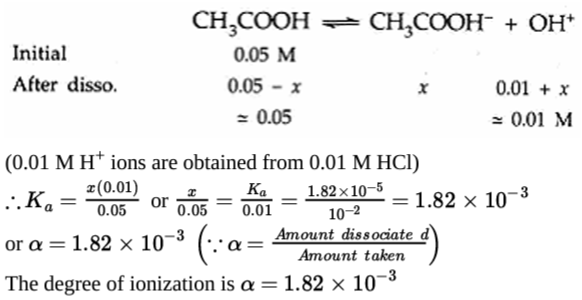
a. In presence of 0.01 MHCl , if x is the amount dissociated, then
Image
b. In the presence of 0.1 M HCl , if y is the amount of acetic acid dissociated, then at equilibrium
$
\begin{aligned}
& {\left[CH_3 COOH\right]=0.05-y \simeq 0.05 M} \\
& {\left[CH_3 COO^{-}\right]=y,\left[H^{+}\right]=0.1 M+y \simeq 0.1 M} \\
& K_a=\frac{y(0.1)}{0.05} \text { or } \frac{y}{0.05}=\frac{K_2}{0.1}=\frac{1.82 \times 10^{-5}}{10^{-1}}=1.82 \times 10^{-4} \text { i.e. } \\
& \alpha=1.82 \times 10^{-4}
\end{aligned}
$
The degree of ionization is $\alpha=1.82 \times 10^{-4}$
View full question & answer
Question 45 Marks
$K _1$ and $K _2$ for dissociation of $H _2 S$ are $4 \times 10^{-3}$ and $1 \times 10^{-5}$. Calculate sulphide ion concentration in $0.1 M H _2 S$ solution.
Answer

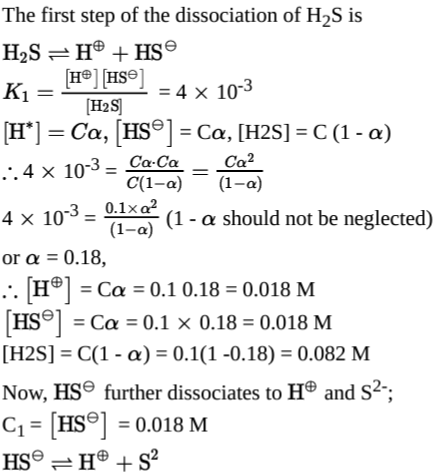
Image
1$0$$0$
$\left(1-\alpha_1\right)$$\alpha_1$$\alpha_1$

$\therefore K _2=1 \times 10^{-5}=0.018$ and thus, dissociation of $HS ^{\ominus}$ further suppresses due to common ion effect and $1-\alpha \approx 1$
$
\begin{aligned}
& \therefore 1 \times 10-5=\frac{0.018 \times C_1 \alpha_1}{C_1\left(1-\alpha_1\right)}=0.018 \times \alpha_1 \\
& \alpha_1=\frac{1 \times 10^{-5}}{0.018}=5.55 \times 10^{-4} \\
& {\left[S^{2-}\right]=C_1 \alpha_1=0.018 \times 5.55 \times 10^{-4}} \\
& =0.099 \times 10^{-4}
\end{aligned}
$
View full question & answer
Question 55 Marks
Attempt any five of the following:
(a) What happens when benzene is treated with acetyl chloride in presence of $AlCl _3$ ?
Image
(c) Classify the hydrocarbons according to the carbon-carbon bond.
(d) Arrange the following: $HCl , HBr , Hl , HF$ in order of decreasing reactivity towards alkenes.
(e) Why is $CH _2= CH - CH _2- Cl$ more easily hydrolysed than $CH _3- CH _2- CH _2- Cl$ ?
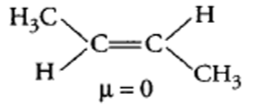
(f) Which of the two trans-but-2-ene or trans-pent-2-ene is non-polar?
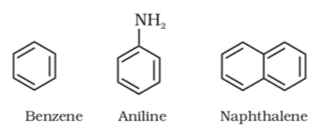
(g) What are benzenoids?
Answer
(a) Acetophenone is formed.
(b)
Image
(c)Hydrocarbons are categorized into three categories according to the carbon-carbon bond that exists between them:
i. Saturated hydrocarbon (In which carbon-carbon single bond are present)
ii. Unsaturated hydrocarbon (In which carbon-carbon double and triple bonds are present)
iii. Aromatic hydrocarbon (In which alternate single and double bond and $(4 n+2) \pi$ electrons are present)
(d) $HI > HBr > HCl > HF$
(e) Carbocation formed gets stabilised due to resonance.
(f)In trans-but-2-ene, the dipole moments of the two $C - CH _3$ bonds are equal and opposite and therefore, they cancel out each other.
Hence, trans-2-butene is non-polar.
Image
(g) Benzenoids: Aromatic hydrocarbon compound containing benzene ring are known as benzenoids. Examples for benzenoids are:
Image
View full question & answer