
Question
Image

Answer

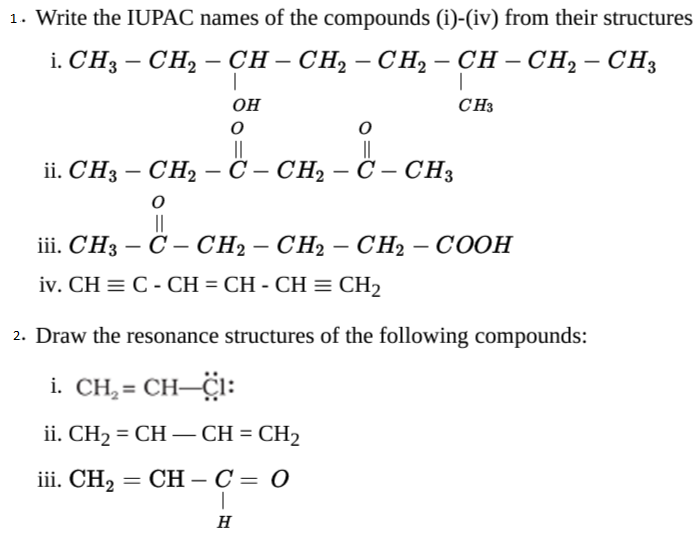
1. i. 6-methyl octan-3-ol,
ii. Hexane-2,4-dione,
iii. 5-oxohexanoic acid,
iv. Hexa-1, 3-dien-5-yne
2. Resonance structure of the given compounds are as follows:

Need a full question paper?

Generate a complete, print-ready paper with questions like this in minutes — across 16+ boards, with answer keys.

Start Generating Free

Similar questions

Explain the principle of paper chromatography.
At 700K, equilibrium constant for the reaction:
$\text{H}_2\text{ (g) + I}_2\text{ (g)}\rightleftharpoons2\text{HI (g)}$ is 54.8. If $0.5 ~mol L^{–1}$ of $HI(g)$ is present at equilibrium at 700K, what are the concentration of $H^2(g)$ and $I^2(g)$ assuming that we initially started with HI(g) and allowed it to reach equilibrium at 700K?
  1. Write the conjugate acid of $NH_3$.
  2. Assign reason for the following:
  1. A solution of $NH_4Cl$ in water shows pH less than 7.
  2. In qualitative analysis $NH_4Cl$ is added before adding $NH_4OH$ for testing $Fe^{3+}$ or $AP^{3+}$ ions.
  1. Consider the reaction:
$\text{N}_2(\text{g})+3\text{H}_2\text{(g)}\rightleftharpoons2\text{NH}_3+\text{Heat}$
Indicate the direction in which the equilibrium will shift when:
  1. Temperature is increased.
  2. Pressure is increased.
What is the significance of the terms — ‘isolated gaseous atom’ and ‘ground state’
while defining the ionization enthalpy and electron gain enthalpy?
Hint : Requirements for comparison purposes.
  1. Sketch the following molecular shapes and give the various bond angles in the structure linear, triangular planar, tetrahedral and octahedral.
  2. What are the shapes of $\mathrm{PCl}_5, \mathrm{NH}_3, \mathrm{BCl}_3, \mathrm{SF}_6, \mathrm{H}_2 \mathrm{O}, \mathrm{CCl}_4, \mathrm{SF}_4, \mathrm{ClF}_3,\left[\mathrm{BrF}_5\right]^{-}, \mathrm{XeF}_4, \mathrm{XeF}_2$
S. No.
Column I
Column II
1.
Gypsum
$NaHCO_3$
2.
Plaster of Paris
$Na_2CO_3.10H_2O$
3.
Bleaching powder
$CaSO_4.2H_2O$
4.
Washing soda
$\text{CaSO}_4\frac{1}{2}\text{H}_2\text{O}$
5.
Baking soda
$CaOCl_2$
Match the ions given in Column I with their nature given in Column II.
 
Column I
 
Column II
(i)
(a)
Stable due to resonance.
(ii)
$\text{F}_3-\text{C}^\oplus$
(b)
Destabilised due to inductive effect.
(iii)
$\ \ \ \ \ \ \ \ \ \ \ \ \text{CH}_3\\\ \ \ \ \ \ \ \ \ \ \ \ \ |\\\text{CH}_3-\text{C}^\ominus\\\ \ \ \ \ \ \ \ \ \ \ \ \ \ |\\\ \ \ \ \ \ \ \ \ \ \ \ \ \text{CH}_3$
(c)
Stabilised by hyperconjugation.
(iv)
$\ \ \ \ \ \ \ \ \ \ \ \ \ _\oplus\\\text{CH}_3-\text{CH}-\text{CH}_3$
(d)
A secondary carbocation.
The $Mn^{3+}$ ion is unstable in solution and undergoes disproportionation to give $Mn^{2+}, MnO_2,$ and $H^+$ ion. Write a balanced ionic equation for the reaction.
Structures of molecules of two compounds are given below:
  1. Which of the two compounds will have intermolccular hydrogen bonding and which compound is expected to show intramolecular hydrogen bonding?
  2. The melting point of a compound depends on. among other things, the extent of hydrogen bonding. On this basis explain which of the above two compounds will show higher melting point.
  3. Solubility of compounds in water depends on power to form hydrogen bonds with water. Which of the above compounds will form hydrogen bond with water easily and be more soluble in it?
How can production of hydrogen from water gas be increased by using water gas shift reaction?