Questions

5 Marks Questions

Take a timed test

5 questions · self-marked practice — reveal the answer and mark yourself.

Question 15 Marks
1. Suggest a method to purify
i. a liquid which decomposes at its boiling point.
ii. kerosene oil containing water.
iii. camphor containing traces of common salt.
2. Giving justification, categorise the following molecules/ions as nucleophile or electrophile:
$
\begin{aligned}
& HS^{-}, BF_3, C_2 H_5 O^{-},\left(CH_3\right)_3 N:, \\
& C \stackrel{+}{l}, C H_3-\stackrel{+}{C}=O, H_2 N \stackrel{+}{:}, \stackrel{+}{N} O_2
\end{aligned}
$
Answer
1. i. Distillation under reduced pressure.
ii. Since the two liquids are immiscible, the technique of solvent extraction with a separating funnel is used. Kerosene being lighter than water forms the upper layer while water forms the lower layer.
The lower water layer is run off when kerosene oil is obtained. It is dried over anhydrous $CaCl _2$ or $M _{ g } SO _4$ and then distilled to give pure kerosene oil.
iii. Sublimation Camphor sublimes while common salt remains as residue in the China dish.
2. Nucleophiles(reagent that brings electron pair): $HS ^{-}, C _2 H _5 O ^{-},\left( CH _3\right)_3 N$ :, $H _2 N$ :-
These species have unshared pair of electrons, which can be donated and shared with an electrophile.
Electrophiles(reagent which takes away electron pair): $BF _3, C \stackrel{+}{l}, CH _3-\stackrel{+}{ C }= O , \stackrel{+}{ N } O _2$
Reactive sites have only six valence electrons; can accept electron pair from a nucleophile.
View full question & answer
Question 25 Marks
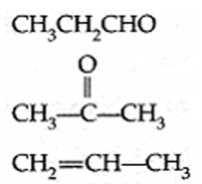
1. Write all structural isomers of molecular formula $C _3 H _6 O$
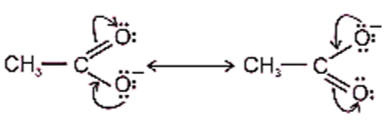
2. Write resonance structures of $CH _3 COO ^{-}$and show the movement of electrons by curved arrows.
Answer
1.
Image
2. First, write the structure and put unshared pairs of valence electrons on appropriate atoms. Then draw the arrows(half headed curved arrow) one at a time moving the electrons to get the other structures.
Image
View full question & answer
Question 35 Marks
Calculate the pH of a 0.10 M ammonia solution. Calculate the pH after 50.0 mL of this solution is treated with 25.0 mL of 0.10 M HCl . The dissociation constant of ammonia, $K _{ b }=1.77 \times 10^{-5}$
Answer
$
\begin{aligned}
& NH_3+H_2 O \longrightarrow NH_4^{+}+OH^{-} \\
& Kb=\left[NH_4^{+}\right]\left[OH^{-}\right] /\left[NH_3\right]=1.77 \times 10^{-5}
\end{aligned}
$
Before neutralization,
$
\begin{aligned}
& {\left[NH_3\right]=0.10-x=0.10} \\
& x^2 / 0.10=1.77 \times 10^{-5}
\end{aligned}
$
Thus, $x =1.33 \times 10^{-3}=\left[ OH ^{-}\right]$
Therefore,
$
\begin{aligned}
& {\left[H^{+}\right]=K_{w} /\left[OH^{-}\right]=10^{-14} /\left(1.33 \times 10^{-3}\right)=7.51 \times 10^{-12}} \\
& pH=-\log \left(7.5 \times 10^{-12}\right)=11.12
\end{aligned}
$
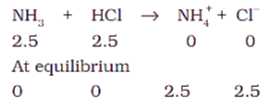
On addition of 25 mL of 0.1 M HCl solution (i.e., 2.5 mmol of HCl ) to 50 mL of 0.1 M ammonia solution (i.e., 5 mmol of $NH _3$ ), 2.5 mmol of ammonia molecules are neutralized. The resulting 75 mL solution contains the remaining unneutralized 2.5 mmol of $NH _3$ molecules and 2.5 mmol of $NH _4^{+}$
Image
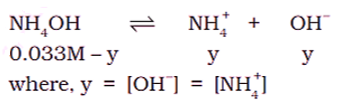
The resulting 75 mL of solution contains 2.5 mmol of $NH _4^{+}$ions (i.e., 0.033 M ) and 2.5 mmol (i.e., 0.033 M ) of neutralised $NH _3$ molecules. This $NH _3$ exists in the following equilibrium:
Image
The final 75 mL solution after neutralization already contains $2.5 m mol NH _4^{+}$ions (i.e. 0.033 M ), thus total concentration of $NH _4^{+}$ions is given as:
$
\left[NH_4^{+}\right]=0.033+y
$
As y is small, $\left[ NH _4 OH \right] \simeq 0.033 M$ and $\left[ NH _4^{+}\right] \simeq 0.033 M$.
We know,
$
\begin{aligned}
& K_{b}=\left[NH_4^{+}\right][OH] /\left[NH_4 OH\right] \\
& =y(0.033) /(0.033)=1.77 \times 10^{-5} M
\end{aligned}
$
Thus, $y =1.77 \times 10^{-5}=\left[ OH ^{-}\right]$
$
\left[H^{+}\right]=10^{-14} / 1.77 \times 10^{-5}=0.56 \times 10^{-9}
$
Hence, $pH =9.24$
View full question & answer
Question 45 Marks
The value of $K _{ p }$ for the reaction,
$
CO_2(g)+C(s) \rightleftharpoons 2 CO(g)
$
is 3.0 at 1000 K . If initially, $P_{ CO _2}=0.48$ bar and $P _{ CO }=0$ bar and pure graphite is present, calculate the equilibrium partial pressures of CO and $CO _2$.
Answer
For the reaction, let ' $x$ ' be the decrease in pressure of $CO _2$, then
$
CO_2(g)+C(s) \rightleftharpoons 2 CO(g)
$
Initial
pressure: 0.48 bar 0
At equilibrium: $(0.48- x )$ bar 2 x bar
$
\begin{aligned}
& K_p=\frac{p_{C O}^2}{p_{C O_2}^2} \\
& K_{p}=(2 x)^2 /(0.48-x)=3 \\
& 4 x^2=3(0.48-x) \\
& 4 x^2=1.44-x \\
& 4 x^2+3 x-1.44=0 \\
& a=4, b=3, c=-1.44 \\
& x=\frac{\left(-b \pm \sqrt{b^2-4 a c}\right)}{2 a}
\end{aligned}
$
$
\begin{aligned}
& x=\frac{-3 \pm \sqrt{3^2-4(4)(-1.44)}}{2(4)} \\
& =(-3 \pm 5.66) / 8 \\
& =(-3+5.66) / 8 \text { (as value of } x \text { cannot be negative hence we neglect that value) } \\
& x=2.66 / 8=0.33
\end{aligned}
$
The equilibrium partial pressures are,
$
\begin{aligned}
& P_{CO_2}=2 x=2 \times 0.33=0.66 bar \\
& P_{CO_2}=0.48-x=0.48-0.33=0.15 bar
\end{aligned}
$
View full question & answer
Question 55 Marks
Attempt any five of the following:
1. If $Qc < Kc$, when we continuously remove the product, what would be the direction of the reaction?
2. Explain the reason for the extraordinary stability of benzene in spite of the presence of three double bonds in it.
3. What effect does branching of an alkene chain has on its boiling point?
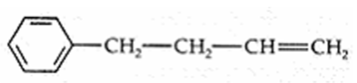
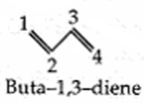
4. Write the IUPAC name:
Image
5. How will you demonstrate that double bonds of benzene are somewhat different from that of olefines?
6. Why do alkynes not show geometrical isomerism?
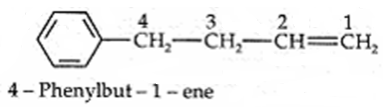
7. Write an IUPAC name:
Image
Answer
1. Continuous removal of a product maintains Qc at a value less than Kc and reaction continues to move in the forward direction.
2. Due to resonance, and delocalisation of electrons benzene is more stable.
3. Branching of carbon atom chain decreases the boiling point of alkane.
4.
Image
5. The double bonds of benzene are different from that of olefines as the double bonds of olefines decolourise $Br _2$ in $CCl _4$ and discharge the pink colour of Baeyer's reagent with simultaneous formation of a brown ppt. of $MnO _2$ while those of benzene do not.
6. Alkynes have a linear structure. Alkynes have triple bond. So, rotation is not possible. Hence, alkynes cannot show geometrical isomerism.
7. 
Image
View full question & answer