Questions

2 Marks Questions

Take a timed test

6 questions · self-marked practice — reveal the answer and mark yourself.

Question 12 Marks
What kind of information about an electron in an atom is obtained from its wave function?
Answer
The square of the amplitude of the electron wave, i.e, $\Psi^2$ at any point gives the probability of finding an electron at that point. since the region around the nucleus which represents the electron density at different points is called an orbital, hence the wave function for an electron in an atom is called orbital wave function.
View full question & answer
Question 22 Marks
Write a short note on hydrogenation of unsaturated aliphatic hydrocarbons.
Answer
When unsaturated compounds, i.e. alkenes or alkynes, are treated with dihydrogen in the presence of finely divided catalysts (i.e. Pt , Pd or Ni ), alkanes are obtained and the reaction is called hydrogenation reaction. As represented in the following reaction where ethene is converted into ethane.
$
\underset{\text { Ethene }}{eg CH_2}=CH_2+H_2 \xrightarrow{Pt \backslash Pd \backslash Ni} \underset{\text { Ethane }}{CH_3-} CH_3
$
View full question & answer
Question 32 Marks
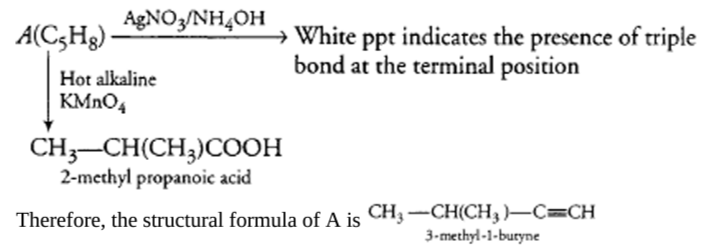
Hydrocarbon A (molecular formula is $C _5 H _8$ ) gave a white precipitate with ammoniacal silver nitrate. Oxidation of A with hot alkaline $KMnO _4$ gave 2-methyl propanoic acid. What is the structural formula of A?
Answer
White precipitate indicates that the triple bond is present at terminal position. The compound (A) is 3-methyl-1-butyne. It will oxidised in the presence of hot alkaline $KMnO _4$ to give 2-Methylpropanoic acid.
Image
View full question & answer
Question 42 Marks
What will be the mass of one ${ }^{12} C$ atom in g ?
Answer
Since,
the number of atoms in 1 mol of ${ }^{12} C$ atoms $=6.022 \times 10^{23}$ atoms $=$ Atomic mass of carbon -12 in gms. $=12 g$ Thus, $6.0022 \times 10^{23}$ atoms of ${ }^{12} C$ have mass $=12 g$ $\therefore 1$ atom of ${ }^{12} C$ will have mass $=\frac{12}{6.022 \times 10^{23}} g$ $=1.9927 \times 10^{-23} g$
View full question & answer
Question 52 Marks
1. How do the electronic configurations of the elements with $Z =107-109$ differ from one another?
2. $Rn ( Z =86)$ is the last noble gas discovered. Predict what will be the atomic number of the next noble gas to be discovered. Write its symbol.
Answer
1.
Atomic Number of element (Z)Electronic configurationNumber of electrons in 6d orbitalGroup Number
107$\begin{gathered}{[R n] 5 s^{14} 6 d^5} 7 s^2\end{gathered}$57
108$\begin{gathered}{[ Rn ] 5 s^{14} 6 d^6} 7 s^2\end{gathered}$68
109$\begin{gathered}{[R n] 5 s^{14} 6 d^7} 7 s^2\end{gathered}$79
It is clear that these elements differ in the number of electrons in the 6d-subshell and group number in periodic table.
2. 118, Uuo
View full question & answer
Question 62 Marks
The pH of a sample of vinegar is 3.76. Calculate the concentration of hydrogen ion in it.
Answer
We know that, $pH =-\log \left[ H ^{+}\right]$or $\log \left[ H ^{+}\right]=- pH =-3.76=\overline{4} .24$ Before taking antilog, add -1 in the characteristic $(-3)$ and +1 in mantissa (0.76), i.e. $(-3.76-1+1=\overline{4} .24)]$
$
\therefore\left[H^{+}\right]=\text {Anti } \log \overline{4} .24=1.738 \times 10^{-4} M=1.74 \times 10^{-4} M
$
View full question & answer