Questions

3 Marks Question

Take a timed test

7 questions · self-marked practice — reveal the answer and mark yourself.

Question 13 Marks
1. Calculate the gram molecular mass of sugar having molecular formula $C _{12} H _{22} O _{11}$.
2. Calculate
a. The mass of 0.5 g molecule of sugar and
b. Gram molecule of sugar in 547.2 g .
Answer
1. Molecular mass of sugar $\left( C _{12} H _{22} O _{11}\right)=12 \times$ atomic mass of $C +22 \times$ atomic mass of $H +11 \times$ atomic mass of $O =12 \times$
$
12+22 \times 1+11 \times 16=342 g
$
2. a. Since, 1 gram molecule of sugar $=342 g$ ( Molecular Mass of Sugar, $C _{12} H _{22} O _{11}=342 g$ )
$\therefore 0.5$ gram molecule of sugar $=342 \times 0.5=171 g$
b. Since, 342 g of sugar $=1$ gram molecule $\left(\right.$ Molecular Mass of sugar, $C _{12} H _{22} O _{11}=342 g$ )
547.2 g of sugar $=\frac{1}{342} \times 547.2=1.6$ gram molecule
View full question & answer
Question 23 Marks
Describe the theory associated with the radius of an atom as it:
1. gains an electron
2. loses an electron
Answer
a. When an atom gains an electron, it forms an anion. The size of an anion is larger than that of the parent atom because the addition of one or more electrons results in increased repulsion among electrons and a decrease in effective nuclear charge. For example the ionic radius of fluoride ion ( $F ^{-}$) is 136 pm whereas the atomic radius of Fluorine $( F )$ is only 64 pm .
b. When an atom loses an electron, it forms a cation. A cation is smaller than its parent atom because it has lesser electrons while its nuclear charge remains the same. This implies that the valence electrons are more tightly held towards the nucleus thereby reducing the size. For example, the atomic radius of sodium $( Na )$ is 186 pm and atomic radius of sodium ion $\left( Na ^{+}\right)=95 pm$.
View full question & answer
Question 33 Marks
In a hydrogen atom, the energy of an electron in first Bohr's orbit is $E _{ n }=-\frac{2 \pi^2 me ^4}{ n ^2 h^2}$.
What is the energy required for its excitation to Bohr's second orbit?
Answer
The expression for the energy of hydrogen of an electron is:
$
E_{n}=-\frac{2 \pi^2 m e^4}{n^2 h^2}
$
When $n =1, E _1=-\frac{2 \pi^2 me ^4}{(1)^2 h^2}=-13.12 \times 10^5 J mol ^{-1}$
When $n =2$, $E 2=--\frac{2 \pi^2 me ^4}{(2)^2 h^2}=-\frac{13.12 \times 10^5}{4} J mol ^{-1}$
$
=-3.28 \times 10^5 J mol^{-1}
$
The energy required for the excitation is:
$
\Delta E=E_2-E_1=\left(-3.28 \times 10^5\right)-\left(-13.12 \times 10^5\right)=9.84 \times 10^5 J mol^{-1}
$
View full question & answer
Question 43 Marks
Consider the reactions :
a. $6 CO _2(g)+6 H _2 O ( I ) \longrightarrow C _6 H _{12} O _6( aq )+6 O _2$ (g)
b. $O _3(g)+ H _2 O _2( I ) \longrightarrow H _2 O ( I )+2 O _2(g)$
Why it is more appropriate to write these reactions as :
a. $6 CO _2+12 H _2 O ( I ) \longrightarrow C _6 H _{12} O _6( aq )+6 H _2 O ( I )+6 O _2(g)$
b. $O _3(g)+ H _2 O _2( I ) \longrightarrow H _2 O ( I )+ O _2(g)+ O _2(g)$
Also suggest a technique to investigate the path of the above (a) and (b) redox reactions.
Answer
It is believed that the photosynthesis reaction occurs in two steps. In the first step, $H _2 O$ decomposes to give $H _2$ and $O _2$ in the presence of chlorophyll and the $H _2$ produced reduces $CO _2$, to $C _6 H _{12} O _6$ in the second step. During the second step, some $H _2 O$ molecules are also produced and therefore, the reaction occurs as:
$
\begin{aligned}
& \text { a. i. } 12 H_2 O(I) \longrightarrow 12 H_2(g)+6 O_2(g) \\
& \text { ii. } 6 CO_2 \text { (g) }+12 H_2 \text { (g) } \longrightarrow C_6 H_{12} O_6 \text { (s) }+6 H_2 O \text { (I) } \\
& \text { iii. } 6 CO_2(g)+12 H_2 O(I) \longrightarrow C_6 H_{12} O_6 \text { (s) }+6 H_2 O(I)+6 O_2(g)
\end{aligned}
$
Therefore, it is more appropriate to write the reaction for photosynthesis as (III) because it means that 12 molecules of $H _2 O$ are used per molecule of carbohydrate and $6 H _2 O$ molecules are produced per molecule of carbohydrate during the process.
b. $O _2$ is written two times in the product which suggests that 0 , is being obtained from the two reactants as:
$
\begin{aligned}
& O_3(g) \longrightarrow O_2(g)+O(g) \\
& \frac{H_2 O_2(l)+O(g) \longrightarrow H_2 O(l)+O_2(g)}{O_3(g)+H_2 O_2(l) \longrightarrow H_2 O(l)+O_2(g)+O_2(g)}
\end{aligned}
$
The path of the reaction can be studied by using $H _2 O ^{18}$ in reaction (a) or by using $H _2 O ^{18}$ or $O _3{ }^{18}$ in reaction (b).
View full question & answer
Question 53 Marks
1 mole of an ideal gas undergoes reversible isothermal expansion from an initial volume of $V _1$ to a final volume of $10 V_1$ and does 10 kJ of work. The initial pressure was $1 \times 10^7 Pa$.
1. Calculate $V _1$.
2. If there were 2 moles of gas what must its temperature have been?
Answer
According to the question, $n =1$, Initial volume $= V _1$, final volume $=10 V_1, W=10 kJ, p =1 \times 10^7 Pa$.
$
\begin{aligned}
& \text {1. } W=-2.303 n R T \log \frac{V_2}{V_1} \\
& \qquad 10 \times 10^3 J=-2.303 \times 1 \times 8.314 \times T \times \log \frac{10 V_1}{V_1} \\
& \Rightarrow T=522.3 K
\end{aligned}
$
For initial conditions, $p_1 V_1=n_1 R T$
$
\begin{aligned}
& \Rightarrow\left(10^7\right) V_1=1 \times 8.314 \times 522.3 \\
& \Rightarrow V_1=4.342 \times 10^{-4} m^3 \\
& =4.342 \times 10^2 cm^3 \\
& =434.2 cm^3
\end{aligned}
$
2. If there were 2 moles of the gas, applying $p_1 V_1=n_1 R T$, we get
$
\begin{aligned}
& \left(10^7\right)\left(4.342 \times 10^{-4}\right)=2 \times 8.314 \times T \\
& \Rightarrow T=261.1 K
\end{aligned}
$
View full question & answer
Question 63 Marks
1. The fact that the enthalpy is a state function forms the basis of a very useful law. Name the law.
2. Two liters of an ideal gas at a pressure of 10 atm expands isothermally at $25^{\circ} C$ into a vacuum until its total volume is 10 liters. How much heat is absorbed and how much work is done in the expansion?
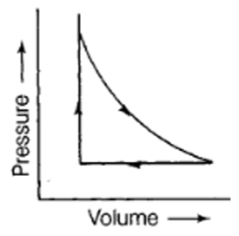
3. A sample of 1.0 mole of a monoatomic ideal gas is taken through a cyclic process of expansion and compression as shown in the figure. What will be the value of $\Delta H$ for the cycle as a whole?
Image
Answer
1. The name of the law is Hess's law of heat summation.
2. We have $q =- w = p _{ ex }(10-2)=0(8)=0$ No work is done; no heat is absorbed.
3. According to the question, 1 mole of a mono atomic ideal gas is taken through a cyclic process of expansion and compression.
Image
$\Delta H$ for a cyclic process is zero because enthalpy change is a state function.
View full question & answer
Question 73 Marks
On the basis of VSEPR theory, predict the shapes of the following
1. $NH _2^{-}$
2. $O _3$
Answer
1. Shape of $NH _2^{-}$
Number of valence electrons on central N atom $=5+1$ (due to one unit negative charge) $=6$ Number of atoms linked to it $=2$
$\therefore$ Total number of electron pairs around
$N =\frac{6+2}{2}=4$ and number of bond pairs $=2$ ion is of the type $A B_2 E_2$.
Hence, it has bent shape (V-shape).
2. Shape of $O _3$
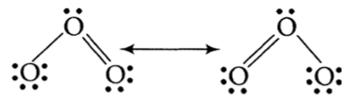
While predicting geometry of molecules containing the double (or multiple) bond is considered as one electron pair. e.g. in case of ozone, its two resonating structures are
Image
Thus, the central O -atom is considered to have two bond pairs and one lone pair, i.e. it is of the type $AB _2 E$.
Hence, it is a bent molecule. Thus, the two resonating structures will be
Image
View full question & answer