Question 15 Marks
Pay load is defined as the difference between the mass of displaced air and the mass of the balloon. Calculate the pay load when a balloon of radius $10 \ m$ , mass $100 \ kg$ is filled with helium at 1.66 bar at $27^{\circ} C$. (Density of air $=1.2 kg$ $m ^{-3}$ and $R =0.083 bar dm ^3 K^{-1} mol^{-1}$ ).
AnswerGiven,
Radius of the balloon, $r = 10m$
$\therefore$ Volume of the balloon $=\frac{4}{3}\pi\text{r}^3$
$=\frac{4}{3}\times\frac{22}{7}\times10^3$
$4190.5\text{m}^3$ (approx)
Thus, the volume of the displaced air is $4190.5 m^3$.
Given,
Density of air $=1.2 kg m ^{-3}$
Then, mass of displaced air $=4190.5 \times 1.2 kg$
$=5028.6 kg$
Now, mass of helium (m) inside the balloon is given by,
$\text{m}=\frac{\text{MpV}}{\text{RT}}$
Here,
$M = 4 \times 10^{-3}kg mol^{-1}$
$p = 1.66$ bar
V = Volume of the balloon
$= 4190.5m^3$
$R = 0.083$ bar $dm^3 K^{-1} mol^{-1}$
$T = 27^\circ C = 300K$
Then, $\text{m}=\frac{4\times10^{-3}\times1.66\times4190.5\times10^3}{0.083\times300}$
$=1117.5\text{kg}$ (approx)
Now, total mass of the balloon filled with helium = (100 + 1117.5)kg
= 1217.5kg
Hence, pay load = (5028.6 – 1217.5)kg
= 3811.1kg
Hence, the pay load of the balloon is 3811.1kg.
View full question & answer→Question 25 Marks
Pressure of $1$ g of an ideal gas A at $27^{\circ} C$ is found to be $2$ bar. When $2$ g of another ideal gas B is introduced in the same flask at same temperature the pressure becomes $3$ bar. Find a relationship between their molecular masses.
AnswerFor ideal gas A, the ideal gas equation is given by,$\text{p}_{\text{A}}\text{V}=\text{n}_{\text{A}}\text{RT}\ \dots\dots(\text{i})$
Where, $p_A$ and $n_A$ represent the pressure and number of moles of gas A.
For ideal gas B, the ideal gas equation is given by,
$\text{p}_{\text{B}}\text{V}=\text{n}_{\text{B}}\text{RT}\ \dots\dots(\text{ii})$
Where, $p_B$ and $n_B$ represent the pressure and number of moles of gas B.
[V and T are constants for gases A and B]
From equation (i), we have
$\text{p}_{\text{A}}\text{V}=\frac{\text{m}_{\text{A}}}{\text{M}_{\text{A}}}\text{RT}\Rightarrow\frac{\text{p}_{\text{A}}\text{M}_{\text{A}}}{\text{m}_{\text{A}}}=\frac{\text{RT}}{\text{V}}\ \dots\dots(\text{iii})$
From equation (ii), we have
$\text{p}_{\text{B}}\text{V}=\frac{\text{m}_{\text{B}}}{\text{M}_{\text{B}}}\text{RT}\Rightarrow\frac{\text{p}_{\text{B}}\text{M}_{\text{B}}}{\text{m}_{\text{B}}}=\frac{\text{RT}}{\text{V}}\ \dots\dots(\text{iv})$
Where, $M_A$ and $M_B$ are the molecular masses of gases A and B respectively.
Now, from equations (iii) and (iv), we have
$\frac{\text{p}_{\text{A}}\text{M}_{\text{A}}}{\text{m}_{\text{A}}}=\frac{\text{p}_{\text{B}}\text{M}_{\text{B}}}{\text{m}_{\text{B}}}\ \dots\dots(\text{v})$
Given,
$m_A = 1g$
$p_A = 2 bar$
$m_B = 2g$
$p_B = (3 - 2) = 1 bar$
(Since total pressure is 3 bar)
Substituting these values in equation (v), we have
$\frac{2\times\text{M}_{\text{A}}}{1}=\frac{1\times\text{M}_{\text{B}}}{2}$
$\Rightarrow\ 4\text{M}_{\text{A}}=\text{M}_{\text{B}}$
Thus, a relationship between the molecular masses of A and B is given by
$4\text{M}_{\text{A}}=\text{M}_{\text{B}}$
View full question & answer→Question 35 Marks
What will be the pressure exerted by a mixture of $3.2g$ of methane and $4.4g$ of carbon dioxide contained in a $9dm^3$ flask at $27^\circ C$?
AnswerIt is known that,$\text{p}=\frac{\text{m}}{\text{M}}\frac{\text{RT}}{\text{V}}$
For methane $(CH_4)$,
$\text{p}_{\text{CH}_4}=\frac{3.2}{16}\times\frac{8.314\times300}{9\times10^{-3}}$ $\begin{bmatrix}\text{Since 9dm}^3=9\times10^{-3}\text{m}^3\\27^{\circ}\text{C}=300\text{K}\ \ \ \ \ \ \ \ \ \ \ \ \ \ \ \ \ \ \ \ \ \ \end{bmatrix}$
For carbon dioxide $(CO_2)$,
$\text{p}_{\text{CO}_2}=\frac{4.4}{44}\times\frac{8.314\times300}{9\times10^{-3}}$
$=2.771\times10^4\text{Pa}$
Total pressure exerted by the mixture can be obtained as:
$\text{p}=\text{p}_{\text{CH}_4}+\text{p}_{\text{CO}_2}$
$=(5.543\times10^4+2.771\times10^4)\text{Pa}$
$=8.314\times10^4\text{Pa}$
Hence, the total pressure exerted by the mixture is $8.314 \times 10^4 Pa$.
View full question & answer→Question 45 Marks
Using the equation of state pV = nRT; show that at a given temperature density of a gas is proportional to gas pressure p.
AnswerThe equation of state is given by,
pV = nRT …… (i)
Where,
p → Pressure of gas
V → Volume of gas
n→ Number of moles of gas
R → Gas constant
T → Temperature of gas
From equation (i) we have,
$\frac{\text{n}}{\text{V}}=\frac{\text{p}}{\text{RT}}$
Replacing n with $\frac{\text{m}}{\text{M}},$ we have
$\frac{\text{m}}{\text{MV}}=\frac{\text{p}}{\text{RT}}\ \dots\dots(\text{ii})$
Where,
m → Mass of gas
M → Molar mass of gas
But, $\frac{\text{m}}{\text{V}}=\text{d}$ (d = density of gas)
Thus, from equation (ii), we have
$\frac{\text{d}}{\text{M}}=\frac{\text{p}}{\text{RT}}$
$\Rightarrow\text{d}=\Big(\frac{\text{M}}{\text{RT}}\Big)\text{p}$
Molar mass (M) of a gas is always constant and therefore, at constant temperature $(\text{T}),\frac{\text{M}}{\text{RT}}=$ constant.
d = (constant)p
$\Rightarrow\text{d}\propto\text{p}$
Hence, at a given temperature, the density (d) of gas is proportional to its pressure (p)
View full question & answer→Question 55 Marks
What will be the pressure of the gaseous mixture when 0.5 L of $\mathrm{H}_2$ at 0.8 bar and 2.0 L of dioxygen at 0.7 bar are introduced in a 1 L vessel at $27^{\circ} \mathrm{C}$ ?
AnswerLet the partial pressure of $\mathrm{H}_2$ in the vessel be $\text{p}_{\text{H}_2}$.Now,
$\text{p}_1=0.8\text{ bar},$ $\text{p}_2=\text{p}_{\text{H}_2}=?$
$\text{V}_1=0.5\text{L},$ $\text{V}_2=1\text{L}$
It is known that,
$\text{p}_1\text{V}_1=\text{p}_2\text{V}_2$
$\Rightarrow\ \text{p}_2=\frac{\text{p}_1\text{V}_1}{\text{V}_2}$
$\Rightarrow\ \text{p}_{\text{H}_2}=\frac{0.8\times0.5}{1}$
$=0.4\text{ bar}$
Now, let the partial pressure of $\mathrm{O}_2$ in the vessel be $\text{p}_{\text{O}_2}$.
Now,
$\text{p}_1=0.7\text{ bar},$ $\text{p}_2=\text{p}_{\text{O}_2}=?$
$\text{V}_1=2.0\text{L},$ $\text{V}_2=1\text{L}$
$\text{p}_1\text{V}_1=\text{p}_2\text{V}_2$
$\Rightarrow\ \text{p}_2=\frac{\text{p}_1\text{V}_1}{\text{V}_2}$
$\Rightarrow\ \text{p}_{\text{O}_2}=\frac{0.7\times2.0}{1}=1.4\text{ bar}$
Total pressure of the gas mixture in the vessel can be obtained as:
$\text{p}_{\text{total}}=\text{p}_{\text{H}_2}+\text{p}_{\text{O}_2}$
$=0.4+1.4$
$=1.8\text{ bar}$
Hence, the total pressure of the gaseous mixture in the vessel is 1.8 bar.
View full question & answer→Question 65 Marks
Density of a gas is found to be $5.46 \mathrm{~g} / \mathrm{dm}^3$ at $27^{\circ} \mathrm{C}$ at 2 bar pressure. What will be its density at STP?
AnswerGiven,
$\mathrm{d}_1=5.46 \mathrm{~g} / \mathrm{dm}^3$
$\mathrm{p}_1=2 \mathrm{bar}$
$\mathrm{T}_1=27^{\circ} \mathrm{C}=(27+273) \mathrm{K}=300 \mathrm{~K}$
$\mathrm{p}_2=1 \mathrm{bar}$
$\mathrm{T}_2=273 \mathrm{~K}$
$\mathrm{d}_2=?$
The density $\left(\mathrm{d}_2\right)$ of the gas at STP can be calculated using the equation,
$\text{d}=\frac{\text{Mp}}{\text{RT}}$
$\therefore\ \frac{\text{d}_1}{\text{d}_2}=\frac{\frac{\text{Mp}_1}{\text{RT}_1}}{\frac{\text{Mp}_2}{\text{RT}_2}}$
$\Rightarrow\ \frac{\text{d}_1}{\text{d}_2}=\frac{\text{p}_1\text{T}_2}{\text{p}_2\text{T}_1}$
$\Rightarrow\ \text{d}_2=\frac{\text{p}_2\text{T}_1\text{d}_1}{\text{p}_1\text{T}_2}$
$=\frac{1\times300\times5.46}{2\times273}$
$=3\text{g dm}^{-3}$
Hence, the density of the gas at STP will be $3 \mathrm{g} \mathrm{~dm}^{-3}$.
View full question & answer→Question 75 Marks
The drain cleaner, Drainex contains small bits of aluminum which react with caustic soda to produce dihydrogen. What volume of dihydrogen at $20^\circ C$ and one bar will be released when $0.15g$ of aluminum reacts?
AnswerThe reaction of aluminium with caustic soda can be represented as:$2\text{Al}+2\text{NaOH}+2\text{H}_2\text{O}\xrightarrow{\ \ \ \ \ \ \ \ \ \ \ \ }2\text{NaAlO}_2+3\text{H}_2\\2\times27\text{g}\ \ \ \ \ \ \ \ \ \ \ \ \ \ \ \ \ \ \ \ \ \ \ \ \ \ \ \ \ \ \ \ \ \ \ \ \ \ \ \ \ \ \ \ \ \ \ \ \ \ \ \ \ \ \ \ \ \ \ 3\times22400\text{mL}$
At STP (273.15K and 1 atm), 54g (2 × 27g) of Al gives 3 × 22400mL of $H_{2.}$
$\therefore$ 0.15 g Al gives $\frac{3\times22400\times0.15}{54}\text{mL of H}_2$ i.e., 186.67mL of $H_{2.}$
At $STP,$
$p_1 = 1 atm$
$V_1 = 186.67mL$
$T_1 = 273.15K$
Let the volume of dihydrogen be $V_2$ at $p_2 = 0.987$ atm (since 1 bar $= 0.987$ atm) and $T_2 = 20^\circ C = (273.15 + 20)K = 293.15K.$
Now,
$\frac{\text{p}_1\text{V}_1}{\text{T}_1}=\frac{\text{p}_2\text{V}_2}{\text{T}_2}$
$\Rightarrow\ \text{V}_2=\frac{\text{p}_1\text{V}_1\text{T}_2}{\text{p}_1\text{T}_2}$
$=\frac{1\times186.67\times293.15}{0.987\times273.15}$
$=202.98\text{mL}$
$=203\text{mL}$
Therefore, 203mL of dihydrogen will be released.
View full question & answer→Question 85 Marks
At $0°C$, the density of a certain oxide of a gas at $2$ bar is same as that of dinitrogen at $5$ bar. What is the molecular mass of the oxide?
AnswerDensity (d) of the substance at temperature (T) can be given by the expression,
$\text{d}=\frac{\text{Mp}}{\text{RT}}$
Now, density of oxide $(d_1)$ is given by,
$\text{d}_1=\frac{\text{M}_1\text{p}_1}{\text{RT}}$
Where, $M_1$ and $p_1$ are the mass and pressure of the oxide respectively.
Density of dinitrogen gas $(d_2)$ is given by,
$\text{d}_2=\frac{\text{M}_2\text{p}_2}{\text{RT}}$
Where, $M_2$ and $p_2$ are the mass and pressure of the oxide respectively.
According to the given question,
$d_1 = d_2$
$\therefore M_1p_1 = M_2p_2$
Given,
$p_1 = 2$ bar
$p_2 = 5$ bar
Molecular mass of nitrogen,$M_2 = 28g/ mol$
Now, $\text{M}_1=\frac{\text{M}_2\text{p}_2}{\text{p}_1}$
$=\frac{28\times5}{2}$
$=70\text{g/ mol}$
Hence, the molecular mass of the oxide is 70g/ mol.
View full question & answer→Question 95 Marks
Calculate the total pressure in a mixture of $8$ g of dioxygen and $4$ g of dihydrogen confined in a vessel of $1 dm ^3$ at $27^{\circ} C . R =$ 0.083 bar dm3 K
AnswerGiven,
Mass of dioxygen $(O_2) = 8g$
Thus, number of moles of $\text{O}_2=\frac{8}{32}=0.25$ mole
Mass of dihydrogen $(H_2) = 4g$
Thus, number of moles of $\text{H}_2=\frac{4}{2}=2$ mole
Therefore, total number of moles in the mixture = 0.25 + 2 = 2.25 mole
Given,
$V = 1dm^3$
$n = 2.25mol$
$R = 0.083 bar dm^3 K^{–1} mol^{–1}$
$T = 27^\circ C = 300K$
Total pressure (p) can be calculated as:
pV = nRT
$\Rightarrow\ \text{p}=\frac{\text{nRT}}{\text{V}}$
$=\frac{2.25\times0.083\times300}{1}$
$=56.025\text{ bar}$
Hence, the total pressure of the mixture is 56.025 bar.
View full question & answer→Question 105 Marks
Calculate the temperature of 4.0 mol of a gas occupying $5 \mathrm{dm}^3$ at 3.32 bar. $\left(\mathrm{R}=0.083 \mathrm{bar}^{-1} \mathrm{dm}^3 \mathrm{~K}^{-1} \mathrm{~mol}^{-1}\right)$.
AnswerGiven,
$\mathrm{n}=4.0 \mathrm{~mol}$
$\mathrm{~V}=5 \mathrm{dm}^3$
$\mathrm{p}=3.32 \mathrm{bar}$
$\mathrm{R}=0.083 \mathrm{bar} \mathrm{dm}^3 \mathrm{~K}^{-1} \mathrm{~mol}^{-1}$
The temperature (T) can be calculated using the ideal gas equation as:
$\text{pV}=\text{nRT}$
$\Rightarrow\ \text{T}=\frac{\text{pV}}{\text{nR}}$
$=\frac{3.32\times5}{4\times0.083}$
$=50\text{K}$
Hence, the required temperature is 50K.
View full question & answer→Question 115 Marks
In terms of Charles’ law explain why –273 °C is the lowest possible temperature.
AnswerCharles’ law states that at constant pressure, the volume of a fixed mass of gas is directly proportional to its absolute temperature.
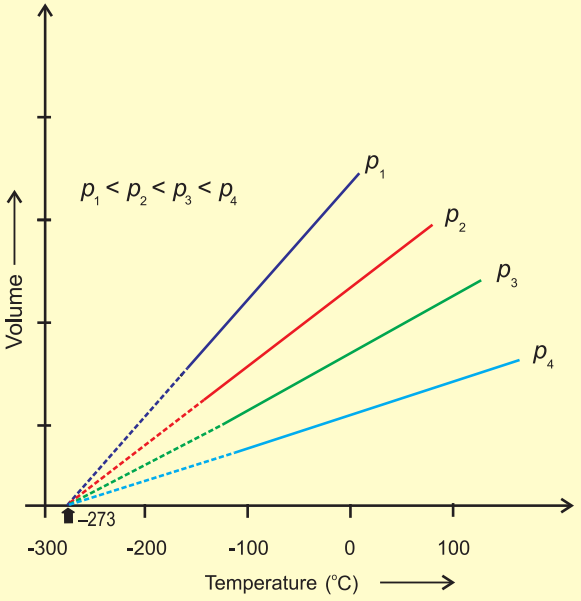
It was found that for all gases (at any given pressure), the plots of volume vs. temperature (in °C) is a straight line. If this line is extended to zero volume, then it intersects the temperature-axis at – 273°C. In other words, the volume of any gas at –273°C is zero. This is because all gases get liquefied before reaching a temperature of – 273°C. Hence, it can be concluded that – 273°C is the lowest possible temperature.
View full question & answer→Question 125 Marks
What will be the minimum pressure required to compress $500 \mathrm{dm}^3$ of air at 1 bar to $200 \mathrm{dm}^3$ at $30^{\circ} \mathrm{C}$ ?
AnswerGiven,
Initial pressure, $\mathrm{p}_1=1 \mathrm{bar}$
Initial volume, $V_1=500 \mathrm{dm}^3$
Final volume, $V_2=200 \mathrm{dm}^3$
Since the temperature remains constant, the final pressure $\left(\mathrm{p}_2\right)$ can be calculated using Boyle's law.
According to Boyle’s law,
$\text{p}_1\text{V}_1=\text{p}_2\text{V}_2$
$\Rightarrow\ \text{p}_2=\frac{\text{p}_1\text{V}_1}{\text{V}_2}$
$=\frac{1\times500}{200}\text{ bar}$
$=2.5\text{ bar}$
Therefore, the minimum pressure required is 2.5 bar.
View full question & answer→Question 135 Marks
$34.05mL$ of phosphorus vapour weighs $0.0625g$ at $546°C$ and $0.1$ bar pressure. What is the molar mass of phosphorus?
AnswerGiven,
p = 0.1 bar
$V = 34.05mL = 34.05 \times 10^{–3}L = 34.05 \times 10^{–3}dm^3$
$R = 0.083$ bar $dm^3 K^{–1} mol^{–1}$
$T = 546^\circ C = (546 + 273)K = 819K$
The number of moles (n) can be calculated using the ideal gas equation as:
$\text{pV}=\text{nRT}$
$\Rightarrow\ \text{n}=\frac{\text{pV}}{\text{RT}}$
$=\frac{0.1\times34.05\times10^{-3}}{0.083\times819}$
$=5.01\times10^{-5}\text{mol}$
Therefore, molar mass of phosphorus $=\frac{0.0625}{5.01\times10^{-5}}= 1247.5\text{g mol}^{–1}$
Hence, the molar mass of phosphorus is $1247.5 g mol^{–1}$.
View full question & answer→Question 145 Marks
A mixture of dihydrogen and dioxygen at one bar pressure contains 20% by weight of dihydrogen. Calculate the partial pressure of dihydrogen.
AnswerLet the weight of dihydrogen be 20g and the weight of dioxygen be 80g. Then, the number of moles of dihydrogen, $\text{n}_{\text{H}_2}=\frac{20}{2}=10$ moles and the number of moles of dioxygen, $\text{n}_{\text{O}_2}=\frac{80}{32}=2.5$ moles. Given, Total pressure of the mixture, $\text{p}_{\text{total}}$ = $1$ bar Then, partial pressure of dihydrogen, $\text{p}_{\text{H}_2}=\frac{\text{n}_{\text{H}_2}}{\text{n}_{\text{H}_2}+\text{n}_{\text{O}_2}}\times\text{p}_{\text{total}}$ $=\frac{10}{10+2.5}\times1$ $=0.8\text{ bar}$Hence, the partial pressure of dihydrogen is. 0.8 bar.
View full question & answer→Question 155 Marks
A vessel of $120mL$ capacity contains a certain amount of gas at $35°C$ and $1.2$ bar pressure. The gas is transferred to another vessel of volume $180mL$ at $35°C$. What would be its pressure?
AnswerGiven,
Initial pressure, $p_1 = 1.2 bar$
Initial volume, $V_1= 120mL$
Final volume, $V_2 = 180mL$
Since the temperature remains constant, the final pressure $(p_2)$ can be calculated using Boyle’s law.
According to Boyle’s law,
$\text{p}_1\text{V}_1=\text{p}_2\text{V}_2$
$\text{p}_2=\frac{\text{p}_1\text{V}_1}{\text{V}_2}$
$=\frac{1.2\times120}{180}\text{ bar}$
$=0.8\text{ bar}$
Therefore, the pressure would be 0.8 bar.
View full question & answer→Question 165 Marks
A student forgot to add the reaction mixture to the round bottomed flask at $27^\circ\ C$ but instead he/she placed the flask on the flame. After a lapse of time, he realized his mistake, and using a pyrometer he found the temperature of the flask was $477^\circ\ C$. What fraction of air would have been expelled out?
AnswerLet the volume of the round bottomed flask be V.
Then, the volume of air inside the flask at $27^\circ\ C$ is V.
Now,
$V_1 = V$
$T_1 = 27^\circ C = 300K$
$V_2 = ?$
$T_2 = 477^\circ C = 750K$
According to Charles’s law,
$\frac{\text{V}_1}{\text{T}_1}=\frac{\text{V}_2}{\text{T}_2}$
$\Rightarrow\ \text{V}_2=\frac{\text{V}_1\text{T}_2}{\text{T}_1}$
$=\frac{750\text{V}}{300}$
$=2.5\text{V}$
Therefore, volume of air expelled out = 2.5V – V = 1.5V
Hence, fraction of air expelled out $=\frac{1.5\text{V}}{2.5\text{V}}=\frac{3}{5}$
View full question & answer→Question 175 Marks
$2.9g$ of a gas at $95^\circ C$ occupied the same volume as $0.184g$ of dihydrogen at $17^\circ C$, at the same pressure. What is the molar mass of the gas?
AnswerVolume (V) occupied by dihydrogen is given by,
$\text{V}=\frac{\text{m}}{\text{M}}\frac{\text{RT}}{\text{p}}$
$=\frac{0.184}2\times\frac{\text{R}\times290}{\text{p}}$
Let M be the molar mass of the unknown gas. Volume (V) occupied by the unknown gas can be calculated as:
$\text{V}=\frac{\text{m}}{\text{M}}\frac{\text{RT}}{\text{p}}$
$=\frac{2.9}{\text{M}}\times\frac{\text{R}\times368}{\text{p}}$
According to the question,
$\frac{0.184}{2}\times\frac{\text{R}\times290}{\text{p}}=\frac{2.9}{\text{M}}\times\frac{\text{R}\times368}{\text{p}}$
$\Rightarrow\ \frac{0.184\times290}{2}=\frac{2.9\times368}{\text{M}}$
$\Rightarrow\ \text{M}=\frac{2.9\times368\times2}{0.184\times290}$
$=40\text{g mol}^{-1}$
Hence, the molar mass of the gas is $40g ~mol^{–1}$.
View full question & answer→Question 185 Marks
If $1$ gram of each of the following gases are taken at STP, which of the gases will occupy (a) greatest volume and (b) smallest volume?
$CO, H_2O, CH_4, NO$.
AnswerMolar volume of a gas is volume occupied by 1 mole of gas at STP (273.15 K and 1 bar pressure) and is equal to 22700mL
28g of CO occupy volume = 22700mL
$\therefore$ 1g of CO occupies volume $=\frac{22700}{28}$ mL at STP.
Similarly,
$1g$ of $H_2O$ occupies volume $=\frac{22700}{18}$ mL at STP.
$1g$ of $CH_4$ occupies volume $=\frac{22700}{16}$ mL at STP.
- $CH_4$ occupies greatest volume.
- No occupies smallest volume.
View full question & answer→Question 195 Marks
Isotherms of carbon dioxide gas are shown in Fig. Mark a path for changing gas into liquid such that only one phase (i.e., either a gas or a liquid) exists at any time during the change. Explain how the temperature, volume and pressure should be changed to carry out the change.
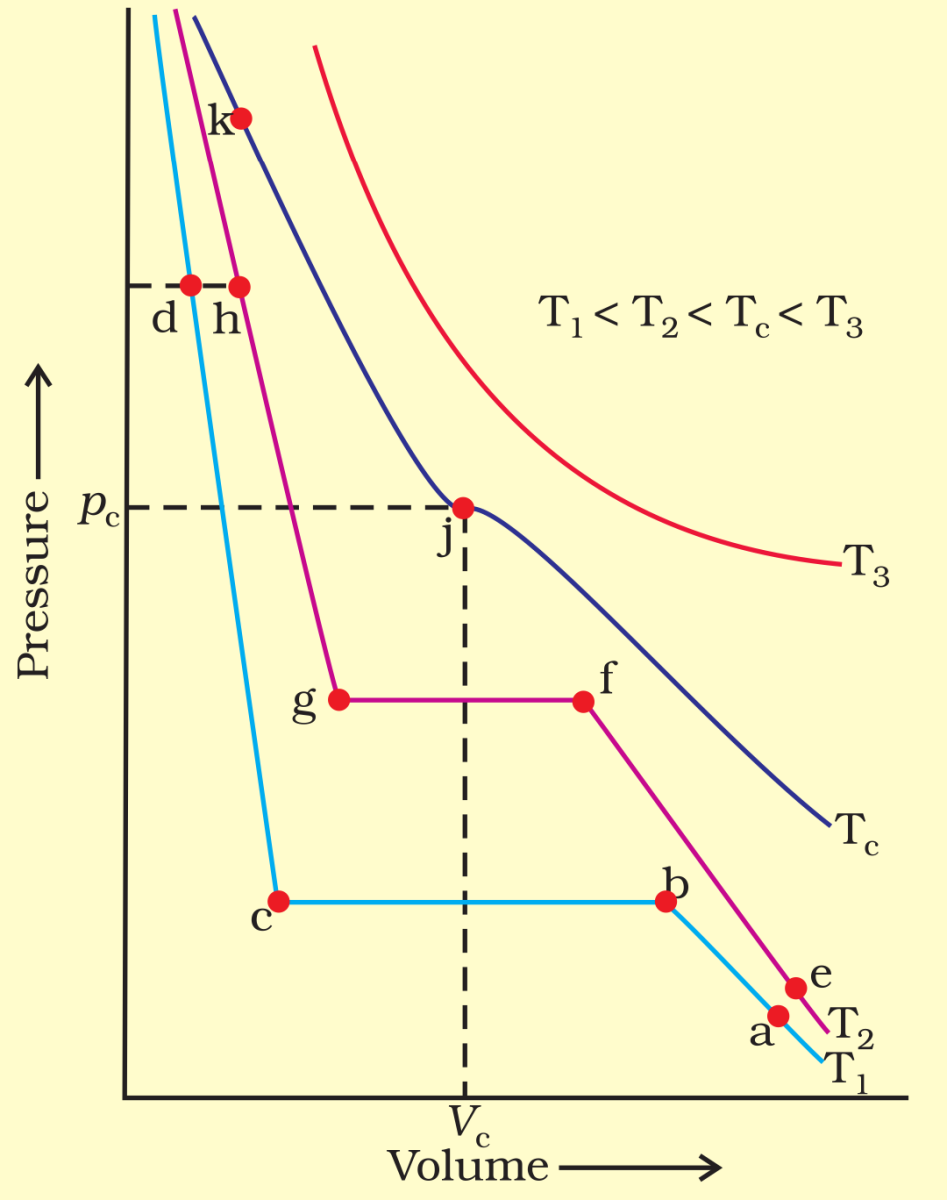
AnswerIn isotherm of carbon dioxide, it is possible to change a gas into liquid or a liquid into gas by a process in which always a single phase is present.
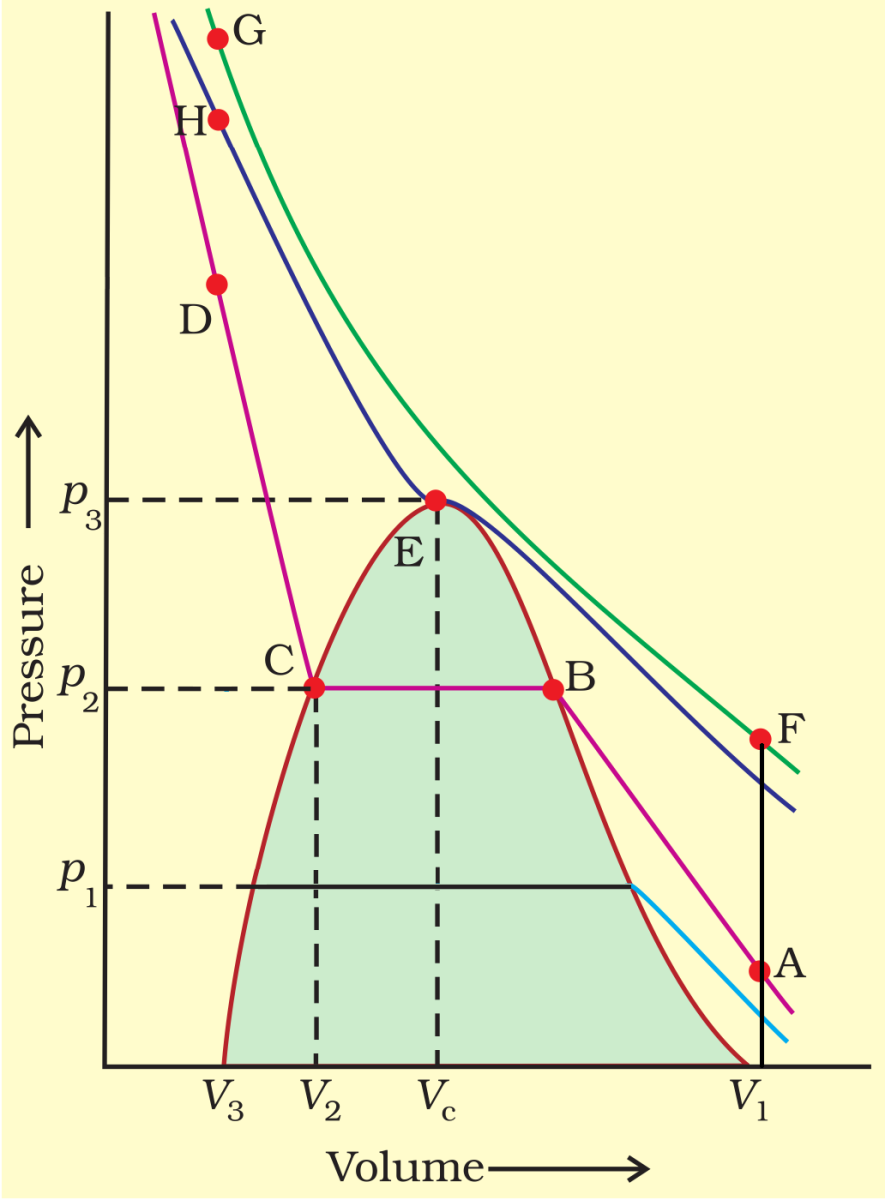
If we move vertically from point A to F by increasing the temperature, then we can reach the point G by compressing the gas at constant temperature along this (isotherm at 31.1°C). Now we can move vertically downwards to D by lowering the temperature. As soon as we cross point H on critical isotherm, we get liquid. If process is carried out at critical temperature, substance always remains in one phase. Hence the path for the change is A → F → G → H → D.
View full question & answer→Question 205 Marks
Using van der Waal's equation, calculate the constant 'a' when two moles of gas confined in a four litre flask exerts a pressure of 11.0 atm at a temperature of 300K. The value of 'b' is 0.05 litre per mole.
Answer$\text{a} = \ ? \text{ n } 2 \text{moles} \ \text{V} = 4\text{L P} = 11.0 \text{atm}$
$\text{T} = 300\text{K, b} = 0.05 \text{L} \text{ mol}^{-1}$
$\Big(\text{p}+\frac{\text{an}^{2}}{\text{V}^{2}}\Big)(\text{V} - \text{nb}) = \text{nRT}$
$\Big(11+\frac{2^2 \times \text{a}}{(4)^{2}}\Big)(4 - 2 \times 0.05) = 2 \times 0.0821 \times 300$
$\Big(11 + \frac{\text{a}}{4}\Big) (4 - 0.10) = 2 \times 24.63$
$= \frac{49.26}{3.9} = 12.630$
$\frac{\text{a}}{4} = 12.63 - 11 = 1.63$
$\text{a} = 1.63 \times 4 = 6.52 \text{atm} \text{ L}^{2} \text{mol}^{-2}$
View full question & answer→Question 215 Marks
Two flasks 'A' and 'B' have equal volumes. Flask 'A' contains $H_2$ and is maintained at $300K$ while 'B' contains equal mass of $CH_4$ gas and is maintained at $600K$.
- Which flask contains greater number of molecules? How many times more?
- In which flask pressure is greater? How many times more?
- In which flask molecules are moving faster?
- In which flask the number of collisions with walls are greater?
Answer
- Flask 'A' contains greater number of molecules. Number of moles in flask A = 8 × Number of moles in flask B.
Let the equal mass be x.
Ratio of number of moles $=\frac{\text{x}}{2}:\frac{\text{x}}{16}=8:1$
- Flask 'A' has greater pressure.
Pressure $\propto$ Number of moles
Pressure $\propto$ Temperature
If temperature had been equal, pressure in 'A' would have been 8 times but in 'A', temperature is $\frac{1}{2}$ of that in B.
$\therefore$ Pressure will be 4 times more.
$P_1 \times V = n_1RT_1$
$P_2 \times V = n_2RT_2$
$\Rightarrow\frac{\text{P}_1}{\text{P}_2}=\frac{8\times\text{R}\times300\text{K}}{1\times\text{R}\times600\text{K}}$
$\Rightarrow\frac{\text{P}_1}{\text{P}_2}=\frac{4}{1}$
Pressure in flask A = 4 × Pressure in flask B.
- Flask B. because velocity is directly proportional to square root of temperature.
- Flask A, because number of molecules of flask A is more.
View full question & answer→Question 225 Marks
- A gas occupies a volume of 4 L at $8 \times 10^5Nm^{-2}$. Calculate the additional pressure required to decrease the volume of the gas to $2.5L$. keeping the temperature constant.
- Which of the following gas will hale smaller value of van der Waals' constant a?
- Ne
- $NH_3$
- The size of a weather balloon changes as it rises. What change is expected in its size and why?
Answer
- Here, $P_1 = 8 \times 105NM^{-2}, P_2 = ?$
$V_1 = 4L, V_2 = 2.5L$
From Boyle's law equation:
$P_1V_1 = P_2V_2$
$\therefore \text{P}_2=\frac{\text{P}_1\text{V}_1}{\text{V}_2}$
$=\frac{8.0\times10^5(\text{Nm}^{-2})\times4\text{L}}{2.5\text{L}}$
$=12.8\times105\text{Nm}^{-2}$
The additional pressure required
$= 12.8 \times 10^5(Nm-2) -8 \times 105(Nm^{-2})$
$= 4.8 \times 105Nm^{-2}.$
-
- Ne
- It sizes increases because the atmospheric pressure decreases as it rises.
View full question & answer→Question 235 Marks
i. A discharge tube containing oxygen gas at $35^{\circ} C$ is evacuated till the pressure is $5 \times 10^{-2} mm$. If the volume of discharge tube is 4.5 litres. Calculate the number of oxygen molecules still present in the tube.
$\left(R=0.0821 L \text {-atm } mol^{-1} K^{-1}\right) .$
ii. Name the two processes that can be used to liquefy gases.
iii. What type of intermolecular forces are as follows:
a. Noble gases.
b. Water
Answer$P=5 \times 10^{-2} mm=5 \times 106-2 \times \frac{1}{760} \text { atm. }$
London forces.
Hydrogen bonding.
$V=4.5 L, T=35^{\circ} C=308 n=?$
According to ideal gas equation,
$PV=nRT$
$n=\frac{PV}{RT}$
$=5 \times 10^{-2} \times \frac{1}{760} \times \frac{4.5}{0.0821} \times \frac{1}{308}$
$=1.17 \times 10^{-5} mol$
1 mol of oxygen contains $=6.022 \times 10^{23}$ molecules
$1.17 \times 10^{-5} mol$ of oxygen contain
$=6.022 \times 10^{23} \times 1.17 \times 10^{-5}$ molecules
$=7.045 \times 10^{18}$ molecules
The processes are cooling and compression.
View full question & answer→Question 245 Marks
i. A vessel of $1.00 dm ^3$ capacity contains $16.00$ g of oxygen and $8.00$ g of hydrogen at $17^{\circ} C$. Calculate the partial
ii. According to kinetic molecular theory, explain why gases exert pressure?
iii. How is isotherm at critical temperature of a gas different from those at lower temperatures?
AnswerLet the partial pressure of hydrogen be $\text{p}_{\text{H}_2}$ and the partial pressure of oxygen be $\text{P}_{\text{O}_2}.$
The number of mole of hydrogen ($n_1$) $=\frac{8}{2}=4\text{ mole}$
The number of mole of oxygen ($n_2$) $=\frac{16}{32}=0.5\text{ mole}$
Now, applying ideal gas equation for each gas
$\text{P}_{\text{H}_2}\times\text{V}=\text{n}_1\text{RT}$
$\text{P}_{\text{H}_2}=\frac{\text{n}_1\text{RT}}{\text{V}}$
$=\frac{4\times0.083\times290}{1}$
$=92.8\text{bar}$
Similarly, $\text{P}_{\text{O}_2}\times\text{V}=\text{n}_2\text{RT}$
$\text{P}_{\text{O}_2}=\frac{\text{n}_2\text{RT}}{\text{V}}$
$=\frac{0.5\times0.083\times290}{1}$
$=12.035\text{bar}$
Total pressure of gaseous mixture $=\text{P}_{\text{H}_2}+\text{P}_{\text{O}_2}$
$=92.8+12.35\text{bar}$
$=104.835$
They exert pressure because of the impact of collisions of gas molecules on wails of the container.
The isotherm at critical temperature does not have any horizontal portion but has only a point of inflection in its place.
View full question & answer→Question 255 Marks
A liquefied petroleum gas (LPG) cylinder weighs 14.8kg when empty. When full it weighs 29.0kg and shows a pressure of 2.5atm. In the course of use at 27°C, the mass of the full cylinder is reduced to 23.2kg. Find out the volume of the gas in cubic metres used up at the normal usage conditions and the final pressure inside the cylinder. Assume LPG to be n-butane with normal boiling point of 0°C.
AnswerWeight of LPG originally present = 29.0 - 14.8 = 14.2kg
Pressure = 2.5atm
Weight of LPG present after use = 23.2 - 14.8
= 8.4kg
Since volume of the cylinder is constant, applying
$\text{pV}=\text{nRT}$
$\Rightarrow\frac{\text{p}_1}{\text{p}_2}=\frac{\text{n}_1}{\text{n}_2}=\frac{\frac{\text{w}_1}{\text{m}}}{\frac{\text{w}_2}{\text{m}}}=\frac{\text{w}_1}{\text{w}_2}$
$\Rightarrow\frac{2.5}{\text{p}^2}=\frac{14.2}{8.4}$
$\text{p}_2=\frac{2.5\times8.4}{14.2}=1.48\text{atm}$
$\because $ Weight of used gas $=14.2-8.4=5.8\text{kg}$
Moles of gas $=\frac{5.8\times10^3}{28}=100\text{mol}$
Normal conditions p = 1atm;
$\text{T}=273+27=300\text{K}$
Volume of 100mL of LPG at 1atm and 300K
$\text{V}=\frac{\text{nRT}}{\text{p}}=\frac{100\times0.082\times300}{1}$
$=2460\text{L}=2460\text{m}^3$
View full question & answer→Question 265 Marks
Isotherms of carbon dioxide at various temperatures are represented in the figure. Answer the following questions based on the figure.
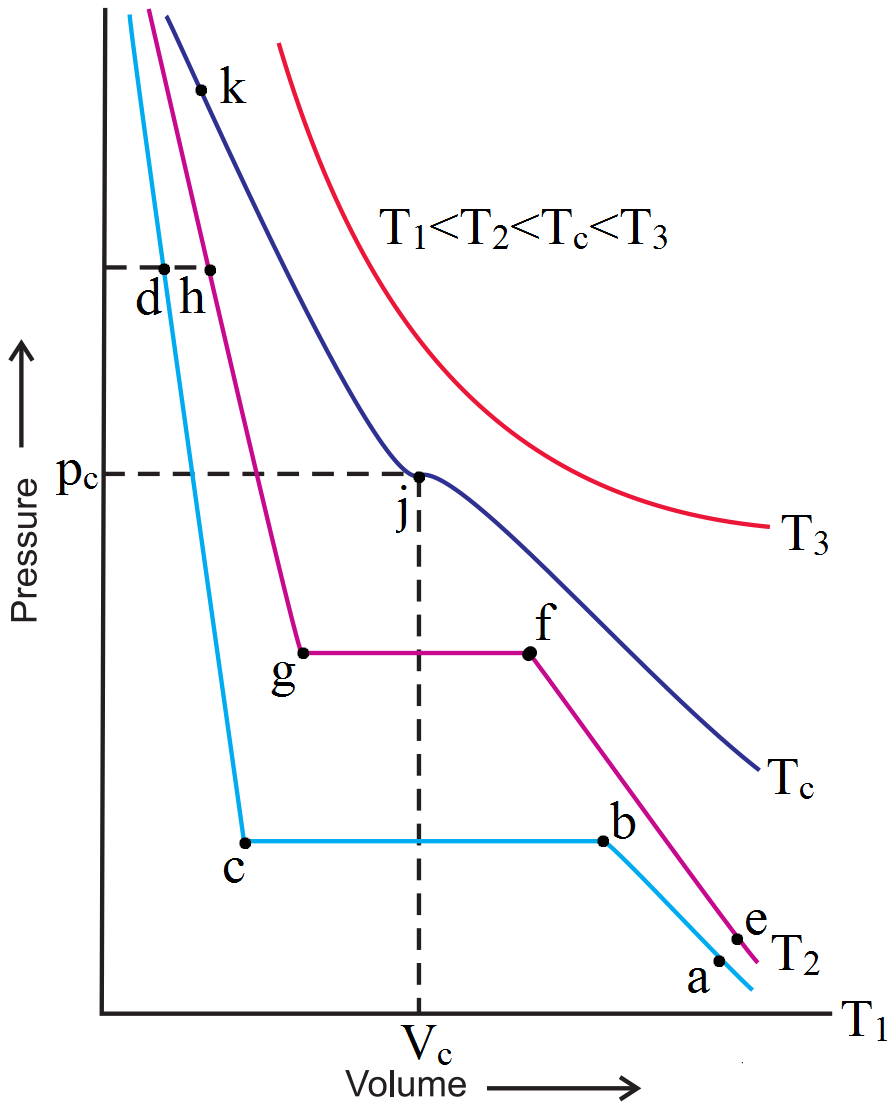
i. In which state will $CO _2$ exist between the points a and b at temperature $T _1$ ?
ii. At what point will $CO _2$ start liquefying when temperature is $T _1$ ?
iii. At what point will $CO _2$ be completely liquefied when temperature is $T _2$ ?
iv. Will condensation take place when the temperature is $T_3$ ?
v. What portion of the isotherm at $T _1$ represent liquid and gaseous $CO _2$ at equilibrium? Answeri. $CO _2$ will exist as gaseous state between ' a ' and ' B '.
ii. At point ' $b$ ', $CO _2$ will start liquefying.
iii. At point ' g ', $CO _2$ will be completely liquefied.
iv. No, because $T_3$ is greater than $T_c$. (critical temperature).
v. Between 'b' and 'c' is the portion of isotherm at which liquid $CO _2$ is in equilibrium with gaseous $CO _2$.
View full question & answer→Question 275 Marks
Explain the following.
- The boiling point of a liquid rises on increasing pressure.
- Drops of liquids assume spherical shape.
- The boiling point of water $(373K)$ is abnormally high when compared to that of $H_2S (211.2K).$
- The level of mercury in a capillary tube is lower than the level outside when a Se capillary tube is inserted in the mercury.
- Tea or coffee is sipped from a saucer when it is quite hot.
Answer
- A liquid boils when its vapour pressure becomes equal to the atmospheric pressure. An increase in pressure on liquid, therefore, causes a rise in the boiling temperature of the liquids.
- Liquids have a property, called surface tension, due to which liquids tend to contract (to decrease the surface area). For a given volume of a liquid, since a sphere has the least surface area, hence the liquids tend to form spherical droplets
- The extensive hydrogen bonding in water gives a polymeric structure. This makes the escape of molecules from the liquid more difficult.
Therefore, water requires higher temperature to bring its vapour pressure equal to the atmospheric pressure.
On the other hand, sulphur being less electronegative, does not form hydrogen bonds with H of $H_2S$. As a result, $H_2S$ has low boiling point.
- The cohesive forces in mercury are much stronger than the force of adhesion between glass and mercury. Therefore, mercury-glass contact angle is greater than $90^\circ$. As a result, the vertical component of the surface tension forces acts vertically downward, thereby lowering the level of mercury column in the capillary țube.
- Evaporation causes cooling and the rate of evaporation increases with an increase in the surface area. Since, saucer has a large surface area, hence tea/ coffee taken in a saucer cools quickly.
View full question & answer→Question 285 Marks
Nitrogen molecule $\left( N _2\right)$ has radius of about 0.2 nm . Assuming that nitrogen molecule is spherical in shape, calculate:
i. Volume of a single molecule of $N _2$.
ii. The percentage of empty space in one mole of $N _2$ gas at STP.
AnswerThe volume of a sphere $=\frac{4}{3} \pi r^3$ where is the redius of the sphere. For $N_2$ molecule,
$r=0.2 nm=0.2 \times 10^{-9} m=2 \times 10^{-8} cm$
Volume of a molecule of
$N_2=\frac{4}{3} \times \frac{22}{7} \times\left(2 \times 10^{-8}\right)^3 cm^3$
$=3.35 \times 10^{-23} cm^3$
To calculate the empty space, let us first find the total volume of 1 mole ( $6.02 \times 10^{23}$ molecules) of $N _2$.
Volume of $6.02 \times 10^{23}$ molecules of
$N_2=3.35 \times 10^{-23} \times 6.02 \times 10^{23}$
$=20.17 cm^3$
Now, volume occupied by 1 mole of gas at STP
$=22.4 \text { litre }=22400 cm^3$
$\text { Empty volume }=\text { Total volume of gas }- \text { volume oc }$
$=(22400-20.17) cm^3$
$=22379.83 cm^3$
$\therefore \text { Percentage empty space }=\frac{\text { empty space }}{\text { total volume }} \times 100$
$=\frac{22379.83}{22400} \times 100=99.9 \%$
Empty volume = Total volume of gas - volume occupied by molecules
Thus, $99.9 \%$ of space of 1 mole of $N _2$ at STP is empty.
View full question & answer→Question 295 Marks
- Define an ideal gas.
- Define boiling point of a liquid.
- Which will have higher viscosity Glycerol or ethylene glycol and why?
- What are real gases?
- What do you understand by the term laminar flow?
Answera. Ideal gas is a gas which follows all the gas laws at all temperature and pressure e.g. $H _2$ and lie are nearly ideal gases,
b. It is temperature of which vapour pressure of liquid becomes equal to atmospheric pressure.
c. Glycerol will have higher viscosity because it has H -bonds to more extent due to presence of three - OH groups than ethylene glycol which has two - OH groups.
d. Real gases are those gases which do not follow all the gas laws at all temperature and pressure. e.g. $CO _2, SO _2$, $NH _3, CH _4$ are real gases.
e. Laminar flow is the flow in which there is regular change in velocity in passing from one layer to another.
View full question & answer→