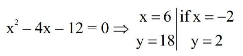
MCQ 14 Marks
Let $A$ be a $3 \times 3$ real matrix such that $A^{2}(A-2 I)-$ $4(\mathrm{~A}-\mathrm{I})=\mathrm{O}$, where I and O are the identity and null matrices, respectively. If $A^{5}=\alpha A^{2}+\beta A+\gamma I$, where $\alpha, \beta$ and $\gamma$ are real constants, then $\alpha+\beta+\gamma$ is equal to:
AnswerA.12
$A^{3}-2 A^{2}-4 A+4 I=0$
$A^{3}=2 A^{2}+4 A-4 I$
$\mathrm{A}^{4}=2 \mathrm{~A}^{3}+4 \mathrm{~A}^{2}-4 \mathrm{~A}$
$=2\left(2 \mathrm{~A}^{2}+4 \mathrm{~A}-4 \mathrm{I}\right)+4 \mathrm{~A}^{2}-4 \mathrm{~A}$
$A^{4}=8 A^{2}+4 A-8 I$
$A^{5}=8 A^{3}+4 A^{2}-8 A$
$=8\left(2 \mathrm{~A}^{2}+4 \mathrm{~A}-4 \mathrm{I}\right)+4 \mathrm{~A}^{2}-8 \mathrm{~A}$
$A^{5}=20 A^{2}+24 A-32 I$
$\therefore \alpha=20, \beta=24, \gamma=-32$
$\therefore \alpha+\beta+\gamma=12$
View full question & answer→MCQ 24 Marks
Let the area of the triangle formed by a straight Line L : $\mathrm{x}+\mathrm{by}+\mathrm{c}=0$ with co-ordinate axes be 48 square units. If the perpendicular drawn from the origin to the line L makes an angle of $45^{\circ}$ with the positive x -axis, then the value of $\mathrm{b}^{2}+\mathrm{c}^{2}$ is:
AnswerC. 97
$\frac{x}{-c}+\frac{y}{-c / b}=1$
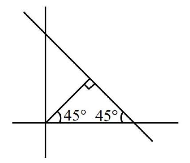
$\therefore$ area of triangle $=\frac{1}{2}\left|\frac{\mathrm{c}^{2}}{\mathrm{~b}}\right|=48$
$\left|\frac{c^{2}}{b}\right|=96$
$\because-\mathrm{c}=-\frac{\mathrm{c}}{\mathrm{b}}$
$\Rightarrow \mathrm{b}=1 \quad \therefore \mathrm{c}^{2}=96$
$\therefore \mathrm{b}^{2}+\mathrm{c}^{2}=97$ View full question & answer→MCQ 34 Marks
Let $\overrightarrow{\mathrm{a}}=2 \hat{\mathrm{i}}-3 \hat{\mathrm{j}}+\mathrm{k}, \overrightarrow{\mathrm{b}}=3 \hat{\mathrm{i}}+2 \hat{\mathrm{j}}+5 \mathrm{k}$ and a vector $\overrightarrow{\mathrm{c}}$ be such that $(\overrightarrow{\mathrm{a}}-\overrightarrow{\mathrm{c}}) \times \overrightarrow{\mathrm{b}}=-18 \hat{\mathrm{i}}-3 \hat{\mathrm{j}}+12 \mathrm{k}$ and $\overrightarrow{\mathrm{a}} \cdot \overrightarrow{\mathrm{c}}=3$. If $\overrightarrow{\mathrm{b}} \times \overrightarrow{\mathrm{c}}=\overrightarrow{\mathrm{d}}$, then $|\overrightarrow{\mathrm{a}} \cdot \overrightarrow{\mathrm{d}}|$ is equal to :
AnswerD. 15
$\vec{a}=2 \hat{i}-3 \hat{j}+\hat{k}, \vec{b}=3 \hat{i}+2 \hat{j}+5 \hat{k}$
$\vec{a} \times \vec{b}=\left|\begin{array}{ccc}i & j & k \\ 2 & -3 & 1 \\ 3 & 2 & 5\end{array}\right|$
$=-17 \hat{\mathrm{i}}-7 \hat{\mathrm{j}}+13 \hat{\mathrm{k}}$
$(\vec{a}-\vec{c}) \times \vec{b}=-18 \hat{i}-3 j+12 \hat{k}$
$\Rightarrow(\overrightarrow{\mathrm{a}} \times \overrightarrow{\mathrm{b}})-(\overrightarrow{\mathrm{c}} \times \overrightarrow{\mathrm{b}})=-18 \hat{\mathrm{i}}-3 \hat{\mathrm{j}}+12 \hat{\mathrm{k}}$
$\Rightarrow \overrightarrow{\mathrm{b}} \times \overrightarrow{\mathrm{c}}=(-18 \hat{\mathrm{i}}-3 \hat{\mathrm{j}}+12 \hat{\mathrm{k}})-(\overrightarrow{\mathrm{a}} \times \overrightarrow{\mathrm{b}})$
$=(-18 \hat{\mathrm{i}}-3 \hat{\mathrm{j}}+12 \hat{\mathrm{k}})-(-17 \mathrm{i}-7 \hat{\mathrm{j}}+13 \hat{\mathrm{k}})$
$\overrightarrow{\mathrm{b}} \times \overrightarrow{\mathrm{c}}=-\hat{\mathrm{i}}+4 \hat{\mathrm{j}}-\hat{\mathrm{k}}$
$\therefore \overrightarrow{\mathrm{a}} \cdot \overrightarrow{\mathrm{d}}=\overrightarrow{\mathrm{a}} \cdot(\overrightarrow{\mathrm{b}} \times \overrightarrow{\mathrm{c}})=(2 \mathrm{i}-3 \mathrm{j}+\mathrm{k}) \cdot(-\hat{\mathrm{i}}+4 \hat{\mathrm{j}}-\hat{\mathrm{k}})$
$=-2-12-1=-15$
$\therefore|\overrightarrow{\mathrm{a}} \cdot \overrightarrow{\mathrm{d}}|=15$
View full question & answer→MCQ 44 Marks
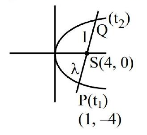
Let the point $P$ of the focal chord $P Q$ of the parabola $y^{2}=16 x$ be $(1,-4)$. If the focus of the parabola divides the chord PQ in the ratio $\mathrm{m}: \mathrm{n}$, $\operatorname{gcd}(\mathrm{m}, \mathrm{n})=1$, then $\mathrm{m}^{2}+\mathrm{n}^{2}$ is equal to :
View full question & answer→MCQ 54 Marks
View full question & answer→MCQ 64 Marks
If $\sum_{\mathrm{r}=0}^{10}\left(\frac{10^{\mathrm{r}+1}-1}{10^{\mathrm{r}}}\right) \cdot{ }^{11} \mathrm{C}_{\mathrm{r}+1}=\frac{\alpha^{11}-11^{11}}{10^{10}}$, then $\alpha$ is equal to :
AnswerD. 20
$\sum_{\mathrm{r}=0}^{10}\left(\frac{10^{\mathrm{r}-1}-1}{10^{\mathrm{r}}}\right){ }^{11} \mathrm{C}_{\mathrm{r}+1}$
$=\sum_{\mathrm{r}=0}^{10}\left(10-\frac{1}{10^{\mathrm{r}}}\right){ }^{11} \mathrm{C}_{\mathrm{r}+1}$
$=10 \sum_{\mathrm{r}=0}^{10}{ }^{11} \mathrm{C}_{\mathrm{r}+1}-10 \sum\left({ }^{11} \mathrm{C}_{\mathrm{r}+1}\left(\frac{1}{10}\right)^{\mathrm{r}+1}\right)$
$=10\left[{ }^{11} \mathrm{C}_{1}+{ }^{11} \mathrm{C}_{2}+\ldots . .+{ }^{11} \mathrm{C}_{11}\right]$
$-10\left[{ }^{11} \mathrm{C}_{1}\left(\frac{1}{10}\right)^{1}+{ }^{11} \mathrm{C}_{2}\left(\frac{1}{10}\right)^{2}+\ldots . .+{ }^{11} \mathrm{C}_{11}\left(\frac{1}{10}\right)^{11}\right]$
$=10\left[2^{11}-1\right]-10\left[\left(1+\frac{1}{10}\right)^{11}-1\right]$
$=10(2)^{11}-10-\frac{11^{11}}{10^{10}}+10$
$=\frac{(20)^{11}-11^{11}}{10^{10}}$
$\therefore \alpha=20$
View full question & answer→MCQ 74 Marks
If $\lim _{x \rightarrow 0} \frac{\cos (2 x)+a \cos (4 x)-b}{x^{4}}$ is finite, then $(a+b)$ is equal to :
- A
$\frac{1}{2}$
- B
$0$
- C
$\frac{3}{4}$
- D
AnswerA. $\frac{1}{2}$
$\lim _{x \rightarrow 0} \frac{\cos 2 x+a \cos 4 x-b}{x^{4}}=$ finite
$\mathrm{L}=\frac{\left\{1-\frac{(2 \mathrm{x})^{2}}{\underline{2}}+\frac{(2 \mathrm{x})^{4}}{\underline{4}} \ldots .\right\}+\mathrm{a}\left\{1-\frac{(4 \mathrm{x})^{2}}{\underline{2}}+\frac{(4 \mathrm{x})^{4}}{\underline{4}} \ldots .\right\}-\mathrm{b}}{\mathrm{x}^{4}}$
$L=\frac{(1+a-b)-x^{2}(2+8 a)+x^{4}\left(\frac{2}{3}+\frac{32}{3} a\right)+x^{6}() \ldots}{x^{4}}$
$\therefore 1+\mathrm{a}-\mathrm{b}=0$ and $2+8 \mathrm{a}=0 \Rightarrow \mathrm{a}=-\frac{1}{4}$
$b=a+1$
$=-\frac{1}{4}+1=\frac{3}{4}$
$\therefore \mathrm{a}+\mathrm{b}=-\frac{1}{4}+\frac{3}{4}=\frac{1}{2}$
View full question & answer→MCQ 84 Marks
$4 \int_{0}^{1}\left(\frac{1}{\sqrt{3+\mathrm{x}^{2}}+\sqrt{1+\mathrm{x}^{2}}}\right) \mathrm{dx}-3 \log _{\mathrm{c}}(\sqrt{3})$ is equal to :
- A
$2+\sqrt{2}+\log _{\mathrm{e}}(1+\sqrt{2})$
- B
$2-\sqrt{2}-\log _{e}(1+\sqrt{2})$
- C
$2+\sqrt{2}-\log _{\mathrm{e}}(1+\sqrt{2})$
- D
$2-\sqrt{2}+\log _{\mathrm{e}}(1+\sqrt{2})$
AnswerB. $2-\sqrt{2}-\log _{c}(1+\sqrt{2})$
$4 \int_{0}^{1} \frac{1}{\sqrt{3+\mathrm{x}^{2}}+\sqrt{1+\mathrm{x}^{2}}} \mathrm{dx}-3 \ln \sqrt{3}$
$=4 \int_{0}^{1} \frac{\sqrt{3+\mathrm{x}^{2}}-\sqrt{1+\mathrm{x}^{2}}}{\left(3+\mathrm{x}^{2}\right)-\left(1-\mathrm{x}^{2}\right)} \mathrm{dx}-\frac{3}{2} \ln 3$
$=2\left[\left\{\frac{\mathrm{x}}{2} \sqrt{3+\mathrm{x}^{2}}+\frac{3}{2} \ln \left(\mathrm{x}+\sqrt{3+\mathrm{x}^{2}}\right)\right\}_{0}^{1}\right.$
$\left.-\left\{\frac{\mathrm{x}}{2} \sqrt{1+\mathrm{x}^{2}}+\frac{1}{2} \ln \left(\mathrm{x}+\sqrt{1+\mathrm{x}^{2}}\right)\right\}_{0}^{1}\right]-\frac{3}{2} \ln 3$
$=2\left[\left\{\frac{1}{2} \sqrt{4}+\frac{3}{2} \ln (1+\sqrt{4})\right\}-\left\{0+\frac{3}{2} \ln \sqrt{3}\right\}\right.$
$\left.-\left\{\frac{1}{2} \sqrt{2}+\frac{1}{2} \ln (1+\sqrt{2})\right\}+\left\{0+\frac{1}{2}(0)\right\}\right]-\frac{3}{2} \ln 3$
$=2\left[1+\frac{3}{2} \ln 3-\frac{3}{4} \ln 3-\frac{1}{\sqrt{2}}-\frac{1}{2} \ln (1+\sqrt{2})\right]-\frac{3}{2} \ln 3$
$=2+3 \ln 3-\frac{3}{2} \ln 3-\sqrt{2}-\ln (1+\sqrt{2})-\frac{3}{2} \ln 3$
$=2-\sqrt{2}-\ln (1+\sqrt{2})$
View full question & answer→MCQ 94 Marks
If the domain of the function
$f(x)=\frac{1}{\sqrt{10+3 \mathrm{x}-\mathrm{x}^{2}}}+\frac{1}{\sqrt{\mathrm{x}+|\mathrm{x}|}}$ is $(\mathrm{a}, \mathrm{b})$, then $(1+a)^{2}+b^{2}$ is equal to :
AnswerA. 26
$\mathrm{x}+|\mathrm{x}|>0 \quad \Rightarrow \mathrm{x} \in(0, \infty)$ $\quad$ ...(1)
& $10+3 x-x^{2}>0$
$\Rightarrow \mathrm{x}^{2}-3 \mathrm{x}-10<0$
$
\Rightarrow x \in(-2,5)\quad ...(2)
$
from (1) & (2) $\quad x \in(0,5)$
$\therefore \mathrm{a}=0 \& \mathrm{~b}=5$
$\therefore\left(1+a^{2}\right)+b^{2}=1+25=26$
View full question & answer→MCQ 104 Marks
If the mean and the variance of $6,4, a, 8, b, 12,10$, 13 are 9 and 9.25 respectively, then $a+b+a b$ is equal to :
AnswerB. 103
$\because$ mean $=9$
$\therefore 53+\mathrm{a}+\mathrm{b}=72$
$\Rightarrow \mathrm{a}+\mathrm{b}=19$
$\because \sigma^{2}=\frac{37}{4}$ and $(\overline{\mathrm{X}})^{2}+\sigma^{2}=\frac{\sum \mathrm{x}_{1}^{2}}{\mathrm{~N}}$
$\Rightarrow 81+\frac{37}{4}=\frac{529+\mathrm{a}^{2}+\mathrm{b}^{2}}{8}$
$\Rightarrow 648+74=529+a^{2}+b^{2}$
$\Rightarrow a^{2}+b^{2}=193$
$\because a+b=19 \Rightarrow a^{2}+b^{2}+2 a b=361$
$\Rightarrow 2 \mathrm{ab}=168$
$\Rightarrow \mathrm{ab}=84$
$\therefore \mathrm{a}+\mathrm{b}+\mathrm{ab}=103$
View full question & answer→MCQ 114 Marks
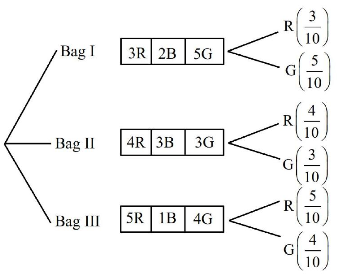
Given three indentical bags each containing 10 balls, whose colours are as follows :| | Red | Blue | Green |
| Bag I | 3 | 2 | 5 |
| Bag II | 4 | 3 | 3 |
| Bag III | 5 | 1 | 4 |
A person chooses a bag at random and takes out a ball. If the ball is Red, the probability that it is from bag I is p and if the balls is Green, the probability that it is from bag III is $q$, then the value of $\left(\frac{1}{p}+\frac{1}{q}\right)$ is : View full question & answer→MCQ 124 Marks
If $\theta \in\left[-\frac{7 \pi}{6}, \frac{4 \pi}{3}\right]$, then the number of solutions of $\sqrt{3} \operatorname{cosec}^{2} \theta-2(\sqrt{3}-1) \operatorname{cosec} \theta-4=0$, is equal to
AnswerA. 6
$\operatorname{cosec} \theta=\frac{2(\sqrt{3}-1) \pm \sqrt{4(3+1-2 \sqrt{3})+16 \sqrt{3}}}{2 \sqrt{3}}$
$=\frac{2(\sqrt{3-1}) \pm \sqrt{16+8 \sqrt{3}}}{2 \sqrt{3}}$
$=\frac{2(\sqrt{3}-1) \pm(2+2 \sqrt{3})}{2 \sqrt{3}}$
$\operatorname{cosec} \theta=2$ or $\frac{-2}{\sqrt{3}}$
$\therefore \sin \theta=\frac{1}{2}$ or $\frac{-\sqrt{3}}{2}$
$\therefore \sin \theta=\frac{1}{2}$ has 3 solutions & also $\sin \theta=\frac{-\sqrt{3}}{2}$ has 3 solutions in $\left[\frac{-7 \pi}{6}, \frac{4 \pi}{3}\right]$
View full question & answer→MCQ 134 Marks
If the system of equation
$2 x+\lambda y+3 z=5$
$3 x+2 y-z=7$
$4 x+5 y+\mu z=9$
has infinitely many solutions, then $\left(\lambda^{2}+\mu^{2}\right)$ is equal to :
AnswerC. 26
$\Delta=0 \Rightarrow\left|\begin{array}{ccc}2 & \lambda & 3 \\ 3 & 2 & -1 \\ 4 & 5 & \mu\end{array}\right|=0$
$\Rightarrow 2(2 \mu+5)+\lambda(-4-3 \mu)+3(7)=0$
$\Rightarrow 4 \mu-3 \lambda \mu-4 \lambda+31=0 \ldots .$. (1)
$\Delta_{3}=0 \Rightarrow\left|\begin{array}{lll}2 & \lambda & 5 \\ 3 & 2 & 7 \\ 4 & 5 & 9\end{array}\right|=0$
$\Rightarrow 2(-17)+\lambda(1)+5(7)=0$
$\Rightarrow \lambda=-1$
from equation (1)
$4 \mu+3 \mu+4+31=0 \Rightarrow \mu=-5$
$\therefore \lambda^{2}+\mu^{2}=26$
View full question & answer→MCQ 144 Marks
Let $(a, b)$ be the point of intersection of the curve $x^{2}=2 y$ and the straight line $y-2 x-6=0$ in the second quadrant. Then the integral $I=\int_{a}^{b} \frac{9 x^{2}}{1+5^{x}} d x$ is equal to :
View full question & answer→MCQ 154 Marks
The line $L_{1}$ is parallel to the vector $\overrightarrow{\mathrm{a}}=-3 \hat{\mathrm{i}}+2 \hat{\mathrm{j}}+4 \hat{\mathrm{k}}$ and passes through the point $(7,6,2)$ and the line $L_{2}$ is parallel to the vector $\overrightarrow{\mathrm{b}}=2 \hat{\mathrm{i}}+\hat{\mathrm{j}}+3 \hat{\mathrm{k}}$ and passes through the point $(5,3,4)$. The shortest distance between the lines $L_{1}$ and $L_{2}$ is :
- A
$\frac{23}{\sqrt{38}}$
- B
$\frac{21}{\sqrt{57}}$
- C
$\frac{23}{\sqrt{57}}$
- D
$\frac{21}{\sqrt{38}}$
AnswerA. $\frac{23}{\sqrt{38}}$
$L_{1}:(7 \hat{\mathrm{i}}+6 \hat{\mathrm{j}}+2 \mathrm{k})+\lambda(-3 \hat{\mathrm{i}}+2 \hat{\mathrm{j}}+4 \mathrm{k})$
$L_{2}:(5 \hat{i}+3 \hat{j}+4 \mathrm{k})+\lambda(2 \hat{i}+\hat{j}+3 \mathrm{k})$
Distance between skew lines
$=\frac{(2 \hat{i}+3 \hat{j}-2 \hat{k}) \cdot(2 \hat{i}+17 \hat{j}-7 \hat{k})}{\sqrt{342}}$
$=\frac{69}{\sqrt{342}}=\frac{69}{3 \sqrt{38}}=\frac{23}{\sqrt{38}}$
View full question & answer→MCQ 164 Marks
If the length of the minor axis of an ellipse is equal to one fourth of the distance between the foci, then the eccentricity of the ellipse is :
- A
$\frac{4}{\sqrt{17}}$
- B
$\frac{\sqrt{3}}{16}$
- C
$\frac{3}{\sqrt{19}}$
- D
$\frac{\sqrt{5}}{7}$
AnswerA. $\frac{4}{\sqrt{17}}$
$2 \mathrm{~b}=\frac{1}{4}(2 \mathrm{ae})$
$\frac{b}{a}=\frac{\mathrm{e}}{4}$
$e=\sqrt{1-\frac{b^{2}}{a^{2}}}$
$e=\sqrt{1-\frac{\mathrm{e}^{2}}{16}}$
$\mathrm{e}^{2}\left(1+\frac{1}{16}\right)=1$
$e=\frac{4}{\sqrt{17}}$
View full question & answer→MCQ 174 Marks
Let $\mathrm{A}=\{1,2,3, \ldots, 10\}$ and R be a relation on A such that $R=\{(a, b): a=2 b+1\}$. Let $\left(a_{1}, a_{2}\right)$, $\left(a_{2}, a_{3}\right),\left(a_{3}, a_{4}\right), \ldots .,\left(a_{k}, a_{k+1}\right)$ be a sequence of $k$ elements of R such that the second entry of an ordered pair is equal to the first entry of the next ordered pair. Then the largest integer k, for which such a sequence exists, is equal to :
AnswerC. 5
$a=2 b+1$
$2 b=a-1$
$\mathrm{R}=\{(3,1),(5,2), \ldots,(99,49)\}$
Let $(2 m+1, m),(2 \lambda-1, \lambda)$ are such ordered pairs.
According to the condition
$\mathrm{m}=2 \lambda-1 \Rightarrow \mathrm{~m}=$ odd number
$\Rightarrow 1^{\text {st }}$ element of ordered pair $(\mathrm{a}, \mathrm{b})$
$\mathrm{a}=2(2 \lambda-1)+1=4 \lambda-1$
Hence $\mathrm{a} \in\{3,7, \ldots, 99\}$
$\Rightarrow \lambda \in\{1,2, \ldots, 25\}$
$\Rightarrow$ set of sequence
$\left\{(4 \lambda-1,2 \lambda-1),(2 \lambda-1, \lambda-1),\left(\lambda-1, \frac{\lambda-2}{2}\right), \ldots \ldots.\right\}$
$2^{\text {nd }}$ element of each ordered pair $=\frac{\lambda-2^{\mathrm{r}-2}}{2^{\mathrm{r}-2}}$
For maximum number of ordered pairs in such sequence
$\frac{\lambda-2^{\mathrm{r}-2}}{2^{\mathrm{r}-2}}=1$ or $2 ; 1 \leq \lambda \leq 25$
$\lambda=2^{\mathrm{r}-1}$ or $\lambda=3.2^{\mathrm{r}-2}$
Case - I : $\lambda=2 \mathrm{r}-1$
$\lambda=2,2^{2}, 2^{3}, 2^{4}$
$\mathrm{r}=2,3,4,5$
Hence maximum value of $r$ is 5 when $\lambda=16$
Case - II : $\lambda=3.2^{\text {r-2 }}$
$\lambda=3,6,12,24$
$\mathrm{r}=2,3,4,5$
Hence maximum value of $r$ is 5 when $\lambda=24$
View full question & answer→MCQ 184 Marks
The number of terms of an A.P. is even; the sum of all the odd terms is 24, the sum of all the even terms is 30 and the last term exceeds the first by $\frac{21}{2}$. Then the number of terms which are integers in the A.P. is :
AnswerA. 4
$
\begin{array}{l}
a_2+a_4+\ldots+a_n=30 & ....(1)\\
a_1+a_3+\ldots+a_{n-1}=24 & ...(2)
\end{array}
$
(1) $-(2)$
$\left(a_{2}-a_{1}\right)+\left(a_{4}-a_{3}\right) \ldots\left(a_{n}-a_{n-1}\right)=6$
$\Rightarrow \frac{\mathrm{n}}{2} \mathrm{~d}=6 \Rightarrow \mathrm{nd}=12$
$a_{n}-a_{1}=(n-1) d=\frac{21}{2}$
$\Rightarrow \mathrm{nd}-\mathrm{d}=\frac{21}{2} \Rightarrow 12-\frac{21}{2}=\mathrm{d}$
$\Rightarrow \mathrm{d}=\frac{3}{2}, \mathrm{n}=8$
Sum of odd terms $=\frac{4}{2}[2 \mathrm{a}+(4-1) 3]=24$
$\Rightarrow \mathrm{a}=\frac{3}{2}$
A.P. $\Rightarrow \frac{3}{2}, 3, \frac{9}{2}, 6, \frac{15}{2}, 9, \frac{21}{2}, 12$
no. of integer terms $=4$
View full question & answer→MCQ 194 Marks
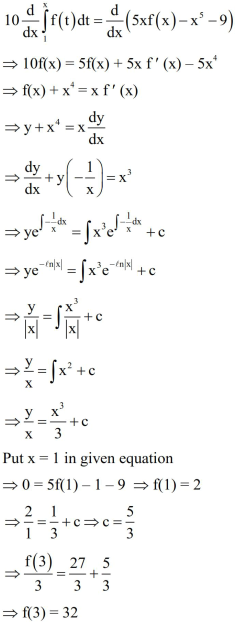
Let $f:[1, \infty) \rightarrow[2, \infty)$ be a differentiable function, If $10 \int_{1}^{x} f(\mathrm{t}) \mathrm{dt}=5 \mathrm{x} f(\mathrm{x})-\mathrm{x}^{5}-9$ for all $\mathrm{x} \geq 1$, then the value of $f(3)$ is :
View full question & answer→MCQ 204 Marks
If the image of the point $\mathrm{P}(1,0,3)$ in the line joining the points $\mathrm{A}(4,7,1)$ and $\mathrm{B}(3,5,3)$ is $\mathrm{Q}(\alpha, \beta, \gamma)$, then $\alpha+\beta+\gamma$ is equal to
- A
$\frac{47}{3}$
- B
$\frac{46}{3}$
- C
- D
AnswerB. $\frac{46}{3}$
$\mathrm{P}(1,0,3)$
$\mathrm{A}(4,7,1), \mathrm{B}(3,5,3)$
Line $\mathrm{AB} \Rightarrow \frac{\mathrm{x}-3}{1}=\frac{\mathrm{y}-5}{2}=\frac{\mathrm{z}-3}{-2}=\lambda$
Let foot of perpendicular of P on AB be
$\mathrm{R} \equiv(\lambda+3,2 \lambda+5,-2 \lambda+3)$
$\Rightarrow(\lambda+3-1)(1)+(2 \lambda+5-0)(2)+(-2 \lambda+3-3)$$(-2)=0$
$\Rightarrow \lambda+2+4 \lambda+10+4 \lambda=0$
$\Rightarrow \lambda=-\frac{4}{3}$
$\Rightarrow \mathrm{R} \equiv\left(\frac{5}{3}, \frac{7}{3}, \frac{17}{3}\right)$
$\mathrm{Q} \equiv\left(\frac{10}{3}-1, \frac{14}{3}-0, \frac{34}{3}-3\right) \equiv\left(\frac{7}{3}, \frac{14}{3}, \frac{25}{3}\right)$
$\Rightarrow \alpha+\beta+\gamma=\frac{7+14+25}{3}=\frac{46}{3}$
View full question & answer→