Sample QuestionsJEE Main 2-April-2025 Paper - Shift 2 questions
One sample from each question group in this chapter. Select any group above to see the full set with answer keys.
Let $A$ be a $3 \times 3$ real matrix such that $A^{2}(A-2 I)-$ $4(\mathrm{~A}-\mathrm{I})=\mathrm{O}$, where I and O are the identity and null matrices, respectively. If $A^{5}=\alpha A^{2}+\beta A+\gamma I$, where $\alpha, \beta$ and $\gamma$ are real constants, then $\alpha+\beta+\gamma$ is equal to:
View full solution →Let the area of the triangle formed by a straight Line L : $\mathrm{x}+\mathrm{by}+\mathrm{c}=0$ with co-ordinate axes be 48 square units. If the perpendicular drawn from the origin to the line L makes an angle of $45^{\circ}$ with the positive x -axis, then the value of $\mathrm{b}^{2}+\mathrm{c}^{2}$ is:
View full solution →Let $\overrightarrow{\mathrm{a}}=2 \hat{\mathrm{i}}-3 \hat{\mathrm{j}}+\mathrm{k}, \overrightarrow{\mathrm{b}}=3 \hat{\mathrm{i}}+2 \hat{\mathrm{j}}+5 \mathrm{k}$ and a vector $\overrightarrow{\mathrm{c}}$ be such that $(\overrightarrow{\mathrm{a}}-\overrightarrow{\mathrm{c}}) \times \overrightarrow{\mathrm{b}}=-18 \hat{\mathrm{i}}-3 \hat{\mathrm{j}}+12 \mathrm{k}$ and $\overrightarrow{\mathrm{a}} \cdot \overrightarrow{\mathrm{c}}=3$. If $\overrightarrow{\mathrm{b}} \times \overrightarrow{\mathrm{c}}=\overrightarrow{\mathrm{d}}$, then $|\overrightarrow{\mathrm{a}} \cdot \overrightarrow{\mathrm{d}}|$ is equal to :
View full solution →Let the point $P$ of the focal chord $P Q$ of the parabola $y^{2}=16 x$ be $(1,-4)$. If the focus of the parabola divides the chord PQ in the ratio $\mathrm{m}: \mathrm{n}$, $\operatorname{gcd}(\mathrm{m}, \mathrm{n})=1$, then $\mathrm{m}^{2}+\mathrm{n}^{2}$ is equal to :
View full solution →View full solution →If the set of all $a \in R-\{1\}$, for which the roots of the equation $(1-a) x^{2}+2(a-3) x+9=0$ are positive is $(-\infty,-\alpha] \cup[\beta, \gamma)$, then $2 \alpha+\beta+\gamma$ is equal to __________ .
View full solution →Let $\mathrm{A}(4,-2), \mathrm{B}(1,1)$ and $\mathrm{C}(9,-3)$ be the vertices of a triangle $A B C$. Then the maximum area of the parallelogram AFDE, formed with vertices D, E and $F$ on the sides $\mathrm{BC}, \mathrm{CA}$ and AB of the triangle ABC respectively, is __________ .
View full solution →If $y=\cos \left(\frac{\pi}{3}+\cos ^{-1} \frac{x}{2}\right)$, then $(x-y)^{2}+3 y^{2}$ is equal to __________ .
View full solution →If the sum of the first 10 terms of the series $\frac{4.1}{1+4.1^{4}}+\frac{4.2}{1+4.2^{4}}+\frac{4.3}{1+4.3^{4}}+\ldots$ is $\frac{m}{n}$, where $\operatorname{gcd}(\mathrm{m}, \mathrm{n})=1$, then $\mathrm{m}+\mathrm{n}$ is equal to __________ .
View full solution →Let $y=y(x)$ be the solution of the differential equation $\frac{d y}{d x}+2 y \sec ^{2} x=2 \sec ^{2} x+3 \tan x \cdot \sec ^{2} x$ such that $\mathrm{y}(0)=\frac{5}{4}$. Then $12\left(\mathrm{y}\left(\frac{\pi}{4}\right)-\mathrm{e}^{-2}\right)$ is equal to __________ .
View full solution →Consider a circular loop that is uniformly charged and has a radius $\mathrm{a} \sqrt{2}$. Find the position along the positive z - axis of the cartesian coordinate system where the electric field is maximum if the ring was assumed to be placed in xy - plane at the origin :
View full solution →Match List-I with List-II.| List-I | List-II |
| (A) Heat capacity of body | (I) $\mathrm{J} \mathrm{kg}^{-1}$ |
| (B) Specific heat capacity of body | (II) $\mathrm{JK}^{-1}$ |
| (C) Latent heat | (III) $\mathrm{J} \mathrm{kg}^{-1} \mathrm{~K}^{-1}$ |
| (D) Thermal conductivity | (IV) $\mathrm{Jm}^{-1} \mathrm{~K}^{-1} \mathrm{~s}^{-1}$ |
Choose the correct answer from the options given below : - A
(A)-(III), (B)-(I), (C)-(II), (D)-(IV)
- B
(A)-(IV), (B)-(III), (C)-(II), (D)-(I)
- C
(A)-(III), (B)-(IV), (C)-(I), (D)-(II)
- D
(A)-(II), (B)-(III), (C)-(I), (D)-(IV)
View full solution →If $\mu_{0}$ and $\varepsilon_{0}$ are the permeability and permittivity of free space, respectively, then the dimension of $\left(\frac{1}{\mu_{0} \varepsilon_{0}}\right)$ is :
View full solution →A bi-convex lens has radius of curvature of both the surfaces same as $1 / 6 \mathrm{~cm}$. If this lens is required to be replaced by another convex lens having different radii of curvatures on both sides ( $\mathrm{R}_{1} \neq \mathrm{R}_{2}$ ), without any change in lens power then possible combination of $R_{1}$ and $R_{2}$ is :
- A
$\frac{1}{3} \mathrm{~cm}$ and $\frac{1}{3} \mathrm{~cm}$
- B
$\frac{1}{5} \mathrm{~cm}$ and $\frac{1}{7} \mathrm{~cm}$
- C
$\frac{1}{3} \mathrm{~cm}$ and $\frac{1}{7} \mathrm{~cm}$
- D
$\frac{1}{6} \mathrm{~cm}$ and $\frac{1}{9} \mathrm{~cm}$
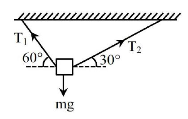
View full solution →- A
$5,5 \sqrt{3}$
- B
$5 \sqrt{3}, 5$
- C
$5 \sqrt{3}, 5 \sqrt{3}$
- D
View full solution →A satellite of mass 1000 kg is launched to revolve around the earth in an orbit at a height of 270 km from the earth's surface. Kinetic energy of the satellite in this orbit is __________ $\times 10^{10} \mathrm{~J}$.
(Mass of earth $=6 \times 10^{24} \mathrm{~kg}$, Radius of earth $=$ $6.4 \times 10^{6} \mathrm{~m}$, Gravitational constant $=$ $6.67 \times 10^{-11} \mathrm{Nm}^{2} \mathrm{~kg}^{-2}$ )
View full solution →The length of a light string is 1.4 m when the tension on it is 5 N. If the tension increases to 7 N, the length of the string is 1.56 m. The original length of the string is __________ m.
A ray of light suffers minimum deviation when incident on a prism having angle of the prism equal to $60^{\circ}$. The refractive index of the prism material is $\sqrt{2}$. The angle of incidence (in degrees) is __________ .
View full solution →The internal energy of air in $4 \mathrm{~m} \times 4 \mathrm{~m} \times 3 \mathrm{~m}$ sized room at 1 atmospheric pressure will be __________ $\times 10^{6} \mathrm{~J}$.
(Consider air as diatomic molecule)
View full solution →View full solution →In Dumas' method for estimation of nitrogen, 0.5 gram of an organic compound gave 60 mL of nitrogen collected at 300 K temperature and 715 mm Hg pressure. The percentage composition of nitrogen in the compound (Aqueous tension at $300 \mathrm{~K}=15 \mathrm{~mm} \mathrm{Hg}$ ) is
View full solution →A tetrapeptide "$x$" on complete hydrolysis produced glycine (Gly), alanine (Ala), valine (Val), leucine (Leu) in equimolar proportion each. The number of tetrapeptides (sequences) possible involving each of these amino acids is
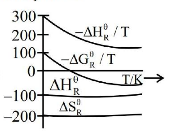
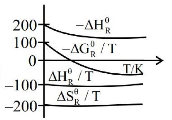
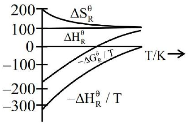
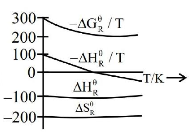
View full solution →Which of the following graphs correctly represents the variation of thermodynamic properties of Haber's process ?
Consider the following chemical equilibrium of the gas phase reaction at a constant temperature : $\mathrm{A}(\mathrm{g}) \rightleftharpoons \mathrm{B}(\mathrm{g})+\mathrm{C}(\mathrm{g})$
If $p$ being the total pressure, $K_{p}$ is the pressure equilibrium constant and $\alpha$ is the degree of dissociation, then which of the following is true at equilibrium?
- A
If p value is extremely high compared to $\mathrm{K}_{\mathrm{p}}, \alpha \approx 1$
- B
When $p$ increases $\alpha$ decreases
- C
If $k_{p}$ value is extremely high compared to $p, \alpha$ becomes much less than unity
- D
When $p$ increases $\alpha$ increases
View full solution →Match List-I with List-II
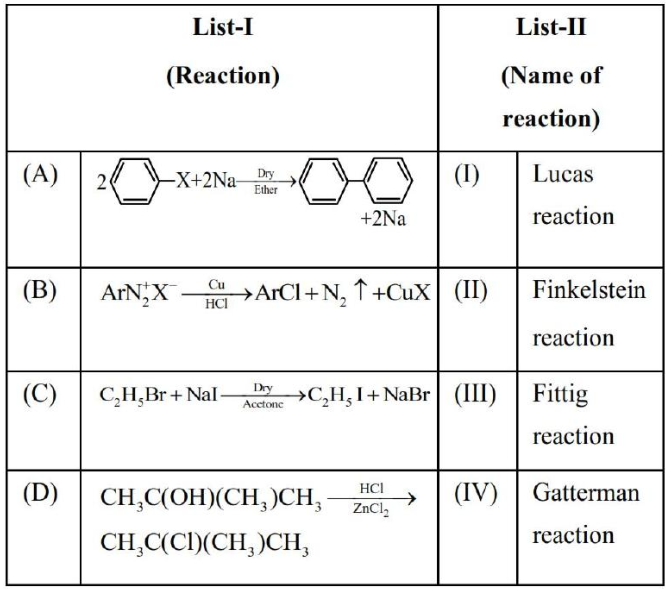
Choose the correct answer from the options given below :
- A
(A)-(III), (B)-(II), (C)-(IV), (D)-(I)
- B
(A)-(III), (B)-(IV), (C)-(II), (D)-(I)
- C
(A)-(IV), (B)-(III), (C)-(I), (D)-(II)
- D
(A)-(IV), (B)-(I), (C)-(II), (D)-(III)
View full solution →The spin-only magnetic moment value of $\mathrm{M}^{\mathrm{n+-}}$ ion formed among $\mathrm{Ni}, \mathrm{Zn} \mathrm{Mn}$ and Cu that has the least enthalpy of atomisation is __________ . (in nearest integer)
Here n is equal to the number of diamagnetic complexes among $\mathrm{K}_{2}\left[\mathrm{NiCl}_{4}\right],\left[\mathrm{Zn}\left(\mathrm{H}_{2} \mathrm{O}\right)_{6}\right] \mathrm{Cl}_{2}$,
$\mathrm{K}_{3}\left[\mathrm{Mn}(\mathrm{CN})_{6}\right]$ and $\left[\mathrm{Cu}\left(\mathrm{PPh}_{3}\right)_{3} \mathrm{I}\right]$
View full solution →When 1 g each of compounds AB and $\mathrm{AB}_{2}$ are dissolved in 15 g of water separately, they increased the boiling point of water by 2.7 K and 1.5 K respectively. The atomic mass of A (in amu) is __________ $\times 10^{-1}$ (Nearest integer)
(Given : Molal boiling point elevation constant is $0.5 \mathrm{~K} \mathrm{~kg} \mathrm{~mol}^{-1}$ )
View full solution →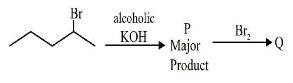
Consider the above sequence of reactions. 151 g of 2-bromopentane is made to react. Yield of major product P is $80 \%$ whereas Q is $100 \%$.
Mass of product Q obtained is $\qquad$ g.
(Given molar mass in $\mathrm{g} \mathrm{mol}^{-1} \mathrm{H}: 1, \mathrm{C}: 12, \mathrm{O}: 16$, Br : 80)$0.2 \%(\mathrm{w} / \mathrm{v})$ solution of NaOH is measured to have resistivity $870.0 \mathrm{~m} \Omega \mathrm{~m}$. The molar conductivity of the solution will be __________ $\times 10^{2} \mathrm{mS} \mathrm{dm}{ }^{2} \mathrm{~mol}^{-1}$. (Nearest integer)
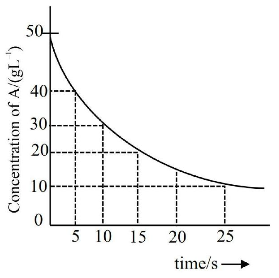
View full solution →For the reaction $\mathrm{A} \rightarrow \mathrm{B}$ the following graph was obtained. The time required (in seconds) for the concentration of A to reduce to $2.5 \mathrm{~g} \mathrm{~L}^{-1}$ (if the initial concentration of A was $50 \mathrm{~g} \mathrm{~L}^{-1}$ ) is __________ (Nearest integer)
Given : $\log 2=0.3010$
View full solution →