Questions

SECTION - B [CHEMISTY - NUMERIC]

Take a timed test

5 questions · self-marked practice — reveal the answer and mark yourself.

Question 14 Marks
The spin-only magnetic moment value of $\mathrm{M}^{\mathrm{n+-}}$ ion formed among $\mathrm{Ni}, \mathrm{Zn} \mathrm{Mn}$ and Cu that has the least enthalpy of atomisation is __________ . (in nearest integer)
Here n is equal to the number of diamagnetic complexes among $\mathrm{K}_{2}\left[\mathrm{NiCl}_{4}\right],\left[\mathrm{Zn}\left(\mathrm{H}_{2} \mathrm{O}\right)_{6}\right] \mathrm{Cl}_{2}$,
$\mathrm{K}_{3}\left[\mathrm{Mn}(\mathrm{CN})_{6}\right]$ and $\left[\mathrm{Cu}\left(\mathrm{PPh}_{3}\right)_{3} \mathrm{I}\right]$
Answer
0
$\mathrm{K}_{2}\left[\mathrm{NiCl}_{4}\right] \Rightarrow \mathrm{sp}^{3}$, Paramagnetic
$\left[\mathrm{Zn}\left(\mathrm{H}_{2} \mathrm{O}\right)_{6}\right] \mathrm{Cl}_{2} \Rightarrow \mathrm{sp}^{3} \mathrm{~d}^{2}$, Diamagnetic
$\mathrm{K}_{3}\left[\mathrm{Mn}(\mathrm{CN})_{6}\right] \Rightarrow \mathrm{d}^{2} \mathrm{sp}^{3}$, Paramagnetic
$\left[\mathrm{Cu}\left(\mathrm{PPh}_{3}\right)_{3} \mathrm{I}\right] \Rightarrow \mathrm{sp}^{3}$, Diamagnetic
Hence the value of $n$ is 2
Least value of enthalpy of atomisation among Ni , $\mathrm{Zn}, \mathrm{Mn}$ and Cu is of Zn
$\mathrm{Zn}^{+2}$ :- $[\mathrm{Ar}] 3 \mathrm{~d}^{10}$
$\mu=0$
View full question & answer
Question 24 Marks
When 1 g each of compounds AB and $\mathrm{AB}_{2}$ are dissolved in 15 g of water separately, they increased the boiling point of water by 2.7 K and 1.5 K respectively. The atomic mass of A (in amu) is __________ $\times 10^{-1}$ (Nearest integer)
(Given : Molal boiling point elevation constant is $0.5 \mathrm{~K} \mathrm{~kg} \mathrm{~mol}^{-1}$ )
Answer
25
For AB
$\Delta \mathrm{T}_{\mathrm{b}}=2.7 \mathrm{~K}$
$2.7=1 \times 0.5 \times \mathrm{m}$
$\mathrm{m}=\frac{27}{5}$
Let molar mass of $A B=x$.
So $\frac{1 / \mathrm{x}}{15} \times 1000=\frac{27}{5}$
$\mathrm{x}=12.34$
For $\mathrm{AB}_{2}$
$\Delta \mathrm{T}_{\mathrm{b}}=1.5 \mathrm{~K}$
$1.5=1 \times 0.5 \times \mathrm{m}$
$\mathrm{m}=3$
Let molar mass of $\mathrm{AB}_{2}=\mathrm{y}$
So $\frac{1 / y}{15} \times 1000=3$
$y=\frac{1000}{45}$
$y=22.22$
Now let a and b be atomic masses of A and B respectively, then
$
\begin{array}{l}
A+b=12.34 & ...(i)\\
A+2 b=22.22 & ...(ii)
\end{array}
$
$\mathrm{B}=22.22-12.34=9.88$
Now $\mathrm{a}=12.34-9.88=2.46$
$=24.6 \times 10^{-1}=25 \times 10^{-1}$
View full question & answer
Question 44 Marks
$0.2 \%(\mathrm{w} / \mathrm{v})$ solution of NaOH is measured to have resistivity $870.0 \mathrm{~m} \Omega \mathrm{~m}$. The molar conductivity of the solution will be __________ $\times 10^{2} \mathrm{mS} \mathrm{dm}{ }^{2} \mathrm{~mol}^{-1}$. (Nearest integer)
Answer
23
Given : Concentration of $\mathrm{NaOH}=0.2 \%(\mathrm{w} / \mathrm{v})$
$\therefore 0.2 \mathrm{~g}$ of NaOH in 100 ml of solution.
Molarity of NaOH solution
$\begin{array}{r}=\frac{\text { moles of solute }}{ V _{ ml }} \times 1000 \\ =\frac{0.2 / 40}{100} \times 1000==\frac{0.2}{40 \times 100} \times 1000=\frac{2}{40} M \end{array}$
Given resistivity of solution $=870 \mathrm{~m}$ ohm m
$=870 \times 10^{-3} \mathrm{ohm} \mathrm{m}$
$=870 \times 10^{-3} \times 10 \mathrm{ohm} \mathrm{dm}$
$=870 \times 10^{-2}$ ohm dm
$=8.7 \mathrm{ohm} \mathrm{dm}$
Now conductivity
$\mathrm{K}=\frac{1}{\rho}=\frac{1}{8.7} \mathrm{ohm}^{-1} \mathrm{dm}^{-1}$
Now molar conductivity of solution is
$\lambda_{\mathrm{m}}=\frac{\mathrm{K}}{\mathrm{M}}=\frac{\frac{1}{8.7}}{\frac{2}{40}}=\frac{40}{2 \times 8.7}=2.29 \mathrm{~S} \mathrm{dm}^{2} \mathrm{~mol}^{-1}$
$2.29 \times 10^{3} \mathrm{~m} \mathrm{~S} \mathrm{dm}^{2} \mathrm{~mol}^{-1}$
$=22.9 \times 10^{2} \mathrm{~m} \mathrm{~S} \mathrm{dm}^{2} \mathrm{~mol}^{-1}$
$=23 \times 10^{2} \mathrm{~m} \mathrm{~S} \mathrm{dm}^{2} \mathrm{~mol}^{-1}$
View full question & answer
Question 54 Marks
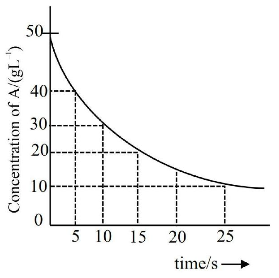
For the reaction $\mathrm{A} \rightarrow \mathrm{B}$ the following graph was obtained. The time required (in seconds) for the concentration of A to reduce to $2.5 \mathrm{~g} \mathrm{~L}^{-1}$ (if the initial concentration of A was $50 \mathrm{~g} \mathrm{~L}^{-1}$ ) is __________ (Nearest integer)
Given : $\log 2=0.3010$
Image
Answer
43
As it is difficult to predict order using data provided in graph.
For specific time interval $0-5 \mathrm{sec}, 5-10 \mathrm{sec}$ and $10-15 \mathrm{sec}$. order comes to be zero, but graph is not a straight line.
Assuming $1^{\text {st }}$ order kinetics
$\mathrm{K}=\frac{1}{\mathrm{t}} \ln \frac{\mathrm{A}_{0}}{\mathrm{~A}_{\mathrm{t}}}$
$\mathrm{K}=\frac{1}{10} \ln \frac{40}{20}$
Time required to reduce to $2.5 \mathrm{~g} / \mathrm{L}$
$\mathrm{K}=\frac{1}{\mathrm{t}} \ln \frac{50}{2.5}$
$\frac{1}{10} \ln 2=\frac{1}{\mathrm{t}} \ln 20$
$\mathrm{t}=\frac{1.3010 \times 10}{0.3010}=43.3 \mathrm{sec}$.
View full question & answer