Questions

SECTION - B [MATHS - NUMERIC]

Take a timed test

5 questions · self-marked practice — reveal the answer and mark yourself.

Question 14 Marks
If the set of all $a \in R-\{1\}$, for which the roots of the equation $(1-a) x^{2}+2(a-3) x+9=0$ are positive is $(-\infty,-\alpha] \cup[\beta, \gamma)$, then $2 \alpha+\beta+\gamma$ is equal to __________ .
Answer
7
Both the roots are positive
$\mathrm{D} \geq 0$
$4(a-3)^{2}-4 \times 9(1-a) \geq 0$
$a^{2}-6 a+9-9+9 a \geq 0$
$a^{2}+3 a \geq 0$
$a(a+3) \geq 0$
$
a \in(-\infty,-3] \cup[0, \infty) \quad ...(i)
$
$-\frac{\mathrm{b}}{2 \mathrm{a}}>0$
$\frac{2(a-3)}{2(a-1)}>0$
$
a \in(-\infty, 1) \cup(3, \infty) \quad ...(ii)
$
$\mathrm{f}(0)=9>0$
Equation (i) $\cap$ (ii)
$a \in(-\infty,-3] \cup[0,1)$
$2 \alpha+\beta+\gamma-6+0+1=7$
View full question & answer
Question 24 Marks
Let $\mathrm{A}(4,-2), \mathrm{B}(1,1)$ and $\mathrm{C}(9,-3)$ be the vertices of a triangle $A B C$. Then the maximum area of the parallelogram AFDE, formed with vertices D, E and $F$ on the sides $\mathrm{BC}, \mathrm{CA}$ and AB of the triangle ABC respectively, is __________ .
Answer
3
Area of $\triangle \mathrm{ABC}=\frac{1}{2}\left|\begin{array}{ccc}4 & -2 & 1 \\ 1 & 1 & 1 \\ 9 & -3 & 1\end{array}\right|$
$=6$ square units
Maximum area of $\mathrm{AFDE}=\frac{1}{2} \times 6=3$ sq. units
View full question & answer
Question 34 Marks
If $y=\cos \left(\frac{\pi}{3}+\cos ^{-1} \frac{x}{2}\right)$, then $(x-y)^{2}+3 y^{2}$ is equal to __________ .
Answer
3
$y=\cos \left(\cos ^{-1} \frac{1}{2}+\cos ^{-1} \frac{x}{2}\right)$
$\mathrm{y}=\frac{1}{2} \times \frac{\mathrm{x}}{2}-\sqrt{1-\frac{1}{4}} \sqrt{1-\frac{\mathrm{x}^{2}}{4}}$
$4 y=x-\sqrt{3} \sqrt{4-x^{2}}$
$3\left(4-x^{2}\right)=x^{2}+16 y^{2}-8 x y$
$12-3 x^{2}=x^{2}+16 y^{2}-8 x y$
$4 x^{2}+16 y^{2}-8 x y=12$
$x^{2}+4 y^{2}-2 x y=3$
$x^{2}+y^{2}-2 x y-3 y^{2}=3$
$(x-y)^{2}+3 y^{2}=3$
View full question & answer
Question 44 Marks
If the sum of the first 10 terms of the series $\frac{4.1}{1+4.1^{4}}+\frac{4.2}{1+4.2^{4}}+\frac{4.3}{1+4.3^{4}}+\ldots$ is $\frac{m}{n}$, where $\operatorname{gcd}(\mathrm{m}, \mathrm{n})=1$, then $\mathrm{m}+\mathrm{n}$ is equal to __________ .
Answer
441
$\begin{aligned} T _{ r } & =\frac{4 . r }{1+4 . r ^4} \\ T_{ r } & =\frac{4 . r }{\left(2 r ^2+2 r +1\right)\left(2 r ^2-2 r +1\right)} \\ T _{ r } & =\frac{\left(2 r ^2+2 r +1\right)-\left(2 r ^2-2 r +1\right)}{\left(2 r ^2+2 r +1\right)\left(2 r ^2-2 r +1\right)}\end{aligned}$
$T_{r}=\frac{1}{2 r^{2}-2 r+1}-\frac{1}{2 r^{2}+2 r+1}$
$\mathrm{T}_{1}=\frac{1}{1}-\frac{1}{5}$
$\mathrm{T}_{2}=\frac{1}{5}-\frac{1}{13}$
$\mathrm{T}_{10}=\frac{1}{181}-\frac{1}{221}$
$\mathrm{S}_{10}=1-\frac{1}{221}=\frac{220}{221}=\frac{\mathrm{m}}{\mathrm{n}}$
$\mathrm{m}+\mathrm{n}=441$
View full question & answer
Question 54 Marks
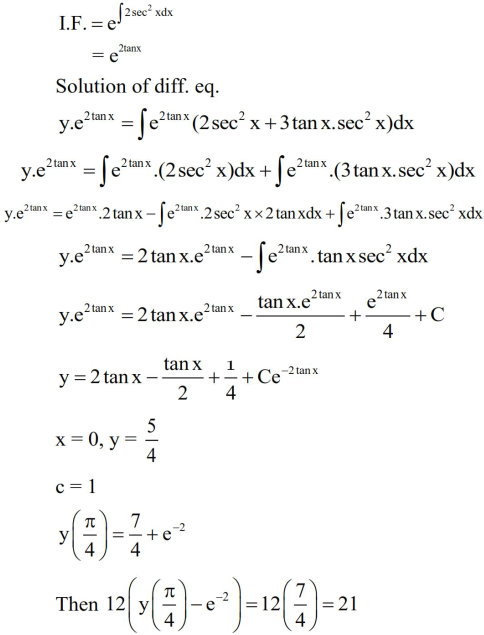
Let $y=y(x)$ be the solution of the differential equation $\frac{d y}{d x}+2 y \sec ^{2} x=2 \sec ^{2} x+3 \tan x \cdot \sec ^{2} x$ such that $\mathrm{y}(0)=\frac{5}{4}$. Then $12\left(\mathrm{y}\left(\frac{\pi}{4}\right)-\mathrm{e}^{-2}\right)$ is equal to __________ .
Answer
View full question & answer