Questions

SECTION - A [PHYSICS MCQ]

Take a timed test

20 questions · 19 auto-graded MCQ + 1 self-marked written.

MCQ 14 Marks
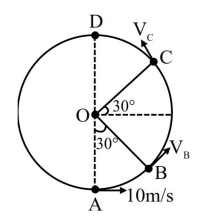
A body of mass 100 g is moving in circular path of radius 2 m on vertical plane as shown in figure. The velocity of the body at point A is $10 m / s$. The ratio of its kinetic energies at point B and C is :
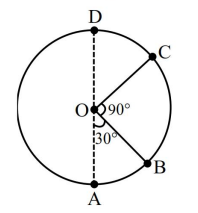
Image
(Take acceleration due to gravity as $10 m / s ^2$ )
  • A
    $\frac{2+\sqrt{3}}{3}$
  • B
    $\frac{2+\sqrt{2}}{3}$
  • $\frac{3+\sqrt{3}}{2}$
  • D
    $\frac{3-\sqrt{2}}{2}$
Answer
Correct option: C.
$\frac{3+\sqrt{3}}{2}$
(C) $\frac{3+\sqrt{3}}{2}$
Sol.
Image
$\begin{array}{l}\frac{1}{2} m \times 100+0=\frac{1}{2} m V_B^2+m g\left(R-\frac{R \sqrt{3}}{2}\right) \\ 100=V_B^2+2 g R\left(1-\frac{\sqrt{3}}{2}\right] \\ V_B^2=100-20(2-\sqrt{3}) \\ \left.V_B^2=60+20 \sqrt{3}\right) \\ K . E_B=\frac{1}{2} m V_B^2=\frac{m}{2}(60+20 \sqrt{3}) \\ \frac{1}{2} m(100)=\frac{1}{2} m V_C^2+m g\left(\frac{3 R}{2}\right) \\ 100=V_c^2=60 \\ V_c^2=40 \\ K . E_C=\frac{1}{2} m V_c^2=\frac{1}{2} m(40) \\ K . E_B=\frac{60+20 \sqrt{3}}{40}=\frac{3}{2}+\frac{\sqrt{3}}{2}=\frac{3+\sqrt{3}}{2}\end{array}$
View full question & answer
MCQ 24 Marks
Given are statements for certain thermodynamic variables,
(A) Internal energy, volume (V) and mass (M) are extensive variables.
(B) Pressure ( P ), temperature ( T ) and density ( $\rho$ ) are intensive variables.
(C) Volume (V), temperature (T) and density ( $\rho$ ) are intensive variables.
(D) Mass (M), temperature (T) and internal energy are extensive variables.
Choose the correct answer from the points given below :
  • A
    (C) and (D) only
  • B
    (D) and (A) only
  • (A) and (B) only
  • D
    (B) and (C) only
Answer
Correct option: C.
(A) and (B) only
(C) (A) and (B) only
Sol. Extensive variables depends on size or mass of system ex : internal energy, volume, mass
View full question & answer
MCQ 34 Marks
Image
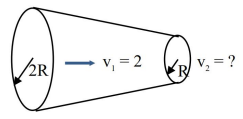
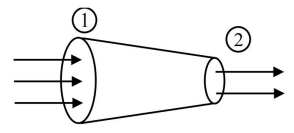
The tube of length L is shown in the figure. The radius of cross section at the point (1) is 2 cm and at the point (2) is 1 cm, respectively. If the velocity of water entering at point (1) is $2 m / s$, then velocity of water leaving the point (2) will be :
  • A
    $2 m / s$
  • B
    $4 m / s$
  • C
    $6 m / s$
  • $8 m / s$
Answer
Correct option: D.
$8 m / s$
(D) $8 m / s$
Sol.
Image
$\begin{array}{l}A_1 V_1=A_2 V_2 \Rightarrow 2 \pi(2 R)^2=V_2 \pi R^2 \\ \therefore V_2=8 m / s \end{array}$
View full question & answer
MCQ 44 Marks
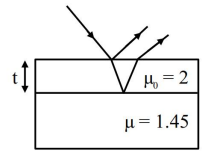
A transparent film of refractive index, 2.0 is coated on a glass slab of refractive index, 1.45. What is the minimum thickness of transparent film to be coated for the maximum transmission of Green light of wavelength 550 nm . [Assume that the light is incident nearly perpendicular to the glass surface.]
  • A
    94.8 nm
  • B
    68.7 nm
  • C
    137.5 nm
  • D
    275 nm
View full question & answer
MCQ 54 Marks
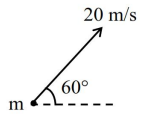
A ball of mass 100 g is projected with velocity $20 m / s$ at $60^{\circ}$ with horizontal. The decrease in kinetic energy of the ball during the motion from point of projection to highest point is :
  • A
    20 J
  • 15 J
  • C
    zero
  • D
    5 J
Answer
Correct option: B.
15 J
(B) 15 J
Sol.
Image
$\begin{array}{l} k _{ i }=\frac{1}{2} mv^2 \\ k _{ f }=\frac{1}{2} m\left( v \cos 60^{\circ}\right)^2=\frac{1}{8} mv ^2 \\ \Delta k = k _{ i }- k _{ f }=\frac{3}{8} mv ^2=\frac{3}{8} \times 0.1 \times 400=15 J\end{array}$
View full question & answer
MCQ 64 Marks
Given below are two statements. On is labelled as Assertion (A) and the other is labelled as Reason (R).
Assertion (A) : In Young's double slit experiment, the fringes produced by red light are closer as compared to those produced by blue light.
Reason (R) : The fringe width is directly proportional to the wavelength of light.
In the light of above statements, choose the correct answer from the options given below :
  • A
    Both (A) and (R) are true and (R) is the correct explanation of (A)
  • (A) is false but (R) is true.
  • C
    Both (A) and (R) are true but (R) is NOT the correct explanation of (A).
  • D
    (A) is true but (R) is false.
Answer
Correct option: B.
(A) is false but (R) is true.
(B) (A) is false but (R) is true.
Sol. $\beta=\frac{\lambda D }{ d } \& \lambda_{ R }>\lambda_{ b }$
$\therefore \beta_{ R }>\beta_{ b }$
View full question & answer
MCQ 74 Marks
A force $\overrightarrow{ F }=2 \hat{ i }+ b \hat{ j }+\hat{ k }$ is applied on a particle and it undergoes a displacement $\hat{ i }-2 \hat{ j }-\hat{ k }$. What will be the value of b, if work done on the particle is zero.
  • A
    0
  • $\frac{1}{2}$
  • C
    $\frac{1}{3}$
  • D
    2
Answer
Correct option: B.
$\frac{1}{2}$
(B) $\frac{1}{2}$
Sol. $W D=\overrightarrow{ F } \cdot \overrightarrow{ S }=2-2 b-1=0$
$\therefore b =\frac{1}{2}$
View full question & answer
MCQ 84 Marks
Image
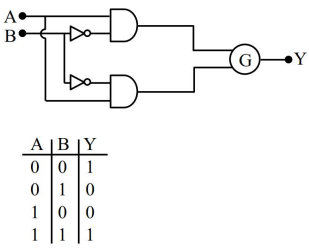
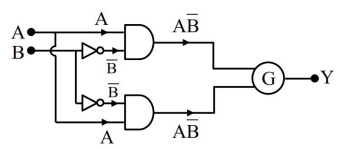
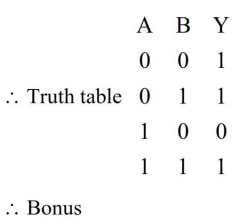
To obtain the given truth table, following logic gate should be placed at G :
  • NOR Gate
  • B
    AND Gate
  • C
    NAND Gate
  • D
    OR Gate
Answer
Correct option: A.
NOR Gate
(A) NOR Gate
Sol.
Image
For NOR gate : $\overline{ A } \overline{ B }=\overrightarrow{ A }+ B$
Image
View full question & answer
MCQ 94 Marks
The torque due the force $(2 \hat{ i }+\hat{ j }+2 \hat{ k })$ about the origin, acting on a particle whose position vector is $(\hat{ i }+\hat{ j }+\hat{ k })$, would be
  • A
    $\hat{i}-\hat{j}+\hat{k}$
  • B
    $\hat{ i }+\hat{ k }$
  • $\hat{i}-\hat{k}$
  • D
    $\hat{ j }-\hat{ k }$
Answer
Correct option: C.
$\hat{i}-\hat{k}$
(C) $\hat{i}-\hat{k}$
Sol. $\vec{\tau}=\overrightarrow{ r } \times \overrightarrow{ F }=\left|\begin{array}{ccc}\hat{ i } & \hat{j} & \hat{k} \\ 1 & 1 & 1 \\ 2 & 1 & 2\end{array}\right|=\hat{ i }-0 \hat{ j }-\hat{ k }$
View full question & answer
MCQ 104 Marks
Given below are two statements. One is labelled as Assertion (A) and the other is labelled as Reason (R).
Assertion (A) : A simple pendulum is taken to a planet of mass and radius, 4 times and 2 times, respectively, than the Earth. The time period of the pendulum remains same on earth and the planet.
Reason (R) : The mass of the pendulum remains unchanged at Earth and the other planet. In the light of the above statements, choose the correct answer from the options given below :
  • Both (A) and (R) are true but (R) is NOT the correct explanation of (A)
  • B
    (A) is true but (R) is false
  • C
    (A) is false but (R) is true
  • D
    Both (A) and (R) are true and (R) is the correct explanation of (A)
Answer
Correct option: A.
Both (A) and (R) are true but (R) is NOT the correct explanation of (A)
(A) Both (A) and (R) are true but (R) is NOT the correct explanation of (A)
Sol. $g =\frac{ GM }{ R ^2}$
$g^{\prime}=\frac{G(4 M)}{(2 R)^2}=g$
A is correct, R is correct ; but since $T =2 \pi \sqrt{\frac{\ell}{g}}$
doesn't depend on mass ; R doesn't explain A .
View full question & answer
MCQ 114 Marks
A light source of wavelength $\lambda$ illuminates a metal surface and electrons are ejected with maximum kinetic energy of 2 eV . If the same surface is illuminated by a light source of wavelength $\frac{\lambda}{2}$, then the maximum kinetic energy of ejected electrons will be (The work function of metal is 1 eV )
  • A
    2 eV
  • B
    6 eV
  • 5 eV
  • D
    3 eV
Answer
Correct option: C.
5 eV
(C) 5 eV
Sol. $\frac{ hc }{\lambda}=\phi+ eV \Rightarrow \frac{ hc }{\lambda}=1+2=3 eV$ ......(1)
$\frac{ hc }{\lambda / 2}=6=1+ k _{\max } \quad \therefore k _{\max }=5 eV$
View full question & answer
MCQ 124 Marks
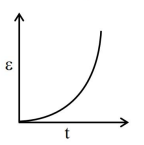
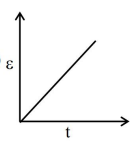
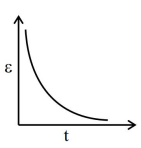
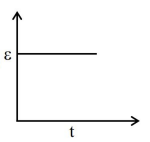
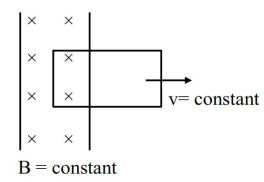
A rectangular metallic loop is moving out of a uniform magnetic field region to a field free region with a constant speed. When the loop is partially inside the magnate field, the plot of magnitude of induced emf $(\varepsilon)$ with time $(t)$ is given by
  • A
    Image
  • B
    Image
  • C
    Image
  • Image
Answer
Correct option: D.
Image
(D) Image

Sol.
Image
Motional $emf : \varepsilon= B \ell v =$ constant
View full question & answer
MCQ 134 Marks
For a diatomic gas, if $\gamma_1=\left(\frac{ Cp }{ Cv }\right)$ for rigid molecules and $\gamma_2=\left(\frac{C p}{C v}\right)$ for another diatomic molecules, but also having vibrational modes. Then, which one of the following options is correct ?
(Cp and Cv are specific heats of the gas at constant pressure and volume)
  • A
    $\gamma_2>\gamma_1$
  • B
    $\gamma_2=\gamma_1$
  • C
    $2 \gamma_2=\gamma_1$
  • $\gamma_2<\gamma_1$
Answer
Correct option: D.
$\gamma_2<\gamma_1$
(D) $\gamma_2<\gamma_1$
Sol. $\gamma=\frac{2}{ f }+1$
without vibration : $f =5: \gamma_1=1.4$
without vibration : $f =7: \gamma_2=1.14$
$
\therefore \gamma_2<\gamma_1
$
View full question & answer
MCQ 144 Marks
An electron projected perpendicular to a uniform magnetic field B moves in a circle. If Bohr's quantization is applicable, then the radius of the electronic orbit in the first excited state is :
  • A
    $\sqrt{\frac{2 h}{\pi e B}}$
  • B
    $\sqrt{\frac{4 h}{\pi eB }}$
  • C
    $\sqrt{\frac{ h }{2 \pi eB }}$
  • $\sqrt{\frac{ h }{\pi eB }}$
Answer
Correct option: D.
$\sqrt{\frac{ h }{\pi eB }}$
(D) $\sqrt{\frac{ h }{\pi eB }}$
Sol. $r =\frac{ mv }{ eB } \& mvr =\frac{ nh }{2 \pi} \Rightarrow( eBr ) r =\frac{ nh }{2 \pi}$
$\Rightarrow r =\sqrt{\frac{ nh }{2 \pi eB }}$
first excited state $: n=2 \therefore r=\sqrt{\frac{h}{\pi e B}}$
View full question & answer
MCQ 154 Marks
Which one of the following is the correct dimensional formula for the capacitance in F ? M, $L , T$ and C stand for unit of mass, length, time and charge,
  • A
    $[ F ]=\left[ C ^2 M ^{-2} L^2 T^2\right]$
  • B
    $[ F ]=\left[ CM ^{-2} L^{-2} T^{-2}\right]$
  • C
    $[ F ]=\left[ CM ^{-1} L^{-2} T^2\right]$
  • $[ F ]=\left[ C ^2 M ^{-1} L^{-2} T^2\right]$
Answer
Correct option: D.
$[ F ]=\left[ C ^2 M ^{-1} L^{-2} T^2\right]$
(D) $[ F ]=\left[ C ^2 M ^{-1} L^{-2} T^2\right]$
Sol. $\quad C=\frac{q}{V}=\frac{q \cdot q}{V \cdot q}=\frac{q^2}{W D}=\frac{C^2}{M L^2 T^{-2}}=C^2 M^{-1} L^{-2} T^2$
View full question & answer
MCQ 164 Marks
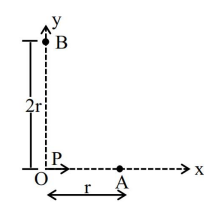
For a short dipole placed at origin O , the dipole moment P is along x -axis, as shown in the figure. If the electric potential and electric field at A are $V_0$ and $E_0$, respectively, then the correct combination of the electric potential and electric field, respectively, at point B on the $y$-axis is given by
Image
  • A
    $\frac{V_0}{2}$ and $\frac{E_0}{16}$
  • B
    zero and $\frac{E_0}{8}$
  • zero and $\frac{E_0}{16}$
  • D
    $V_0$ and $\frac{E_0}{4}$
Answer
Correct option: C.
zero and $\frac{E_0}{16}$
(C) zero and $\frac{E_0}{16}$
Sol. $E _{ A }=\frac{2 kP }{ r ^3}= E _0 \& V_{ A }=\frac{ kP }{ r ^2}= v _0$
$E_B=\frac{k P}{(2 r)^3}=\frac{E_0}{16} \& V_B=\frac{k \vec{P} \cdot \hat{r}}{r^2}=0$
View full question & answer
MCQ 174 Marks
A series LCR circuit is connected to an alternating source of emf E. The current amplitude at resonant frequency is $I_0$. If the value of resistance $R$ becomes twice of its initial value then amplitude of current at resonance will be
  • A
    $I_0$
  • $\frac{I_0}{2}$
  • C
    $\frac{I_0}{\sqrt{2}}$
  • D
    $2 I_0$
Answer
Correct option: B.
$\frac{I_0}{2}$
(B) $\frac{I_0}{2}$
Sol. Initially, $I _0=\frac{\varepsilon_{ m }}{ R }$
Finally, $I_0^1=\frac{\varepsilon_m}{2 R}=\frac{I_0}{2}$
View full question & answer
MCQ 184 Marks
The maximum percentage error in the measurment of density of a wire is
[Given, mass of wire $=(0.60 \pm 0.003) g$
radius of wire $=(0.50 \pm 0.01) cm$
length of wire $(10.00 \pm 0.05) cm ]$
  • A
    4
  • 5
  • C
    8
  • D
    7
Answer
Correct option: B.
5
(B) 5
Sol. $d =\frac{ m }{\text { vol. }}=\frac{ m }{\pi R ^2 \ell} \Rightarrow \frac{d \rho}{\rho}=\frac{ dm }{ m }+\frac{2 dR }{ R }+\frac{ d \ell}{\ell}$
$\Rightarrow \frac{ d \rho}{\rho}=\left(\frac{0.003}{0.6}+\frac{2 \times 0.01}{0.5}+\frac{0.05}{10}\right) 100=5 \%$
View full question & answer
MCQ 194 Marks
A small rigid spherical ball of mass $M$ is dropped in a long vertical tube containing glycerine. The velocity of the ball becomes constant after some time. If the density of glycerine is half of the density of the ball, then the viscous force acting on the ball will be
(consider g as acceleration due to gravity)
  • A
    $\frac{3}{2} Mg$
  • $\frac{ Mg }{2}$
  • C
    Mg
  • D
    2 Mg
Answer
Correct option: B.
$\frac{ Mg }{2}$
(B) $\frac{ Mg }{2}$
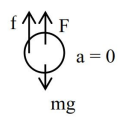
Sol.
Image
$\begin{array}{l} mg - F _{ B }- f =0 \\ \Rightarrow mg -\frac{ mg }{2}- f =0 \\ \therefore f =\frac{ mg }{2}\end{array}$
View full question & answer
MCQ 204 Marks
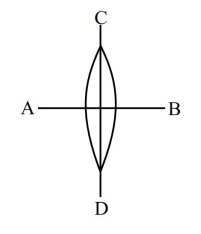
A symmetric thin biconvex lens is cut into four equal parts by two planes AB and CD as shown in figure. If the power of original lens is 4D then the power of a part of the divided lens isImage
  • A
    8D
  • B
    4D
  • C
    D
  • 2D
Answer
Correct option: D.
2D
(D) 2D
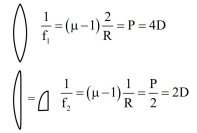
Sol.
Image
View full question & answer